Submitted to:
Miss.Komal Bashir
Submitted by:
Maira shahnawaz
Uneza rehman
Amna siddiqui
Binary Search Tree (BST) is a good
data structure and It supports:
 Insertion
 Deletion
 Search
 Red-Black Tree is one of the balanced binary search
tree
 A red-black tree is a binary search tree with one
extra attribute for each node: the colour, which is
either red or black
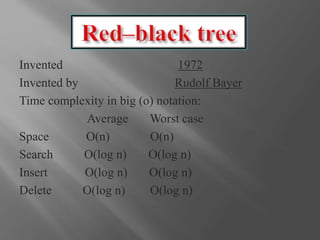
Invented 1972
Invented by Rudolf Bayer
Time complexity in big (o) notation:
Average Worst case
Space O(n) O(n)
Search O(log n) O(log n)
Insert O(log n) O(log n)
Delete O(log n) O(log n)
That's really your decision, but I've found that red black
trees are best suited to largely random data that has
occasional degenerate runs, and searches have no
locality of reference. This takes full advantage of the
minimal work that red black trees perform to maintain
balance compared to AVL trees and still allows for
speedy searches.
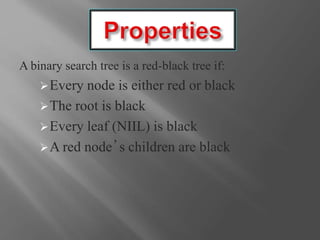
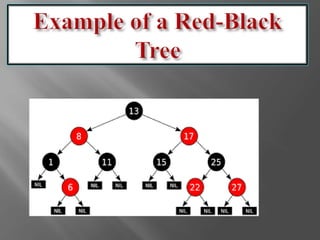
A binary search tree is a red-black tree if:
Every node is either red or black
The root is black
Every leaf (NIIL) is black
A red node’s children are black
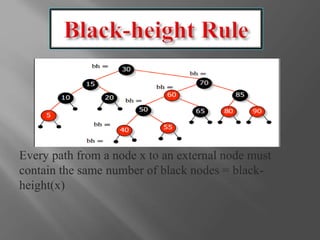
Every path from a node x to an external node must
contain the same number of black nodes = black-
height(x)
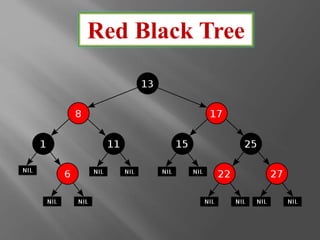
Red Black Tree
Since red-black tree is a balanced BST, it supports
 Search
 Insertion
 Deletion
 A new item is always inserted as a leaf in the tree
 If we color a leaf black, we will create a longer path
of black nodes (violating property 4)
 Therefore, a new item must be colored red [unless it
is the root]
 if the parent is colored black, we are done
 If the parent is red, we will have consecutive red
nodes (violating property 3)
 We must adjust the tree to ensure property three,
without introducing a violation to property 4
 The operations are rotations and color changes.
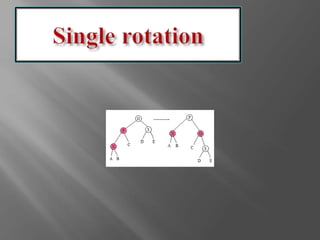
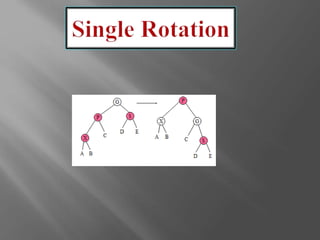
 Sibling of the parent is black [adopt the convention
that null references are black]
 Inserted node is an outside grandchild
 A single rotation between the parent and the
grandparent, with appropriate color changes,
restores property 3
 Notice that before insertion of node X, there was
one black node from G to each of A, B, and C, and
two black nodes from G to each of D and E
 After the rotation and recoloring, notice that the
number of black nodes on each of those paths
remains unchanged
 Property 3 has been restored
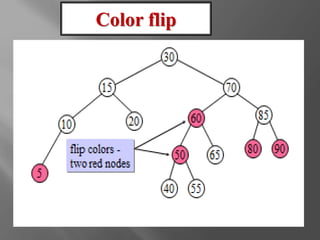
 Sibling of the parent is red
 Neither single nor double rotations work, since both
result in (possibly) consecutive red nodes
Case 2
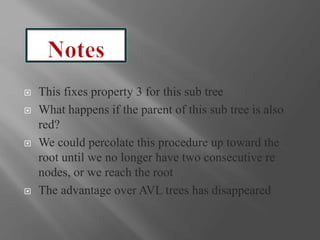
 This fixes property 3 for this sub tree
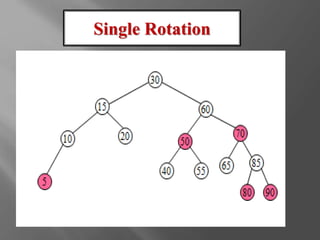
 What happens if the parent of this sub tree is also
red?
 We could percolate this procedure up toward the
root until we no longer have two consecutive re
nodes, or we reach the root
 The advantage over AVL trees has disappeared
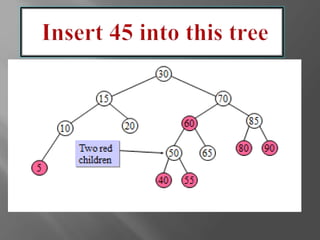
Color flip
Single Rotation
 Recall that in deleting from a binary search tree, the
only nodes which are actually removed are leaves or
nodes with exactly one child
 Nodes with two children are never removed. Their
contents are just replaced
Deletions
 If the node to be deleted is red, there is no problem -
- just delete the node
 If the node to be deleted is black, its removal will
violate property 4
 The solution is to ensure that any node to be deleted
is red
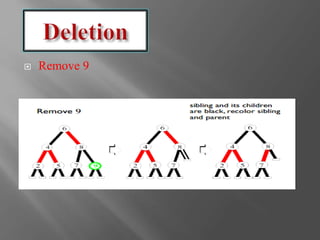
 Remove 9
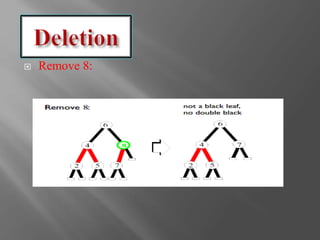
 Remove 8:
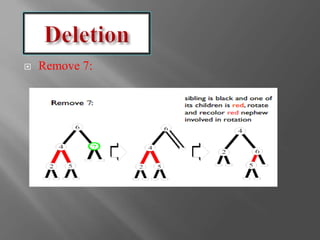
 Remove 7:
Although you may never need to implement your own
set or map classes, thanks to their common built-in
support, understanding how these data structures work
should help you better assess the performance of your
applications and give you more insight into what
structure is right for a given task. For more practice with
these concepts, check out these problems from the Top
Coder archive that involve trees:

Red black trees

  • 1.
    Submitted to: Miss.Komal Bashir Submittedby: Maira shahnawaz Uneza rehman Amna siddiqui
  • 2.
    Binary Search Tree(BST) is a good data structure and It supports:  Insertion  Deletion  Search
  • 3.
     Red-Black Treeis one of the balanced binary search tree  A red-black tree is a binary search tree with one extra attribute for each node: the colour, which is either red or black
  • 4.
    Invented 1972 Invented byRudolf Bayer Time complexity in big (o) notation: Average Worst case Space O(n) O(n) Search O(log n) O(log n) Insert O(log n) O(log n) Delete O(log n) O(log n)
  • 5.
    That's really yourdecision, but I've found that red black trees are best suited to largely random data that has occasional degenerate runs, and searches have no locality of reference. This takes full advantage of the minimal work that red black trees perform to maintain balance compared to AVL trees and still allows for speedy searches.
  • 6.
    A binary searchtree is a red-black tree if: Every node is either red or black The root is black Every leaf (NIIL) is black A red node’s children are black
  • 7.
    Every path froma node x to an external node must contain the same number of black nodes = black- height(x)
  • 9.
  • 10.
    Since red-black treeis a balanced BST, it supports  Search  Insertion  Deletion
  • 11.
     A newitem is always inserted as a leaf in the tree  If we color a leaf black, we will create a longer path of black nodes (violating property 4)  Therefore, a new item must be colored red [unless it is the root]  if the parent is colored black, we are done
  • 12.
     If theparent is red, we will have consecutive red nodes (violating property 3)  We must adjust the tree to ensure property three, without introducing a violation to property 4  The operations are rotations and color changes.
  • 13.
     Sibling ofthe parent is black [adopt the convention that null references are black]  Inserted node is an outside grandchild  A single rotation between the parent and the grandparent, with appropriate color changes, restores property 3
  • 15.
     Notice thatbefore insertion of node X, there was one black node from G to each of A, B, and C, and two black nodes from G to each of D and E  After the rotation and recoloring, notice that the number of black nodes on each of those paths remains unchanged  Property 3 has been restored
  • 16.
     Sibling ofthe parent is red  Neither single nor double rotations work, since both result in (possibly) consecutive red nodes Case 2
  • 18.
     This fixesproperty 3 for this sub tree  What happens if the parent of this sub tree is also red?  We could percolate this procedure up toward the root until we no longer have two consecutive re nodes, or we reach the root  The advantage over AVL trees has disappeared
  • 20.
  • 21.
  • 22.
     Recall thatin deleting from a binary search tree, the only nodes which are actually removed are leaves or nodes with exactly one child  Nodes with two children are never removed. Their contents are just replaced Deletions
  • 23.
     If thenode to be deleted is red, there is no problem - - just delete the node  If the node to be deleted is black, its removal will violate property 4  The solution is to ensure that any node to be deleted is red
  • 24.
  • 25.
  • 26.
  • 27.
    Although you maynever need to implement your own set or map classes, thanks to their common built-in support, understanding how these data structures work should help you better assess the performance of your applications and give you more insight into what structure is right for a given task. For more practice with these concepts, check out these problems from the Top Coder archive that involve trees: