Red-black Trees


            Author:
            Varun Mahajan
            <varunmahajan06@gmail.com>
Contents
 ●
     Dynamic sets
       ●
           Operations on Dynamic sets

 ●
     Binary trees: Basic terminology

 ●
     Binary search trees
       ●
           TREE_SEARCH
       ●
           TREE_INSERT
       ●
           Operations' running time: O(h)

 ●
     Red-black trees
       ●
           Red-black properties
       ●
           Height: O(lg n)
       ●
           Queries: O(lg n)
       ●
           Rotations: O(1)
       ●
           RB-INSERT: O(lg n)
Dynamic sets
 Set: A collection of objects of a particular kind

 The Sets manipulated by algorithms can grow, shrink, or otherwise change
 over time. Such sets are called Dynamic Sets

 In a typical implementation of a dynamic set, each element is represented by
 an object whose fields can be examined and manipulated if we have a pointer
 to the object

 Object fields:
    ●
      Identifying Key field
    ●
      Satellite data
Operations on Dynamic sets
 Two categories:
 ●
   Queries
 ●
   Modifying Operations

 SEARCH(S,k): A query that, given a set S and a key value k, returns a
 pointer x to an element in S such that key[x] = k, or NIL if no such element
 belongs to S

 INSERT(S,x): A modifying operation that augments the set S with the
 element pointed to by x. We usually assume that any fields in element x
 needed by the set implementation have already been initialized

 DELETE(S,x): A modifying operation that, given a pointer x to an element in
 the set S, removes x from S. (Note that this operation uses a pointer to an
 element x, not a key value.)

 MINIMUM(S): A query on a totally ordered set S that returns a pointer to
 the element of S with the smallest key
Operations on Dynamic sets
 MAXIMUM(S): A query on a totally ordered set S that returns a pointer to
 the element of S with the largest key

 SUCCESSOR(S,x): A query that, given an element x whose key is from a
 totally ordered set S, returns a pointer to the next larger element in S, or NIL
 if x is the maximum element

 PREDESESSOR(S,x): A query that, given an element x whose key is from a
 totally ordered set S, returns a pointer to the next smaller element in S, or
 NIL if x is the minimum element


 Totally ordered set: For any two elements a and b in the set, exactly one of the
 following must hold: a < b, a = b, or a > b
Binary trees
 Binary trees are defined recursively. A binary tree T is a structure defined on
 a finite set of nodes that either

     ●
         contains no nodes, or
     ●
         is composed of three disjoint sets of nodes: a root node, a binary tree
         called its left subtree, and a binary tree called its right subtree

 The binary tree that contains no nodes is called the empty tree or null tree,
 sometimes denoted NIL

 If the left subtree is nonempty, its root is called the left child of the root of
 the entire tree

 Likewise, the root of a nonnull right subtree is the right child of the root of
 the entire tree

 A node with no children is an external node or leaf

 A nonleaf node is an internal node
Binary trees
 If n1, n2, . . . , nk is a sequence of nodes in a tree such that ni is the parent
 of ni+1 for 1 ≤ i < k, then this sequence is called a path from node n1 to
 node nk.

 The length of a path is one less than the number of nodes in the path

 The height of a node in a tree is the length of a longest path from the node
 to a leaf

 The height of a tree is the height of the root

 The depth of a node is the length of the unique path from the root to that
 node
Binary Search trees


 The keys in a binary search tree are always stored in such a way as to
 satisfy the binary-search-tree property:

    ●
        Let x be a node in a binary search tree. If y is a node in the left subtree
        of x, then key[y] ≤ key[x]. If y is a node in the right subtree of x, then
        key[x] ≤ key[y]
TREE-SEARCH
 T R E E -S E A R C H (T, k )

  if T = N I L of k = key[T ]
       return T
  els e if k < key[T ]
       return T R E E -S E A R C H (left[T ], k )
  els e
       return T R E E -S E A R C H (rig ht[T ], k )

 TREE-SEARCH runs in O(h) time on a tree of height h


                                                      (a) A binary search tree on 6 nodes
                                                      with height 2. (b) A less efficient
                                                      binary search tree with height 4 that
                                                      contains the same keys
TREE-INSERT
 T R E E -I N S E R T (T, x )

  if T = N I L
       T = x
  return
  els e if key[x ] < key[T ]
       return T R E E -I N S E R T (left[T ], x )
  els e
       return T R E E -I N S E R T (rig ht[T ], x )

 TREE-INSERT runs in O(h) time on a tree of height h


                                                      Inserting an item with key 13 into a binary
                                                      search tree. Lightly shaded nodes indicate the
                                                      path from the root down to the position where
                                                      the item is inserted. The dashed line indicates
                                                      the link in the tree that is added to insert the
                                                      item
Binary Search trees Operations: Running time
  The worst-case running time for most search-tree operations is
  proportional to the height of the tree

  Queries:
     ●
       TREE-SEARCH(S,k):        O(h)
     ●
       TREE-MINIMUM(S):         O(h)
     ●
       TREE-MAXIMUM(S):         O(h)
     ●
       TREE-SUCCESSOR(S,x):     O(h)
     ●
       TREE-PREDECESSOR(S,x):   O(h)

  Modifying operations:
     ●
       TREE-INSERT(S,x):        O(h)
     ●
       TREE-DELETE(S,x):        O(h)
Red-black trees
 Red-black trees are binary search trees that are "balanced" in order to
 guarantee that basic dynamic-set operations take O(lg n) time in the
 worst case (height of the tree: O(lg n) where n is the no of nodes)

 A red-black tree is a binary search tree with one extra bit of storage per node:
 its color, which can be either RED or BLACK. By constraining the way
 nodes can be colored on any path from the root to a leaf, red-black
 trees ensure that no such path is more than twice as long as any
 other, so that the tree is approximately balanced
Red-black properties
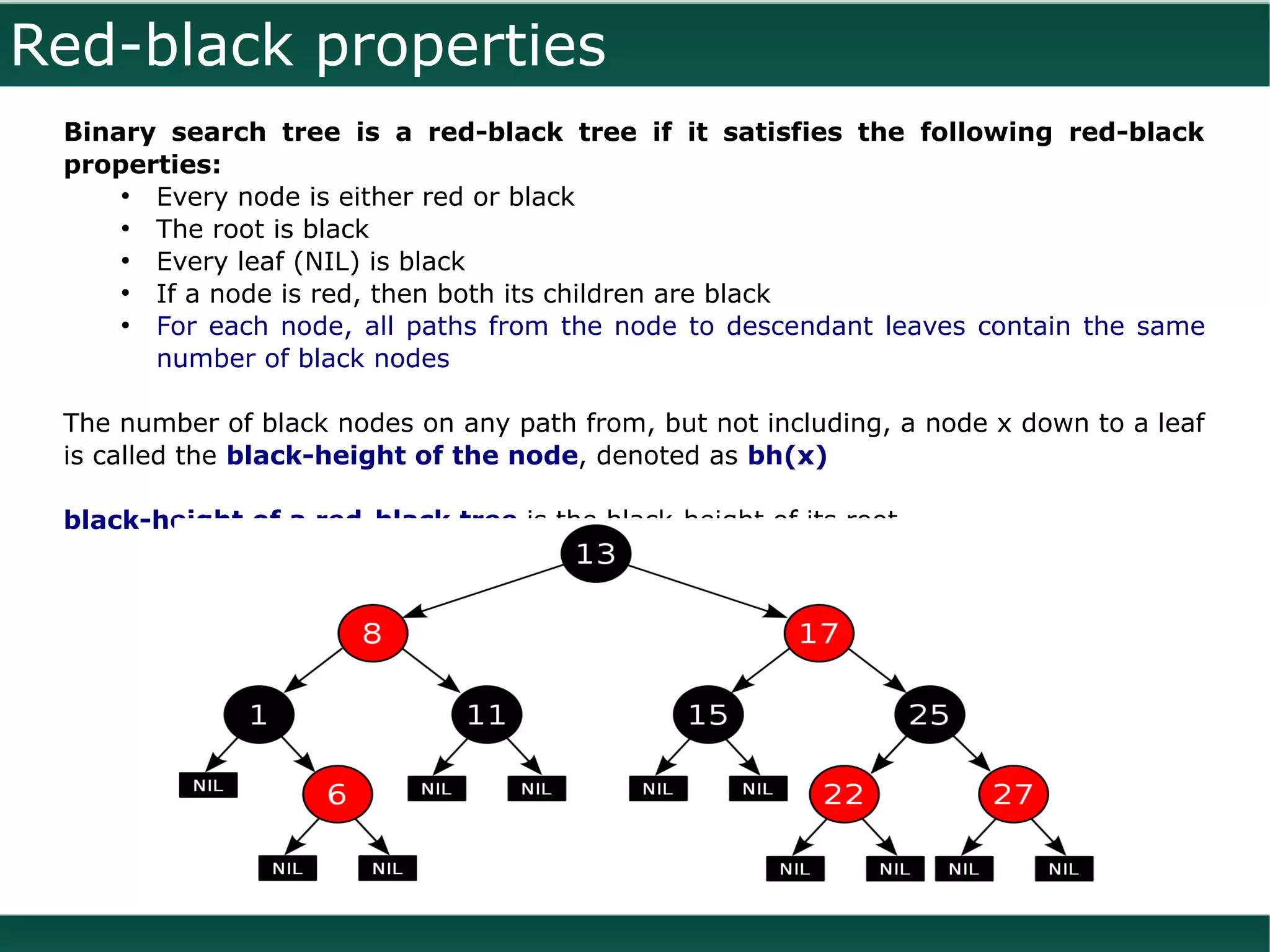
 Binary search tree is a red-black tree if it satisfies the following red-black
 properties:
     ●
       Every node is either red or black
     ●
       The root is black
     ●
       Every leaf (NIL) is black
     ●
       If a node is red, then both its children are black
     ●
       For each node, all paths from the node to descendant leaves contain the same
       number of black nodes

 The number of black nodes on any path from, but not including, a node x down to a leaf
 is called the black-height of the node, denoted as bh(x)

 black-height of a red-black tree is the black-height of its root
Height O(lg n)
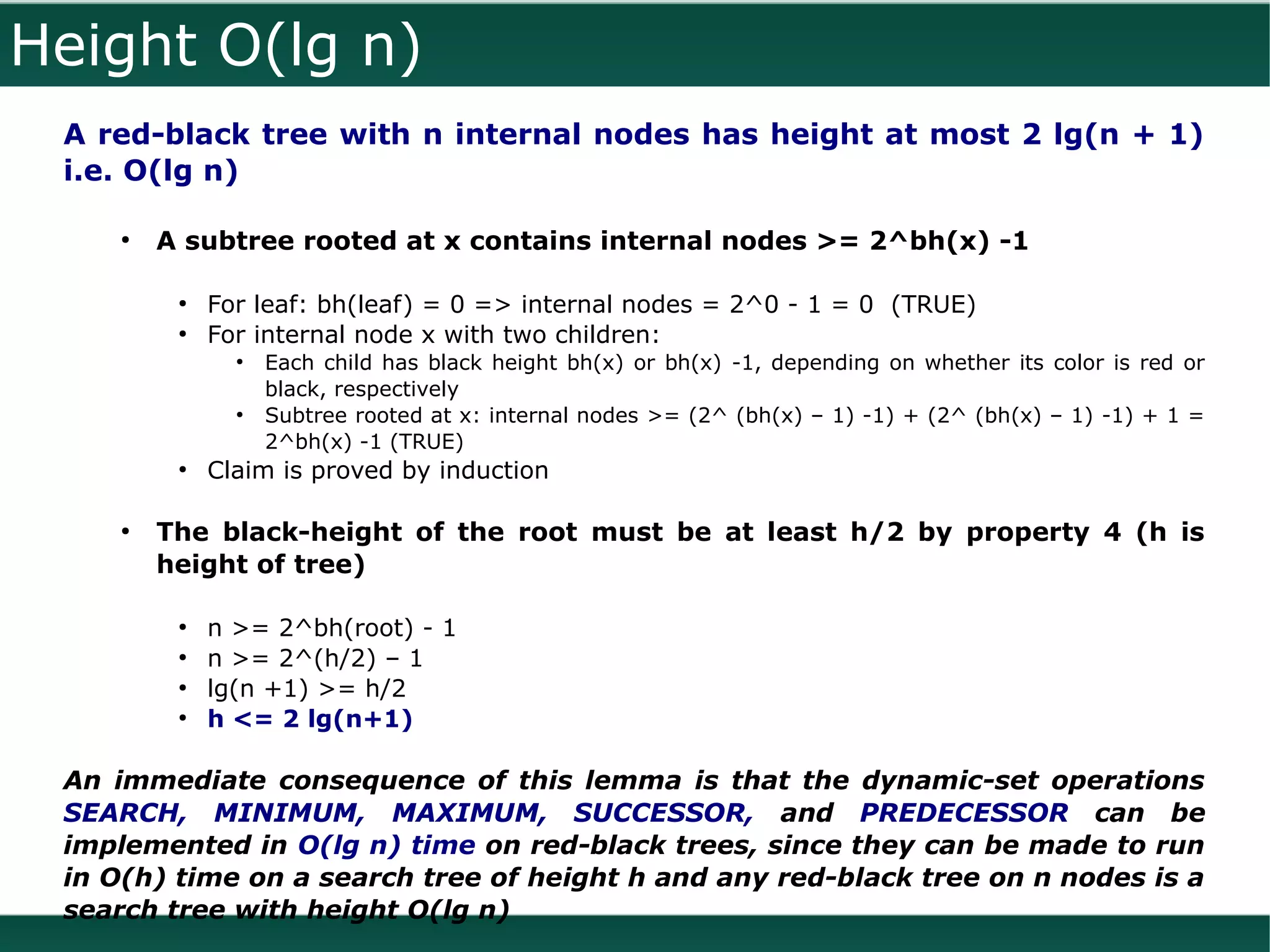
 A red-black tree with n internal nodes has height at most 2 lg(n + 1)
 i.e. O(lg n)

     ●
         A subtree rooted at x contains internal nodes >= 2^bh(x) -1

          ●
              For leaf: bh(leaf) = 0 => internal nodes = 2^0 - 1 = 0 (TRUE)
          ●
              For internal node x with two children:
                ●
                    Each child has black height bh(x) or bh(x) -1, depending on whether its color is red or
                    black, respectively
                ●
                    Subtree rooted at x: internal nodes >= (2^ (bh(x) – 1) -1) + (2^ (bh(x) – 1) -1) + 1 =
                    2^bh(x) -1 (TRUE)
          ●
              Claim is proved by induction

     ●
         The black-height of the root must be at least h/2 by property 4 (h is
         height of tree)

          ●
              n >= 2^bh(root) - 1
          ●
              n >= 2^(h/2) – 1
          ●
              lg(n +1) >= h/2
          ●
              h <= 2 lg(n+1)

 An immediate consequence of this lemma is that the dynamic-set operations
 SEARCH, MINIMUM, MAXIMUM, SUCCESSOR, and PREDECESSOR can be
 implemented in O(lg n) time on red-black trees, since they can be made to run
 in O(h) time on a search tree of height h and any red-black tree on n nodes is a
 search tree with height O(lg n)
Rotations
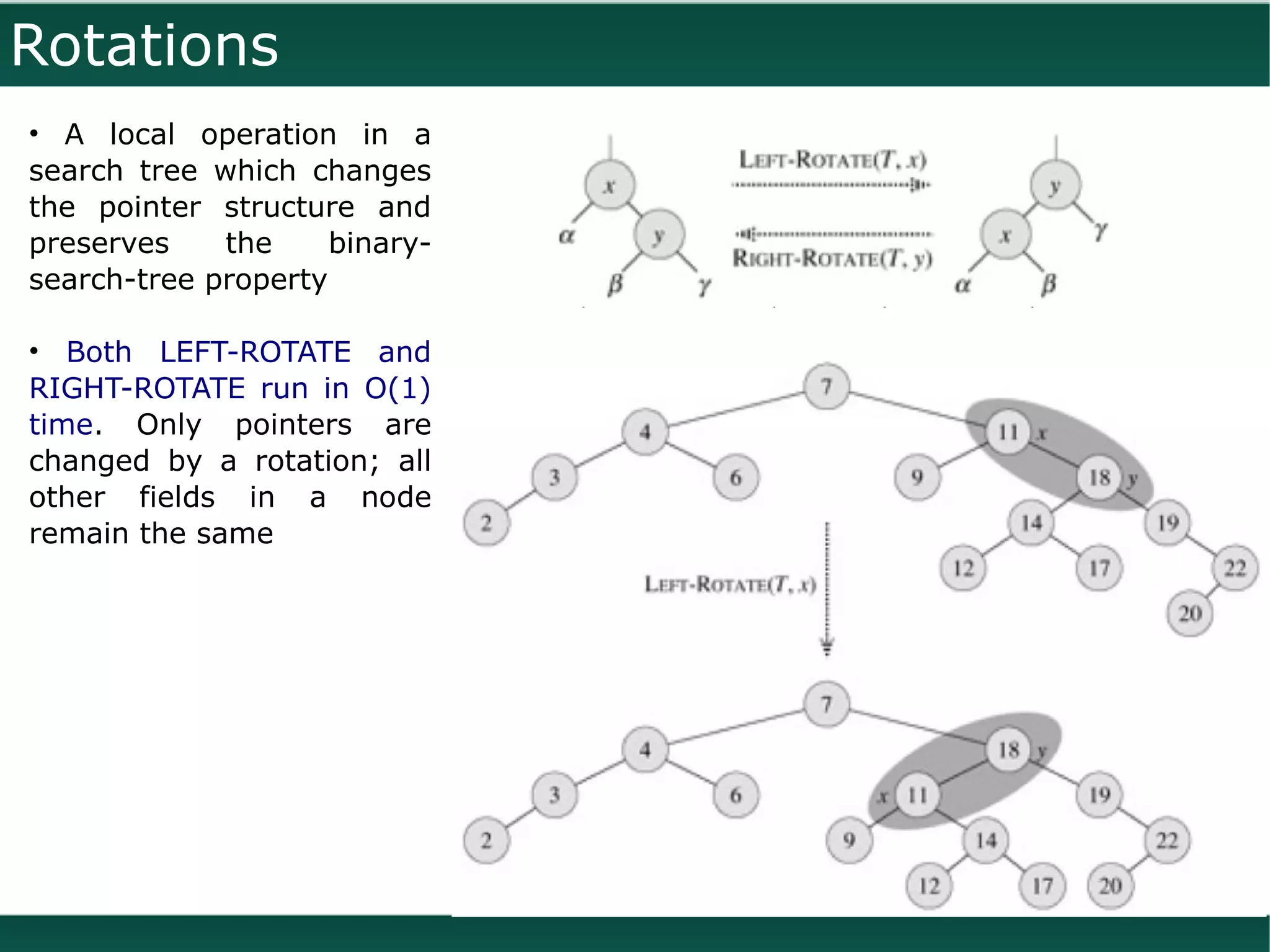
• A local operation in a
search tree which changes
the pointer structure and
preserves    the     binary-
search-tree property

• Both LEFT-ROTATE and
RIGHT-ROTATE run in O(1)
time. Only pointers are
changed by a rotation; all
other fields in a node
remain the same
RB-INSERT
R B -I N S E R T (T, z)

    T R E E -I N S E R T (T, z)
    c o lo r[z] = R E D
    R B -I N S E R T-FI X U P (T, z)
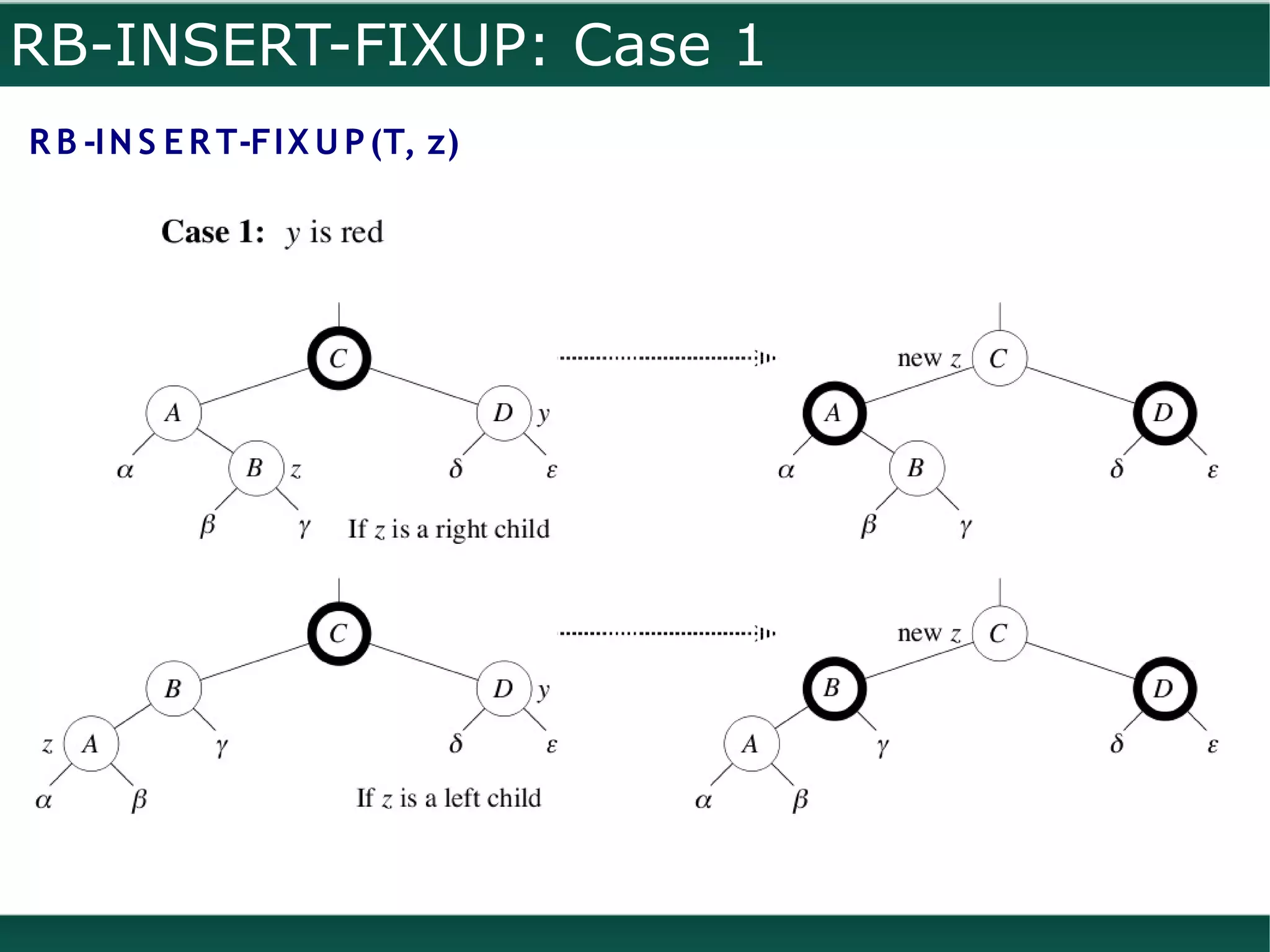
RB-INSERT-FIXUP: Case 1
R B -I N S E R T-FI X U P (T, z)
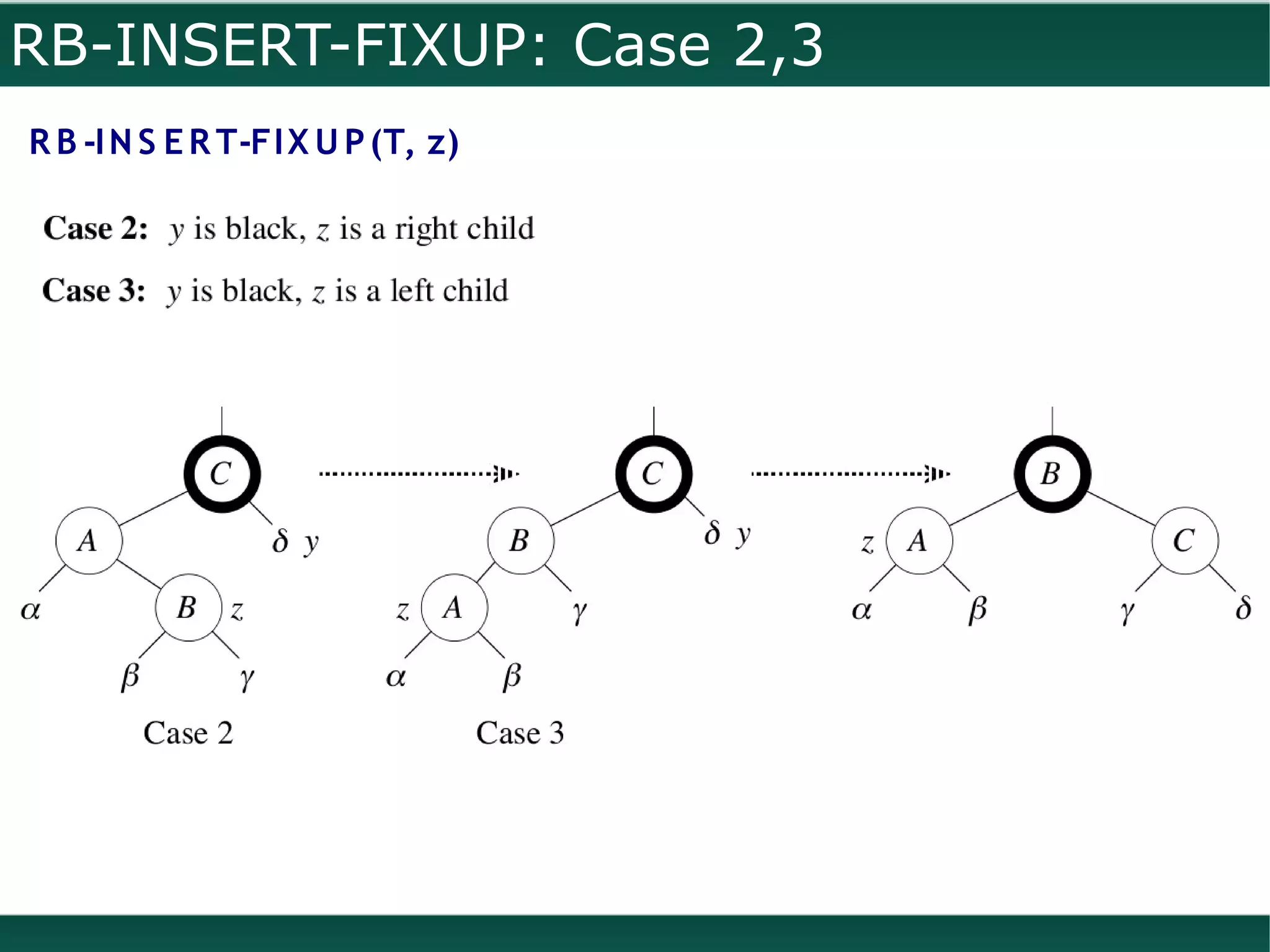
RB-INSERT-FIXUP: Case 2,3
R B -I N S E R T-FI X U P (T, z)
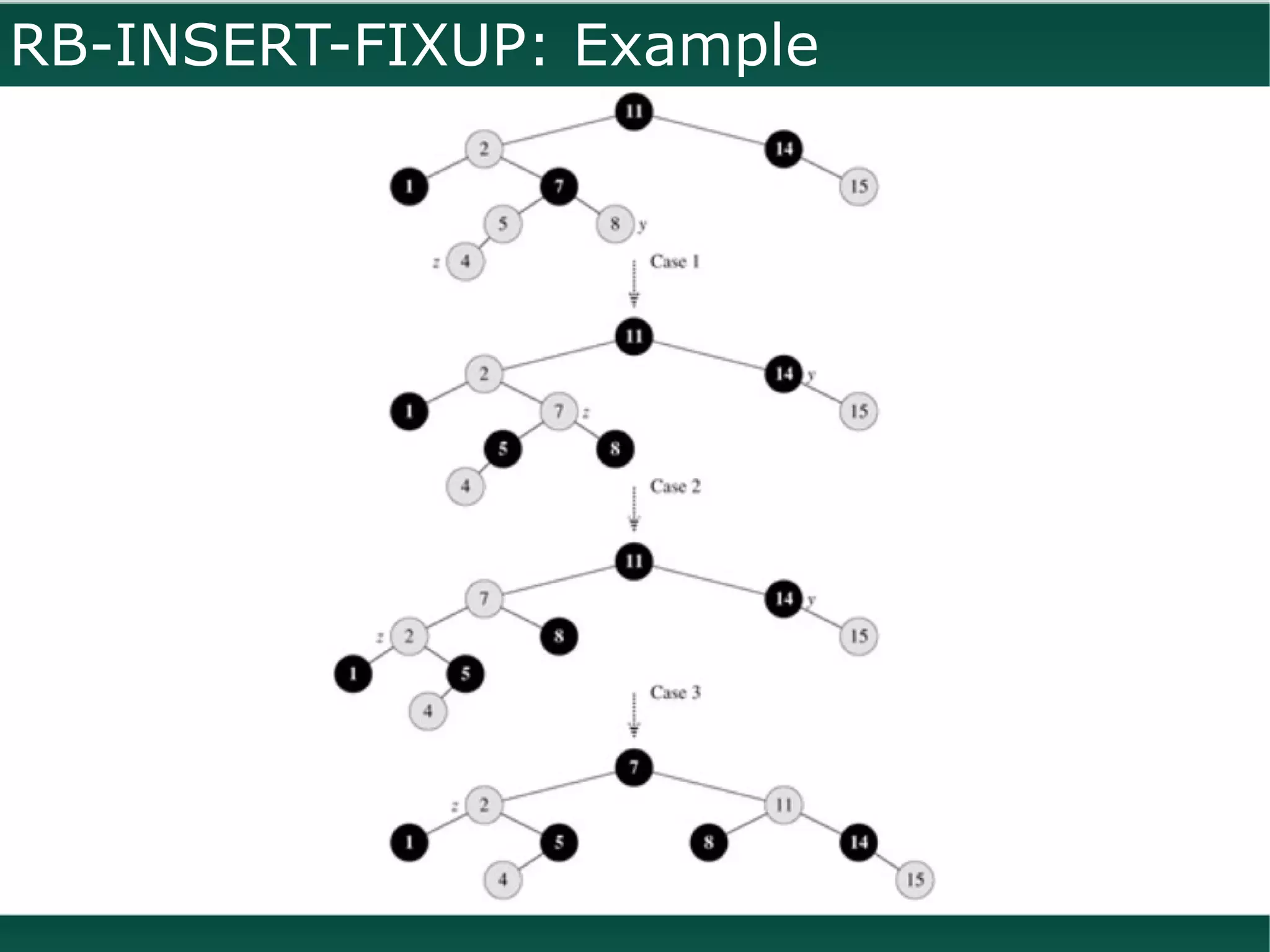
RB-INSERT-FIXUP: Example
RB-INSERT: Running time
R B -I N S E R T (T, z): O (lg n)

       T R E E -I N S E R T (T, z)              O (lg n)
       c o lo r[z] = R E D                      O (1)
       R B -I N S E R T-FI X U P (T, z)         O (lg n)

 R B -I N S E R T-FI X U P (T, z): O (lg n)
   ●
        Case 1: The pointer z moves two levels up the tree. Maximum times this can happen
        (when case 1 is repeated) is O(lg n)
   ●
        Case 2,3: At the maximum two rotations are done


The running time of RB-DELETE(T, z) is also O(lg n)
Exercise
 Study:

   ●
       TREE-DELETE, TREE-SUCCESSOR, TREE_PREDECESSOR
   ●
       RB-DELETE
   ●
       Linux kernel implementation of Red-black tree:
         ●
           ../include/linux/rbtree.h
         ●
           ../lib/rbtree.c
References
 ●
  Introduction to Algorithms, Second Edition, Thomas H. Cormen, Charles E. Leiserson, Ronald
 L. Rivest, Clifford Stein; The MIT Press

 ●
     http://ocw.mit.edu/courses/electrical-engineering-and-computer-science/6-046j-introduction-to-alg

 ●
     http://lwn.net/Articles/184495/
END...

Red Black Trees

  • 1.
    Red-black Trees Author: Varun Mahajan <varunmahajan06@gmail.com>
  • 2.
    Contents ● Dynamic sets ● Operations on Dynamic sets ● Binary trees: Basic terminology ● Binary search trees ● TREE_SEARCH ● TREE_INSERT ● Operations' running time: O(h) ● Red-black trees ● Red-black properties ● Height: O(lg n) ● Queries: O(lg n) ● Rotations: O(1) ● RB-INSERT: O(lg n)
  • 3.
    Dynamic sets Set:A collection of objects of a particular kind The Sets manipulated by algorithms can grow, shrink, or otherwise change over time. Such sets are called Dynamic Sets In a typical implementation of a dynamic set, each element is represented by an object whose fields can be examined and manipulated if we have a pointer to the object Object fields: ● Identifying Key field ● Satellite data
  • 4.
    Operations on Dynamicsets Two categories: ● Queries ● Modifying Operations SEARCH(S,k): A query that, given a set S and a key value k, returns a pointer x to an element in S such that key[x] = k, or NIL if no such element belongs to S INSERT(S,x): A modifying operation that augments the set S with the element pointed to by x. We usually assume that any fields in element x needed by the set implementation have already been initialized DELETE(S,x): A modifying operation that, given a pointer x to an element in the set S, removes x from S. (Note that this operation uses a pointer to an element x, not a key value.) MINIMUM(S): A query on a totally ordered set S that returns a pointer to the element of S with the smallest key
  • 5.
    Operations on Dynamicsets MAXIMUM(S): A query on a totally ordered set S that returns a pointer to the element of S with the largest key SUCCESSOR(S,x): A query that, given an element x whose key is from a totally ordered set S, returns a pointer to the next larger element in S, or NIL if x is the maximum element PREDESESSOR(S,x): A query that, given an element x whose key is from a totally ordered set S, returns a pointer to the next smaller element in S, or NIL if x is the minimum element Totally ordered set: For any two elements a and b in the set, exactly one of the following must hold: a < b, a = b, or a > b
  • 6.
    Binary trees Binarytrees are defined recursively. A binary tree T is a structure defined on a finite set of nodes that either ● contains no nodes, or ● is composed of three disjoint sets of nodes: a root node, a binary tree called its left subtree, and a binary tree called its right subtree The binary tree that contains no nodes is called the empty tree or null tree, sometimes denoted NIL If the left subtree is nonempty, its root is called the left child of the root of the entire tree Likewise, the root of a nonnull right subtree is the right child of the root of the entire tree A node with no children is an external node or leaf A nonleaf node is an internal node
  • 7.
    Binary trees Ifn1, n2, . . . , nk is a sequence of nodes in a tree such that ni is the parent of ni+1 for 1 ≤ i < k, then this sequence is called a path from node n1 to node nk. The length of a path is one less than the number of nodes in the path The height of a node in a tree is the length of a longest path from the node to a leaf The height of a tree is the height of the root The depth of a node is the length of the unique path from the root to that node
  • 8.
    Binary Search trees The keys in a binary search tree are always stored in such a way as to satisfy the binary-search-tree property: ● Let x be a node in a binary search tree. If y is a node in the left subtree of x, then key[y] ≤ key[x]. If y is a node in the right subtree of x, then key[x] ≤ key[y]
  • 9.
    TREE-SEARCH T RE E -S E A R C H (T, k ) if T = N I L of k = key[T ] return T els e if k < key[T ] return T R E E -S E A R C H (left[T ], k ) els e return T R E E -S E A R C H (rig ht[T ], k ) TREE-SEARCH runs in O(h) time on a tree of height h (a) A binary search tree on 6 nodes with height 2. (b) A less efficient binary search tree with height 4 that contains the same keys
  • 10.
    TREE-INSERT T RE E -I N S E R T (T, x ) if T = N I L T = x return els e if key[x ] < key[T ] return T R E E -I N S E R T (left[T ], x ) els e return T R E E -I N S E R T (rig ht[T ], x ) TREE-INSERT runs in O(h) time on a tree of height h Inserting an item with key 13 into a binary search tree. Lightly shaded nodes indicate the path from the root down to the position where the item is inserted. The dashed line indicates the link in the tree that is added to insert the item
  • 11.
    Binary Search treesOperations: Running time The worst-case running time for most search-tree operations is proportional to the height of the tree Queries: ● TREE-SEARCH(S,k): O(h) ● TREE-MINIMUM(S): O(h) ● TREE-MAXIMUM(S): O(h) ● TREE-SUCCESSOR(S,x): O(h) ● TREE-PREDECESSOR(S,x): O(h) Modifying operations: ● TREE-INSERT(S,x): O(h) ● TREE-DELETE(S,x): O(h)
  • 12.
    Red-black trees Red-blacktrees are binary search trees that are "balanced" in order to guarantee that basic dynamic-set operations take O(lg n) time in the worst case (height of the tree: O(lg n) where n is the no of nodes) A red-black tree is a binary search tree with one extra bit of storage per node: its color, which can be either RED or BLACK. By constraining the way nodes can be colored on any path from the root to a leaf, red-black trees ensure that no such path is more than twice as long as any other, so that the tree is approximately balanced
  • 13.
    Red-black properties Binarysearch tree is a red-black tree if it satisfies the following red-black properties: ● Every node is either red or black ● The root is black ● Every leaf (NIL) is black ● If a node is red, then both its children are black ● For each node, all paths from the node to descendant leaves contain the same number of black nodes The number of black nodes on any path from, but not including, a node x down to a leaf is called the black-height of the node, denoted as bh(x) black-height of a red-black tree is the black-height of its root
  • 14.
    Height O(lg n) A red-black tree with n internal nodes has height at most 2 lg(n + 1) i.e. O(lg n) ● A subtree rooted at x contains internal nodes >= 2^bh(x) -1 ● For leaf: bh(leaf) = 0 => internal nodes = 2^0 - 1 = 0 (TRUE) ● For internal node x with two children: ● Each child has black height bh(x) or bh(x) -1, depending on whether its color is red or black, respectively ● Subtree rooted at x: internal nodes >= (2^ (bh(x) – 1) -1) + (2^ (bh(x) – 1) -1) + 1 = 2^bh(x) -1 (TRUE) ● Claim is proved by induction ● The black-height of the root must be at least h/2 by property 4 (h is height of tree) ● n >= 2^bh(root) - 1 ● n >= 2^(h/2) – 1 ● lg(n +1) >= h/2 ● h <= 2 lg(n+1) An immediate consequence of this lemma is that the dynamic-set operations SEARCH, MINIMUM, MAXIMUM, SUCCESSOR, and PREDECESSOR can be implemented in O(lg n) time on red-black trees, since they can be made to run in O(h) time on a search tree of height h and any red-black tree on n nodes is a search tree with height O(lg n)
  • 15.
    Rotations • A localoperation in a search tree which changes the pointer structure and preserves the binary- search-tree property • Both LEFT-ROTATE and RIGHT-ROTATE run in O(1) time. Only pointers are changed by a rotation; all other fields in a node remain the same
  • 16.
    RB-INSERT R B -IN S E R T (T, z) T R E E -I N S E R T (T, z) c o lo r[z] = R E D R B -I N S E R T-FI X U P (T, z)
  • 17.
    RB-INSERT-FIXUP: Case 1 RB -I N S E R T-FI X U P (T, z)
  • 18.
    RB-INSERT-FIXUP: Case 2,3 RB -I N S E R T-FI X U P (T, z)
  • 19.
  • 20.
    RB-INSERT: Running time RB -I N S E R T (T, z): O (lg n) T R E E -I N S E R T (T, z) O (lg n) c o lo r[z] = R E D O (1) R B -I N S E R T-FI X U P (T, z) O (lg n) R B -I N S E R T-FI X U P (T, z): O (lg n) ● Case 1: The pointer z moves two levels up the tree. Maximum times this can happen (when case 1 is repeated) is O(lg n) ● Case 2,3: At the maximum two rotations are done The running time of RB-DELETE(T, z) is also O(lg n)
  • 21.
    Exercise Study: ● TREE-DELETE, TREE-SUCCESSOR, TREE_PREDECESSOR ● RB-DELETE ● Linux kernel implementation of Red-black tree: ● ../include/linux/rbtree.h ● ../lib/rbtree.c
  • 22.
    References ● Introduction to Algorithms, Second Edition, Thomas H. Cormen, Charles E. Leiserson, Ronald L. Rivest, Clifford Stein; The MIT Press ● http://ocw.mit.edu/courses/electrical-engineering-and-computer-science/6-046j-introduction-to-alg ● http://lwn.net/Articles/184495/
  • 23.