HEAP TREE
BY
S.RAJAPRIYA
Assistant Professor
E-MAILID : rajapriya@vvvcollege.org
۳ A heap is a tree-based data structure in which all the
nodes of the tree are in a specific order.
۳ For example, if X is the parent node of Y, then the value
of X follows a specific order with respect to the value
of Y and the same order will be followed across the tree.
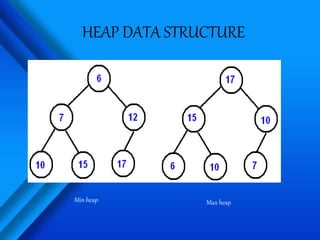
۳ Generally, Heaps can be of two types:
Max-Heap: In a Max-Heap the key present at the
root node must be greatest among the keys present at all of
it’s children. The same property must be recursively true for
all sub-trees in that Binary Tree.
Min-Heap: In a Min-Heap the key present at the
root node must be minimum among the keys present at all of
it’s children. The same property must be recursively true for
all sub-trees in that Binary Tree.
HEAP TREE
HEAP DATA STRUCTURE
Min heap Max heap
REPRESENTATION OF A HEAP TREE
Heaps are built
on arrays
Heaps are often stored
as arrays, one node
after the other, like
this:
An array can be used
to simulate a tree in
the following way :
If we are storing one
element at
index I then
Parent :will be stored
at index I/2
Left child : will be
stored at [2∗I]
Right child : will be
stored at [2∗I+1].
 Index of root will
be 1 in an array.
OPERATIONS OF A HEAP TREE
The Major operations required to be
performed on a heap tree are :
⁕ Insertion
⁕Deletion
⁕Merging
INSERTION OPERATION
1. Add the item to the bottom of the tree.To insert an item 7 to the heap tree
2. Compare the item with its parent. If the
new item is smaller, swap the two
3. Continue comparing and swapping, allowing
the new item to "bubble up" until the it's
larger than its parent.
DELETION OPERATION
The standard deletion operation on Heap is to delete the element
present at the root node of the Heap.
That is if it is a Max Heap, the standard deletion operation will delete
the maximum element and if it is a Min heap, it will delete the
minimum element.
Process of Deletion:
 Replace the root node by the last node in the Heap tree.
 Delete the last element from the Heap.
 Compare the item with its children.
 If it's larger than either child, swap the item with the smaller of
the two children.
 Continue comparing and swapping, allowing the item to "bubble
down" until it's smaller than its children.
ILLUSTRATION
APPLICATIONS OF HEAP TREE
Some of the Heap tree applications are:
⁕ Sorting using heap tree
We can use heaps in sorting the elements in a specific order in
efficient time.
⁕ Heap as a Priority queue
Priority queues can be efficiently implemented using Binary Heap
because it supports insert(), delete() and extractmax(), decreaseKey()
operations in O(logn) time
⁕Order statistics
The Heap data structure can be used to efficiently find the kth
smallest (or largest) element in an array.
.
Advantages :
Quickly access the smallest item. Binary heaps
allow you to grab the smallest item (the root)
in O(1)O(1) time, while keeping other operations relatively
cheap (O(lg(n))O(lg(n)) time).
Space efficient. Binary heaps are usually
implemented with arrays, saving the overhead cost of storing
pointers to child nodes.
Disadvantages :
Limited interface. Binary heaps only provide easy
access to the smallest item. Finding other items in the heap
takes O(n)O(n) time, since we have to iterate through all the
nodes.
ADVANTAGES & DISADVANTAGES
Heaptree

Heaptree

  • 1.
  • 2.
    ۳ A heapis a tree-based data structure in which all the nodes of the tree are in a specific order. ۳ For example, if X is the parent node of Y, then the value of X follows a specific order with respect to the value of Y and the same order will be followed across the tree. ۳ Generally, Heaps can be of two types: Max-Heap: In a Max-Heap the key present at the root node must be greatest among the keys present at all of it’s children. The same property must be recursively true for all sub-trees in that Binary Tree. Min-Heap: In a Min-Heap the key present at the root node must be minimum among the keys present at all of it’s children. The same property must be recursively true for all sub-trees in that Binary Tree. HEAP TREE
  • 3.
  • 4.
    REPRESENTATION OF AHEAP TREE Heaps are built on arrays Heaps are often stored as arrays, one node after the other, like this: An array can be used to simulate a tree in the following way : If we are storing one element at index I then Parent :will be stored at index I/2 Left child : will be stored at [2∗I] Right child : will be stored at [2∗I+1].  Index of root will be 1 in an array.
  • 5.
    OPERATIONS OF AHEAP TREE The Major operations required to be performed on a heap tree are : ⁕ Insertion ⁕Deletion ⁕Merging
  • 6.
    INSERTION OPERATION 1. Addthe item to the bottom of the tree.To insert an item 7 to the heap tree 2. Compare the item with its parent. If the new item is smaller, swap the two 3. Continue comparing and swapping, allowing the new item to "bubble up" until the it's larger than its parent.
  • 7.
    DELETION OPERATION The standarddeletion operation on Heap is to delete the element present at the root node of the Heap. That is if it is a Max Heap, the standard deletion operation will delete the maximum element and if it is a Min heap, it will delete the minimum element. Process of Deletion:  Replace the root node by the last node in the Heap tree.  Delete the last element from the Heap.  Compare the item with its children.  If it's larger than either child, swap the item with the smaller of the two children.  Continue comparing and swapping, allowing the item to "bubble down" until it's smaller than its children.
  • 8.
  • 9.
    APPLICATIONS OF HEAPTREE Some of the Heap tree applications are: ⁕ Sorting using heap tree We can use heaps in sorting the elements in a specific order in efficient time. ⁕ Heap as a Priority queue Priority queues can be efficiently implemented using Binary Heap because it supports insert(), delete() and extractmax(), decreaseKey() operations in O(logn) time ⁕Order statistics The Heap data structure can be used to efficiently find the kth smallest (or largest) element in an array. .
  • 10.
    Advantages : Quickly accessthe smallest item. Binary heaps allow you to grab the smallest item (the root) in O(1)O(1) time, while keeping other operations relatively cheap (O(lg(n))O(lg(n)) time). Space efficient. Binary heaps are usually implemented with arrays, saving the overhead cost of storing pointers to child nodes. Disadvantages : Limited interface. Binary heaps only provide easy access to the smallest item. Finding other items in the heap takes O(n)O(n) time, since we have to iterate through all the nodes. ADVANTAGES & DISADVANTAGES