PRAVIN D’SILVA
1109
MCA , GOA UNIVERSITY
Acknowledgement
I would like express my sincere gratitude to Dr.
Jyoti Pawar, for the support and guidance as
well as the feedback she has provided
throughout this study.
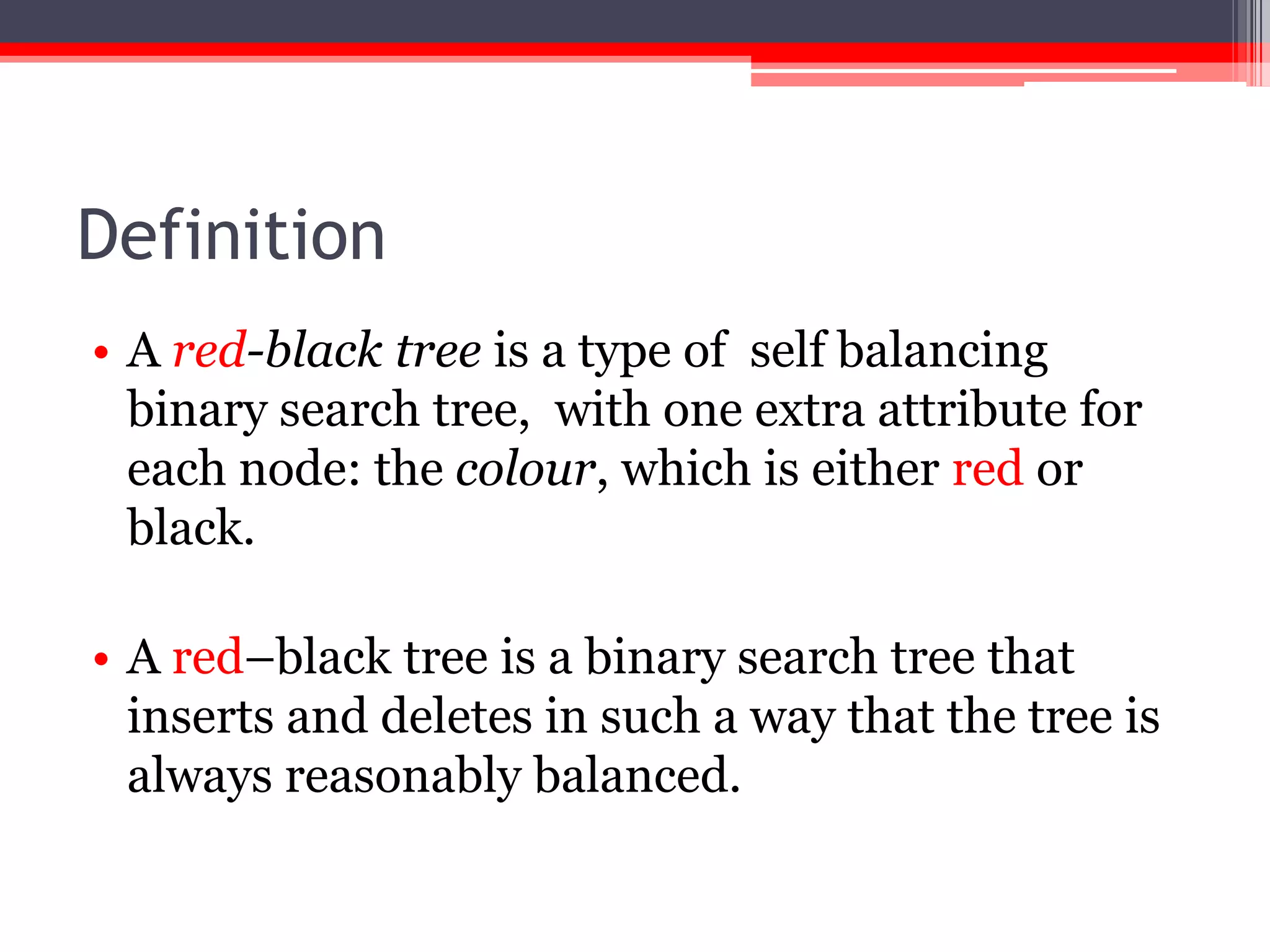
Definition
• A red-black tree is a type of self balancing
binary search tree, with one extra attribute for
each node: the colour, which is either red or
black.
• A red–black tree is a binary search tree that
inserts and deletes in such a way that the tree is
always reasonably balanced.
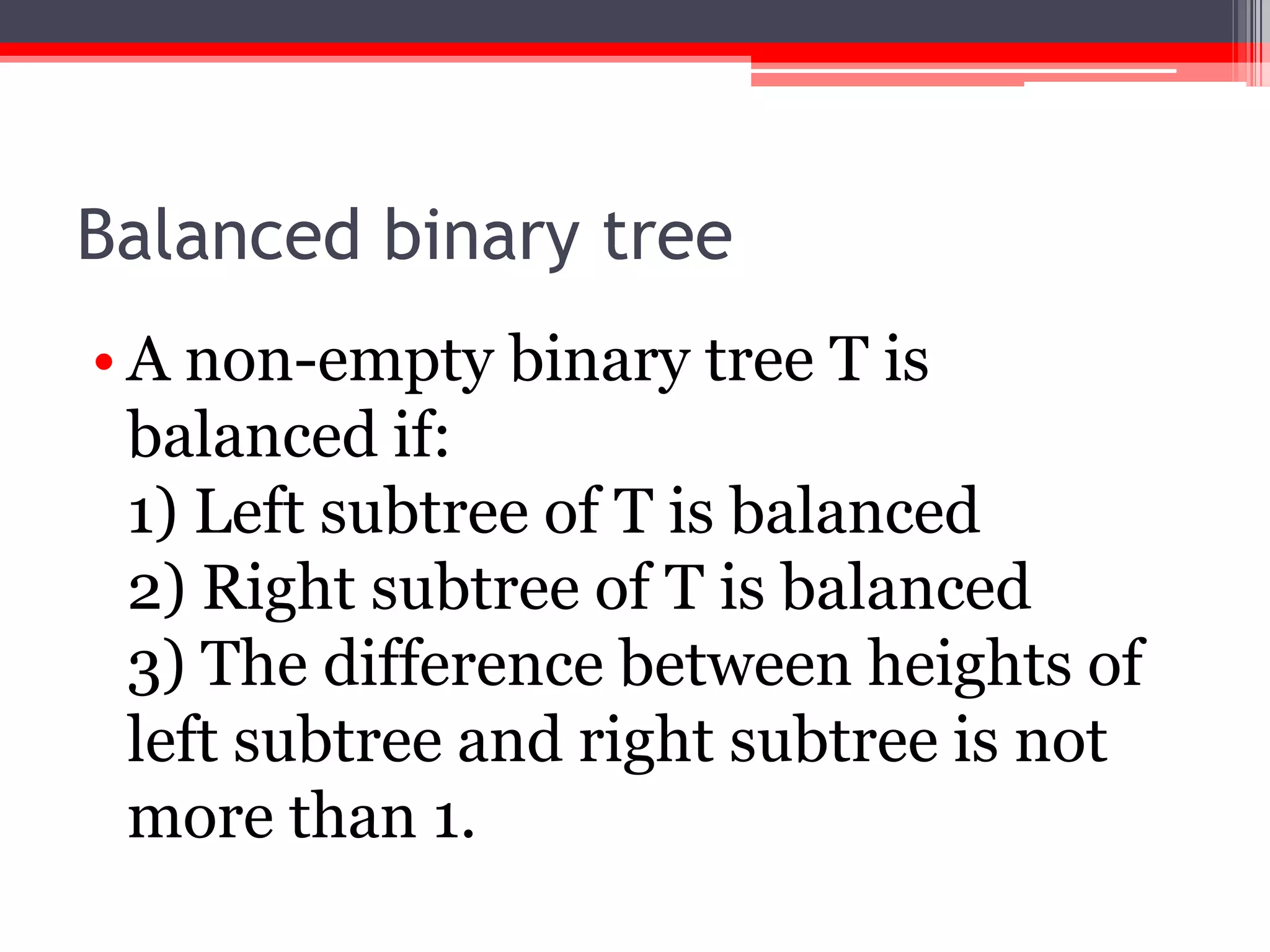
Balanced binary tree
• A non-empty binary tree T is
balanced if:
1) Left subtree of T is balanced
2) Right subtree of T is balanced
3) The difference between heights of
left subtree and right subtree is not
more than 1.
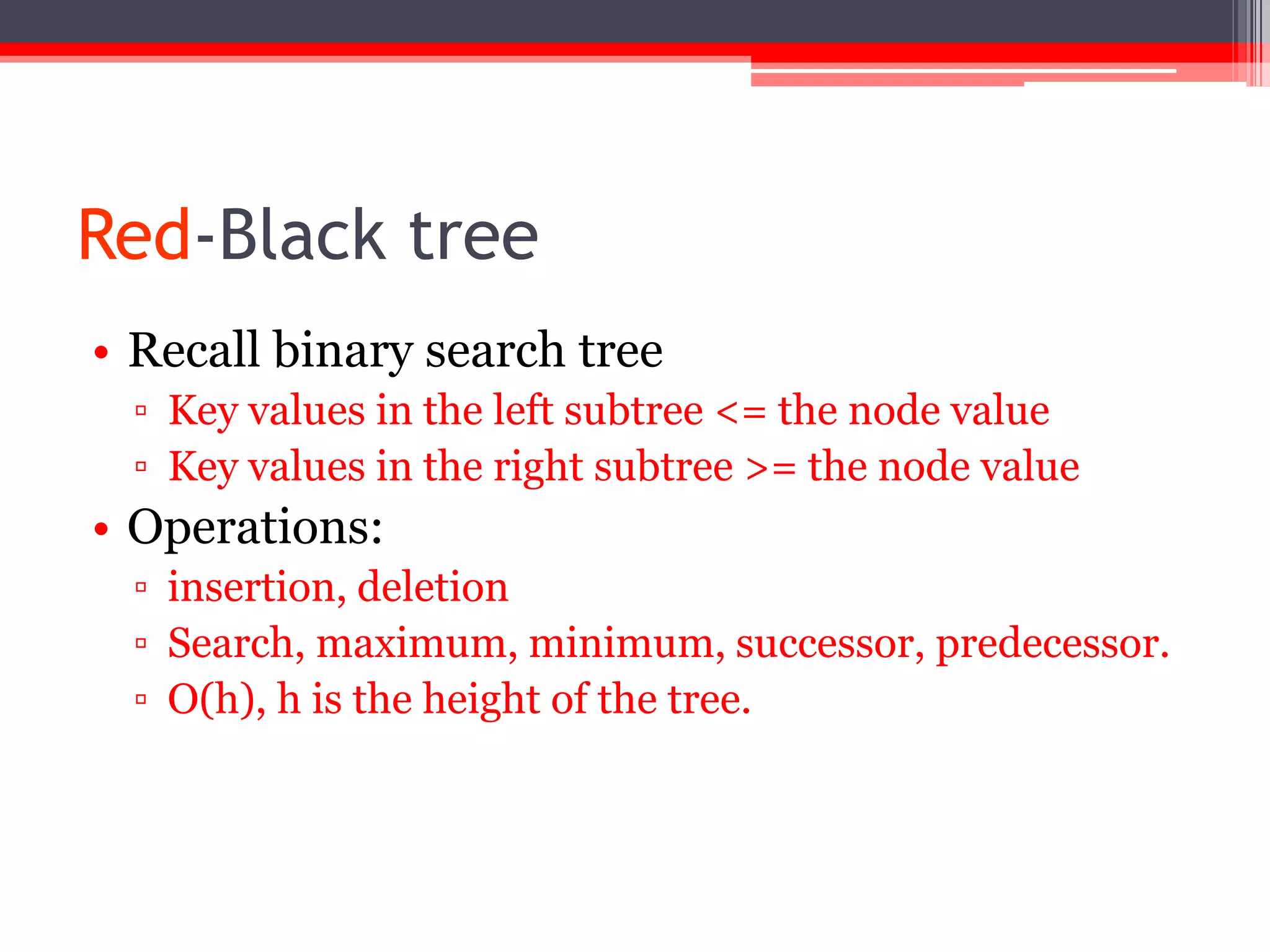
Red-Black tree
• Recall binary search tree
▫ Key values in the left subtree <= the node value
▫ Key values in the right subtree >= the node value

• Operations:
▫ insertion, deletion
▫ Search, maximum, minimum, successor, predecessor.
▫ O(h), h is the height of the tree.
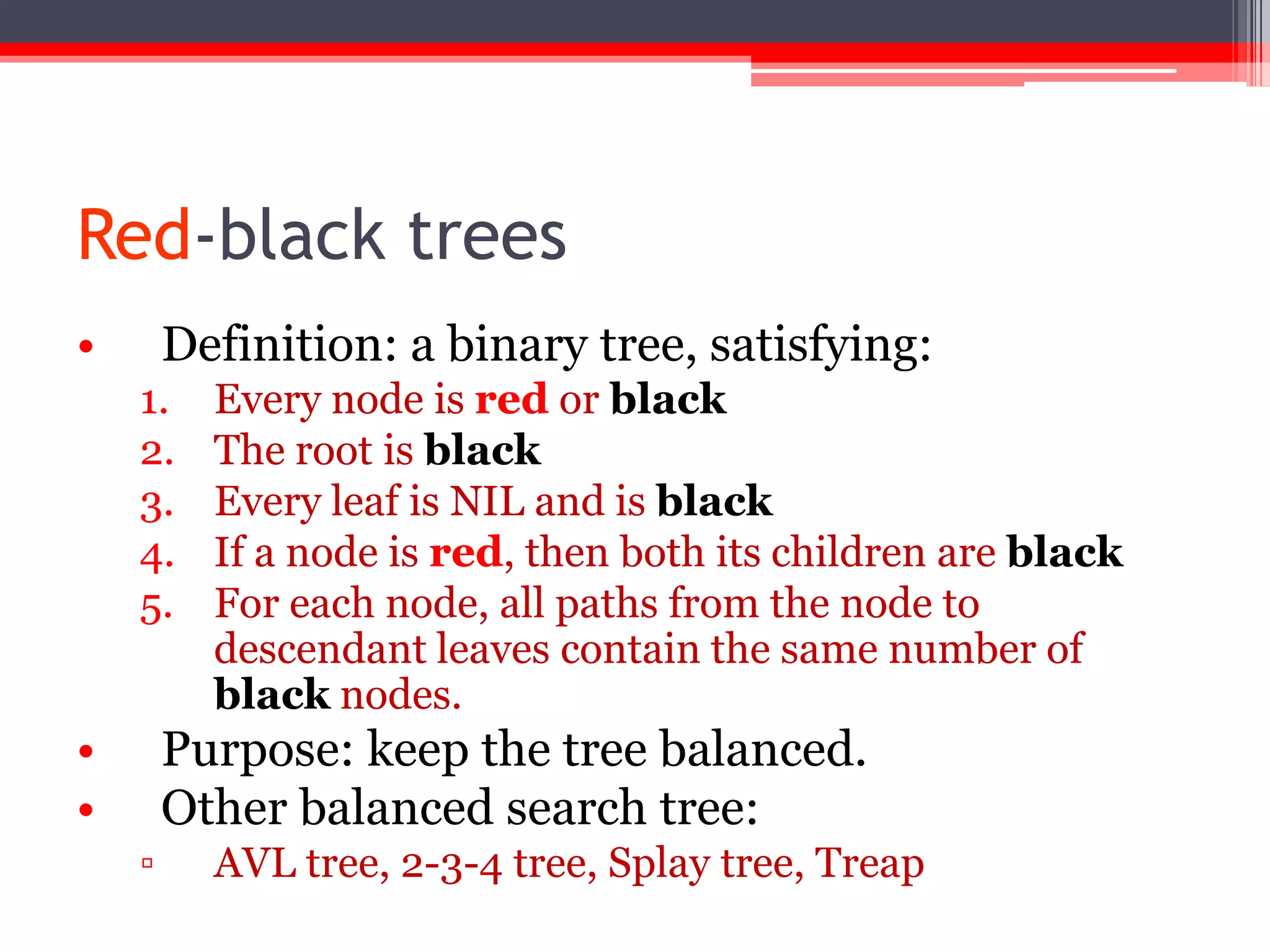
Red-black trees
•

Definition: a binary tree, satisfying:
1.
2.
3.
4.
5.

•
•

Every node is red or black
The root is black
Every leaf is NIL and is black
If a node is red, then both its children are black
For each node, all paths from the node to
descendant leaves contain the same number of
black nodes.

Purpose: keep the tree balanced.
Other balanced search tree:
▫

AVL tree, 2-3-4 tree, Splay tree, Treap
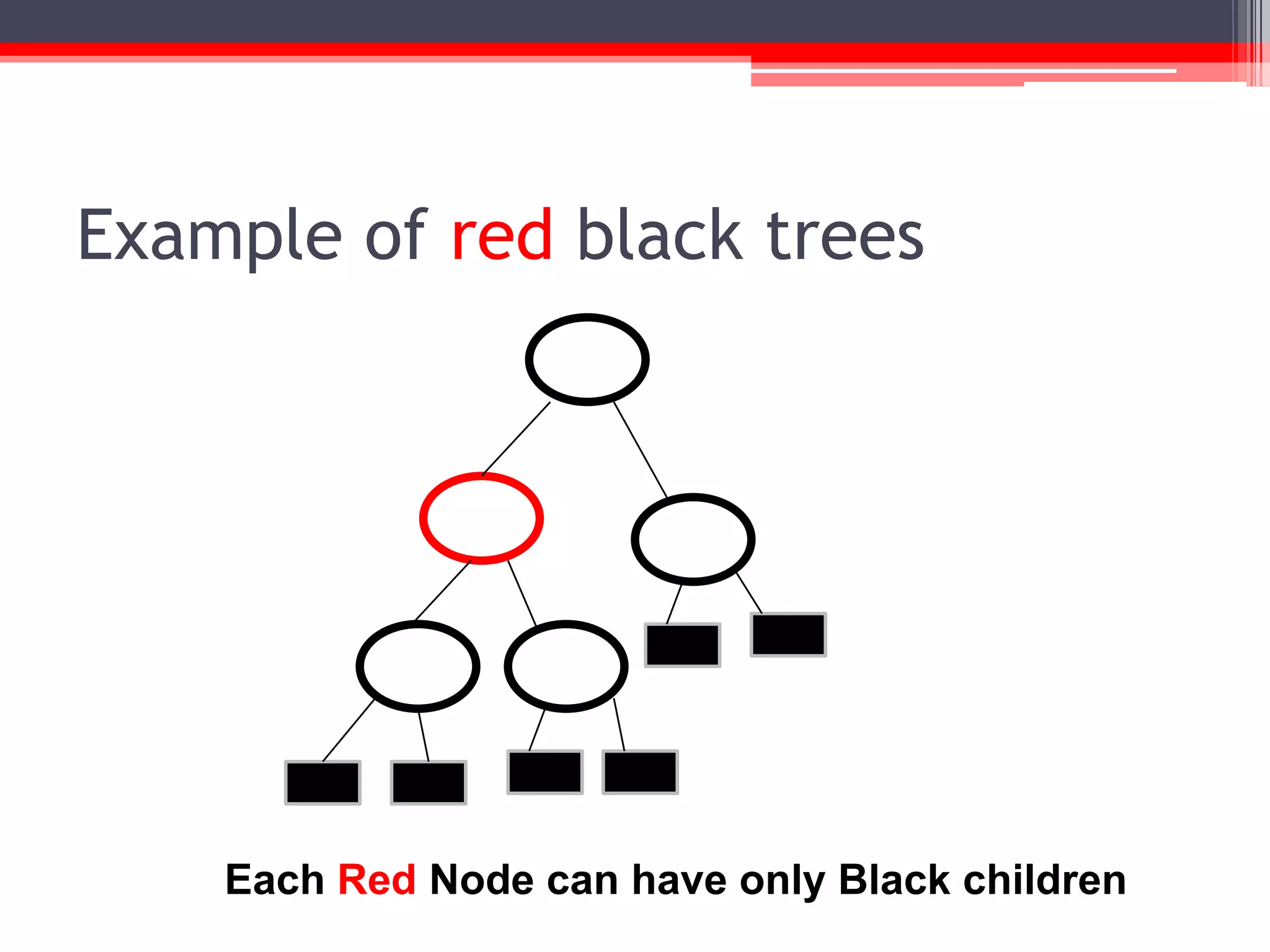
Example of red black trees

Each Red Node can have only Black children
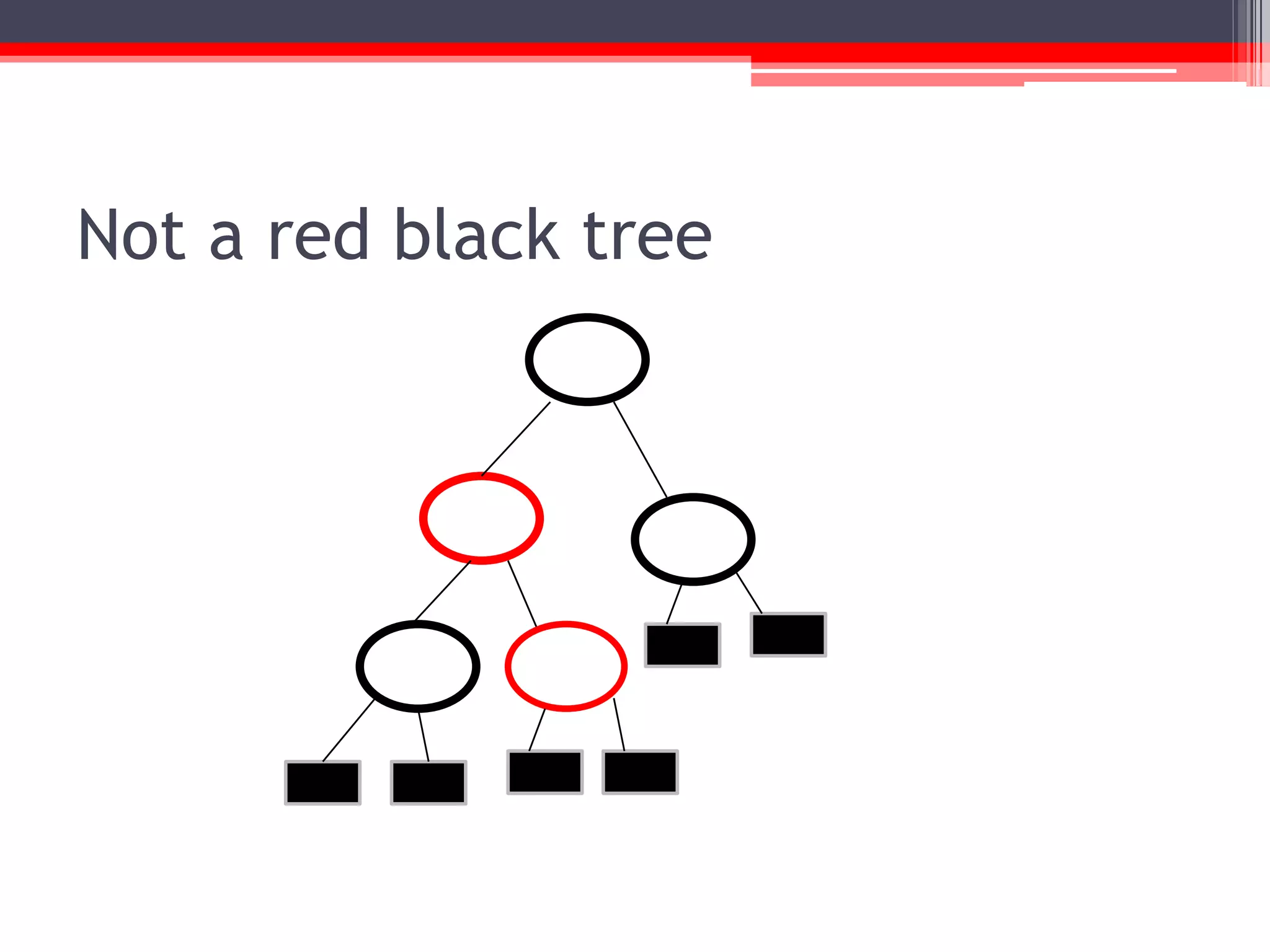
Not a red black tree
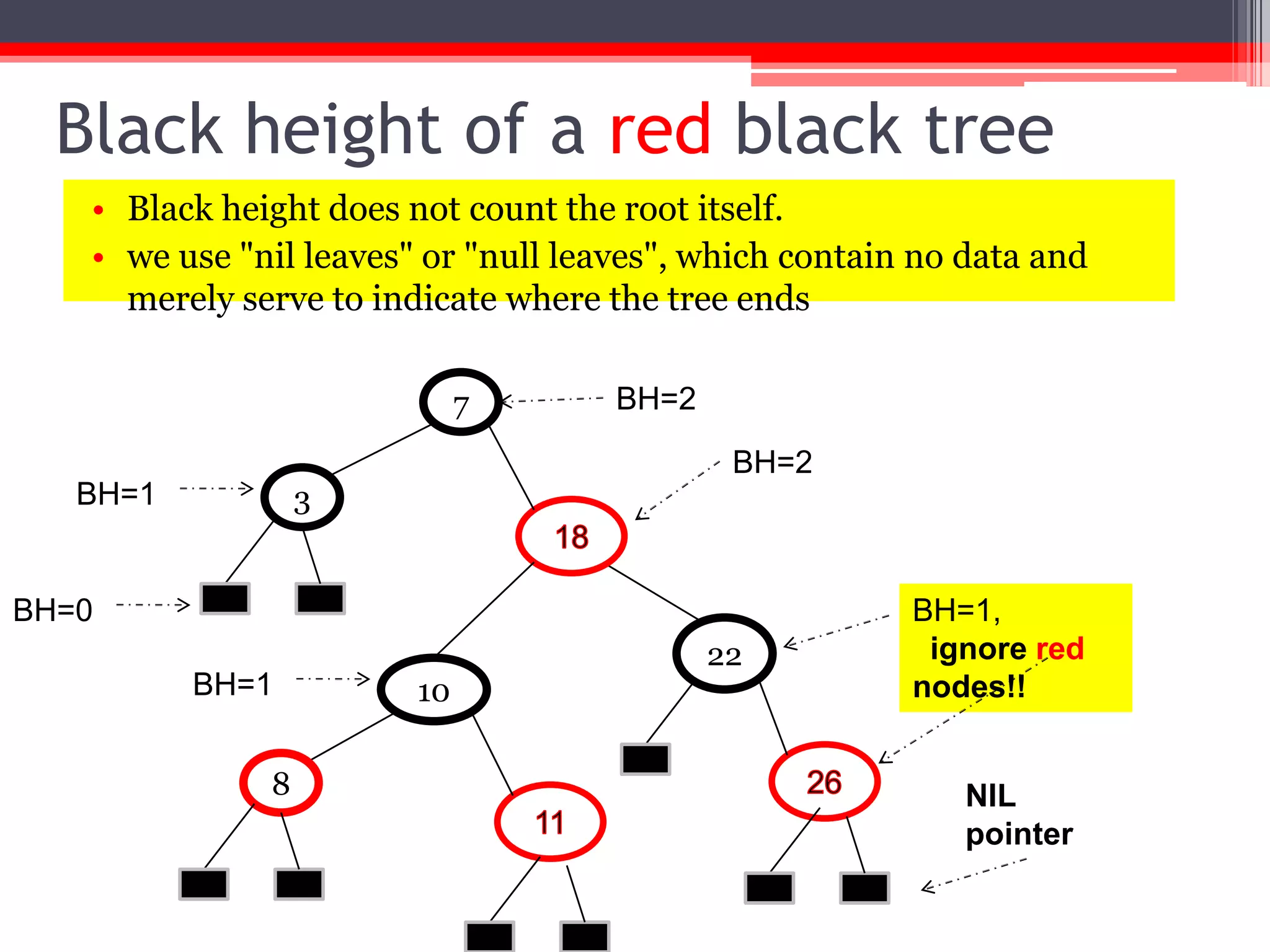
Black height of a red black tree
• Black height does not count the root itself.
• we use "nil leaves" or "null leaves", which contain no data and
merely serve to indicate where the tree ends
7

BH=2
BH=2

3

BH=1

BH=0
22
BH=1
8

10

BH=1,
ignore red
nodes!!

NIL
pointer
Complexity
• The persistent version of red-black trees
requires O(log n) space for each insertion or
deletion.
Some operations in log(n)
• Search, minimum, maximum,
successor, predecessor.
• Let us discuss insert and delete.
Inserting in a red black tree
• Let k be the key being inserted.
• As in case of a BST, we first search for k; this
gives us the place where we have to insert k.
• We create a new node with key k and insert it at
this place
• The new node is colored red.
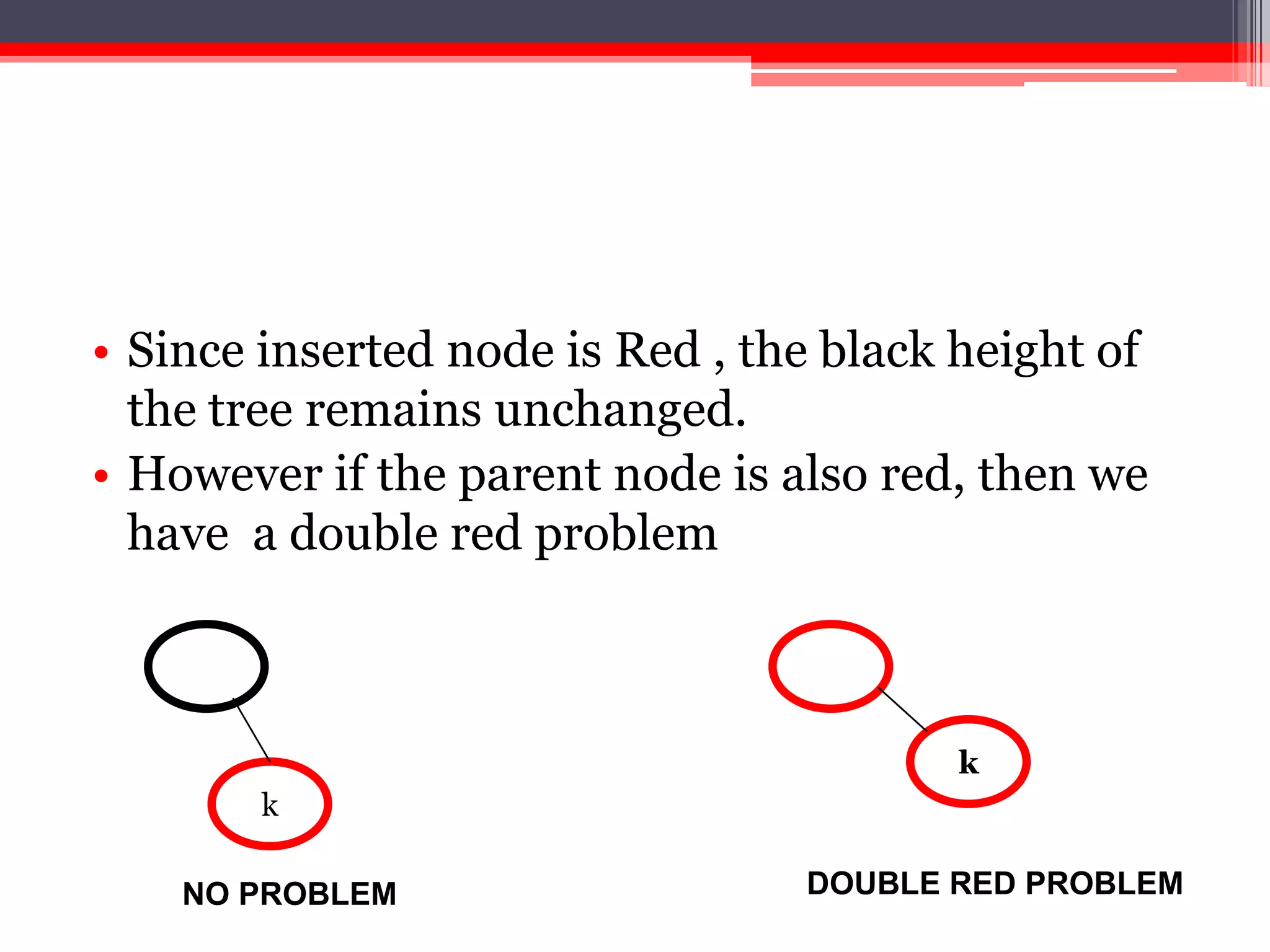
• Since inserted node is Red , the black height of
the tree remains unchanged.
• However if the parent node is also red, then we
have a double red problem

k
k
NO PROBLEM

DOUBLE RED PROBLEM
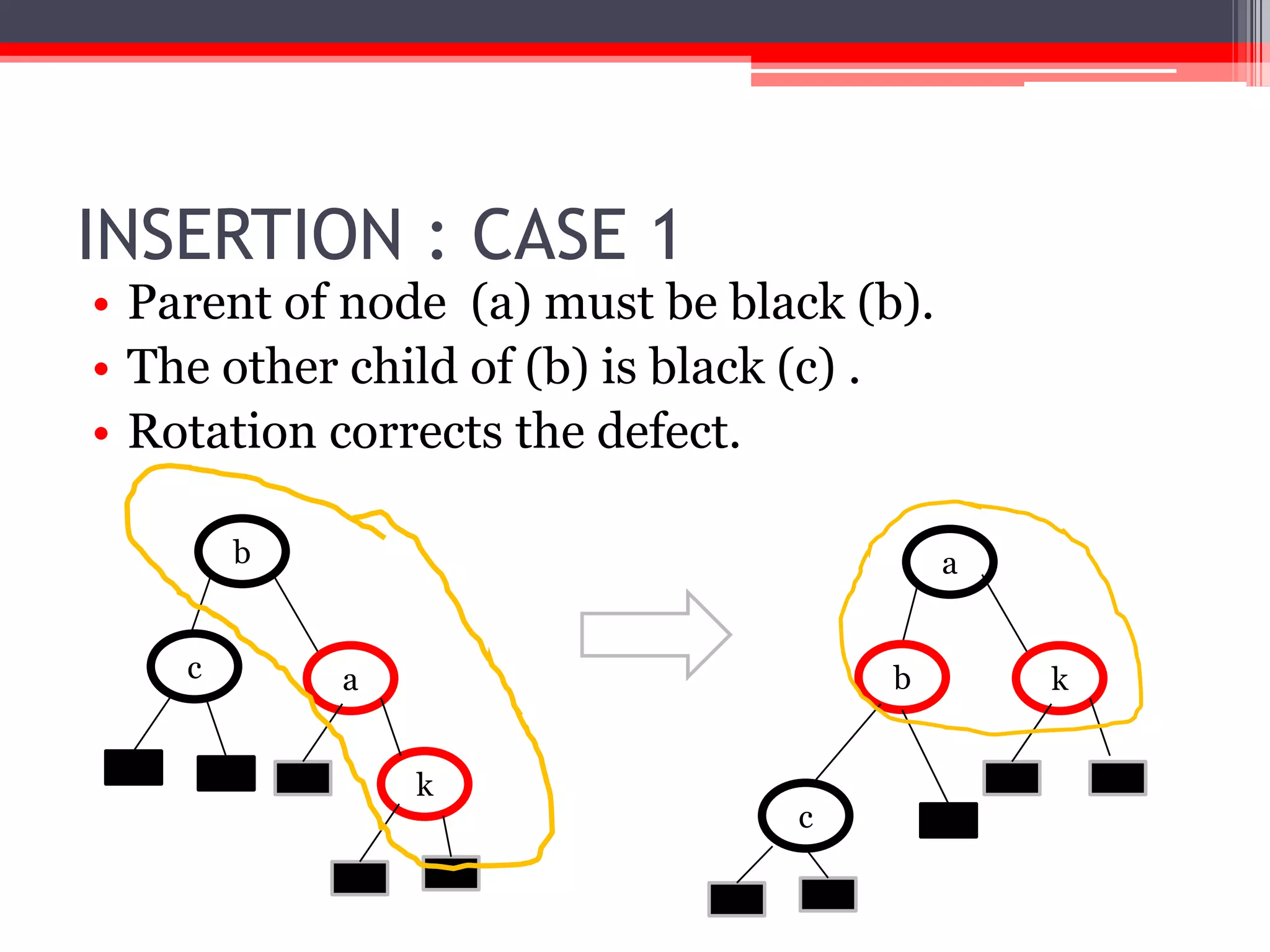
INSERTION : CASE 1
• Parent of node (a) must be black (b).
• The other child of (b) is black (c) .
• Rotation corrects the defect.
b
c

a
b

a
k

c

k
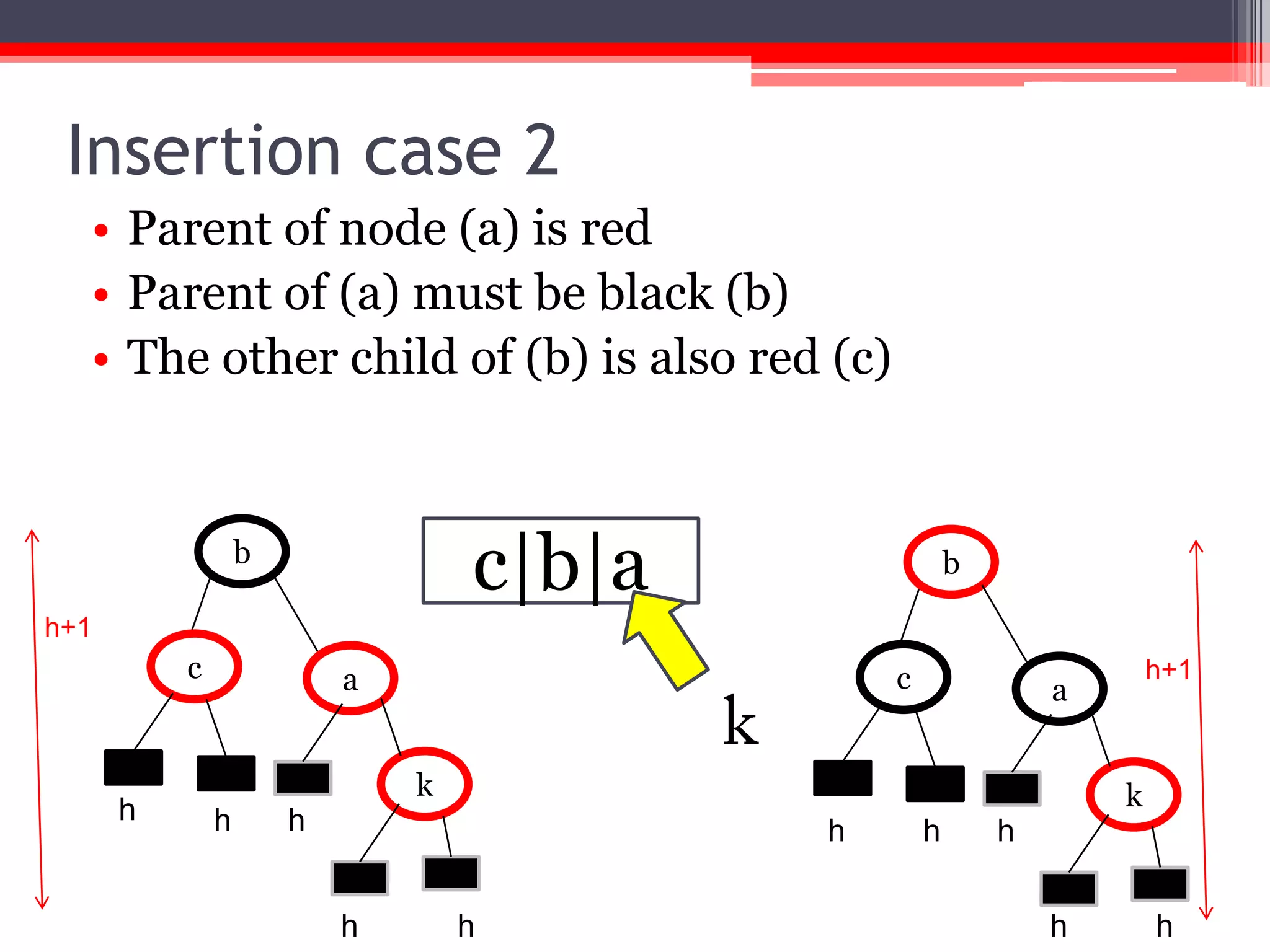
Insertion case 2
• Parent of node (a) is red
• Parent of (a) must be black (b)
• The other child of (b) is also red (c)

c|b|a

b

b

h+1

c

h

c

a
k
h

k

h

h
h

h+1

a

h

h

h
h

h
Deletion
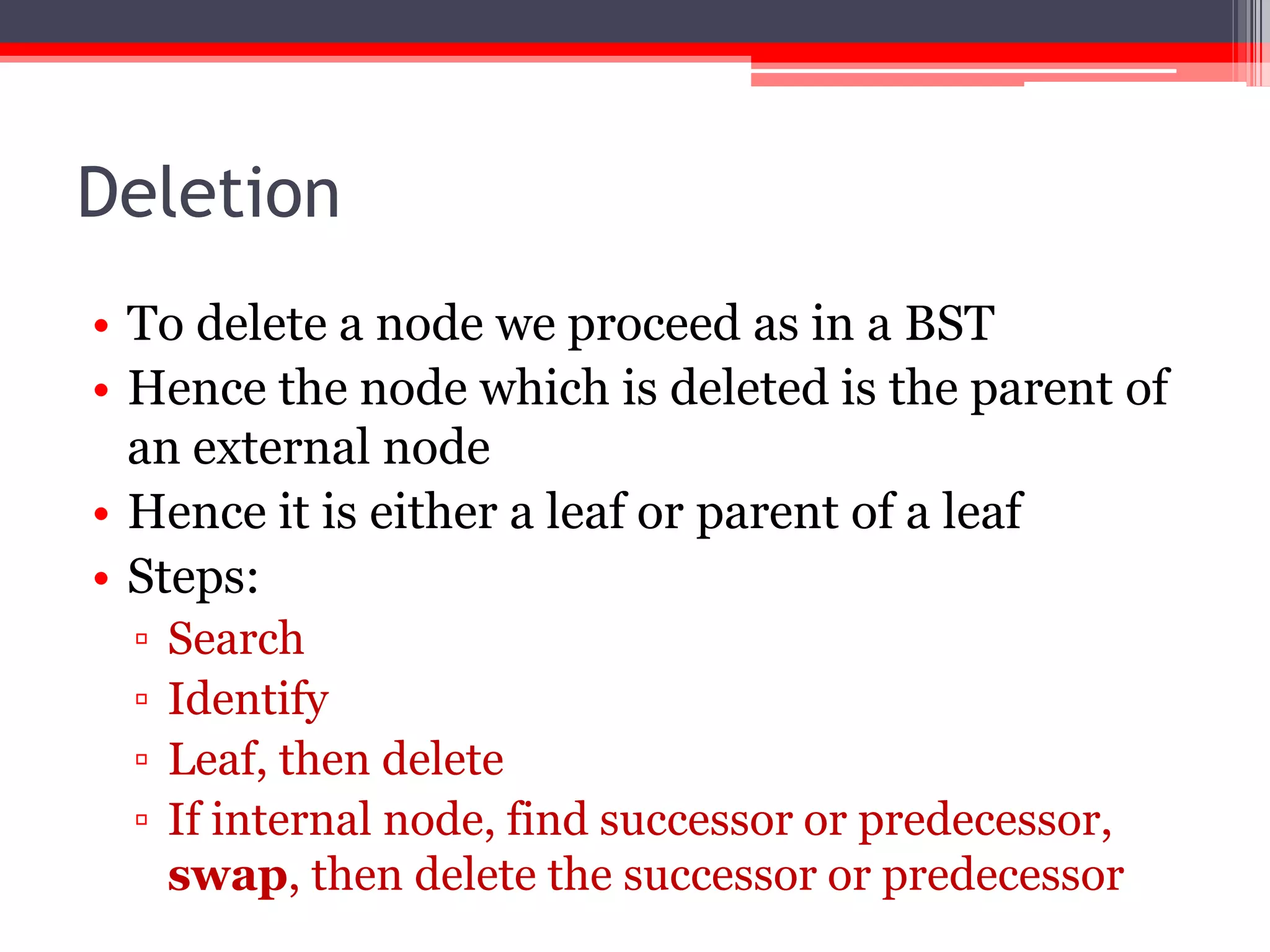
• To delete a node we proceed as in a BST
• Hence the node which is deleted is the parent of
an external node
• Hence it is either a leaf or parent of a leaf
• Steps:
▫
▫
▫
▫

Search
Identify
Leaf, then delete
If internal node, find successor or predecessor,
swap, then delete the successor or predecessor
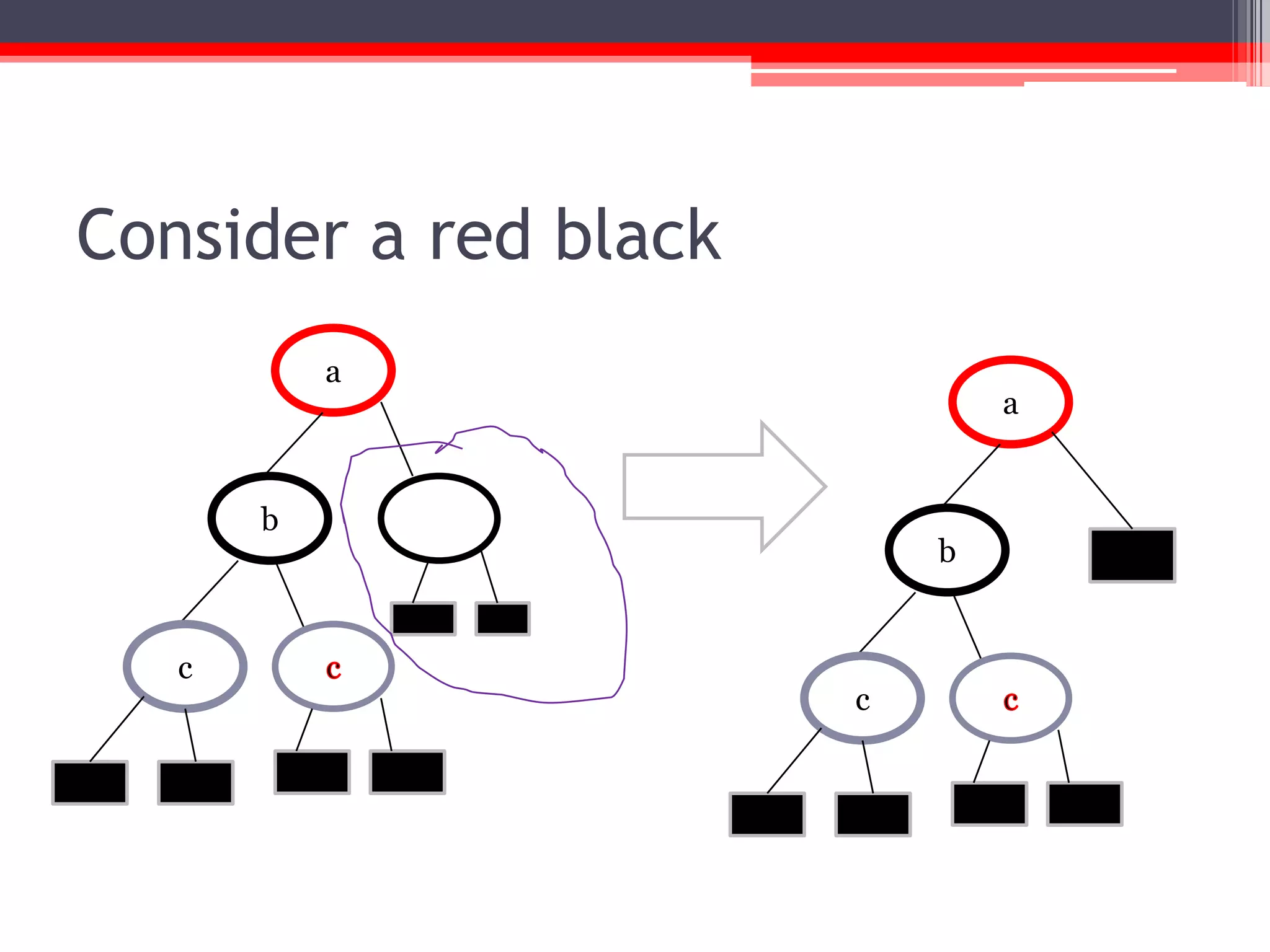
Consider a red black
a

a

b

c

b

c
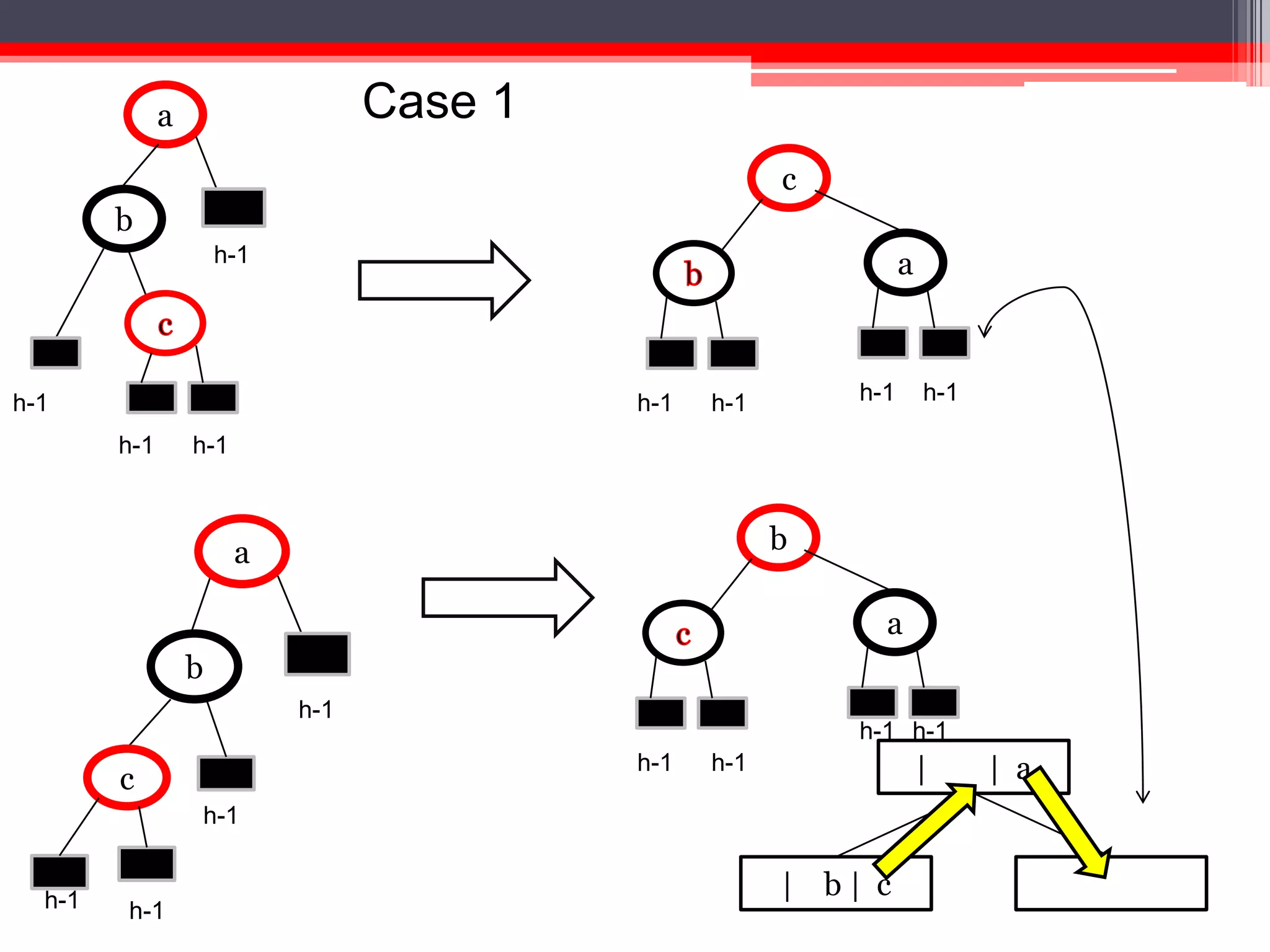
Case 1

a

c

b
a

h-1

h-1

h-1
h-1

h-1

h-1

h-1

h-1

b

a

a
b
h-1

h-1 h-1

h-1

c

|

h-1

h-1
h-1

h-1

| b| c

| a
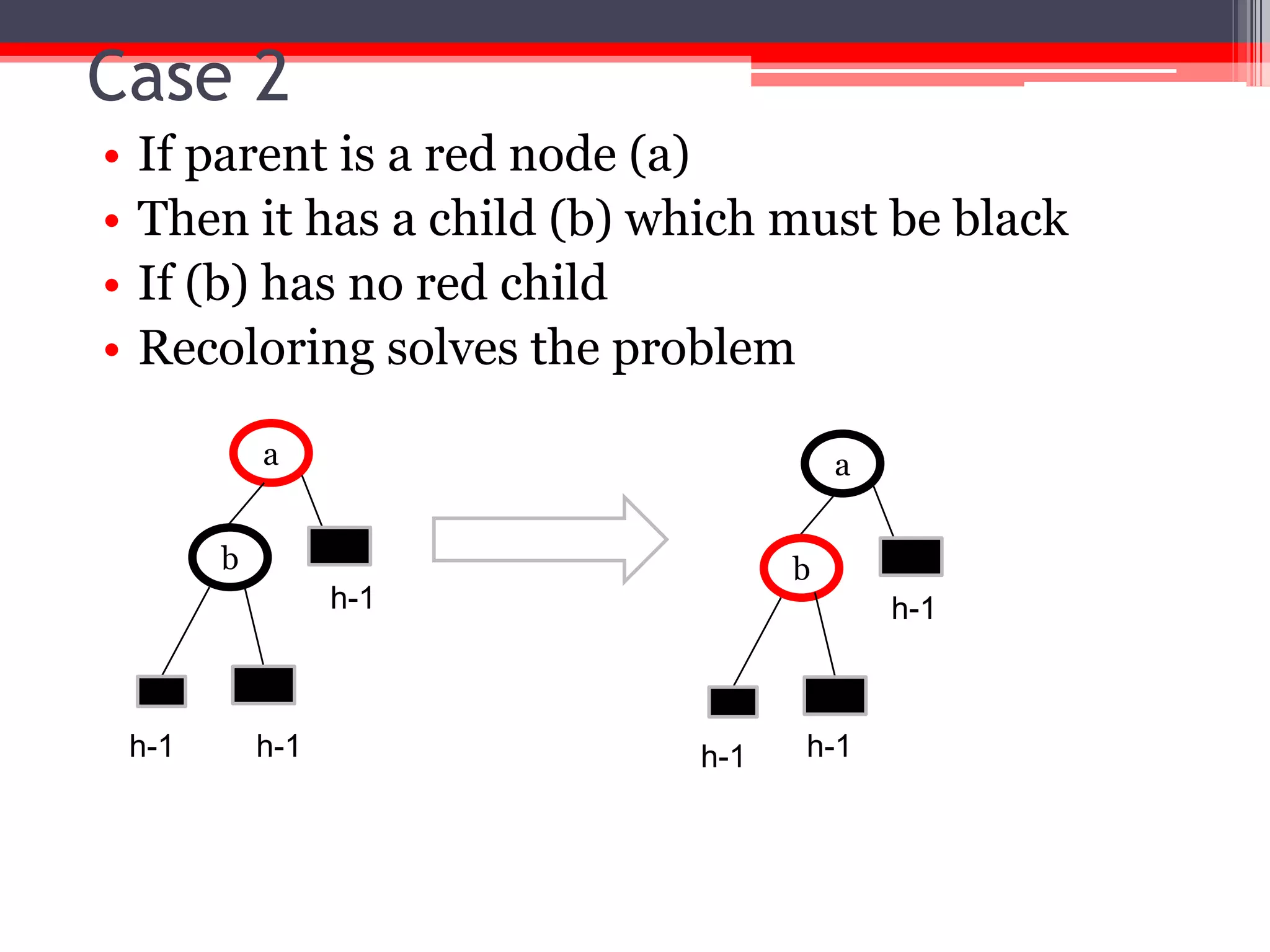
Case 2
•
•
•
•

If parent is a red node (a)
Then it has a child (b) which must be black
If (b) has no red child
Recoloring solves the problem
a

a

b

b

h-1

h-1

h-1

h-1

h-1

h-1
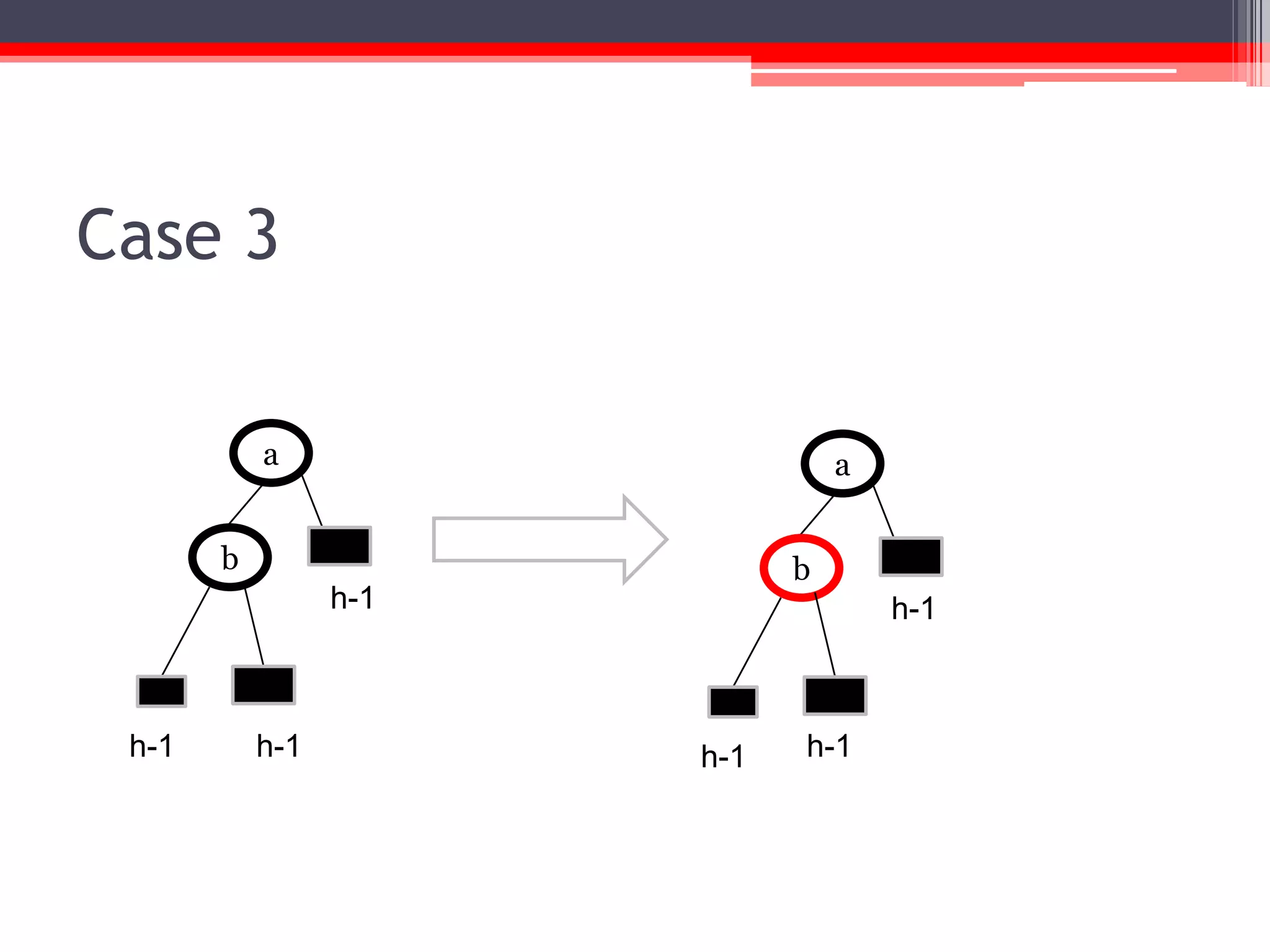
Case 3
a

a

b

b

h-1

h-1

h-1

h-1

h-1

h-1
Deletion Summary
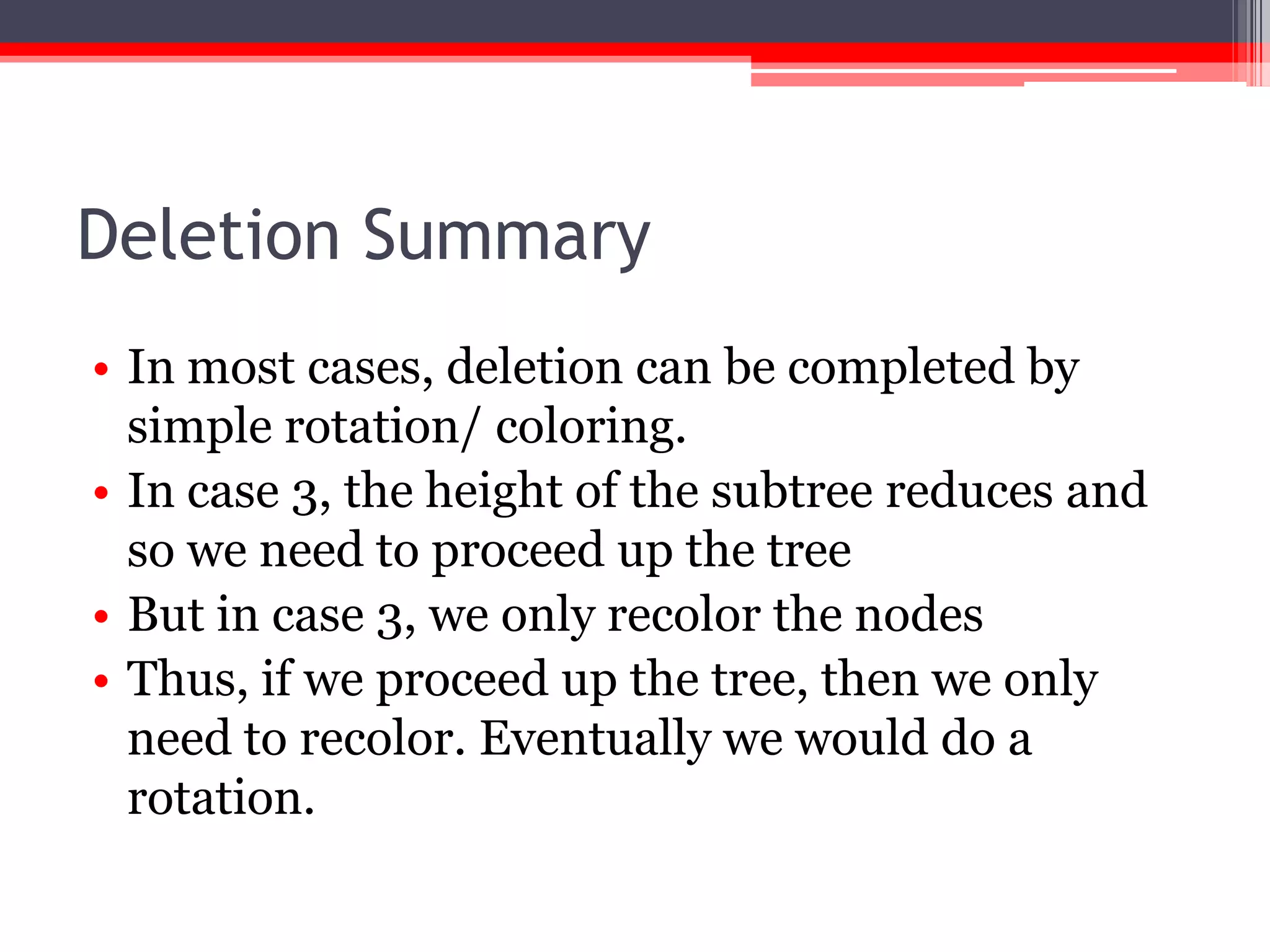
• In most cases, deletion can be completed by
simple rotation/ coloring.
• In case 3, the height of the subtree reduces and
so we need to proceed up the tree
• But in case 3, we only recolor the nodes
• Thus, if we proceed up the tree, then we only
need to recolor. Eventually we would do a
rotation.
References
• "Introduction to Algorithms, Third Edition," by Thomas H.
Cormen, Charles E. Leiserson, Ronald L. Rivest and Clifford Stein.
• Lecture Series on Data Structures and Algorithms by Dr. Naveen
Garg, Department of Computer Science and Engineering, IIT Delhi.
http://nptel.iitm.ac.in
• Lecture 10: Red-black Trees, Rotations, Insertions, Deletions:
http://videolectures.net/mit6046jf05_demaine_lec10/
• http://mitpress.mit.edu/algorithms/solutions/chap13-solutions.pdf
• http://www.cs.purdue.edu/homes/ayg/CS251/slides/chap13c.pdf
• Left leaning Red black trees
• http://www.cs.princeton.edu/~rs/talks/LLRB/RedBlack.pdf
• http://www.cs.princeton.edu/~rs/talks/LLRB/LLRB.pdf
Thank
You

Red black trees1109

  • 1.
  • 2.
    Acknowledgement I would likeexpress my sincere gratitude to Dr. Jyoti Pawar, for the support and guidance as well as the feedback she has provided throughout this study.
  • 3.
    Definition • A red-blacktree is a type of self balancing binary search tree, with one extra attribute for each node: the colour, which is either red or black. • A red–black tree is a binary search tree that inserts and deletes in such a way that the tree is always reasonably balanced.
  • 4.
    Balanced binary tree •A non-empty binary tree T is balanced if: 1) Left subtree of T is balanced 2) Right subtree of T is balanced 3) The difference between heights of left subtree and right subtree is not more than 1.
  • 5.
    Red-Black tree • Recallbinary search tree ▫ Key values in the left subtree <= the node value ▫ Key values in the right subtree >= the node value • Operations: ▫ insertion, deletion ▫ Search, maximum, minimum, successor, predecessor. ▫ O(h), h is the height of the tree.
  • 6.
    Red-black trees • Definition: abinary tree, satisfying: 1. 2. 3. 4. 5. • • Every node is red or black The root is black Every leaf is NIL and is black If a node is red, then both its children are black For each node, all paths from the node to descendant leaves contain the same number of black nodes. Purpose: keep the tree balanced. Other balanced search tree: ▫ AVL tree, 2-3-4 tree, Splay tree, Treap
  • 7.
    Example of redblack trees Each Red Node can have only Black children
  • 8.
    Not a redblack tree
  • 9.
    Black height ofa red black tree • Black height does not count the root itself. • we use "nil leaves" or "null leaves", which contain no data and merely serve to indicate where the tree ends 7 BH=2 BH=2 3 BH=1 BH=0 22 BH=1 8 10 BH=1, ignore red nodes!! NIL pointer
  • 10.
    Complexity • The persistentversion of red-black trees requires O(log n) space for each insertion or deletion.
  • 11.
    Some operations inlog(n) • Search, minimum, maximum, successor, predecessor. • Let us discuss insert and delete.
  • 12.
    Inserting in ared black tree • Let k be the key being inserted. • As in case of a BST, we first search for k; this gives us the place where we have to insert k. • We create a new node with key k and insert it at this place • The new node is colored red.
  • 13.
    • Since insertednode is Red , the black height of the tree remains unchanged. • However if the parent node is also red, then we have a double red problem k k NO PROBLEM DOUBLE RED PROBLEM
  • 14.
    INSERTION : CASE1 • Parent of node (a) must be black (b). • The other child of (b) is black (c) . • Rotation corrects the defect. b c a b a k c k
  • 15.
    Insertion case 2 •Parent of node (a) is red • Parent of (a) must be black (b) • The other child of (b) is also red (c) c|b|a b b h+1 c h c a k h k h h h h+1 a h h h h h
  • 16.
    Deletion • To deletea node we proceed as in a BST • Hence the node which is deleted is the parent of an external node • Hence it is either a leaf or parent of a leaf • Steps: ▫ ▫ ▫ ▫ Search Identify Leaf, then delete If internal node, find successor or predecessor, swap, then delete the successor or predecessor
  • 17.
    Consider a redblack a a b c b c
  • 18.
  • 19.
    Case 2 • • • • If parentis a red node (a) Then it has a child (b) which must be black If (b) has no red child Recoloring solves the problem a a b b h-1 h-1 h-1 h-1 h-1 h-1
  • 20.
  • 21.
    Deletion Summary • Inmost cases, deletion can be completed by simple rotation/ coloring. • In case 3, the height of the subtree reduces and so we need to proceed up the tree • But in case 3, we only recolor the nodes • Thus, if we proceed up the tree, then we only need to recolor. Eventually we would do a rotation.
  • 22.
    References • "Introduction toAlgorithms, Third Edition," by Thomas H. Cormen, Charles E. Leiserson, Ronald L. Rivest and Clifford Stein. • Lecture Series on Data Structures and Algorithms by Dr. Naveen Garg, Department of Computer Science and Engineering, IIT Delhi. http://nptel.iitm.ac.in • Lecture 10: Red-black Trees, Rotations, Insertions, Deletions: http://videolectures.net/mit6046jf05_demaine_lec10/ • http://mitpress.mit.edu/algorithms/solutions/chap13-solutions.pdf • http://www.cs.purdue.edu/homes/ayg/CS251/slides/chap13c.pdf • Left leaning Red black trees • http://www.cs.princeton.edu/~rs/talks/LLRB/RedBlack.pdf • http://www.cs.princeton.edu/~rs/talks/LLRB/LLRB.pdf
  • 23.