Red Black Trees
Data Structures
Some Properties of Binary Search Tree
• The common properties of binary search trees are as follows:
• The left sub tree of a node contains only nodes with keys less than the node's key.
• The right sub tree of a node contains only nodes with keys greater than the node's
key.
• The left and right sub tree each must also be a binary search tree.
• There must be no duplicate nodes.
• A unique path exists from the root to every other node.
Problem with Binary Search Tree
• Binary Search Tree is fast in insertion and deletion etc. when balanced.
• Time Complexity of performing operations (e.g. searching , inserting , deletion etc) on
binary search tree is O(logn) in best case i.e when tree is balanced.
• And on the other hand performance degrades from O(logn) to O(n) when tree is not
balanced.
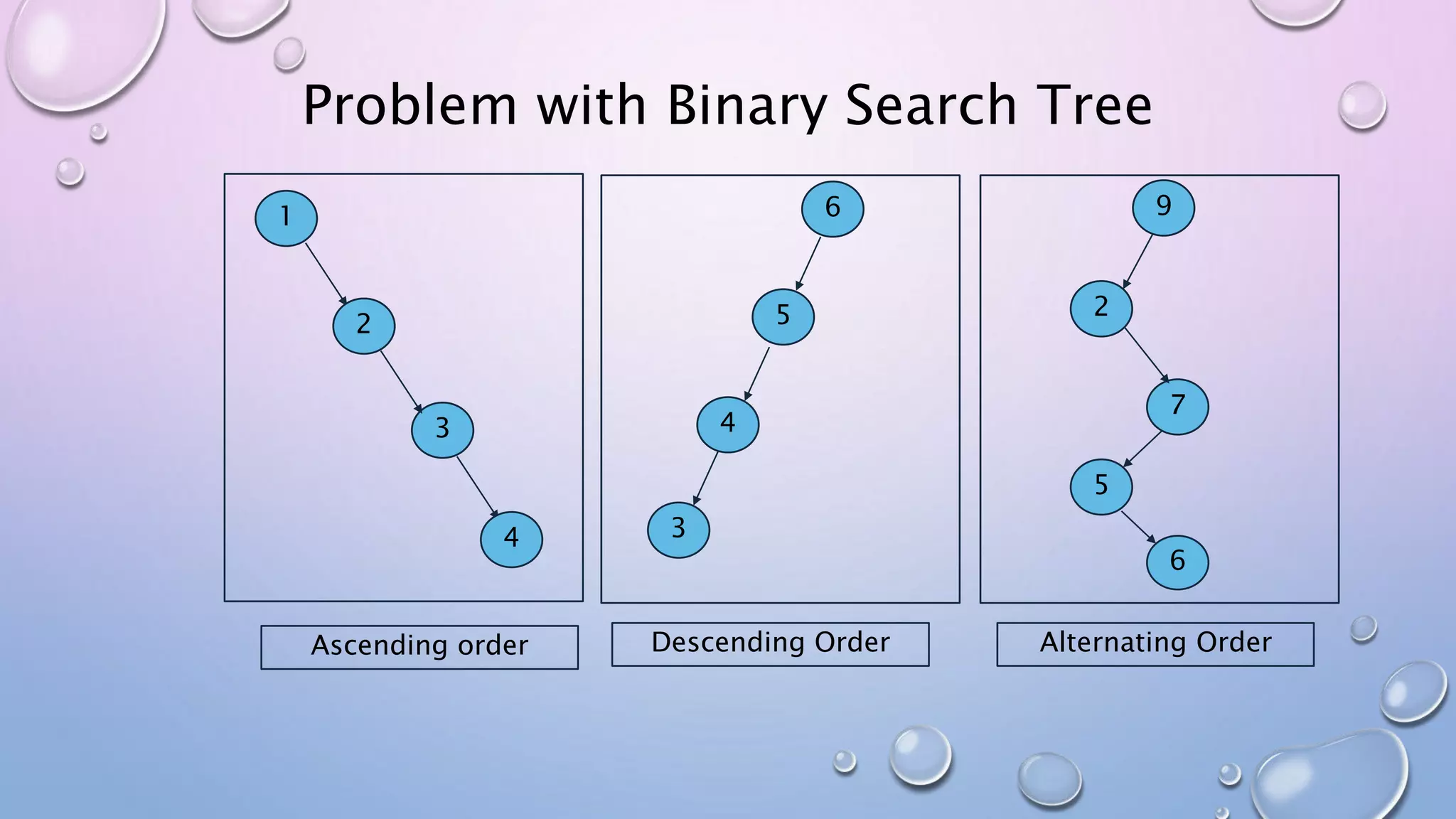
• Basic binary search trees have three very nasty degenerate cases where the structure
stops being logarithmic and becomes a glorified linked list.
• The two most common of these degenerate cases is ascending or descending sorted
order (the third is outside-in alternating order).
Problem with Binary Search Tree
1
2
3
4
6
5
3
4
9
2
6
5
7
Alternating OrderDescending OrderAscending order
Red Black Tree
• A red-black tree is a balanced binary search tree with one extra bit of storage per node:
its color, which can be either Red or Black.
• By constraining the node colors on any simple path from the root to a leaf, red-black
trees ensure that no such path is more than twice as long as any other, so that the tree
is approximately balanced.
• Each node of the tree now contains the attributes color, key, left, right, and p.
• If a child or the parent of a node does not exist, the corresponding pointer attribute of
the node contains the value NIL.
Properties of Red Black Tree
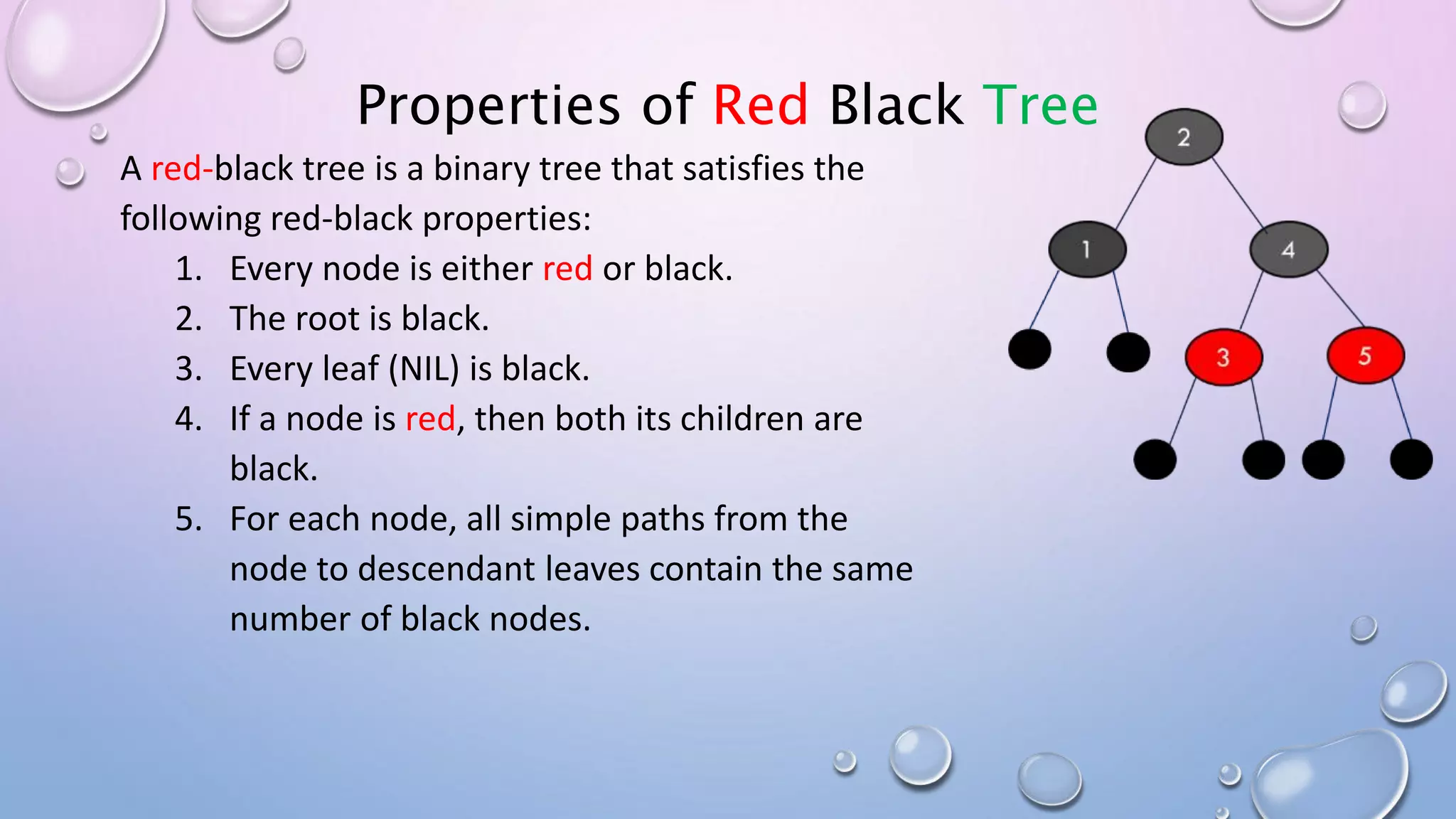
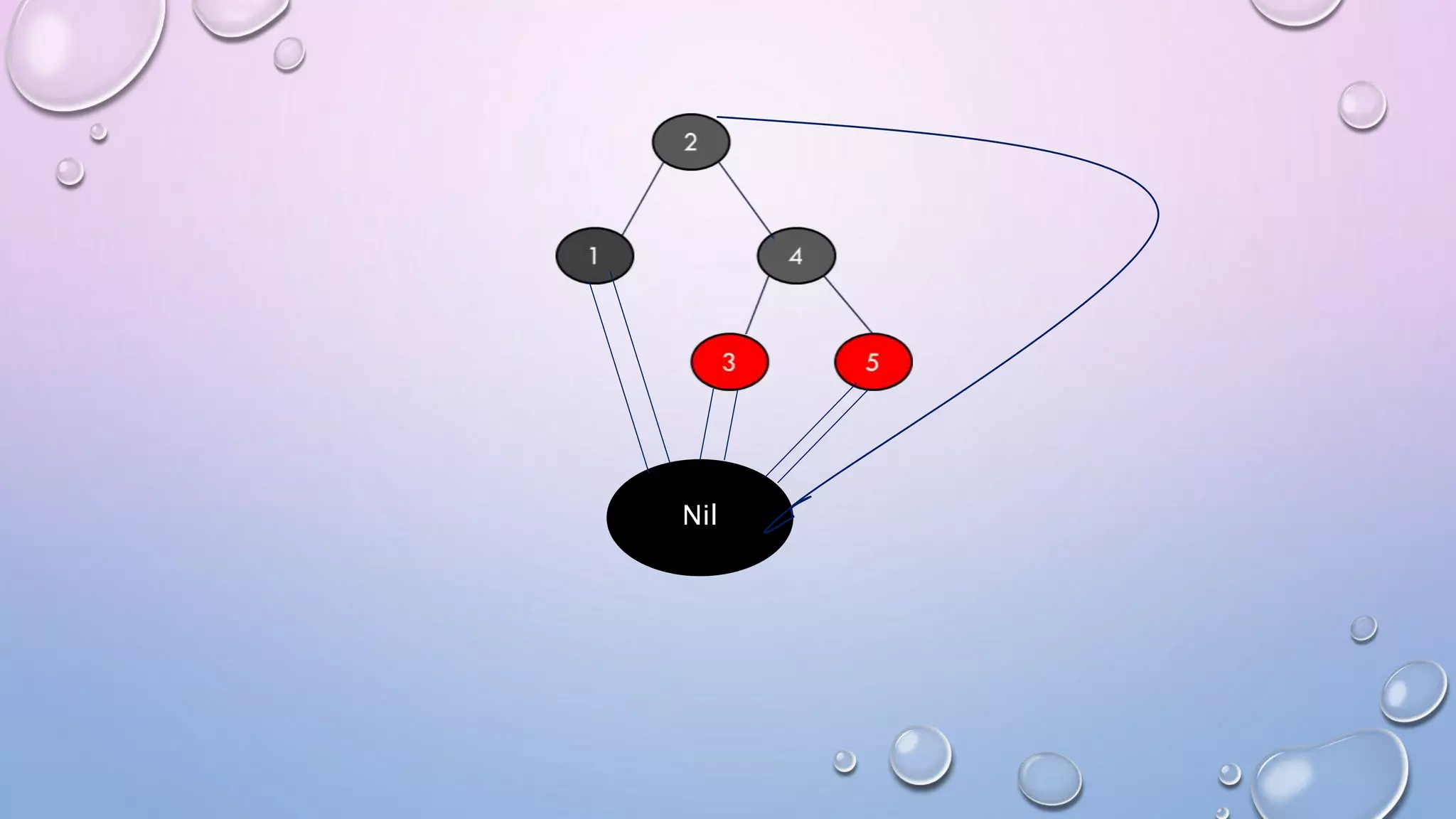
A red-black tree is a binary tree that satisfies the
following red-black properties:
1. Every node is either red or black.
2. The root is black.
3. Every leaf (NIL) is black.
4. If a node is red, then both its children are
black.
5. For each node, all simple paths from the
node to descendant leaves contain the same
number of black nodes.
Nil
• The search-tree operations TREE-INSERT and TREE-DELETE, when run on a red black
tree with n keys, take O(log n)time. Because they modify the tree, the result may
violate the red-black properties.
• To restore these properties, we must change the colors of some of the nodes in the
tree and also change the pointer structure.
• We change the pointer structure through rotation, which is a local operation in a
search tree that preserves the binary-search-tree property.
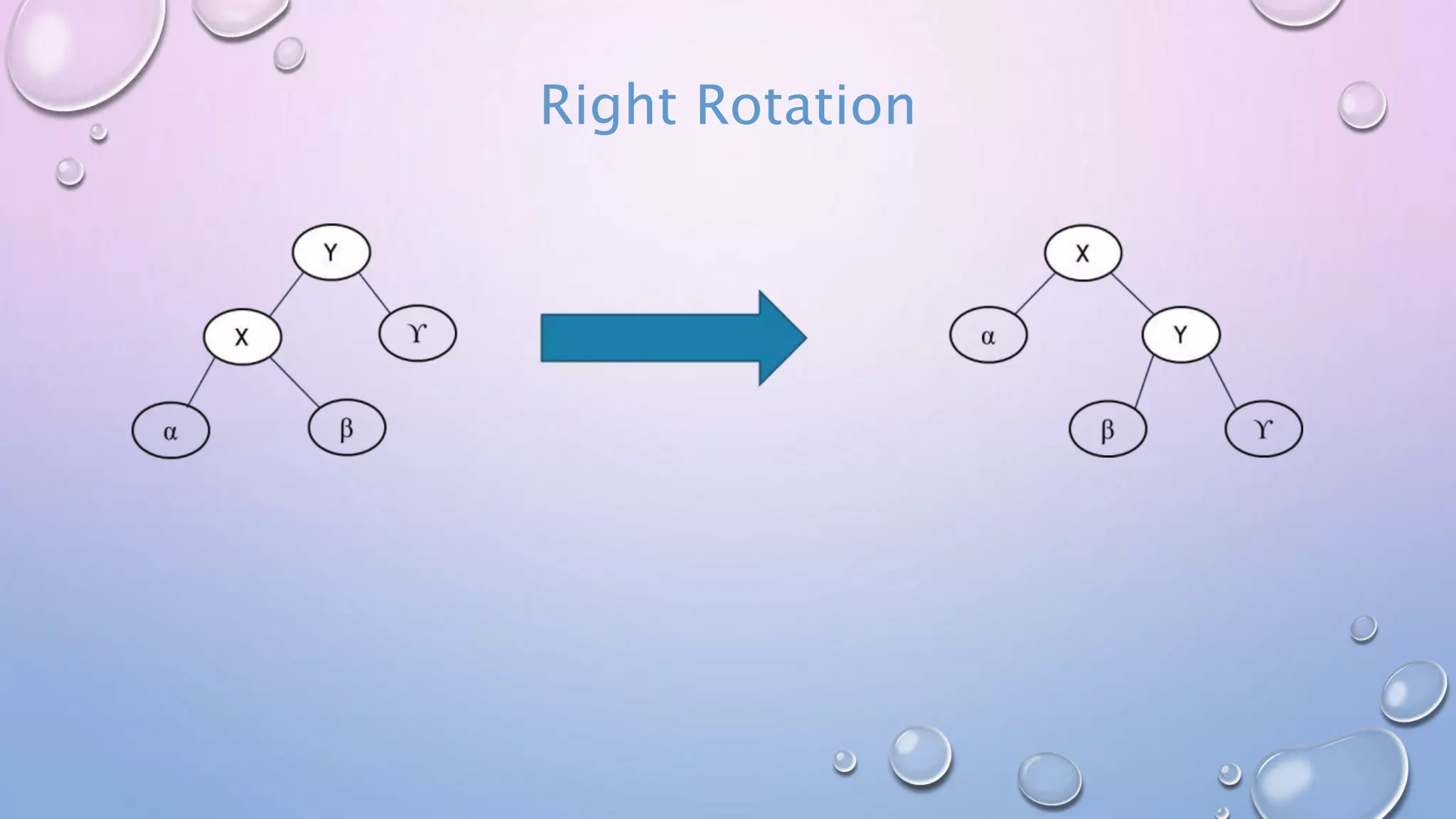
• There are two kinds of rotations : left rotations and right rotations.
Red Black Tree (Rotations)
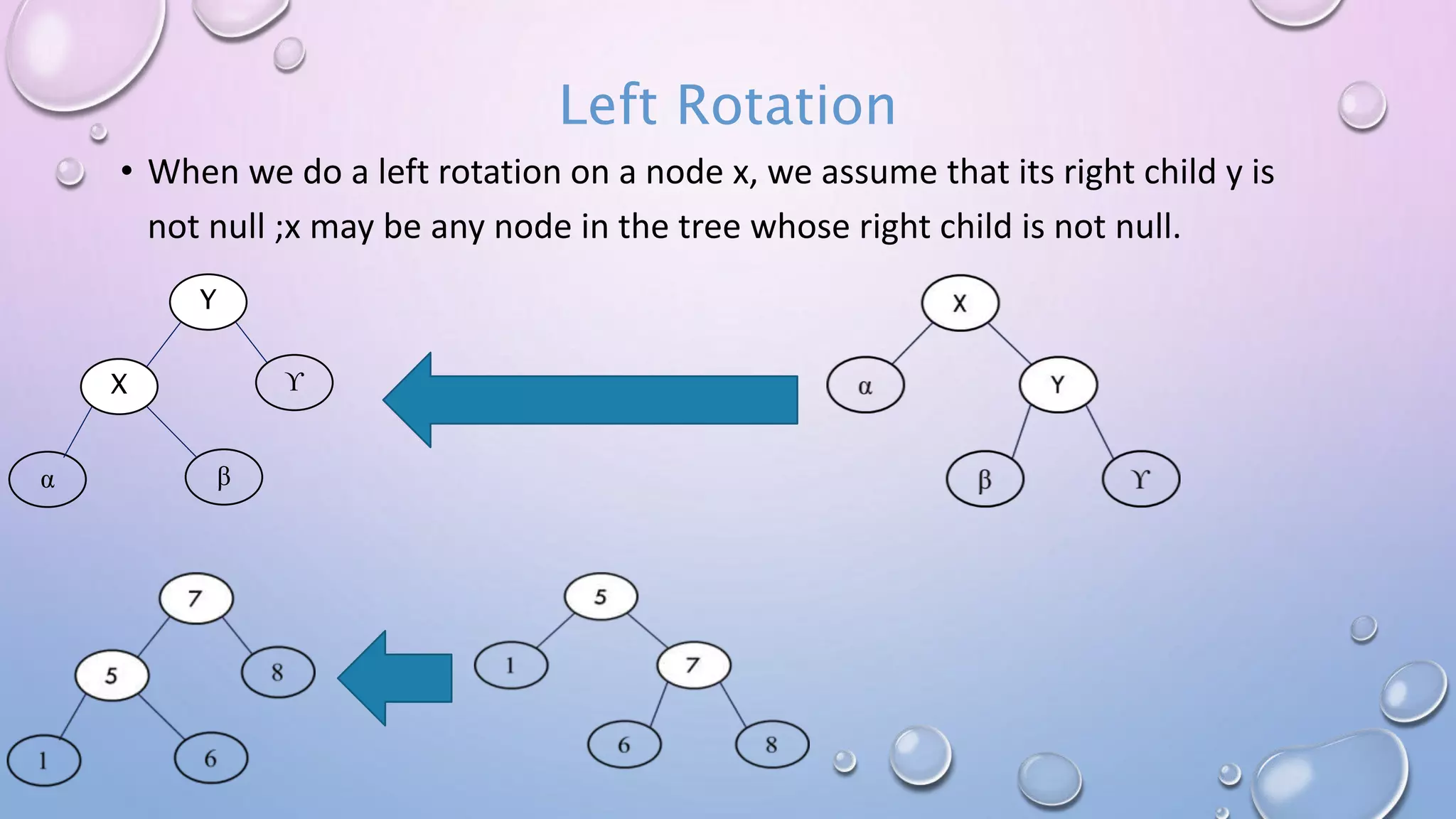
• When we do a left rotation on a node x, we assume that its right child y is
not null ;x may be any node in the tree whose right child is not null.
Left Rotation
X
Y
α β
ϒ
LEFT-ROTATE (T , x)
1. y = x.right // set y new temporary node
2. x.right = y.left // turn y’s left subtree into x’s
right subtree
3. if y.left != T.nil
4. y.left.p = x
5. y.p= x.p // link x’s parent to y
6. if x.p == T. nil
7. T.root = y
8. else if x == x.p.left
9. x.p.left = y
10.else x.p.right = y
11. y.left = x // put x on y’s left
12. x.p = y
X
Y
α β
ϒ
Right Rotation
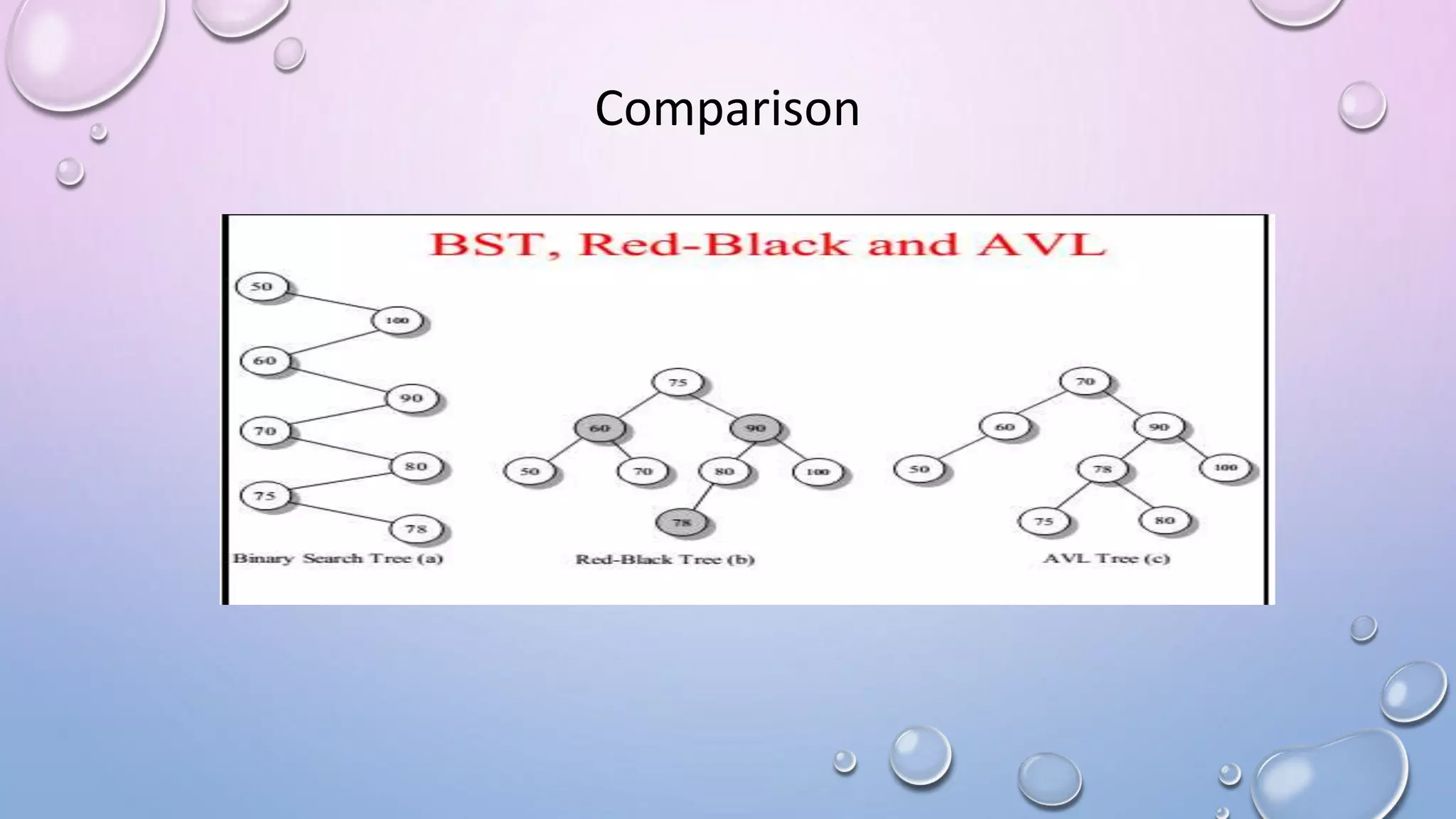
Comparison
Insertion
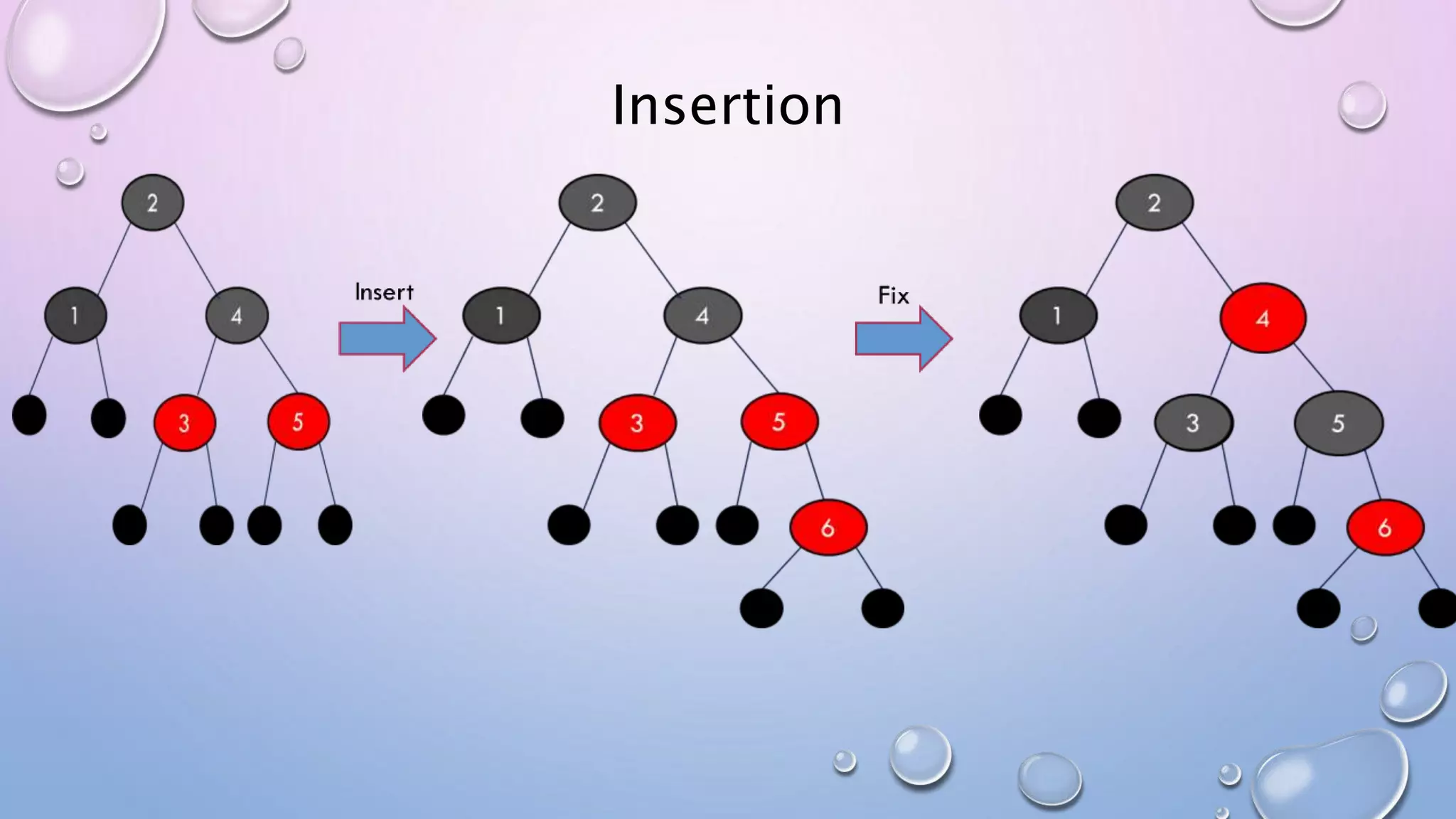
• We can insert a node into an n-node red-black tree in O(logn) time.
• To do so, we use a slightly modified version of the TREE-INSERT procedure to
insert node into the tree T as if it were an ordinary binary search tree.
• Then we color it to red.
• To guarantee that the red-black properties are preserved, we then call an
auxiliary procedure RB-INSERT-FIXUP to recolor nodes and perform rotations.
Insertion
Insertion
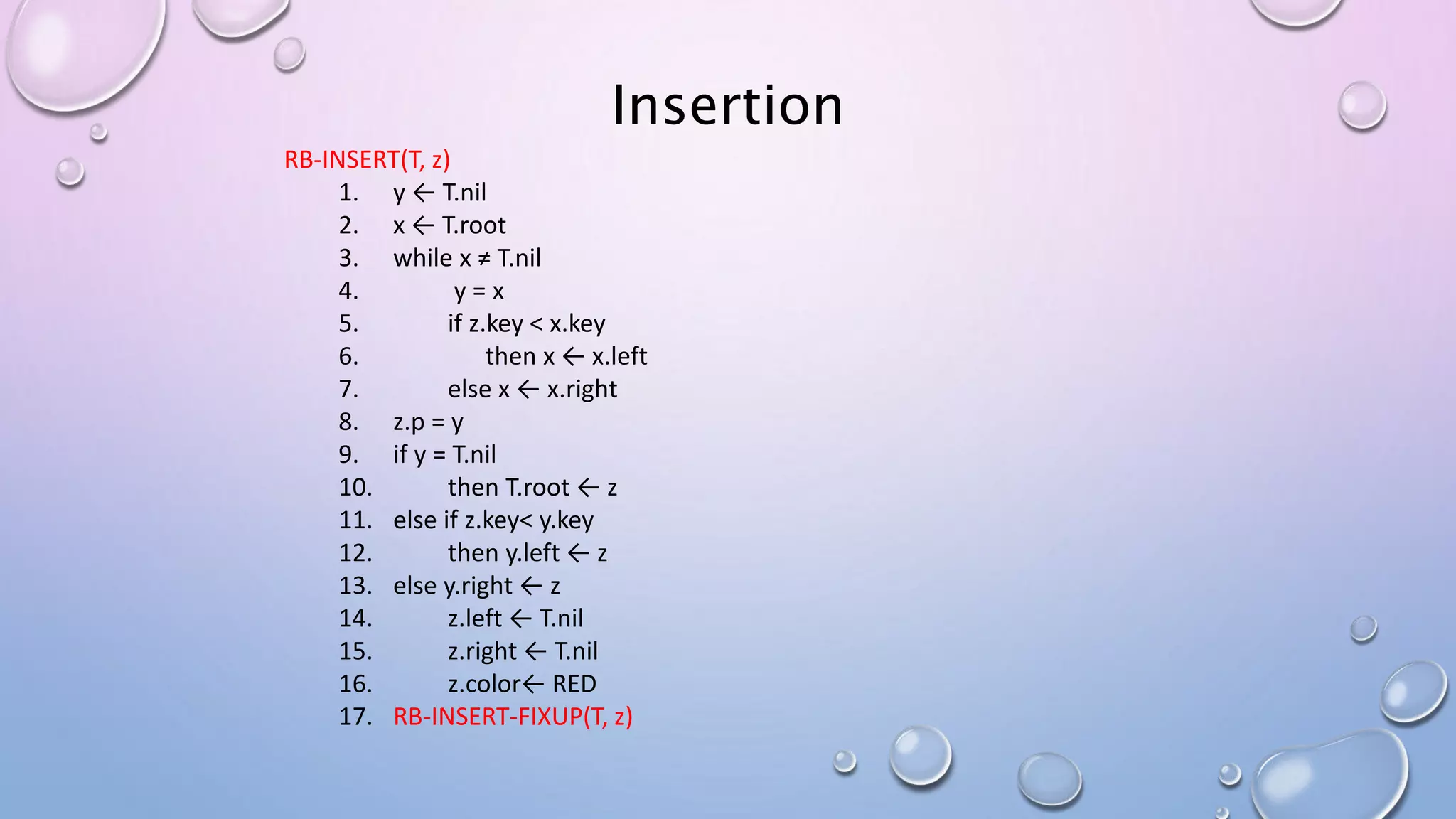
RB-INSERT(T, z)
1. y ← T.nil
2. x ← T.root
3. while x ≠ T.nil
4. y = x
5. if z.key < x.key
6. then x ← x.left
7. else x ← x.right
8. z.p = y
9. if y = T.nil
10. then T.root ← z
11. else if z.key< y.key
12. then y.left ← z
13. else y.right ← z
14. z.left ← T.nil
15. z.right ← T.nil
16. z.color← RED
17. RB-INSERT-FIXUP(T, z)
Insertion
The procedures TREE-INSERT and RB-INSERT differ in four ways.
• First, all instances of NIL in TREE-INSERT are replaced by T.nil.
• Second, we set z.left and z.right to T. nil in lines 14–15 of RB-INSERT, in order to
maintain the proper tree structure.
• Third, we color z red in line 16.
• Fourth, because coloring z.red may cause a violation of one of the red-black
properties, we call RB-INSERT-FIXUP(T,z) in line 17 of RB-INSERT to restore the
red-black properties
Insertion
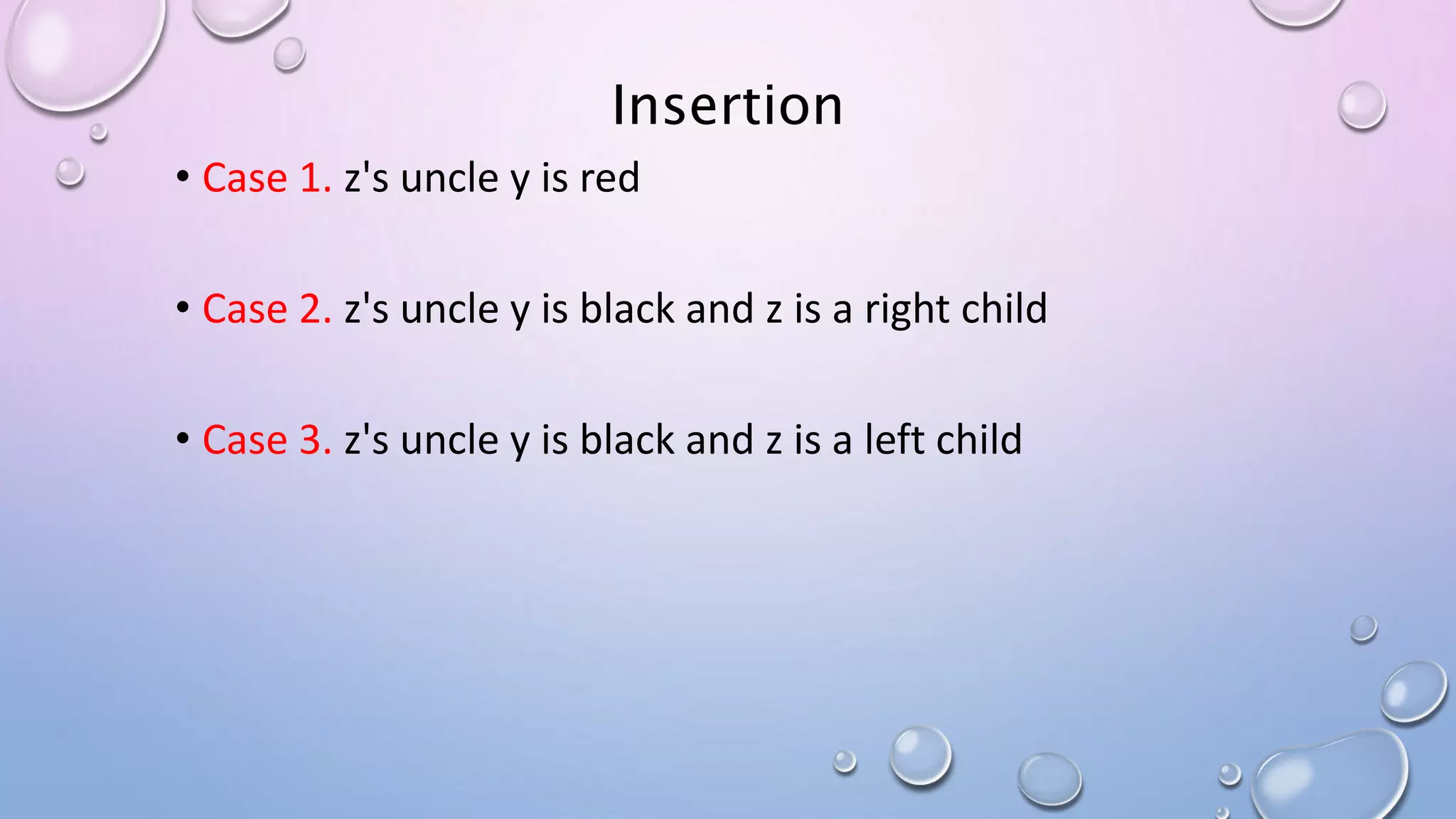
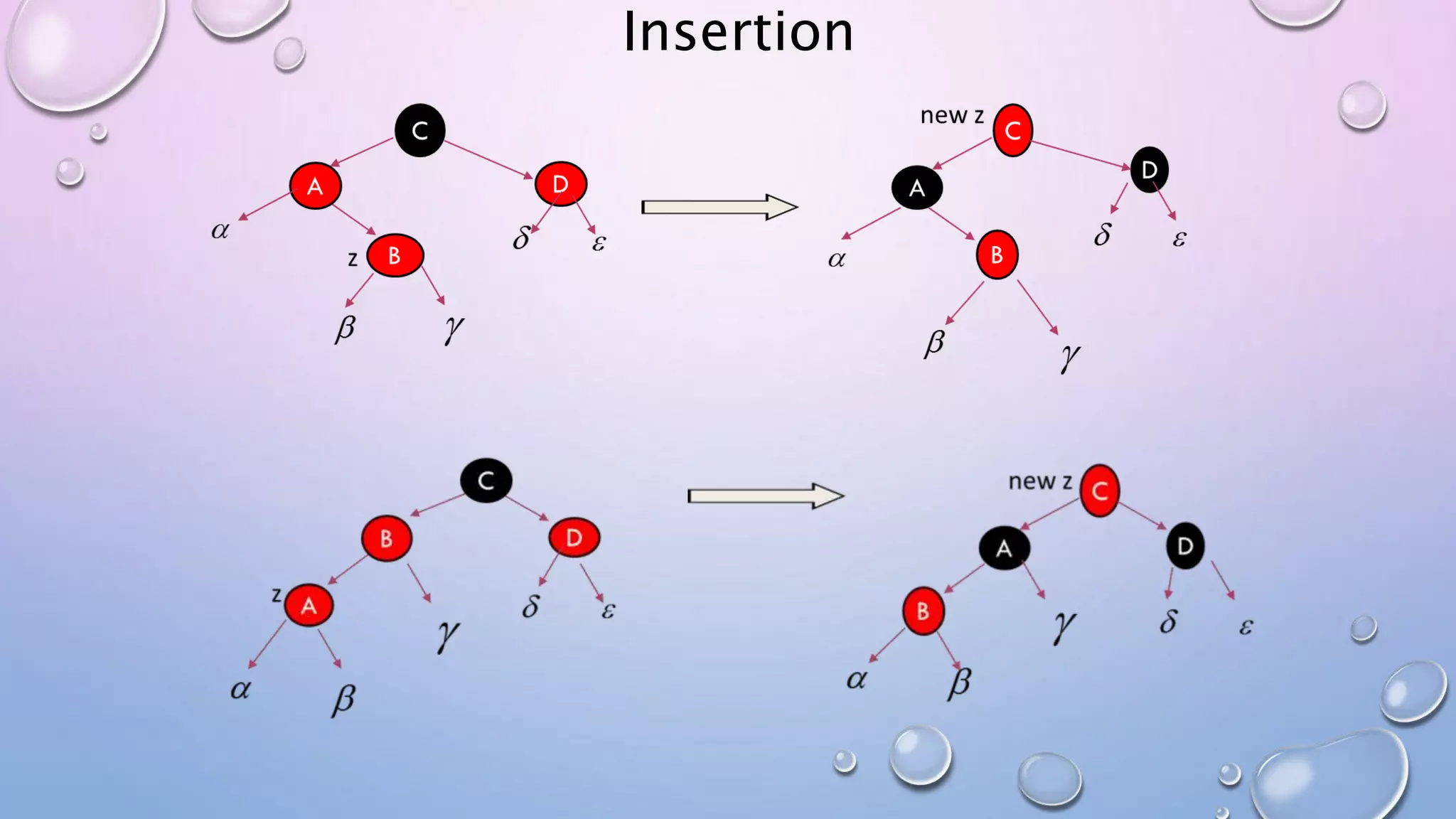
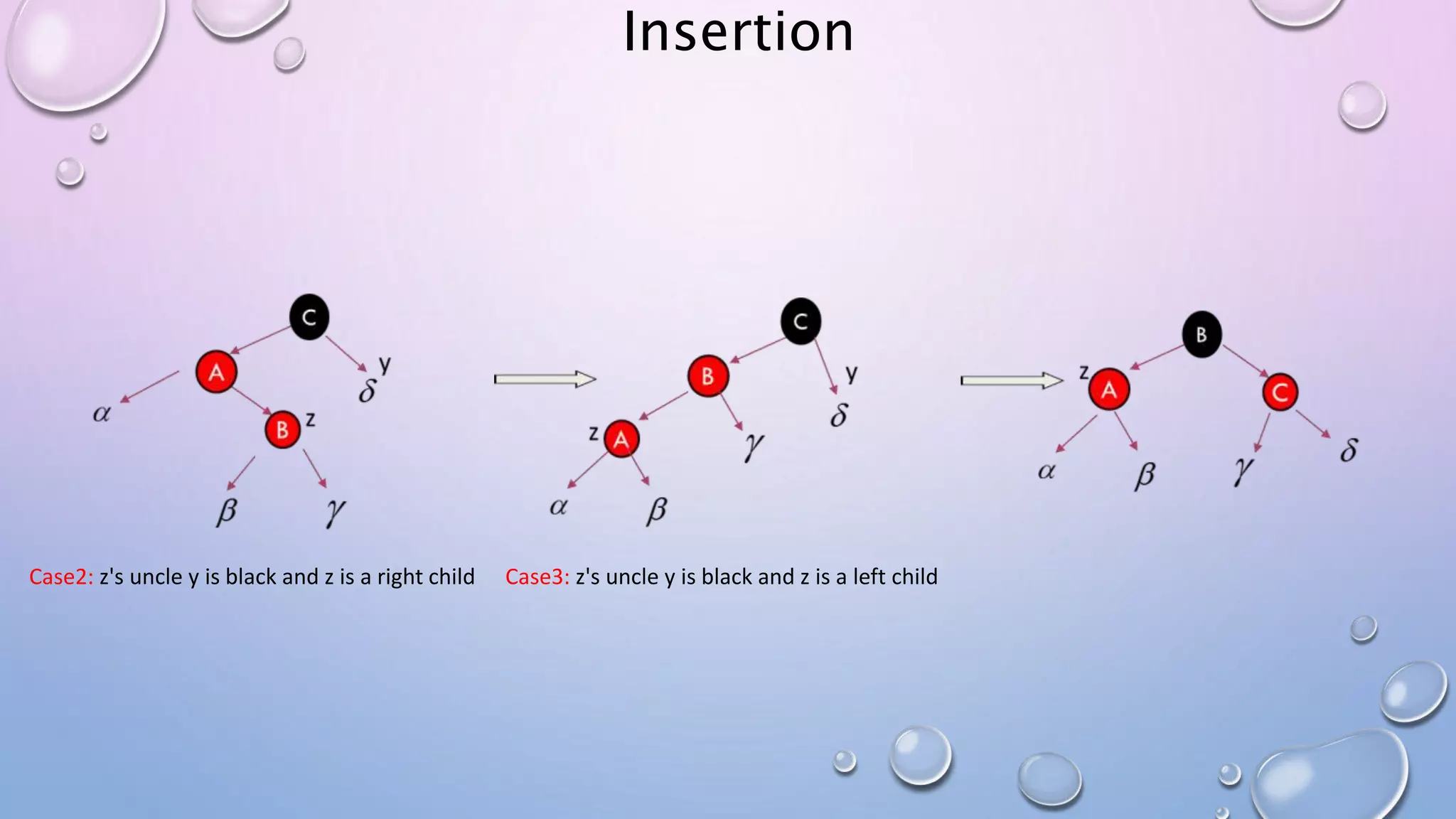
• Case 1. z's uncle y is red
• Case 2. z's uncle y is black and z is a right child
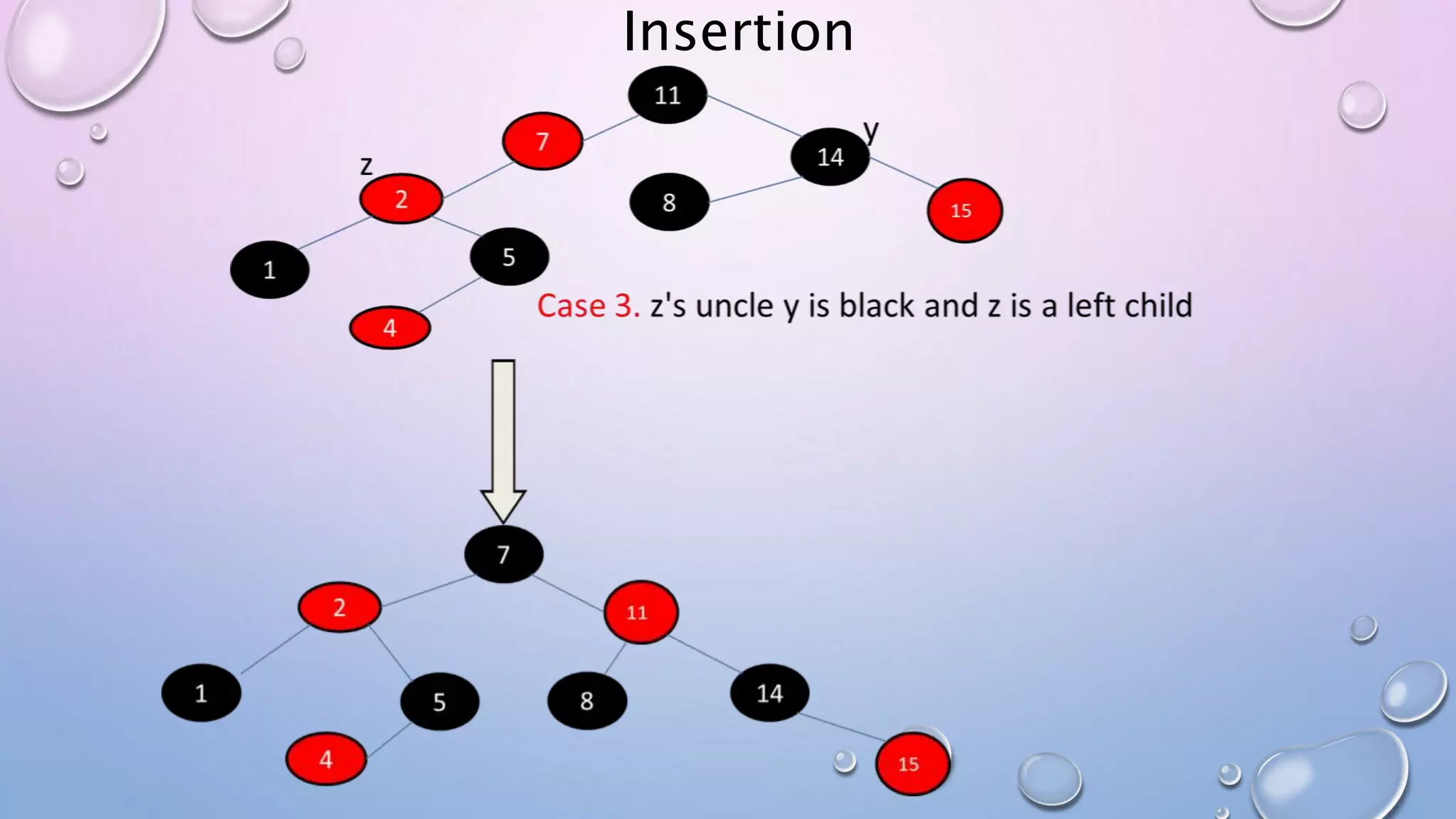
• Case 3. z's uncle y is black and z is a left child
Insertion
Insertion
Insertion
Insertion
Case3: z's uncle y is black and z is a left childCase2: z's uncle y is black and z is a right child
Insertion
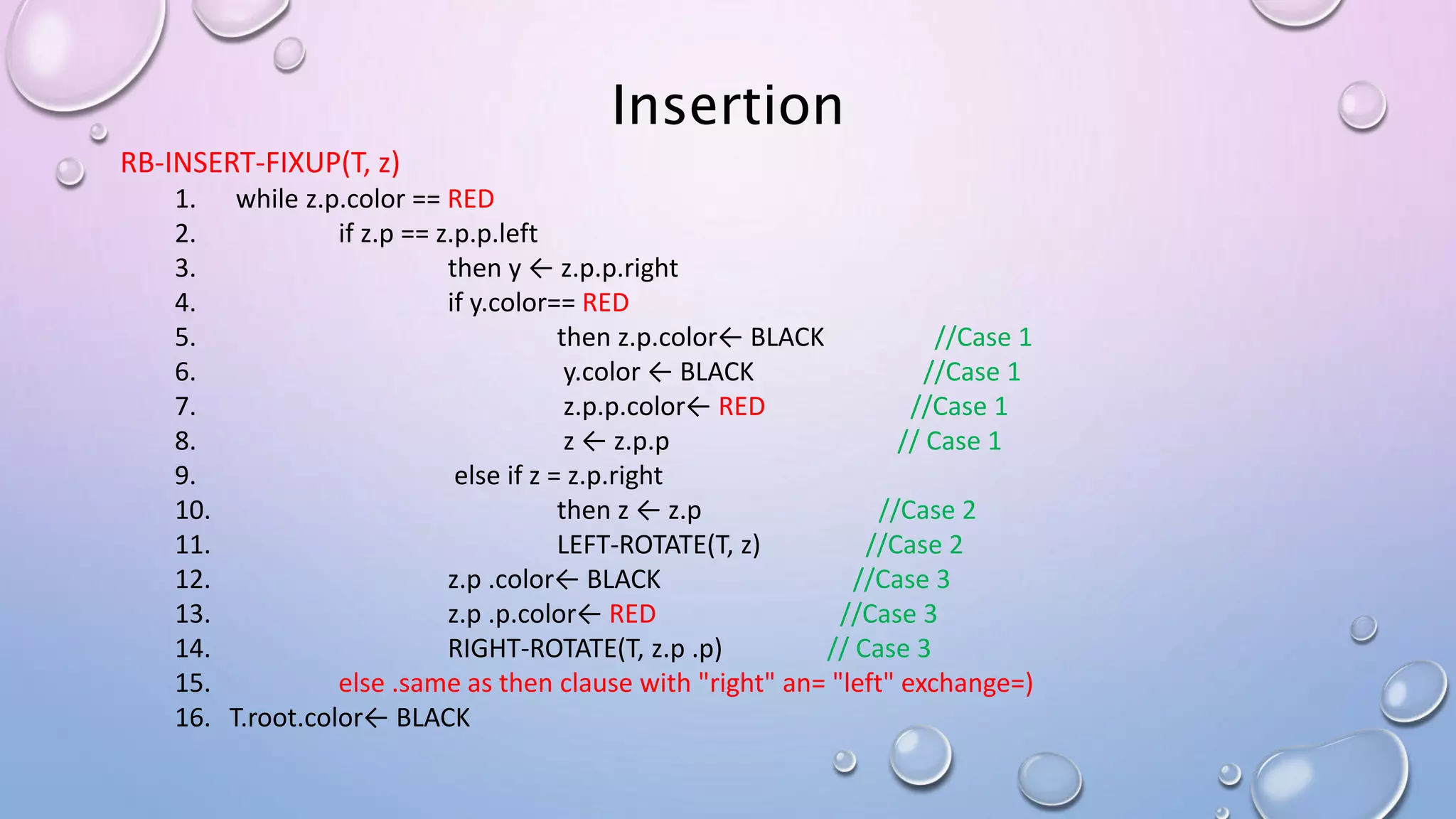
RB-INSERT-FIXUP(T, z)
1. while z.p.color == RED
2. if z.p == z.p.p.left
3. then y ← z.p.p.right
4. if y.color== RED
5. then z.p.color← BLACK //Case 1
6. y.color ← BLACK //Case 1
7. z.p.p.color← RED //Case 1
8. z ← z.p.p // Case 1
9. else if z = z.p.right
10. then z ← z.p //Case 2
11. LEFT-ROTATE(T, z) //Case 2
12. z.p .color← BLACK //Case 3
13. z.p .p.color← RED //Case 3
14. RIGHT-ROTATE(T, z.p .p) // Case 3
15. else .same as then clause with "right" an= "left" exchange=)
16. T.root.color← BLACK
Insertion
• To understand how RB-INSERT-FIXUP works, we shall break our examination of
the code into three major steps.
• First, we shall determine what violations of the red-black properties are
introduced in RB-INSERT when node z is inserted and colored red.
• Second, we shall examine the overall goal of the while loop in lines 1–15.
• Finally, we shall explore each of the three cases within the while loop’s body and
see how they accomplish the goal.
Insertion
• The while loop in lines 1–15 maintains the following three-part invariant.
• At the start of each iteration of the loop,
a) Node z is red.
b) If z.p is the root, then z.p is black.
c) If there is a violation of the red-black properties , there is at most one violation, and it is of
either property 2 or property 4. If there is a violation of property 2, it occurs because z is the
root and is red. If there is a violation of property 4, it occurs because both z and z.p are red.
Deletion
• Like the other basic operations on an Red Black tree, deletion of a node takes time
O(logn)
• Deleting a node from a red-black tree is a bit more complicated than inserting a node.
• The procedure for deleting a node from a red-black tree is based on the RB-DELETE
procedure
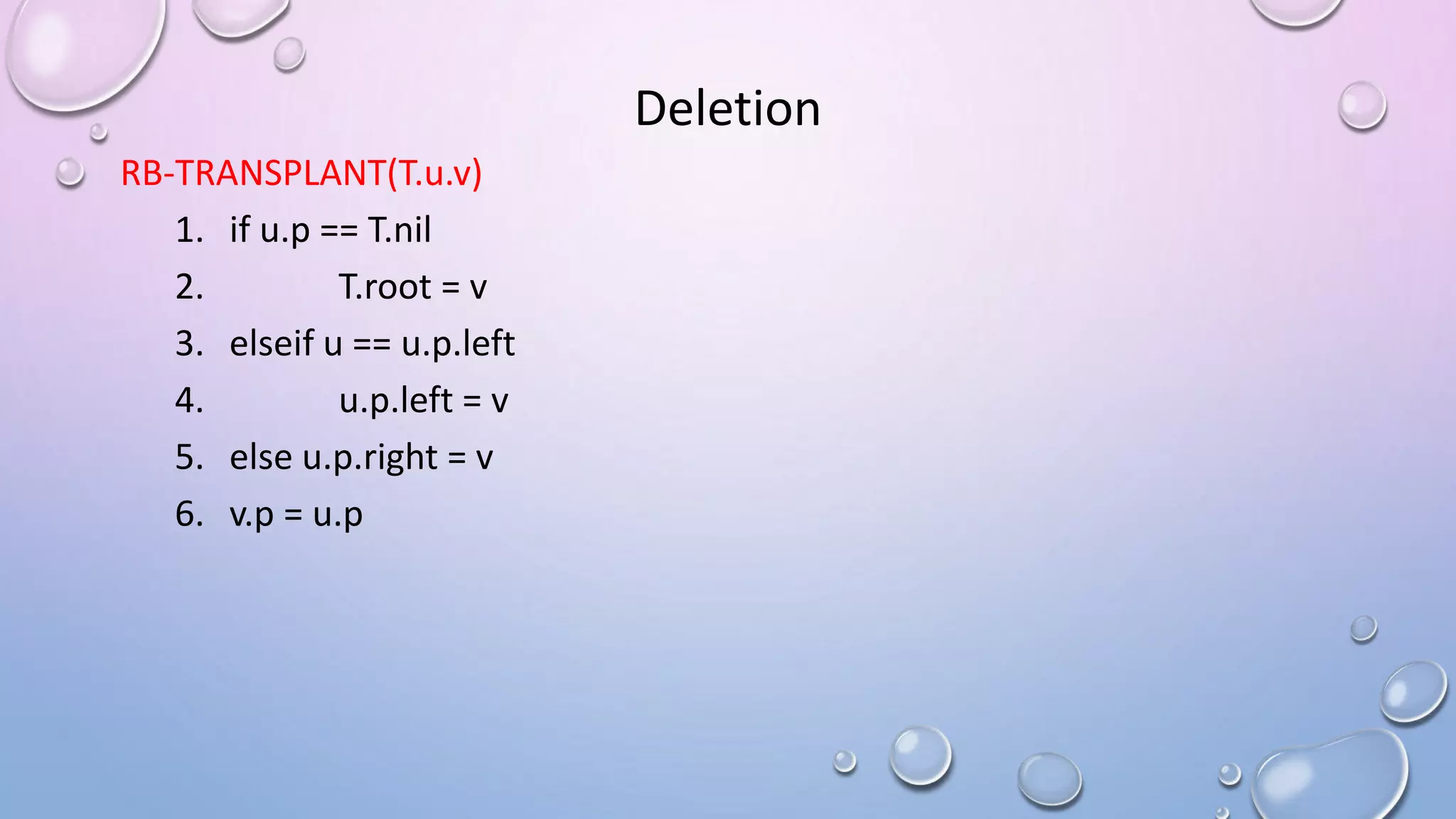
• First, we need to customize the TRANSPLANT subroutine that RB-DELETE calls so that it
applies to a red-black tree.
Deletion
RB-TRANSPLANT(T.u.v)
1. if u.p == T.nil
2. T.root = v
3. elseif u == u.p.left
4. u.p.left = v
5. else u.p.right = v
6. v.p = u.p
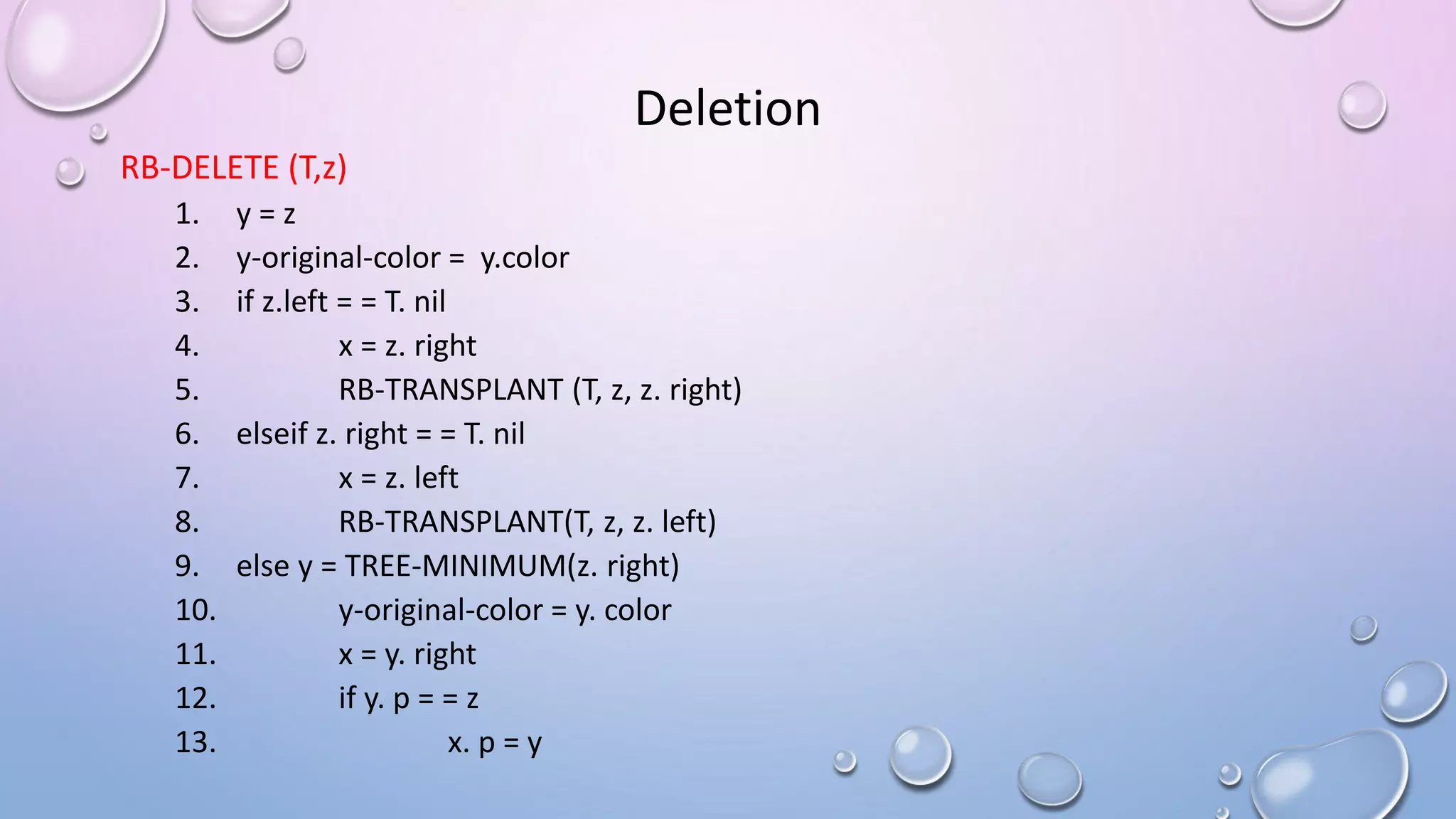
Deletion
RB-DELETE (T,z)
1. y = z
2. y-original-color = y.color
3. if z.left = = T. nil
4. x = z. right
5. RB-TRANSPLANT (T, z, z. right)
6. elseif z. right = = T. nil
7. x = z. left
8. RB-TRANSPLANT(T, z, z. left)
9. else y = TREE-MINIMUM(z. right)
10. y-original-color = y. color
11. x = y. right
12. if y. p = = z
13. x. p = y
Deletion
14. else RB-TRANSPLANT(T, y, y. right)
15. y. right = z. right
16. y. right. p = y
17. RB-TRANSPLANT(T, z, y)
18. y. left = z. left
19. y. left. p = y
20. y. color = z. color
21. if y-original-color == BLACK
22. RB-DELETE-FIXUP(T, x)
Deletion
Case 1: x's sibling w is red
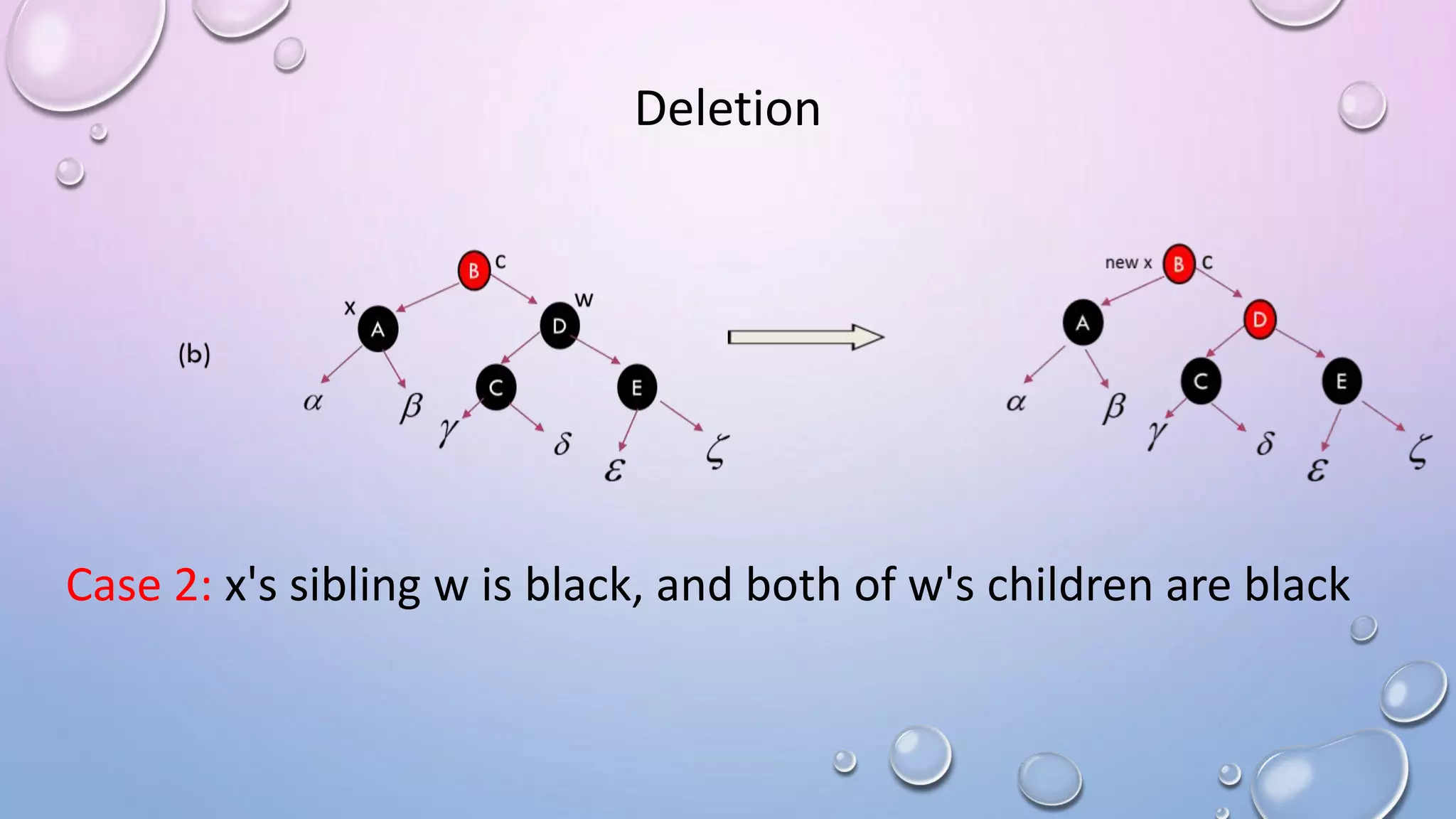
Deletion
Case 2: x's sibling w is black, and both of w's children are black
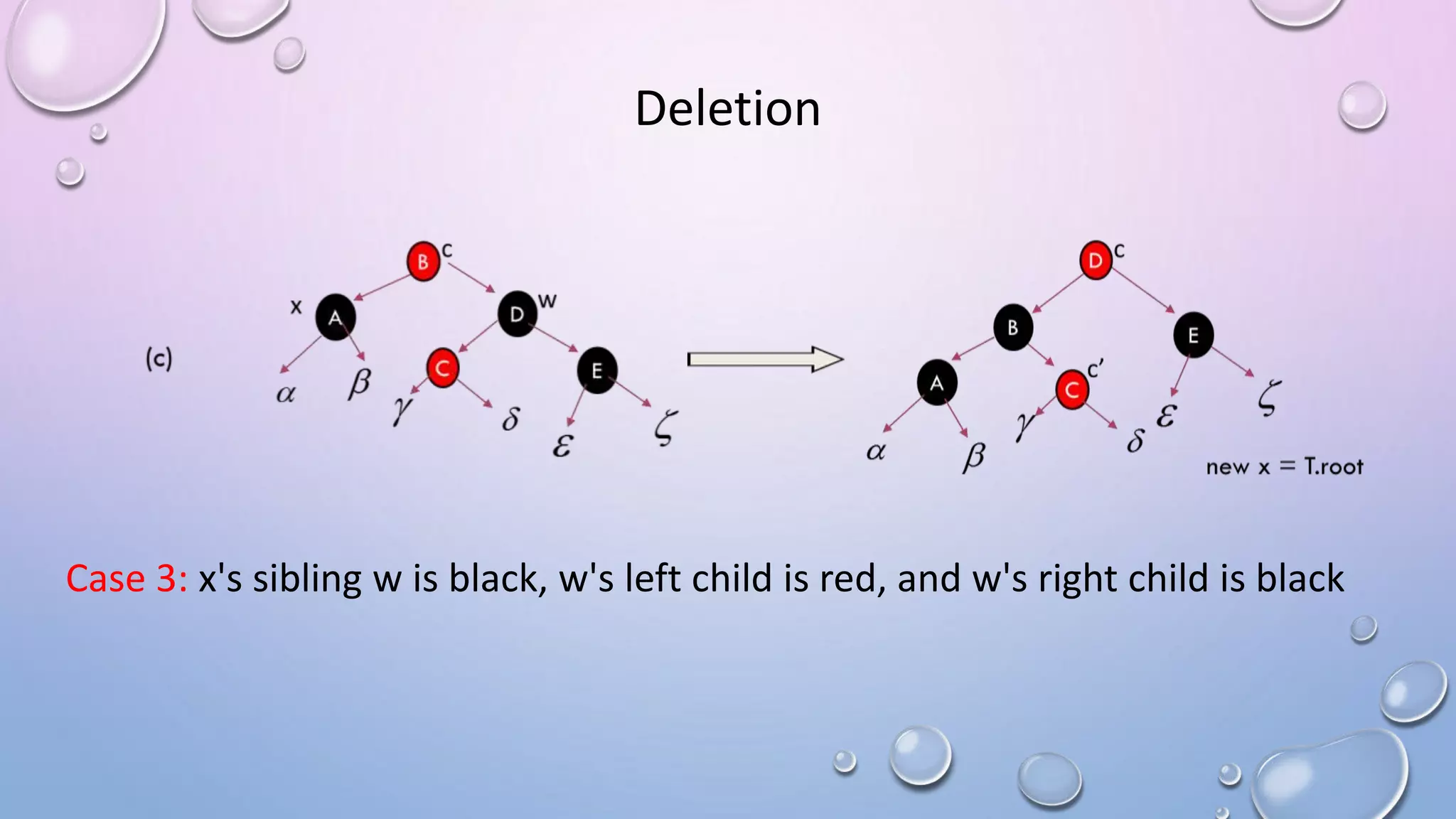
Deletion
Case 3: x's sibling w is black, w's left child is red, and w's right child is black
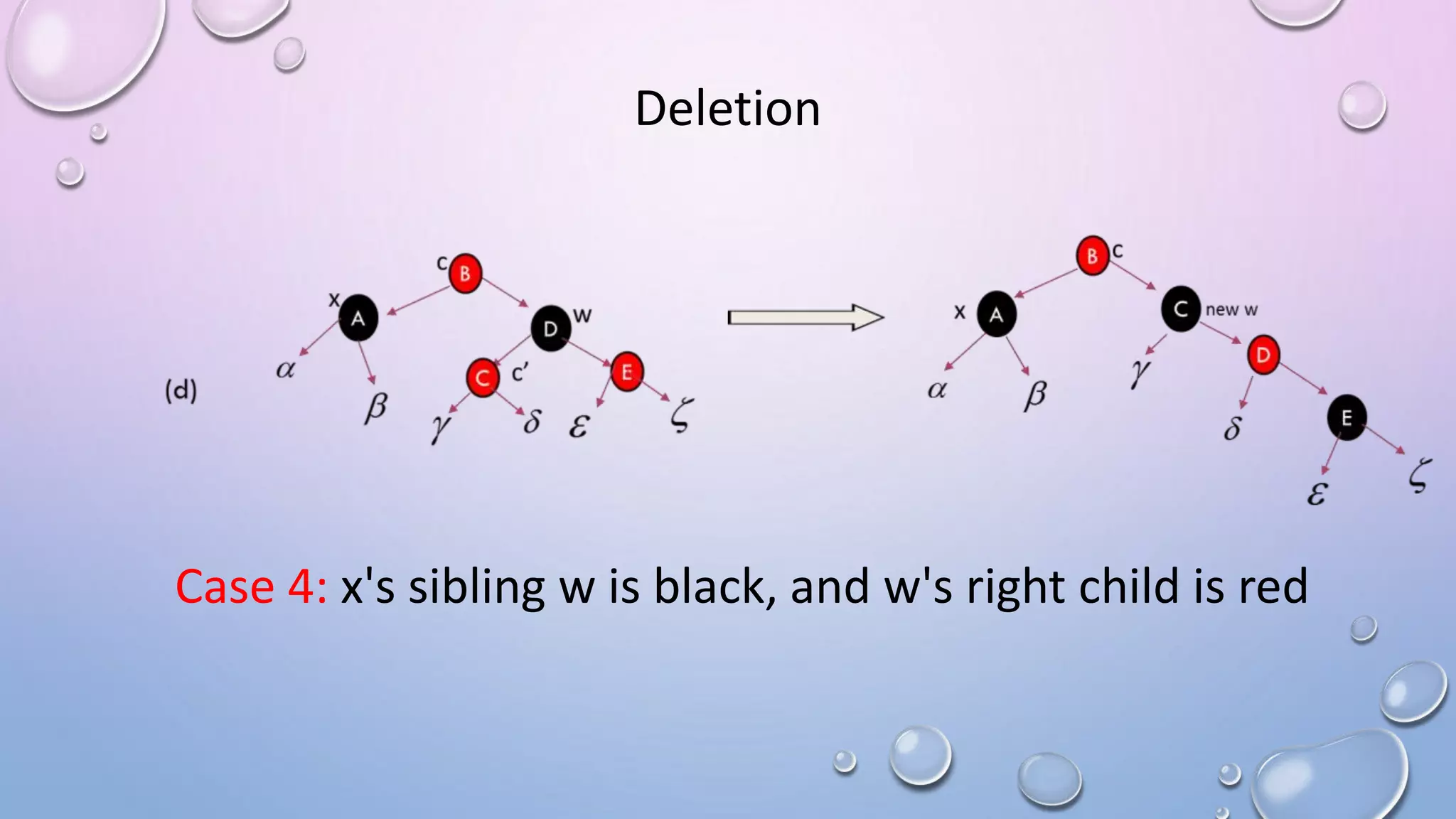
Deletion
Case 4: x's sibling w is black, and w's right child is red
Deletion
RB-DELETE-FIXUP(T, x)
1. while x !=T.root an= x. color == BLACK
2. if x == x. p. left
3. w = x. p. right
4. if w. color = = RED
5. w. color = BLACK //case 1
6. x. p. color = RED //case 1
7. LEFT-ROTATE(T, x. p) //case 1
8. w = x. p. right //case 1
9. if w. left. color == BLACK and w. right. color = = BLACK
10. w. color = RED //case 2
11. x = x. p //case 2
Deletion
12. else if w. right. color == BLACK
13. w. left. color = BLACK //case 3
14. w. color = RED //case 3
15. RIGHT-ROTATE(T, w) //case 3
16. w = x. p. right //case 3
17. w. color = x. p. color //case 4
18. x. p. color = BLACK //case 4
19. w. right. color = BLACK //case 4
20. LEFT-ROTATE(T, x. p) //case 4
21. x = T. root //case 4
22. else (same as then clause with “right” and “left” exchanged)
23. x. color = BLACK

Red black trees

  • 1.
  • 2.
    Some Properties ofBinary Search Tree • The common properties of binary search trees are as follows: • The left sub tree of a node contains only nodes with keys less than the node's key. • The right sub tree of a node contains only nodes with keys greater than the node's key. • The left and right sub tree each must also be a binary search tree. • There must be no duplicate nodes. • A unique path exists from the root to every other node.
  • 3.
    Problem with BinarySearch Tree • Binary Search Tree is fast in insertion and deletion etc. when balanced. • Time Complexity of performing operations (e.g. searching , inserting , deletion etc) on binary search tree is O(logn) in best case i.e when tree is balanced. • And on the other hand performance degrades from O(logn) to O(n) when tree is not balanced. • Basic binary search trees have three very nasty degenerate cases where the structure stops being logarithmic and becomes a glorified linked list. • The two most common of these degenerate cases is ascending or descending sorted order (the third is outside-in alternating order).
  • 4.
    Problem with BinarySearch Tree 1 2 3 4 6 5 3 4 9 2 6 5 7 Alternating OrderDescending OrderAscending order
  • 5.
    Red Black Tree •A red-black tree is a balanced binary search tree with one extra bit of storage per node: its color, which can be either Red or Black. • By constraining the node colors on any simple path from the root to a leaf, red-black trees ensure that no such path is more than twice as long as any other, so that the tree is approximately balanced. • Each node of the tree now contains the attributes color, key, left, right, and p. • If a child or the parent of a node does not exist, the corresponding pointer attribute of the node contains the value NIL.
  • 6.
    Properties of RedBlack Tree A red-black tree is a binary tree that satisfies the following red-black properties: 1. Every node is either red or black. 2. The root is black. 3. Every leaf (NIL) is black. 4. If a node is red, then both its children are black. 5. For each node, all simple paths from the node to descendant leaves contain the same number of black nodes.
  • 7.
  • 8.
    • The search-treeoperations TREE-INSERT and TREE-DELETE, when run on a red black tree with n keys, take O(log n)time. Because they modify the tree, the result may violate the red-black properties. • To restore these properties, we must change the colors of some of the nodes in the tree and also change the pointer structure. • We change the pointer structure through rotation, which is a local operation in a search tree that preserves the binary-search-tree property. • There are two kinds of rotations : left rotations and right rotations. Red Black Tree (Rotations)
  • 9.
    • When wedo a left rotation on a node x, we assume that its right child y is not null ;x may be any node in the tree whose right child is not null. Left Rotation X Y α β ϒ
  • 10.
    LEFT-ROTATE (T ,x) 1. y = x.right // set y new temporary node 2. x.right = y.left // turn y’s left subtree into x’s right subtree 3. if y.left != T.nil 4. y.left.p = x 5. y.p= x.p // link x’s parent to y 6. if x.p == T. nil 7. T.root = y 8. else if x == x.p.left 9. x.p.left = y 10.else x.p.right = y 11. y.left = x // put x on y’s left 12. x.p = y X Y α β ϒ
  • 11.
  • 12.
  • 13.
    Insertion • We caninsert a node into an n-node red-black tree in O(logn) time. • To do so, we use a slightly modified version of the TREE-INSERT procedure to insert node into the tree T as if it were an ordinary binary search tree. • Then we color it to red. • To guarantee that the red-black properties are preserved, we then call an auxiliary procedure RB-INSERT-FIXUP to recolor nodes and perform rotations.
  • 14.
  • 15.
    Insertion RB-INSERT(T, z) 1. y← T.nil 2. x ← T.root 3. while x ≠ T.nil 4. y = x 5. if z.key < x.key 6. then x ← x.left 7. else x ← x.right 8. z.p = y 9. if y = T.nil 10. then T.root ← z 11. else if z.key< y.key 12. then y.left ← z 13. else y.right ← z 14. z.left ← T.nil 15. z.right ← T.nil 16. z.color← RED 17. RB-INSERT-FIXUP(T, z)
  • 16.
    Insertion The procedures TREE-INSERTand RB-INSERT differ in four ways. • First, all instances of NIL in TREE-INSERT are replaced by T.nil. • Second, we set z.left and z.right to T. nil in lines 14–15 of RB-INSERT, in order to maintain the proper tree structure. • Third, we color z red in line 16. • Fourth, because coloring z.red may cause a violation of one of the red-black properties, we call RB-INSERT-FIXUP(T,z) in line 17 of RB-INSERT to restore the red-black properties
  • 17.
    Insertion • Case 1.z's uncle y is red • Case 2. z's uncle y is black and z is a right child • Case 3. z's uncle y is black and z is a left child
  • 18.
  • 19.
  • 20.
  • 21.
    Insertion Case3: z's uncley is black and z is a left childCase2: z's uncle y is black and z is a right child
  • 22.
    Insertion RB-INSERT-FIXUP(T, z) 1. whilez.p.color == RED 2. if z.p == z.p.p.left 3. then y ← z.p.p.right 4. if y.color== RED 5. then z.p.color← BLACK //Case 1 6. y.color ← BLACK //Case 1 7. z.p.p.color← RED //Case 1 8. z ← z.p.p // Case 1 9. else if z = z.p.right 10. then z ← z.p //Case 2 11. LEFT-ROTATE(T, z) //Case 2 12. z.p .color← BLACK //Case 3 13. z.p .p.color← RED //Case 3 14. RIGHT-ROTATE(T, z.p .p) // Case 3 15. else .same as then clause with "right" an= "left" exchange=) 16. T.root.color← BLACK
  • 23.
    Insertion • To understandhow RB-INSERT-FIXUP works, we shall break our examination of the code into three major steps. • First, we shall determine what violations of the red-black properties are introduced in RB-INSERT when node z is inserted and colored red. • Second, we shall examine the overall goal of the while loop in lines 1–15. • Finally, we shall explore each of the three cases within the while loop’s body and see how they accomplish the goal.
  • 24.
    Insertion • The whileloop in lines 1–15 maintains the following three-part invariant. • At the start of each iteration of the loop, a) Node z is red. b) If z.p is the root, then z.p is black. c) If there is a violation of the red-black properties , there is at most one violation, and it is of either property 2 or property 4. If there is a violation of property 2, it occurs because z is the root and is red. If there is a violation of property 4, it occurs because both z and z.p are red.
  • 25.
    Deletion • Like theother basic operations on an Red Black tree, deletion of a node takes time O(logn) • Deleting a node from a red-black tree is a bit more complicated than inserting a node. • The procedure for deleting a node from a red-black tree is based on the RB-DELETE procedure • First, we need to customize the TRANSPLANT subroutine that RB-DELETE calls so that it applies to a red-black tree.
  • 26.
    Deletion RB-TRANSPLANT(T.u.v) 1. if u.p== T.nil 2. T.root = v 3. elseif u == u.p.left 4. u.p.left = v 5. else u.p.right = v 6. v.p = u.p
  • 27.
    Deletion RB-DELETE (T,z) 1. y= z 2. y-original-color = y.color 3. if z.left = = T. nil 4. x = z. right 5. RB-TRANSPLANT (T, z, z. right) 6. elseif z. right = = T. nil 7. x = z. left 8. RB-TRANSPLANT(T, z, z. left) 9. else y = TREE-MINIMUM(z. right) 10. y-original-color = y. color 11. x = y. right 12. if y. p = = z 13. x. p = y
  • 28.
    Deletion 14. else RB-TRANSPLANT(T,y, y. right) 15. y. right = z. right 16. y. right. p = y 17. RB-TRANSPLANT(T, z, y) 18. y. left = z. left 19. y. left. p = y 20. y. color = z. color 21. if y-original-color == BLACK 22. RB-DELETE-FIXUP(T, x)
  • 29.
    Deletion Case 1: x'ssibling w is red
  • 30.
    Deletion Case 2: x'ssibling w is black, and both of w's children are black
  • 31.
    Deletion Case 3: x'ssibling w is black, w's left child is red, and w's right child is black
  • 32.
    Deletion Case 4: x'ssibling w is black, and w's right child is red
  • 33.
    Deletion RB-DELETE-FIXUP(T, x) 1. whilex !=T.root an= x. color == BLACK 2. if x == x. p. left 3. w = x. p. right 4. if w. color = = RED 5. w. color = BLACK //case 1 6. x. p. color = RED //case 1 7. LEFT-ROTATE(T, x. p) //case 1 8. w = x. p. right //case 1 9. if w. left. color == BLACK and w. right. color = = BLACK 10. w. color = RED //case 2 11. x = x. p //case 2
  • 34.
    Deletion 12. else ifw. right. color == BLACK 13. w. left. color = BLACK //case 3 14. w. color = RED //case 3 15. RIGHT-ROTATE(T, w) //case 3 16. w = x. p. right //case 3 17. w. color = x. p. color //case 4 18. x. p. color = BLACK //case 4 19. w. right. color = BLACK //case 4 20. LEFT-ROTATE(T, x. p) //case 4 21. x = T. root //case 4 22. else (same as then clause with “right” and “left” exchanged) 23. x. color = BLACK