TOPIC: RED BLACK TREE
MEMBERS NAME ID
1. Sazidur Rahman Bhuiyan 1511672042
2. MD. Nurul Alam 1511971042
3. Md. Monir Hossain 1521507042
RED BLACK TREE
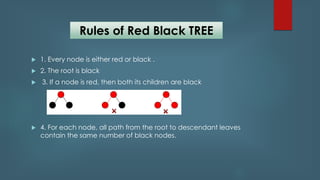
 1. Every node is either red or black .
 2. The root is black
 3. If a node is red, then both its children are black
 4. For each node, all path from the root to descendant leaves
contain the same number of black nodes.
Rules of Red Black TREE
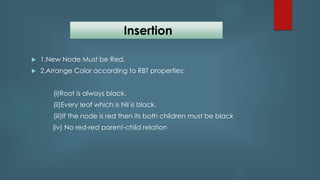
 1.New Node Must be Red.
 2.Arrange Color according to RBT properties:
(i)Root is always black.
(ii)Every leaf which is Nil is black.
(iii)If the node is red then its both children must be black
(iv) No red-red parent-child relation
Insertion
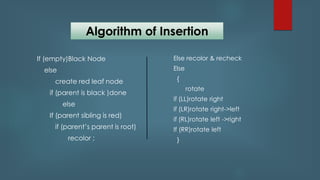
If (empty)Black Node
else
create red leaf node
if (parent is black )done
else
If (parent sibling is red)
if (parent’s parent is root)
recolor ;
Else recolor & recheck
Else
{
rotate
if (LL)rotate right
if (LR)rotate right->left
if (RL)rotate left ->right
If (RR)rotate left
}
Algorithm of Insertion
10
-10 17
40
50
15
20
60
B
B
BB
R
R R
R
 We’ve inserted 60 in the tree and here
red-red situation occurred.
For this we have to check sibling color.
Here it’s red and so that we have to do re-coloring
the tree to make it balanced by color.
Insertion Example
10
-10 17
40
50
15
20
60
B
B
RB
R
B B
R
 Again red-red situation occurred and
sibling is black.
So we have to make rotation. As it’s a
Right-right situation, we have to do left rotation
left rotation
17
40
50
20
60
RR
B
B
B
R
10
-10 B 15B
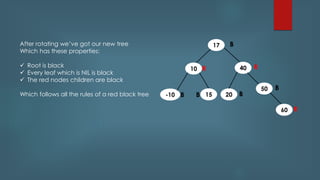
After rotating we’ve got our new tree
Which has these properties:
 Root is black
 Every leaf which is NIL is black
 The red nodes children are black
Which follows all the rules of a red black tree
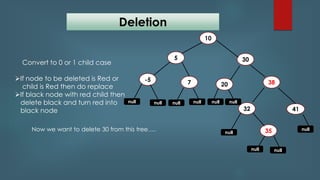
Convert to 0 or 1 child case
If node to be deleted is Red or
child is Red then do replace
If black node with red child then
delete black and turn red into
black node
10
5 30
-5 7 3820
4132
35Now we want to delete 30 from this tree….
null null nullnull null null
null
null null
null
Deletion
10
5 30
-5 7 3820
4132
null null nullnull null null
null
null
32
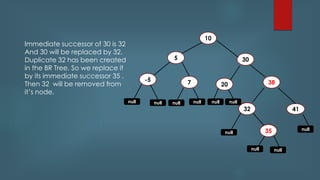
Immediate successor of 30 is 32
And 30 will be replaced by 32.
Duplicate 32 has been created
in the BR Tree. So we replace it
by its immediate successor 35 .
Then 32 will be removed from
it’s node.
35
null null
35
10
5 32
-5 7 3820
4135
null null nullnull null null
null null
null
Here the color of the node 35
has been changed to black.
After the deletion process we get
a perfect balanced tree.
 Here every path contains same
Number of black nodes.
Double black node has six cases
10
-10 30
nullnullnull null
10
30
nullnull
null
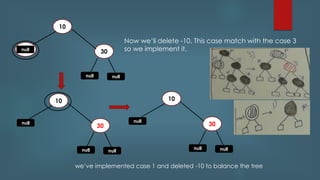
Now we’ll delete -10. This case match with the case 3
so we implement it.
10
30
nullnull
null
we’ve implemented case 1 and deleted -10 to balance the tree
10
30
nullnull
null
Fig: Example of an worst case RB Tree
6
3
*Length of the smallest path = 3
*Length of the longest path = 6
 Length of the longest path of a RBT is not more than the
double length of the shortest path. That’s why the run time
complexity of search ,insert and delete always remains
O(log N).
*No red-red parent child.
*Same number of black nodes in all paths.
Time Complexity
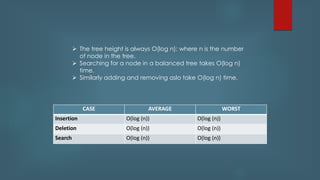
 The tree height is always O(log n); where n is the number
of node in the tree.
 Searching for a node in a balanced tree takes O(log n)
time.
 Similarly adding and removing aslo take O(log n) time.
CASE AVERAGE WORST
Insertion O(log (n)) O(log (n))
Deletion O(log (n)) O(log (n))
Search O(log (n)) O(log (n))
 Red-black trees are self-balancing so these operations are
guaranteed to be O(log(n)); a simple binary search tree, on the
other hand, could potentially become unbalanced, degrading to
O(n) performance for Insert, Delete, and Get. Particularly useful
when inserts and/or deletes are relatively frequent. Relatively low
constants in a wide variety of scenarios. All the advantages of
binary search trees.
Benefits of RBT
Cse 225 rbt_red_black_tree

Cse 225 rbt_red_black_tree

  • 1.
    TOPIC: RED BLACKTREE MEMBERS NAME ID 1. Sazidur Rahman Bhuiyan 1511672042 2. MD. Nurul Alam 1511971042 3. Md. Monir Hossain 1521507042
  • 2.
  • 3.
     1. Everynode is either red or black .  2. The root is black  3. If a node is red, then both its children are black  4. For each node, all path from the root to descendant leaves contain the same number of black nodes. Rules of Red Black TREE
  • 4.
     1.New NodeMust be Red.  2.Arrange Color according to RBT properties: (i)Root is always black. (ii)Every leaf which is Nil is black. (iii)If the node is red then its both children must be black (iv) No red-red parent-child relation Insertion
  • 5.
    If (empty)Black Node else createred leaf node if (parent is black )done else If (parent sibling is red) if (parent’s parent is root) recolor ; Else recolor & recheck Else { rotate if (LL)rotate right if (LR)rotate right->left if (RL)rotate left ->right If (RR)rotate left } Algorithm of Insertion
  • 6.
    10 -10 17 40 50 15 20 60 B B BB R R R R We’ve inserted 60 in the tree and here red-red situation occurred. For this we have to check sibling color. Here it’s red and so that we have to do re-coloring the tree to make it balanced by color. Insertion Example
  • 7.
    10 -10 17 40 50 15 20 60 B B RB R B B R Again red-red situation occurred and sibling is black. So we have to make rotation. As it’s a Right-right situation, we have to do left rotation left rotation
  • 8.
    17 40 50 20 60 RR B B B R 10 -10 B 15B Afterrotating we’ve got our new tree Which has these properties:  Root is black  Every leaf which is NIL is black  The red nodes children are black Which follows all the rules of a red black tree
  • 9.
    Convert to 0or 1 child case If node to be deleted is Red or child is Red then do replace If black node with red child then delete black and turn red into black node 10 5 30 -5 7 3820 4132 35Now we want to delete 30 from this tree…. null null nullnull null null null null null null Deletion
  • 10.
    10 5 30 -5 73820 4132 null null nullnull null null null null 32 Immediate successor of 30 is 32 And 30 will be replaced by 32. Duplicate 32 has been created in the BR Tree. So we replace it by its immediate successor 35 . Then 32 will be removed from it’s node. 35 null null 35
  • 11.
    10 5 32 -5 73820 4135 null null nullnull null null null null null Here the color of the node 35 has been changed to black. After the deletion process we get a perfect balanced tree.  Here every path contains same Number of black nodes.
  • 12.
    Double black nodehas six cases 10 -10 30 nullnullnull null
  • 13.
    10 30 nullnull null Now we’ll delete-10. This case match with the case 3 so we implement it. 10 30 nullnull null we’ve implemented case 1 and deleted -10 to balance the tree 10 30 nullnull null
  • 14.
    Fig: Example ofan worst case RB Tree 6 3 *Length of the smallest path = 3 *Length of the longest path = 6  Length of the longest path of a RBT is not more than the double length of the shortest path. That’s why the run time complexity of search ,insert and delete always remains O(log N). *No red-red parent child. *Same number of black nodes in all paths. Time Complexity
  • 15.
     The treeheight is always O(log n); where n is the number of node in the tree.  Searching for a node in a balanced tree takes O(log n) time.  Similarly adding and removing aslo take O(log n) time. CASE AVERAGE WORST Insertion O(log (n)) O(log (n)) Deletion O(log (n)) O(log (n)) Search O(log (n)) O(log (n))
  • 16.
     Red-black treesare self-balancing so these operations are guaranteed to be O(log(n)); a simple binary search tree, on the other hand, could potentially become unbalanced, degrading to O(n) performance for Insert, Delete, and Get. Particularly useful when inserts and/or deletes are relatively frequent. Relatively low constants in a wide variety of scenarios. All the advantages of binary search trees. Benefits of RBT