Red-black trees
A red-black tree is a binary search tree with one extra bit of storage
per node: its color, which can be either RED or BLACK. By
constraining the node colors on any simple path from the root to a
leaf, red-black trees ensure that no such path is more than twice
as long as any other, so that the tree is approximately balanced.
Each node of the tree now contains the attributes color, key, left, right,
and p. If a child or the parent of a node does not exist, the
corresponding pointer attribute of the node contains the value NIL.
We shall regard these NILs as being pointers to leaves (external
nodes) of the binary search tree and the normal, key-bearing nodes as
being internal nodes of the tree.
Red - Black Tree is a variant of Binary Search Tree in which every node is colored
either RED or BLACK. We can define a Red Black Tree as follows.
Red Black Tree is a Binary Search Tree in which every node is colored either
RED or BLACK.
In Red Black Tree, the color of a node is decided based on the properties of Red-
Black Tree. Every Red Black Tree has the following properties.
Properties of Red Black Tree
Property #1: Red - Black Tree must be a Binary Search Tree.
Property #2: The ROOT node must be colored BLACK.
Property #3: The children of Red colored node must be colored BLACK. (There
should not be two consecutive RED nodes).
Property #4: In all the paths of the tree, there should be same number of BLACK
colored nodes.
Property #5: Every new node must be inserted with RED color.
Property #6: Every leaf (e.i. NULL node) must be colored BLACK.
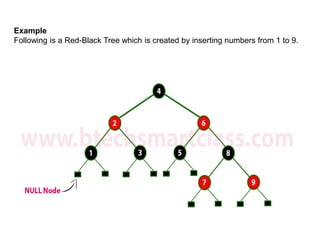
Example
Following is a Red-Black Tree which is created by inserting numbers from 1 to 9.
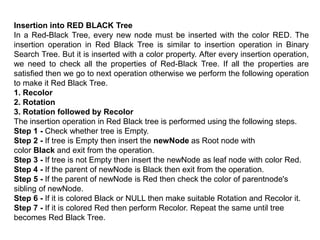
Insertion into RED BLACK Tree
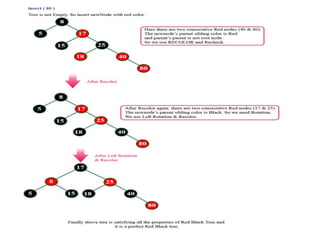
In a Red-Black Tree, every new node must be inserted with the color RED. The
insertion operation in Red Black Tree is similar to insertion operation in Binary
Search Tree. But it is inserted with a color property. After every insertion operation,
we need to check all the properties of Red-Black Tree. If all the properties are
satisfied then we go to next operation otherwise we perform the following operation
to make it Red Black Tree.
1. Recolor
2. Rotation
3. Rotation followed by Recolor
The insertion operation in Red Black tree is performed using the following steps.
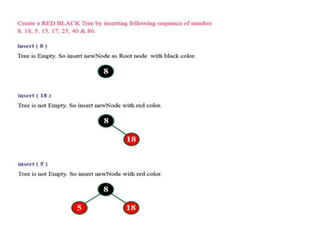
Step 1 - Check whether tree is Empty.
Step 2 - If tree is Empty then insert the newNode as Root node with
color Black and exit from the operation.
Step 3 - If tree is not Empty then insert the newNode as leaf node with color Red.
Step 4 - If the parent of newNode is Black then exit from the operation.
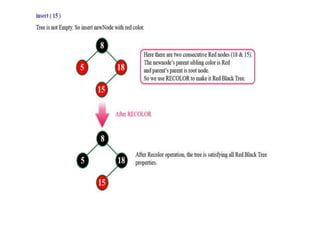
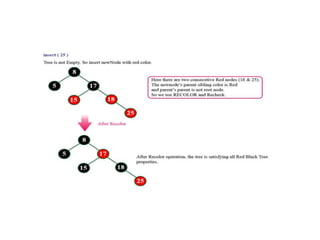
Step 5 - If the parent of newNode is Red then check the color of parentnode's
sibling of newNode.
Step 6 - If it is colored Black or NULL then make suitable Rotation and Recolor it.
Step 7 - If it is colored Red then perform Recolor. Repeat the same until tree
becomes Red Black Tree.
Left rotation:
y=right[x]; right[x] left[y];
If(left[y]!=nil) p[left[y]]=x;
p[y]=p[x];
if(p[x]==nil) {root=y;}
else
if (left[p[x]]==x) left[p[x]]=y;
else right[p[x]]=y;
left[y]=x; p[x]=y;
Left rotation:
y=right[x]; right[x] left[y];
If(left[y]!=nil) p[left[y]]=x;
p[y]=p[x];
if(p[x]==nil) {root=y;}
else
if (left[p[x]]==x) left[p[x]]=y;
else right[p[x]]=y;
left[y]=x; p[x]=y;
Right rotation:
x=left[y]; left[y]=right[x];
If(right[x]!=nil) p[right[x]]=y;
p[x]=p[y];
if(p[y]==nil) root=x;
If(left[p[y]]=y) left[p[y]]=x;
else right[p[y]]=x;
right[x]=y; p[y]=x;
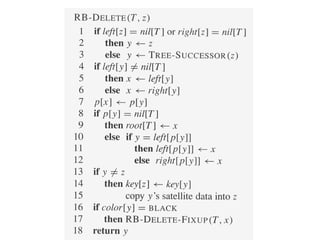
Copyright © The McGraw-Hill Companies, Inc. Permission required for reproduction or display.
Left rotation:
y=right[x]; right[x] left[y]; If(left[y]!=nil) p[left[y]]=x; p[y]=p[x];
if(p[x]==nil) {root=y;} else if (left[p[x]]==x) left[p[x]]=y; else right[p[x]]=y;
left[y]=x; p[x]=y;
Right rotation:
x=left[y]; left[y]=right[x];
If(right[x]!=nil) p[right[x]]=y;
p[x]=p[y]; if(p[y]==nil) root=x;
If(left[p[y]]=y) left[p[y]]=x;
else right[p[y]]=x;
right[x]=y; p[y]=x;
Algorithm
Basic operations associated with Red Black Tree:
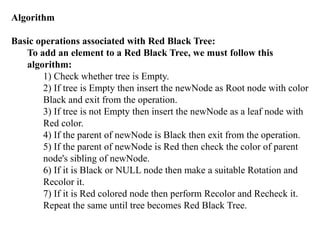
To add an element to a Red Black Tree, we must follow this
algorithm:
1) Check whether tree is Empty.
2) If tree is Empty then insert the newNode as Root node with color
Black and exit from the operation.
3) If tree is not Empty then insert the newNode as a leaf node with
Red color.
4) If the parent of newNode is Black then exit from the operation.
5) If the parent of newNode is Red then check the color of parent
node's sibling of newNode.
6) If it is Black or NULL node then make a suitable Rotation and
Recolor it.
7) If it is Red colored node then perform Recolor and Recheck it.
Repeat the same until tree becomes Red Black Tree.
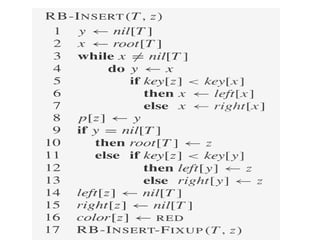
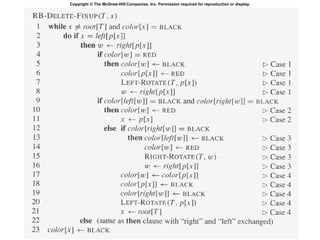
Case 1,2,3: p[z] is the left child of p[p[z]].
Correspondingly, there are 3 other cases,
In which p[z] is the right child of p[p[z]]
Deletion Operation in Red Black Tree
The deletion operation in Red-Black Tree is
similar to deletion operation in BST. But after
every deletion operation, we need to check with
the Red-Black Tree properties. If any of the
properties are violated then make suitable
operations like Recolor, Rotation and Rotation
followed by Recolor to make it Red-Black Tree.
Deletion of a node in Red Black Tree:
Algorithm
1) Perform standard Binary Search Tree delete. When we perform
standard delete operation in BST, we always end up deleting a node which
is either leaf or has only one child (For an internal node, we copy the
successor and then recursively call delete for successor, successor is
always a leaf node or a node with one child). So we only need to handle
cases where a node is leaf or has one child. Let v be the node to be deleted
and u be the child that replaces v (Note that u is NULL when v is a leaf
and color of NULL is considered as Black).
2) Simple Case: If either u or v is red, we mark the replaced child as
black (No change in black height). Note that both u and v cannot be red as
v is parent of u and two consecutive reds are not allowed in red-black tree.
3) If Both u and v are Black.
3.1) Color u as double black. Now our task reduces to convert this
double black to single black. Note that If v is leaf, then u is NULL and
color of NULL is considered as black. So the deletion of a black leaf also
causes a double black.
3.2) Do following while the current node u is double black and it is not
root. Let sibling of node be s.
(a): If sibling s is black and at least one of sibling’s children is red,
perform rotation(s). Let the red child of s be r. This case can be divided
in four subcases depending upon positions of s and r.
(i) Left Left Case (s is left child of its parent and r is left child of s or
both children of s are red). This is mirror of right right case shown in
below diagram.
(ii) Left Right Case (s is left child of its parent and r is right child). This
is mirror of right left case shown in below diagram.
(iii) Right Right Case (s is right child of its parent and r is right child of s
or both children of s are red)
(iv) Right Left Case (s is right child of its parent and r is left child of s)
(b): If sibling is black and its both children are black, perform
recoloring, and recur for the parent if parent is black.
(c): If sibling is red, perform a rotation to move old sibling up, recolor
the old sibling and parent. The new sibling is always black (See the
below diagram). This mainly converts the tree to black sibling case (by
rotation) and leads to case (a) or (b).
This case can be divided in two subcases.
(i) Left Case (s is left child of its parent). This is mirror of right right
case shown in below diagram. We right rotate the parent p.
(ii) Right Case (s is right child of its parent). We left rotate the parent p.
3.3) If u is root, make it single black and return (Black height of
complete tree reduces by 1).
Copyright © The McGraw-Hill Companies, Inc. Permission required for reproduction or display.
Some operations in log(n)
• Search, minimum, maximum, successor,
predecessor.
Complexity
• Average and Worst case deletion time
complexity: Θ(log n)

Unit 2 ADvanced Data Sturctures and Algorithms Red-black_trees.ppt

  • 1.
    Red-black trees A red-blacktree is a binary search tree with one extra bit of storage per node: its color, which can be either RED or BLACK. By constraining the node colors on any simple path from the root to a leaf, red-black trees ensure that no such path is more than twice as long as any other, so that the tree is approximately balanced. Each node of the tree now contains the attributes color, key, left, right, and p. If a child or the parent of a node does not exist, the corresponding pointer attribute of the node contains the value NIL. We shall regard these NILs as being pointers to leaves (external nodes) of the binary search tree and the normal, key-bearing nodes as being internal nodes of the tree.
  • 2.
    Red - BlackTree is a variant of Binary Search Tree in which every node is colored either RED or BLACK. We can define a Red Black Tree as follows. Red Black Tree is a Binary Search Tree in which every node is colored either RED or BLACK. In Red Black Tree, the color of a node is decided based on the properties of Red- Black Tree. Every Red Black Tree has the following properties. Properties of Red Black Tree Property #1: Red - Black Tree must be a Binary Search Tree. Property #2: The ROOT node must be colored BLACK. Property #3: The children of Red colored node must be colored BLACK. (There should not be two consecutive RED nodes). Property #4: In all the paths of the tree, there should be same number of BLACK colored nodes. Property #5: Every new node must be inserted with RED color. Property #6: Every leaf (e.i. NULL node) must be colored BLACK.
  • 3.
    Example Following is aRed-Black Tree which is created by inserting numbers from 1 to 9.
  • 4.
    Insertion into REDBLACK Tree In a Red-Black Tree, every new node must be inserted with the color RED. The insertion operation in Red Black Tree is similar to insertion operation in Binary Search Tree. But it is inserted with a color property. After every insertion operation, we need to check all the properties of Red-Black Tree. If all the properties are satisfied then we go to next operation otherwise we perform the following operation to make it Red Black Tree. 1. Recolor 2. Rotation 3. Rotation followed by Recolor The insertion operation in Red Black tree is performed using the following steps. Step 1 - Check whether tree is Empty. Step 2 - If tree is Empty then insert the newNode as Root node with color Black and exit from the operation. Step 3 - If tree is not Empty then insert the newNode as leaf node with color Red. Step 4 - If the parent of newNode is Black then exit from the operation. Step 5 - If the parent of newNode is Red then check the color of parentnode's sibling of newNode. Step 6 - If it is colored Black or NULL then make suitable Rotation and Recolor it. Step 7 - If it is colored Red then perform Recolor. Repeat the same until tree becomes Red Black Tree.
  • 7.
    Left rotation: y=right[x]; right[x]left[y]; If(left[y]!=nil) p[left[y]]=x; p[y]=p[x]; if(p[x]==nil) {root=y;} else if (left[p[x]]==x) left[p[x]]=y; else right[p[x]]=y; left[y]=x; p[x]=y;
  • 9.
    Left rotation: y=right[x]; right[x]left[y]; If(left[y]!=nil) p[left[y]]=x; p[y]=p[x]; if(p[x]==nil) {root=y;} else if (left[p[x]]==x) left[p[x]]=y; else right[p[x]]=y; left[y]=x; p[x]=y; Right rotation: x=left[y]; left[y]=right[x]; If(right[x]!=nil) p[right[x]]=y; p[x]=p[y]; if(p[y]==nil) root=x; If(left[p[y]]=y) left[p[y]]=x; else right[p[y]]=x; right[x]=y; p[y]=x;
  • 11.
    Copyright © TheMcGraw-Hill Companies, Inc. Permission required for reproduction or display. Left rotation: y=right[x]; right[x] left[y]; If(left[y]!=nil) p[left[y]]=x; p[y]=p[x]; if(p[x]==nil) {root=y;} else if (left[p[x]]==x) left[p[x]]=y; else right[p[x]]=y; left[y]=x; p[x]=y; Right rotation: x=left[y]; left[y]=right[x]; If(right[x]!=nil) p[right[x]]=y; p[x]=p[y]; if(p[y]==nil) root=x; If(left[p[y]]=y) left[p[y]]=x; else right[p[y]]=x; right[x]=y; p[y]=x;
  • 12.
    Algorithm Basic operations associatedwith Red Black Tree: To add an element to a Red Black Tree, we must follow this algorithm: 1) Check whether tree is Empty. 2) If tree is Empty then insert the newNode as Root node with color Black and exit from the operation. 3) If tree is not Empty then insert the newNode as a leaf node with Red color. 4) If the parent of newNode is Black then exit from the operation. 5) If the parent of newNode is Red then check the color of parent node's sibling of newNode. 6) If it is Black or NULL node then make a suitable Rotation and Recolor it. 7) If it is Red colored node then perform Recolor and Recheck it. Repeat the same until tree becomes Red Black Tree.
  • 14.
    Case 1,2,3: p[z]is the left child of p[p[z]]. Correspondingly, there are 3 other cases, In which p[z] is the right child of p[p[z]]
  • 15.
    Deletion Operation inRed Black Tree The deletion operation in Red-Black Tree is similar to deletion operation in BST. But after every deletion operation, we need to check with the Red-Black Tree properties. If any of the properties are violated then make suitable operations like Recolor, Rotation and Rotation followed by Recolor to make it Red-Black Tree.
  • 16.
    Deletion of anode in Red Black Tree: Algorithm 1) Perform standard Binary Search Tree delete. When we perform standard delete operation in BST, we always end up deleting a node which is either leaf or has only one child (For an internal node, we copy the successor and then recursively call delete for successor, successor is always a leaf node or a node with one child). So we only need to handle cases where a node is leaf or has one child. Let v be the node to be deleted and u be the child that replaces v (Note that u is NULL when v is a leaf and color of NULL is considered as Black). 2) Simple Case: If either u or v is red, we mark the replaced child as black (No change in black height). Note that both u and v cannot be red as v is parent of u and two consecutive reds are not allowed in red-black tree.
  • 17.
    3) If Bothu and v are Black. 3.1) Color u as double black. Now our task reduces to convert this double black to single black. Note that If v is leaf, then u is NULL and color of NULL is considered as black. So the deletion of a black leaf also causes a double black. 3.2) Do following while the current node u is double black and it is not root. Let sibling of node be s. (a): If sibling s is black and at least one of sibling’s children is red, perform rotation(s). Let the red child of s be r. This case can be divided in four subcases depending upon positions of s and r. (i) Left Left Case (s is left child of its parent and r is left child of s or both children of s are red). This is mirror of right right case shown in below diagram. (ii) Left Right Case (s is left child of its parent and r is right child). This is mirror of right left case shown in below diagram. (iii) Right Right Case (s is right child of its parent and r is right child of s or both children of s are red) (iv) Right Left Case (s is right child of its parent and r is left child of s)
  • 18.
    (b): If siblingis black and its both children are black, perform recoloring, and recur for the parent if parent is black. (c): If sibling is red, perform a rotation to move old sibling up, recolor the old sibling and parent. The new sibling is always black (See the below diagram). This mainly converts the tree to black sibling case (by rotation) and leads to case (a) or (b). This case can be divided in two subcases. (i) Left Case (s is left child of its parent). This is mirror of right right case shown in below diagram. We right rotate the parent p. (ii) Right Case (s is right child of its parent). We left rotate the parent p. 3.3) If u is root, make it single black and return (Black height of complete tree reduces by 1).
  • 20.
    Copyright © TheMcGraw-Hill Companies, Inc. Permission required for reproduction or display.
  • 21.
    Some operations inlog(n) • Search, minimum, maximum, successor, predecessor.
  • 22.
    Complexity • Average andWorst case deletion time complexity: Θ(log n)