Red-Black Trees
Dr. AMIT KUMAR @JUET
Red-Black Trees
• “Balanced” binary search trees guarantee an
O(lgn) running time
• Red-black-tree
– Binary search tree with an additional attribute for its
nodes: color which can be red or black
– Constrains the way nodes can be colored on any path
from the root to a leaf:
Ensures that no path is more than twice as long as any other
path  the tree is balanced
Example: RED-BLACK-TREE
• For convenience we use a sentinel NIL[T] to represent all
the NIL nodes at the leafs
– NIL[T] has the same fields as an ordinary node
– Color[NIL[T]] = BLACK
– The other fields may be set to arbitrary values
26
17 41
30 47
38 50
NIL NIL
NIL
NIL NIL NIL NIL
NIL
Red-Black-Trees Properties
(**Satisfy the binary search tree property**)
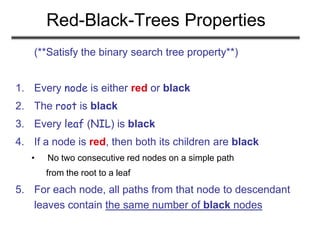
1. Every node is either red or black
2. The root is black
3. Every leaf (NIL) is black
4. If a node is red, then both its children are black
• No two consecutive red nodes on a simple path
from the root to a leaf
5. For each node, all paths from that node to descendant
leaves contain the same number of black nodes
Black-Height of a Node
• Height of a node: the number of edges in the longest
path to a leaf
• Black-height of a node x: bh(x) is the number of
black nodes (including NIL) on the path from x to a leaf,
not counting x
26
17 41
30 47
38 50
NIL NIL
NIL
NIL NIL NIL NIL
NIL
h = 4
bh = 2
h = 3
bh = 2
h = 2
bh = 1
h = 1
bh = 1
h = 1
bh = 1
h = 2
bh = 1 h = 1
bh = 1
Most important property of
Red-Black-Trees
A red-black tree with n internal nodes
has height at most 2lg(n + 1)
• Need to prove two claims first …
Claim 1
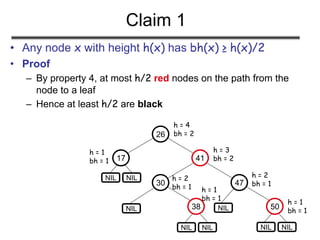
• Any node x with height h(x) has bh(x) ≥ h(x)/2
• Proof
– By property 4, at most h/2 red nodes on the path from the
node to a leaf
– Hence at least h/2 are black
26
17 41
30 47
38 50
NIL NIL
NIL
NIL NIL NIL NIL
NIL
h = 4
bh = 2
h = 3
bh = 2
h = 2
bh = 1
h = 1
bh = 1
h = 1
bh = 1
h = 2
bh = 1 h = 1
bh = 1
Claim 2
• The subtree rooted at any node x contains
at least 2bh(x) - 1 internal nodes
26
17 41
30 47
38 50
NIL NIL
NIL
NIL NIL NIL NIL
NIL
h = 4
bh = 2
h = 3
bh = 2
h = 2
bh = 1
h = 1
bh = 1
h = 1
bh = 1
h = 2
bh = 1 h = 1
bh = 1
Claim 2 (cont’d)
Proof: By induction on h[x]
Basis: h[x] = 0 
x is a leaf (NIL[T]) 
bh(x) = 0 
# of internal nodes: 20 - 1 = 0
Inductive Hypothesis: assume it is true for
h[x]=h-1
NIL
x
Claim 2 (cont’d)
Inductive step:
• Prove it for h[x]=h
• Let bh(x) = b, then any child y of x has:
– bh (y) =
– bh (y) =
b (if the child is red), or
b - 1 (if the child is black)
26
17 41
30 47
38 50
x
y1 y2
bh = 2
bh = 2
bh = 1
NIL NIL
NIL NIL
NILNIL
Claim 2 (cont’d)
• Using inductive hypothesis, the
number of internal nodes for each
child of x is at least:
2bh(x) - 1 - 1
• The subtree rooted at x contains at
least:
(2bh(x) - 1 – 1) + (2bh(x) - 1 – 1) + 1 =
2 · (2bh(x) - 1 - 1) + 1 =
2bh(x) - 1 internal nodes
x
l r
h
h-1
bh(l)≥bh(x)-1
bh(r)≥bh(x)-1
Height of Red-Black-Trees (cont’d)
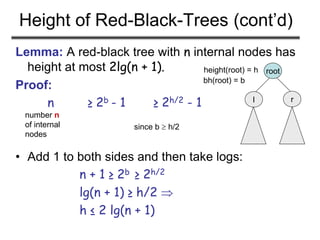
Lemma: A red-black tree with n internal nodes has
height at most 2lg(n + 1).
Proof:
n
• Add 1 to both sides and then take logs:
n + 1 ≥ 2b ≥ 2h/2
lg(n + 1) ≥ h/2 
h ≤ 2 lg(n + 1)
root
l r
height(root) = h
bh(root) = b
number n
of internal
nodes
≥ 2b - 1 ≥ 2h/2 - 1
since b  h/2
Operations on Red-Black-Trees
• The non-modifying binary-search-tree operations
MINIMUM, MAXIMUM, SUCCESSOR,
PREDECESSOR, and SEARCH run in O(h) time
– They take O(lgn) time on red-black trees
• What about TREE-INSERT and TREE-DELETE?
– They will still run on O(lgn)
– We have to guarantee that the modified tree will still be
a red-black tree
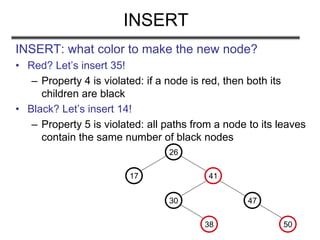
INSERT
INSERT: what color to make the new node?
• Red? Let’s insert 35!
– Property 4 is violated: if a node is red, then both its
children are black
• Black? Let’s insert 14!
– Property 5 is violated: all paths from a node to its leaves
contain the same number of black nodes
26
17 41
30 47
38 50
DELETE
DELETE: what color was the
node that was removed? Black?
1. Every node is either red or black
2. The root is black
3. Every leaf (NIL) is black
4. If a node is red, then both its children are black
5. For each node, all paths from the node to descendant
leaves contain the same number of black nodes
OK!
OK!
Not OK! Could create
two red nodes in a row
Not OK! Could change the
black heights of some nodes
26
17 41
30 47
38 50
Not OK! If removing
the root and the child
that replaces it is red
Rotations
• Operations for re-structuring the tree after insert
and delete operations on red-black trees
• Rotations take a red-black-tree and a node within
the tree and:
– Together with some node re-coloring they help restore
the red-black-tree property
– Change some of the pointer structure
– Do not change the binary-search tree property
• Two types of rotations:
– Left & right rotations
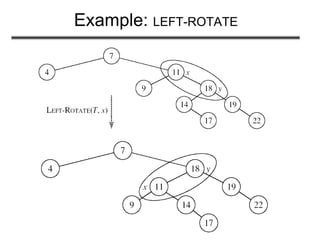
Left Rotations
• Assumptions for a left rotation on a node x:
– The right child of x (y) is not NIL
• Idea:
– Pivots around the link from x to y
– Makes y the new root of the subtree
– x becomes y’s left child
– y’s left child becomes x’s right child
Example: LEFT-ROTATE
LEFT-ROTATE(T, x)
1. y ← right[x] ►Set y
2. right[x] ← left[y] ► y’s left subtree becomes x’s right subtree
3. if left[y]  NIL
4. then p[left[y]] ← x ► Set the parent relation from left[y] to x
5. p[y] ← p[x] ► The parent of x becomes the parent of y
6. if p[x] = NIL
7. then root[T] ← y
8. else if x = left[p[x]]
9. then left[p[x]] ← y
10. else right[p[x]] ← y
11. left[y] ← x ► Put x on y’s left
12. p[x] ← y ► y becomes x’s parent
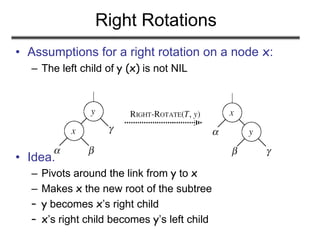
Right Rotations
• Assumptions for a right rotation on a node x:
– The left child of y (x) is not NIL
• Idea:
– Pivots around the link from y to x
– Makes x the new root of the subtree
– y becomes x’s right child
– x’s right child becomes y’s left child
Insertion
• Goal:
– Insert a new node z into a red-black-tree
• Idea:
– Insert node z into the tree as for an ordinary binary
search tree
– Color the node red
– Restore the red-black-tree properties
• Use an auxiliary procedure RB-INSERT-FIXUP
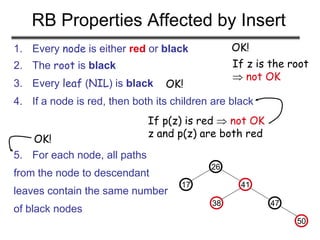
RB Properties Affected by Insert
1. Every node is either red or black
2. The root is black
3. Every leaf (NIL) is black
4. If a node is red, then both its children are black
5. For each node, all paths
from the node to descendant
leaves contain the same number
of black nodes
OK!
If z is the root
 not OK
OK!
26
17 41
4738
50
If p(z) is red  not OK
z and p(z) are both red
OK!
RB-INSERT-FIXUP – Case 1
z’s “uncle” (y) is red
Idea: (z is a right child)
• p[p[z]] (z’s grandparent) must
be black: z and p[z] are both red
• Color p[z] black
• Color y black
• Color p[p[z]] red
• z = p[p[z]]
– Push the “red” violation up the tree
RB-INSERT-FIXUP – Case 1
z’s “uncle” (y) is red
Idea: (z is a left child)
• p[p[z]] (z’s grandparent) must be
black: z and p[z] are both red
• color p[z]  black
• color y  black
• color p[p[z]]  red
• z = p[p[z]]
– Push the “red” violation up the tree
RB-INSERT-FIXUP – Case 3
Case 3:
• z’s “uncle” (y) is black
• z is a left child
Case 3
Idea:
• color p[z]  black
• color p[p[z]]  red
• RIGHT-ROTATE(T, p[p[z]])
• No longer have 2 reds in a row
• p[z] is now black
RB-INSERT-FIXUP – Case 2
Case 2:
• z’s “uncle” (y) is black
• z is a right child
Idea:
• z  p[z]
• LEFT-ROTATE(T, z)
 now z is a left child, and both z and p[z] are red  case 3
Case 2 Case 3
RB-INSERT-FIXUP(T, z)
1. while color[p[z]] = RED
2. do if p[z] = left[p[p[z]]]
3. then y ← right[p[p[z]]]
4. if color[y] = RED
5. then Case1
6. else if z = right[p[z]]
7. then Case2
8. Case3
9. else (same as then clause with “right”
and “left” exchanged)
10. color[root[T]] ← BLACK
The while loop repeats only when
case1 is executed: O(lgn) times
Set the value of x’s “uncle”
We just inserted the root, or
The red violation reached
the root
Example
11
Insert 4
2 14
1 157
85
4
y
11
2 14
1 157
85
4
z
Case 1
y
z and p[z] are both red
z’s uncle y is redz
z and p[z] are both red
z’s uncle y is black
z is a right child
Case 2
11
2
14
1
15
7
8
5
4
z
y
Case 3
z and p[z] are red
z’s uncle y is black
z is a left child
112
141
15
7
85
4
z
RB-INSERT(T, z)
1. y ← NIL
2. x ← root[T]
3. while x  NIL
4. do y ← x
5. if key[z] < key[x]
6. then x ← left[x]
7. else x ← right[x]
8. p[z] ← y
• Initialize nodes x and y
• Throughout the algorithm y points
to the parent of x
• Go down the tree until
reaching a leaf
• At that point y is the
parent of the node to be
inserted
• Sets the parent of z to be y
26
17 41
30 47
38 50
RB-INSERT(T, z)
9. if y = NIL
10. then root[T] ← z
11. else if key[z] < key[y]
12. then left[y] ← z
13. else right[y] ← z
14. left[z] ← NIL
15. right[z] ← NIL
16. color[z] ← RED
17. RB-INSERT-FIXUP(T, z)
The tree was empty:
set the new node to be the root
Otherwise, set z to be the left or
right child of y, depending on
whether the inserted node is
smaller or larger than y’s key
Set the fields of the newly added node
Fix any inconsistencies that could have
been introduced by adding this new red
node
26
17 41
30 47
38 50
Analysis of RB-INSERT
• Inserting the new element into the tree O(lgn)
• RB-INSERT-FIXUP
– The while loop repeats only if CASE 1 is executed
– The number of times the while loop can be executed
is O(lgn)
• Total running time of RB-INSERT: O(lgn)
Red-Black Trees - Summary
• Operations on red-black-trees:
– SEARCH O(h)
– PREDECESSOR O(h)
– SUCCESOR O(h)
– MINIMUM O(h)
– MAXIMUM O(h)
– INSERT O(h)
– DELETE O(h)
• Red-black-trees guarantee that the height of the
tree will be O(lgn)
Problems
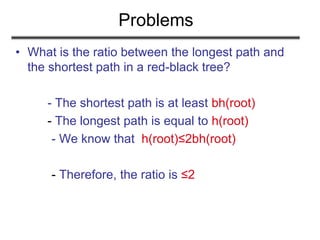
• What is the ratio between the longest path and
the shortest path in a red-black tree?
- The shortest path is at least bh(root)
- The longest path is equal to h(root)
- We know that h(root)≤2bh(root)
- Therefore, the ratio is ≤2
Problems
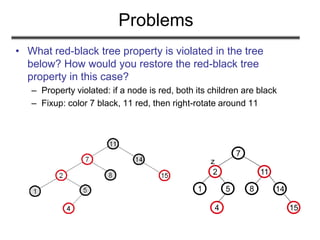
• What red-black tree property is violated in the tree
below? How would you restore the red-black tree
property in this case?
– Property violated: if a node is red, both its children are black
– Fixup: color 7 black, 11 red, then right-rotate around 11
112
141
15
7
85
4
z
Problems
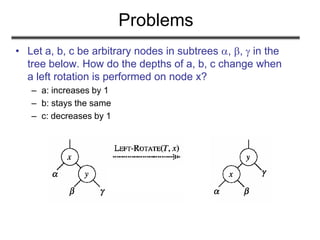
• Let a, b, c be arbitrary nodes in subtrees , ,  in the
tree below. How do the depths of a, b, c change when
a left rotation is performed on node x?
– a: increases by 1
– b: stays the same
– c: decreases by 1
Problems
• When we insert a node into a red-black tree, we
initially set the color of the new node to red. Why
didn’t we choose to set the color to black?
• (Exercise 13.4-7, page 294) Would inserting a
new node to a red-black tree and then
immediately deleting it, change the tree?

Red black trees

  • 1.
  • 2.
    Red-Black Trees • “Balanced”binary search trees guarantee an O(lgn) running time • Red-black-tree – Binary search tree with an additional attribute for its nodes: color which can be red or black – Constrains the way nodes can be colored on any path from the root to a leaf: Ensures that no path is more than twice as long as any other path  the tree is balanced
  • 3.
    Example: RED-BLACK-TREE • Forconvenience we use a sentinel NIL[T] to represent all the NIL nodes at the leafs – NIL[T] has the same fields as an ordinary node – Color[NIL[T]] = BLACK – The other fields may be set to arbitrary values 26 17 41 30 47 38 50 NIL NIL NIL NIL NIL NIL NIL NIL
  • 4.
    Red-Black-Trees Properties (**Satisfy thebinary search tree property**) 1. Every node is either red or black 2. The root is black 3. Every leaf (NIL) is black 4. If a node is red, then both its children are black • No two consecutive red nodes on a simple path from the root to a leaf 5. For each node, all paths from that node to descendant leaves contain the same number of black nodes
  • 5.
    Black-Height of aNode • Height of a node: the number of edges in the longest path to a leaf • Black-height of a node x: bh(x) is the number of black nodes (including NIL) on the path from x to a leaf, not counting x 26 17 41 30 47 38 50 NIL NIL NIL NIL NIL NIL NIL NIL h = 4 bh = 2 h = 3 bh = 2 h = 2 bh = 1 h = 1 bh = 1 h = 1 bh = 1 h = 2 bh = 1 h = 1 bh = 1
  • 6.
    Most important propertyof Red-Black-Trees A red-black tree with n internal nodes has height at most 2lg(n + 1) • Need to prove two claims first …
  • 7.
    Claim 1 • Anynode x with height h(x) has bh(x) ≥ h(x)/2 • Proof – By property 4, at most h/2 red nodes on the path from the node to a leaf – Hence at least h/2 are black 26 17 41 30 47 38 50 NIL NIL NIL NIL NIL NIL NIL NIL h = 4 bh = 2 h = 3 bh = 2 h = 2 bh = 1 h = 1 bh = 1 h = 1 bh = 1 h = 2 bh = 1 h = 1 bh = 1
  • 8.
    Claim 2 • Thesubtree rooted at any node x contains at least 2bh(x) - 1 internal nodes 26 17 41 30 47 38 50 NIL NIL NIL NIL NIL NIL NIL NIL h = 4 bh = 2 h = 3 bh = 2 h = 2 bh = 1 h = 1 bh = 1 h = 1 bh = 1 h = 2 bh = 1 h = 1 bh = 1
  • 9.
    Claim 2 (cont’d) Proof:By induction on h[x] Basis: h[x] = 0  x is a leaf (NIL[T])  bh(x) = 0  # of internal nodes: 20 - 1 = 0 Inductive Hypothesis: assume it is true for h[x]=h-1 NIL x
  • 10.
    Claim 2 (cont’d) Inductivestep: • Prove it for h[x]=h • Let bh(x) = b, then any child y of x has: – bh (y) = – bh (y) = b (if the child is red), or b - 1 (if the child is black) 26 17 41 30 47 38 50 x y1 y2 bh = 2 bh = 2 bh = 1 NIL NIL NIL NIL NILNIL
  • 11.
    Claim 2 (cont’d) •Using inductive hypothesis, the number of internal nodes for each child of x is at least: 2bh(x) - 1 - 1 • The subtree rooted at x contains at least: (2bh(x) - 1 – 1) + (2bh(x) - 1 – 1) + 1 = 2 · (2bh(x) - 1 - 1) + 1 = 2bh(x) - 1 internal nodes x l r h h-1 bh(l)≥bh(x)-1 bh(r)≥bh(x)-1
  • 12.
    Height of Red-Black-Trees(cont’d) Lemma: A red-black tree with n internal nodes has height at most 2lg(n + 1). Proof: n • Add 1 to both sides and then take logs: n + 1 ≥ 2b ≥ 2h/2 lg(n + 1) ≥ h/2  h ≤ 2 lg(n + 1) root l r height(root) = h bh(root) = b number n of internal nodes ≥ 2b - 1 ≥ 2h/2 - 1 since b  h/2
  • 13.
    Operations on Red-Black-Trees •The non-modifying binary-search-tree operations MINIMUM, MAXIMUM, SUCCESSOR, PREDECESSOR, and SEARCH run in O(h) time – They take O(lgn) time on red-black trees • What about TREE-INSERT and TREE-DELETE? – They will still run on O(lgn) – We have to guarantee that the modified tree will still be a red-black tree
  • 14.
    INSERT INSERT: what colorto make the new node? • Red? Let’s insert 35! – Property 4 is violated: if a node is red, then both its children are black • Black? Let’s insert 14! – Property 5 is violated: all paths from a node to its leaves contain the same number of black nodes 26 17 41 30 47 38 50
  • 15.
    DELETE DELETE: what colorwas the node that was removed? Black? 1. Every node is either red or black 2. The root is black 3. Every leaf (NIL) is black 4. If a node is red, then both its children are black 5. For each node, all paths from the node to descendant leaves contain the same number of black nodes OK! OK! Not OK! Could create two red nodes in a row Not OK! Could change the black heights of some nodes 26 17 41 30 47 38 50 Not OK! If removing the root and the child that replaces it is red
  • 16.
    Rotations • Operations forre-structuring the tree after insert and delete operations on red-black trees • Rotations take a red-black-tree and a node within the tree and: – Together with some node re-coloring they help restore the red-black-tree property – Change some of the pointer structure – Do not change the binary-search tree property • Two types of rotations: – Left & right rotations
  • 17.
    Left Rotations • Assumptionsfor a left rotation on a node x: – The right child of x (y) is not NIL • Idea: – Pivots around the link from x to y – Makes y the new root of the subtree – x becomes y’s left child – y’s left child becomes x’s right child
  • 18.
  • 19.
    LEFT-ROTATE(T, x) 1. y← right[x] ►Set y 2. right[x] ← left[y] ► y’s left subtree becomes x’s right subtree 3. if left[y]  NIL 4. then p[left[y]] ← x ► Set the parent relation from left[y] to x 5. p[y] ← p[x] ► The parent of x becomes the parent of y 6. if p[x] = NIL 7. then root[T] ← y 8. else if x = left[p[x]] 9. then left[p[x]] ← y 10. else right[p[x]] ← y 11. left[y] ← x ► Put x on y’s left 12. p[x] ← y ► y becomes x’s parent
  • 20.
    Right Rotations • Assumptionsfor a right rotation on a node x: – The left child of y (x) is not NIL • Idea: – Pivots around the link from y to x – Makes x the new root of the subtree – y becomes x’s right child – x’s right child becomes y’s left child
  • 21.
    Insertion • Goal: – Inserta new node z into a red-black-tree • Idea: – Insert node z into the tree as for an ordinary binary search tree – Color the node red – Restore the red-black-tree properties • Use an auxiliary procedure RB-INSERT-FIXUP
  • 22.
    RB Properties Affectedby Insert 1. Every node is either red or black 2. The root is black 3. Every leaf (NIL) is black 4. If a node is red, then both its children are black 5. For each node, all paths from the node to descendant leaves contain the same number of black nodes OK! If z is the root  not OK OK! 26 17 41 4738 50 If p(z) is red  not OK z and p(z) are both red OK!
  • 23.
    RB-INSERT-FIXUP – Case1 z’s “uncle” (y) is red Idea: (z is a right child) • p[p[z]] (z’s grandparent) must be black: z and p[z] are both red • Color p[z] black • Color y black • Color p[p[z]] red • z = p[p[z]] – Push the “red” violation up the tree
  • 24.
    RB-INSERT-FIXUP – Case1 z’s “uncle” (y) is red Idea: (z is a left child) • p[p[z]] (z’s grandparent) must be black: z and p[z] are both red • color p[z]  black • color y  black • color p[p[z]]  red • z = p[p[z]] – Push the “red” violation up the tree
  • 25.
    RB-INSERT-FIXUP – Case3 Case 3: • z’s “uncle” (y) is black • z is a left child Case 3 Idea: • color p[z]  black • color p[p[z]]  red • RIGHT-ROTATE(T, p[p[z]]) • No longer have 2 reds in a row • p[z] is now black
  • 26.
    RB-INSERT-FIXUP – Case2 Case 2: • z’s “uncle” (y) is black • z is a right child Idea: • z  p[z] • LEFT-ROTATE(T, z)  now z is a left child, and both z and p[z] are red  case 3 Case 2 Case 3
  • 27.
    RB-INSERT-FIXUP(T, z) 1. whilecolor[p[z]] = RED 2. do if p[z] = left[p[p[z]]] 3. then y ← right[p[p[z]]] 4. if color[y] = RED 5. then Case1 6. else if z = right[p[z]] 7. then Case2 8. Case3 9. else (same as then clause with “right” and “left” exchanged) 10. color[root[T]] ← BLACK The while loop repeats only when case1 is executed: O(lgn) times Set the value of x’s “uncle” We just inserted the root, or The red violation reached the root
  • 28.
    Example 11 Insert 4 2 14 1157 85 4 y 11 2 14 1 157 85 4 z Case 1 y z and p[z] are both red z’s uncle y is redz z and p[z] are both red z’s uncle y is black z is a right child Case 2 11 2 14 1 15 7 8 5 4 z y Case 3 z and p[z] are red z’s uncle y is black z is a left child 112 141 15 7 85 4 z
  • 29.
    RB-INSERT(T, z) 1. y← NIL 2. x ← root[T] 3. while x  NIL 4. do y ← x 5. if key[z] < key[x] 6. then x ← left[x] 7. else x ← right[x] 8. p[z] ← y • Initialize nodes x and y • Throughout the algorithm y points to the parent of x • Go down the tree until reaching a leaf • At that point y is the parent of the node to be inserted • Sets the parent of z to be y 26 17 41 30 47 38 50
  • 30.
    RB-INSERT(T, z) 9. ify = NIL 10. then root[T] ← z 11. else if key[z] < key[y] 12. then left[y] ← z 13. else right[y] ← z 14. left[z] ← NIL 15. right[z] ← NIL 16. color[z] ← RED 17. RB-INSERT-FIXUP(T, z) The tree was empty: set the new node to be the root Otherwise, set z to be the left or right child of y, depending on whether the inserted node is smaller or larger than y’s key Set the fields of the newly added node Fix any inconsistencies that could have been introduced by adding this new red node 26 17 41 30 47 38 50
  • 31.
    Analysis of RB-INSERT •Inserting the new element into the tree O(lgn) • RB-INSERT-FIXUP – The while loop repeats only if CASE 1 is executed – The number of times the while loop can be executed is O(lgn) • Total running time of RB-INSERT: O(lgn)
  • 32.
    Red-Black Trees -Summary • Operations on red-black-trees: – SEARCH O(h) – PREDECESSOR O(h) – SUCCESOR O(h) – MINIMUM O(h) – MAXIMUM O(h) – INSERT O(h) – DELETE O(h) • Red-black-trees guarantee that the height of the tree will be O(lgn)
  • 33.
    Problems • What isthe ratio between the longest path and the shortest path in a red-black tree? - The shortest path is at least bh(root) - The longest path is equal to h(root) - We know that h(root)≤2bh(root) - Therefore, the ratio is ≤2
  • 34.
    Problems • What red-blacktree property is violated in the tree below? How would you restore the red-black tree property in this case? – Property violated: if a node is red, both its children are black – Fixup: color 7 black, 11 red, then right-rotate around 11 112 141 15 7 85 4 z
  • 35.
    Problems • Let a,b, c be arbitrary nodes in subtrees , ,  in the tree below. How do the depths of a, b, c change when a left rotation is performed on node x? – a: increases by 1 – b: stays the same – c: decreases by 1
  • 36.
    Problems • When weinsert a node into a red-black tree, we initially set the color of the new node to red. Why didn’t we choose to set the color to black? • (Exercise 13.4-7, page 294) Would inserting a new node to a red-black tree and then immediately deleting it, change the tree?