RED BLACK TREE
M.Surya (II-M Sc(CS&IT)
P.Vinitha (II-M Sc(CS&IT)
NS College of Arts And Science , Theni ,Tamilnadu.
Red Black Tree
• Red black tree: BST in which each node is colored
red or black.
• Constrains on the colored and connection of nodes
ensure that no root to leaf path is more than twice as
long as any other, so tree is approximately balanced.
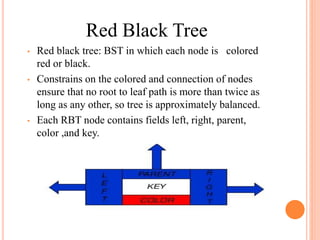
• Each RBT node contains fields left, right, parent,
color ,and key.
DEFINITION
 A red –black tree is a type of self balancing binary
search tree,with one extra attribute for each node:the
color,which is either red or black.
 A red –black tree is a binary search tree that inserts
and deletes in such a way that the tree is always
reasonably balanced.
OPERATIONS
 It includes in three operations
* Searching
* Inserting
* Deleting
SEARCHING
 A search a red black tree with the code we used
to search an ordinary binary search tree.
 This code has complexity O(h),which is O(log n)
for a red-black tree.
 We can use the same code to search ordinary
binary search trees, AVLtrees, and red-black
trees.
INSERTING INTO A RED-BLACK TREE
 Find the correct leaf to insert new node instead of it
 Color node in red, and attach 2 black leafs to it.
 Make sure RB-tree properties hold.
Correction:
•When a violation is created for inserting a(case 4-6 are
symmetric.
Case 1: a’s uncle (d) is red:
•Color a’s father (b) and uncle (d) black
•Color a’s father (c) red
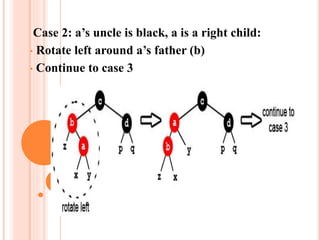
Case 2: a’s uncle is black, a is a right child:
• Rotate left around a’s father (b)
• Continue to case 3
Case 3: a’s uncle is black, a is a left child:
• Rotate right around a’s grandfather (c)
• Switch colors between a’s father (b) and a’s
(new) sibling (c)
DELETION OF RED BLACK TREE
• As with binary search trees, we can always delete a node that
has at least one external child
• If the key to be deleted is stored at a node that has no external
children, we move there the key of its in order predecessor (or
successor), and delete that node instead.
• Deleting node a (disregard colors, fix later):
Case 1: a has no left child
Remove a and put its right child (b) instead
Notes:
if the red rule is now broken b and its new father
(originally a’s father), we can color b in black keeping the
black height, since a was definitely black (as its father is red)
Case 2: a has no right child:
• Remove a and put its left child (b) instead
Note: same as case 1
Case 3: a has two children, a’s
successor (c) is its right child:
• Remove a and put its successor (c) instead
• Make a’s left child (b) the successor’s (c) left child
Notes:
 The successor always has no left child.
 Moving the successor, we color it in a’s color. If the
successor was black, the child that replaced it (d) is colored in
“extra” black, making it red-black or black-black. This is fixed
in the correction.
Case 4: a has two children, a’s
successor (d) is not its child:
 Put the successor’s (d) left child (e) instead of it.
 Remove a and put its successor (d) instead of it, making a’s
children (b, c) its new children .
Notes: same as case 3 .

Red black tree

  • 1.
    RED BLACK TREE M.Surya(II-M Sc(CS&IT) P.Vinitha (II-M Sc(CS&IT) NS College of Arts And Science , Theni ,Tamilnadu.
  • 2.
    Red Black Tree •Red black tree: BST in which each node is colored red or black. • Constrains on the colored and connection of nodes ensure that no root to leaf path is more than twice as long as any other, so tree is approximately balanced. • Each RBT node contains fields left, right, parent, color ,and key.
  • 3.
    DEFINITION  A red–black tree is a type of self balancing binary search tree,with one extra attribute for each node:the color,which is either red or black.  A red –black tree is a binary search tree that inserts and deletes in such a way that the tree is always reasonably balanced.
  • 4.
    OPERATIONS  It includesin three operations * Searching * Inserting * Deleting
  • 5.
    SEARCHING  A searcha red black tree with the code we used to search an ordinary binary search tree.  This code has complexity O(h),which is O(log n) for a red-black tree.  We can use the same code to search ordinary binary search trees, AVLtrees, and red-black trees.
  • 6.
    INSERTING INTO ARED-BLACK TREE  Find the correct leaf to insert new node instead of it  Color node in red, and attach 2 black leafs to it.  Make sure RB-tree properties hold.
  • 7.
    Correction: •When a violationis created for inserting a(case 4-6 are symmetric. Case 1: a’s uncle (d) is red: •Color a’s father (b) and uncle (d) black •Color a’s father (c) red
  • 8.
    Case 2: a’suncle is black, a is a right child: • Rotate left around a’s father (b) • Continue to case 3
  • 9.
    Case 3: a’suncle is black, a is a left child: • Rotate right around a’s grandfather (c) • Switch colors between a’s father (b) and a’s (new) sibling (c)
  • 10.
    DELETION OF REDBLACK TREE • As with binary search trees, we can always delete a node that has at least one external child • If the key to be deleted is stored at a node that has no external children, we move there the key of its in order predecessor (or successor), and delete that node instead. • Deleting node a (disregard colors, fix later):
  • 11.
    Case 1: ahas no left child Remove a and put its right child (b) instead Notes: if the red rule is now broken b and its new father (originally a’s father), we can color b in black keeping the black height, since a was definitely black (as its father is red)
  • 12.
    Case 2: ahas no right child: • Remove a and put its left child (b) instead Note: same as case 1 Case 3: a has two children, a’s successor (c) is its right child: • Remove a and put its successor (c) instead • Make a’s left child (b) the successor’s (c) left child
  • 13.
    Notes:  The successoralways has no left child.  Moving the successor, we color it in a’s color. If the successor was black, the child that replaced it (d) is colored in “extra” black, making it red-black or black-black. This is fixed in the correction.
  • 14.
    Case 4: ahas two children, a’s successor (d) is not its child:  Put the successor’s (d) left child (e) instead of it.  Remove a and put its successor (d) instead of it, making a’s children (b, c) its new children . Notes: same as case 3 .