RED BLACK TREES
Presented By,
T. Janani
II-M.sc(CS&IT)
Nadar Saraswathi College Of
Arts & Science, Theni.
Red - Black Tree
A Red-Black tree is a binary search tree
where each node is colored either RED or BLACK such that
the following invariants are satisfied :
1. The root is BLACK.
2. A RED node can only have BLACK children.
3. Every path from a root down to a “leaf" contains
the same number of BLACK nodes. Here a “leaf“ means a
node with less than two children.
Binary Search Tree :
Binary Search Tree (BST) is a good data
structure for searching algorithm.
It supports
1. Search (key , tree) .
2. Find predecessor(key , tree).
3. Find successor (key , tree).
4. Find minimum (tree).
5. Find maximum(tree).
6. Insertion.
7. Deletion.
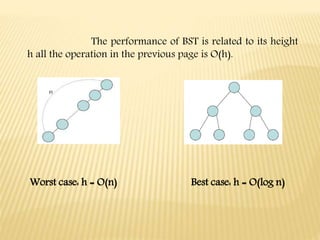
The performance of BST is related to its height
h all the operation in the previous page is O(h).
Worst case: h = O(n) Best case: h = O(log n)
1. We want a balanced binary search tree.
Height of the tree is O(log n).
2. Red-Black Tree is one of the balanced binary
search tree.
Property :
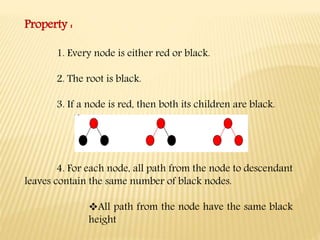
1. Every node is either red or black.
2. The root is black.
3. If a node is red, then both its children are black.
4. For each node, all path from the node to descendant
leaves contain the same number of black nodes.
All path from the node have the same black
height
Insertion
1. When insert a node z, we set the color of z to red
2. This may violate property 2 and 3
3. For property 2, we set the color of root to black
after insertion.
4. To fix property 3, we will consider if
 The z’s parent is a left child or right child
 The color of z's uncle y is red or black
 z is a left child or right child
5. We consider the z’s parent is a left child first, the
other case can be done by symmetric operation
There are 4 cases :
Case 1 : y is red and z is a left child
Case 2 : y is red and z is a right child
Case 3 : y is black and z is a left child
Case 4 : y is black and z is a right child
Case 1 : y is red and z is a left child
Case 2 : y is a red and z is a right child
Case 3 : y is a Black and z is a left child
Case 4 : y is a Black and z is a right child
Insertion Analysis
1. Case 1 and 2 move z up 2 levels
2. Case 3 and 4 will terminate after some number of
steps
3. The height of tree is finite and is O(log n)
4. The running time is O(log n)
5. At most 2 rotations
Deletion
1. From now on, we always call the deleted node to be z
2. If z is red, it won't violate any property
3. If z is a leaf, it won't violate any property
4. Otherwise z is black and has a child, it will violate
property 2, 3, and 4
5. For property 2, set the color of root to black after
deletion.
To fix property 3 and 4:
 If z's child x (which is the replacing node) is red, set
x to black. Done!
 If x is black, add another black to x, so that x will be a
doubly black node, and property 3 and 4 are fixed. But
property 1 is violated.
 To fix property 1, we will consider if
 x is a left child or right child
 The color of x's sibling w is red or black
 The colors of w's children
We consider x is a left child first, the other case
can be done by symmetric operation.
There are 4 cases:
Case1: w is red
Case2: w is black, both w's children are black
Case3: w is black, w's left child is red, w's right
child is black
Case4: w is black, w's right child is red
Case 1 : W is red
Case 2 : w is black, both w's children are black
Case 3 : w is black, w's left child is red, w's right
child is black
Case 4 : w is black, w's right child is red
Deletion Analysis
1. Case 2 move x up 1 level
2. Case 1, 3 and 4 will terminate after some number
of steps.
3. The height of tree is finite and is O(log n)
4. The running time is O(log n)
5. At most 3 rotations
Conclusion
Red-Black Tree is a balanced binary
search tree which supports the operation search, find
predecessor, find successor, find minimum, find
maximum, insertion and deletion in O(log n)-time.
Thank You

Data structure

  • 1.
    RED BLACK TREES PresentedBy, T. Janani II-M.sc(CS&IT) Nadar Saraswathi College Of Arts & Science, Theni.
  • 2.
    Red - BlackTree A Red-Black tree is a binary search tree where each node is colored either RED or BLACK such that the following invariants are satisfied : 1. The root is BLACK. 2. A RED node can only have BLACK children. 3. Every path from a root down to a “leaf" contains the same number of BLACK nodes. Here a “leaf“ means a node with less than two children.
  • 3.
    Binary Search Tree: Binary Search Tree (BST) is a good data structure for searching algorithm. It supports 1. Search (key , tree) . 2. Find predecessor(key , tree). 3. Find successor (key , tree). 4. Find minimum (tree). 5. Find maximum(tree). 6. Insertion. 7. Deletion.
  • 4.
    The performance ofBST is related to its height h all the operation in the previous page is O(h). Worst case: h = O(n) Best case: h = O(log n)
  • 5.
    1. We wanta balanced binary search tree. Height of the tree is O(log n). 2. Red-Black Tree is one of the balanced binary search tree.
  • 6.
    Property : 1. Everynode is either red or black. 2. The root is black. 3. If a node is red, then both its children are black. 4. For each node, all path from the node to descendant leaves contain the same number of black nodes. All path from the node have the same black height
  • 7.
    Insertion 1. When inserta node z, we set the color of z to red 2. This may violate property 2 and 3 3. For property 2, we set the color of root to black after insertion. 4. To fix property 3, we will consider if  The z’s parent is a left child or right child  The color of z's uncle y is red or black  z is a left child or right child 5. We consider the z’s parent is a left child first, the other case can be done by symmetric operation
  • 8.
    There are 4cases : Case 1 : y is red and z is a left child Case 2 : y is red and z is a right child Case 3 : y is black and z is a left child Case 4 : y is black and z is a right child Case 1 : y is red and z is a left child
  • 9.
    Case 2 :y is a red and z is a right child
  • 10.
    Case 3 :y is a Black and z is a left child
  • 11.
    Case 4 :y is a Black and z is a right child
  • 12.
    Insertion Analysis 1. Case1 and 2 move z up 2 levels 2. Case 3 and 4 will terminate after some number of steps 3. The height of tree is finite and is O(log n) 4. The running time is O(log n) 5. At most 2 rotations
  • 13.
    Deletion 1. From nowon, we always call the deleted node to be z 2. If z is red, it won't violate any property 3. If z is a leaf, it won't violate any property 4. Otherwise z is black and has a child, it will violate property 2, 3, and 4 5. For property 2, set the color of root to black after deletion. To fix property 3 and 4:  If z's child x (which is the replacing node) is red, set x to black. Done!  If x is black, add another black to x, so that x will be a doubly black node, and property 3 and 4 are fixed. But property 1 is violated.
  • 14.
     To fixproperty 1, we will consider if  x is a left child or right child  The color of x's sibling w is red or black  The colors of w's children We consider x is a left child first, the other case can be done by symmetric operation. There are 4 cases: Case1: w is red Case2: w is black, both w's children are black Case3: w is black, w's left child is red, w's right child is black Case4: w is black, w's right child is red
  • 15.
    Case 1 :W is red
  • 16.
    Case 2 :w is black, both w's children are black
  • 17.
    Case 3 :w is black, w's left child is red, w's right child is black
  • 18.
    Case 4 :w is black, w's right child is red
  • 19.
    Deletion Analysis 1. Case2 move x up 1 level 2. Case 1, 3 and 4 will terminate after some number of steps. 3. The height of tree is finite and is O(log n) 4. The running time is O(log n) 5. At most 3 rotations
  • 20.
    Conclusion Red-Black Tree isa balanced binary search tree which supports the operation search, find predecessor, find successor, find minimum, find maximum, insertion and deletion in O(log n)-time.
  • 21.