

Recombinant DNA Technology
(Introducution)
Dr. Abhishek Roy
Junior Resident (III)
Dept. of Biochemistry
Grant Govt. Medical College
And Sir JJ Group of Hospitals, Mumbai
Email: mail@abhishek.ro
Twitter: @abhishekroy
Objectives
 Concept of Recombinant DNA Technology.
 Role of Restriction Endonucleases
 Role of Various Enzymes used in Recombinant DNA Technology
 Cloning Vectors types, purpose and method of preparation
 Plasmids (pBR322)
 BAC
 YAC
What is RDT?
 A clone is an identical copy.
 The process DNA Cloning involves
 Cutting target DNA at precise locations.
 Selecting a small carrier molecule of DNA capable of self-replication.
 Joining two DNA fragments covalently.
 Moving recombinant DNA from the test tube to a host cell.
 Selecting or identifying host cells that contain recombinant DNA.
 The methods used to accomplish these and related tasks are
collectively referred to as recombinant DNA technology or, more
informally, genetic engineering.
Role of Restriction Endonucleases
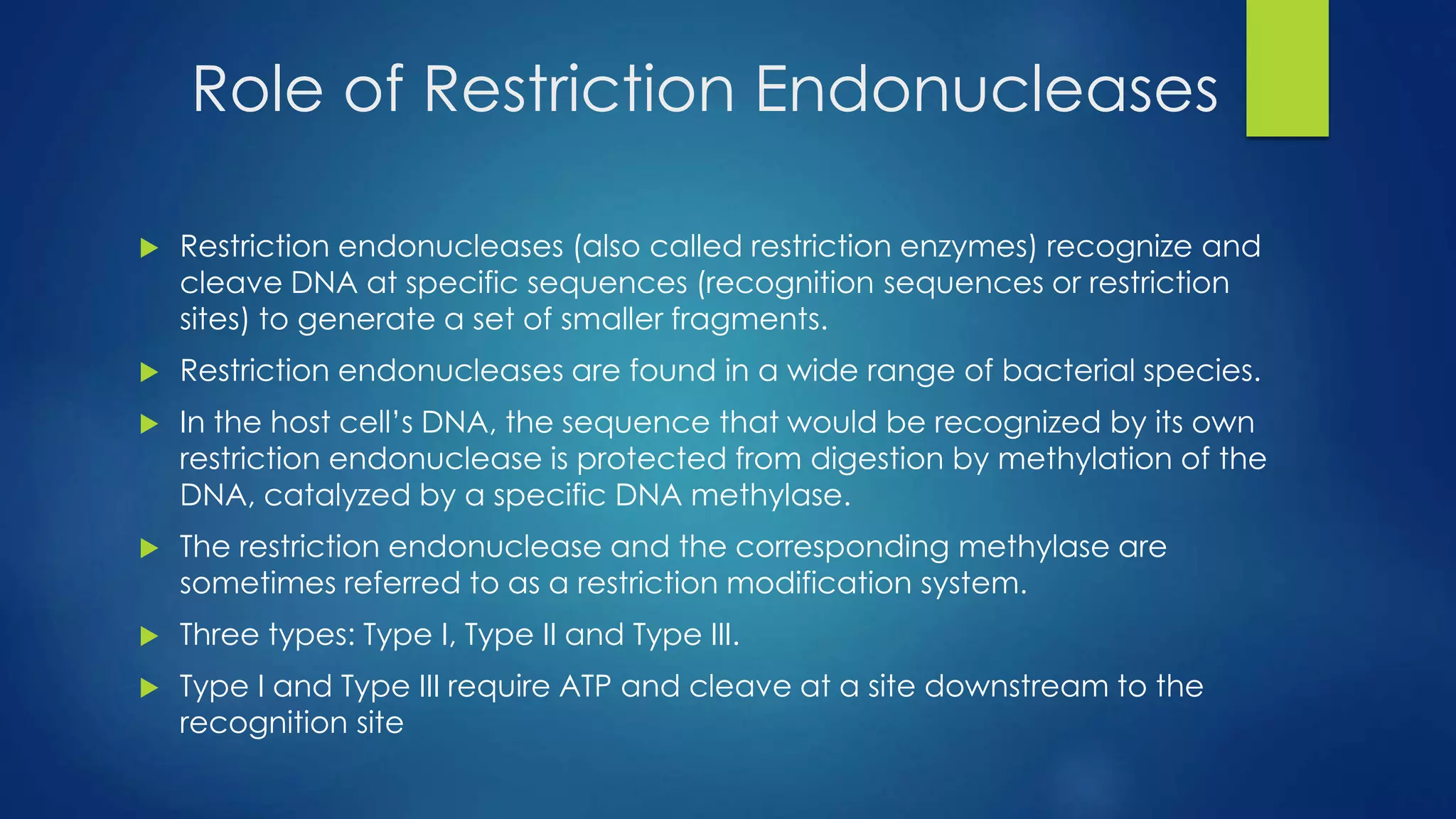
 Restriction endonucleases (also called restriction enzymes) recognize and
cleave DNA at specific sequences (recognition sequences or restriction
sites) to generate a set of smaller fragments.
 Restriction endonucleases are found in a wide range of bacterial species.
 In the host cell’s DNA, the sequence that would be recognized by its own
restriction endonuclease is protected from digestion by methylation of the
DNA, catalyzed by a specific DNA methylase.
 The restriction endonuclease and the corresponding methylase are
sometimes referred to as a restriction modification system.
 Three types: Type I, Type II and Type III.
 Type I and Type III require ATP and cleave at a site downstream to the
recognition site
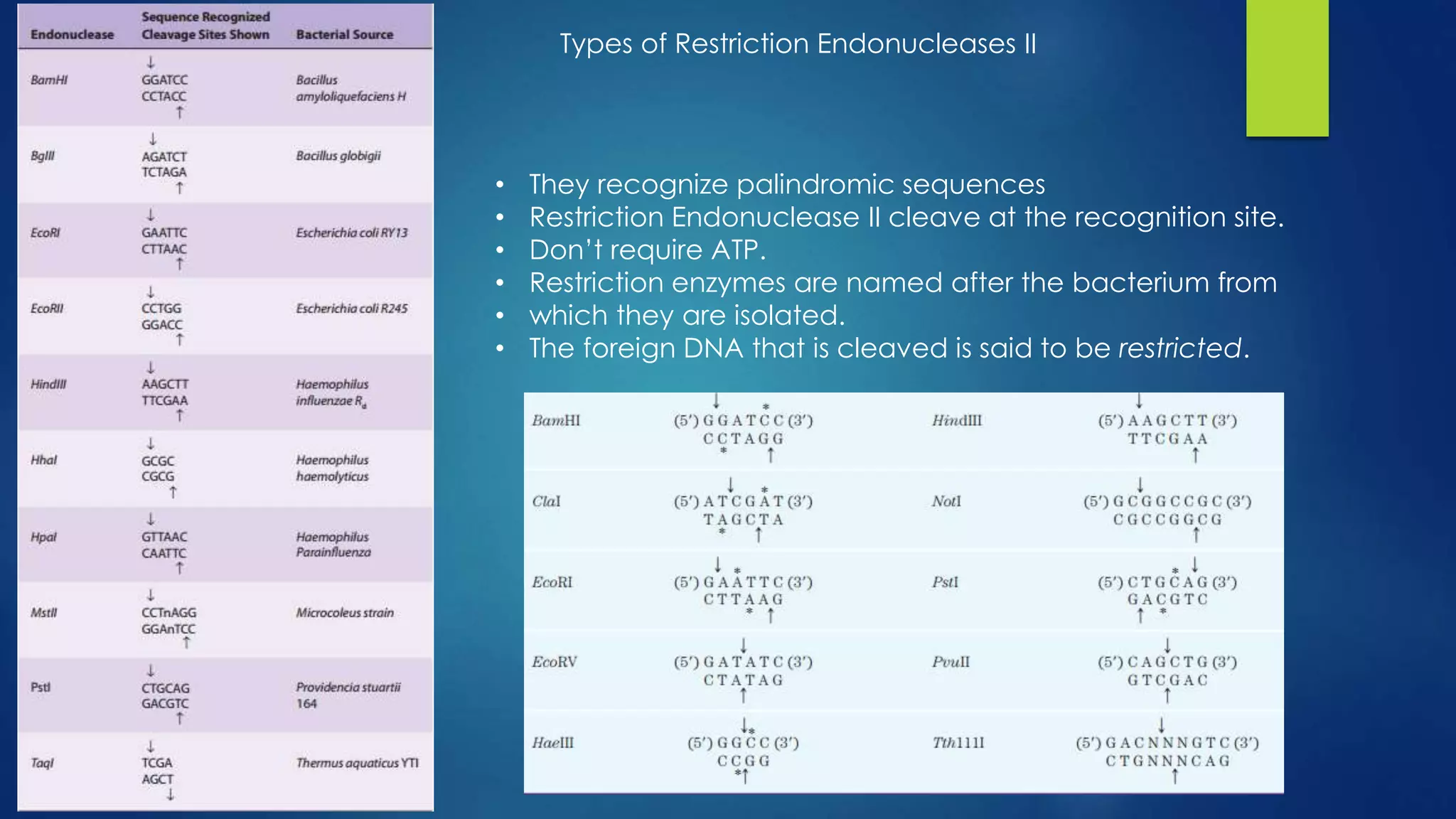
Types of Restriction Endonucleases II
• They recognize palindromic sequences
• Restriction Endonuclease II cleave at the recognition site.
• Don’t require ATP.
• Restriction enzymes are named after the bacterium from
• which they are isolated.
• The foreign DNA that is cleaved is said to be restricted.
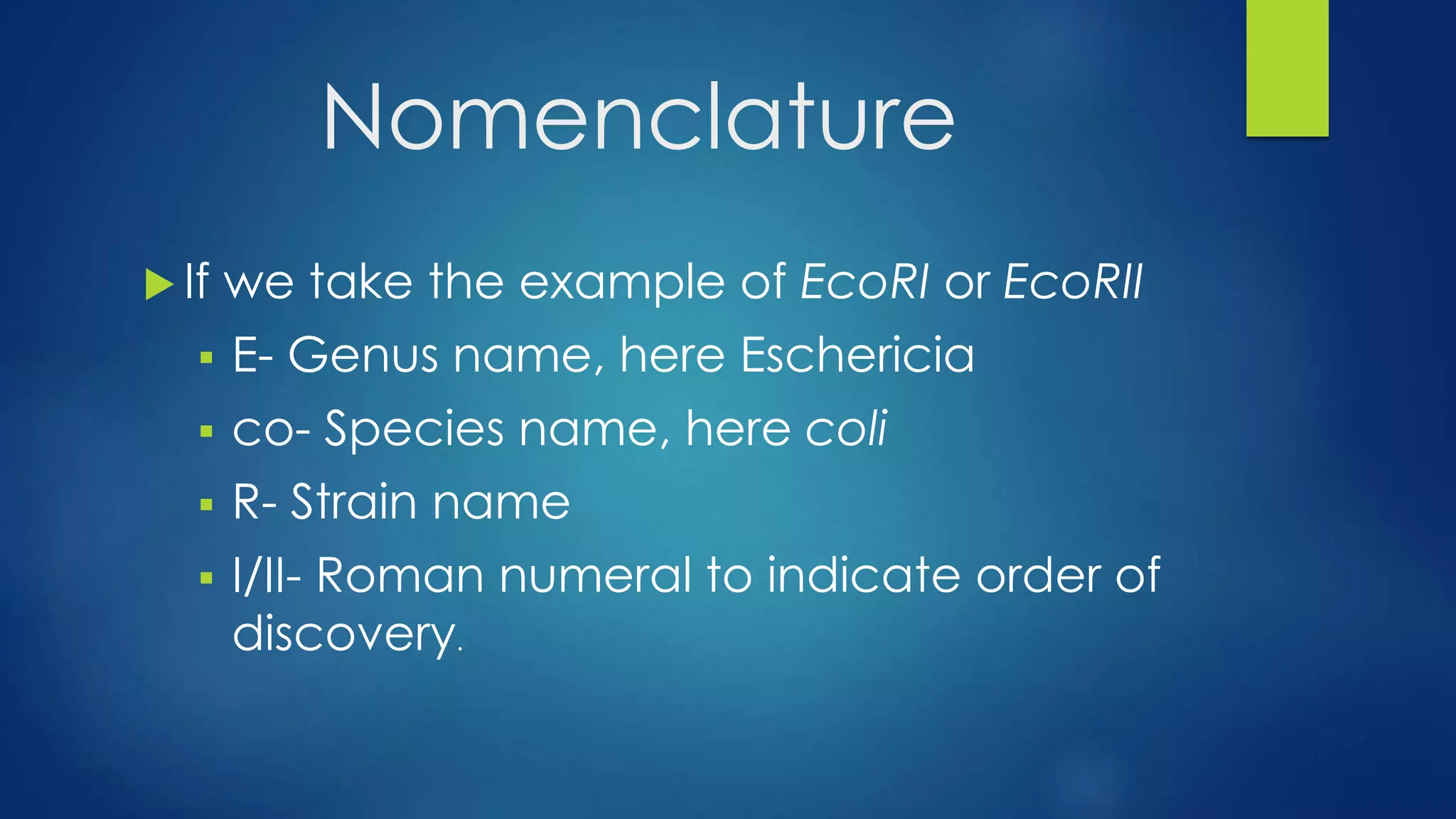
Nomenclature
 If we take the example of EcoRI or EcoRII
 E- Genus name, here Eschericia
 co- Species name, here coli
 R- Strain name
 I/II- Roman numeral to indicate order of
discovery.
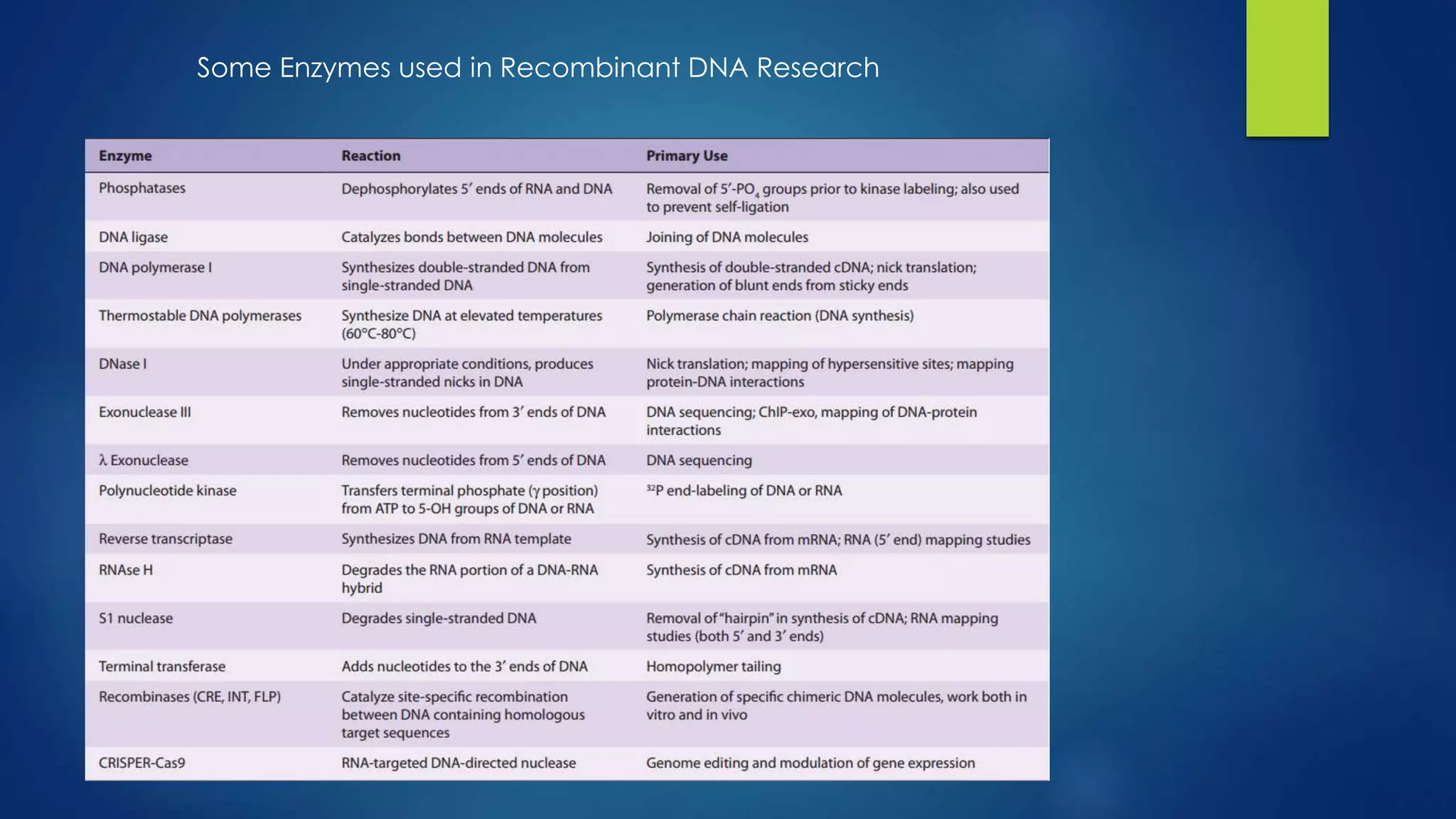
Some Enzymes used in Recombinant DNA Research
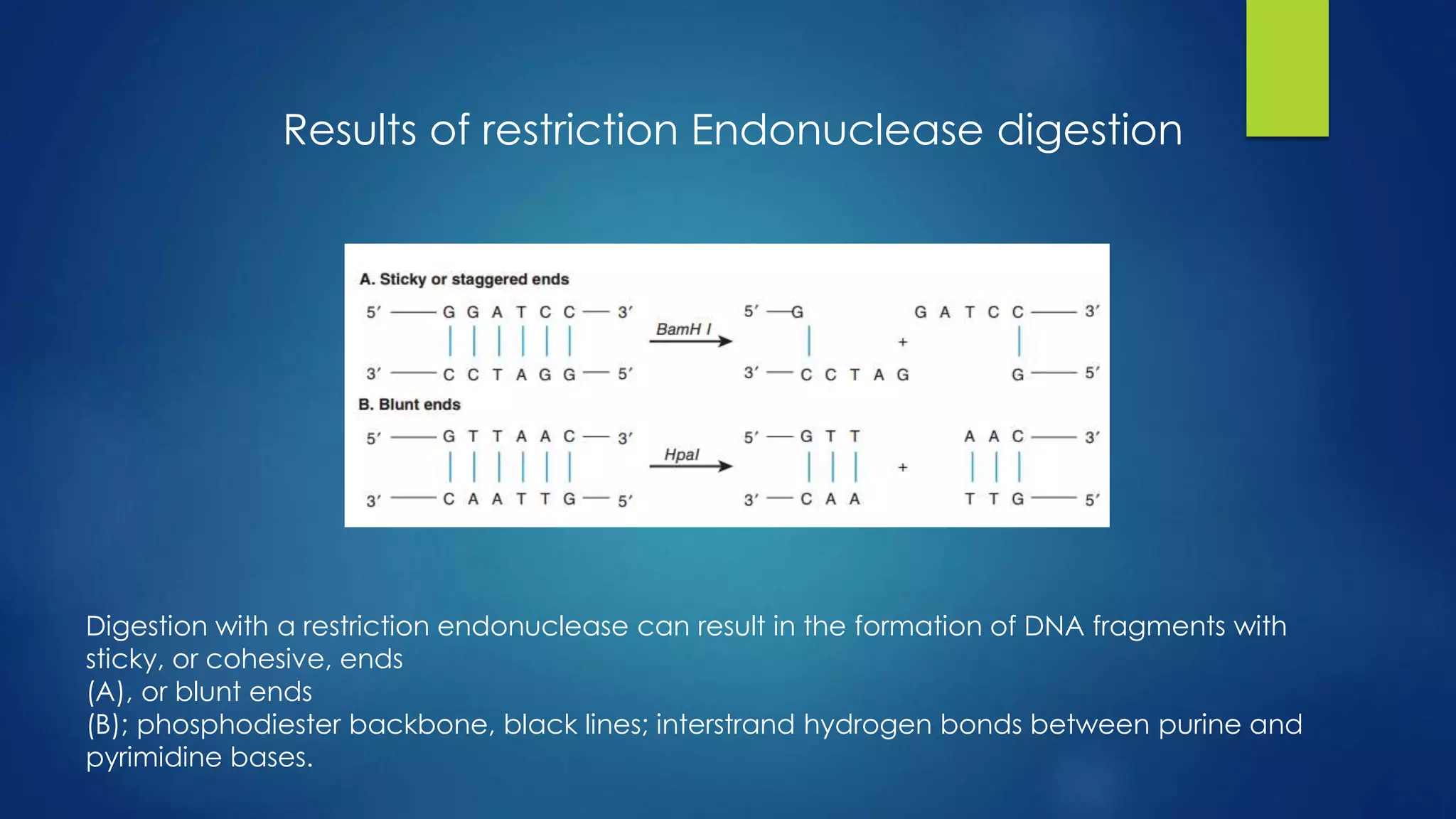
Digestion with a restriction endonuclease can result in the formation of DNA fragments with
sticky, or cohesive, ends
(A), or blunt ends
(B); phosphodiester backbone, black lines; interstrand hydrogen bonds between purine and
pyrimidine bases.
Results of restriction Endonuclease digestion
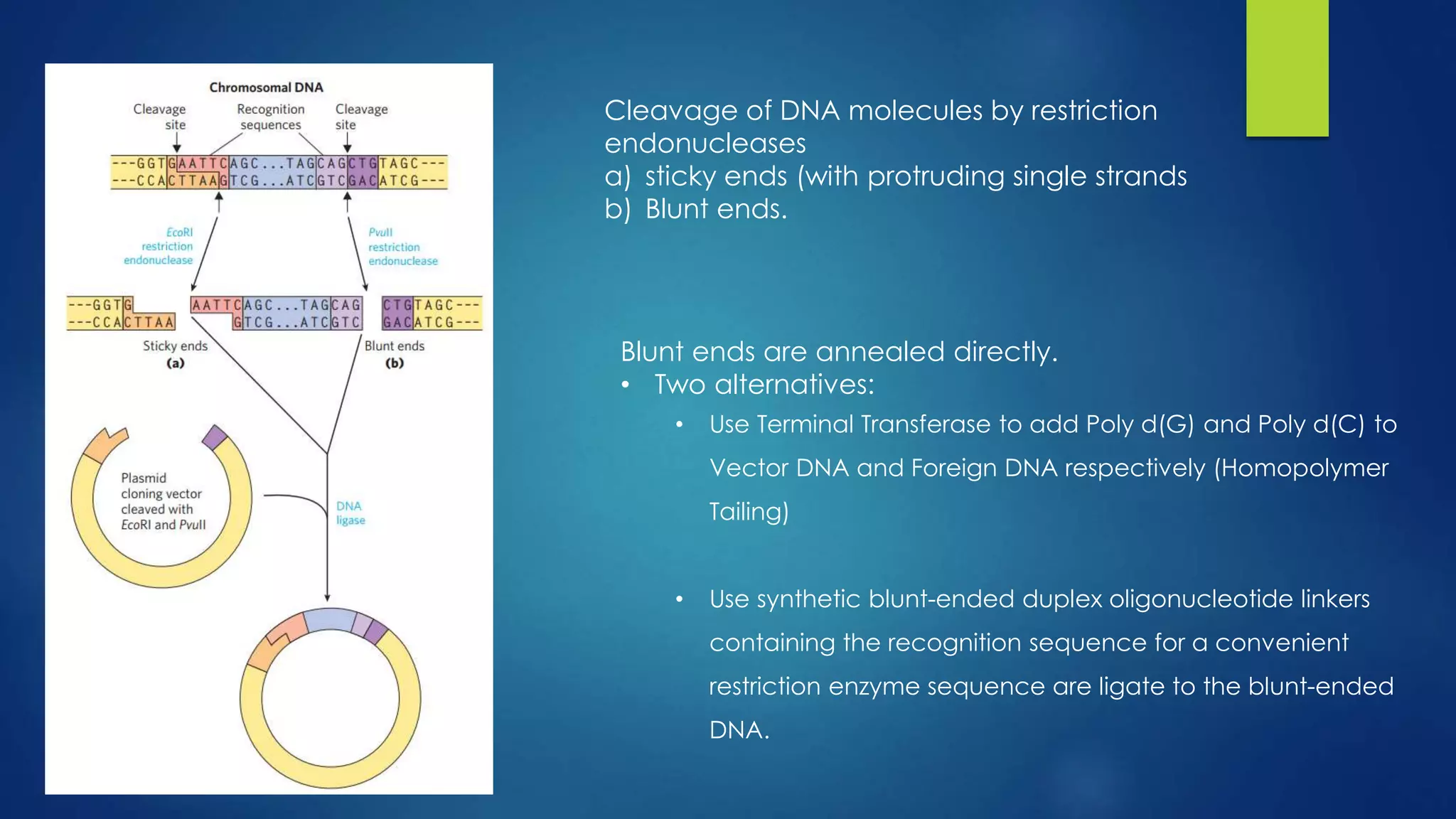
Cleavage of DNA molecules by restriction
endonucleases
a) sticky ends (with protruding single strands
b) Blunt ends.
Blunt ends are annealed directly.
• Two alternatives:
• Use Terminal Transferase to add Poly d(G) and Poly d(C) to
Vector DNA and Foreign DNA respectively (Homopolymer
Tailing)
• Use synthetic blunt-ended duplex oligonucleotide linkers
containing the recognition sequence for a convenient
restriction enzyme sequence are ligate to the blunt-ended
DNA.
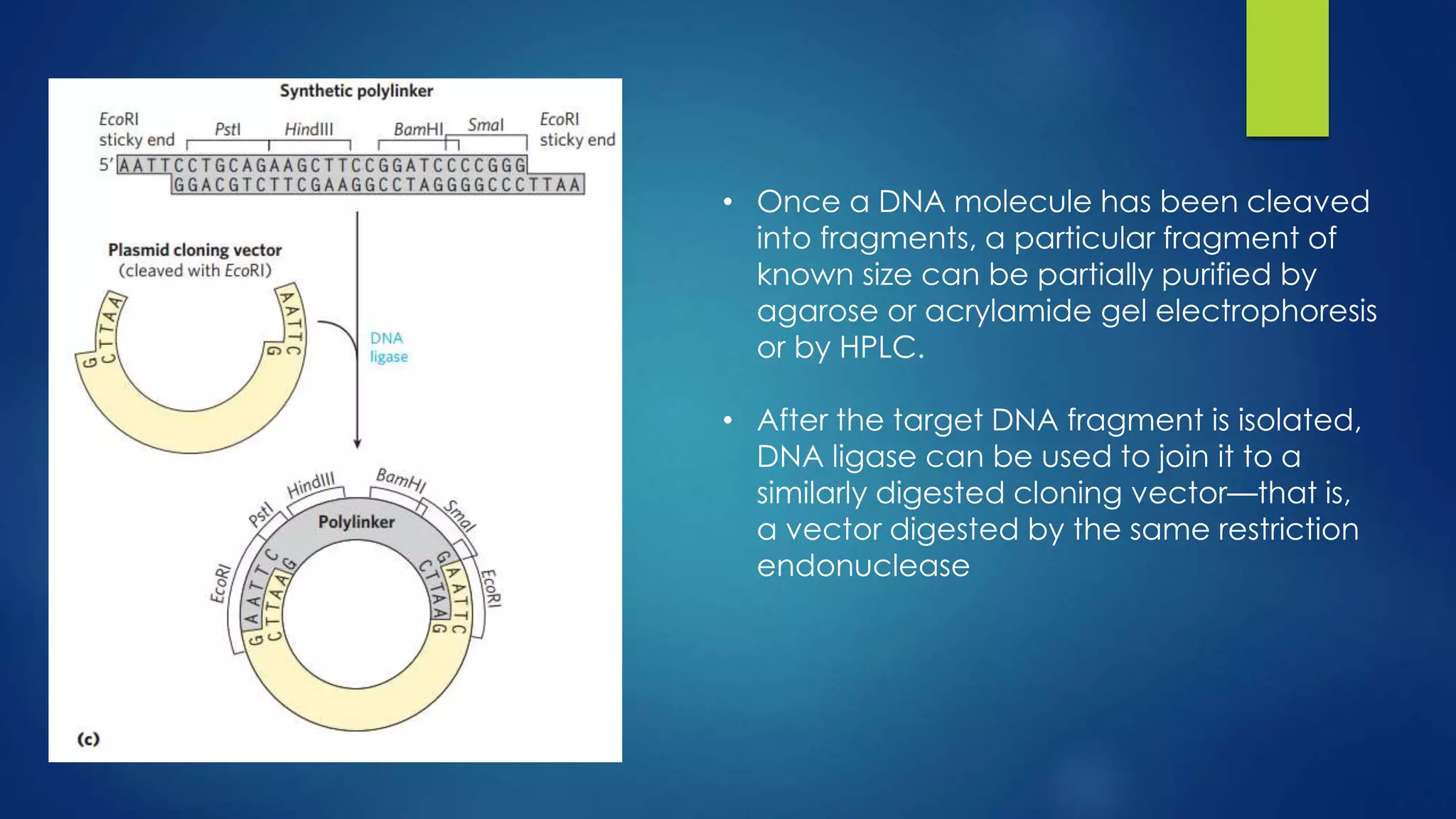
• Once a DNA molecule has been cleaved
into fragments, a particular fragment of
known size can be partially purified by
agarose or acrylamide gel electrophoresis
or by HPLC.
• After the target DNA fragment is isolated,
DNA ligase can be used to join it to a
similarly digested cloning vector—that is,
a vector digested by the same restriction
endonuclease
 DNA ligase catalyzes the formation of new phosphodiester bonds in
a reaction that uses ATP or a similar cofactor.
 The base pairing of complementary sticky ends greatly facilitates
the ligation reaction.
 Researchers can create new DNA sequences by inserting synthetic
DNA fragments (called linkers) between the ends that are being
ligated
 Inserted DNA fragments with multiple recognition sequences for
restriction endonucleases (often useful later as points for inserting
additional DNA by cleavage and ligation) are called polylinkers.
Cloning
 A clone is a large population of
identical molecules, bacteria, or
cells that arise from a common
ancestor.
 This technique is based on the fact
that chimeric or hybrid DNA
molecules can be constructed in
cloning vectors— typically bacterial
plasmids, phages, or cosmids.
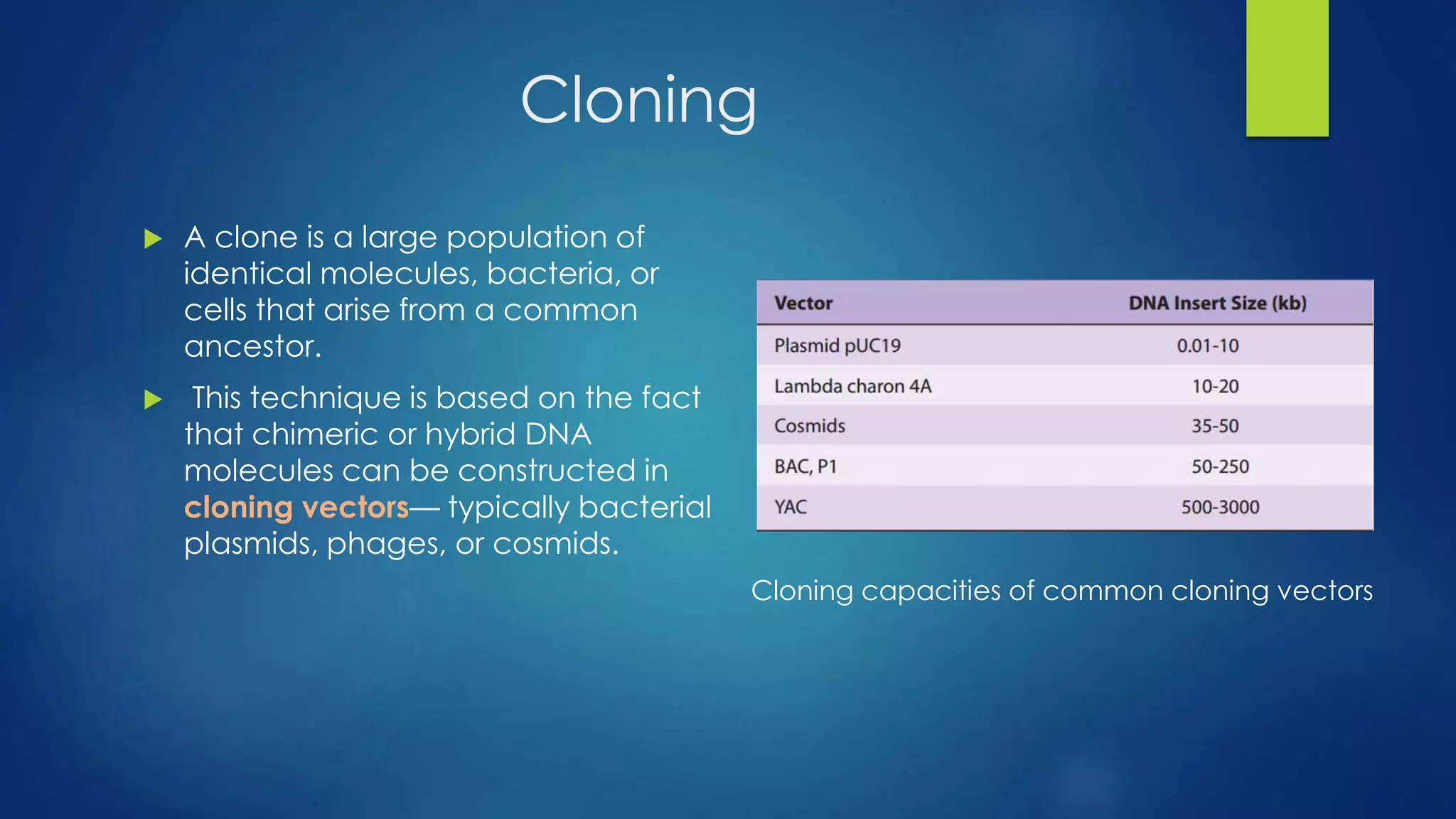
Cloning capacities of common cloning vectors
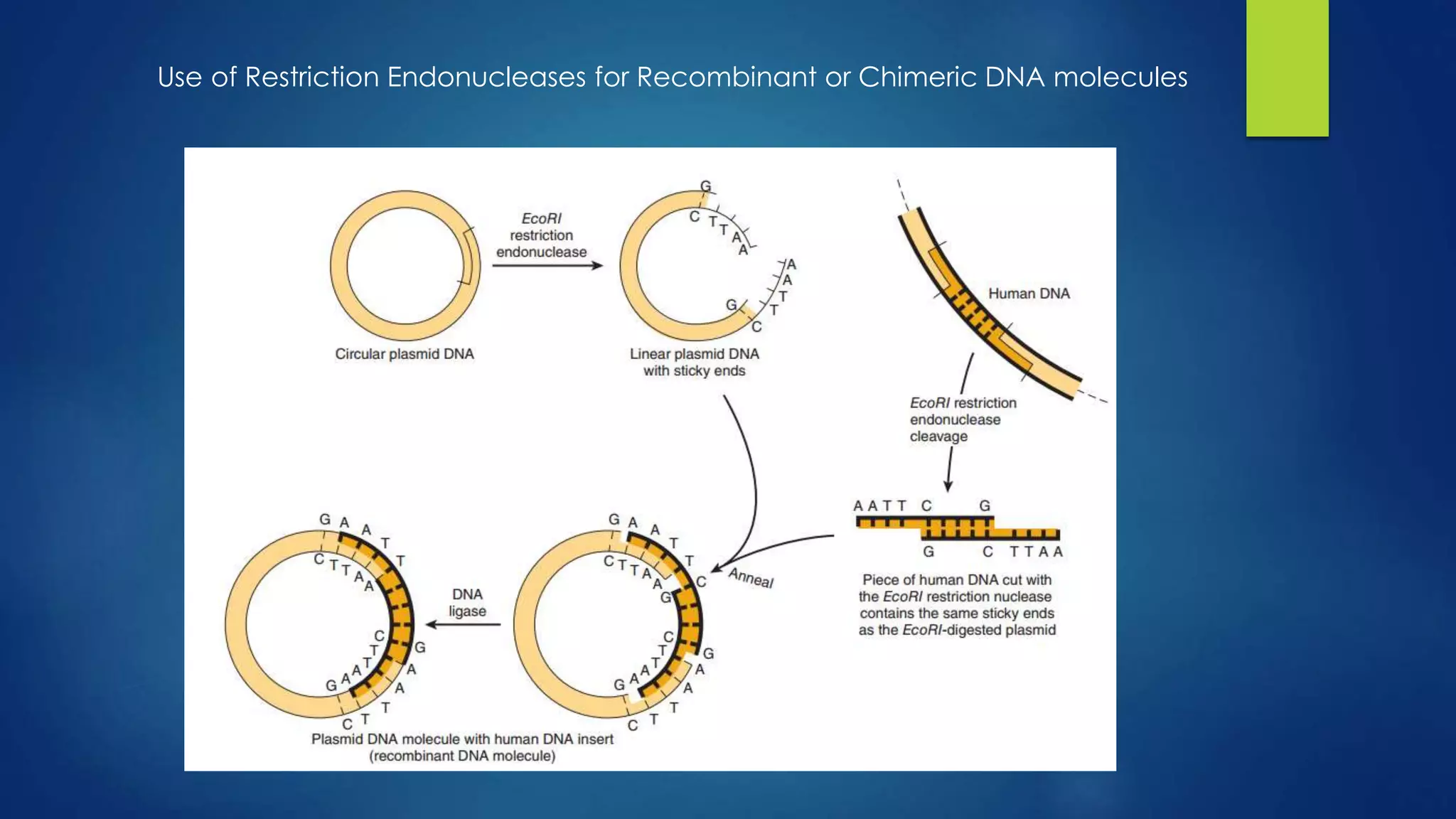
Use of Restriction Endonucleases for Recombinant or Chimeric DNA molecules
Cloning Vectors
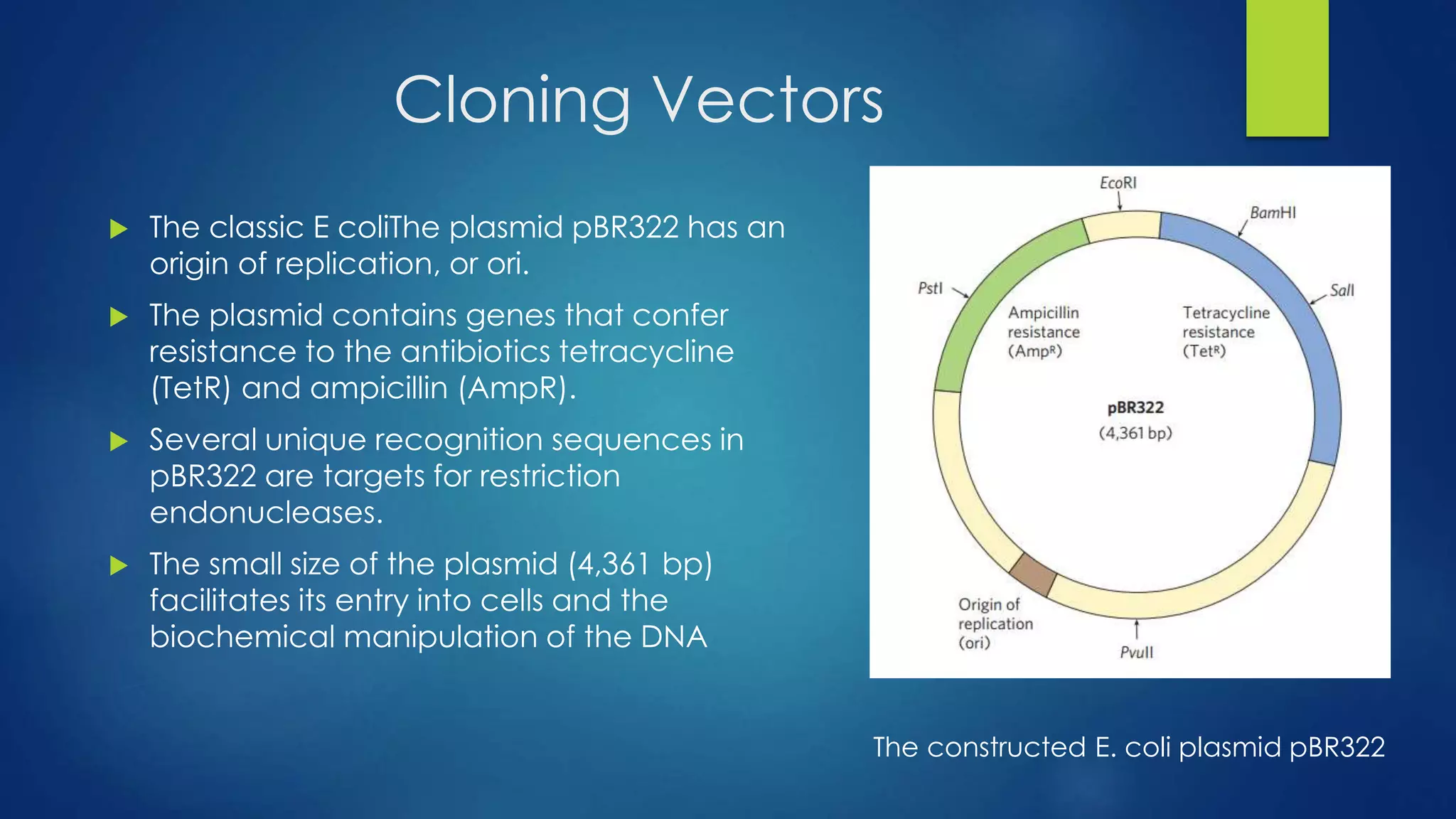
 The classic E coliThe plasmid pBR322 has an
origin of replication, or ori.
 The plasmid contains genes that confer
resistance to the antibiotics tetracycline
(TetR) and ampicillin (AmpR).
 Several unique recognition sequences in
pBR322 are targets for restriction
endonucleases.
 The small size of the plasmid (4,361 bp)
facilitates its entry into cells and the
biochemical manipulation of the DNA
The constructed E. coli plasmid pBR322
Inserting the DNA
 Transformation
 The cells (often E. coli, but other bacterial species are also used) and plasmid DNA
are incubated together at 0ºC in a calcium chloride solution
 Subjected to heat shock by rapidly shifting the temperature to between 37ºC and
43ºC.
 Electroporation
 Cells incubated with the plasmid DNA are subjected to a high voltage pulse.
 This approach, called electroporation, transiently renders the bacterial membrane
permeable to large molecules.
 Bacteriophage
 These are viruses like λ- Phage that can infect bacteria and incorporate its DNA into
it.
 The DNA of the phage tailored and the phage uses bacterial machinery for
replication
Identification of the Cells
 Regardless of approach relatively few cells take up
plasmids
 Use of Selectable or Screenable markers.
 Selectable markers:
 Either permit the growth of a cell (positive selection) or kill
the cell (negative selection) under a defined set of
conditions. The plasmid pBR322 provides examples of
both positive and negative selection
 Screenable Markers:
 Gene encoding a protein that causes the cell to
produce a colored or fluorescent molecule.
Use of pBR322 to clone foreign DNA in E. coli and identify
cells containing it
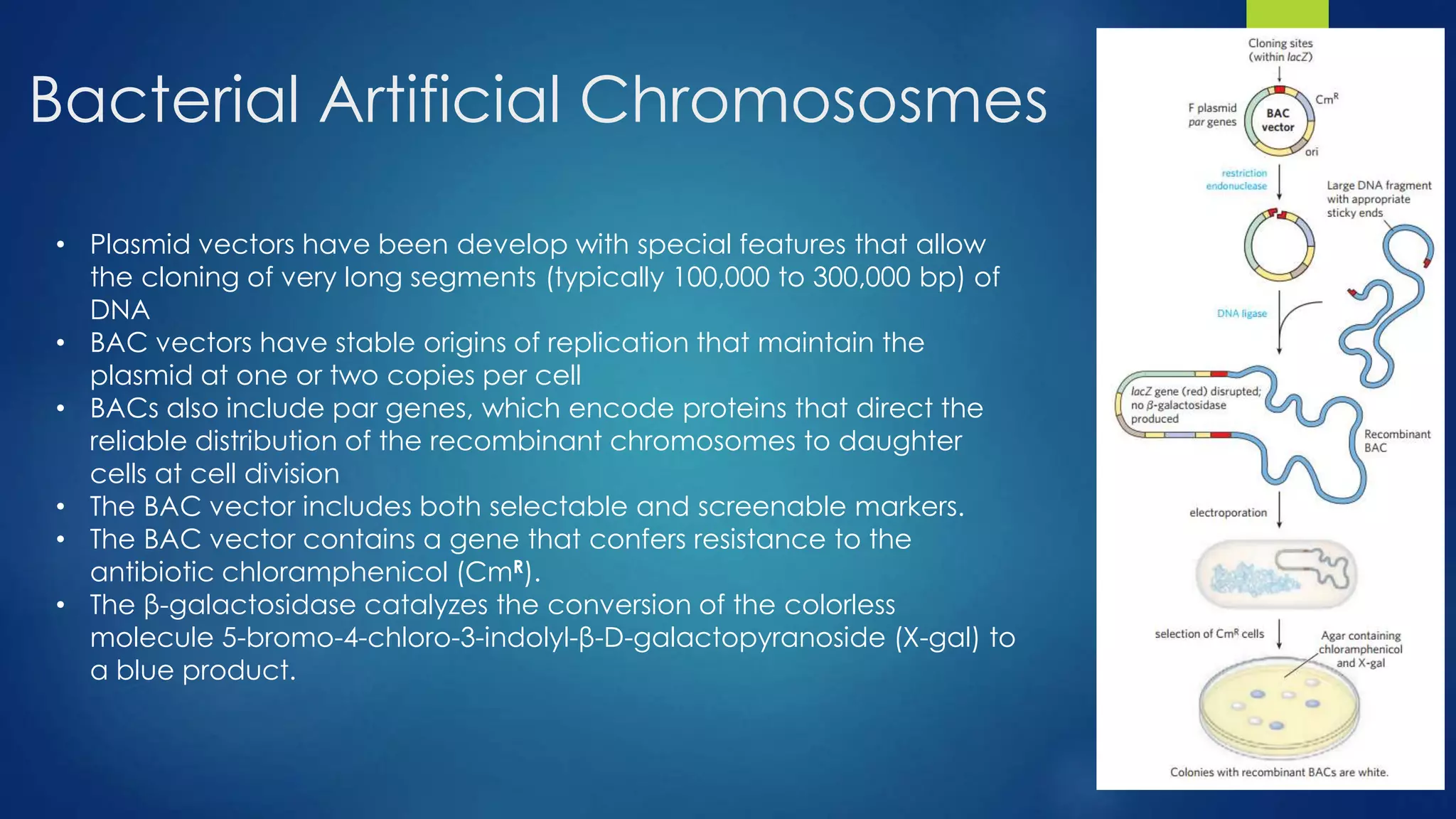
Bacterial Artificial Chromososmes
• Plasmid vectors have been develop with special features that allow
the cloning of very long segments (typically 100,000 to 300,000 bp) of
DNA
• BAC vectors have stable origins of replication that maintain the
plasmid at one or two copies per cell
• BACs also include par genes, which encode proteins that direct the
reliable distribution of the recombinant chromosomes to daughter
cells at cell division
• The BAC vector includes both selectable and screenable markers.
• The BAC vector contains a gene that confers resistance to the
antibiotic chloramphenicol (CmR).
• The β-galactosidase catalyzes the conversion of the colorless
molecule 5-bromo-4-chloro-3-indolyl-β-D-galactopyranoside (X-gal) to
a blue product.
Yeast Artificial Chromosome
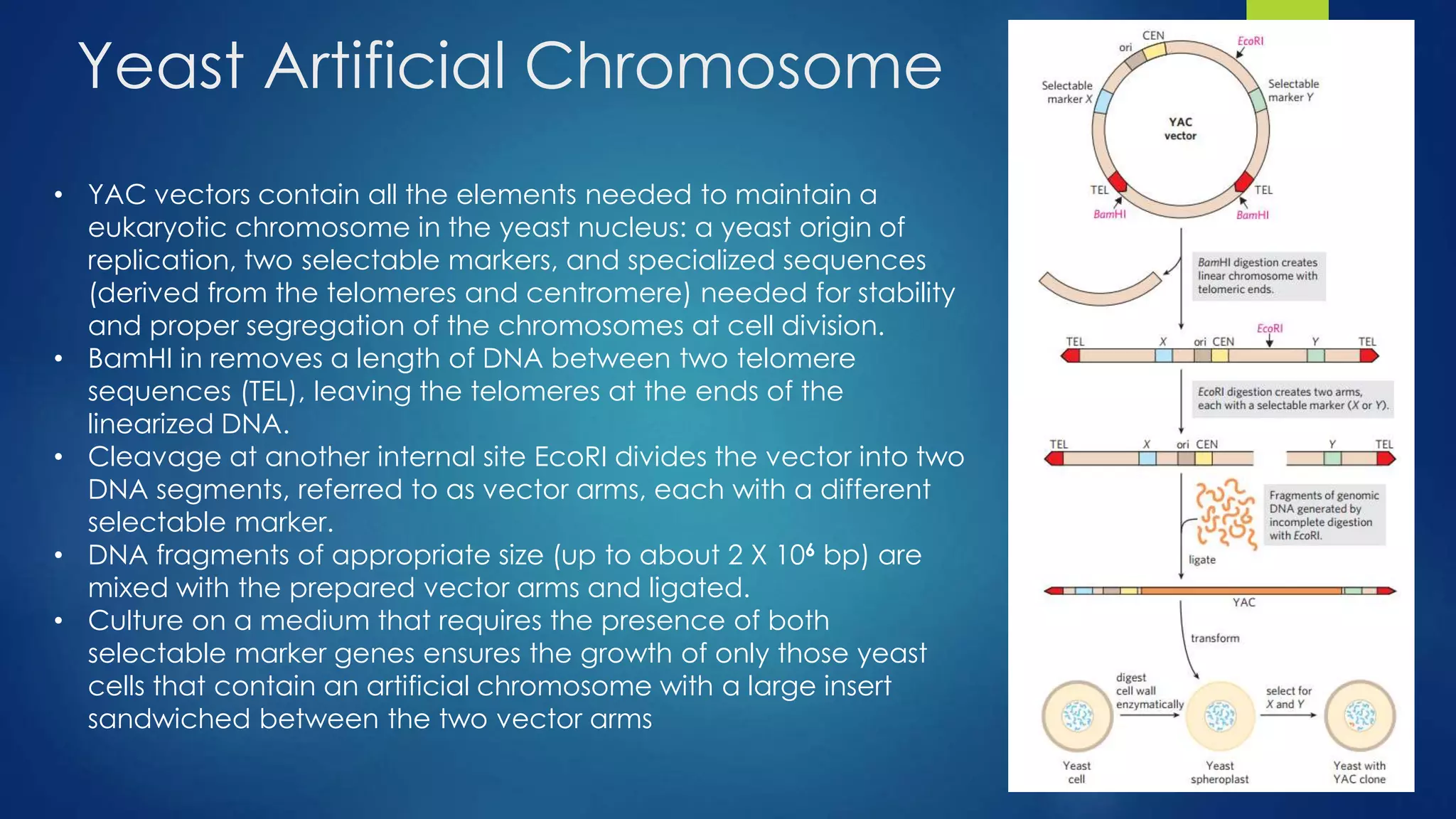
• YAC vectors contain all the elements needed to maintain a
eukaryotic chromosome in the yeast nucleus: a yeast origin of
replication, two selectable markers, and specialized sequences
(derived from the telomeres and centromere) needed for stability
and proper segregation of the chromosomes at cell division.
• BamHI in removes a length of DNA between two telomere
sequences (TEL), leaving the telomeres at the ends of the
linearized DNA.
• Cleavage at another internal site EcoRI divides the vector into two
DNA segments, referred to as vector arms, each with a different
selectable marker.
• DNA fragments of appropriate size (up to about 2 X 10⁶ bp) are
mixed with the prepared vector arms and ligated.
• Culture on a medium that requires the presence of both
selectable marker genes ensures the growth of only those yeast
cells that contain an artificial chromosome with a large insert
sandwiched between the two vector arms
Thank You

Recombinant DNA Technology (Introdcution)

  • 1.
    Recombinant DNA Technology (Introducution) Dr.Abhishek Roy Junior Resident (III) Dept. of Biochemistry Grant Govt. Medical College And Sir JJ Group of Hospitals, Mumbai Email: mail@abhishek.ro Twitter: @abhishekroy
  • 2.
    Objectives  Concept ofRecombinant DNA Technology.  Role of Restriction Endonucleases  Role of Various Enzymes used in Recombinant DNA Technology  Cloning Vectors types, purpose and method of preparation  Plasmids (pBR322)  BAC  YAC
  • 3.
    What is RDT? A clone is an identical copy.  The process DNA Cloning involves  Cutting target DNA at precise locations.  Selecting a small carrier molecule of DNA capable of self-replication.  Joining two DNA fragments covalently.  Moving recombinant DNA from the test tube to a host cell.  Selecting or identifying host cells that contain recombinant DNA.  The methods used to accomplish these and related tasks are collectively referred to as recombinant DNA technology or, more informally, genetic engineering.
  • 4.
    Role of RestrictionEndonucleases  Restriction endonucleases (also called restriction enzymes) recognize and cleave DNA at specific sequences (recognition sequences or restriction sites) to generate a set of smaller fragments.  Restriction endonucleases are found in a wide range of bacterial species.  In the host cell’s DNA, the sequence that would be recognized by its own restriction endonuclease is protected from digestion by methylation of the DNA, catalyzed by a specific DNA methylase.  The restriction endonuclease and the corresponding methylase are sometimes referred to as a restriction modification system.  Three types: Type I, Type II and Type III.  Type I and Type III require ATP and cleave at a site downstream to the recognition site
  • 5.
    Types of RestrictionEndonucleases II • They recognize palindromic sequences • Restriction Endonuclease II cleave at the recognition site. • Don’t require ATP. • Restriction enzymes are named after the bacterium from • which they are isolated. • The foreign DNA that is cleaved is said to be restricted.
  • 6.
    Nomenclature  If wetake the example of EcoRI or EcoRII  E- Genus name, here Eschericia  co- Species name, here coli  R- Strain name  I/II- Roman numeral to indicate order of discovery.
  • 7.
    Some Enzymes usedin Recombinant DNA Research
  • 8.
    Digestion with arestriction endonuclease can result in the formation of DNA fragments with sticky, or cohesive, ends (A), or blunt ends (B); phosphodiester backbone, black lines; interstrand hydrogen bonds between purine and pyrimidine bases. Results of restriction Endonuclease digestion
  • 9.
    Cleavage of DNAmolecules by restriction endonucleases a) sticky ends (with protruding single strands b) Blunt ends. Blunt ends are annealed directly. • Two alternatives: • Use Terminal Transferase to add Poly d(G) and Poly d(C) to Vector DNA and Foreign DNA respectively (Homopolymer Tailing) • Use synthetic blunt-ended duplex oligonucleotide linkers containing the recognition sequence for a convenient restriction enzyme sequence are ligate to the blunt-ended DNA.
  • 10.
    • Once aDNA molecule has been cleaved into fragments, a particular fragment of known size can be partially purified by agarose or acrylamide gel electrophoresis or by HPLC. • After the target DNA fragment is isolated, DNA ligase can be used to join it to a similarly digested cloning vector—that is, a vector digested by the same restriction endonuclease
  • 11.
     DNA ligasecatalyzes the formation of new phosphodiester bonds in a reaction that uses ATP or a similar cofactor.  The base pairing of complementary sticky ends greatly facilitates the ligation reaction.  Researchers can create new DNA sequences by inserting synthetic DNA fragments (called linkers) between the ends that are being ligated  Inserted DNA fragments with multiple recognition sequences for restriction endonucleases (often useful later as points for inserting additional DNA by cleavage and ligation) are called polylinkers.
  • 12.
    Cloning  A cloneis a large population of identical molecules, bacteria, or cells that arise from a common ancestor.  This technique is based on the fact that chimeric or hybrid DNA molecules can be constructed in cloning vectors— typically bacterial plasmids, phages, or cosmids. Cloning capacities of common cloning vectors
  • 13.
    Use of RestrictionEndonucleases for Recombinant or Chimeric DNA molecules
  • 14.
    Cloning Vectors  Theclassic E coliThe plasmid pBR322 has an origin of replication, or ori.  The plasmid contains genes that confer resistance to the antibiotics tetracycline (TetR) and ampicillin (AmpR).  Several unique recognition sequences in pBR322 are targets for restriction endonucleases.  The small size of the plasmid (4,361 bp) facilitates its entry into cells and the biochemical manipulation of the DNA The constructed E. coli plasmid pBR322
  • 15.
    Inserting the DNA Transformation  The cells (often E. coli, but other bacterial species are also used) and plasmid DNA are incubated together at 0ºC in a calcium chloride solution  Subjected to heat shock by rapidly shifting the temperature to between 37ºC and 43ºC.  Electroporation  Cells incubated with the plasmid DNA are subjected to a high voltage pulse.  This approach, called electroporation, transiently renders the bacterial membrane permeable to large molecules.  Bacteriophage  These are viruses like λ- Phage that can infect bacteria and incorporate its DNA into it.  The DNA of the phage tailored and the phage uses bacterial machinery for replication
  • 16.
    Identification of theCells  Regardless of approach relatively few cells take up plasmids  Use of Selectable or Screenable markers.  Selectable markers:  Either permit the growth of a cell (positive selection) or kill the cell (negative selection) under a defined set of conditions. The plasmid pBR322 provides examples of both positive and negative selection  Screenable Markers:  Gene encoding a protein that causes the cell to produce a colored or fluorescent molecule.
  • 17.
    Use of pBR322to clone foreign DNA in E. coli and identify cells containing it
  • 18.
    Bacterial Artificial Chromososmes •Plasmid vectors have been develop with special features that allow the cloning of very long segments (typically 100,000 to 300,000 bp) of DNA • BAC vectors have stable origins of replication that maintain the plasmid at one or two copies per cell • BACs also include par genes, which encode proteins that direct the reliable distribution of the recombinant chromosomes to daughter cells at cell division • The BAC vector includes both selectable and screenable markers. • The BAC vector contains a gene that confers resistance to the antibiotic chloramphenicol (CmR). • The β-galactosidase catalyzes the conversion of the colorless molecule 5-bromo-4-chloro-3-indolyl-β-D-galactopyranoside (X-gal) to a blue product.
  • 19.
    Yeast Artificial Chromosome •YAC vectors contain all the elements needed to maintain a eukaryotic chromosome in the yeast nucleus: a yeast origin of replication, two selectable markers, and specialized sequences (derived from the telomeres and centromere) needed for stability and proper segregation of the chromosomes at cell division. • BamHI in removes a length of DNA between two telomere sequences (TEL), leaving the telomeres at the ends of the linearized DNA. • Cleavage at another internal site EcoRI divides the vector into two DNA segments, referred to as vector arms, each with a different selectable marker. • DNA fragments of appropriate size (up to about 2 X 10⁶ bp) are mixed with the prepared vector arms and ligated. • Culture on a medium that requires the presence of both selectable marker genes ensures the growth of only those yeast cells that contain an artificial chromosome with a large insert sandwiched between the two vector arms
  • 20.

Editor's Notes

  • #10 Fragments can be ligated to other DNAs, such as the cleaved cloning vector (a plasmid) shown here. This reaction is facilitated by the annealing of complementary sticky ends. Ligation is less efficient for DNA fragments with blunt ends than for those with complementary sticky ends, and DNA fragments with different (noncomplementary) sticky ends generally are not ligated.