Recombinant DNA
MD MATIUR RAHMAN
ID: 01101152009
Dept.: Biochemistry & Cell Biology
Course Title: Molecular Biology II
Recombinant DNA
• Recombinant DNA is a DNA molecule
constructed by joining two DNA segment
derived from different sources. The segments
should be cut by the same restriction
enzyme.
• The technology that are used in DNA cloning,
which permits researcher to prepare large
number of identical DNA molecule is called
Recombinant DNA technology
Basics steps for DNA cloning
Vector + DNA fragment
Recombinant DNA
Introduce within a host cell
Replication of recombinant DNA within host cells
Isolation, Sequencing, and manipulation of purified DNA fragments
Restriction enzyme
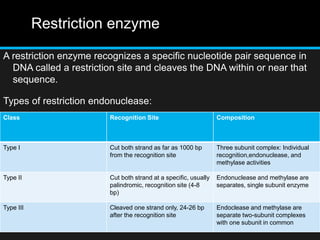
A restriction enzyme recognizes a specific nucleotide pair sequence in
DNA called a restriction site and cleaves the DNA within or near that
sequence.
Types of restriction endonuclease:
Class Recognition Site Composition
Type I Cut both strand as far as 1000 bp
from the recognition site
Three subunit complex: Individual
recognition,endonuclease, and
methylase activities
Type II Cut both strand at a specific, usually
palindromic, recognition site (4-8
bp)
Endonuclease and methylase are
separates, single subunit enzyme
Type III Cleaved one strand only, 24-26 bp
after the recognition site
Endoclease and methylase are
separate two-subunit complexes
with one subunit in common
Cutting DNA molecule by restriction enzyme
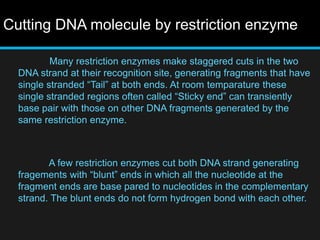
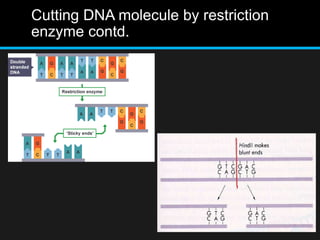
Many restriction enzymes make staggered cuts in the two
DNA strand at their recognition site, generating fragments that have
single stranded “Tail” at both ends. At room temparature these
single stranded regions often called “Sticky end” can transiently
base pair with those on other DNA fragments generated by the
same restriction enzyme.
A few restriction enzymes cut both DNA strand generating
fragements with “blunt” ends in which all the nucleotide at the
fragment ends are base pared to nucleotides in the complementary
strand. The blunt ends do not form hydrogen bond with each other.
Cutting DNA molecule by restriction
enzyme contd.
Cloning vector
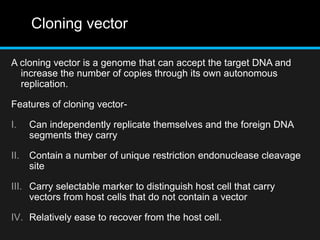
A cloning vector is a genome that can accept the target DNA and
increase the number of copies through its own autonomous
replication.
Features of cloning vector-
I. Can independently replicate themselves and the foreign DNA
segments they carry
II. Contain a number of unique restriction endonuclease cleavage
site
III. Carry selectable marker to distinguish host cell that carry
vectors from host cells that do not contain a vector
IV. Relatively ease to recover from the host cell.
Cloning vecctors contd.
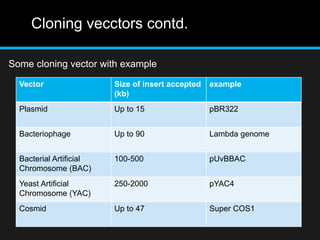
Some cloning vector with example
Vector Size of insert accepted
(kb)
example
Plasmid Up to 15 pBR322
Bacteriophage Up to 90 Lambda genome
Bacterial Artificial
Chromosome (BAC)
100-500 pUvBBAC
Yeast Artificial
Chromosome (YAC)
250-2000 pYAC4
Cosmid Up to 47 Super COS1
Plasmid
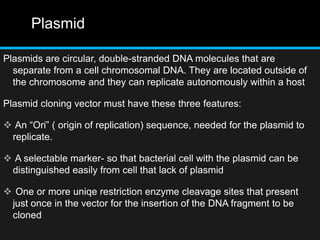
Plasmids are circular, double-stranded DNA molecules that are
separate from a cell chromosomal DNA. They are located outside of
the chromosome and they can replicate autonomously within a host
Plasmid cloning vector must have these three features:
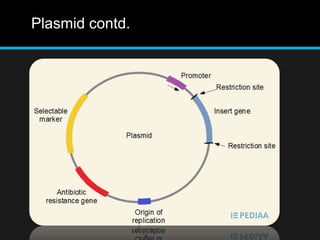
 An “Ori” ( origin of replication) sequence, needed for the plasmid to
replicate.
 A selectable marker- so that bacterial cell with the plasmid can be
distinguished easily from cell that lack of plasmid
 One or more uniqe restriction enzyme cleavage sites that present
just once in the vector for the insertion of the DNA fragment to be
cloned
Plasmid contd.
pBR322
One of the first versatile plasmid vectors developed. It is the
ancestor of many of the common plasmid vectors used in
biochemistry laboratories
Features of pBR322 :
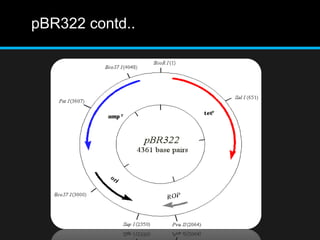
 contain an origin of replication (ori) and a gene (rop) that helps to
regulate the number of copies of plasmid DNA in a cell
 There are two selectable marker genes, confers resistance to
ampicillin and tetracyclin
 Contain a number of unique restriction sites that are useful
constructing recombinant DNA
pBR322 contd.
Advantage of pBR322 :
I. Small size enables easy purification and manipulation.
II. Two selectable marker allow easily selection of recombinant
DNA
Disadvantage of pBR322 :
I. It has very high mobility
II. Not a very high copy number is present as is expected from a
good vector
pBR322 contd..
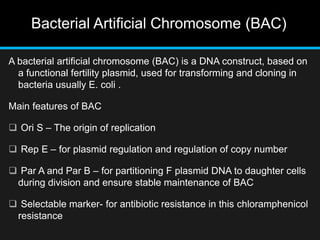
Bacterial Artificial Chromosome (BAC)
A bacterial artificial chromosome (BAC) is a DNA construct, based on
a functional fertility plasmid, used for transforming and cloning in
bacteria usually E. coli .
Main features of BAC
 Ori S – The origin of replication
 Rep E – for plasmid regulation and regulation of copy number
 Par A and Par B – for partitioning F plasmid DNA to daughter cells
during division and ensure stable maintenance of BAC
 Selectable marker- for antibiotic resistance in this chloramphenicol
resistance
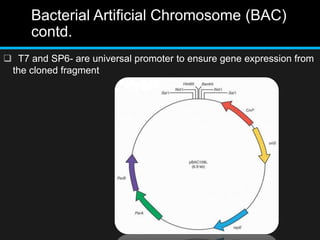
Bacterial Artificial Chromosome (BAC)
contd.
 T7 and SP6- are universal promoter to ensure gene expression from
the cloned fragment
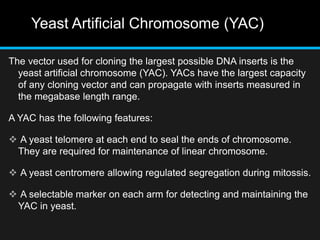
Yeast Artificial Chromosome (YAC)
The vector used for cloning the largest possible DNA inserts is the
yeast artificial chromosome (YAC). YACs have the largest capacity
of any cloning vector and can propagate with inserts measured in
the megabase length range.
A YAC has the following features:
 A yeast telomere at each end to seal the ends of chromosome.
They are required for maintenance of linear chromosome.
 A yeast centromere allowing regulated segregation during mitossis.
 A selectable marker on each arm for detecting and maintaining the
YAC in yeast.
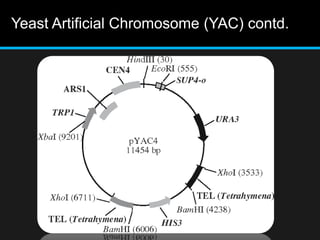
Yeast Artificial Chromosome (YAC) contd.
 An origin of replication sequence ARS that allows the vector to
replicate in a yeast cell.
An origin of replication (ori) that allows vector to replicate and a
selectable marker such as amp
 A cloning region that contains one or more restriction site, the
restriction cutting in this site.
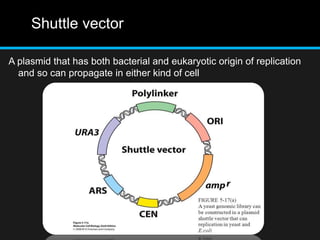
Shuttle vector
A plasmid that has both bacterial and eukaryotic origin of replication
and so can propagate in either kind of cell
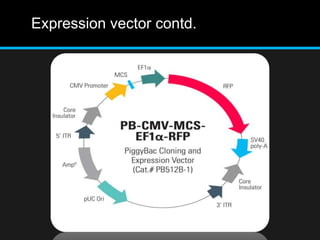
Expression vector
An expression vector is a cloning vector containing the necessary
regulatory sequence to allow transcription and translation of a
cloned gene or genes.
Features of expression vector:
 A promoter upstream of the multiple cloning site
 A transcription terminator downstream of the multiple cloning site
and
 A DNA sequence encoding Shine Dalgarno sequence for
translation initiation located between the promoter and the multiple
cloning site
Expression vector contd.
Basic steps for recombinant DNA
 Isolation and purification of DNA
Both vector and target DNA molecule can be prepared by a variety of
routine method of heating the cell extracts in the presence of
detergents and removing proteins by phenol extraction. In some
cases the target DNA is synthesized in vitro.
 Cleavage of DNA at particular sequence
Cleaving DNA to generate fragment of defined length or specific end
point is done by restriction enzyme usually endonuclease
 Ligation of DNA fragments
A recombinant DNA molecule is usually formed by ligating cleaved
DNA to vector DNA. DNA fragments are typically joined by using
DNA ligase
Basic steps for recombinant DNA contd.
 Introduction of recombinant DNA into compatible host cell-
Suitable host cells are selected and rDNA is introduced into these host cells.
The direct uptake of foreign DNA by a host cell is called genetic
transformation. rDNA can also be packaged into virus particle and
transferred into host cell by transfection.
 Replication and expression of recombinant DNA in host cells-
 The inserted gene doing along with the vector will replicate inside the host
so that many copies of the desired gene is synthesized. For expression of
the desired gene, expression vector is used.
 Identification of host cell that contain recombinant DNA of interest-
Vectors are usually contain selction marker through which we can identify the
host cell that have taken up foreign DNA
cDNA library
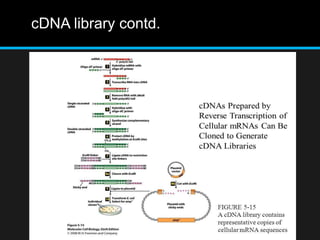
A collection of cDNA clones that represent all the mRNAs expressed
in a cell type is called cDNA library.
Generating a cDNA library :
 Isolation of mRNA- All mRNA have a poly A tail. By using a
column that contains a short poly T sequence it is possible to
isolate the mRNA for both tRNA and rRNA.
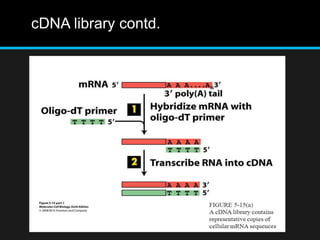
 Isolated mRNA is treated with an enzyme reverse transcriptase,
that will create cDNA intermediate from the mRNA.
By hybridizing the poly A of the mRNA with oligo T’d a primer is
created. Reverse transcriptase recognizes this template and will
add bases to 3’ end.
cDNA library contd.
cDNA library contd.
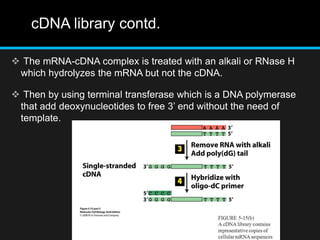
 The mRNA-cDNA complex is treated with an alkali or RNase H
which hydrolyzes the mRNA but not the cDNA.
 Then by using terminal transferase which is a DNA polymerase
that add deoxynucleotides to free 3’ end without the need of
template.
cDNA library contd.
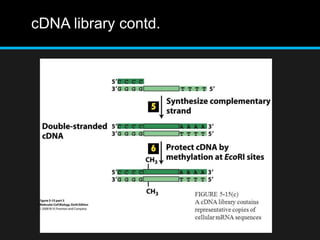
 To this a synthetic poly C is hybridized which is used as primer for
the synthesis of the complentary strand of the cDNA.
 It is necessary to protect the cDNA from unwanted digesstion by
restriction enzymes. Therefore the cDNA is treated with a
modification enzymes. Therefore the cDNA is treated with a
modification enzyme that methylates specific bases within the
restriction enzyme sequence
cDNA library contd.
cDNA library contd.
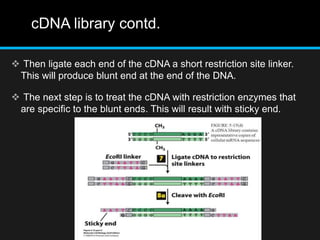
 Then ligate each end of the cDNA a short restriction site linker.
This will produce blunt end at the end of the DNA.
 The next step is to treat the cDNA with restriction enzymes that
are specific to the blunt ends. This will result with sticky end.
cDNA library contd.
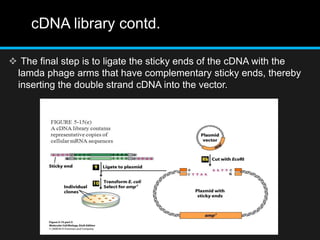
 The final step is to ligate the sticky ends of the cDNA with the
lamda phage arms that have complementary sticky ends, thereby
inserting the double strand cDNA into the vector.
cDNA library contd.
Screening of cDNA library
There are several way to screen a cDNA library-
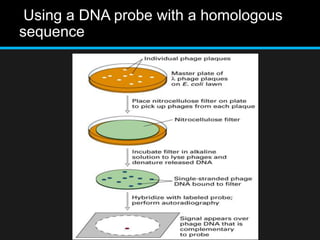
i. Using a DNA probe with a homologous sequence
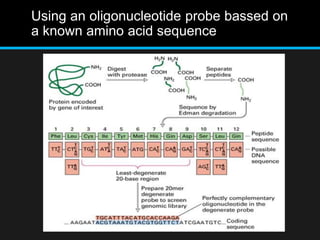
ii. Using an oligonucleotide probe bassed on a known amino acid
sequence
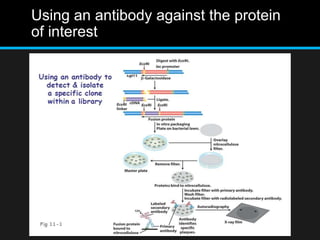
iii. Using an antibody against the protein of interest
iv. Plus/Minus or differential screening
Using a DNA probe with a homologous
sequence
Using an oligonucleotide probe bassed on
a known amino acid sequence
Using an antibody against the protein
of interest

Recombinant dna

  • 1.
    Recombinant DNA MD MATIURRAHMAN ID: 01101152009 Dept.: Biochemistry & Cell Biology Course Title: Molecular Biology II
  • 2.
    Recombinant DNA • RecombinantDNA is a DNA molecule constructed by joining two DNA segment derived from different sources. The segments should be cut by the same restriction enzyme. • The technology that are used in DNA cloning, which permits researcher to prepare large number of identical DNA molecule is called Recombinant DNA technology
  • 3.
    Basics steps forDNA cloning Vector + DNA fragment Recombinant DNA Introduce within a host cell Replication of recombinant DNA within host cells Isolation, Sequencing, and manipulation of purified DNA fragments
  • 4.
    Restriction enzyme A restrictionenzyme recognizes a specific nucleotide pair sequence in DNA called a restriction site and cleaves the DNA within or near that sequence. Types of restriction endonuclease: Class Recognition Site Composition Type I Cut both strand as far as 1000 bp from the recognition site Three subunit complex: Individual recognition,endonuclease, and methylase activities Type II Cut both strand at a specific, usually palindromic, recognition site (4-8 bp) Endonuclease and methylase are separates, single subunit enzyme Type III Cleaved one strand only, 24-26 bp after the recognition site Endoclease and methylase are separate two-subunit complexes with one subunit in common
  • 5.
    Cutting DNA moleculeby restriction enzyme Many restriction enzymes make staggered cuts in the two DNA strand at their recognition site, generating fragments that have single stranded “Tail” at both ends. At room temparature these single stranded regions often called “Sticky end” can transiently base pair with those on other DNA fragments generated by the same restriction enzyme. A few restriction enzymes cut both DNA strand generating fragements with “blunt” ends in which all the nucleotide at the fragment ends are base pared to nucleotides in the complementary strand. The blunt ends do not form hydrogen bond with each other.
  • 6.
    Cutting DNA moleculeby restriction enzyme contd.
  • 7.
    Cloning vector A cloningvector is a genome that can accept the target DNA and increase the number of copies through its own autonomous replication. Features of cloning vector- I. Can independently replicate themselves and the foreign DNA segments they carry II. Contain a number of unique restriction endonuclease cleavage site III. Carry selectable marker to distinguish host cell that carry vectors from host cells that do not contain a vector IV. Relatively ease to recover from the host cell.
  • 8.
    Cloning vecctors contd. Somecloning vector with example Vector Size of insert accepted (kb) example Plasmid Up to 15 pBR322 Bacteriophage Up to 90 Lambda genome Bacterial Artificial Chromosome (BAC) 100-500 pUvBBAC Yeast Artificial Chromosome (YAC) 250-2000 pYAC4 Cosmid Up to 47 Super COS1
  • 9.
    Plasmid Plasmids are circular,double-stranded DNA molecules that are separate from a cell chromosomal DNA. They are located outside of the chromosome and they can replicate autonomously within a host Plasmid cloning vector must have these three features:  An “Ori” ( origin of replication) sequence, needed for the plasmid to replicate.  A selectable marker- so that bacterial cell with the plasmid can be distinguished easily from cell that lack of plasmid  One or more uniqe restriction enzyme cleavage sites that present just once in the vector for the insertion of the DNA fragment to be cloned
  • 10.
  • 11.
    pBR322 One of thefirst versatile plasmid vectors developed. It is the ancestor of many of the common plasmid vectors used in biochemistry laboratories Features of pBR322 :  contain an origin of replication (ori) and a gene (rop) that helps to regulate the number of copies of plasmid DNA in a cell  There are two selectable marker genes, confers resistance to ampicillin and tetracyclin  Contain a number of unique restriction sites that are useful constructing recombinant DNA
  • 12.
    pBR322 contd. Advantage ofpBR322 : I. Small size enables easy purification and manipulation. II. Two selectable marker allow easily selection of recombinant DNA Disadvantage of pBR322 : I. It has very high mobility II. Not a very high copy number is present as is expected from a good vector
  • 13.
  • 14.
    Bacterial Artificial Chromosome(BAC) A bacterial artificial chromosome (BAC) is a DNA construct, based on a functional fertility plasmid, used for transforming and cloning in bacteria usually E. coli . Main features of BAC  Ori S – The origin of replication  Rep E – for plasmid regulation and regulation of copy number  Par A and Par B – for partitioning F plasmid DNA to daughter cells during division and ensure stable maintenance of BAC  Selectable marker- for antibiotic resistance in this chloramphenicol resistance
  • 15.
    Bacterial Artificial Chromosome(BAC) contd.  T7 and SP6- are universal promoter to ensure gene expression from the cloned fragment
  • 16.
    Yeast Artificial Chromosome(YAC) The vector used for cloning the largest possible DNA inserts is the yeast artificial chromosome (YAC). YACs have the largest capacity of any cloning vector and can propagate with inserts measured in the megabase length range. A YAC has the following features:  A yeast telomere at each end to seal the ends of chromosome. They are required for maintenance of linear chromosome.  A yeast centromere allowing regulated segregation during mitossis.  A selectable marker on each arm for detecting and maintaining the YAC in yeast.
  • 17.
  • 18.
    Yeast Artificial Chromosome(YAC) contd.  An origin of replication sequence ARS that allows the vector to replicate in a yeast cell. An origin of replication (ori) that allows vector to replicate and a selectable marker such as amp  A cloning region that contains one or more restriction site, the restriction cutting in this site.
  • 19.
    Shuttle vector A plasmidthat has both bacterial and eukaryotic origin of replication and so can propagate in either kind of cell
  • 20.
    Expression vector An expressionvector is a cloning vector containing the necessary regulatory sequence to allow transcription and translation of a cloned gene or genes. Features of expression vector:  A promoter upstream of the multiple cloning site  A transcription terminator downstream of the multiple cloning site and  A DNA sequence encoding Shine Dalgarno sequence for translation initiation located between the promoter and the multiple cloning site
  • 21.
  • 22.
    Basic steps forrecombinant DNA  Isolation and purification of DNA Both vector and target DNA molecule can be prepared by a variety of routine method of heating the cell extracts in the presence of detergents and removing proteins by phenol extraction. In some cases the target DNA is synthesized in vitro.  Cleavage of DNA at particular sequence Cleaving DNA to generate fragment of defined length or specific end point is done by restriction enzyme usually endonuclease  Ligation of DNA fragments A recombinant DNA molecule is usually formed by ligating cleaved DNA to vector DNA. DNA fragments are typically joined by using DNA ligase
  • 23.
    Basic steps forrecombinant DNA contd.  Introduction of recombinant DNA into compatible host cell- Suitable host cells are selected and rDNA is introduced into these host cells. The direct uptake of foreign DNA by a host cell is called genetic transformation. rDNA can also be packaged into virus particle and transferred into host cell by transfection.  Replication and expression of recombinant DNA in host cells-  The inserted gene doing along with the vector will replicate inside the host so that many copies of the desired gene is synthesized. For expression of the desired gene, expression vector is used.  Identification of host cell that contain recombinant DNA of interest- Vectors are usually contain selction marker through which we can identify the host cell that have taken up foreign DNA
  • 24.
    cDNA library A collectionof cDNA clones that represent all the mRNAs expressed in a cell type is called cDNA library. Generating a cDNA library :  Isolation of mRNA- All mRNA have a poly A tail. By using a column that contains a short poly T sequence it is possible to isolate the mRNA for both tRNA and rRNA.  Isolated mRNA is treated with an enzyme reverse transcriptase, that will create cDNA intermediate from the mRNA. By hybridizing the poly A of the mRNA with oligo T’d a primer is created. Reverse transcriptase recognizes this template and will add bases to 3’ end.
  • 25.
  • 26.
    cDNA library contd. The mRNA-cDNA complex is treated with an alkali or RNase H which hydrolyzes the mRNA but not the cDNA.  Then by using terminal transferase which is a DNA polymerase that add deoxynucleotides to free 3’ end without the need of template.
  • 27.
    cDNA library contd. To this a synthetic poly C is hybridized which is used as primer for the synthesis of the complentary strand of the cDNA.  It is necessary to protect the cDNA from unwanted digesstion by restriction enzymes. Therefore the cDNA is treated with a modification enzymes. Therefore the cDNA is treated with a modification enzyme that methylates specific bases within the restriction enzyme sequence
  • 28.
  • 29.
    cDNA library contd. Then ligate each end of the cDNA a short restriction site linker. This will produce blunt end at the end of the DNA.  The next step is to treat the cDNA with restriction enzymes that are specific to the blunt ends. This will result with sticky end.
  • 30.
    cDNA library contd. The final step is to ligate the sticky ends of the cDNA with the lamda phage arms that have complementary sticky ends, thereby inserting the double strand cDNA into the vector.
  • 31.
  • 32.
    Screening of cDNAlibrary There are several way to screen a cDNA library- i. Using a DNA probe with a homologous sequence ii. Using an oligonucleotide probe bassed on a known amino acid sequence iii. Using an antibody against the protein of interest iv. Plus/Minus or differential screening
  • 33.
    Using a DNAprobe with a homologous sequence
  • 34.
    Using an oligonucleotideprobe bassed on a known amino acid sequence
  • 35.
    Using an antibodyagainst the protein of interest