Mansi Prajapati
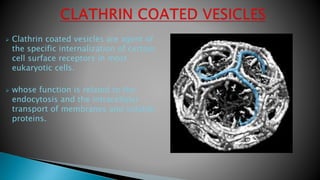
 Clathrin coated vesicles are agent of
the specific internalization of certain
cell surface receptors in most
eukaryotic cells.
 whose function is related to the
endocytosis and the intracellular
transport of membranes and soluble
proteins.
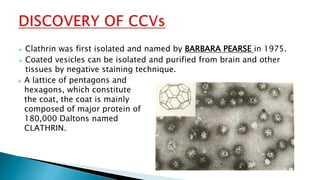
 Clathrin was first isolated and named by BARBARA PEARSE in 1975.
 Coated vesicles can be isolated and purified from brain and other
tissues by negative staining technique.
 A lattice of pentagons and
hexagons, which constitute
the coat, the coat is mainly
composed of major protein of
180,000 Daltons named
CLATHRIN.
 It forms a triskelion shape
composed of three light chain
and three heavy chains. When the
triskelion interact they forms a
polyhedral lattice that surround
the vesicle.
The three heavy chain provide
the structural backbone of the
clathrin lattice.
The three light chains are
regulate the assembly and
disassembly.
CLATHRIN MEDIATED
ENDOCYTOSIS
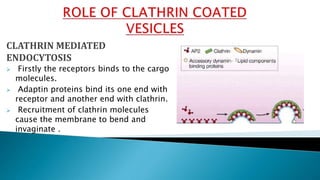
 Firstly the receptors binds to the cargo
molecules.
 Adaptin proteins bind its one end with
receptor and another end with clathrin.
 Recruitment of clathrin molecules
cause the membrane to bend and
invaginate .
 Now, the vesicles uncoated,
losing clathrin lattice.
 The vesicles fuses with the
endosome. the low endosomal
pH causes the receptors to
release their cargo molecules.
 Empty receptors are recycled to
plasma membrane in vesicles
that bud off from the
endosome.
 The endosomal content is then
delivered to a lysosome which
contains hydrolytic enzymes
capable of degradation.
 Dynamin forms a ring
around the stalk.
 GTP hydrolysis causes a
conformational changes in
the dynamin ring, leading
to fission of the coated
vesicles from the plasma
membrane.
The photograph showing that clathrin mediated endocytosis
This video showing the clathrin mediated endocytosis
and degradation
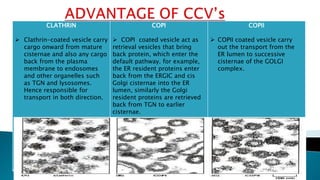
CLATHRIN
 Clathrin-coated vesicle carry
cargo onward from mature
cisternae and also any cargo
back from the plasma
membrane to endosomes
and other organelles such
as TGN and lysosomes.
Hence responsible for
transport in both direction.
COPI
 COPI coated vesicle act as
retrieval vesicles that bring
back protein, which enter the
default pathway. for example,
the ER resident proteins enter
back from the ERGIC and cis
Golgi cisternae into the ER
lumen, similarly the Golgi
resident proteins are retrieved
back from TGN to earlier
cisternae.
COPII
 COPII coated vesicle carry
out the transport from the
ER lumen to successive
cisternae of the GOLGI
complex.
 It act as a Multifunctional proteins.
 Uptake of extra cellular yolk into chicken oocytes.
 Transfer of maternal immunoglobulin (IgG) through the
placenta into the fetus.
 Incorporation into cells of macromolecules and protein
bound nutrients.
 The recycling of membranes from exocytose secretary
granules and synaptic vesicles.
Clathrin coated vesicle

Clathrin coated vesicle

  • 1.
  • 2.
     Clathrin coatedvesicles are agent of the specific internalization of certain cell surface receptors in most eukaryotic cells.  whose function is related to the endocytosis and the intracellular transport of membranes and soluble proteins.
  • 3.
     Clathrin wasfirst isolated and named by BARBARA PEARSE in 1975.  Coated vesicles can be isolated and purified from brain and other tissues by negative staining technique.  A lattice of pentagons and hexagons, which constitute the coat, the coat is mainly composed of major protein of 180,000 Daltons named CLATHRIN.
  • 4.
     It formsa triskelion shape composed of three light chain and three heavy chains. When the triskelion interact they forms a polyhedral lattice that surround the vesicle. The three heavy chain provide the structural backbone of the clathrin lattice. The three light chains are regulate the assembly and disassembly.
  • 5.
    CLATHRIN MEDIATED ENDOCYTOSIS  Firstlythe receptors binds to the cargo molecules.  Adaptin proteins bind its one end with receptor and another end with clathrin.  Recruitment of clathrin molecules cause the membrane to bend and invaginate .
  • 6.
     Now, thevesicles uncoated, losing clathrin lattice.  The vesicles fuses with the endosome. the low endosomal pH causes the receptors to release their cargo molecules.  Empty receptors are recycled to plasma membrane in vesicles that bud off from the endosome.
  • 7.
     The endosomalcontent is then delivered to a lysosome which contains hydrolytic enzymes capable of degradation.  Dynamin forms a ring around the stalk.  GTP hydrolysis causes a conformational changes in the dynamin ring, leading to fission of the coated vesicles from the plasma membrane. The photograph showing that clathrin mediated endocytosis
  • 8.
    This video showingthe clathrin mediated endocytosis and degradation
  • 9.
    CLATHRIN  Clathrin-coated vesiclecarry cargo onward from mature cisternae and also any cargo back from the plasma membrane to endosomes and other organelles such as TGN and lysosomes. Hence responsible for transport in both direction. COPI  COPI coated vesicle act as retrieval vesicles that bring back protein, which enter the default pathway. for example, the ER resident proteins enter back from the ERGIC and cis Golgi cisternae into the ER lumen, similarly the Golgi resident proteins are retrieved back from TGN to earlier cisternae. COPII  COPII coated vesicle carry out the transport from the ER lumen to successive cisternae of the GOLGI complex.
  • 10.
     It actas a Multifunctional proteins.  Uptake of extra cellular yolk into chicken oocytes.  Transfer of maternal immunoglobulin (IgG) through the placenta into the fetus.  Incorporation into cells of macromolecules and protein bound nutrients.  The recycling of membranes from exocytose secretary granules and synaptic vesicles.