BACTERIOPHAGE
CLONING VECTORS
(λ AND M13)
Lecture-4
1
2
INRODUCTION
•Esther Lederberg found E.coli K12 to be
lysogenic for λ phage, which marked the
discovery of λ phage as well as
phenomenon of lysogeny
•This is a temprate phage
•It is a lamboid phage that can infect E.coli
3
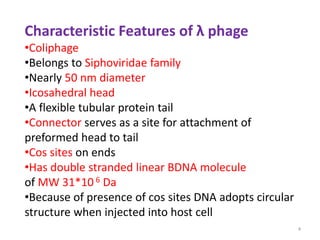
Characteristic Features of λ phage
•Coliphage
•Belongs to Siphoviridae family
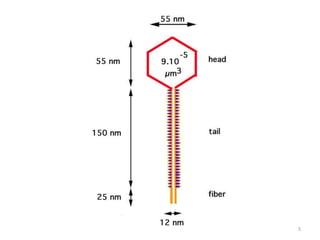
•Nearly 50 nm diameter
•Icosahedral head
•A flexible tubular protein tail
•Connector serves as a site for attachment of
preformed head to tail
•Cos sites on ends
•Has double stranded linear BDNA molecule
of MW 31*10 6 Da
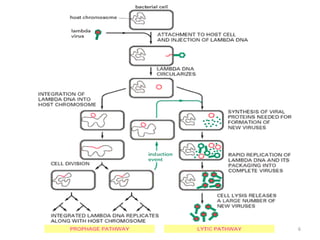
•Because of presence of cos sites DNA adopts circular
structure when injected into host cell
4
5
6
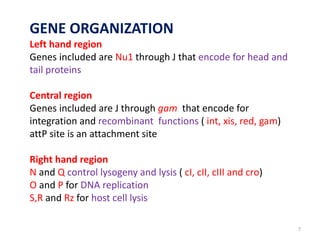
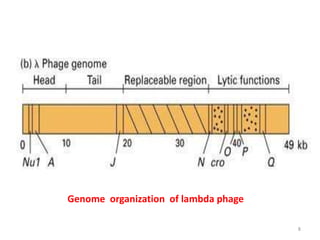
GENE ORGANIZATION
Left hand region
Genes included are Nu1 through J that encode for head and
tail proteins
Central region
Genes included are J through gam that encode for
integration and recombinant functions ( int, xis, red, gam)
attP site is an attachment site
Right hand region
N and Q control lysogeny and lysis ( cI, cII, cIII and cro)
O and P for DNA replication
S,R and Rz for host cell lysis
7
Genome organization of lambda phage
8
λ bacteriophage as a
cloning vehicle
•Large genome size and low insert capacity
Head can accommodate certain amount of DNA ( 48.5
kbp)
•Presence of multiple sites for a commonly used
restriction enzymes
•Size diminution and increasing cloning capacity
Only 50% of genes of wild type phage are essential for
its replication and lysis of host cell
9
•Alteration in the number of cleavage
sites for restriction enzymes
•Natural selection of modified λ
bacteriophage lacking certain restriction
sites
•Natural selection followed by genetic
crossing with λ bacteriophage
10
•Recombinational insertion of regions
from other lamboid phages
This was done by in vivo genetic
recombination that lead to exchange of
immunity regions of two phages λ and
ф434
•In vitro mutagenesis
•In vitro manipulation
11
CLONING IN λ VECTORS
Steps are as follows:
1. Restriction digestion of λ vector as well as genomic
DNA
2. Ligation of the DNA fragments into λ vector to form
recombinants
3. Introduction into host by transfection of competent
E. coli host or in vitro packaging of recombinant DNA
by addition of packaging extract followed by natural
infection of the host
4. Selection and screening of recombinants
12
CHOICE OF λ VECTORS
Following considerations influence the selection of vector:
1. Restriction enzymes to be employed
2. The size of the foreign gene to be inserted
3. Type of screening system to be employed
4. Expression of the cloned gene in E. coli
13
Classes of λ vectors
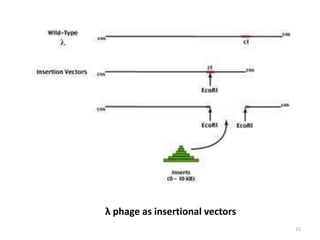
1. Insertional vectors
• Vectors containing at least one unique restriction
enzyme site for the insertion of the foreign DNA
are insertional vectors
• Size of insertional vectors should not be below
37kbp and that of foreign DNA should be such
that it should not increase the size of vector
above 52kbp
• E.g. :λ gt10, λ gt11, λ gt18, λ gt23
14
λ phage as insertional vectors
15
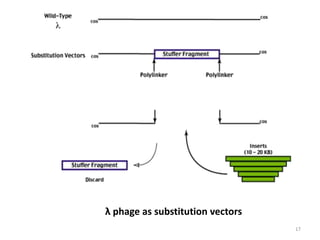
2.Replacement or substitution vectors
•Substituting the non essential part of vector
with gene of interest
•Lowest possible size of replacement vector
should be 37kbp
•E.g.: Charon series, λ EMBL Series, λ gt. λ C, λ
GEM 11, λ GEM 12, λ DASH, λ FIX
16
λ phage as substitution vectors
17
18
INTRODUCTION
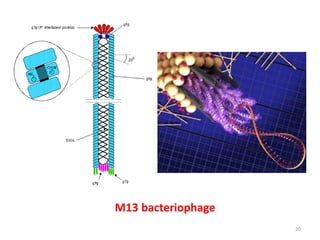
•Filamentous rod shaped E.coli bacteriophage
•Belongs to family Inoviridae
•A small phage
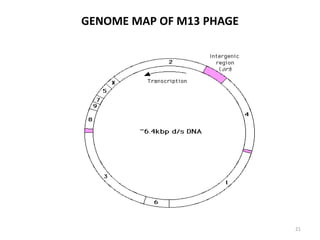
•Has circular single stranded DNA of 6400
nucleotides in length
•During replication inside the host cell M13 is
present in double stranded replicative form (RF)
•During morphogenesis the DNA is converted
into single stranded conformation
•Its genome is completely sequenced
•Phage particle has dimensions of nearly 900 x 6-
7 nm
19
M13 bacteriophage
20
GENOME MAP OF M13 PHAGE
21
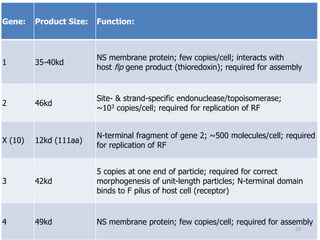
Gene: Product Size: Function:
1 35-40kd
NS membrane protein; few copies/cell; interacts with
host fip gene product (thioredoxin); required for assembly
2 46kd
Site- & strand-specific endonuclease/topoisomerase;
~103 copies/cell; required for replication of RF
X (10) 12kd (111aa)
N-terminal fragment of gene 2; ~500 molecules/cell; required
for replication of RF
3 42kd
5 copies at one end of particle; required for correct
morphogenesis of unit-length particles; N-terminal domain
binds to F pilus of host cell (receptor)
4 49kd NS membrane protein; few copies/cell; required for assembly
22
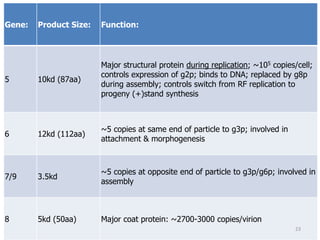
Gene: Product Size: Function:
5 10kd (87aa)
Major structural protein during replication; ~105 copies/cell;
controls expression of g2p; binds to DNA; replaced by g8p
during assembly; controls switch from RF replication to
progeny (+)stand synthesis
6 12kd (112aa)
~5 copies at same end of particle to g3p; involved in
attachment & morphogenesis
7/9 3.5kd
~5 copies at opposite end of particle to g3p/g6p; involved in
assembly
8 5kd (50aa) Major coat protein: ~2700-3000 copies/virion
23
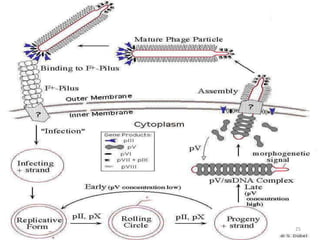
Replication cycle of M13 DNA
24
25
M13 bacteriophage as a cloning vector
First vectors used – M13mp18 & M13mp19
Advantages
– blue/white screening system
– genes cloned in pUC18 or pUC19
– can be subcloned to same sites in M13mp
equivalent
– different directions for multiple cloning sites
- both strands of cloned DNA converted to single-
stranded form in different vectors
26
Disadvantages
– limits to size of cloned DNA (2 kb)
– low yield of DNA
– cannot amplify phage genome numbers
much
– phage proteins toxic in high
concentrations
27
Types of M13 vectors based on location of
cloning sites
1.Cloning into the large intergenic region
2.Cloning into the small intergenic region
3.Cloning into gene X
28
MODIFIED M13 VECTORS
Modified M13 vectors have large number of cloning
sites
Examples:
M13mp1,
M13mp8,
M13mp9,
M13mp10,
M13mp11,
M13mp18,
M13mp19 29
Advantages of modified M13 vectors
1. Facilitate directional cloning by using two different enzymes
for cleavage
2. Cloning in dual vectors is advantageous
3. Cloned DNA fragments can be moved between M13mp
vectors and pUC vectors with great ease
4. The intergenic region of M13 is now standard fixture of most
plasmids
5. Single stranded DNA can be directly isolated from M13
phages
30
Bacterial hosts for M13 vector
•Only male (F+) bacteria are used for
proliferation of M13 phage because it enters
the host cell through sex pilli encoded by F
factor
•Female bacteria can be infected by
transfection
31

Lectut btn-202-ppt-l4. bacteriophage lambda and m13 vectors (1)

  • 1.
  • 2.
  • 3.
    INRODUCTION •Esther Lederberg foundE.coli K12 to be lysogenic for λ phage, which marked the discovery of λ phage as well as phenomenon of lysogeny •This is a temprate phage •It is a lamboid phage that can infect E.coli 3
  • 4.
    Characteristic Features ofλ phage •Coliphage •Belongs to Siphoviridae family •Nearly 50 nm diameter •Icosahedral head •A flexible tubular protein tail •Connector serves as a site for attachment of preformed head to tail •Cos sites on ends •Has double stranded linear BDNA molecule of MW 31*10 6 Da •Because of presence of cos sites DNA adopts circular structure when injected into host cell 4
  • 5.
  • 6.
  • 7.
    GENE ORGANIZATION Left handregion Genes included are Nu1 through J that encode for head and tail proteins Central region Genes included are J through gam that encode for integration and recombinant functions ( int, xis, red, gam) attP site is an attachment site Right hand region N and Q control lysogeny and lysis ( cI, cII, cIII and cro) O and P for DNA replication S,R and Rz for host cell lysis 7
  • 8.
    Genome organization oflambda phage 8
  • 9.
    λ bacteriophage asa cloning vehicle •Large genome size and low insert capacity Head can accommodate certain amount of DNA ( 48.5 kbp) •Presence of multiple sites for a commonly used restriction enzymes •Size diminution and increasing cloning capacity Only 50% of genes of wild type phage are essential for its replication and lysis of host cell 9
  • 10.
    •Alteration in thenumber of cleavage sites for restriction enzymes •Natural selection of modified λ bacteriophage lacking certain restriction sites •Natural selection followed by genetic crossing with λ bacteriophage 10
  • 11.
    •Recombinational insertion ofregions from other lamboid phages This was done by in vivo genetic recombination that lead to exchange of immunity regions of two phages λ and ф434 •In vitro mutagenesis •In vitro manipulation 11
  • 12.
    CLONING IN λVECTORS Steps are as follows: 1. Restriction digestion of λ vector as well as genomic DNA 2. Ligation of the DNA fragments into λ vector to form recombinants 3. Introduction into host by transfection of competent E. coli host or in vitro packaging of recombinant DNA by addition of packaging extract followed by natural infection of the host 4. Selection and screening of recombinants 12
  • 13.
    CHOICE OF λVECTORS Following considerations influence the selection of vector: 1. Restriction enzymes to be employed 2. The size of the foreign gene to be inserted 3. Type of screening system to be employed 4. Expression of the cloned gene in E. coli 13
  • 14.
    Classes of λvectors 1. Insertional vectors • Vectors containing at least one unique restriction enzyme site for the insertion of the foreign DNA are insertional vectors • Size of insertional vectors should not be below 37kbp and that of foreign DNA should be such that it should not increase the size of vector above 52kbp • E.g. :λ gt10, λ gt11, λ gt18, λ gt23 14
  • 15.
    λ phage asinsertional vectors 15
  • 16.
    2.Replacement or substitutionvectors •Substituting the non essential part of vector with gene of interest •Lowest possible size of replacement vector should be 37kbp •E.g.: Charon series, λ EMBL Series, λ gt. λ C, λ GEM 11, λ GEM 12, λ DASH, λ FIX 16
  • 17.
    λ phage assubstitution vectors 17
  • 18.
  • 19.
    INTRODUCTION •Filamentous rod shapedE.coli bacteriophage •Belongs to family Inoviridae •A small phage •Has circular single stranded DNA of 6400 nucleotides in length •During replication inside the host cell M13 is present in double stranded replicative form (RF) •During morphogenesis the DNA is converted into single stranded conformation •Its genome is completely sequenced •Phage particle has dimensions of nearly 900 x 6- 7 nm 19
  • 20.
  • 21.
    GENOME MAP OFM13 PHAGE 21
  • 22.
    Gene: Product Size:Function: 1 35-40kd NS membrane protein; few copies/cell; interacts with host fip gene product (thioredoxin); required for assembly 2 46kd Site- & strand-specific endonuclease/topoisomerase; ~103 copies/cell; required for replication of RF X (10) 12kd (111aa) N-terminal fragment of gene 2; ~500 molecules/cell; required for replication of RF 3 42kd 5 copies at one end of particle; required for correct morphogenesis of unit-length particles; N-terminal domain binds to F pilus of host cell (receptor) 4 49kd NS membrane protein; few copies/cell; required for assembly 22
  • 23.
    Gene: Product Size:Function: 5 10kd (87aa) Major structural protein during replication; ~105 copies/cell; controls expression of g2p; binds to DNA; replaced by g8p during assembly; controls switch from RF replication to progeny (+)stand synthesis 6 12kd (112aa) ~5 copies at same end of particle to g3p; involved in attachment & morphogenesis 7/9 3.5kd ~5 copies at opposite end of particle to g3p/g6p; involved in assembly 8 5kd (50aa) Major coat protein: ~2700-3000 copies/virion 23
  • 24.
  • 25.
  • 26.
    M13 bacteriophage asa cloning vector First vectors used – M13mp18 & M13mp19 Advantages – blue/white screening system – genes cloned in pUC18 or pUC19 – can be subcloned to same sites in M13mp equivalent – different directions for multiple cloning sites - both strands of cloned DNA converted to single- stranded form in different vectors 26
  • 27.
    Disadvantages – limits tosize of cloned DNA (2 kb) – low yield of DNA – cannot amplify phage genome numbers much – phage proteins toxic in high concentrations 27
  • 28.
    Types of M13vectors based on location of cloning sites 1.Cloning into the large intergenic region 2.Cloning into the small intergenic region 3.Cloning into gene X 28
  • 29.
    MODIFIED M13 VECTORS ModifiedM13 vectors have large number of cloning sites Examples: M13mp1, M13mp8, M13mp9, M13mp10, M13mp11, M13mp18, M13mp19 29
  • 30.
    Advantages of modifiedM13 vectors 1. Facilitate directional cloning by using two different enzymes for cleavage 2. Cloning in dual vectors is advantageous 3. Cloned DNA fragments can be moved between M13mp vectors and pUC vectors with great ease 4. The intergenic region of M13 is now standard fixture of most plasmids 5. Single stranded DNA can be directly isolated from M13 phages 30
  • 31.
    Bacterial hosts forM13 vector •Only male (F+) bacteria are used for proliferation of M13 phage because it enters the host cell through sex pilli encoded by F factor •Female bacteria can be infected by transfection 31