RECOMBINANT DNA TECHNOLOGY
Guided By: Dr. P.G. Jain sir Presented By: Shubham D .Mahajan
(F.Y. M-Pharmacy )
Department Of Pharmacology
Recombinant DNA technology procedure by which DNA from
different species can be isolated, cut and spliced together –new
“recombinant” molecule are multiplied in quantity in population
of rapidly dividing cells (eg. Bacteria, yeast).
Recombinant DNA technology
• Intentional modification of organism genome for practical
purpose.
 Three Goals
 Eliminate undesirable phenotypic traits.
 Combine beneficial traits of two or more organisms.
 Create organisms that synthesize products human need.
The Role of Recombinant DNA
Technology in Biotechnology
Basic principles of rDNA technology:
 Generation of DNA Fragments & Selection of the desired piece
of DNA.
 Insertion of the selected DNA into a cloning Vector to create a
rDNA and then introduction of the recombinant vector into host
cell.
 Multiplication and selection of clones containing the
recombinant molecule.
 Expression of gene to produce desired products
4
5
Restriction enzyme
Ligase
Host
Vector
application
Key tool for RDT
Restriction enzyme belong to a larger class of enzyme called
nuclease .
There are two kind of endonucleases
1. Exonuclease remove nucleotide from the ends of the DNA.
2. Endonuclease make cut at specific position within the DNA.
Bacterial enzyme that can cut /split at specific site.
These were first discovered in E. coli, restricting the replication
of bacteriophage by cutting the the viral DNA Thus, the enzyme
that restrict the viral replication are known as restriction enzyme
or restriction endonuclease
Restriction Enzyme
 Restriction endonuclease function by inspecting the length of a
DNA sequence. Once it finds its specific recognition sequence, it
will bind to the DNA and cut each of the two strand of the
double helix at specific points in their sugar-phosphate backbone
.
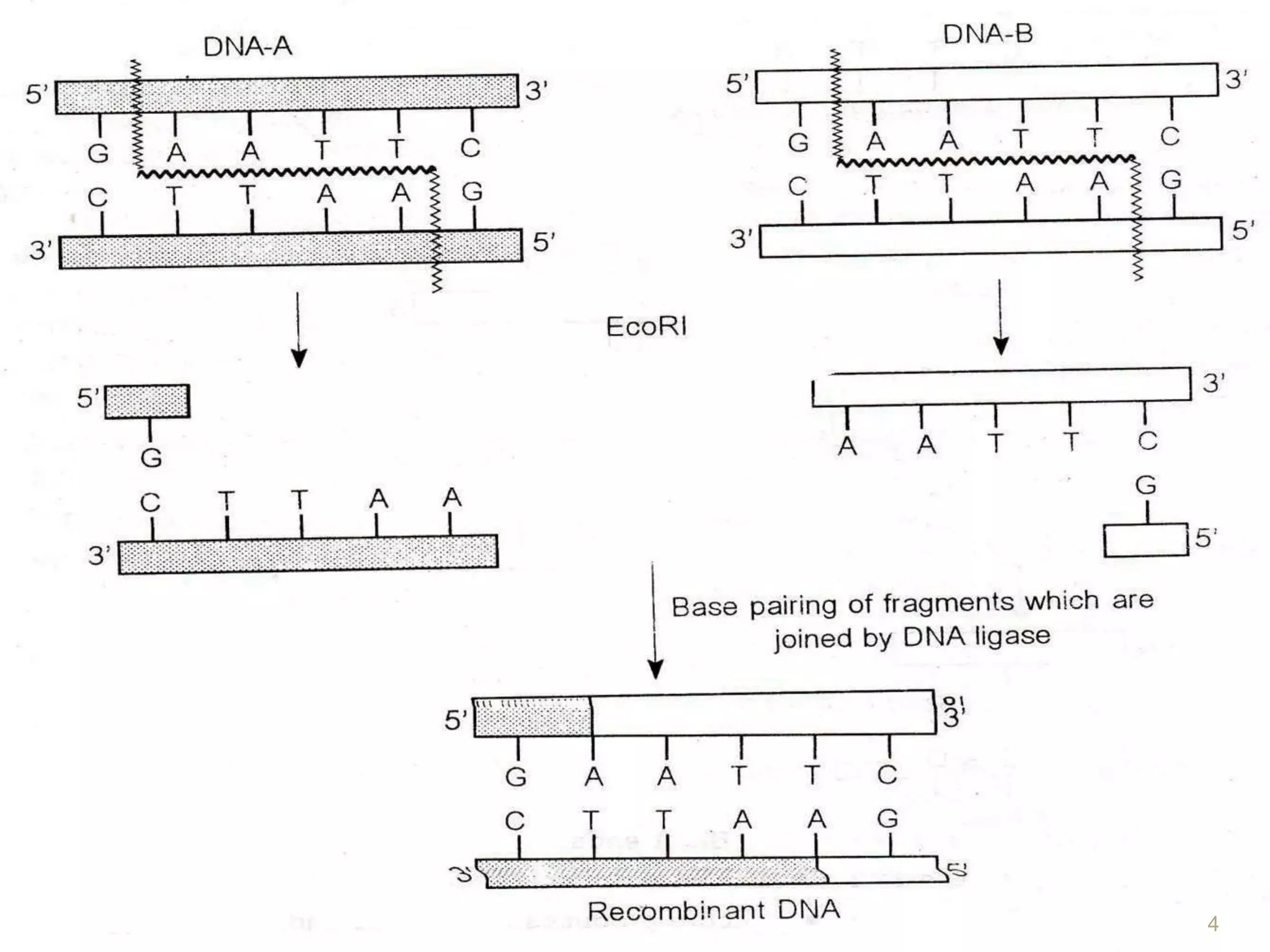
 Each restriction endonuclease recognise a specific palindromic
nucleotide sequence in the DNA.
5' — GAATTC —3’
3' — CTTAAG —5’
Restriction Endonuclease Function
The palindrome in DNA is a sequence of base pair that read same
on the two strand when orientation of reading is kept the same for
e.g. The following sequence read the same on the two strand in 5’to
3’ direction.
This is also true if read in the 3’ to 5’ direction.
Cont.........
Recognition sequences:
 Recognition endonuclease on sequence is the site where the
DNA is cut by a restriction.
 Restriction endonucleases can specifically recognise DNA with
particular sequence of 4-8 nucleotide and cleave.
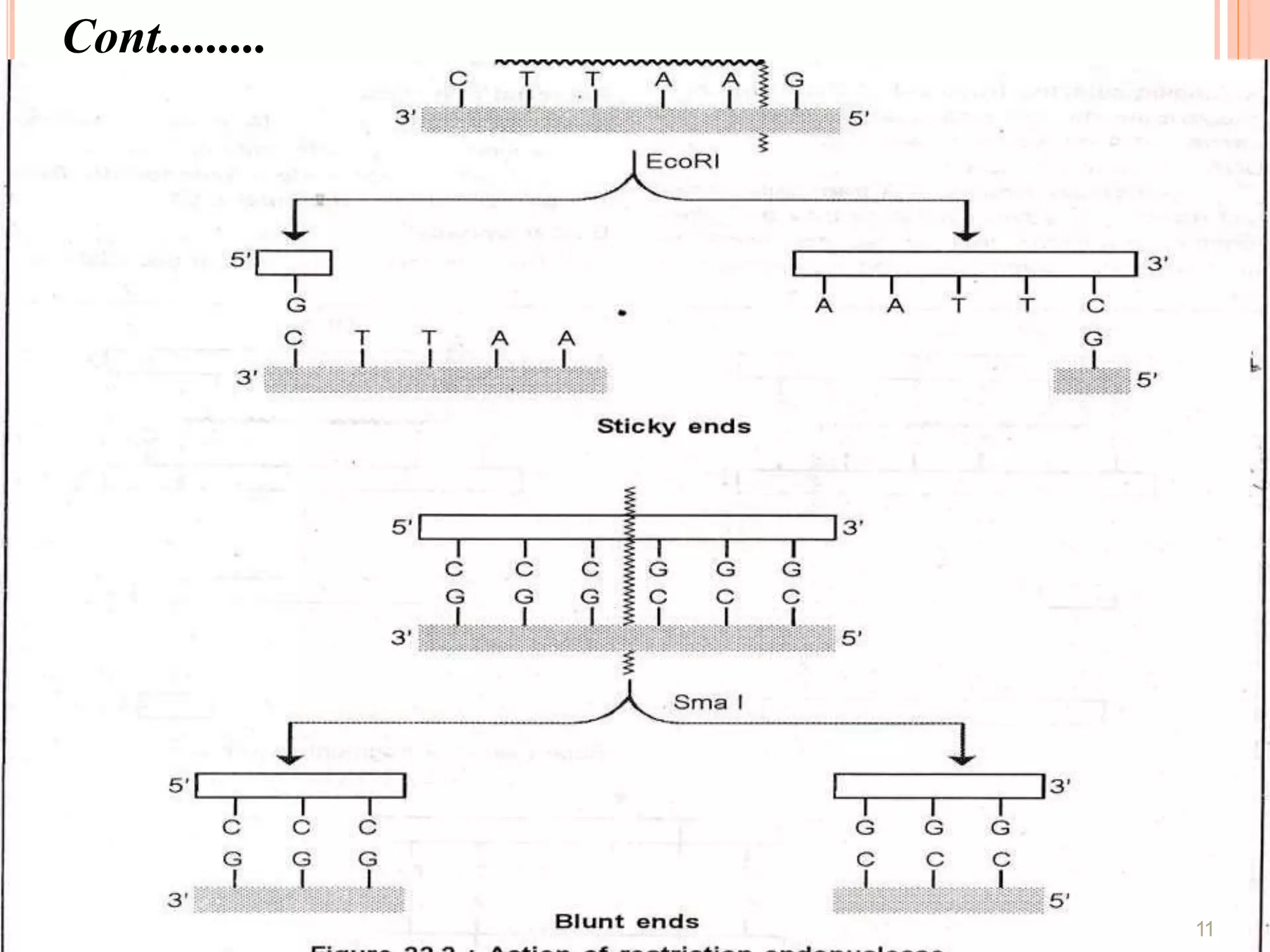
Cleavage patterns:
 The cut DNAfragments by restriction endonucleases may have
mostly sticky ends or blunt ends.
 DNA fragments with sticky ends are particularly useful for rDNA
experiments, since single stranded sticky DNA ends can easily
pair with any other DNA fragment having complementary.
Cont.........
11
Cont.........
Cont.........
 Type 1
 Don’t generate specific fragment
 Require the presence of Mg+2, ATP and S-adenosyl
methionine ; the latter activate the enzyme
 Track along the DNA for a variable distance before breaking
 Type 2
 Cut within or immediately adjescent to target sequence
generate specific fragment
 Mg2 +essential
 No ATP, No SAM
Types Of Restriction Enzyme
Structures of free, nonspecific, and specific
DNA-bound forms of BamHI
Cont.........
 Type 3
 The type III enzymes recognize and methylate the same DNA sequence.
However, they cleave nearly 24-26 base pairs away.
 They are composed of two different subunits. The recognition and
modification of DNA are carried out by the first subunit- ‘M’ and the
nuclease activity is rendered by the other subunit ‘R’.
 DNA cleavage is aided by ATP as well as Mg2+ whereas SAM is responsible
for stimulating cleavage.
 Only one of the DNA strand is cleaved. However, to break the double-
stranded DNA, two recognition sites in opposite directions are required.
Cont.........
 DNA ligase covalently links the two fragments together by
forming phosphodiester bonds
 Restriction enzymes cut the strand of DNA a little away from
the centre of the palindrome sites, but between the same two
bases on the opposite Strands. This leaves single stranded
portions at the ends. There are overhanging stretches called
sticky ends on each strand
 These are named so because they form hydrogen bonds with
their complementary cut counterparts.
Ligases
Action of ligases
 When cut by the same restriction enzyme, the resultant DNA
fragments have the same kind of ‘sticky-ends’ and, these can be
joined together. (end-to-end) using DNA ligases
Cont.........
ncertbooks.prashanthellina.com/class_12.Biology
gy/
Cont.........
 Various cloing vector is used:
1. Plasmid
2. Bacteriophage
3. Cosmid
4. Artificial chromosome vector
Cloning Vector
1. Plasmids
 Are extrachromosomal, double stranded, circular, self
replicating DNA molecules.
 Usually plasmids contribute to about 0.5% - 5.0% of the total
DNA of bacteria.
 A few bacteria contain linear plasmids E.g., streptomyces
sp, Borelia burgdorferi. E.g., pBR322,pUC
 The plasmids carries genes resistance for ampicillin &
tetracycline that serve as markers for the identification of clones
carrying plasmids.
• Examples
pBR322
One of the original plasmids used
Two selectable markers (Amp and Tet resistance)
Several unique restriction sites scattered throughout
plasmid (some lie within antibiotic resistance genes
= means of screening for inserts) ColE1 ORI
Cont.........
pUC18
Derivative of pBR322
Advantages over pBR322:
Smaller – so can accommodate larger DNA
fragments during cloning (5-10kbp)
Higher copy # per cell (500 per cell = 5-10x more
than pBR322)
Multiple cloning sites clustered in same location =
“polylinker”
Cont.........
Cont.........
Fig. Plasmid
Lambda vector
 Bacteriophage lambda (l) infects E. Coli.
 Double-stranded, linear DNA vector – suitable for library
construction.
 Can accommodate large segments of foreign DNA Central
1/3 = “stuffer” fragment.
Can be substituted with any DNA fragment of similar size
without affecting ability of lambda to package itself and
infect E. Coli.
Accommodates ~15kbp of foreign DNA
Foreign DNA is ligated to Left and Right Arms of
lambda Then either:
1) Transfected into E. coli as naked DNA, or
2) Packaged in vitro by combining with phage protein
components (heads and tails) (more efficient, but labor
intensive and expensive).
Cosmids
Are the vectors possessing the characteristics both plasmid
& bacteriophage λ.
These carry larger fragment compared to the plasmid.
It is a plasmid that contain phage sequence that allow the
vector to be packaged and transmitted to bacteria like phage
vector.
Property:
These vector are used in construction of genomic libraries
 A cosmid may have one or two cos site.
1. Ligation of foreign DNA between between two cos site.
2. Making a concantemeric DNA .
3. Invitro packaging to introduce the DNA into phage
head to form the matured phage particle .
4. Introduction of the the cloned DNA into E. coli by
transduction .
5. After their entry into host cell the cosmid are maintain
as plasmid .
Cloning Of Foreign DNA In Cosmid
Vector Involve The Following Step:
Artificial chromosome vectors
• E.g.,Human artificial chromosome, Yeast artificial chromosomes,
Bacterial artificial chromosome.
• It can accept large fragment of foreign DNA .
• BACs
• These are plasmid used for cloning and stably maintaining large
segment of foreign DNA in E.coli.
• A problem in some recombinant DNA experiments is the stable
maintenance of large (>100kbp)inserted in E coli.
• Some plasmid vector have problem with on exceeds the size of bp.
24
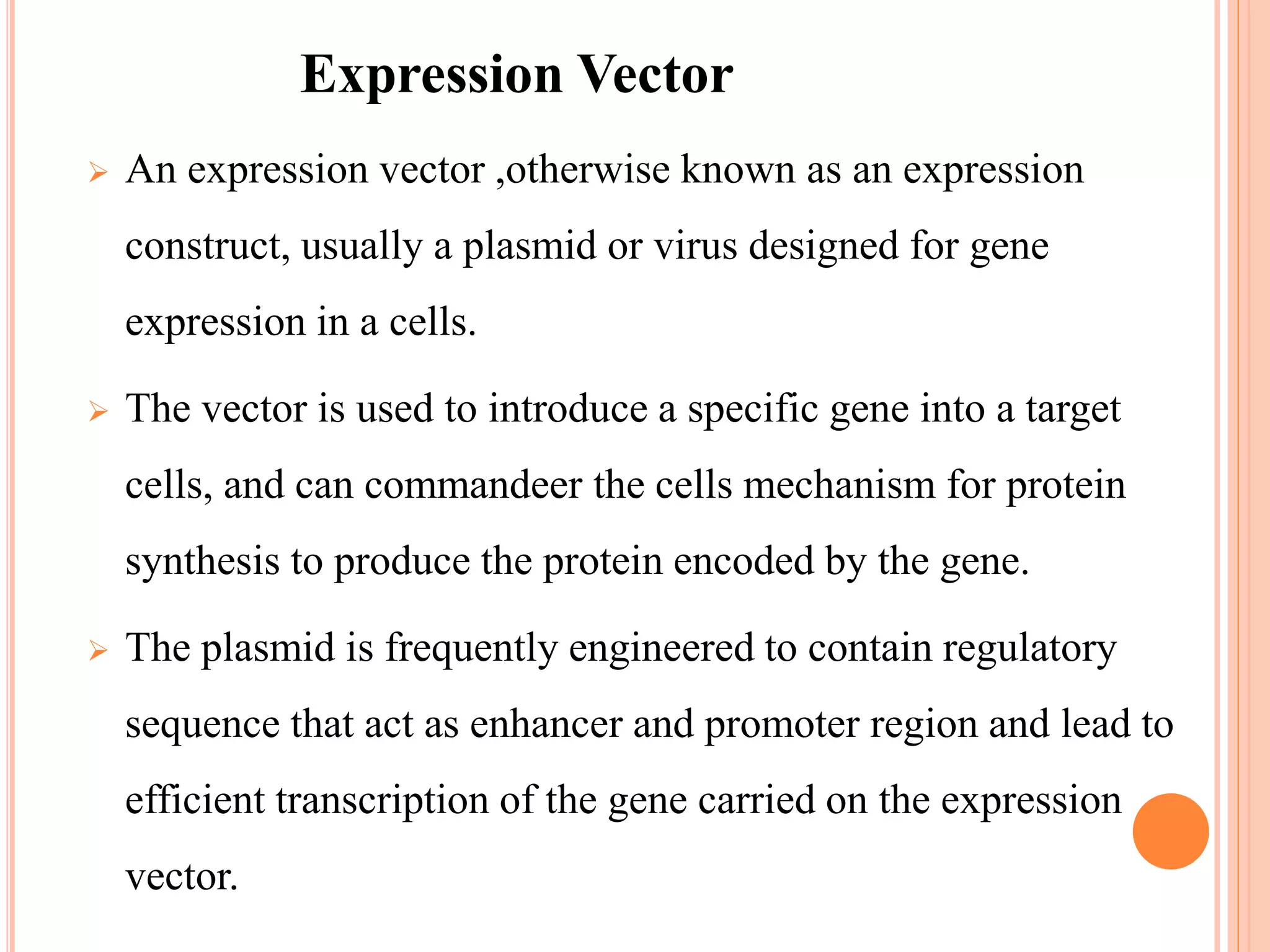
 An expression vector ,otherwise known as an expression
construct, usually a plasmid or virus designed for gene
expression in a cells.
 The vector is used to introduce a specific gene into a target
cells, and can commandeer the cells mechanism for protein
synthesis to produce the protein encoded by the gene.
 The plasmid is frequently engineered to contain regulatory
sequence that act as enhancer and promoter region and lead to
efficient transcription of the gene carried on the expression
vector.
Expression Vector
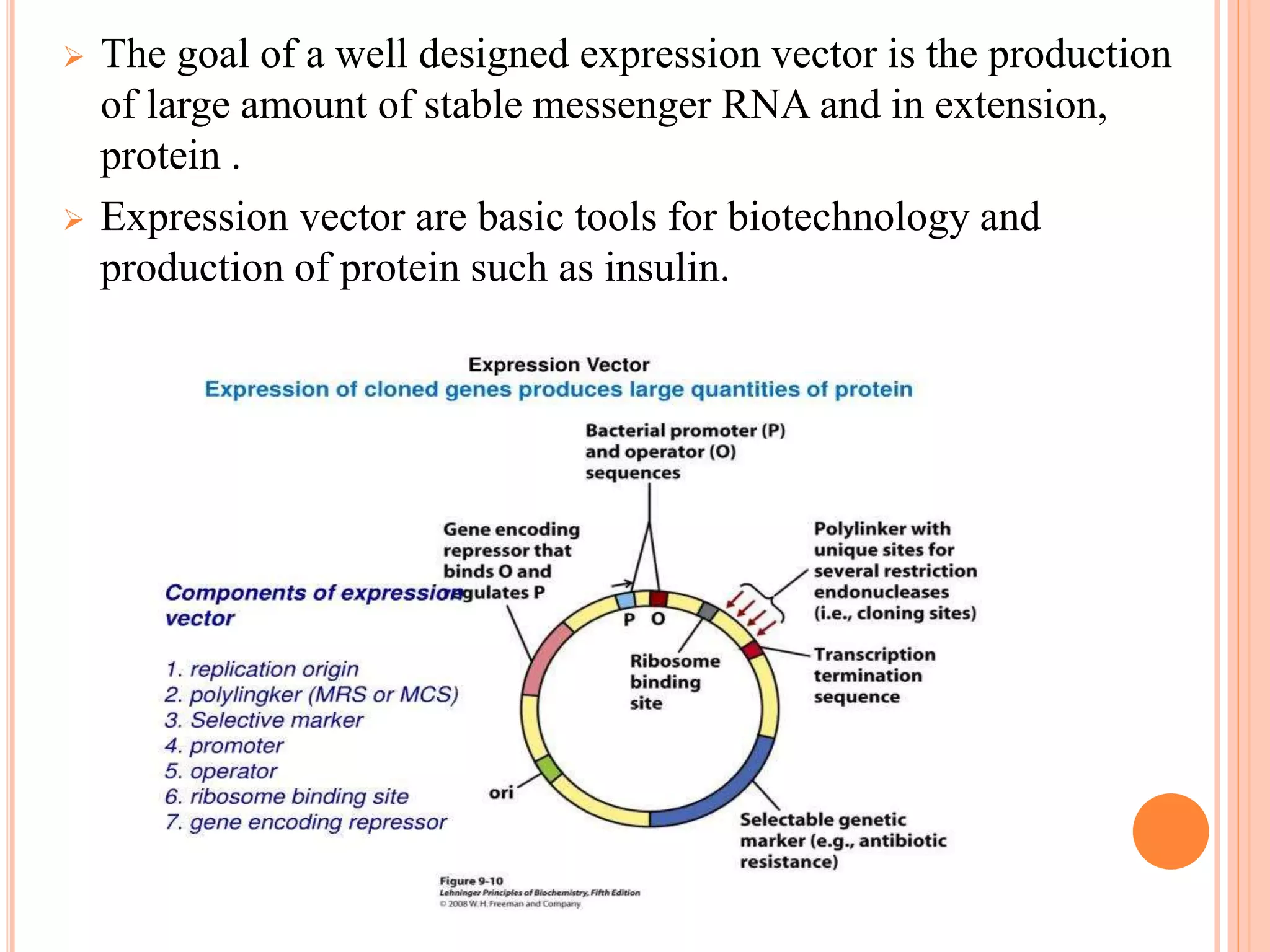
 The goal of a well designed expression vector is the production
of large amount of stable messenger RNA and in extension,
protein .
 Expression vector are basic tools for biotechnology and
production of protein such as insulin.
Features that are required to
facilitate cloning into a vector
Origin of replication (ori) :This is a sequence from
where replication start and piece of DNA when linked to this
sequence can be made to replicate within the host cells. This
sequence is also responsible for controlling the copy number
of the linked DNA.
Selectable Marker: In addition to ‘ori’ the vector requires
a selectable marker, which helps in identifying and
eliminating non transformant and selectively permitting the
growth of the transformant.
EXAMPLE OF SELECTABLE MARKER
If a recombinant DNA bearing gene for resistance to an antibiotic
(e.g., ampicillin) is transferred into E. coli cells, the host cells
become transformed into ampicillin-resistant cells.
If we spread the transformed cells on agar plates containing
ampicillin, only transformants will grow, untransformed
recipient cells will die.
Since, due to ampicillin resistance gene, one is able to select a
transformed cell in the presence of ampicillin. The ampicillin
resistance gene in this case is called a selectable marker.
Methods
Electroporation -:This is done by treating them with a specific
concentration of a divalent cation, such as calcium, which increases
the efficiency with DNA enter the bacterium through pores in its cell
wall. Recombinant DNA can then be forced into such cells by
incubating the cells with recombinant DNA on ice, followed by
placing them briefly at 420C (heat shock),and then putting them
back on ice. This enables the bacteria to take up the recombinant
DNA.
Micro-injection -: recombinant DNA is directly injected into the
Nucleus of an animal cell. In another method, suitable for plants,
cells are bombarded With high velocity micro-particles or gold
tungsten coated with DNA in a method known as biolistics or
gene gun.
Disarmed pathogen vector -: which when allowed to infect
the cell transfer The recombinant DNA into the host
 A cDNA library is a set of CDNA clones prepared from the
mRNAs isolated from a particular type of tissue .
 The cDNA library contain only complementary DNA molecule in
a cell. This molecule represent in the cell at different stage of it’s
development.
Construction
 cDNA library are constructed by synthesizing cDNA from
purified cellular mRNA via oligo(dt).
 This is done to recover the poly-A mRNA so as to anneal with the
oligo (dt) chains.
cDNA Library
Isolation of eukaryotic mRNA using oligo (dt)-
purification column
Oligomeric deoxythymidine nucleotide coated with resin
Poly-A tail of mRNA bind on the resin
Rest of the RNA eluted out
mRNA eluted out by using eluting buffer and some heat to
separate the mRNA strand from oligo-dt
Screening
 A probe is a piece of DNA or RNA used to detect specific nucleic
acid sequence by hybridisation.
 Oligonucleotide can be used as a probe.
 They are radioactively labeled so that the hybridised nucleic acid
can be identified by autoradiography.
Applications of rDNA technology
 AIDS test: Has become simple & rapid
 Diagnosis of molecular diseases: sickle anaemia,
thalassaemia, familial hypercholesterolemia, cystic fibrosis
 Prenatal diagnosis: DNA from cells collected
from amniotic fluid, chorionic villi.
Gene Therapy:
This is achieved by cloning a gene into a vector that will readily
be taken incorporated into genome of a host cell.
ADA deficiency has been successfully treated
Application in Agriculture:
 Genetically engineered plants are developed to resist draught &
diseases.
increased yield of crops is Good quality of food also possible
Industrial Application:
Enzymes use to produce sugars, cheese, detergents.
Protein products---used as food additives, increases
nutritive value, besides imparting flavour
Application in forensic medicine: The restriction
analysis pattern of DNA of one individual will be very
specific(DNAfingerprinting),butthe pattern will be different
from person to person. Helps to identify criminals & to settle
disputes of parenthood of children.
Transgenesis: Gene replacement therapy will not
pass on to offspring.
 Industrial Application:
Enzymes use to produce sugars, cheese, detergents.
Protein products---used as food additives, increases
nutritive value, besides imparting flavour.
Application in forensic medicine: The restriction
analysis pattern of DNA of one individual will be very
specific(DNAfingerprinting),butthe pattern will be different
from person to person. Helps to identify criminals & to settle
disputes of parenthood of children.

Transgenesis: Gene replacement therapy will not
pass on to offspring.
in29
Gene cloning
The recombinant DNAmolecule is transferred a host
cell.Within the host cell it replicates producing dozens of
identical copies i.e., it is cloned.
to
The cloned DNA can be recovered from host
cells purified, analysed & transcribed.
It’s mRNA translated.
Gene product isolated
sold commercially.
& used for researchor
30
32
REFERENCES
Lei, Hsien-Hsien top 10 ways DNA technology will change
your life URL:http:healthnex .typepd.com/web-log/2007/05/-
10wys-dna.html.
Recombinant DNA and gene
cloning.URL:http://users.rcn.com/jkimball.
University of Delware.Rdna.
URL:http://present.smith.udel.edu/Biotech/rDNA.html.Accessed
on March 12 , 2003.
Alberts ,Bruce,et al.Molecular Biology of the cell,4th edition,
New york: Garland publishing
Felsenfeld,Gray.DNA Scientific American 253(1985):58-67
Levin,Benjamin.Genes 7. New york : Oxford University
Press(1999)
Watson,James D,and Francis H .Crick. A Structure of
Deoxyribose Nucleic acid. Nature 171(1953):737.
34

Recombinant DNA Technology

  • 1.
    RECOMBINANT DNA TECHNOLOGY GuidedBy: Dr. P.G. Jain sir Presented By: Shubham D .Mahajan (F.Y. M-Pharmacy ) Department Of Pharmacology
  • 2.
    Recombinant DNA technologyprocedure by which DNA from different species can be isolated, cut and spliced together –new “recombinant” molecule are multiplied in quantity in population of rapidly dividing cells (eg. Bacteria, yeast). Recombinant DNA technology
  • 3.
    • Intentional modificationof organism genome for practical purpose.  Three Goals  Eliminate undesirable phenotypic traits.  Combine beneficial traits of two or more organisms.  Create organisms that synthesize products human need. The Role of Recombinant DNA Technology in Biotechnology
  • 4.
    Basic principles ofrDNA technology:  Generation of DNA Fragments & Selection of the desired piece of DNA.  Insertion of the selected DNA into a cloning Vector to create a rDNA and then introduction of the recombinant vector into host cell.  Multiplication and selection of clones containing the recombinant molecule.  Expression of gene to produce desired products
  • 5.
  • 6.
  • 7.
  • 8.
    Restriction enzyme belongto a larger class of enzyme called nuclease . There are two kind of endonucleases 1. Exonuclease remove nucleotide from the ends of the DNA. 2. Endonuclease make cut at specific position within the DNA. Bacterial enzyme that can cut /split at specific site. These were first discovered in E. coli, restricting the replication of bacteriophage by cutting the the viral DNA Thus, the enzyme that restrict the viral replication are known as restriction enzyme or restriction endonuclease Restriction Enzyme
  • 9.
     Restriction endonucleasefunction by inspecting the length of a DNA sequence. Once it finds its specific recognition sequence, it will bind to the DNA and cut each of the two strand of the double helix at specific points in their sugar-phosphate backbone .  Each restriction endonuclease recognise a specific palindromic nucleotide sequence in the DNA. 5' — GAATTC —3’ 3' — CTTAAG —5’ Restriction Endonuclease Function
  • 10.
    The palindrome inDNA is a sequence of base pair that read same on the two strand when orientation of reading is kept the same for e.g. The following sequence read the same on the two strand in 5’to 3’ direction. This is also true if read in the 3’ to 5’ direction. Cont.........
  • 11.
    Recognition sequences:  Recognitionendonuclease on sequence is the site where the DNA is cut by a restriction.  Restriction endonucleases can specifically recognise DNA with particular sequence of 4-8 nucleotide and cleave. Cleavage patterns:  The cut DNAfragments by restriction endonucleases may have mostly sticky ends or blunt ends.  DNA fragments with sticky ends are particularly useful for rDNA experiments, since single stranded sticky DNA ends can easily pair with any other DNA fragment having complementary. Cont.........
  • 12.
  • 13.
  • 14.
     Type 1 Don’t generate specific fragment  Require the presence of Mg+2, ATP and S-adenosyl methionine ; the latter activate the enzyme  Track along the DNA for a variable distance before breaking  Type 2  Cut within or immediately adjescent to target sequence generate specific fragment  Mg2 +essential  No ATP, No SAM Types Of Restriction Enzyme
  • 15.
    Structures of free,nonspecific, and specific DNA-bound forms of BamHI Cont.........
  • 16.
     Type 3 The type III enzymes recognize and methylate the same DNA sequence. However, they cleave nearly 24-26 base pairs away.  They are composed of two different subunits. The recognition and modification of DNA are carried out by the first subunit- ‘M’ and the nuclease activity is rendered by the other subunit ‘R’.  DNA cleavage is aided by ATP as well as Mg2+ whereas SAM is responsible for stimulating cleavage.  Only one of the DNA strand is cleaved. However, to break the double- stranded DNA, two recognition sites in opposite directions are required. Cont.........
  • 17.
     DNA ligasecovalently links the two fragments together by forming phosphodiester bonds  Restriction enzymes cut the strand of DNA a little away from the centre of the palindrome sites, but between the same two bases on the opposite Strands. This leaves single stranded portions at the ends. There are overhanging stretches called sticky ends on each strand  These are named so because they form hydrogen bonds with their complementary cut counterparts. Ligases
  • 18.
    Action of ligases When cut by the same restriction enzyme, the resultant DNA fragments have the same kind of ‘sticky-ends’ and, these can be joined together. (end-to-end) using DNA ligases Cont.........
  • 19.
  • 20.
     Various cloingvector is used: 1. Plasmid 2. Bacteriophage 3. Cosmid 4. Artificial chromosome vector Cloning Vector
  • 21.
    1. Plasmids  Areextrachromosomal, double stranded, circular, self replicating DNA molecules.  Usually plasmids contribute to about 0.5% - 5.0% of the total DNA of bacteria.  A few bacteria contain linear plasmids E.g., streptomyces sp, Borelia burgdorferi. E.g., pBR322,pUC  The plasmids carries genes resistance for ampicillin & tetracycline that serve as markers for the identification of clones carrying plasmids.
  • 22.
    • Examples pBR322 One ofthe original plasmids used Two selectable markers (Amp and Tet resistance) Several unique restriction sites scattered throughout plasmid (some lie within antibiotic resistance genes = means of screening for inserts) ColE1 ORI Cont.........
  • 23.
    pUC18 Derivative of pBR322 Advantagesover pBR322: Smaller – so can accommodate larger DNA fragments during cloning (5-10kbp) Higher copy # per cell (500 per cell = 5-10x more than pBR322) Multiple cloning sites clustered in same location = “polylinker” Cont.........
  • 24.
  • 25.
    Lambda vector  Bacteriophagelambda (l) infects E. Coli.  Double-stranded, linear DNA vector – suitable for library construction.  Can accommodate large segments of foreign DNA Central 1/3 = “stuffer” fragment. Can be substituted with any DNA fragment of similar size without affecting ability of lambda to package itself and infect E. Coli. Accommodates ~15kbp of foreign DNA Foreign DNA is ligated to Left and Right Arms of lambda Then either: 1) Transfected into E. coli as naked DNA, or 2) Packaged in vitro by combining with phage protein components (heads and tails) (more efficient, but labor intensive and expensive).
  • 26.
    Cosmids Are the vectorspossessing the characteristics both plasmid & bacteriophage λ. These carry larger fragment compared to the plasmid. It is a plasmid that contain phage sequence that allow the vector to be packaged and transmitted to bacteria like phage vector. Property: These vector are used in construction of genomic libraries  A cosmid may have one or two cos site.
  • 27.
    1. Ligation offoreign DNA between between two cos site. 2. Making a concantemeric DNA . 3. Invitro packaging to introduce the DNA into phage head to form the matured phage particle . 4. Introduction of the the cloned DNA into E. coli by transduction . 5. After their entry into host cell the cosmid are maintain as plasmid . Cloning Of Foreign DNA In Cosmid Vector Involve The Following Step:
  • 28.
    Artificial chromosome vectors •E.g.,Human artificial chromosome, Yeast artificial chromosomes, Bacterial artificial chromosome. • It can accept large fragment of foreign DNA . • BACs • These are plasmid used for cloning and stably maintaining large segment of foreign DNA in E.coli. • A problem in some recombinant DNA experiments is the stable maintenance of large (>100kbp)inserted in E coli. • Some plasmid vector have problem with on exceeds the size of bp. 24
  • 29.
     An expressionvector ,otherwise known as an expression construct, usually a plasmid or virus designed for gene expression in a cells.  The vector is used to introduce a specific gene into a target cells, and can commandeer the cells mechanism for protein synthesis to produce the protein encoded by the gene.  The plasmid is frequently engineered to contain regulatory sequence that act as enhancer and promoter region and lead to efficient transcription of the gene carried on the expression vector. Expression Vector
  • 30.
     The goalof a well designed expression vector is the production of large amount of stable messenger RNA and in extension, protein .  Expression vector are basic tools for biotechnology and production of protein such as insulin.
  • 31.
    Features that arerequired to facilitate cloning into a vector Origin of replication (ori) :This is a sequence from where replication start and piece of DNA when linked to this sequence can be made to replicate within the host cells. This sequence is also responsible for controlling the copy number of the linked DNA. Selectable Marker: In addition to ‘ori’ the vector requires a selectable marker, which helps in identifying and eliminating non transformant and selectively permitting the growth of the transformant.
  • 32.
    EXAMPLE OF SELECTABLEMARKER If a recombinant DNA bearing gene for resistance to an antibiotic (e.g., ampicillin) is transferred into E. coli cells, the host cells become transformed into ampicillin-resistant cells. If we spread the transformed cells on agar plates containing ampicillin, only transformants will grow, untransformed recipient cells will die. Since, due to ampicillin resistance gene, one is able to select a transformed cell in the presence of ampicillin. The ampicillin resistance gene in this case is called a selectable marker.
  • 33.
    Methods Electroporation -:This isdone by treating them with a specific concentration of a divalent cation, such as calcium, which increases the efficiency with DNA enter the bacterium through pores in its cell wall. Recombinant DNA can then be forced into such cells by incubating the cells with recombinant DNA on ice, followed by placing them briefly at 420C (heat shock),and then putting them back on ice. This enables the bacteria to take up the recombinant DNA.
  • 34.
    Micro-injection -: recombinantDNA is directly injected into the Nucleus of an animal cell. In another method, suitable for plants, cells are bombarded With high velocity micro-particles or gold tungsten coated with DNA in a method known as biolistics or gene gun. Disarmed pathogen vector -: which when allowed to infect the cell transfer The recombinant DNA into the host
  • 36.
     A cDNAlibrary is a set of CDNA clones prepared from the mRNAs isolated from a particular type of tissue .  The cDNA library contain only complementary DNA molecule in a cell. This molecule represent in the cell at different stage of it’s development. Construction  cDNA library are constructed by synthesizing cDNA from purified cellular mRNA via oligo(dt).  This is done to recover the poly-A mRNA so as to anneal with the oligo (dt) chains. cDNA Library
  • 37.
    Isolation of eukaryoticmRNA using oligo (dt)- purification column Oligomeric deoxythymidine nucleotide coated with resin Poly-A tail of mRNA bind on the resin Rest of the RNA eluted out mRNA eluted out by using eluting buffer and some heat to separate the mRNA strand from oligo-dt
  • 39.
    Screening  A probeis a piece of DNA or RNA used to detect specific nucleic acid sequence by hybridisation.  Oligonucleotide can be used as a probe.  They are radioactively labeled so that the hybridised nucleic acid can be identified by autoradiography.
  • 40.
    Applications of rDNAtechnology  AIDS test: Has become simple & rapid  Diagnosis of molecular diseases: sickle anaemia, thalassaemia, familial hypercholesterolemia, cystic fibrosis  Prenatal diagnosis: DNA from cells collected from amniotic fluid, chorionic villi.
  • 41.
    Gene Therapy: This isachieved by cloning a gene into a vector that will readily be taken incorporated into genome of a host cell. ADA deficiency has been successfully treated Application in Agriculture:  Genetically engineered plants are developed to resist draught & diseases. increased yield of crops is Good quality of food also possible
  • 42.
    Industrial Application: Enzymes useto produce sugars, cheese, detergents. Protein products---used as food additives, increases nutritive value, besides imparting flavour Application in forensic medicine: The restriction analysis pattern of DNA of one individual will be very specific(DNAfingerprinting),butthe pattern will be different from person to person. Helps to identify criminals & to settle disputes of parenthood of children. Transgenesis: Gene replacement therapy will not pass on to offspring.
  • 43.
     Industrial Application: Enzymesuse to produce sugars, cheese, detergents. Protein products---used as food additives, increases nutritive value, besides imparting flavour. Application in forensic medicine: The restriction analysis pattern of DNA of one individual will be very specific(DNAfingerprinting),butthe pattern will be different from person to person. Helps to identify criminals & to settle disputes of parenthood of children.  Transgenesis: Gene replacement therapy will not pass on to offspring. in29
  • 44.
    Gene cloning The recombinantDNAmolecule is transferred a host cell.Within the host cell it replicates producing dozens of identical copies i.e., it is cloned. to The cloned DNA can be recovered from host cells purified, analysed & transcribed. It’s mRNA translated. Gene product isolated sold commercially. & used for researchor 30
  • 45.
  • 46.
    REFERENCES Lei, Hsien-Hsien top10 ways DNA technology will change your life URL:http:healthnex .typepd.com/web-log/2007/05/- 10wys-dna.html. Recombinant DNA and gene cloning.URL:http://users.rcn.com/jkimball. University of Delware.Rdna. URL:http://present.smith.udel.edu/Biotech/rDNA.html.Accessed on March 12 , 2003. Alberts ,Bruce,et al.Molecular Biology of the cell,4th edition, New york: Garland publishing Felsenfeld,Gray.DNA Scientific American 253(1985):58-67 Levin,Benjamin.Genes 7. New york : Oxford University Press(1999) Watson,James D,and Francis H .Crick. A Structure of Deoxyribose Nucleic acid. Nature 171(1953):737. 34