Leptin and Nitric Oxide 
Dr. Abhishek Roy 
Junior Resident (2nd Year) 
Dept. of Biochemistry, 
Grant Govt. Medical College and 
Sir J.J. Group of Hospitals, Mumbai 
Email: mail@abhishek.ro
What is Leptin? 
• It’s the “satiety hormone” in our body. 
• Human leptin is a 16 kDa, 146 amino acid residue, non-glycosylated 
polypeptide. 
• Leptin is encoded by the ob gene. 
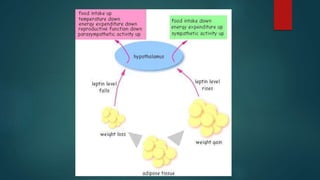
• Its major source is adipose tissue, and its circulating concentrations indirectly 
reflect body fat stores. 
• Circulates in the body eventually activating leptin receptors in Arcuate 
Nucleus of Hypothalamus. 
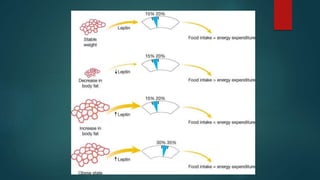
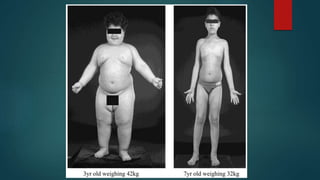
• Plasma or serum concentrations of leptin are increased in obese humans and 
strongly correlate with the degree of adiposity as expressed by percentage of 
body fat or body mass index.
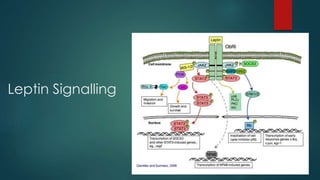
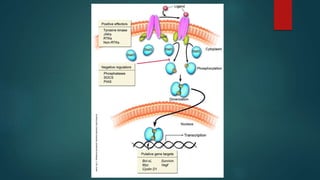
Leptin Signalling
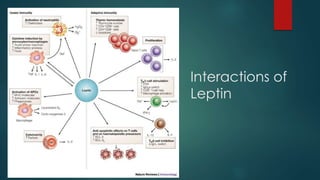
Interactions of 
Leptin
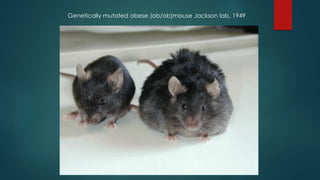
Genetically mutated obese (ob/ob)mouse Jackson lab, 1949
Nitric Oxide
What is Nitric Oxide? 
 Nitric oxide (NO) is a reactive and toxic free radical gas. 
 Thus, it came as a great surprise that this molecule functions as 
paracrine signal in regulating blood vessel dilation and serves as a 
neurotransmitter. 
 It also functions in the immune response. 
 It was proclaimed “Molecule of the Year” in 1992. 
 Research into its function led to the 1998 Nobel Prize for discovering 
the role of nitric oxide as a cardiovascular signaling molecule.
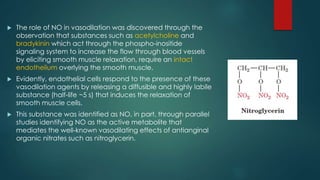
 The role of NO in vasodilation was discovered through the 
observation that substances such as acetylcholine and 
bradykinin which act through the phospho-inositide 
signaling system to increase the flow through blood vessels 
by eliciting smooth muscle relaxation, require an intact 
endothelium overlying the smooth muscle. 
 Evidently, endothelial cells respond to the presence of these 
vasodilation agents by releasing a diffusible and highly labile 
substance (half-life ~5 s) that induces the relaxation of 
smooth muscle cells. 
 This substance was identified as NO, in part, through parallel 
studies identifying NO as the active metabolite that 
mediates the well-known vasodilating effects of antianginal 
organic nitrates such as nitroglycerin.
Nitric Oxide Synthase Requires Five 
Redox-Active Cofactors 
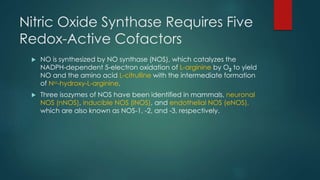
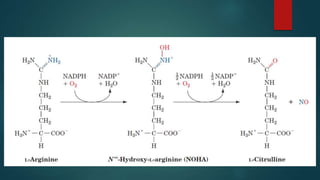
 NO is synthesized by NO synthase (NOS), which catalyzes the 
NADPH-dependent 5-electron oxidation of L-arginine by O2 to yield 
NO and the amino acid L-citrulline with the intermediate formation 
of Nω-hydroxy-L-arginine. 
 Three isozymes of NOS have been identified in mammals, neuronal 
NOS (nNOS), inducible NOS (iNOS), and endothelial NOS (eNOS), 
which are also known as NOS-1, -2, and -3, respectively.
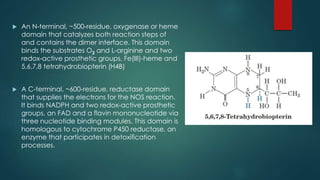
 An N-terminal, ~500-residue, oxygenase or heme 
domain that catalyzes both reaction steps of 
and contains the dimer interface. This domain 
binds the substrates O2 and L-arginine and two 
redox-active prosthetic groups, Fe(III)-heme and 
5,6,7,8 tetrahydrobiopterin (H4B) 
 A C-terminal, ~600-residue, reductase domain 
that supplies the electrons for the NOS reaction. 
It binds NADPH and two redox-active prosthetic 
groups, an FAD and a flavin mononucleotide via 
three nucleotide binding modules. This domain is 
homologous to cytochrome P450 reductase, an 
enzyme that participates in detoxification 
processes.
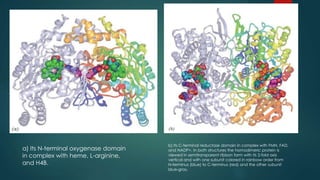
a) Its N-terminal oxygenase domain 
in complex with heme, L-arginine, 
and H4B. 
b) Its C-terminal reductase domain in complex with FMN, FAD, 
and NADP+. In both structures the homodimeric protein is 
viewed in semitransparent ribbon form with its 2-fold axis 
vertical and with one subunit colored in rainbow order from 
N-terminus (blue) to C-terminus (red) and the other subunit 
blue-gray.
 NOS requires bound H4B to produce NO. In the absence of this prosthetic 
group, NOS efficiently catalyzes the NADPH-mediated oxidation of O2 to 
H2O2. Investigations by Steuhr have established that H4B functions as an 
internal redox agent in that, during the reactions forming both NOHA and NO, 
it is oxidized to its radical form (H4B+) and then re-reduced to its reduced form 
(H4B). Thus, H4B does not undergo net oxidation in the NOS reaction. 
 NO rapidly diffuses across cell membranes, although its high reactivity 
prevents it from traveling >1 mm from its site of synthesis (in particular, it 
efficiently reacts with both oxyhemoglobin and deoxyhemoglobin: NO + 
HbO2 → NO- + metHb; and NO + Hb → HbNO). 
3 
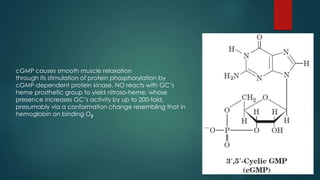
 The physiological target of NO in smooth muscle cells is guanylate cyclase 
(GC), which catalyzes the reaction of GTP to yield 3’,5’-cyclic GMP (cGMP)
cGMP causes smooth muscle relaxation 
through its stimulation of protein phosphorylation by 
cGMP-dependent protein kinase. NO reacts with GC’s 
heme prosthetic group to yield nitroso-heme, whose 
presence increases GC’s activity by up to 200-fold, 
presumably via a conformation change resembling that in 
hemoglobin on binding O2
eNOS and nNOS but Not iNOS Are 
Regulated by [Ca2+] 
 Ca2+–calmodulin activates eNOS and nNOS by binding to the ~30- 
residue segments linking their oxygenase and reductase domains. 
 NO functions to transduce hormonally induced increases in 
intracellular [Ca2+] in endothelial cells to increased rates of 
production of cGMP in neighboring smooth muscle cells. 
 NO produced by nNOS mediates vasodilation through endothelium-independent 
neural stimulation of smooth muscle. In this signal 
transduction pathway, which is responsible for the dilation of 
cerebral and other arteries as well as penile erection, nerve impulses 
cause an increased [Ca2+] in nerve terminals, thereby stimulating 
neuronal NOS.
 Inducible NOS (iNOS) is unresponsive to Ca2+ even though it has two tightly 
bound calmodulin subunits. However, it is transcriptionally induced in 
macrophages and neutrophils (white blood cells that function to ingest and kill 
bacteria), as well as in endothelial and smooth muscle cells (in contrast, eNOS 
and nNOS are expressed constitutively, that is, at a constant rate). 
 Several hours after exposure to cytokines and/or endotoxins, these cells begin 
to produce large quantities of NO and continue to do so for many hours. 
Activated macrophages and neutrophils also produce superoxide ion (O2 
- ), 
which chemically combines with NO to form the even more toxic peroxynitrite 
(OONO-, which rapidly reacts with H2O to yield the highly reactive hydroxide 
radical, OH-, and NO2) that they use to kill ingested bacteria. Indeed, NOS 
inhibitors block the cytotoxic actions of macrophages.
Clinical Scenario 
 Heart: In atherosclerosis, the endothelium has a reduced capacity to 
produce NO. However, NO can be furnished by treatment with 
nitroglycerin. Large efforts in drug discovery are currently aimed at 
generating more powerful and selective cardiac drugs based on the 
new knowledge of NO as a signal molecule. 
 Shock: Bacterial infections can lead to sepsis and circulatory shock. In 
this situation, NO plays a harmful role. White blood cells react to 
bacterial products by releasing enormous amounts of NO that dilate 
the blood vessels. The blood pressure drops and the patient may 
become unconscious. In this situation, inhibitors of NO synthesis may be 
useful in intensive care treatment. 
 Lungs: Intensive care patients can be treated by inhalation of NO gas. 
This has provided good results and even saved lives. For instance, NO 
gas has been used to reduce dangerously high blood pressure in the 
lungs of infants. But the dosage is critical since the gas can be toxic at 
high concentrations.
 Cancer: White blood cells use NO not only to kill infectious agents such as 
bacteria, fungi and parasites, but also to defend the host against tumours. 
Scientists are currently testing whether NO can be used to stop the growth 
of tumours since this gas can induce programmed cell death, apoptosis. 
 Impotence: NO can initiate erection of the penis by dilating the blood 
vessels to the erectile bodies. This knowledge has already led to the 
development of new drugs against impotence. 
 Diagnostic analyses: Inflammatory diseases can be revealed by analysing 
the production of NO from e.g. lungs and intestines. This is used for 
diagnosing asthma, colitis, and other diseases. 
 NO is important for the olfactory sense and our capacity to recognise 
different scents. It may even be important for our memory.
Thank You

Leptin and Nitric Oxide

  • 1.
    Leptin and NitricOxide Dr. Abhishek Roy Junior Resident (2nd Year) Dept. of Biochemistry, Grant Govt. Medical College and Sir J.J. Group of Hospitals, Mumbai Email: mail@abhishek.ro
  • 2.
    What is Leptin? • It’s the “satiety hormone” in our body. • Human leptin is a 16 kDa, 146 amino acid residue, non-glycosylated polypeptide. • Leptin is encoded by the ob gene. • Its major source is adipose tissue, and its circulating concentrations indirectly reflect body fat stores. • Circulates in the body eventually activating leptin receptors in Arcuate Nucleus of Hypothalamus. • Plasma or serum concentrations of leptin are increased in obese humans and strongly correlate with the degree of adiposity as expressed by percentage of body fat or body mass index.
  • 5.
  • 7.
  • 9.
    Genetically mutated obese(ob/ob)mouse Jackson lab, 1949
  • 11.
  • 12.
    What is NitricOxide?  Nitric oxide (NO) is a reactive and toxic free radical gas.  Thus, it came as a great surprise that this molecule functions as paracrine signal in regulating blood vessel dilation and serves as a neurotransmitter.  It also functions in the immune response.  It was proclaimed “Molecule of the Year” in 1992.  Research into its function led to the 1998 Nobel Prize for discovering the role of nitric oxide as a cardiovascular signaling molecule.
  • 13.
     The roleof NO in vasodilation was discovered through the observation that substances such as acetylcholine and bradykinin which act through the phospho-inositide signaling system to increase the flow through blood vessels by eliciting smooth muscle relaxation, require an intact endothelium overlying the smooth muscle.  Evidently, endothelial cells respond to the presence of these vasodilation agents by releasing a diffusible and highly labile substance (half-life ~5 s) that induces the relaxation of smooth muscle cells.  This substance was identified as NO, in part, through parallel studies identifying NO as the active metabolite that mediates the well-known vasodilating effects of antianginal organic nitrates such as nitroglycerin.
  • 14.
    Nitric Oxide SynthaseRequires Five Redox-Active Cofactors  NO is synthesized by NO synthase (NOS), which catalyzes the NADPH-dependent 5-electron oxidation of L-arginine by O2 to yield NO and the amino acid L-citrulline with the intermediate formation of Nω-hydroxy-L-arginine.  Three isozymes of NOS have been identified in mammals, neuronal NOS (nNOS), inducible NOS (iNOS), and endothelial NOS (eNOS), which are also known as NOS-1, -2, and -3, respectively.
  • 16.
     An N-terminal,~500-residue, oxygenase or heme domain that catalyzes both reaction steps of and contains the dimer interface. This domain binds the substrates O2 and L-arginine and two redox-active prosthetic groups, Fe(III)-heme and 5,6,7,8 tetrahydrobiopterin (H4B)  A C-terminal, ~600-residue, reductase domain that supplies the electrons for the NOS reaction. It binds NADPH and two redox-active prosthetic groups, an FAD and a flavin mononucleotide via three nucleotide binding modules. This domain is homologous to cytochrome P450 reductase, an enzyme that participates in detoxification processes.
  • 17.
    a) Its N-terminaloxygenase domain in complex with heme, L-arginine, and H4B. b) Its C-terminal reductase domain in complex with FMN, FAD, and NADP+. In both structures the homodimeric protein is viewed in semitransparent ribbon form with its 2-fold axis vertical and with one subunit colored in rainbow order from N-terminus (blue) to C-terminus (red) and the other subunit blue-gray.
  • 18.
     NOS requiresbound H4B to produce NO. In the absence of this prosthetic group, NOS efficiently catalyzes the NADPH-mediated oxidation of O2 to H2O2. Investigations by Steuhr have established that H4B functions as an internal redox agent in that, during the reactions forming both NOHA and NO, it is oxidized to its radical form (H4B+) and then re-reduced to its reduced form (H4B). Thus, H4B does not undergo net oxidation in the NOS reaction.  NO rapidly diffuses across cell membranes, although its high reactivity prevents it from traveling >1 mm from its site of synthesis (in particular, it efficiently reacts with both oxyhemoglobin and deoxyhemoglobin: NO + HbO2 → NO- + metHb; and NO + Hb → HbNO). 3  The physiological target of NO in smooth muscle cells is guanylate cyclase (GC), which catalyzes the reaction of GTP to yield 3’,5’-cyclic GMP (cGMP)
  • 19.
    cGMP causes smoothmuscle relaxation through its stimulation of protein phosphorylation by cGMP-dependent protein kinase. NO reacts with GC’s heme prosthetic group to yield nitroso-heme, whose presence increases GC’s activity by up to 200-fold, presumably via a conformation change resembling that in hemoglobin on binding O2
  • 20.
    eNOS and nNOSbut Not iNOS Are Regulated by [Ca2+]  Ca2+–calmodulin activates eNOS and nNOS by binding to the ~30- residue segments linking their oxygenase and reductase domains.  NO functions to transduce hormonally induced increases in intracellular [Ca2+] in endothelial cells to increased rates of production of cGMP in neighboring smooth muscle cells.  NO produced by nNOS mediates vasodilation through endothelium-independent neural stimulation of smooth muscle. In this signal transduction pathway, which is responsible for the dilation of cerebral and other arteries as well as penile erection, nerve impulses cause an increased [Ca2+] in nerve terminals, thereby stimulating neuronal NOS.
  • 21.
     Inducible NOS(iNOS) is unresponsive to Ca2+ even though it has two tightly bound calmodulin subunits. However, it is transcriptionally induced in macrophages and neutrophils (white blood cells that function to ingest and kill bacteria), as well as in endothelial and smooth muscle cells (in contrast, eNOS and nNOS are expressed constitutively, that is, at a constant rate).  Several hours after exposure to cytokines and/or endotoxins, these cells begin to produce large quantities of NO and continue to do so for many hours. Activated macrophages and neutrophils also produce superoxide ion (O2 - ), which chemically combines with NO to form the even more toxic peroxynitrite (OONO-, which rapidly reacts with H2O to yield the highly reactive hydroxide radical, OH-, and NO2) that they use to kill ingested bacteria. Indeed, NOS inhibitors block the cytotoxic actions of macrophages.
  • 22.
    Clinical Scenario Heart: In atherosclerosis, the endothelium has a reduced capacity to produce NO. However, NO can be furnished by treatment with nitroglycerin. Large efforts in drug discovery are currently aimed at generating more powerful and selective cardiac drugs based on the new knowledge of NO as a signal molecule.  Shock: Bacterial infections can lead to sepsis and circulatory shock. In this situation, NO plays a harmful role. White blood cells react to bacterial products by releasing enormous amounts of NO that dilate the blood vessels. The blood pressure drops and the patient may become unconscious. In this situation, inhibitors of NO synthesis may be useful in intensive care treatment.  Lungs: Intensive care patients can be treated by inhalation of NO gas. This has provided good results and even saved lives. For instance, NO gas has been used to reduce dangerously high blood pressure in the lungs of infants. But the dosage is critical since the gas can be toxic at high concentrations.
  • 23.
     Cancer: Whiteblood cells use NO not only to kill infectious agents such as bacteria, fungi and parasites, but also to defend the host against tumours. Scientists are currently testing whether NO can be used to stop the growth of tumours since this gas can induce programmed cell death, apoptosis.  Impotence: NO can initiate erection of the penis by dilating the blood vessels to the erectile bodies. This knowledge has already led to the development of new drugs against impotence.  Diagnostic analyses: Inflammatory diseases can be revealed by analysing the production of NO from e.g. lungs and intestines. This is used for diagnosing asthma, colitis, and other diseases.  NO is important for the olfactory sense and our capacity to recognise different scents. It may even be important for our memory.
  • 24.