Name-Samadrita Banik
ST. George College of Management
and Science
2nd Semester
M.Sc Microbiology
INTRODUCTION
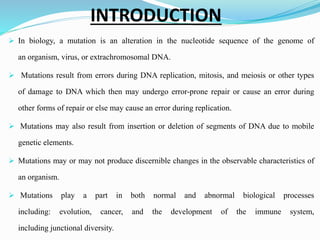
 In biology, a mutation is an alteration in the nucleotide sequence of the genome of
an organism, virus, or extrachromosomal DNA.
 Mutations result from errors during DNA replication, mitosis, and meiosis or other types
of damage to DNA which then may undergo error-prone repair or cause an error during
other forms of repair or else may cause an error during replication.
 Mutations may also result from insertion or deletion of segments of DNA due to mobile
genetic elements.
 Mutations may or may not produce discernible changes in the observable characteristics of
an organism.
 Mutations play a part in both normal and abnormal biological processes
including: evolution, cancer, and the development of the immune system,
including junctional diversity.
HISTORY
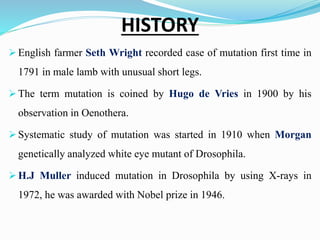
 English farmer Seth Wright recorded case of mutation first time in
1791 in male lamb with unusual short legs.
 The term mutation is coined by Hugo de Vries in 1900 by his
observation in Oenothera.
 Systematic study of mutation was started in 1910 when Morgan
genetically analyzed white eye mutant of Drosophila.
 H.J Muller induced mutation in Drosophila by using X-rays in
1972, he was awarded with Nobel prize in 1946.
Characteristics of Mutation
Generally mutant alleles are recessive to their wild type or
normal alleles
Most mutations have harmful effect but some mutations are
beneficial.
Spontaneous mutations occurs at very low rate.
Some genes show high rate of mutation such genes are called
as mutable gene.
Highly mutable sites within a gene are known as hot spots.
Mutations can occur in any tissue or cell of an organism.
Types of Mutation
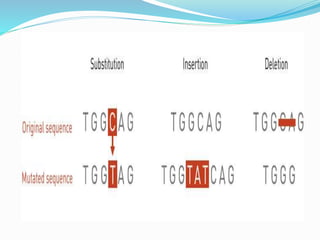
There are three types of DNA
Mutations:
 Base substitutions
 Deletions
 Insertions.
Base Substitutions
Single base substitutions are called point mutations, recall
the point mutation Glu -----> Val which causes sickle-cell
disease. Point mutations are the most common type of
mutation and there are two types.
 Transition: this occurs when a purine is substituted with
another purine or when a pyrimidine is substituted with
another pyrimidine.
 Transversion: when a purine is substituted for a pyrimidine
or a pyrimidine replaces a purine.
Deletions
A deletion, resulting in a frameshift, results when one or
more base pairs are lost from the DNA.
 If one or two bases are deleted the translational frame is
altered resulting in a garbled message and nonfunctional
product.
 A deletion of three or more bases leave the reading frame
intact. A deletion of one or more codons results in a protein
missing one or more amino acids. This may be deleterious or
not.
Insertion
The insertion of additional base pairs may lead to
frameshifts depending on whether or not multiples of
three base pairs are inserted.
Combinations of insertions and deletions leading to a
variety of outcomes are also possible.
Chromosomal Mutation
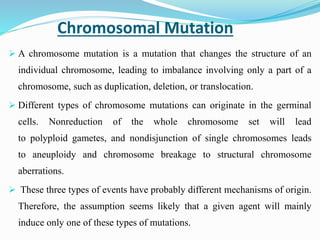
 A chromosome mutation is a mutation that changes the structure of an
individual chromosome, leading to imbalance involving only a part of a
chromosome, such as duplication, deletion, or translocation.
 Different types of chromosome mutations can originate in the germinal
cells. Nonreduction of the whole chromosome set will lead
to polyploid gametes, and nondisjunction of single chromosomes leads
to aneuploidy and chromosome breakage to structural chromosome
aberrations.
 These three types of events have probably different mechanisms of origin.
Therefore, the assumption seems likely that a given agent will mainly
induce only one of these types of mutations.
Based on tissue of origin
Somatic Mutation :
A mutation occuring in somatic cell is called somatic
mutation. In asexually reproducing species somatic
mutations transmits from one progeny to the next
progeny.
Germinal Mutation :
When mutation occur in gametic cells or
reproductive cells are known as germinal mutation.In
sexually reproductive species only germinal mutation are
transmitted to the next generation
Mutation Hotspot
Mutation hotspots (or mutational hotspots) are segments
of DNA that are especially prone to genetic alteration. The
increased susceptibility of these areas of DNA to mutation
is attributed to interactions between mutation-inducing
factors, the structure and function of the DNA sequence,
and enzymes involved in DNA repair, replication, and
modification.
Effect of Mutation
 A single mutation can have a large effect, but in many cases, evolutionary change is based on the
accumulation of many mutations with small effects. Mutational effects can be beneficial, harmful, or neutral,
depending on their context or location. Most non-neutral mutations are deleterious.
 In general, the more base pairs that are affected by a mutation, the larger the effect of the mutation, and the
larger the mutation's probability of being deleterious.
 To better understand the impact of mutations, researchers have started to estimate distributions of mutational
effects (DMEs) that quantify how many mutations occur with what effect on a given property of a biological
system.
 In evolutionary studies, the property of interest is fitness, but in molecular systems biology, other emerging
properties might also be of interest.
 To make things even more difficult, many mutations also interact with each other to alter their effects; this
phenomenon is referred to as epistasis. However, despite all these uncertainties, recent work has repeatedly
indicated that the overwhelming majority of mutations have very small effects.
Conclusion
Mutation rates can vary within a genome and between genomes.
Much more work is required before researchers can obtain more
precise estimates of the frequencies of different mutations. The
rise of high-throughput genomic sequencing methods nurtures the
hope that we will be able to cultivate a more detailed and precise
understanding of mutation rates. Because mutation is one of the
fundamental forces of evolution, such work will continue to be of
paramount importance.

Types of mutation

  • 1.
    Name-Samadrita Banik ST. GeorgeCollege of Management and Science 2nd Semester M.Sc Microbiology
  • 2.
    INTRODUCTION  In biology,a mutation is an alteration in the nucleotide sequence of the genome of an organism, virus, or extrachromosomal DNA.  Mutations result from errors during DNA replication, mitosis, and meiosis or other types of damage to DNA which then may undergo error-prone repair or cause an error during other forms of repair or else may cause an error during replication.  Mutations may also result from insertion or deletion of segments of DNA due to mobile genetic elements.  Mutations may or may not produce discernible changes in the observable characteristics of an organism.  Mutations play a part in both normal and abnormal biological processes including: evolution, cancer, and the development of the immune system, including junctional diversity.
  • 3.
    HISTORY  English farmerSeth Wright recorded case of mutation first time in 1791 in male lamb with unusual short legs.  The term mutation is coined by Hugo de Vries in 1900 by his observation in Oenothera.  Systematic study of mutation was started in 1910 when Morgan genetically analyzed white eye mutant of Drosophila.  H.J Muller induced mutation in Drosophila by using X-rays in 1972, he was awarded with Nobel prize in 1946.
  • 4.
    Characteristics of Mutation Generallymutant alleles are recessive to their wild type or normal alleles Most mutations have harmful effect but some mutations are beneficial. Spontaneous mutations occurs at very low rate. Some genes show high rate of mutation such genes are called as mutable gene. Highly mutable sites within a gene are known as hot spots. Mutations can occur in any tissue or cell of an organism.
  • 5.
    Types of Mutation Thereare three types of DNA Mutations:  Base substitutions  Deletions  Insertions.
  • 7.
    Base Substitutions Single basesubstitutions are called point mutations, recall the point mutation Glu -----> Val which causes sickle-cell disease. Point mutations are the most common type of mutation and there are two types.  Transition: this occurs when a purine is substituted with another purine or when a pyrimidine is substituted with another pyrimidine.  Transversion: when a purine is substituted for a pyrimidine or a pyrimidine replaces a purine.
  • 8.
    Deletions A deletion, resultingin a frameshift, results when one or more base pairs are lost from the DNA.  If one or two bases are deleted the translational frame is altered resulting in a garbled message and nonfunctional product.  A deletion of three or more bases leave the reading frame intact. A deletion of one or more codons results in a protein missing one or more amino acids. This may be deleterious or not.
  • 9.
    Insertion The insertion ofadditional base pairs may lead to frameshifts depending on whether or not multiples of three base pairs are inserted. Combinations of insertions and deletions leading to a variety of outcomes are also possible.
  • 11.
    Chromosomal Mutation  Achromosome mutation is a mutation that changes the structure of an individual chromosome, leading to imbalance involving only a part of a chromosome, such as duplication, deletion, or translocation.  Different types of chromosome mutations can originate in the germinal cells. Nonreduction of the whole chromosome set will lead to polyploid gametes, and nondisjunction of single chromosomes leads to aneuploidy and chromosome breakage to structural chromosome aberrations.  These three types of events have probably different mechanisms of origin. Therefore, the assumption seems likely that a given agent will mainly induce only one of these types of mutations.
  • 12.
    Based on tissueof origin Somatic Mutation : A mutation occuring in somatic cell is called somatic mutation. In asexually reproducing species somatic mutations transmits from one progeny to the next progeny. Germinal Mutation : When mutation occur in gametic cells or reproductive cells are known as germinal mutation.In sexually reproductive species only germinal mutation are transmitted to the next generation
  • 13.
    Mutation Hotspot Mutation hotspots(or mutational hotspots) are segments of DNA that are especially prone to genetic alteration. The increased susceptibility of these areas of DNA to mutation is attributed to interactions between mutation-inducing factors, the structure and function of the DNA sequence, and enzymes involved in DNA repair, replication, and modification.
  • 14.
    Effect of Mutation A single mutation can have a large effect, but in many cases, evolutionary change is based on the accumulation of many mutations with small effects. Mutational effects can be beneficial, harmful, or neutral, depending on their context or location. Most non-neutral mutations are deleterious.  In general, the more base pairs that are affected by a mutation, the larger the effect of the mutation, and the larger the mutation's probability of being deleterious.  To better understand the impact of mutations, researchers have started to estimate distributions of mutational effects (DMEs) that quantify how many mutations occur with what effect on a given property of a biological system.  In evolutionary studies, the property of interest is fitness, but in molecular systems biology, other emerging properties might also be of interest.  To make things even more difficult, many mutations also interact with each other to alter their effects; this phenomenon is referred to as epistasis. However, despite all these uncertainties, recent work has repeatedly indicated that the overwhelming majority of mutations have very small effects.
  • 15.
    Conclusion Mutation rates canvary within a genome and between genomes. Much more work is required before researchers can obtain more precise estimates of the frequencies of different mutations. The rise of high-throughput genomic sequencing methods nurtures the hope that we will be able to cultivate a more detailed and precise understanding of mutation rates. Because mutation is one of the fundamental forces of evolution, such work will continue to be of paramount importance.