1
Biotechnology
2
Dr. Mubashir Hussain
Lecturer Botany
Department of Botany,
Govt. Post Graduate College, Attock
What is Biotechnology?
 Modern techniques by which the genes are removed from one
organism and inserted into another for the production of desired
substances e.g. insulin, vaccines, drugs and hormones.
 Not very long ago, people affected from diabetes mellitus get insulin
for their survival from dead animals. But today dibactics receive
human insulin as a product of biotechnology.
Biotechnology
3
 Initially biotechnology was done in bacteria, viruses, and yeast
etc.
 But today genes can be introduced into an animal or plant cell.
a) In mammals, a permanently altered animal can be produced by
introducing the required gene into a zygote or early embryo in
vitro and than placing in the uterus.
b) In plants, the required gene is introduced into a single
protoplast or a piece of cultured plant tissue from which a new
plant can be generated.
Conti…..
4
Uses
 A large number of benefits have been obtained from
biotechnology e.g. genetically engineered bacteria have been
used:
i) To clean the environmental pollutants
ii) To increase the fertility of soil
iii) To kill the harmful pests
iv) To manufacture the proteins, vaccines, hormones and drugs
etc.
Conti…..
5
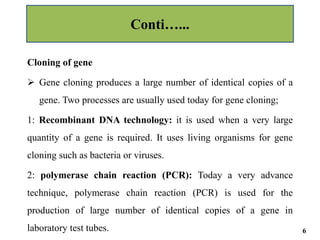
Cloning of gene
 Gene cloning produces a large number of identical copies of a
gene. Two processes are usually used today for gene cloning;
1: Recombinant DNA technology: it is used when a very large
quantity of a gene is required. It uses living organisms for gene
cloning such as bacteria or viruses.
2: polymerase chain reaction (PCR): Today a very advance
technique, polymerase chain reaction (PCR) is used for the
production of large number of identical copies of a gene in
laboratory test tubes.
Conti…...
6
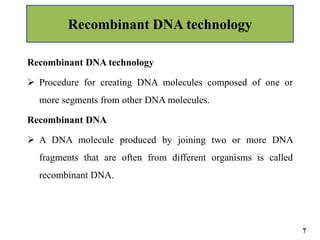
Recombinant DNA technology
 Procedure for creating DNA molecules composed of one or
more segments from other DNA molecules.
Recombinant DNA
 A DNA molecule produced by joining two or more DNA
fragments that are often from different organisms is called
recombinant DNA.
Recombinant DNA technology
7
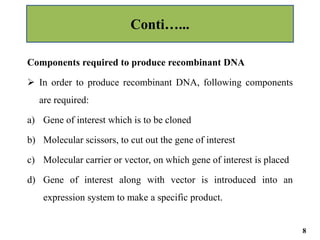
Components required to produce recombinant DNA
 In order to produce recombinant DNA, following components
are required:
a) Gene of interest which is to be cloned
b) Molecular scissors, to cut out the gene of interest
c) Molecular carrier or vector, on which gene of interest is placed
d) Gene of interest along with vector is introduced into an
expression system to make a specific product.
Conti…...
8
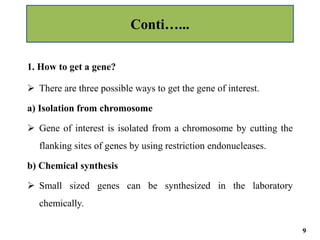
1. How to get a gene?
 There are three possible ways to get the gene of interest.
a) Isolation from chromosome
 Gene of interest is isolated from a chromosome by cutting the
flanking sites of genes by using restriction endonucleases.
b) Chemical synthesis
 Small sized genes can be synthesized in the laboratory
chemically.
Conti…...
9
c) Reverse transcription
 Genes of interest can also be synthesized in the laboratory from
mRNA by using the reverse transcriptase. The DNA molecule
synthesized in this way is called complementary DNA (cDNA)
and this phenomenon is called reverse transcription.
Conti…...
10
2. Molecular scissors: Restriction endonucleases
 These are the enzymes which are present naturally in bacteria
for their protection against viruses. Such enzymes do not harm
the bacterial chromosomes but they restrict the growth of
viruses. Therefore called as restriction enzymes or restriction
endonucleases.
Discovery
 Hamilton O. Smith (1970) at Johns Hopkins University
isolated first restriction enzyme.
Conti…...
11
 About 400 kinds of restriction enzymes have been isolated but
only 20 kinds are commonly used in the recombinant DNA
technology.
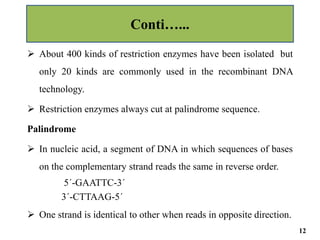
 Restriction enzymes always cut at palindrome sequence.
Palindrome
 In nucleic acid, a segment of DNA in which sequences of bases
on the complementary strand reads the same in reverse order.
5´-GAATTC-3´
3´-CTTAAG-5´
 One strand is identical to other when reads in opposite direction.
Conti…...
12
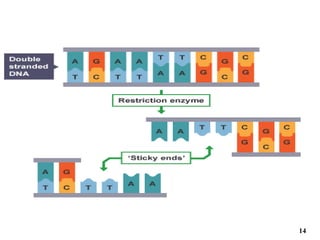
 Restriction enzymes produce sticky and blunt ends.
Sticky ends
 Single stranded end of DNA molecule produced by certain
restriction enzymes capable of reanealing with a complementary
sequence in another such strand.
 EcoR1 produces sticky ends.
Conti…...
13
14
3. Molecular carrier: vector
 A vector is plasmid or phage into which a gene of interest is
inserted for the introduction into bacterial or other host cells for
gene cloning or studies of gene expression.
Types of vector
 There are two main types of vectors.
a) Plasmid
b) Lambda phage
Conti…...
15
Plasmids
 Plasmids are natural extra chromosomal circular DNA
molecules which carry the gene for antibiotic resistance.
 Examples of plasmids are
a) pSC 101
b) pBR 322
 pSC 101 has antibiotic resistance gene for tetracycline.
 pBR 322 has antibiotic resistance genes for tetracycline and
ampicillin.
Conti…...
16
Inserting gene of interest in tetracycline resistant gene of plasmid
pBR 322 would enable separating out colonies of bacteria in a
medium containing ampicillin and vice versa.
Lambda phage
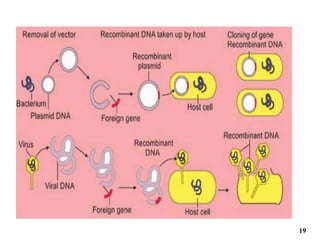
 Lambda phage is also used as vector. Phage containing
recombinant DNA when attaches with the bacterium, it releases
the recombinant DNA into the bacterium. Inside the bacterium,
reproduction of viruses takes place and a clone of phage is
produced, each containing the gene of interest.
Conti…...
17
Production of recombinant DNA
 Recombinant DNA is produced by cutting the plasmid with the
same restriction enzyme which was used for the isolation of
gene of interest.
 The sticky ends of gene of interest are sealed with the sticky
ends of plasmids by using DNA ligase. When two different
pieces of DNA (plasmid + gene of interest) have been joined
together, it is known as recombinant DNA or chimaeric DNA.
Conti…...
18
19
4. Expression of recombinant DNA
 A clone can be a large number of molecules (cloned genes),
cells (cloned bacteria) or organisms that are identical to the
original specimen.
Expression in bacteria
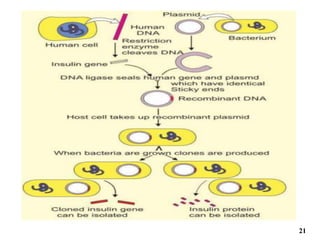
 If bacterial cells are treated with calcium chloride, they take up
recombinant DNA easily because calcium chloride increases the
permeability of bacterial cells. These bacterial cells than
reproduce to form a bacterial clone and each bacterial cell
contains one recombinant plasmid which will express itself and
make the product.
Conti…...
20
21
22

Biotechnology (Lecture 1).ppt

  • 1.
  • 2.
    Biotechnology 2 Dr. Mubashir Hussain LecturerBotany Department of Botany, Govt. Post Graduate College, Attock
  • 3.
    What is Biotechnology? Modern techniques by which the genes are removed from one organism and inserted into another for the production of desired substances e.g. insulin, vaccines, drugs and hormones.  Not very long ago, people affected from diabetes mellitus get insulin for their survival from dead animals. But today dibactics receive human insulin as a product of biotechnology. Biotechnology 3
  • 4.
     Initially biotechnologywas done in bacteria, viruses, and yeast etc.  But today genes can be introduced into an animal or plant cell. a) In mammals, a permanently altered animal can be produced by introducing the required gene into a zygote or early embryo in vitro and than placing in the uterus. b) In plants, the required gene is introduced into a single protoplast or a piece of cultured plant tissue from which a new plant can be generated. Conti….. 4
  • 5.
    Uses  A largenumber of benefits have been obtained from biotechnology e.g. genetically engineered bacteria have been used: i) To clean the environmental pollutants ii) To increase the fertility of soil iii) To kill the harmful pests iv) To manufacture the proteins, vaccines, hormones and drugs etc. Conti….. 5
  • 6.
    Cloning of gene Gene cloning produces a large number of identical copies of a gene. Two processes are usually used today for gene cloning; 1: Recombinant DNA technology: it is used when a very large quantity of a gene is required. It uses living organisms for gene cloning such as bacteria or viruses. 2: polymerase chain reaction (PCR): Today a very advance technique, polymerase chain reaction (PCR) is used for the production of large number of identical copies of a gene in laboratory test tubes. Conti…... 6
  • 7.
    Recombinant DNA technology Procedure for creating DNA molecules composed of one or more segments from other DNA molecules. Recombinant DNA  A DNA molecule produced by joining two or more DNA fragments that are often from different organisms is called recombinant DNA. Recombinant DNA technology 7
  • 8.
    Components required toproduce recombinant DNA  In order to produce recombinant DNA, following components are required: a) Gene of interest which is to be cloned b) Molecular scissors, to cut out the gene of interest c) Molecular carrier or vector, on which gene of interest is placed d) Gene of interest along with vector is introduced into an expression system to make a specific product. Conti…... 8
  • 9.
    1. How toget a gene?  There are three possible ways to get the gene of interest. a) Isolation from chromosome  Gene of interest is isolated from a chromosome by cutting the flanking sites of genes by using restriction endonucleases. b) Chemical synthesis  Small sized genes can be synthesized in the laboratory chemically. Conti…... 9
  • 10.
    c) Reverse transcription Genes of interest can also be synthesized in the laboratory from mRNA by using the reverse transcriptase. The DNA molecule synthesized in this way is called complementary DNA (cDNA) and this phenomenon is called reverse transcription. Conti…... 10
  • 11.
    2. Molecular scissors:Restriction endonucleases  These are the enzymes which are present naturally in bacteria for their protection against viruses. Such enzymes do not harm the bacterial chromosomes but they restrict the growth of viruses. Therefore called as restriction enzymes or restriction endonucleases. Discovery  Hamilton O. Smith (1970) at Johns Hopkins University isolated first restriction enzyme. Conti…... 11
  • 12.
     About 400kinds of restriction enzymes have been isolated but only 20 kinds are commonly used in the recombinant DNA technology.  Restriction enzymes always cut at palindrome sequence. Palindrome  In nucleic acid, a segment of DNA in which sequences of bases on the complementary strand reads the same in reverse order. 5´-GAATTC-3´ 3´-CTTAAG-5´  One strand is identical to other when reads in opposite direction. Conti…... 12
  • 13.
     Restriction enzymesproduce sticky and blunt ends. Sticky ends  Single stranded end of DNA molecule produced by certain restriction enzymes capable of reanealing with a complementary sequence in another such strand.  EcoR1 produces sticky ends. Conti…... 13
  • 14.
  • 15.
    3. Molecular carrier:vector  A vector is plasmid or phage into which a gene of interest is inserted for the introduction into bacterial or other host cells for gene cloning or studies of gene expression. Types of vector  There are two main types of vectors. a) Plasmid b) Lambda phage Conti…... 15
  • 16.
    Plasmids  Plasmids arenatural extra chromosomal circular DNA molecules which carry the gene for antibiotic resistance.  Examples of plasmids are a) pSC 101 b) pBR 322  pSC 101 has antibiotic resistance gene for tetracycline.  pBR 322 has antibiotic resistance genes for tetracycline and ampicillin. Conti…... 16
  • 17.
    Inserting gene ofinterest in tetracycline resistant gene of plasmid pBR 322 would enable separating out colonies of bacteria in a medium containing ampicillin and vice versa. Lambda phage  Lambda phage is also used as vector. Phage containing recombinant DNA when attaches with the bacterium, it releases the recombinant DNA into the bacterium. Inside the bacterium, reproduction of viruses takes place and a clone of phage is produced, each containing the gene of interest. Conti…... 17
  • 18.
    Production of recombinantDNA  Recombinant DNA is produced by cutting the plasmid with the same restriction enzyme which was used for the isolation of gene of interest.  The sticky ends of gene of interest are sealed with the sticky ends of plasmids by using DNA ligase. When two different pieces of DNA (plasmid + gene of interest) have been joined together, it is known as recombinant DNA or chimaeric DNA. Conti…... 18
  • 19.
  • 20.
    4. Expression ofrecombinant DNA  A clone can be a large number of molecules (cloned genes), cells (cloned bacteria) or organisms that are identical to the original specimen. Expression in bacteria  If bacterial cells are treated with calcium chloride, they take up recombinant DNA easily because calcium chloride increases the permeability of bacterial cells. These bacterial cells than reproduce to form a bacterial clone and each bacterial cell contains one recombinant plasmid which will express itself and make the product. Conti…... 20
  • 21.
  • 22.