THE FIRST ART MOVEMENT OF
THE MODERN PERIOD
Realism vs realism
1848–late 1800s
Realism is the attempt to depict subjects
as they are considered to exist in an
objective reality, without embellishment
or interpretation.
Realism portray real and typical
contemporary people and situations with
truth and accuracy, even the unpleasant
or miserable aspects of life.
It depicted people of all classes in
situations that arise in ordinary life, and
often reflected the changes wrought by
Industrial and Commercial Revolutions.
KEY FEATURES:
 Rejection of Romanticism and its exaggerated
emotionalism and drama
 Shunned Classical idealism of the Academy
 Avoided historical, mythological and Biblical subject
matter
 Based on direct observation of the modern world
Romanticism as
--artificial
--irrelevant
--overly-dramatic
Henri Fuseli, Nightmare
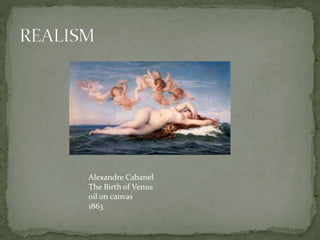
Alexandre Cabanel
The Birth of Venus
oil on canvas
1863
Rejection of
-- idealized forms
--and Roman and
Greek allegories
--simple nudes
REVOLUTIONS (POLITICAL/INDUSTRIAL)
PHOTOGRAPHY
PROGRESSIVE WRITINGS
Louis Philippe I
Monarchy 1830-1848
Under his reign:
--conditions of the working class
worsened
--income gap widened
considerably
--economic crisis (1847)
Napoleon III
Ruler of the Second French Empire
Nephew and heir of Napoleon I
First titular president
Until 1852
Last monarch of France
Until 1870
Era of prosperity and industrialization
in France
Exile in England 1870
Died in England 1873
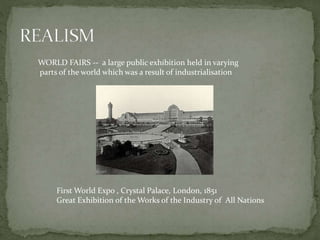
WORLD FAIRS -- a large public exhibition held in varying
parts of the world which was a result of industrialisation
First World Expo , Crystal Palace, London, 1851
Great Exhibition of the Works of the Industry of All Nations
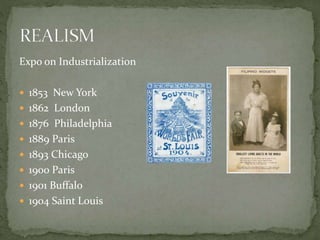
Expo on Industrialization
 1853 New York
 1862 London
 1876 Philadelphia
 1889 Paris
 1893 Chicago
 1900 Paris
 1901 Buffalo
 1904 Saint Louis
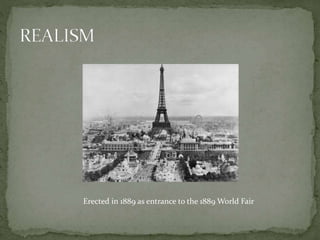
Erected in 1889 as entrance to the 1889 World Fair
 Photography
 Introduced and developed in 1820-1840
Dagguereotype --
Second of the 3
developments of the
modern camera
Louis Daguerre, inventor
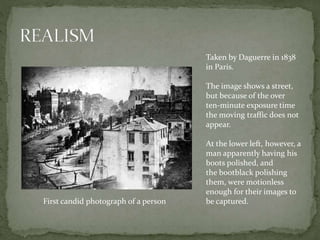
Taken by Daguerre in 1838
in Paris.
The image shows a street,
but because of the over
ten-minute exposure time
the moving traffic does not
appear.
At the lower left, however, a
man apparently having his
boots polished, and
the bootblack polishing
them, were motionless
enough for their images to
be captured.First candid photograph of a person
The Daguerreo type
 was an incredibly important discovery for
photography due to its speed and ease of use.
 represents the first commercially successful
photographic process.
 gift of France in 1839
* France agreed to pay Daguerre for his formula in exchange for
announcing his discovery as the gift of France, which he did in 1839.
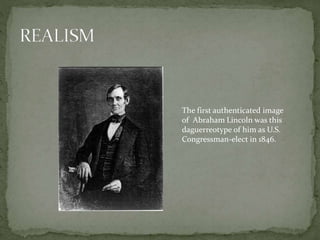
The first authenticated image
of Abraham Lincoln was this
daguerreotype of him as U.S.
Congressman-elect in 1846.
 Paralleled related trends in progressive writings
Naturalist Literature
 A literary movement that seeks to replicate a
believable everyday reality
 Outgrowth of literary realism (1850s)
 Tackled the dark aspects of life (poverty, violence,
disease, corruption, prostitution, etc.)
 Emile Zola, Gustave Flaubert, Honore de Balzac
Emile Zola
A study of alcoholism and poverty
in the working class district of Paris
Hugely successful
 Pierre Proudhon's socialist
philosophies
 Karl Marx's Communist Manifesto
(published, 1848), which urged
a proletarian uprising,
socialism, Communism.
FIRST PHASE (DIVERSE)
--censored and outspoken political cartoonist and
painter, Honoré Daumier
--careful social landscapes of Jean Francois Millet
--Rosa Bonheur, radical lesbian Socialist
--the cautious Socialists
Cartoons and drawings
on social and political
satire
Transnonain Street, 1834
Appeared on La Caricature
The subject, depicted in a
neutral way, was the repression
that had followed a riot on 5
April 1834, during which a family
in the working-class district of St
Martin had been shot by
government troops.
Honore Daumier
The Third Class Wagon
1862-64
Honore Daumier
The First Class Carriage
watercolor, ink wash
and charcoal on paper
1864
Jean Francois Millet
The Gleaners
1857
SECOND PHASE OF REALISM
 developed out of Literary Naturalism
 became more radical after the 1848 Revolution
with the art of Gustave Courbet
Without an overt narrative, the Dutch artists captured
frozen moments in time, enriched by carefully observed
detail, which created a portrait of a particular group of
people at a specific point in time.
The sheer ordinariness of the everyday lives of simple
people who were unremarkable and unpretentious
Adriane van Osted
Peasants in an Interior
oil on copper
1661
 When two of Courbet's major works (A Burial at
Ornans and The Painter's Studio) were rejected by the jury
of the 1855 Exposition Universelle in Paris, he withdrew his
eleven accepted submissions and displayed his paintings
privately in his Pavillon du Réalisme, not far from the
official international exhibition. For the introduction to the
catalogue of this independent, one-man show, Courbet
wrote a Realist manifesto, echoing the tone of the period's
political manifestos, in which he asserts his goal as an artist
"to translate the customs, the ideas, the appearance of my
epoch according to my own estimation.“
GUSTAVE COURBET
1819-1887
“I am fifty years old and I have
always lived in freedom; let me
end my life free; when I am
dead let this be said of me: 'He
belonged to no school, to no
church, to no institution, to no
academy, least of all to any
régime except the régime of
liberty.”
--Gustave Courbet
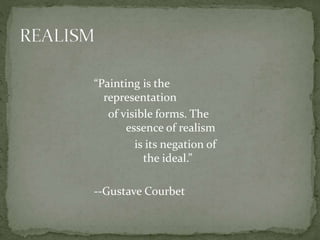
“Painting is the
representation
of visible forms. The
essence of realism
is its negation of
the ideal.”
--Gustave Courbet
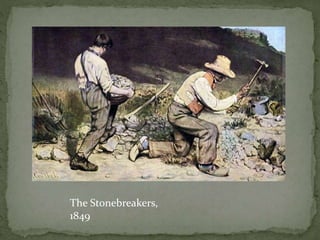
The Stonebreakers,
1849
A Burial at Ornans
1849-50
The Painter's Studio: A Real Allegory of a Seven
Year Phase in my Artistic (and Moral) Life
oil on canvas, 1855
In his autobiographical The Painter's Studio (Musée
d'Orsay, Paris), Courbet is surrounded by groups of
his friends, patrons, and even his models,
documenting his artistic and political experiences
since the Revolution of 1848.
EDOUARD MANET
1832-1883
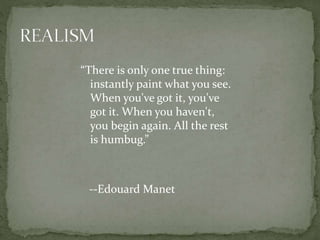
“There is only one true thing:
instantly paint what you see.
When you've got it, you've
got it. When you haven't,
you begin again. All the rest
is humbug.”
--Edouard Manet
“The attacks of which I have
been the object have
broken the spring of life
in me... People don't
realize what it feels like to
be constantly insulted.”
--Edouard Manet
The Luncheon on the Grass
1863
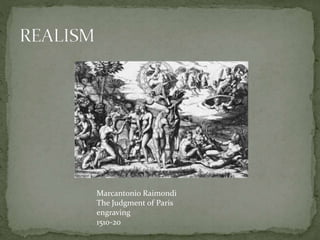
Marcantonio Raimondi
The Judgment of Paris
engraving
1510-20
Alexandre Cabanel
The Birth of Venus
oil on canvas
1863
Olympia
1863
The Fifer
(The Young Flautist)
1866
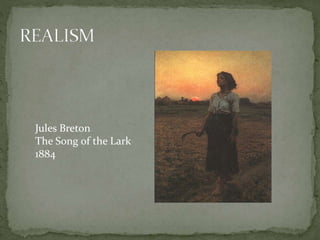
Jules Breton
The Song of the Lark
1884
END

Realism

  • 1.
    THE FIRST ARTMOVEMENT OF THE MODERN PERIOD
  • 2.
  • 3.
  • 4.
    Realism is theattempt to depict subjects as they are considered to exist in an objective reality, without embellishment or interpretation.
  • 5.
    Realism portray realand typical contemporary people and situations with truth and accuracy, even the unpleasant or miserable aspects of life. It depicted people of all classes in situations that arise in ordinary life, and often reflected the changes wrought by Industrial and Commercial Revolutions.
  • 6.
    KEY FEATURES:  Rejectionof Romanticism and its exaggerated emotionalism and drama  Shunned Classical idealism of the Academy  Avoided historical, mythological and Biblical subject matter  Based on direct observation of the modern world
  • 7.
  • 8.
    Alexandre Cabanel The Birthof Venus oil on canvas 1863 Rejection of -- idealized forms --and Roman and Greek allegories --simple nudes
  • 9.
  • 10.
    Louis Philippe I Monarchy1830-1848 Under his reign: --conditions of the working class worsened --income gap widened considerably --economic crisis (1847)
  • 11.
    Napoleon III Ruler ofthe Second French Empire Nephew and heir of Napoleon I First titular president Until 1852 Last monarch of France Until 1870 Era of prosperity and industrialization in France Exile in England 1870 Died in England 1873
  • 12.
    WORLD FAIRS --a large public exhibition held in varying parts of the world which was a result of industrialisation First World Expo , Crystal Palace, London, 1851 Great Exhibition of the Works of the Industry of All Nations
  • 13.
    Expo on Industrialization 1853 New York  1862 London  1876 Philadelphia  1889 Paris  1893 Chicago  1900 Paris  1901 Buffalo  1904 Saint Louis
  • 15.
    Erected in 1889as entrance to the 1889 World Fair
  • 17.
     Photography  Introducedand developed in 1820-1840 Dagguereotype -- Second of the 3 developments of the modern camera Louis Daguerre, inventor
  • 18.
    Taken by Daguerrein 1838 in Paris. The image shows a street, but because of the over ten-minute exposure time the moving traffic does not appear. At the lower left, however, a man apparently having his boots polished, and the bootblack polishing them, were motionless enough for their images to be captured.First candid photograph of a person
  • 19.
    The Daguerreo type was an incredibly important discovery for photography due to its speed and ease of use.  represents the first commercially successful photographic process.  gift of France in 1839 * France agreed to pay Daguerre for his formula in exchange for announcing his discovery as the gift of France, which he did in 1839.
  • 20.
    The first authenticatedimage of Abraham Lincoln was this daguerreotype of him as U.S. Congressman-elect in 1846.
  • 21.
     Paralleled relatedtrends in progressive writings Naturalist Literature  A literary movement that seeks to replicate a believable everyday reality  Outgrowth of literary realism (1850s)  Tackled the dark aspects of life (poverty, violence, disease, corruption, prostitution, etc.)
  • 22.
     Emile Zola,Gustave Flaubert, Honore de Balzac Emile Zola A study of alcoholism and poverty in the working class district of Paris Hugely successful
  • 23.
     Pierre Proudhon'ssocialist philosophies  Karl Marx's Communist Manifesto (published, 1848), which urged a proletarian uprising, socialism, Communism.
  • 24.
    FIRST PHASE (DIVERSE) --censoredand outspoken political cartoonist and painter, Honoré Daumier --careful social landscapes of Jean Francois Millet --Rosa Bonheur, radical lesbian Socialist --the cautious Socialists
  • 25.
    Cartoons and drawings onsocial and political satire Transnonain Street, 1834 Appeared on La Caricature The subject, depicted in a neutral way, was the repression that had followed a riot on 5 April 1834, during which a family in the working-class district of St Martin had been shot by government troops.
  • 26.
    Honore Daumier The ThirdClass Wagon 1862-64
  • 27.
    Honore Daumier The FirstClass Carriage watercolor, ink wash and charcoal on paper 1864
  • 28.
  • 29.
    SECOND PHASE OFREALISM  developed out of Literary Naturalism  became more radical after the 1848 Revolution with the art of Gustave Courbet
  • 30.
    Without an overtnarrative, the Dutch artists captured frozen moments in time, enriched by carefully observed detail, which created a portrait of a particular group of people at a specific point in time. The sheer ordinariness of the everyday lives of simple people who were unremarkable and unpretentious Adriane van Osted Peasants in an Interior oil on copper 1661
  • 31.
     When twoof Courbet's major works (A Burial at Ornans and The Painter's Studio) were rejected by the jury of the 1855 Exposition Universelle in Paris, he withdrew his eleven accepted submissions and displayed his paintings privately in his Pavillon du Réalisme, not far from the official international exhibition. For the introduction to the catalogue of this independent, one-man show, Courbet wrote a Realist manifesto, echoing the tone of the period's political manifestos, in which he asserts his goal as an artist "to translate the customs, the ideas, the appearance of my epoch according to my own estimation.“
  • 32.
  • 33.
    “I am fiftyyears old and I have always lived in freedom; let me end my life free; when I am dead let this be said of me: 'He belonged to no school, to no church, to no institution, to no academy, least of all to any régime except the régime of liberty.” --Gustave Courbet
  • 34.
    “Painting is the representation ofvisible forms. The essence of realism is its negation of the ideal.” --Gustave Courbet
  • 35.
  • 36.
    A Burial atOrnans 1849-50
  • 37.
    The Painter's Studio:A Real Allegory of a Seven Year Phase in my Artistic (and Moral) Life oil on canvas, 1855
  • 38.
    In his autobiographicalThe Painter's Studio (Musée d'Orsay, Paris), Courbet is surrounded by groups of his friends, patrons, and even his models, documenting his artistic and political experiences since the Revolution of 1848.
  • 39.
  • 40.
    “There is onlyone true thing: instantly paint what you see. When you've got it, you've got it. When you haven't, you begin again. All the rest is humbug.” --Edouard Manet
  • 41.
    “The attacks ofwhich I have been the object have broken the spring of life in me... People don't realize what it feels like to be constantly insulted.” --Edouard Manet
  • 42.
    The Luncheon onthe Grass 1863
  • 43.
    Marcantonio Raimondi The Judgmentof Paris engraving 1510-20
  • 44.
    Alexandre Cabanel The Birthof Venus oil on canvas 1863
  • 45.
  • 46.
    The Fifer (The YoungFlautist) 1866
  • 47.
    Jules Breton The Songof the Lark 1884
  • 48.