Realism
The Realistic Period
 The Realistic Period generally is thought to have begun in the
middle of the 19th
Century, though it varies across continents
as far as specific dates. Broadly defined, it is “the faithful
representation of reality.” In comparison to the Romantic
Period, the Realistic Period focuses on people from the
middle class, holds a mirror up to more personal themes that
focus on the individual, and shows more introspection and
psychological examination of the characters.
Art
In art, although a clearly defined realist school
has never evolved, a realist approach has been
manifested in different ways at various times.
The term realist, used to describe a work of art,
has often simply meant that “ugly” objects or
figures are represented, as opposed to those
considered “beautiful.” Frequently used to
describe scenes of humble life, the term implies
a criticism of social conditions.
 Realist literature is defined particularly as the fiction
produced in Europe and the United States from about
1840 until the 1890s, when realism was superseded
by naturalism. This form of realism began in France in
the novels of Gustave Flaubert and the short stories
of Guy de Maupassant.
Realism in Literature
In Russia, realism was represented in the plays
and short stories of Anton Chekhov. The novelist
George Eliot introduced realism into English fiction;
as she declared in Adam Bede (1859), her purpose
was to give a “faithful representation of
commonplace things.”
Mark Twain and William Dean Howells were the
pioneers of realism in the United States. One of
the greatest realists of all, the Anglo-American
novelist Henry James, drew much inspiration from
his mentors, Eliot and Howells. James's concern
with character motivation and behavior led to the
development of a subgenre, the psychological
novel.

The 19th-century French writer Gustave
Flaubert is known for his painstaking
pursuit of literary perfection. His novels,
written in the literary style known as
realism and characterized by keen
observation and attention to detail, are
counterbalanced by romantic language and
form. Flaubert's most famous novel,
Madame Bovary (1857), is one of the most
important works in French literature.
 Nineteenth-century French poet Charles Baudelaire wrote
musical verse as one of the most prominent of the French
symbolists. Baudelaire provoked the wrath of the French
government for offending public morals with his only major
book of poetry, the 1857 work Fleurs du mal (Flowers of
Evil). Considered a master of the sonnet form and a brilliant
literary critic, Baudelaire also helped introduce the works of
Edgar Allan Poe to Europe as a translator. Baudelaire's
notoriously decadent life led to his premature death at the
age of 46.
 Russian writer Leo Tolstoy's psychologically and
morally complex novels are regarded as masterpieces
of realistic fiction. Tolstoy believed that culture and
society were antagonistic to true happiness.
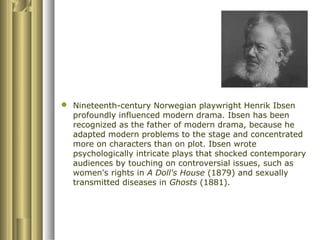
 Nineteenth-century Norwegian playwright Henrik Ibsen
profoundly influenced modern drama. Ibsen has been
recognized as the father of modern drama, because he
adapted modern problems to the stage and concentrated
more on characters than on plot. Ibsen wrote
psychologically intricate plays that shocked contemporary
audiences by touching on controversial issues, such as
women's rights in A Doll's House (1879) and sexually
transmitted diseases in Ghosts (1881).

Realism

  • 1.
  • 2.
    The Realistic Period The Realistic Period generally is thought to have begun in the middle of the 19th Century, though it varies across continents as far as specific dates. Broadly defined, it is “the faithful representation of reality.” In comparison to the Romantic Period, the Realistic Period focuses on people from the middle class, holds a mirror up to more personal themes that focus on the individual, and shows more introspection and psychological examination of the characters.
  • 3.
    Art In art, althougha clearly defined realist school has never evolved, a realist approach has been manifested in different ways at various times. The term realist, used to describe a work of art, has often simply meant that “ugly” objects or figures are represented, as opposed to those considered “beautiful.” Frequently used to describe scenes of humble life, the term implies a criticism of social conditions.
  • 11.
     Realist literatureis defined particularly as the fiction produced in Europe and the United States from about 1840 until the 1890s, when realism was superseded by naturalism. This form of realism began in France in the novels of Gustave Flaubert and the short stories of Guy de Maupassant. Realism in Literature
  • 12.
    In Russia, realismwas represented in the plays and short stories of Anton Chekhov. The novelist George Eliot introduced realism into English fiction; as she declared in Adam Bede (1859), her purpose was to give a “faithful representation of commonplace things.”
  • 13.
    Mark Twain andWilliam Dean Howells were the pioneers of realism in the United States. One of the greatest realists of all, the Anglo-American novelist Henry James, drew much inspiration from his mentors, Eliot and Howells. James's concern with character motivation and behavior led to the development of a subgenre, the psychological novel.
  • 14.
     The 19th-century Frenchwriter Gustave Flaubert is known for his painstaking pursuit of literary perfection. His novels, written in the literary style known as realism and characterized by keen observation and attention to detail, are counterbalanced by romantic language and form. Flaubert's most famous novel, Madame Bovary (1857), is one of the most important works in French literature.
  • 15.
     Nineteenth-century Frenchpoet Charles Baudelaire wrote musical verse as one of the most prominent of the French symbolists. Baudelaire provoked the wrath of the French government for offending public morals with his only major book of poetry, the 1857 work Fleurs du mal (Flowers of Evil). Considered a master of the sonnet form and a brilliant literary critic, Baudelaire also helped introduce the works of Edgar Allan Poe to Europe as a translator. Baudelaire's notoriously decadent life led to his premature death at the age of 46.
  • 16.
     Russian writerLeo Tolstoy's psychologically and morally complex novels are regarded as masterpieces of realistic fiction. Tolstoy believed that culture and society were antagonistic to true happiness.
  • 17.
     Nineteenth-century Norwegianplaywright Henrik Ibsen profoundly influenced modern drama. Ibsen has been recognized as the father of modern drama, because he adapted modern problems to the stage and concentrated more on characters than on plot. Ibsen wrote psychologically intricate plays that shocked contemporary audiences by touching on controversial issues, such as women's rights in A Doll's House (1879) and sexually transmitted diseases in Ghosts (1881).