ROMANTICISMTheArtisticExpressionofLiberalism
TopicOutline
Characteristics
Theme&symbolism
Techniques
Famousartists&greatWorks
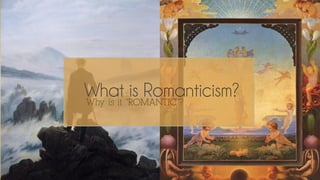
What is Romanticism?Why is it “ROMANTIC”?
ROMANTICISM
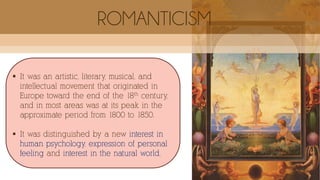
 It was an artistic, literary, musical, and
intellectual movement that originated in
Europe toward the end of the 18th century,
and in most areas was at its peak in the
approximate period from 1800 to 1850.
 It was distinguished by a new interest in
human psychology, expression of personal
feeling and interest in the natural world.
 Romanticism from the root word "Roman" in the various
European languages, such as romance and
Romanesque, has a complicated history, but by the
middle of the 18th century romantic in English and
romantique in French were both in common use as
adjectives of praise for natural phenomena such as
views and sunsets, in a sense close to modern English
usage but without the sexual connotation.
ROMANTICISM
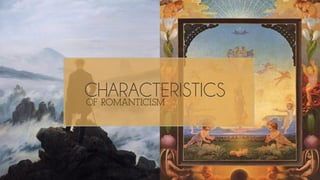
CHARACTERISTICSOF ROMANTICISM
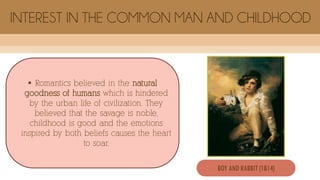
 Romantics believed in the natural
goodness of humans which is hindered
by the urban life of civilization. They
believed that the savage is noble,
childhood is good and the emotions
inspired by both beliefs causes the heart
to soar.
INTEREST IN THE COMMON MAN AND CHILDHOOD
BOY AND RABBIT (1814)
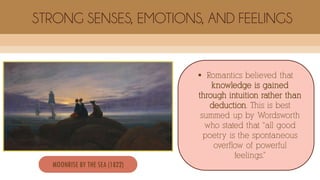
 Romantics believed that
knowledge is gained
through intuition rather than
deduction. This is best
summed up by Wordsworth
who stated that “all good
poetry is the spontaneous
overflow of powerful
feelings.”
STRONG SENSES, EMOTIONS, AND FEELINGS
MOONRISE BY THE SEA (1822)
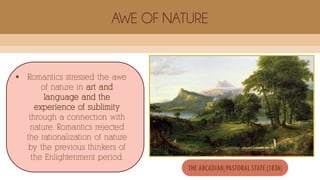
 Romantics stressed the awe
of nature in art and
language and the
experience of sublimity
through a connection with
nature. Romantics rejected
the rationalization of nature
by the previous thinkers of
the Enlightenment period.
AWE OF NATURE
THE ARCADIAN/PASTORAL STATE (1836)
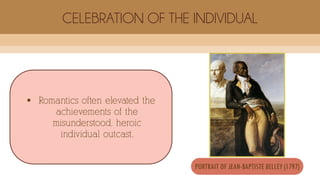
 Romantics often elevated the
achievements of the
misunderstood, heroic
individual outcast.
CELEBRATION OF THE INDIVIDUAL
PORTRAIT OF JEAN-BAPTISTE BELLEY (1797)
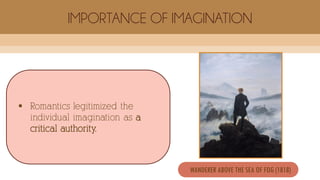
 Romantics legitimized the
individual imagination as a
critical authority.
IMPORTANCE OF IMAGINATION
WANDERER ABOVE THE SEA OF FOG (1818)
THEME & SYMBOLISMOF ROMANTICISM
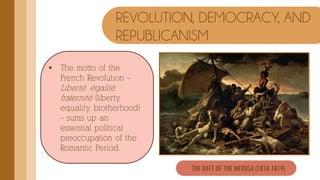
 The motto of the
French Revolution –
Liberté, égalité,
fraternité (liberty,
equality, brotherhood)
– sums up an
essential political
preoccupation of the
Romantic Period.
REVOLUTION, DEMOCRACY, AND
REPUBLICANISM
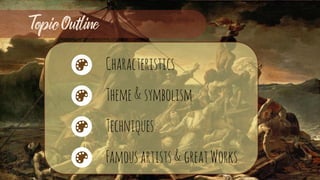
THE RAFT OF THE MEDUSA (1818-1819)
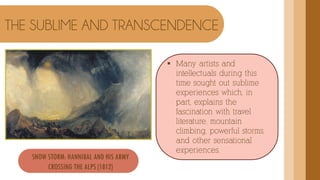
 Many artists and
intellectuals during this
time sought out sublime
experiences which, in
part, explains the
fascination with travel
literature, mountain
climbing, powerful storms,
and other sensational
experiences.
THE SUBLIME AND TRANSCENDENCE
SNOW STORM: HANNIBAL AND HIS ARMY
CROSSING THE ALPS (1812)
PROTO-PSYCHOLOGY & EXTREME
MENTAL STATES
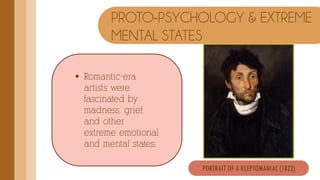
 Romantic-era
artists were
fascinated by
madness, grief,
and other
extreme emotional
and mental states.
PORTRAIT OF A KLEPTOMANIAC (1822)
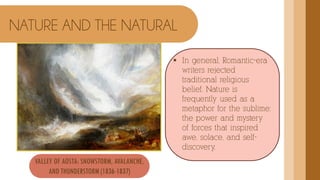
 In general, Romantic-era
writers rejected
traditional religious
belief. Nature is
frequently used as a
metaphor for the sublime:
the power and mystery
of forces that inspired
awe, solace, and self-
discovery.
NATURE AND THE NATURAL
VALLEY OF AOSTA: SNOWSTORM, AVALANCHE,
AND THUNDERSTORM (1836-1837)
TECHNIQUESOF ROMANTICISM
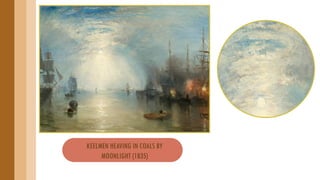
 Impasto is a painting technique occassionally
used by Naturalists and Romantic-era painters.
Paint is thickly layered onto a canvas, often with
visible brush or knife strokes. It is used to add the
artist’s emotion to the painting. It is also used to
carefully manage light and background foliage.
IMPASTO
KEELMEN HEAVING IN COALS BY
MOONLIGHT (1835)
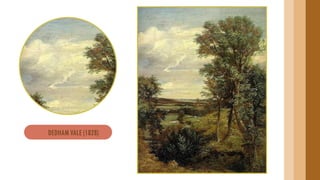
 Romantic-era artists fashioned themselves as
neoclassical painters and paid close attention to
detail. The scenes were always realistic, and the
human figures conveyed distinct emotion and
expressions. Bold brush strokes were used for
skies and landscapes. However, tight and precise
lines were used for human figures and objects in
the foreground.
DETAILED BRUSH STROKES
DEDHAM VALE (1828)
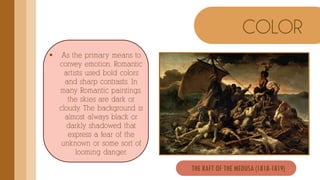
 As the primary means to
convey emotion, Romantic
artists used bold colors
and sharp contrasts. In
many Romantic paintings,
the skies are dark or
cloudy. The background is
almost always black or
darkly shadowed that
express a fear of the
unknown or some sort of
looming danger.
COLOR
THE RAFT OF THE MEDUSA (1818-1819)
FAMOUS ARTISTSOF ROMANTICISM
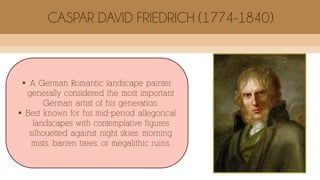
 A German Romantic landscape painter,
generally considered the most important
German artist of his generation.
 Best known for his mid-period allegorical
landscapes with contemplative figures
silhouetted against night skies, morning
mists, barren trees, or megalithic ruins.
CASPAR DAVID FRIEDRICH (1774-1840)
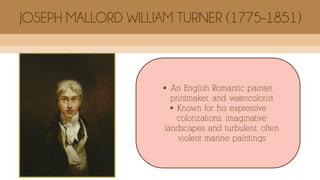
 An English Romantic painter,
printmaker, and watercolorist
 Known for his expressive
colorizations, imaginative
landscapes and turbulent, often
violent marine paintings
JOSEPH MALLORD WILLIAM TURNER (1775-1851)
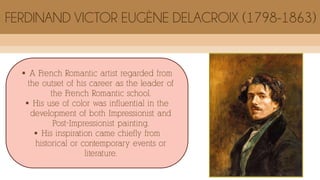
 A French Romantic artist regarded from
the outset of his career as the leader of
the French Romantic school.
 His use of color was influential in the
development of both Impressionist and
Post-Impressionist painting.
 His inspiration came chiefly from
historical or contemporary events or
literature.
FERDINAND VICTOR EUGÈNE DELACROIX (1798-1863)
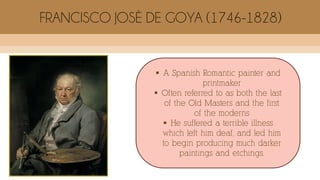
 A Spanish Romantic painter and
printmaker
 Often referred to as both the last
of the Old Masters and the first
of the moderns
 He suffered a terrible illness
which left him deaf, and led him
to begin producing much darker
paintings and etchings.
FRANCISCO JOSÈ DE GOYA (1746-1828)
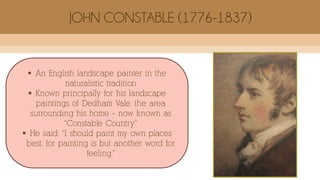
 An English landscape painter in the
naturalistic tradition
 Known principally for his landscape
paintings of Dedham Vale, the area
surrounding his home – now known as
“Constable Country”
 He said: “I should paint my own places
best, for painting is but another word for
feeling.”
JOHN CONSTABLE (1776-1837)
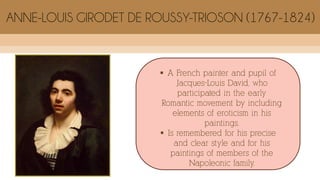
 A French painter and pupil of
Jacques-Louis David, who
participated in the early
Romantic movement by including
elements of eroticism in his
paintings.
 Is remembered for his precise
and clear style and for his
paintings of members of the
Napoleonic family.
ANNE-LOUIS GIRODET DE ROUSSY-TRIOSON (1767-1824)
GREAT WORKSOF ROMANTICISM
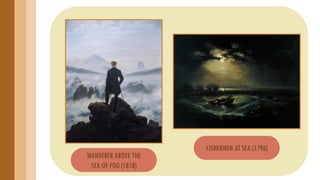
WANDERER ABOVE THE
SEA OF FOG (1818)
FISHERMEN AT SEA (1796)
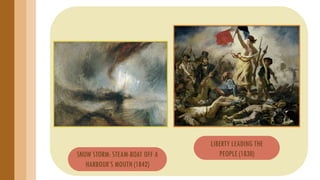
SNOW STORM: STEAM-BOAT OFF A
HARBOUR’S MOUTH (1842)
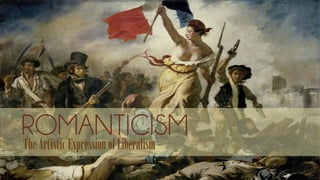
LIBERTY LEADING THE
PEOPLE (1830)
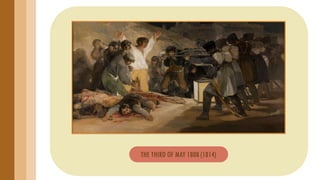
THE THIRD OF MAY 1808 (1814)
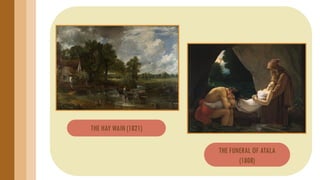
THE HAY WAIN (1821)
THE FUNERAL OF ATALA
(1808)
THANK YOU!
JOSSIE MAE C. BORRES
PHARMACY – 1E

Romanticism PPT

  • 1.
  • 2.
  • 3.
    What is Romanticism?Whyis it “ROMANTIC”?
  • 4.
    ROMANTICISM  It wasan artistic, literary, musical, and intellectual movement that originated in Europe toward the end of the 18th century, and in most areas was at its peak in the approximate period from 1800 to 1850.  It was distinguished by a new interest in human psychology, expression of personal feeling and interest in the natural world.
  • 5.
     Romanticism fromthe root word "Roman" in the various European languages, such as romance and Romanesque, has a complicated history, but by the middle of the 18th century romantic in English and romantique in French were both in common use as adjectives of praise for natural phenomena such as views and sunsets, in a sense close to modern English usage but without the sexual connotation. ROMANTICISM
  • 6.
  • 7.
     Romantics believedin the natural goodness of humans which is hindered by the urban life of civilization. They believed that the savage is noble, childhood is good and the emotions inspired by both beliefs causes the heart to soar. INTEREST IN THE COMMON MAN AND CHILDHOOD BOY AND RABBIT (1814)
  • 8.
     Romantics believedthat knowledge is gained through intuition rather than deduction. This is best summed up by Wordsworth who stated that “all good poetry is the spontaneous overflow of powerful feelings.” STRONG SENSES, EMOTIONS, AND FEELINGS MOONRISE BY THE SEA (1822)
  • 9.
     Romantics stressedthe awe of nature in art and language and the experience of sublimity through a connection with nature. Romantics rejected the rationalization of nature by the previous thinkers of the Enlightenment period. AWE OF NATURE THE ARCADIAN/PASTORAL STATE (1836)
  • 10.
     Romantics oftenelevated the achievements of the misunderstood, heroic individual outcast. CELEBRATION OF THE INDIVIDUAL PORTRAIT OF JEAN-BAPTISTE BELLEY (1797)
  • 11.
     Romantics legitimizedthe individual imagination as a critical authority. IMPORTANCE OF IMAGINATION WANDERER ABOVE THE SEA OF FOG (1818)
  • 12.
  • 13.
     The mottoof the French Revolution – Liberté, égalité, fraternité (liberty, equality, brotherhood) – sums up an essential political preoccupation of the Romantic Period. REVOLUTION, DEMOCRACY, AND REPUBLICANISM THE RAFT OF THE MEDUSA (1818-1819)
  • 14.
     Many artistsand intellectuals during this time sought out sublime experiences which, in part, explains the fascination with travel literature, mountain climbing, powerful storms, and other sensational experiences. THE SUBLIME AND TRANSCENDENCE SNOW STORM: HANNIBAL AND HIS ARMY CROSSING THE ALPS (1812)
  • 15.
    PROTO-PSYCHOLOGY & EXTREME MENTALSTATES  Romantic-era artists were fascinated by madness, grief, and other extreme emotional and mental states. PORTRAIT OF A KLEPTOMANIAC (1822)
  • 16.
     In general,Romantic-era writers rejected traditional religious belief. Nature is frequently used as a metaphor for the sublime: the power and mystery of forces that inspired awe, solace, and self- discovery. NATURE AND THE NATURAL VALLEY OF AOSTA: SNOWSTORM, AVALANCHE, AND THUNDERSTORM (1836-1837)
  • 17.
  • 18.
     Impasto isa painting technique occassionally used by Naturalists and Romantic-era painters. Paint is thickly layered onto a canvas, often with visible brush or knife strokes. It is used to add the artist’s emotion to the painting. It is also used to carefully manage light and background foliage. IMPASTO
  • 19.
    KEELMEN HEAVING INCOALS BY MOONLIGHT (1835)
  • 20.
     Romantic-era artistsfashioned themselves as neoclassical painters and paid close attention to detail. The scenes were always realistic, and the human figures conveyed distinct emotion and expressions. Bold brush strokes were used for skies and landscapes. However, tight and precise lines were used for human figures and objects in the foreground. DETAILED BRUSH STROKES
  • 21.
  • 22.
     As theprimary means to convey emotion, Romantic artists used bold colors and sharp contrasts. In many Romantic paintings, the skies are dark or cloudy. The background is almost always black or darkly shadowed that express a fear of the unknown or some sort of looming danger. COLOR THE RAFT OF THE MEDUSA (1818-1819)
  • 23.
  • 24.
     A GermanRomantic landscape painter, generally considered the most important German artist of his generation.  Best known for his mid-period allegorical landscapes with contemplative figures silhouetted against night skies, morning mists, barren trees, or megalithic ruins. CASPAR DAVID FRIEDRICH (1774-1840)
  • 25.
     An EnglishRomantic painter, printmaker, and watercolorist  Known for his expressive colorizations, imaginative landscapes and turbulent, often violent marine paintings JOSEPH MALLORD WILLIAM TURNER (1775-1851)
  • 26.
     A FrenchRomantic artist regarded from the outset of his career as the leader of the French Romantic school.  His use of color was influential in the development of both Impressionist and Post-Impressionist painting.  His inspiration came chiefly from historical or contemporary events or literature. FERDINAND VICTOR EUGÈNE DELACROIX (1798-1863)
  • 27.
     A SpanishRomantic painter and printmaker  Often referred to as both the last of the Old Masters and the first of the moderns  He suffered a terrible illness which left him deaf, and led him to begin producing much darker paintings and etchings. FRANCISCO JOSÈ DE GOYA (1746-1828)
  • 28.
     An Englishlandscape painter in the naturalistic tradition  Known principally for his landscape paintings of Dedham Vale, the area surrounding his home – now known as “Constable Country”  He said: “I should paint my own places best, for painting is but another word for feeling.” JOHN CONSTABLE (1776-1837)
  • 29.
     A Frenchpainter and pupil of Jacques-Louis David, who participated in the early Romantic movement by including elements of eroticism in his paintings.  Is remembered for his precise and clear style and for his paintings of members of the Napoleonic family. ANNE-LOUIS GIRODET DE ROUSSY-TRIOSON (1767-1824)
  • 30.
  • 31.
    WANDERER ABOVE THE SEAOF FOG (1818) FISHERMEN AT SEA (1796)
  • 32.
    SNOW STORM: STEAM-BOATOFF A HARBOUR’S MOUTH (1842) LIBERTY LEADING THE PEOPLE (1830)
  • 33.
    THE THIRD OFMAY 1808 (1814)
  • 34.
    THE HAY WAIN(1821) THE FUNERAL OF ATALA (1808)
  • 35.
    THANK YOU! JOSSIE MAEC. BORRES PHARMACY – 1E