Realism
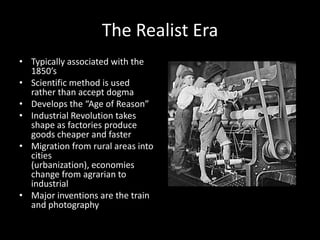
The Realist Era
• Typically associated with the
  1850’s
• Scientific method is used
  rather than accept dogma
• Develops the “Age of Reason”
• Industrial Revolution takes
  shape as factories produce
  goods cheaper and faster
• Migration from rural areas into
  cities
  (urbanization), economies
  change from agrarian to
  industrial
• Major inventions are the train
  and photography
What is Realism?
• Enlightenment put focus on
  scientific method and
  observation
• Empiricism – knowledge
  based on what can be
  measured and directly
  experienced
• What can actually be
  seen/experienced in the
  world
• Realists only painted
  subjects they themselves
  could experience (personal
  experience)
Realism
• context: cultural
   – role of artist:
       • no longer to simply reveal
         beautiful & sublime
       • aimed to tell the truth
       • not beholden to higher,
         idealized reality (i.e., God)
   – subjects:
       • ordinary events and
         objects
       • working class & broad
         panorama of society
       • psychological motivation of
         characters
Realism and Positivism
• Developed by philosopher
  Auguste Comte (1798-1857)
• All knowledge could be
  derived from objectivity of
  scientific observation
• (Ahem…anyone ever hear of
  Aristotle??!!)
• Social scientists would deduce
  laws of human culture
• Metaphysical and theological
  speculation was out
• Positivism stressed emphasis
  on objectivity
Realism: Exploring human evolution &
            social equality
• political context: Marxism
• Communist Manifesto (c. 1850)
   – thesis: all history was history
     of class struggles
   – determined by humanity’s
     relationship to material
     wealth
• Darwin: theory of evolution
• Comte: positivism…all
  knowledge comes from
  tested scientific proof
Realism in France: Courbet

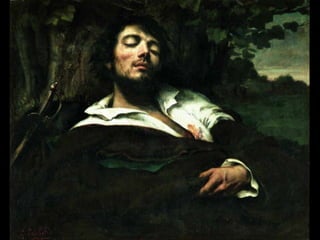
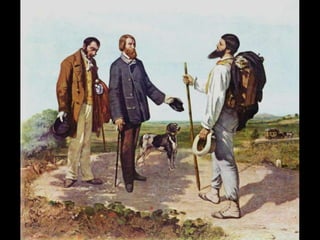
•   style: self-educated; copied
    Spanish, Dutch & Venetian masters @
    Louvre
•   Baroque lighting
    (e.g., Caravaggio, Rembrandt)
•   objective record of customs &
    appearances of contemporary society
•   fight against official art (salon
    REJECT)
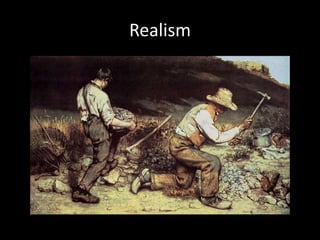
                                      The Stonebreakers, 1850
•   subjects: “Show me an angel, and
                                      Young & old working at miserable job; socialist ideals
    I’ll paint one”
                                             Monmentality of everyday life
•   No exotic locales, no gods and
    goddesses, no heroes of history.. Only
    wht you can see or touch.
GUSTAVE COURBET, The Stone Breakers, 1849.
                                             10
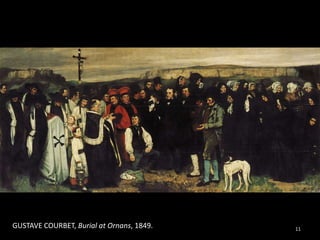
GUSTAVE COURBET, Burial at Ornans, 1849.   11
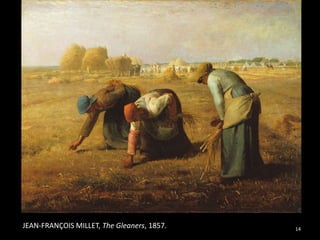
JEAN-FRANÇOIS MILLET, The Gleaners, 1857.   14
HONORÉ DAUMIER, Rue Transnonain, 1834.
                                         16
HONORÉ DAUMIER, Third-Class Carriage, ca. 1862.
                                                  19
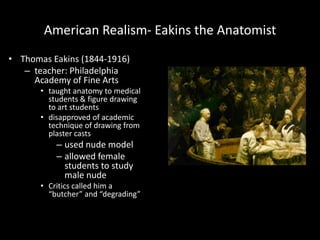
American Realism- Eakins the Anatomist
• Thomas Eakins (1844-1916)
   – teacher: Philadelphia
     Academy of Fine Arts
       • taught anatomy to medical
         students & figure drawing
         to art students
       • disapproved of academic
         technique of drawing from
         plaster casts
           – used nude model
           – allowed female
             students to study
             male nude
       • Critics called him a
         “butcher” and “degrading”
THOMAS EAKINS, The Gross
     Clinic, 1875.

                           23
Eakins vs. Rembrandt…
JOHN SINGER SARGENT, The Daughters of Edward Darley Boit, 1882.
                                                                  29
John Singer Sargent’s Madame X

             •American portrait artist much sought after in
             US and Europe
             •This portrait caused a scandal in the Paris
             salon of 1888
             •Sargent moved to England and painted quasi
             impressionist
             •Captured personality of his subjects
             •Painterly brushwork, outstanding capture of
             clothing/fashions
HONORÉ DAUMIER, Nadar
Raising Photography to the
    Height of Art, 1862.

                             36
JOSIAH JOHNSON HAWES and ALBERT SANDS SOUTHWORTH, Early Operation under
              Ether, Massachusetts General Hospital, ca. 1847.            37
TIMOTHY O’SULLIVAN, A Harvest of Death, Gettysburg, Pennsylvania, July 1863.

                                                                               38
EADWEARD MUYBRIDGE, Horse Galloping, 1878.
                                             39
The Problem of
Photography
What is the purpose of art in the face
of photography?
Vermeer used the camera obscura
Some artists reacted against
photography
Some embraced it – much like
Vermeer
First surviving photograph dates to
1826, by 1880s portable cameras
available
NADAR, Eugène Delacroix, ca.
          1855.


                               43
Reaction: Pre-Raphaelite Brotherhood
• Not everyone was
  enjoying the world
  produced by
  industrialization
• In England, Pre-
  Raphaelite Brotherhood
  departed from subject
  matter of French Realists
• Tired of classical
  themes, focused on
  medieval stories and
  spirituality
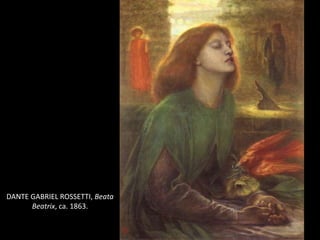
DANTE GABRIEL ROSSETTI, Beata
      Beatrix, ca. 1863.

                                45
JOHN EVERETT MILLAIS, Ophelia.   46
Symbolism
• A loosely organized
  movement that flourished
  in the late 1800’s and was
  closely related to the
  Symbolist movement in
  literature. In reaction
  against both Realism and
  Impressionism, Symbolist
  painters stressed art's
  subjective, symbolic, and
  decorative functions and
  turned to the mystical and
  occult in an attempt to
  evoke subjective states of
  mind by visual means.
Gustave Moreau, THE
SUITORS, 1852.
Gustave Moreau, THE
DAUGHTERS OF
TESPIO, 1882/83.
Gustave Moreau, OEDUPUS THE
WAYFARER, 1888.
Edvard Munch, MADONNA, 1894-95.
Odilin Redon
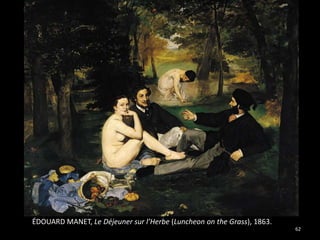
ÉDOUARD MANET, Le Déjeuner sur l’Herbe (Luncheon on the Grass), 1863.
                                                                        62
ÉDOUARD MANET, Olympia, 1863.   63
ADOLPHE-WILLIAM
BOUGUEREAU, Nymphs and
     Satyr, 1873.

                         64
William Bouguereau, THE
NYPMHAEUM, 1878.

Rococo to Realism 2

  • 1.
  • 2.
    The Realist Era •Typically associated with the 1850’s • Scientific method is used rather than accept dogma • Develops the “Age of Reason” • Industrial Revolution takes shape as factories produce goods cheaper and faster • Migration from rural areas into cities (urbanization), economies change from agrarian to industrial • Major inventions are the train and photography
  • 3.
    What is Realism? •Enlightenment put focus on scientific method and observation • Empiricism – knowledge based on what can be measured and directly experienced • What can actually be seen/experienced in the world • Realists only painted subjects they themselves could experience (personal experience)
  • 4.
    Realism • context: cultural – role of artist: • no longer to simply reveal beautiful & sublime • aimed to tell the truth • not beholden to higher, idealized reality (i.e., God) – subjects: • ordinary events and objects • working class & broad panorama of society • psychological motivation of characters
  • 5.
    Realism and Positivism •Developed by philosopher Auguste Comte (1798-1857) • All knowledge could be derived from objectivity of scientific observation • (Ahem…anyone ever hear of Aristotle??!!) • Social scientists would deduce laws of human culture • Metaphysical and theological speculation was out • Positivism stressed emphasis on objectivity
  • 6.
    Realism: Exploring humanevolution & social equality • political context: Marxism • Communist Manifesto (c. 1850) – thesis: all history was history of class struggles – determined by humanity’s relationship to material wealth • Darwin: theory of evolution • Comte: positivism…all knowledge comes from tested scientific proof
  • 7.
    Realism in France:Courbet • style: self-educated; copied Spanish, Dutch & Venetian masters @ Louvre • Baroque lighting (e.g., Caravaggio, Rembrandt) • objective record of customs & appearances of contemporary society • fight against official art (salon REJECT) The Stonebreakers, 1850 • subjects: “Show me an angel, and Young & old working at miserable job; socialist ideals I’ll paint one” Monmentality of everyday life • No exotic locales, no gods and goddesses, no heroes of history.. Only wht you can see or touch.
  • 10.
    GUSTAVE COURBET, TheStone Breakers, 1849. 10
  • 11.
    GUSTAVE COURBET, Burialat Ornans, 1849. 11
  • 14.
    JEAN-FRANÇOIS MILLET, TheGleaners, 1857. 14
  • 16.
    HONORÉ DAUMIER, RueTransnonain, 1834. 16
  • 19.
    HONORÉ DAUMIER, Third-ClassCarriage, ca. 1862. 19
  • 22.
    American Realism- Eakinsthe Anatomist • Thomas Eakins (1844-1916) – teacher: Philadelphia Academy of Fine Arts • taught anatomy to medical students & figure drawing to art students • disapproved of academic technique of drawing from plaster casts – used nude model – allowed female students to study male nude • Critics called him a “butcher” and “degrading”
  • 23.
    THOMAS EAKINS, TheGross Clinic, 1875. 23
  • 28.
  • 29.
    JOHN SINGER SARGENT,The Daughters of Edward Darley Boit, 1882. 29
  • 31.
    John Singer Sargent’sMadame X •American portrait artist much sought after in US and Europe •This portrait caused a scandal in the Paris salon of 1888 •Sargent moved to England and painted quasi impressionist •Captured personality of his subjects •Painterly brushwork, outstanding capture of clothing/fashions
  • 36.
    HONORÉ DAUMIER, Nadar RaisingPhotography to the Height of Art, 1862. 36
  • 37.
    JOSIAH JOHNSON HAWESand ALBERT SANDS SOUTHWORTH, Early Operation under Ether, Massachusetts General Hospital, ca. 1847. 37
  • 38.
    TIMOTHY O’SULLIVAN, AHarvest of Death, Gettysburg, Pennsylvania, July 1863. 38
  • 39.
    EADWEARD MUYBRIDGE, HorseGalloping, 1878. 39
  • 40.
    The Problem of Photography Whatis the purpose of art in the face of photography? Vermeer used the camera obscura Some artists reacted against photography Some embraced it – much like Vermeer First surviving photograph dates to 1826, by 1880s portable cameras available
  • 43.
  • 44.
    Reaction: Pre-Raphaelite Brotherhood •Not everyone was enjoying the world produced by industrialization • In England, Pre- Raphaelite Brotherhood departed from subject matter of French Realists • Tired of classical themes, focused on medieval stories and spirituality
  • 45.
    DANTE GABRIEL ROSSETTI,Beata Beatrix, ca. 1863. 45
  • 46.
  • 49.
    Symbolism • A looselyorganized movement that flourished in the late 1800’s and was closely related to the Symbolist movement in literature. In reaction against both Realism and Impressionism, Symbolist painters stressed art's subjective, symbolic, and decorative functions and turned to the mystical and occult in an attempt to evoke subjective states of mind by visual means.
  • 50.
  • 52.
    Gustave Moreau, THE DAUGHTERSOF TESPIO, 1882/83.
  • 53.
    Gustave Moreau, OEDUPUSTHE WAYFARER, 1888.
  • 58.
  • 59.
  • 62.
    ÉDOUARD MANET, LeDéjeuner sur l’Herbe (Luncheon on the Grass), 1863. 62
  • 63.
  • 64.
  • 65.