Surrealism
& Dada
Expression of the Subconscious
Mind , Juxtaposition of Images
and Concepts
Adapted from Ms.Bauer Art
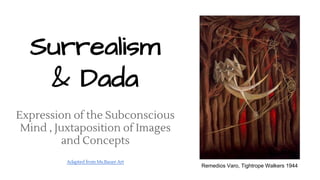
Remedios Varo, Tightrope Walkers 1944
What is Dada?
Man Ray, Le Cadeau (The Gift), 1921
The Dada Movement (1916-23) was anti-
war, anti-materialistic and anti-
nationalistic. Dada rejected traditional
art standards and used nonsense to
represent the senselessness of war and
violence.
Tristan Tzara
● 1896- 1963
● Romanian/French
● Poet, Essayist and Performance Artist
● He wrote the “Dada Manifesto” 1918
I destroy the drawers of the brain, and those of social organisation: to sow
demoralisation everywhere, and throw heaven's hand into hell, hell's eyes into
heaven, to reinstate the fertile wheel of a universal circus in the Powers of reality,
and the fantasy of every individual.
Every man must shout: there is great destructive, negative work to be done. To
sweep, to clean. The cleanliness of the individual materialises after we've gone
through folly, the aggressive, complete folly of a world left in the hands of bandits
who have demolished and destroyed the centuries. With neither aim nor plan,
without organisation: uncontrollable folly, decomposition. Those who are strong in
word or in strength will survive, because they are quick to defend themselves; the
agility of their limbs and feelings flames on their faceted flanks.
DADA DOES NOT MEAN ANYTHING
Sophie Taeuber-Arp, Military Guards, 1918
Marcel Duchamp, Bicycle Wheel, 1913
Raoul Hausmann, The Critic, 1919-20Marcel Duchamp, L.H.O.O.Q., 1919
Origins of Surrealism
Rene Magritte, This is Not a Pipe, 1968
Surrealism developed out of the Dada
Movement.
Surrealists were also influenced by
Abstraction and Expressionism, as well
as Futurism and Cubism.
What is Surrealism?
A 20th century literary and artistic
movement that attempts to express
the workings of the subconscious
mind.
It is characterized by fantastic
imagery and incongruous
juxtaposition of subject matter.
Rene Magritte, Son of Man, 1964
Cultural & Historical Context
Surrealism began during WW1, and continued through WW11,
beginning in Paris and spreading through Europe and beyond.
While Impressionists and Cubists were concerned with painting
the way we see, the Surrealists were more concerned with painting
how we really think.
Surrealists wanted to discover a new reality by mixing dreams with
imagination to create strange and unusual works of art that
allowed individual artists to express new emotions that would
make us think.
Andre Breton
● 1896- 1966
● French
● Surrealism was officially founded in 1924,
when Andre Breton wrote Le Manifeste du
Surrealisme.
● He defined Surrealism as “Psychic automatism
in its pure state, by which one proposes to
express verbally, by means of the written
word, or in any other matter - the actual
functioning of thought.”
Automatism
Automatic drawing was developed by the
Surrealists as a means of expressing the
subconscious.
In automatic drawing, the hand is allowed to move
“randomly” across the paper. In applying chance
and accident to mark-making, drawing is to a large
extent freed from rational control. Hence the
drawing produced may be attributed in part to the
subconscious and may reveal something of the
psyche which would otherwise be repressed.
Andre Masson, Automatic Drawing,
1896-1897
Famous Surrealists
Salvador Dali, Apparition of Face and Fruit Dish on a Beach , 1938
Max Ernst
● 1891- 1976
● German
● “Painting is not for me either decorative
amusement, or the plastic invention of felt
reality; it must be every time: invention,
discovery, revelation.”
Max Ernst, Ubu Imperator (Dada Phase), 1923
Joan Miro
● 1893- 1983
● Spanish
● “The painting rises from the brushstrokes
as a poem rises from the words. The
meaning comes later.”
● Miro did not call himself a Surrealist, but
he helped start the movement.
● Practitioner of automatism.
Joan Miro, The Tilled Field, 1923-24
Rene Magritte
● 1898- 1967
● Belgian
● “It is a union that suggests the essential
mystery of the world. Art for me is not an
end in itself, but a means of evoking that
mystery.”
● Began painting in Surrealist style after
viewing Giorgio di Chirico’s artwork.
Giorgio di Chirico, Love Song, 1914 Rene Magritte, Memory, 1948
Rene Magritte, Transfer, 1966
Salvador Dali
● 1904 - 1989
● Spanish
● “Surrealism is destructive, but it destroys
only what it considers to be shackles
limiting our vision.”
Salvador Dali, The Persistence of Memory, 1931
Women in Surrealism
Surrealism was the first artistic movement of the 20th century in which women
were able to explore feminism and stake a place in the art world.
“Putting psychic life in the service of revolutionary politics, Surrealism publicly
challenged vanguard modernism’s insistence on ‘art for art’s sake.’ Surrealism also
battled the social institutions- church, state, and family- that regulate the place of
women within patriarchy. In offering some women their first locus for artistic and
social resistance, it became the first modernist movement in which a group of
women could explore female subjectivity and give form (however tentatively) to a
feminine imaginary.”
- Whitney Chadwick, from Women, Surrealism, and Self-Representation
Frida Kahlo
● 1907 - 1954
● Mexican
● “I paint my own reality. The only thing I
know is that I paint because I need to, and I
paint whatever passes through my head
without any other consideration.”
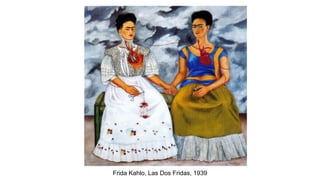
Frida Kahlo, Las Dos Fridas, 1939
Remedios Varo
● 1908 - 1963
● Spanish
● “On second thought, I think I am more
crazy than my goat.”
Remedios Varo, Useless Science or The Alchemist, 1955
Leonora Carrington
● 1916 - 2011
● English/Irish
● “I didn’t have time to be anyone’s muse… I
was too busy rebelling against my family
and learning to be an artist.”
● As a young artist, she married Max Ernst.
Leonora Carrington, Untitled, 1942
Impact of Surrealism
Influenced writing and art, as well as
other literary and artistic movements:
● Expressionism
● Post-Modernism
● Magic Realism
Surrealism: It defines a range of
creative acts of revolt and efforts to
liberate the imagination.
Dada & Surrealist Games
To make a Dadaist poem:
1. Take a newspaper.
2. Take a pair of scissors.
3. Choose an article as long as you are planning to make your poem.
4. Cut out the article.
5. Then cut out each of the words that make up this article and put them in a bag.
6. Shake it gently.
7. Then take out the scraps one after the other in the order in which they left the bag.
8. Copy conscientiously.
9. The poem will be like you.
10. And here you are a writer, infinitely original and endowed with a sensibility that is
charming though beyond the understanding of the vulgar.
-Tristan Tzara
Dada & Surrealist Games
Exquisite Corpse:
Surrealist founding father André Breton claims that several members began to play an old game
known as “Consequences” at a party. One person would write a word on the piece of paper, fold
it back to show only the last word, and hand it to the next person to keep the story rolling.
Considering that the participants of that game and later ones included figures such as Marcel
Duchamp, Man Ray, Tristan Tzara, Paul Éluard, and Joan Miró, it’s not surprising that the normal
verbal twists and turns of the game took on a whole new level.
When the phrase “exquisite corpse” turned up in one session, it instantly became the new name
for the game. Over time, a visual equivalent evolved in which artists would draw part of a figure,
fold back the paper to show just a hint, and hand it to the next artist to carry on the game.
Surrealist Music
Karlheinz- Helikopter-Streichquartett (Helicopter String
Quartet)
John Cage - Branches, Six Melodies
American composer, music theorist, writer, and artist. A pioneer of indeterminacy in music,
electroacoustic music, and non-standard use of musical instruments, Cage was one of the leading
figures of the post-war avant-garde. Critics have lauded him as one of the most influential
American composers of the 20th century.
Yoko Ono- Voice Piece for Soprano & Wish Tree
Surrealist Dance
Martha Graham Lamentation-Choreographed in 1930
American modern dancer and choreographer whose influence on dance has been
compared with the influence Picasso had on the modern visual arts,[1][2]
Stravinsky had on music, or Frank Lloyd Wright had on architecture.[3]
She danced and choreographed for over seventy years.
Isadora Duncan “The Dancer of the Future”
Duncan’s philosophy of dance moved away from rigid ballet technique and
towards what she perceived as natural movement. To restore dance to a high art
form instead of entertainment, she sought the connection between emotions and
movement: “I spent long days and nights in the studio seeking that dance which
might be the divine expression of the human spirit through the medium of the
body’s movement.”
Surrealist Filmmakers
Man Ray
Fritz Lang- Metropolis (1:16:32)
Robert Wiene, Hans Janowitz & Carl Meyer,The Cabinet of Dr. Caligari
Salvador Dali - Dream for Spellbound & Collaboration with Disney, Destino
Tarsem Singh - The Fall (21:19)
Surrealist Mixed Media Collage Project
Using JUXTAPOSITION
to engage the viewer’s
subconscious mind
Surrealism & Dada
Surrealism & Dada
Surrealism & Dada
Surrealism & Dada
Surrealism & Dada
Surrealism & Dada

Surrealism & Dada

  • 1.
    Surrealism & Dada Expression ofthe Subconscious Mind , Juxtaposition of Images and Concepts Adapted from Ms.Bauer Art Remedios Varo, Tightrope Walkers 1944
  • 2.
    What is Dada? ManRay, Le Cadeau (The Gift), 1921 The Dada Movement (1916-23) was anti- war, anti-materialistic and anti- nationalistic. Dada rejected traditional art standards and used nonsense to represent the senselessness of war and violence.
  • 3.
    Tristan Tzara ● 1896-1963 ● Romanian/French ● Poet, Essayist and Performance Artist ● He wrote the “Dada Manifesto” 1918 I destroy the drawers of the brain, and those of social organisation: to sow demoralisation everywhere, and throw heaven's hand into hell, hell's eyes into heaven, to reinstate the fertile wheel of a universal circus in the Powers of reality, and the fantasy of every individual. Every man must shout: there is great destructive, negative work to be done. To sweep, to clean. The cleanliness of the individual materialises after we've gone through folly, the aggressive, complete folly of a world left in the hands of bandits who have demolished and destroyed the centuries. With neither aim nor plan, without organisation: uncontrollable folly, decomposition. Those who are strong in word or in strength will survive, because they are quick to defend themselves; the agility of their limbs and feelings flames on their faceted flanks. DADA DOES NOT MEAN ANYTHING
  • 4.
    Sophie Taeuber-Arp, MilitaryGuards, 1918 Marcel Duchamp, Bicycle Wheel, 1913
  • 5.
    Raoul Hausmann, TheCritic, 1919-20Marcel Duchamp, L.H.O.O.Q., 1919
  • 6.
    Origins of Surrealism ReneMagritte, This is Not a Pipe, 1968 Surrealism developed out of the Dada Movement. Surrealists were also influenced by Abstraction and Expressionism, as well as Futurism and Cubism.
  • 7.
    What is Surrealism? A20th century literary and artistic movement that attempts to express the workings of the subconscious mind. It is characterized by fantastic imagery and incongruous juxtaposition of subject matter. Rene Magritte, Son of Man, 1964
  • 8.
    Cultural & HistoricalContext Surrealism began during WW1, and continued through WW11, beginning in Paris and spreading through Europe and beyond. While Impressionists and Cubists were concerned with painting the way we see, the Surrealists were more concerned with painting how we really think. Surrealists wanted to discover a new reality by mixing dreams with imagination to create strange and unusual works of art that allowed individual artists to express new emotions that would make us think.
  • 9.
    Andre Breton ● 1896-1966 ● French ● Surrealism was officially founded in 1924, when Andre Breton wrote Le Manifeste du Surrealisme. ● He defined Surrealism as “Psychic automatism in its pure state, by which one proposes to express verbally, by means of the written word, or in any other matter - the actual functioning of thought.”
  • 10.
    Automatism Automatic drawing wasdeveloped by the Surrealists as a means of expressing the subconscious. In automatic drawing, the hand is allowed to move “randomly” across the paper. In applying chance and accident to mark-making, drawing is to a large extent freed from rational control. Hence the drawing produced may be attributed in part to the subconscious and may reveal something of the psyche which would otherwise be repressed. Andre Masson, Automatic Drawing, 1896-1897
  • 11.
    Famous Surrealists Salvador Dali,Apparition of Face and Fruit Dish on a Beach , 1938
  • 12.
    Max Ernst ● 1891-1976 ● German ● “Painting is not for me either decorative amusement, or the plastic invention of felt reality; it must be every time: invention, discovery, revelation.”
  • 13.
    Max Ernst, UbuImperator (Dada Phase), 1923
  • 14.
    Joan Miro ● 1893-1983 ● Spanish ● “The painting rises from the brushstrokes as a poem rises from the words. The meaning comes later.” ● Miro did not call himself a Surrealist, but he helped start the movement. ● Practitioner of automatism.
  • 15.
    Joan Miro, TheTilled Field, 1923-24
  • 16.
    Rene Magritte ● 1898-1967 ● Belgian ● “It is a union that suggests the essential mystery of the world. Art for me is not an end in itself, but a means of evoking that mystery.” ● Began painting in Surrealist style after viewing Giorgio di Chirico’s artwork.
  • 17.
    Giorgio di Chirico,Love Song, 1914 Rene Magritte, Memory, 1948
  • 18.
  • 19.
    Salvador Dali ● 1904- 1989 ● Spanish ● “Surrealism is destructive, but it destroys only what it considers to be shackles limiting our vision.”
  • 20.
    Salvador Dali, ThePersistence of Memory, 1931
  • 21.
    Women in Surrealism Surrealismwas the first artistic movement of the 20th century in which women were able to explore feminism and stake a place in the art world. “Putting psychic life in the service of revolutionary politics, Surrealism publicly challenged vanguard modernism’s insistence on ‘art for art’s sake.’ Surrealism also battled the social institutions- church, state, and family- that regulate the place of women within patriarchy. In offering some women their first locus for artistic and social resistance, it became the first modernist movement in which a group of women could explore female subjectivity and give form (however tentatively) to a feminine imaginary.” - Whitney Chadwick, from Women, Surrealism, and Self-Representation
  • 22.
    Frida Kahlo ● 1907- 1954 ● Mexican ● “I paint my own reality. The only thing I know is that I paint because I need to, and I paint whatever passes through my head without any other consideration.”
  • 23.
    Frida Kahlo, LasDos Fridas, 1939
  • 24.
    Remedios Varo ● 1908- 1963 ● Spanish ● “On second thought, I think I am more crazy than my goat.”
  • 25.
    Remedios Varo, UselessScience or The Alchemist, 1955
  • 26.
    Leonora Carrington ● 1916- 2011 ● English/Irish ● “I didn’t have time to be anyone’s muse… I was too busy rebelling against my family and learning to be an artist.” ● As a young artist, she married Max Ernst.
  • 27.
  • 28.
    Impact of Surrealism Influencedwriting and art, as well as other literary and artistic movements: ● Expressionism ● Post-Modernism ● Magic Realism Surrealism: It defines a range of creative acts of revolt and efforts to liberate the imagination.
  • 29.
    Dada & SurrealistGames To make a Dadaist poem: 1. Take a newspaper. 2. Take a pair of scissors. 3. Choose an article as long as you are planning to make your poem. 4. Cut out the article. 5. Then cut out each of the words that make up this article and put them in a bag. 6. Shake it gently. 7. Then take out the scraps one after the other in the order in which they left the bag. 8. Copy conscientiously. 9. The poem will be like you. 10. And here you are a writer, infinitely original and endowed with a sensibility that is charming though beyond the understanding of the vulgar. -Tristan Tzara
  • 30.
    Dada & SurrealistGames Exquisite Corpse: Surrealist founding father André Breton claims that several members began to play an old game known as “Consequences” at a party. One person would write a word on the piece of paper, fold it back to show only the last word, and hand it to the next person to keep the story rolling. Considering that the participants of that game and later ones included figures such as Marcel Duchamp, Man Ray, Tristan Tzara, Paul Éluard, and Joan Miró, it’s not surprising that the normal verbal twists and turns of the game took on a whole new level. When the phrase “exquisite corpse” turned up in one session, it instantly became the new name for the game. Over time, a visual equivalent evolved in which artists would draw part of a figure, fold back the paper to show just a hint, and hand it to the next artist to carry on the game.
  • 31.
    Surrealist Music Karlheinz- Helikopter-Streichquartett(Helicopter String Quartet) John Cage - Branches, Six Melodies American composer, music theorist, writer, and artist. A pioneer of indeterminacy in music, electroacoustic music, and non-standard use of musical instruments, Cage was one of the leading figures of the post-war avant-garde. Critics have lauded him as one of the most influential American composers of the 20th century. Yoko Ono- Voice Piece for Soprano & Wish Tree
  • 32.
    Surrealist Dance Martha GrahamLamentation-Choreographed in 1930 American modern dancer and choreographer whose influence on dance has been compared with the influence Picasso had on the modern visual arts,[1][2] Stravinsky had on music, or Frank Lloyd Wright had on architecture.[3] She danced and choreographed for over seventy years. Isadora Duncan “The Dancer of the Future” Duncan’s philosophy of dance moved away from rigid ballet technique and towards what she perceived as natural movement. To restore dance to a high art form instead of entertainment, she sought the connection between emotions and movement: “I spent long days and nights in the studio seeking that dance which might be the divine expression of the human spirit through the medium of the body’s movement.”
  • 33.
    Surrealist Filmmakers Man Ray FritzLang- Metropolis (1:16:32) Robert Wiene, Hans Janowitz & Carl Meyer,The Cabinet of Dr. Caligari Salvador Dali - Dream for Spellbound & Collaboration with Disney, Destino Tarsem Singh - The Fall (21:19)
  • 34.
    Surrealist Mixed MediaCollage Project Using JUXTAPOSITION to engage the viewer’s subconscious mind