SAMRAT PRITHVIRAJ CHAUHAN,
GOVERNMENT COLLEGE,AJMER
DEPARTMENT OF CHEMISTRY
REACTION INTERMEDIATE- CARBOCATION
SUBMITTED BY- MAMTA SONI
M.SC.CHEMISTRY SEMESTER 1st
.
• CONTENT
• INTRODUCTION OF CARBOCATION
• CLASSIFICATION OF CARBOCATION
• STRUCTURE OF CARBOCATION
• GENERATION OF CARBOCATION
• STABILITY OF CARBOCATION
• REACTIONS OF CARBOCATION
• INTRODUCTION
• The species which are formed as intermediate during the
progress of reaction are called reaction intermediates.
• The important reaction intermediate which are formed in the
organic reaction are:
1. Carbocation
2. Carbanion
3. Carbene
4. Nitrene
5. Free radicals
• INTRODUCTION OF CARBOCATION
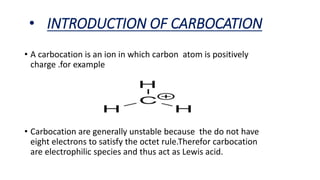
• A carbocation is an ion in which carbon atom is positively
charge .for example
• Carbocation are generally unstable because the do not have
eight electrons to satisfy the octet rule.Therefor carbocation
are electrophilic species and thus act as Lewis acid.
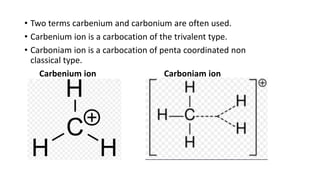
• Two terms carbenium and carbonium are often used.
• Carbenium ion is a carbocation of the trivalent type.
• Carboniam ion is a carbocation of penta coordinated non
classical type.
Carbenium ion Carboniam ion
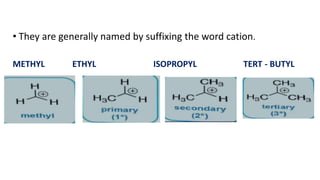
• They are generally named by suffixing the word cation.
METHYL ETHYL ISOPROPYL TERT - BUTYL
• CLASSIFICATION
• Carbocation may be classified into primary ,secondary and
tertiary depending upon the nature of carbon atom bearing
positive charge.
• If no carbon is attached to positively charged carbon atom then it
is simply called METHYL CARBOCATION.
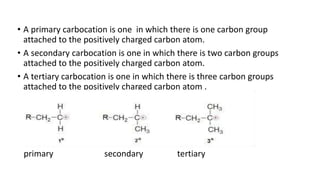
• A primary carbocation is one in which there is one carbon group
attached to the positively charged carbon atom.
• A secondary carbocation is one in which there is two carbon groups
attached to the positively charged carbon atom.
• A tertiary carbocation is one in which there is three carbon groups
attached to the positively charged carbon atom .
primary secondary tertiary
• STRUCTURE OF CARBOCATION
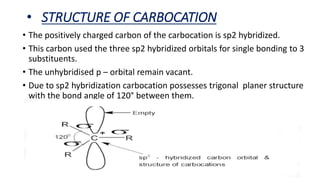
• The positively charged carbon of the carbocation is sp2 hybridized.
• This carbon used the three sp2 hybridized orbitals for single bonding to 3
substituents.
• The unhybridised p – orbital remain vacant.
• Due to sp2 hybridization carbocation possesses trigonal planer structure
with the bond angle of 120° between them.
• GENERATION OF CARBOCATION
• The carbocation can be found in many organic reaction
mechanism ,but most carbocation are formed by one of only
following two basic mechanism steps:
• Ionization of carbon-leaving group bond.
• Electrophilic addition to a pi bond.
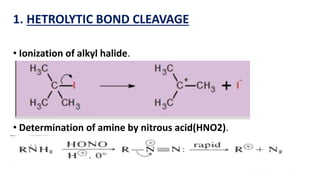
1. HETROLYTIC BOND CLEAVAGE
• Ionization of alkyl halide.
• Determination of amine by nitrous acid(HNO2).
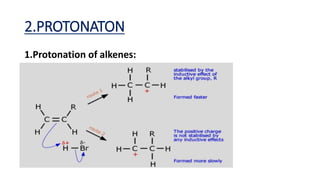
2.PROTONATON
1.Protonation of alkenes:
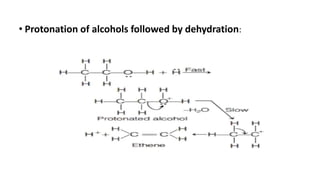
• Protonation of alcohols followed by dehydration:
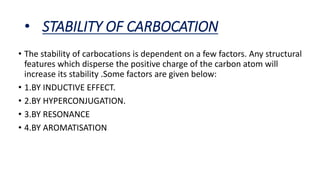
• STABILITY OF CARBOCATION
• The stability of carbocations is dependent on a few factors. Any structural
features which disperse the positive charge of the carbon atom will
increase its stability .Some factors are given below:
• 1.BY INDUCTIVE EFFECT.
• 2.BY HYPERCONJUGATION.
• 3.BY RESONANCE
• 4.BY AROMATISATION
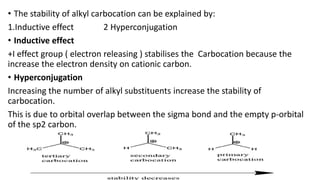
• The stability of alkyl carbocation can be explained by:
1.Inductive effect 2 Hyperconjugation
• Inductive effect
+I effect group ( electron releasing ) stabilises the Carbocation because the
increase the electron density on cationic carbon.
• Hyperconjugation
Increasing the number of alkyl substituents increase the stability of
carbocation.
This is due to orbital overlap between the sigma bond and the empty p-orbital
of the sp2 carbon.
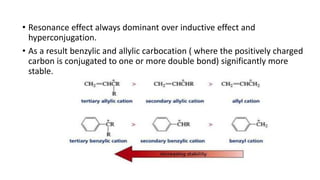
• Resonance effect always dominant over inductive effect and
hyperconjugation.
• As a result benzylic and allylic carbocation ( where the positively charged
carbon is conjugated to one or more double bond) significantly more
stable.
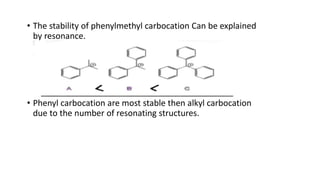
• The stability of phenylmethyl carbocation Can be explained
by resonance.
• Phenyl carbocation are most stable then alkyl carbocation
due to the number of resonating structures.
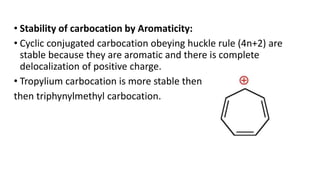
• Stability of carbocation by Aromaticity:
• Cyclic conjugated carbocation obeying huckle rule (4n+2) are
stable because they are aromatic and there is complete
delocalization of positive charge.
• Tropylium carbocation is more stable then
then triphynylmethyl carbocation.
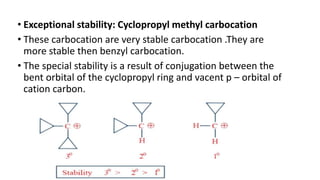
• Exceptional stability: Cyclopropyl methyl carbocation
• These carbocation are very stable carbocation .They are
more stable then benzyl carbocation.
• The special stability is a result of conjugation between the
bent orbital of the cyclopropyl ring and vacent p – orbital of
cation carbon.
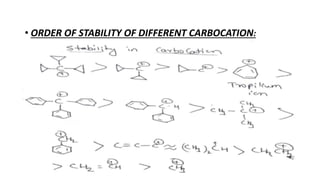
• ORDER OF STABILITY OF DIFFERENT CARBOCATION:
REACTIONS OF CARBOCATIONS
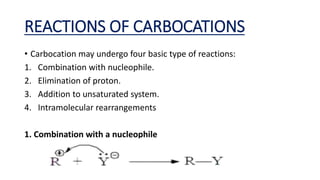
• Carbocation may undergo four basic type of reactions:
1. Combination with nucleophile.
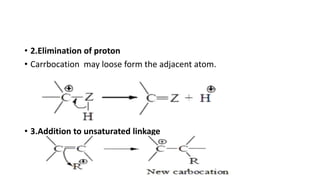
2. Elimination of proton.
3. Addition to unsaturated system.
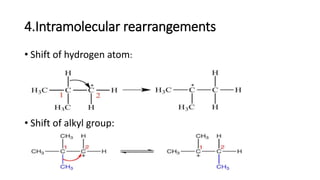
4. Intramolecular rearrangements
1. Combination with a nucleophile
• 2.Elimination of proton
• Carrbocation may loose form the adjacent atom.
• 3.Addition to unsaturated linkage
4.Intramolecular rearrangements
• Shift of hydrogen atom:
• Shift of alkyl group:
•REFERENCES:
•Advanced organic chemistry ,by
Dr.Jagdamba Singh & Dr. L.D.S. Yadav.
Reaction Intermediate-Carbocation

Reaction Intermediate-Carbocation

  • 1.
    SAMRAT PRITHVIRAJ CHAUHAN, GOVERNMENTCOLLEGE,AJMER DEPARTMENT OF CHEMISTRY REACTION INTERMEDIATE- CARBOCATION SUBMITTED BY- MAMTA SONI M.SC.CHEMISTRY SEMESTER 1st .
  • 2.
    • CONTENT • INTRODUCTIONOF CARBOCATION • CLASSIFICATION OF CARBOCATION • STRUCTURE OF CARBOCATION • GENERATION OF CARBOCATION • STABILITY OF CARBOCATION • REACTIONS OF CARBOCATION
  • 3.
    • INTRODUCTION • Thespecies which are formed as intermediate during the progress of reaction are called reaction intermediates. • The important reaction intermediate which are formed in the organic reaction are: 1. Carbocation 2. Carbanion 3. Carbene 4. Nitrene 5. Free radicals
  • 4.
    • INTRODUCTION OFCARBOCATION • A carbocation is an ion in which carbon atom is positively charge .for example • Carbocation are generally unstable because the do not have eight electrons to satisfy the octet rule.Therefor carbocation are electrophilic species and thus act as Lewis acid.
  • 5.
    • Two termscarbenium and carbonium are often used. • Carbenium ion is a carbocation of the trivalent type. • Carboniam ion is a carbocation of penta coordinated non classical type. Carbenium ion Carboniam ion
  • 6.
    • They aregenerally named by suffixing the word cation. METHYL ETHYL ISOPROPYL TERT - BUTYL
  • 7.
    • CLASSIFICATION • Carbocationmay be classified into primary ,secondary and tertiary depending upon the nature of carbon atom bearing positive charge. • If no carbon is attached to positively charged carbon atom then it is simply called METHYL CARBOCATION.
  • 8.
    • A primarycarbocation is one in which there is one carbon group attached to the positively charged carbon atom. • A secondary carbocation is one in which there is two carbon groups attached to the positively charged carbon atom. • A tertiary carbocation is one in which there is three carbon groups attached to the positively charged carbon atom . primary secondary tertiary
  • 9.
    • STRUCTURE OFCARBOCATION • The positively charged carbon of the carbocation is sp2 hybridized. • This carbon used the three sp2 hybridized orbitals for single bonding to 3 substituents. • The unhybridised p – orbital remain vacant. • Due to sp2 hybridization carbocation possesses trigonal planer structure with the bond angle of 120° between them.
  • 10.
    • GENERATION OFCARBOCATION • The carbocation can be found in many organic reaction mechanism ,but most carbocation are formed by one of only following two basic mechanism steps: • Ionization of carbon-leaving group bond. • Electrophilic addition to a pi bond.
  • 11.
    1. HETROLYTIC BONDCLEAVAGE • Ionization of alkyl halide. • Determination of amine by nitrous acid(HNO2).
  • 12.
  • 13.
    • Protonation ofalcohols followed by dehydration:
  • 14.
    • STABILITY OFCARBOCATION • The stability of carbocations is dependent on a few factors. Any structural features which disperse the positive charge of the carbon atom will increase its stability .Some factors are given below: • 1.BY INDUCTIVE EFFECT. • 2.BY HYPERCONJUGATION. • 3.BY RESONANCE • 4.BY AROMATISATION
  • 15.
    • The stabilityof alkyl carbocation can be explained by: 1.Inductive effect 2 Hyperconjugation • Inductive effect +I effect group ( electron releasing ) stabilises the Carbocation because the increase the electron density on cationic carbon. • Hyperconjugation Increasing the number of alkyl substituents increase the stability of carbocation. This is due to orbital overlap between the sigma bond and the empty p-orbital of the sp2 carbon.
  • 16.
    • Resonance effectalways dominant over inductive effect and hyperconjugation. • As a result benzylic and allylic carbocation ( where the positively charged carbon is conjugated to one or more double bond) significantly more stable.
  • 17.
    • The stabilityof phenylmethyl carbocation Can be explained by resonance. • Phenyl carbocation are most stable then alkyl carbocation due to the number of resonating structures.
  • 18.
    • Stability ofcarbocation by Aromaticity: • Cyclic conjugated carbocation obeying huckle rule (4n+2) are stable because they are aromatic and there is complete delocalization of positive charge. • Tropylium carbocation is more stable then then triphynylmethyl carbocation.
  • 19.
    • Exceptional stability:Cyclopropyl methyl carbocation • These carbocation are very stable carbocation .They are more stable then benzyl carbocation. • The special stability is a result of conjugation between the bent orbital of the cyclopropyl ring and vacent p – orbital of cation carbon.
  • 20.
    • ORDER OFSTABILITY OF DIFFERENT CARBOCATION:
  • 21.
    REACTIONS OF CARBOCATIONS •Carbocation may undergo four basic type of reactions: 1. Combination with nucleophile. 2. Elimination of proton. 3. Addition to unsaturated system. 4. Intramolecular rearrangements 1. Combination with a nucleophile
  • 22.
    • 2.Elimination ofproton • Carrbocation may loose form the adjacent atom. • 3.Addition to unsaturated linkage
  • 23.
    4.Intramolecular rearrangements • Shiftof hydrogen atom: • Shift of alkyl group:
  • 24.
    •REFERENCES: •Advanced organic chemistry,by Dr.Jagdamba Singh & Dr. L.D.S. Yadav.