


1
B.Sc. First year
Students
Semester – I
Reactive Intermediates:
by
Dr Pramod R Padole
2
Organic Chemisrtry
Unit-III
A) Electronic Displacements:
B) Reactive Intermediates:
C) Aliphatic Hydrocarbons:
Company
LOGO
B) Reactive Intermediates:
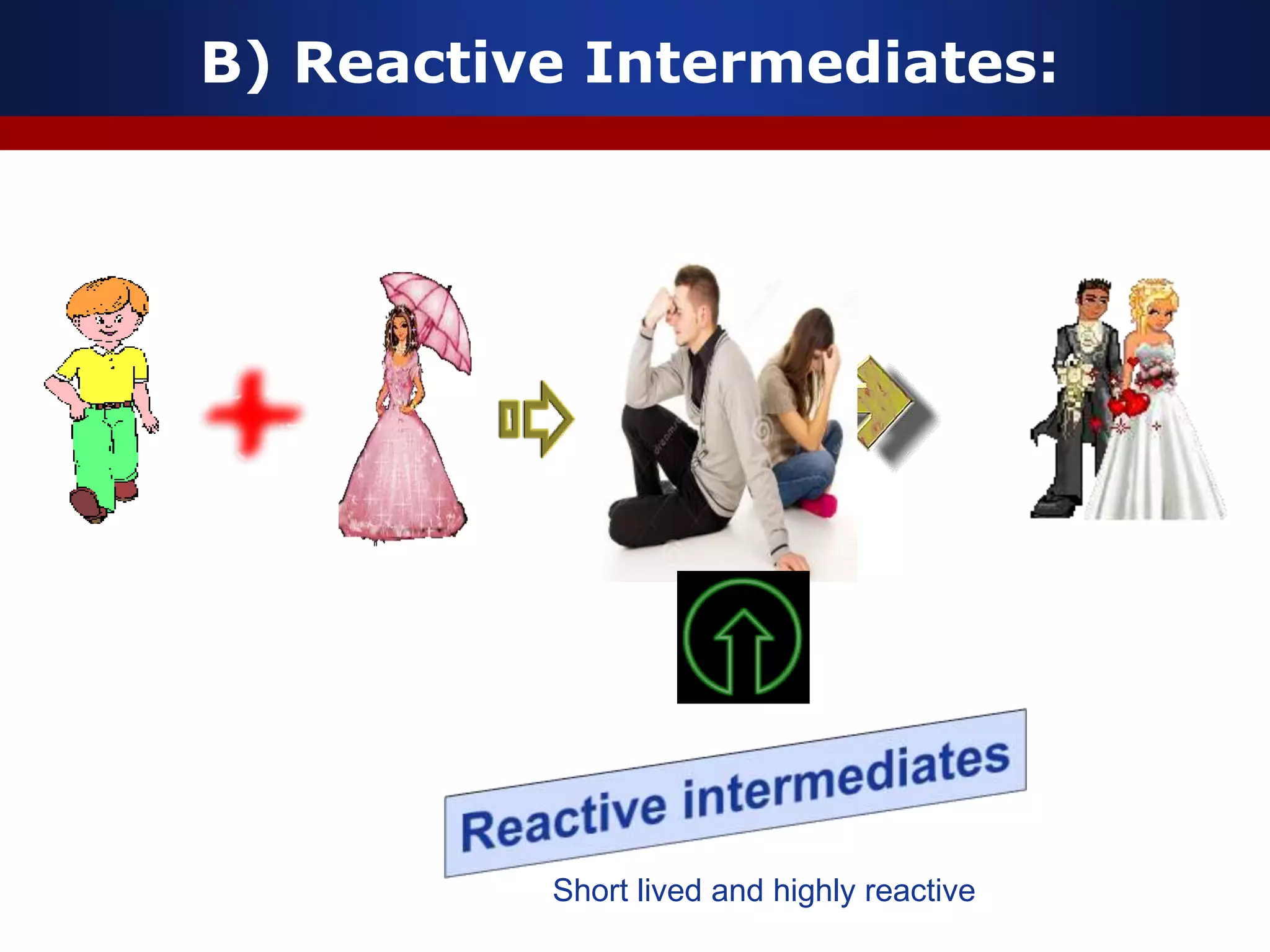
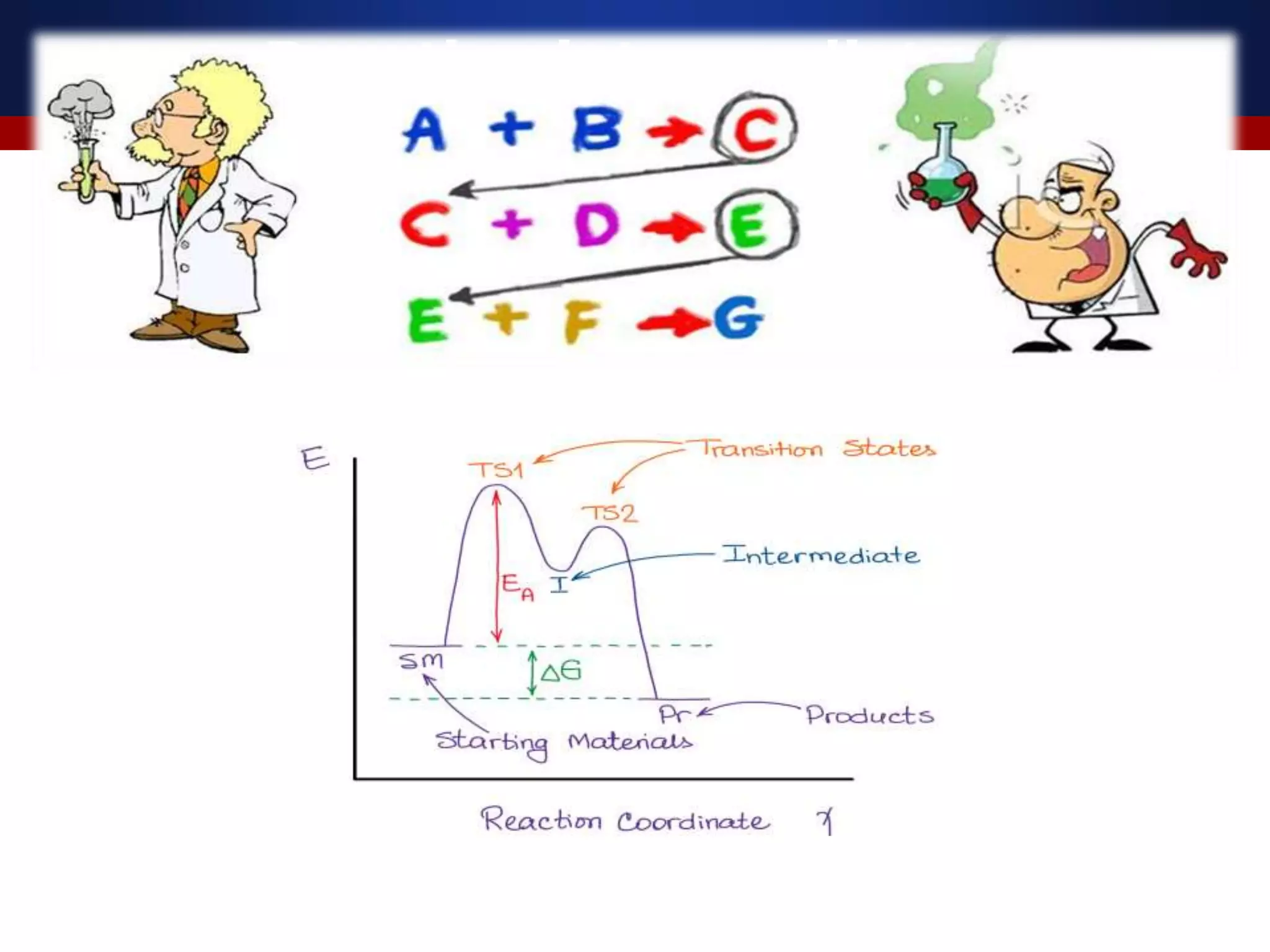
Most organic reactions occur through a intermediate, these are
generally short lived and highly reactive.
B) Reactive Intermediates:
Short lived and highly reactive
Reactive intermediates
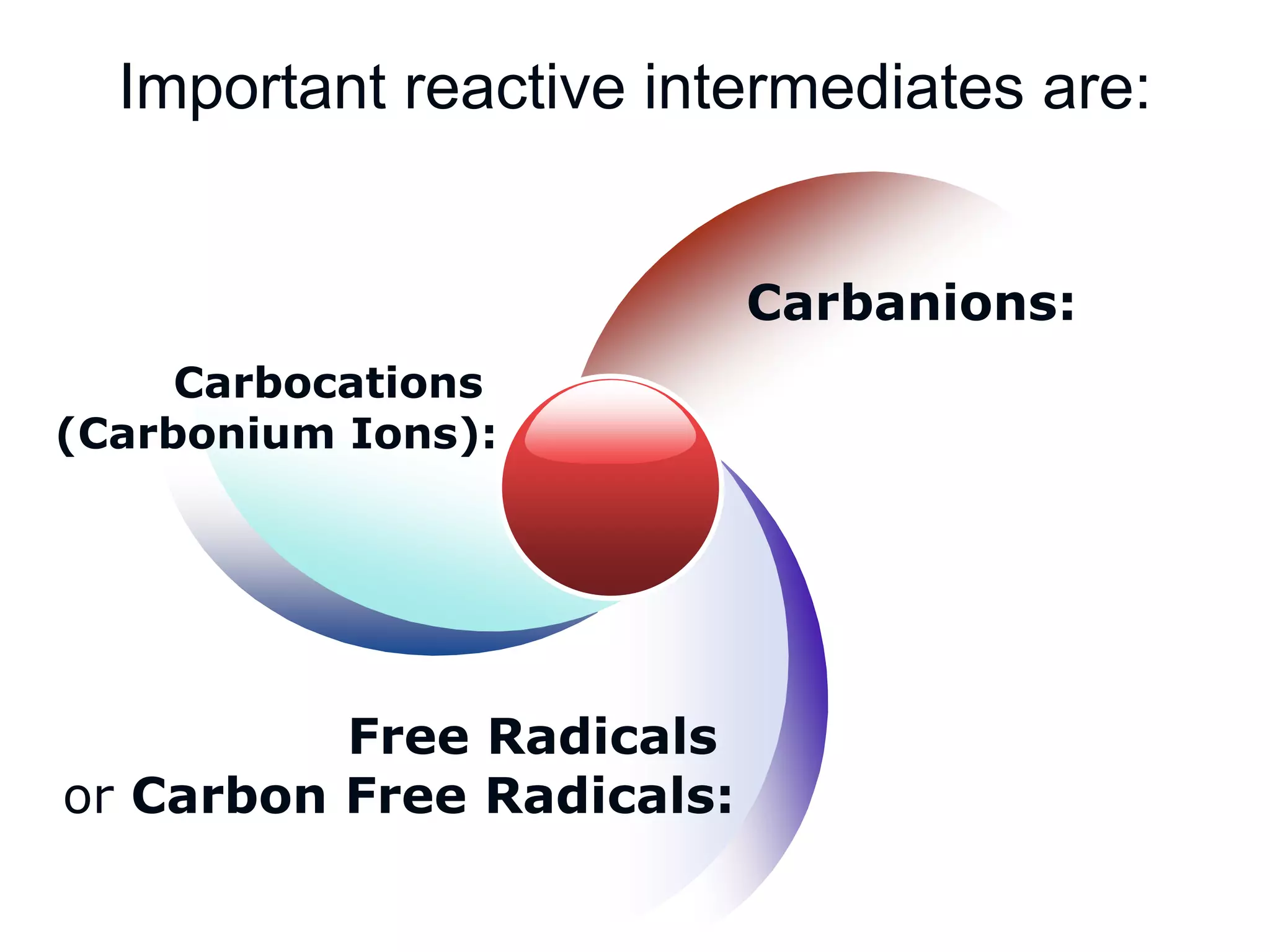
Important reactive intermediates are:
Carbocations
(Carbonium Ions):
Carbanions:
Free Radicals
or Carbon Free Radicals:
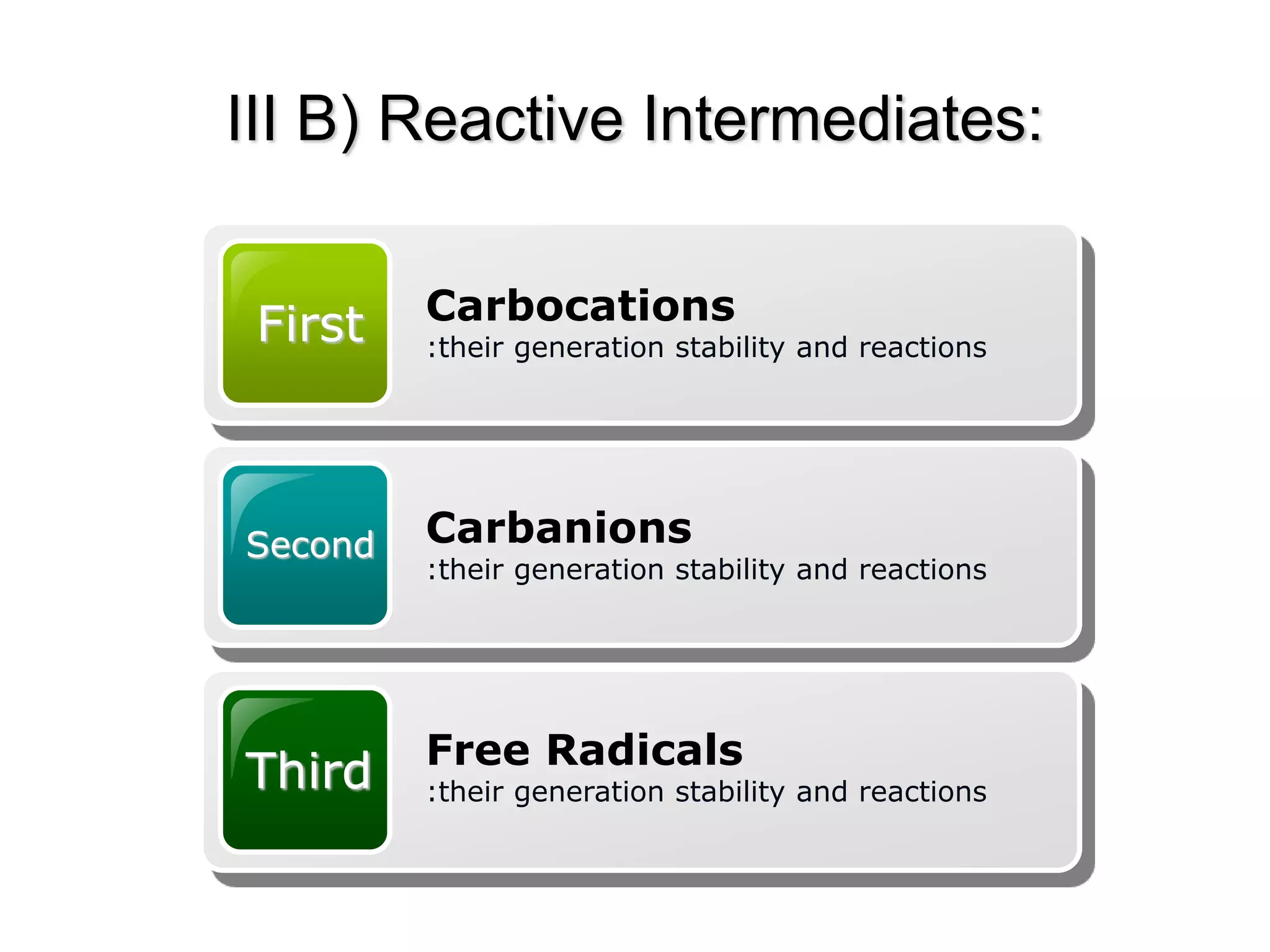
III B) Reactive Intermediates:
First Carbocations
:their generation stability and reactions
Second Carbanions
:their generation stability and reactions
Third Free Radicals
:their generation stability and reactions
III B) Reactive Intermediates:
First Carbocations (Carbonium Ions):
:their generation stability and reactions
Q.1) What are carbocations? How are they obtained? Write their stability order.
(S-11, 5 Mark)
Q.2) Define: Carbocations (Carbonium ion) with examples. (S-12 & S-17, 2 Mark)
Q.3) What are carbocations? (W-13 & W-17, 1 Mark)
Q.4) What are Carbocations? Give two methods of their formation.
(S-14 & W-15, 4 Mark)
Q.5) Carbocations have _____ geometry. (S-14, ½ Mark)
Q.6) Explain the stability of carbocations on the basis of inductive effect and
resonance effect. (W-14, W-16 & W-17, 4 Mark)
Q.7) What are Carbocations? Give one method of their formation and
stability order of alkyl carbocations. (S-15, 5 Mark)
Q.8) Organic ions which containing positively charged carbon atoms are
called _______. (W-15, ½ Mark)
Q.9) The species containing positively charged carbon centre are called _______.
(W-16, ½ Mark)
Q.10) Define: Carbocation. Explain its stability on the basis of inductive effect.
(W-18, 4 Mark)
Carbocations (Carbonium Ions):
Defination:
 Organic ions which contain a positively
charged carbon atom are called carbocations
or carbonium ions.
Or
A species contain the positively charged
carbon is called carbocations or carbonium
ions.
Carbocations (Carbonium Ions):
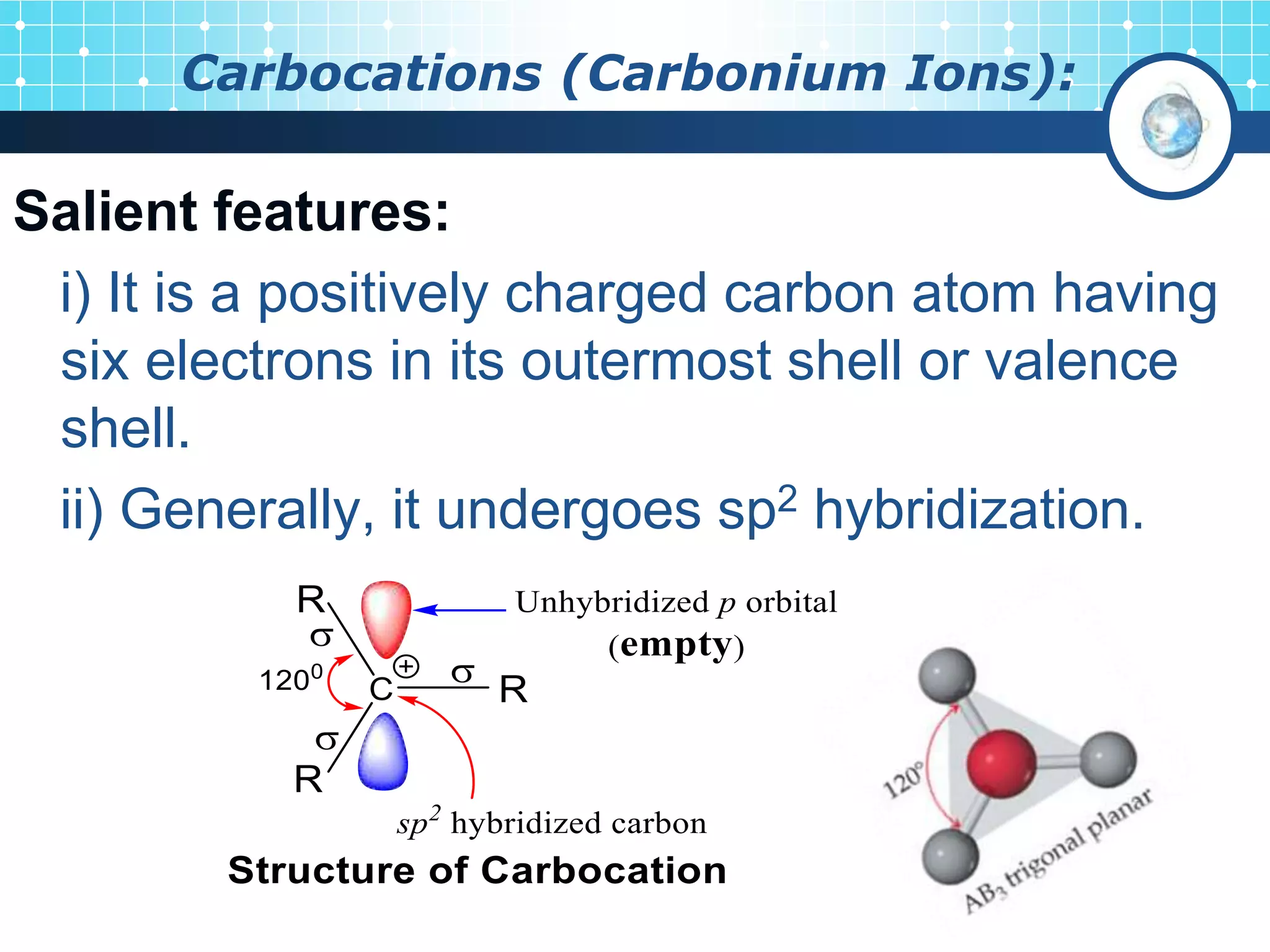
Salient features:
i) It is a positively charged carbon atom having
six electrons in its outermost shell or valence
shell.
ii) Generally, it undergoes sp2 hybridization.
Carbocations (Carbonium Ions):
iii) In carbocation, the carbon atom is sp2 - hybridised.
It uses three sp2 orbitals to form three σ-bonds with other
atoms or group of atoms. An empty (vacant) p-orbital lies
perpendicular to the plane of σ- bonds.
Thus, it has trigonal planar geometry or flat ion and bond
angle is 1200.
iv) It is an electron deficient (electrophile).
v) It combines with electron rich species.
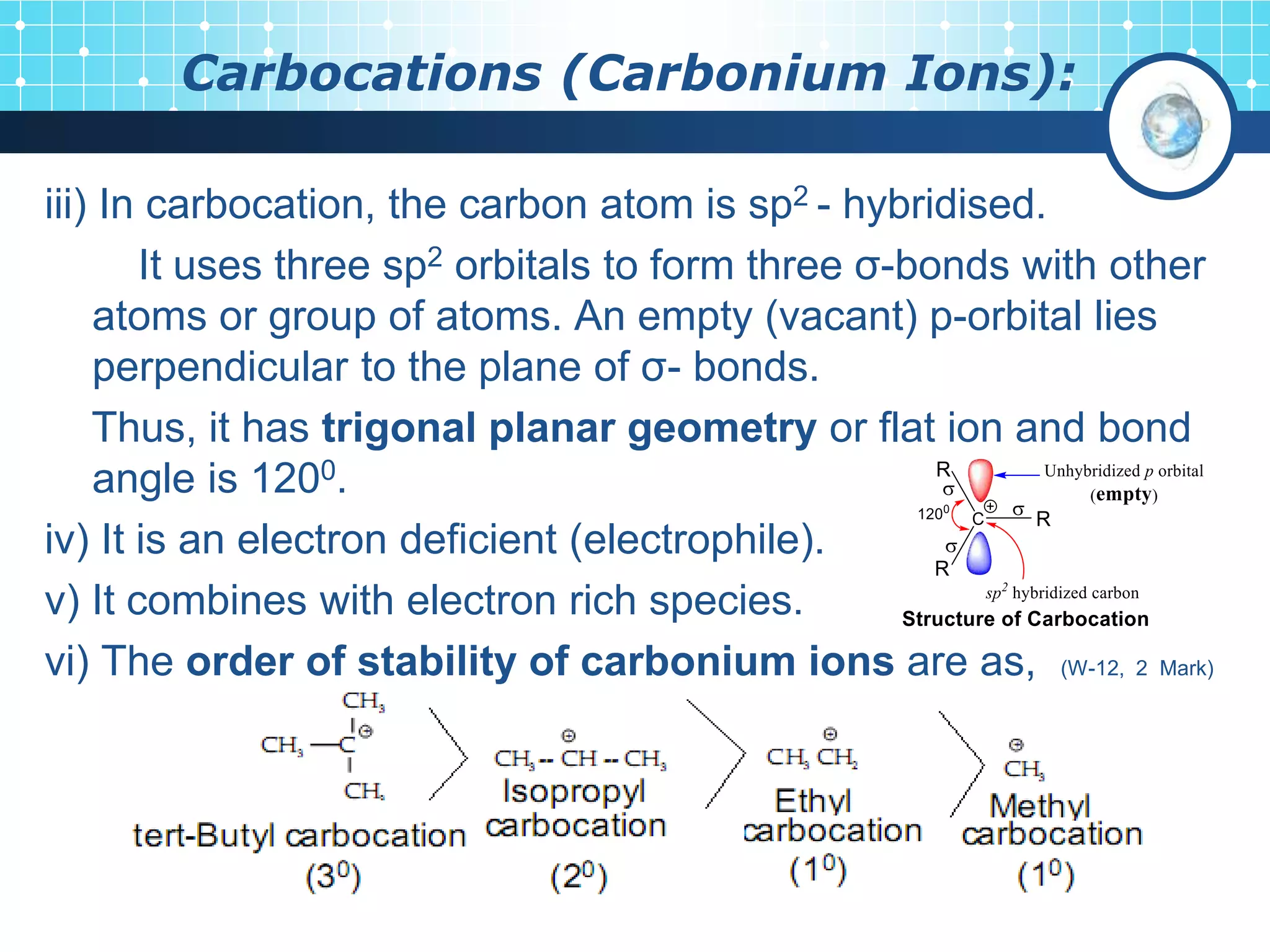
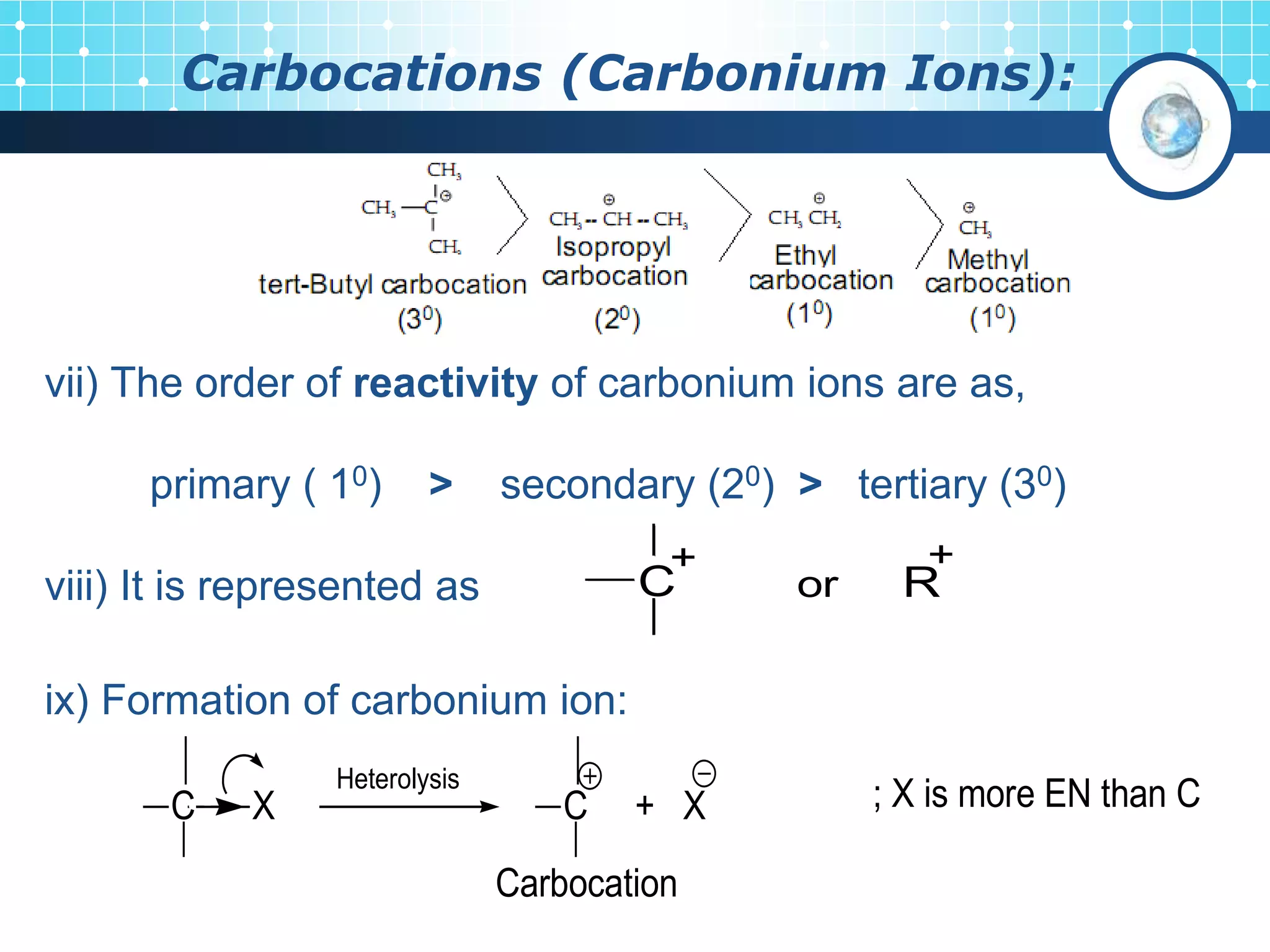
vi) The order of stability of carbonium ions are as, (W-12, 2 Mark)
Carbocations (Carbonium Ions):
vii) The order of reactivity of carbonium ions are as,
primary ( 10) > secondary (20) > tertiary (30)
viii) It is represented as
ix) Formation of carbonium ion:
C
+
or R
+
Heterolysis
C X C + X
Carbocation
; X is more EN than C
Carbocations (Carbonium Ions):
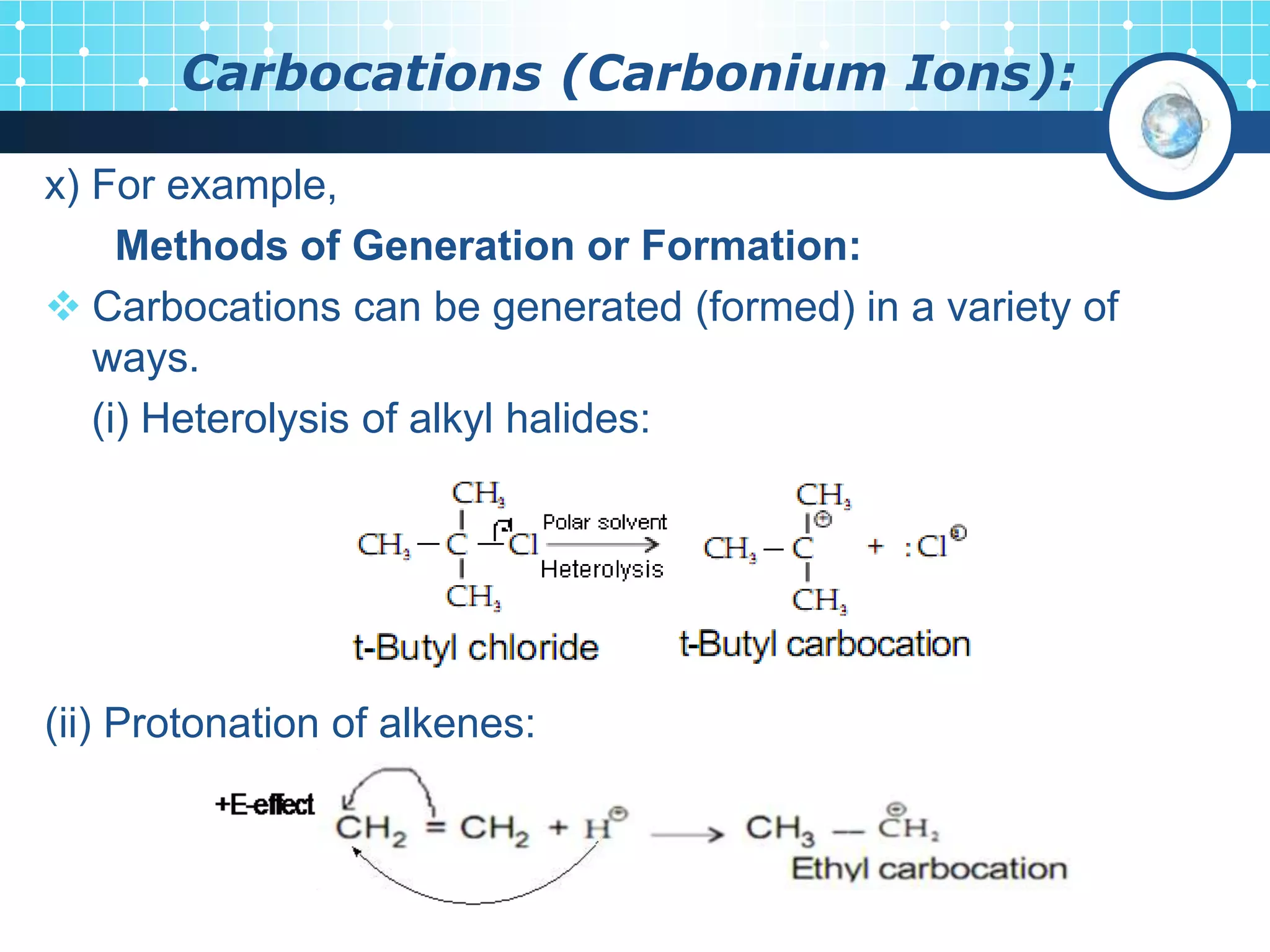
x) For example,
Methods of Generation or Formation:
 Carbocations can be generated (formed) in a variety of
ways.
(i) Heterolysis of alkyl halides:
(ii) Protonation of alkenes:
Carbocations (Carbonium Ions):
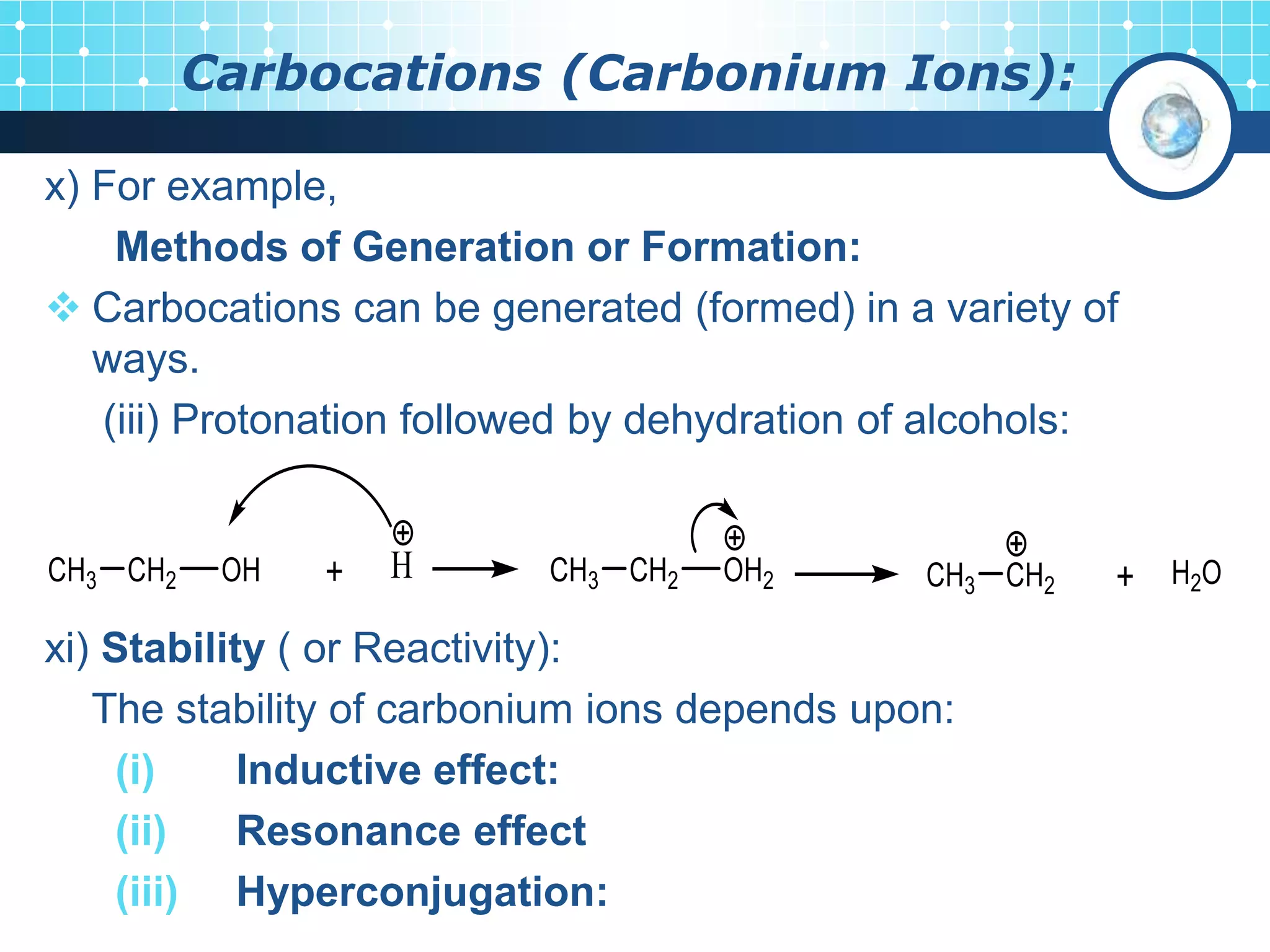
x) For example,
Methods of Generation or Formation:
 Carbocations can be generated (formed) in a variety of
ways.
(iii) Protonation followed by dehydration of alcohols:
xi) Stability ( or Reactivity):
The stability of carbonium ions depends upon:
(i) Inductive effect:
(ii) Resonance effect
(iii) Hyperconjugation:
Stability of Carbocation depends on
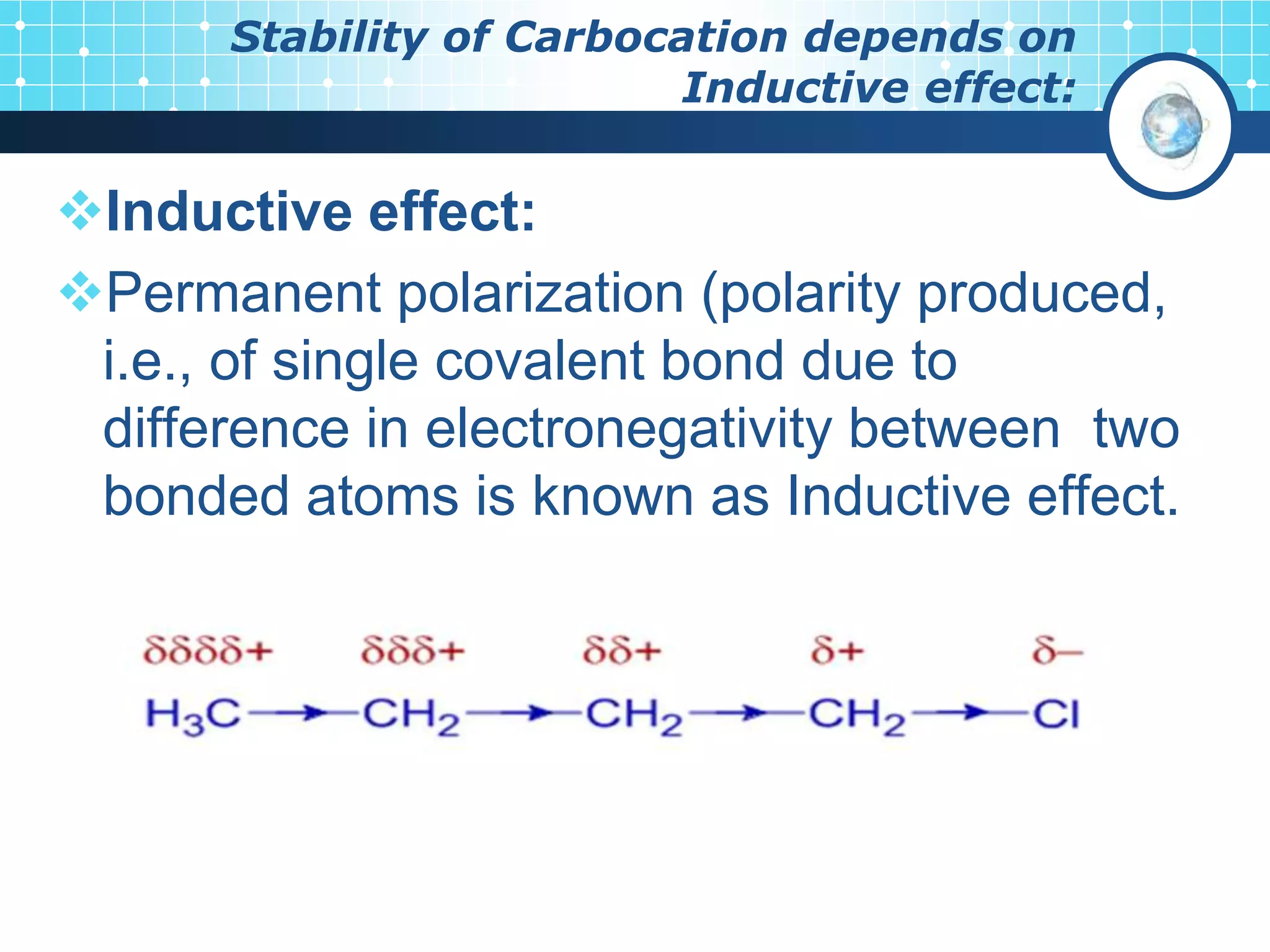
Inductive effect:
Inductive effect:
Permanent polarization (polarity produced,
i.e., of single covalent bond due to
difference in electronegativity between two
bonded atoms is known as Inductive effect.
pramodpadole@gmail.com
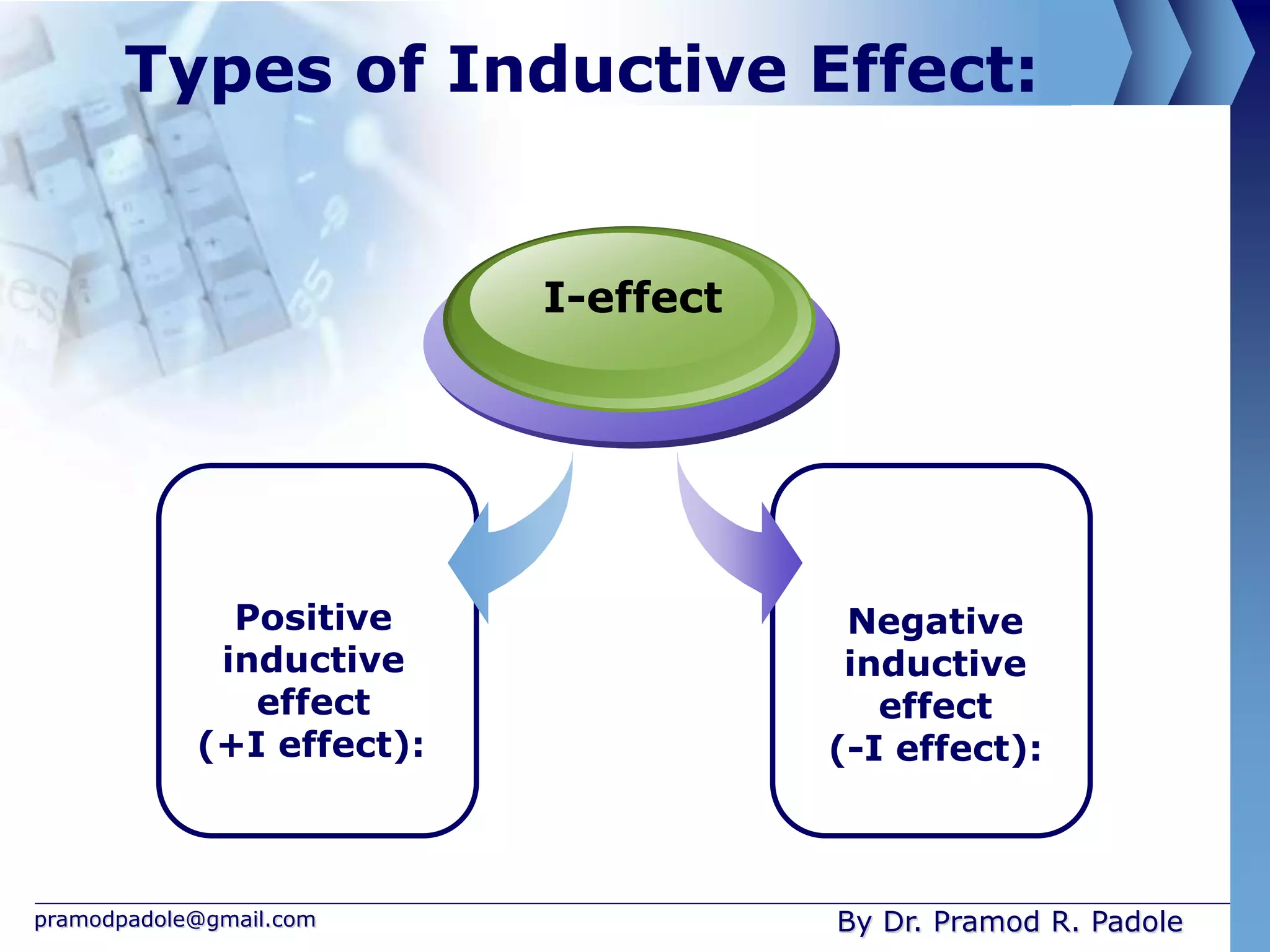
Types of Inductive Effect:
Positive
inductive
effect
(+I effect):
I-effect
Negative
inductive
effect
(-I effect):
By Dr. Pramod R. Padole
pramodpadole@gmail.com By Dr. Pramod R. Padole
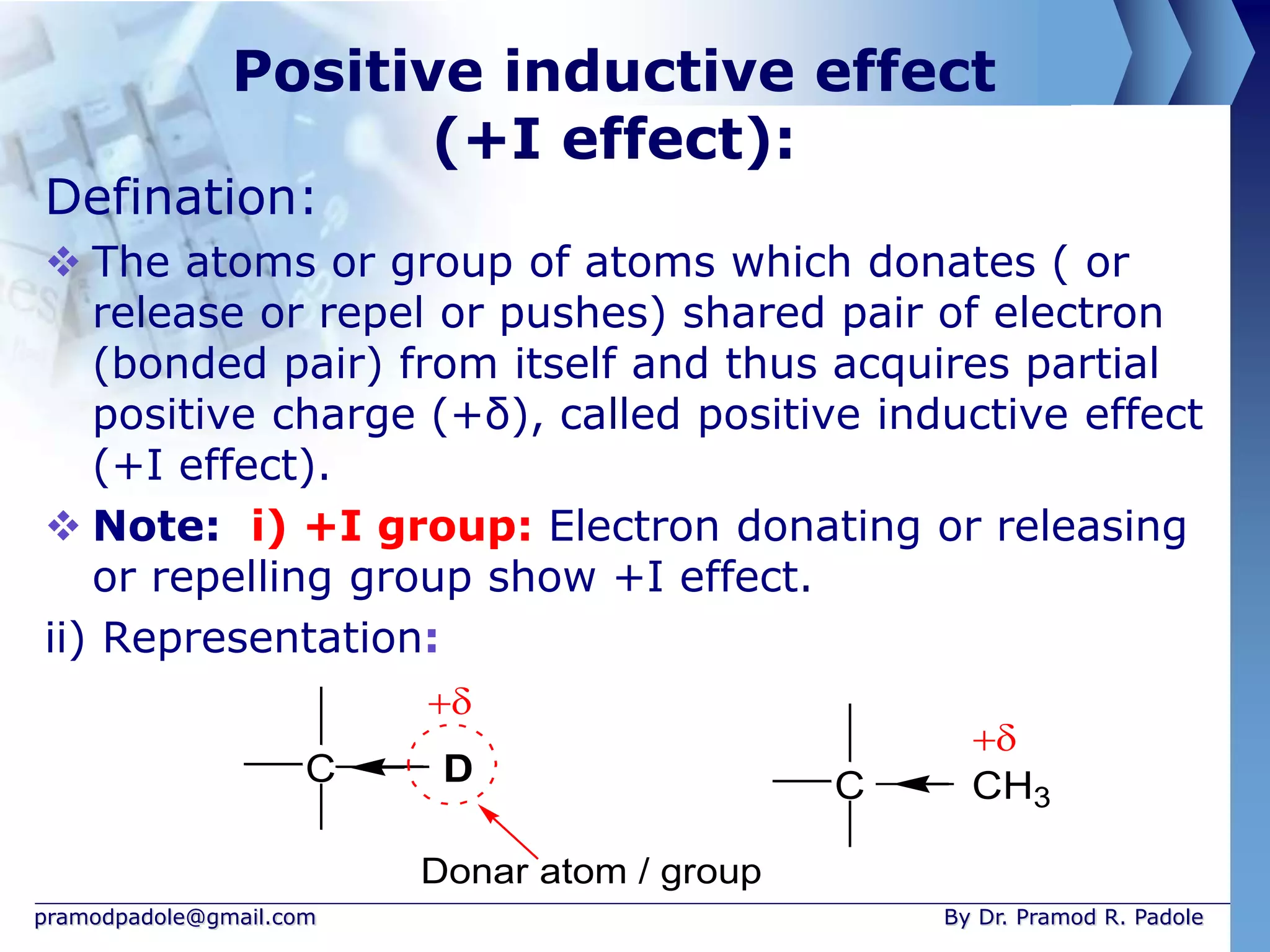
Positive inductive effect
(+I effect):
Defination:
 The atoms or group of atoms which donates ( or
release or repel or pushes) shared pair of electron
(bonded pair) from itself and thus acquires partial
positive charge (+δ), called positive inductive effect
(+I effect).
 Note: i) +I group: Electron donating or releasing
or repelling group show +I effect.
ii) Representation:
C CH3
C D
Donar atom / group


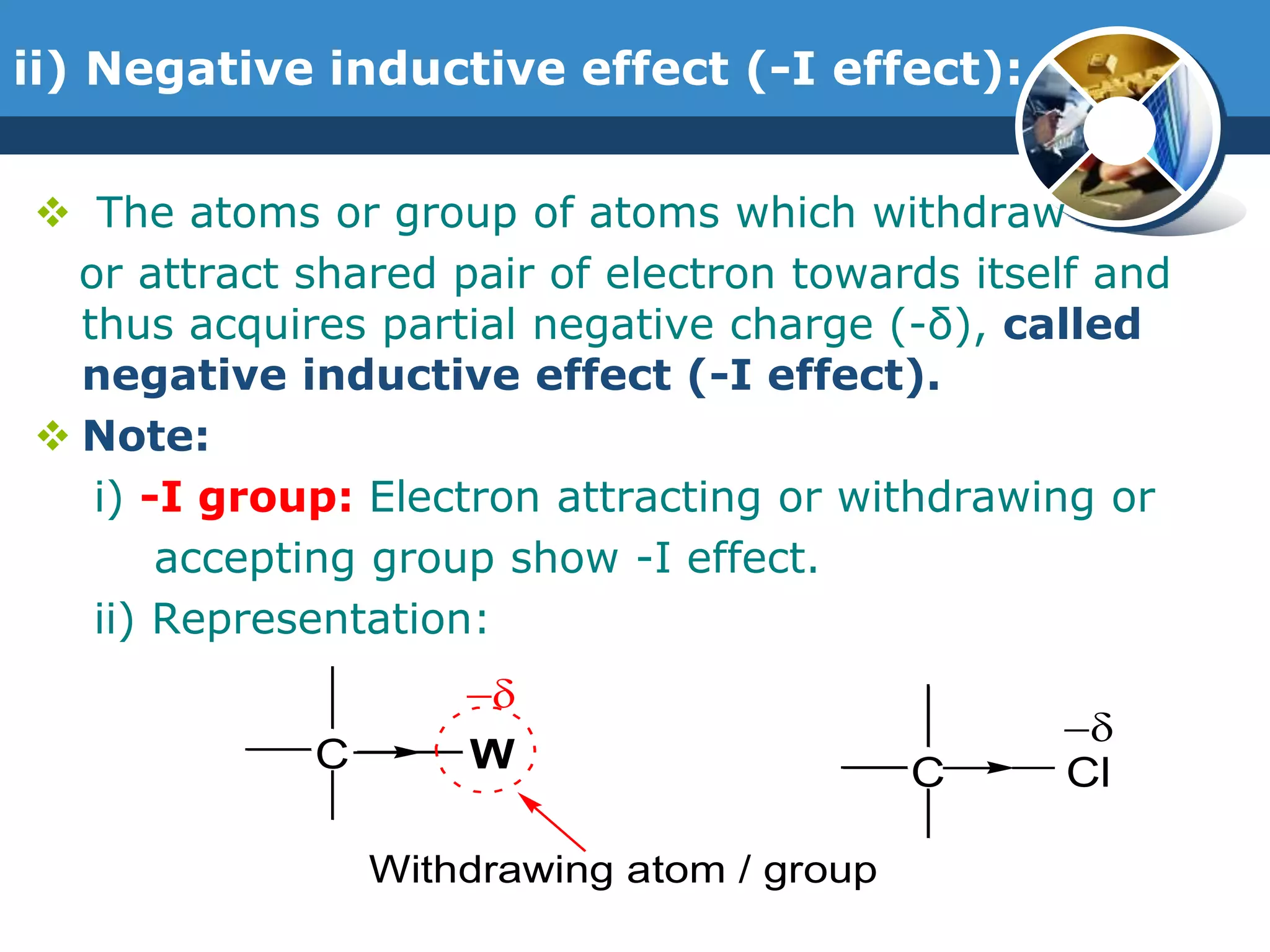
ii) Negative inductive effect (-I effect):
 The atoms or group of atoms which withdraw
or attract shared pair of electron towards itself and
thus acquires partial negative charge (-δ), called
negative inductive effect (-I effect).
 Note:
i) -I group: Electron attracting or withdrawing or
accepting group show -I effect.
ii) Representation:

C Cl
C W
Withdrawing atom / group

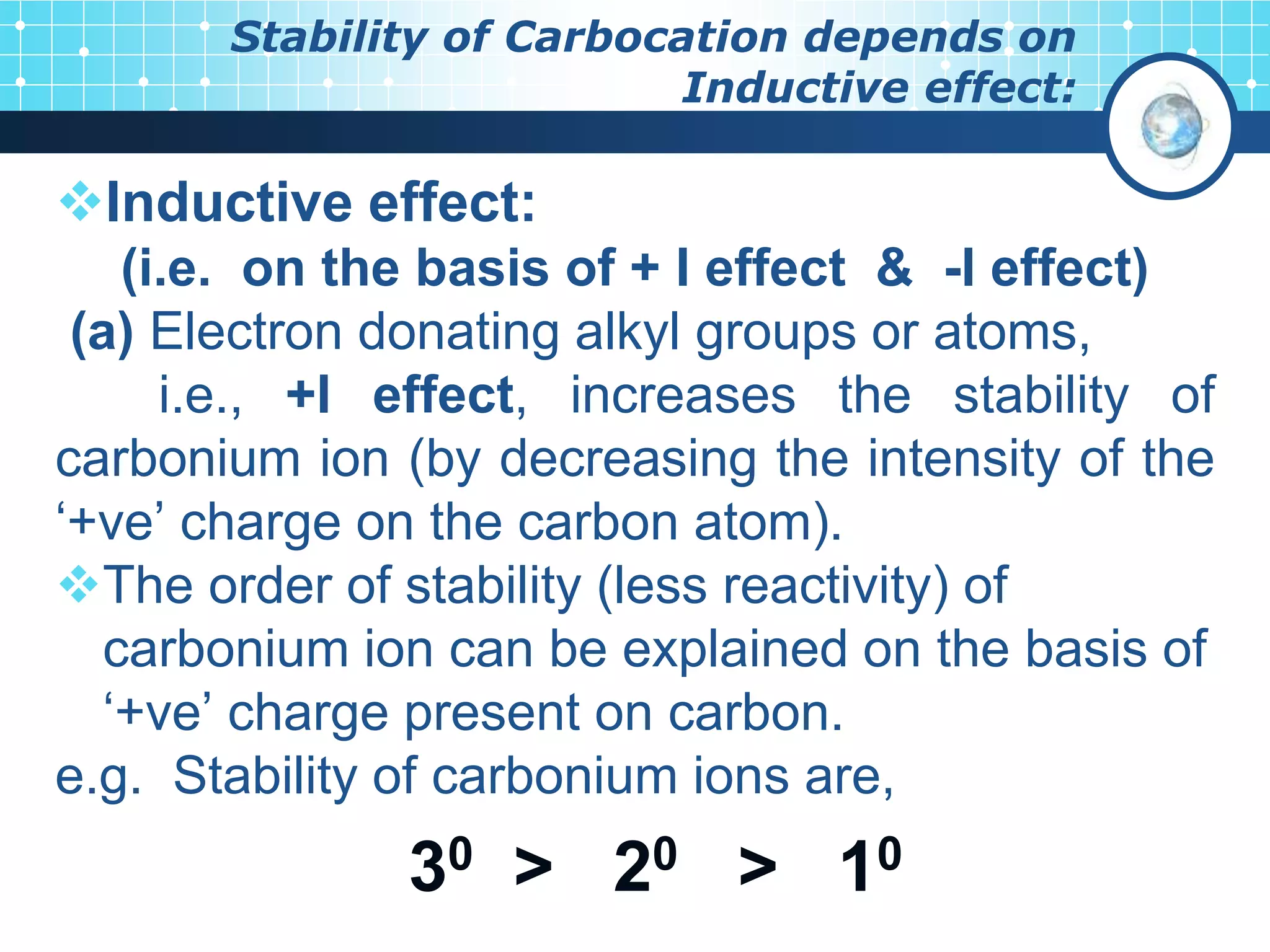
Stability of Carbocation depends on
Inductive effect:
Inductive effect:
(i.e. on the basis of + I effect & -I effect)
(a) Electron donating alkyl groups or atoms,
i.e., +I effect, increases the stability of
carbonium ion (by decreasing the intensity of the
‘+ve’ charge on the carbon atom).
The order of stability (less reactivity) of
carbonium ion can be explained on the basis of
‘+ve’ charge present on carbon.
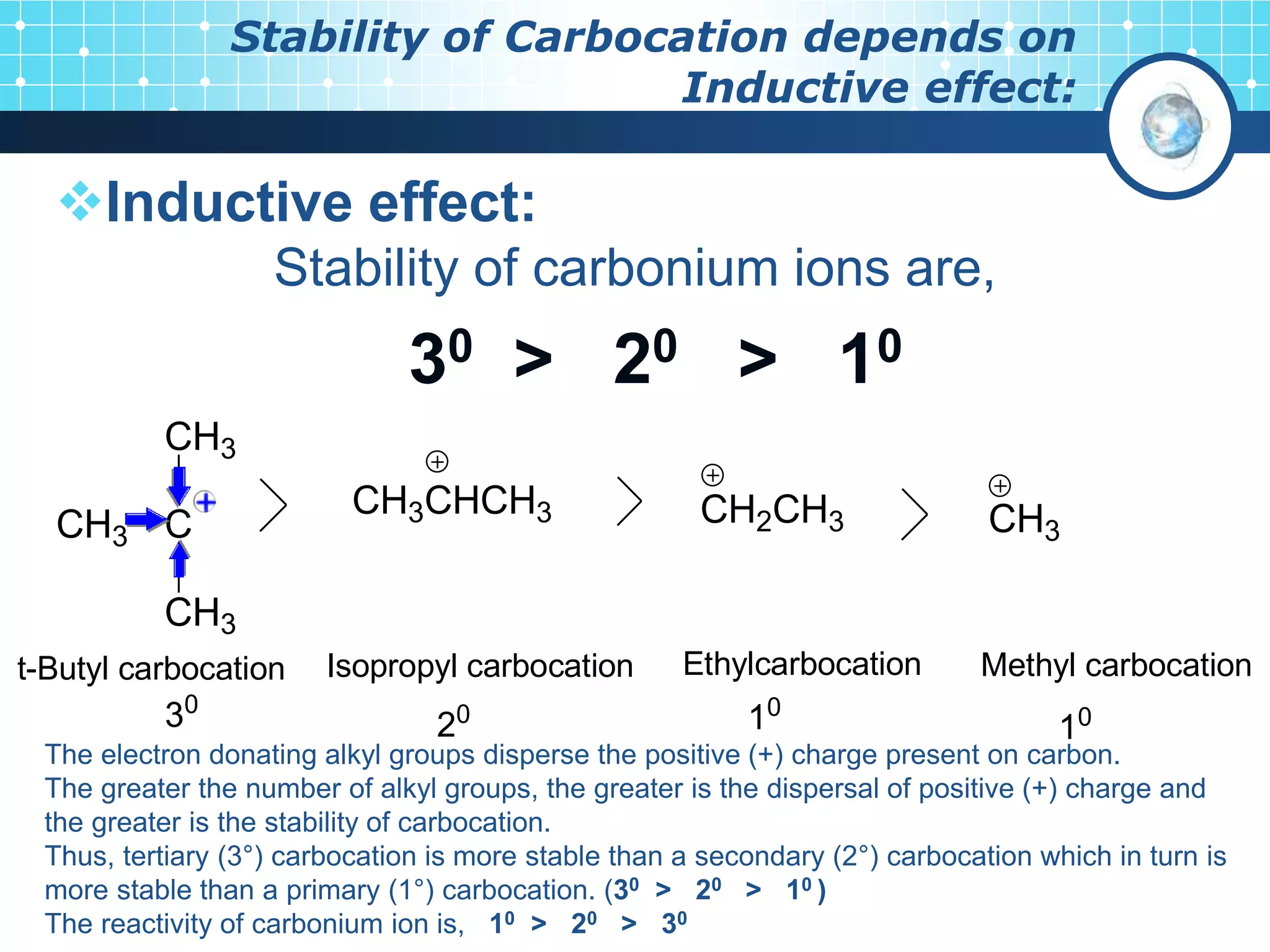
e.g. Stability of carbonium ions are,
30 > 20 > 10
Stability of Carbocation depends on
Inductive effect:
Inductive effect:
Stability of carbonium ions are,
30 > 20 > 10
CH3
CH2CH3
CH3CHCH3
C
CH3
CH3
CH3
Methyl carbocation
Ethylcarbocation
Isopropyl carbocation
t-Butyl carbocation
30
20 10
10
The electron donating alkyl groups disperse the positive (+) charge present on carbon.
The greater the number of alkyl groups, the greater is the dispersal of positive (+) charge and
the greater is the stability of carbocation.
Thus, tertiary (3°) carbocation is more stable than a secondary (2°) carbocation which in turn is
more stable than a primary (1°) carbocation. (30 > 20 > 10 )
The reactivity of carbonium ion is, 10 > 20 > 30
C
Cl
H
H
C
Cl
H
Cl
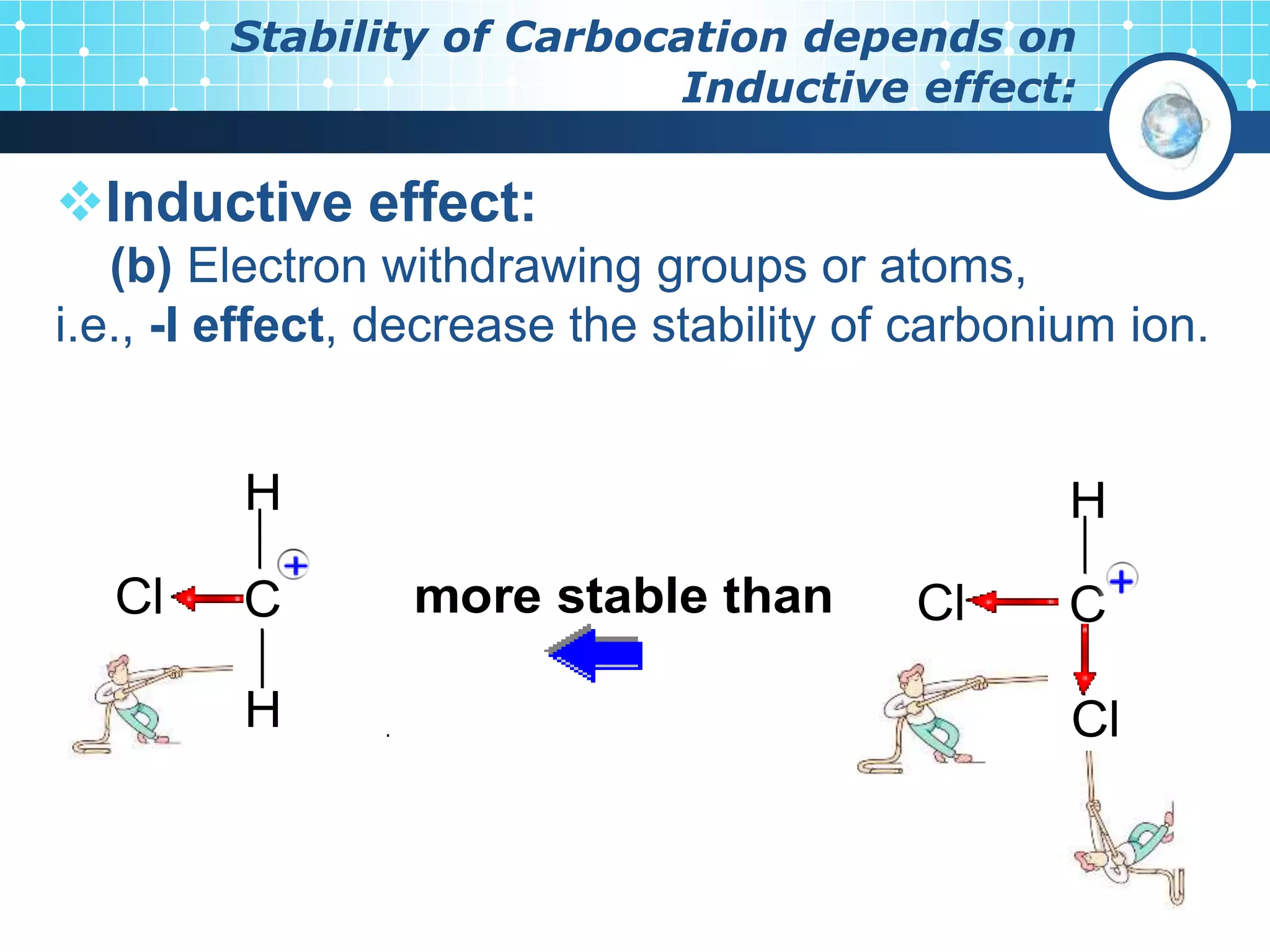
more stable than
Stability of Carbocation depends on
Inductive effect:
Inductive effect:
(b) Electron withdrawing groups or atoms,
i.e., -I effect, decrease the stability of carbonium ion.
Stability of Carbocation depends on
Resonance effect:
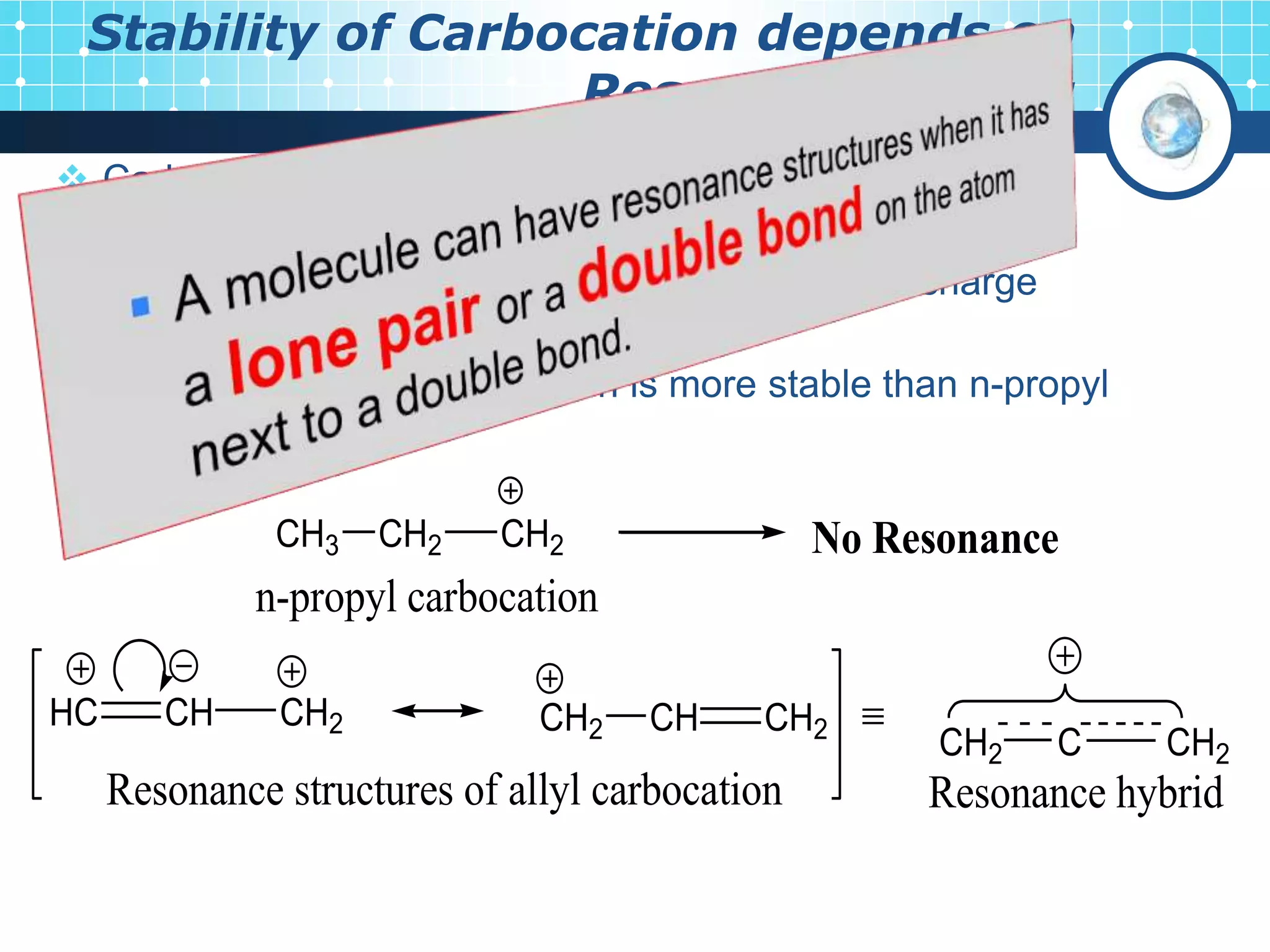
 Carbocations involving resonance are more stable than
those which do not involve resonance.
The resonance delocalisation of positive charge
increases the stability of carbocation.
 For example, allyl carbocation is more stable than n-propyl
carbocation.
HC CH CH2 CH2 CH CH2 
CH2 C CH2
Resonance structures of allyl carbocation Resonance hybrid
CH3 CH2 CH2
n-propyl carbocation
No Resonance
Stability of Carbocation depends on
Resonance effect:
 Carbocations involving resonance are more stable than
those which do not involve resonance.
The resonance delocalisation of positive charge
increases the stability of carbocation.
 For example, allyl carbocation is more stable than n-propyl
carbocation.
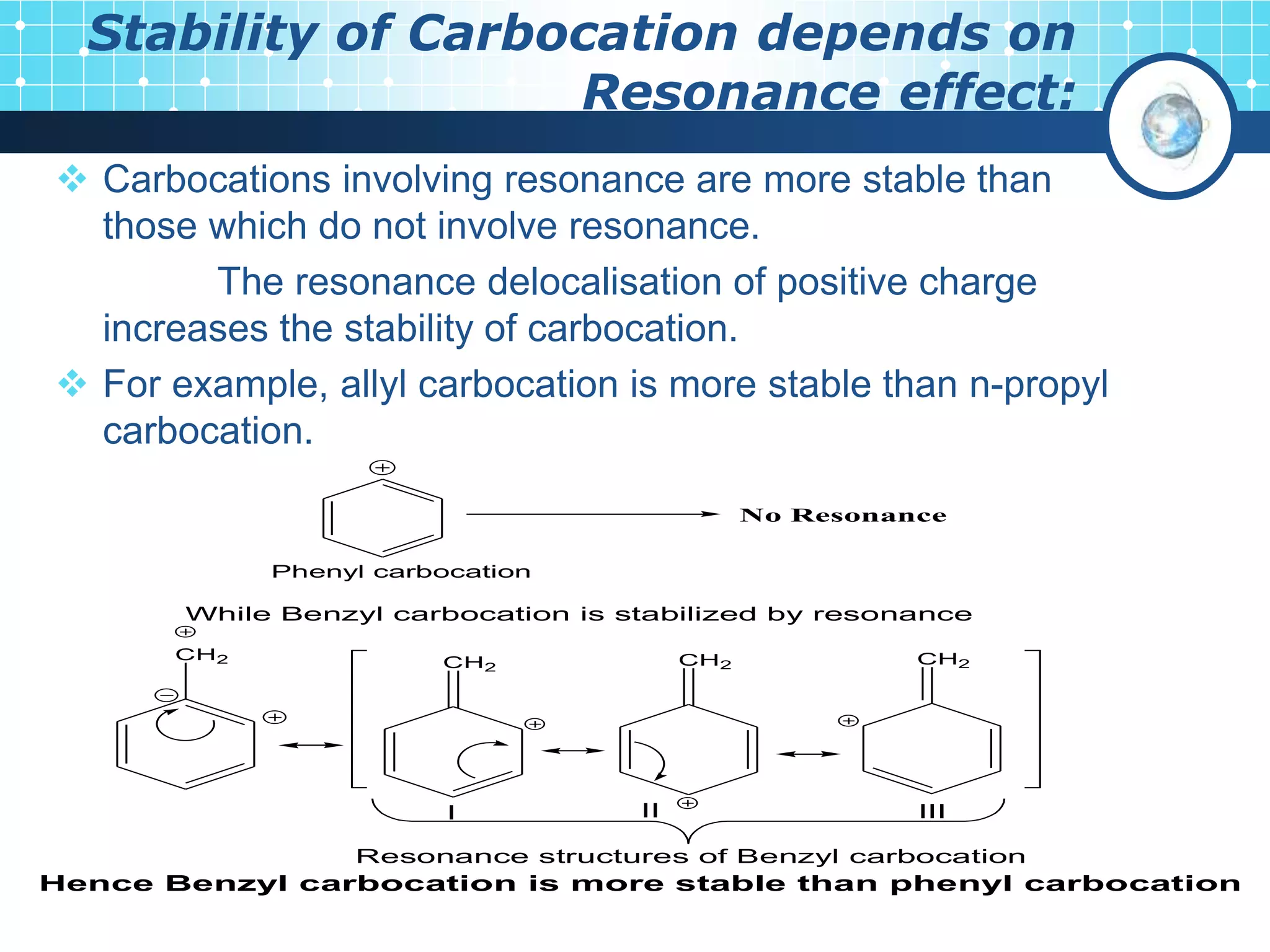
No Resonance
CH2 CH2 CH2 CH2
Phenyl carbocation
While Benzyl carbocation is stabilized by resonance
Resonance structures of Benzyl carbocation
I II III
Hence Benzyl carbocation is more stable than phenyl carbocation
Stability of Carbocation depends on
Hyperconjugation:
:
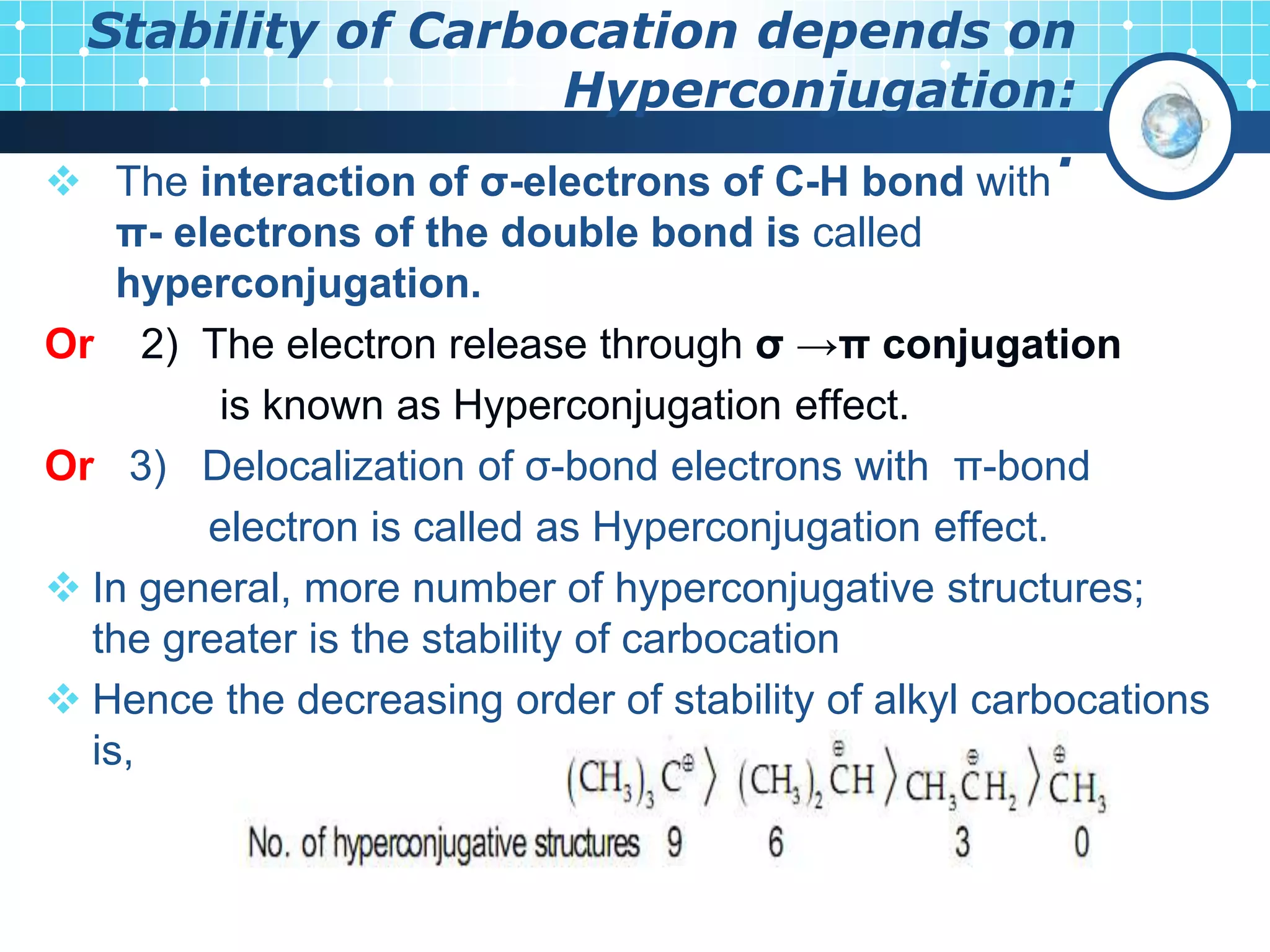
 The interaction of σ-electrons of C-H bond with
π- electrons of the double bond is called
hyperconjugation.
Or 2) The electron release through σ →π conjugation
is known as Hyperconjugation effect.
Or 3) Delocalization of σ-bond electrons with π-bond
electron is called as Hyperconjugation effect.
 In general, more number of hyperconjugative structures;
the greater is the stability of carbocation
 Hence the decreasing order of stability of alkyl carbocations
is,
pramodpadole@gmail.com
Hyperconjugation:
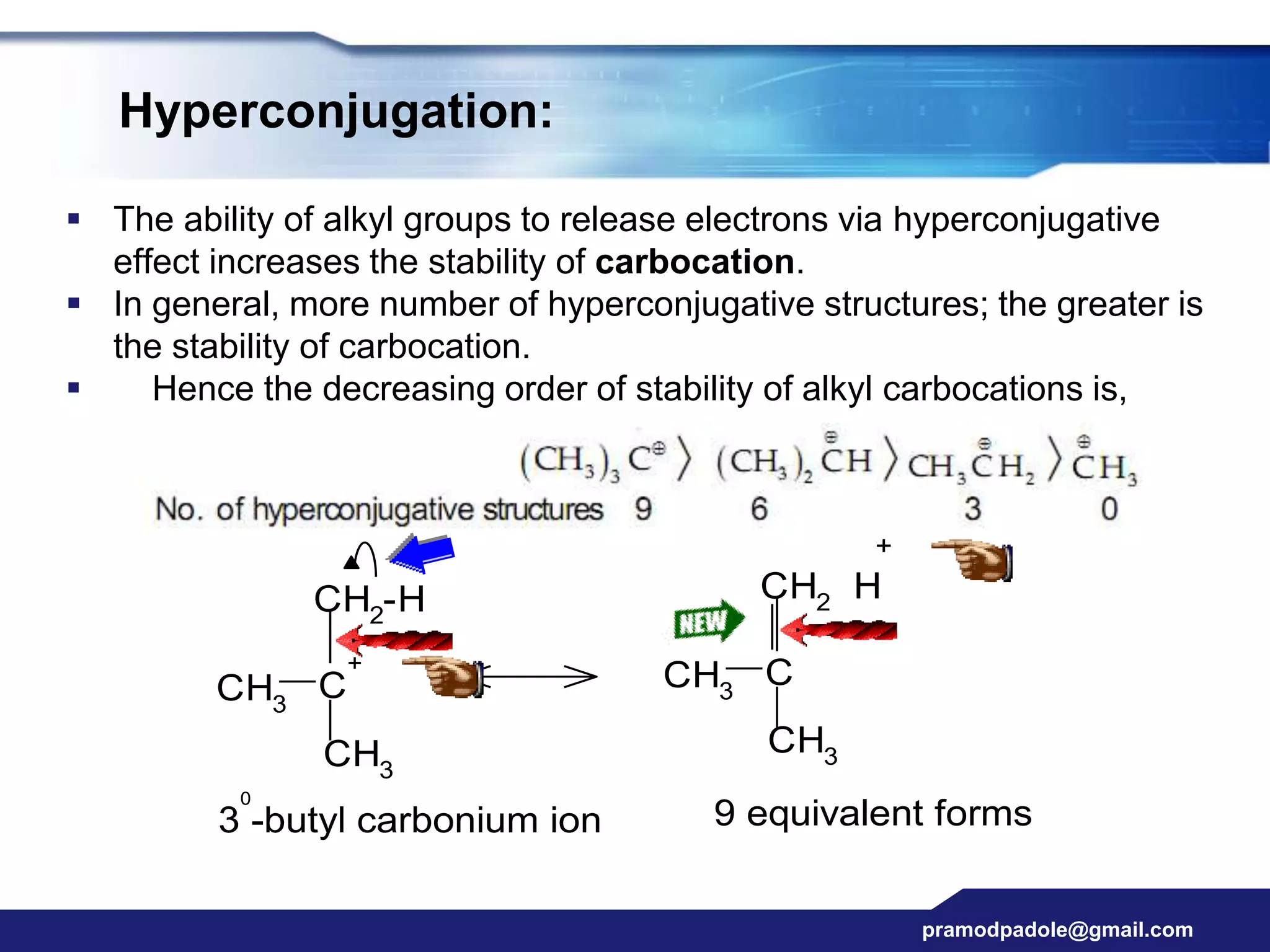
 The ability of alkyl groups to release electrons via hyperconjugative
effect increases the stability of carbocation.
 In general, more number of hyperconjugative structures; the greater is
the stability of carbocation.
 Hence the decreasing order of stability of alkyl carbocations is,
C
CH2-H
CH3
CH3
C
CH2 H
CH3
CH3
+
+
3 -butyl carbonium ion
0
9 equivalent forms
pramodpadole@gmail.com
Hyperconjugation:
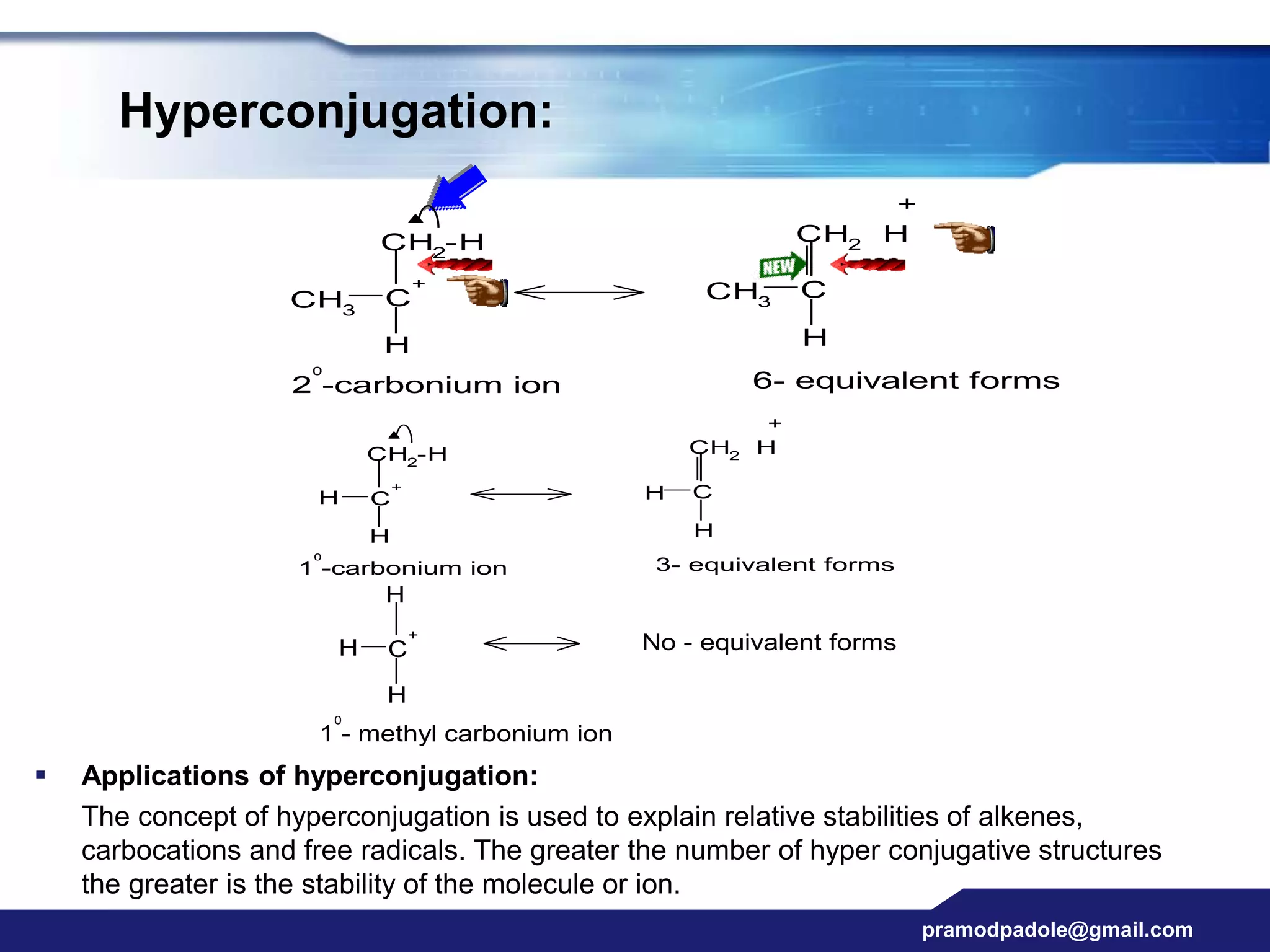
 Applications of hyperconjugation:
The concept of hyperconjugation is used to explain relative stabilities of alkenes,
carbocations and free radicals. The greater the number of hyper conjugative structures
the greater is the stability of the molecule or ion.
C
CH2-H
CH3
C
CH2
H
CH3
H
H
+
+
2 -carbonium ion
0
6- equivalent forms
C
CH2-H
H C
CH2
H
H
H
H
+
+
1 -carbonium ion
0
3- equivalent forms
C
H
H
H
+
1 - methyl carbonium ion
0
No - equivalent forms
B)
Carbanions:
Negatively charged carbon atom
LOGO
LOGO
B) Carbanions:
Q.1) Define Carbanion with example. (S-11, W-11 & W-12, 2 Mark)
Q.2) What is carbanion? Discuss it’s structure. (S-13, 4 Mark)
Q.3) The organic ion which has unshared pair of electrons on central
carbon atom is called _______. (W-14, ½ Mark)
Q.4) What are Carbanions? Give two methods of their formation.
(S-14 & W-19, 4 Mark)
Q.5) What is Carbanion ion? Give one preparation of it and explain the
structure of carbanion ion. (S-16, 4 Mark)
Q.6) The organic ion containing negatively charged carbon center is
called Carbanion. (W-17, ½ Mark)
Q.7) What are Carbanions? Explain the stability of carbanions on the
basis of resonance effect and inductive effect. (S-19, 4 Mark)
LOGO
B) Carbanions:
 Organic ions which contain a negatively charged
carbon atom are called carbanions.
Or
A species contain the negatively charged carbon are
called carbanions.
Or
The organic ion containing negatively charged carbon
center is called Carbanion.
Or
The organic ion which has unshared pair of electrons
on central carbon atom is called Carbanion.
Defination:
Defination:
LOGO
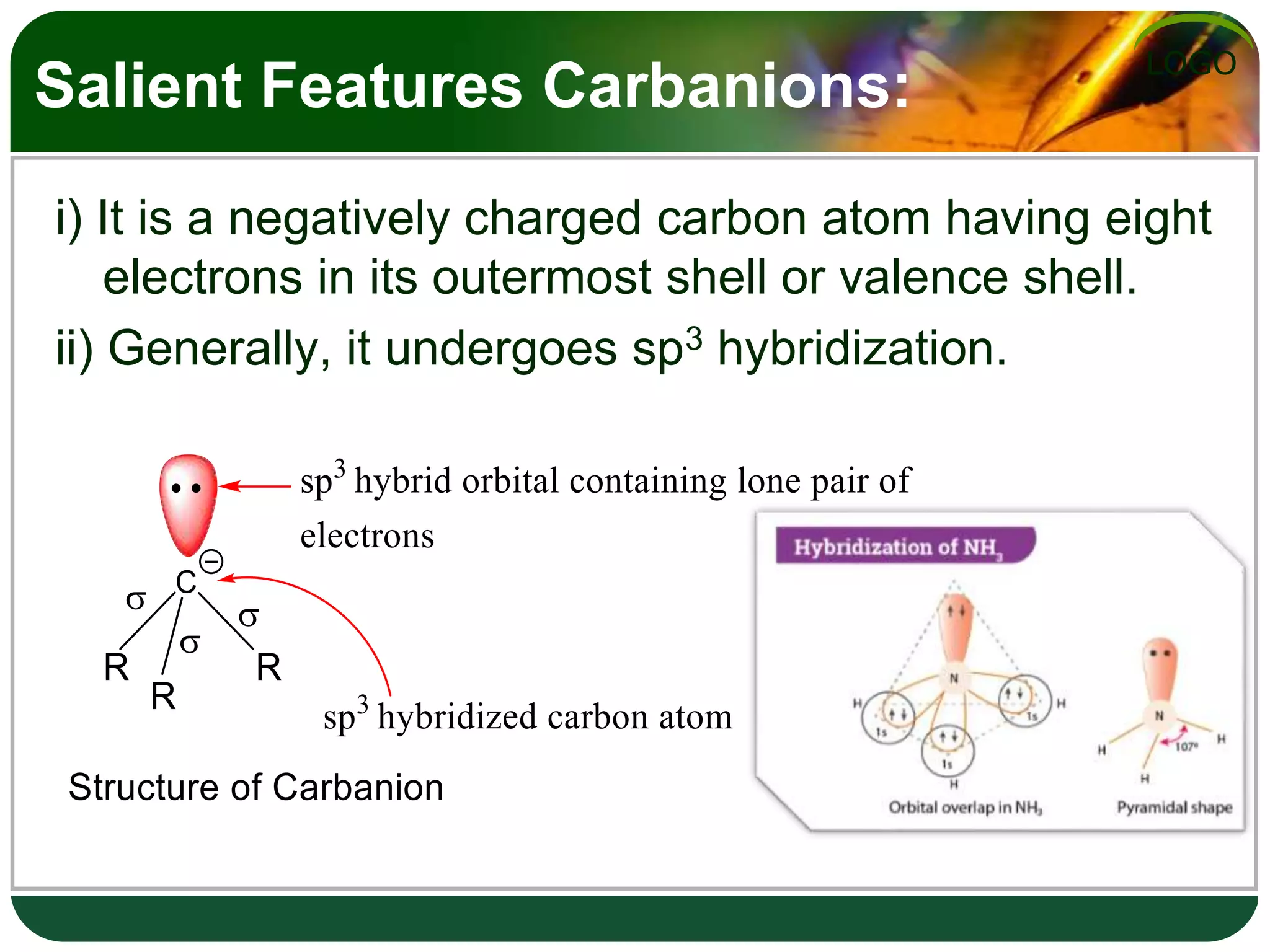
Salient Features Carbanions:
i) It is a negatively charged carbon atom having eight
electrons in its outermost shell or valence shell.
ii) Generally, it undergoes sp3 hybridization.
LOGO
Salient Features Carbanions:
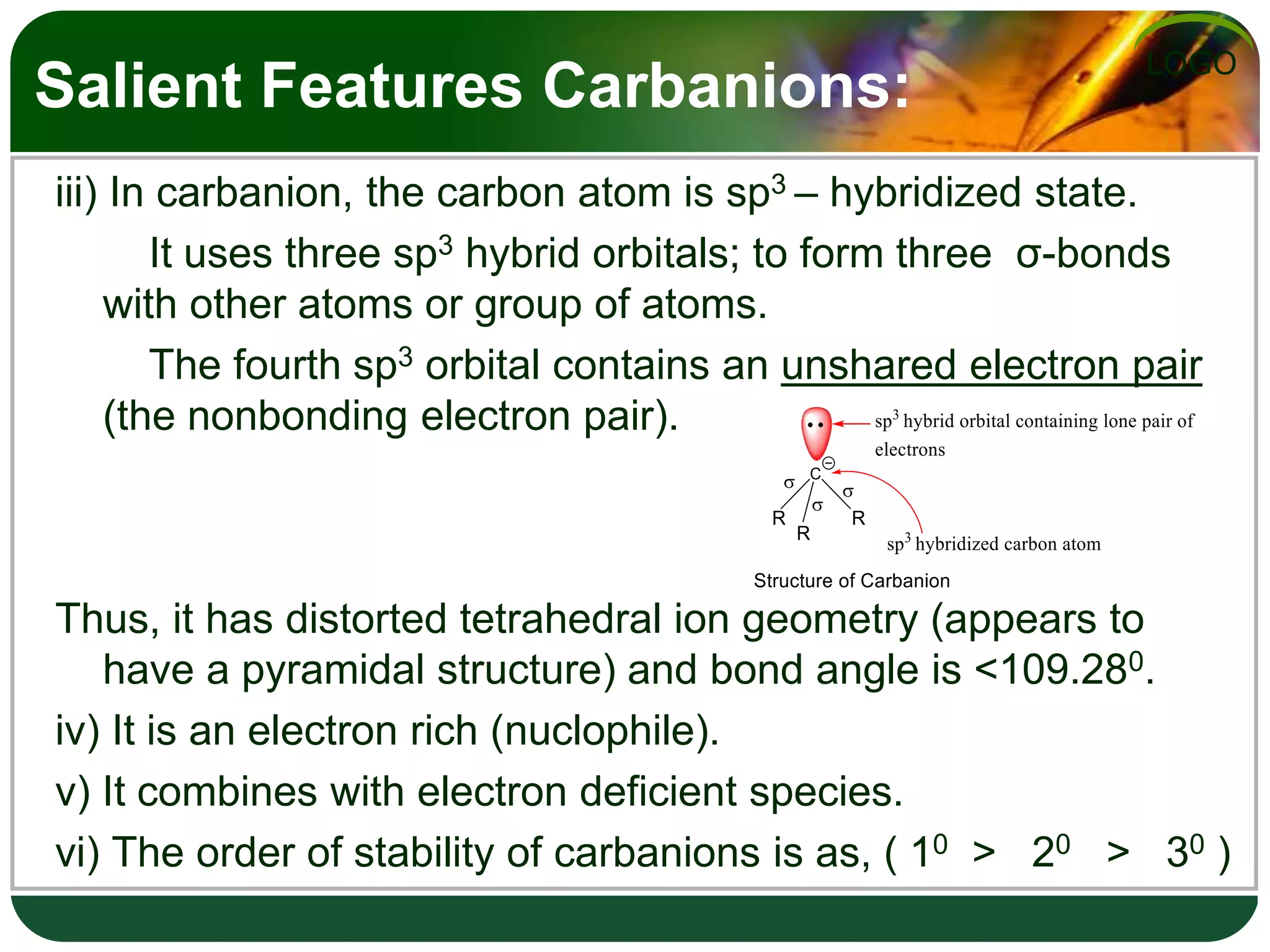
iii) In carbanion, the carbon atom is sp3 – hybridized state.
It uses three sp3 hybrid orbitals; to form three σ-bonds
with other atoms or group of atoms.
The fourth sp3 orbital contains an unshared electron pair
(the nonbonding electron pair).
Thus, it has distorted tetrahedral ion geometry (appears to
have a pyramidal structure) and bond angle is <109.280.
iv) It is an electron rich (nuclophile).
v) It combines with electron deficient species.
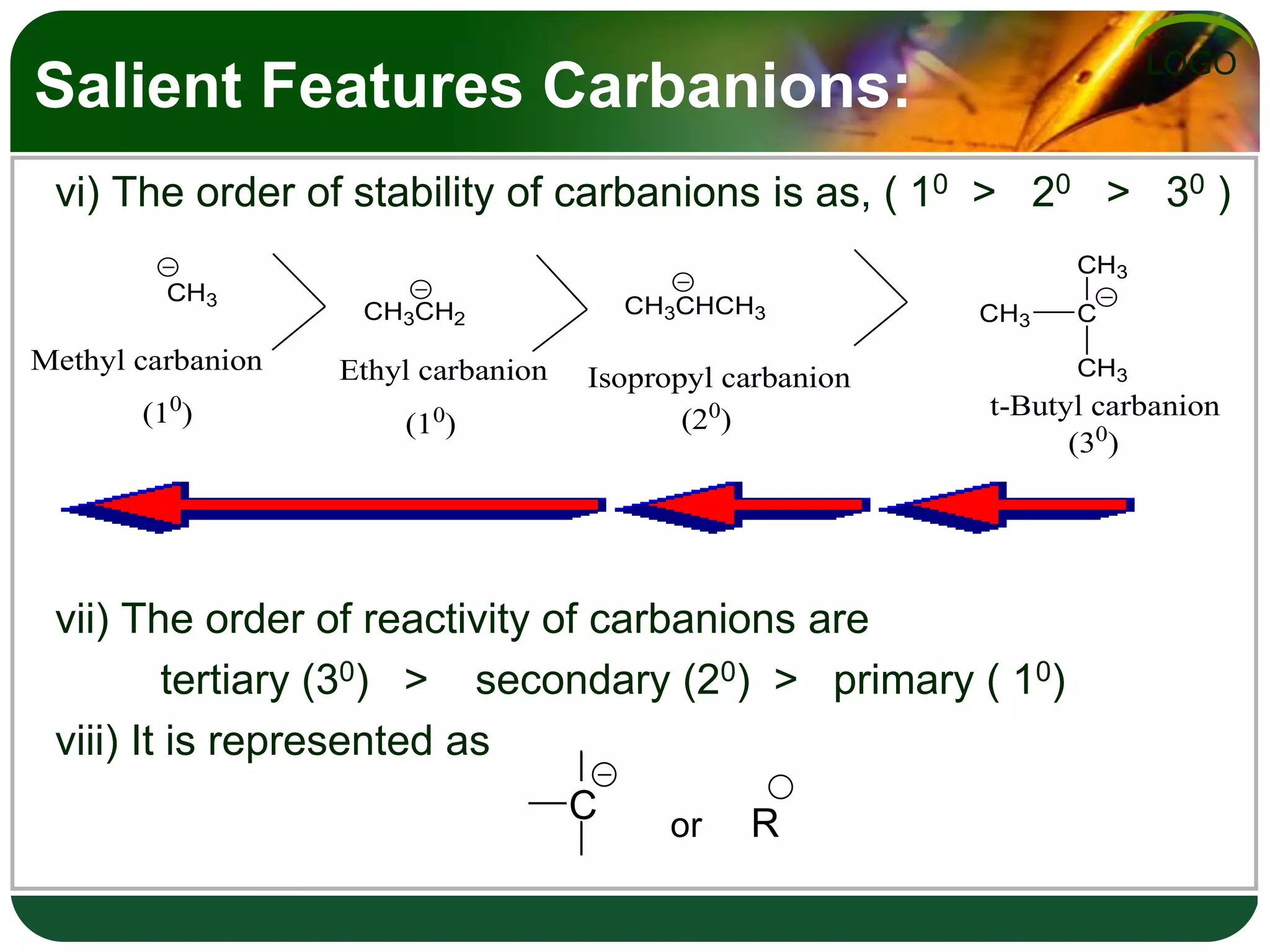
vi) The order of stability of carbanions is as, ( 10 > 20 > 30 )
LOGO
Salient Features Carbanions:
vi) The order of stability of carbanions is as, ( 10 > 20 > 30 )
vii) The order of reactivity of carbanions are
tertiary (30) > secondary (20) > primary ( 10)
viii) It is represented as
CH3
CH3CH2
CH3CHCH3 C
CH3
CH3
CH3
Methyl carbanion Ethyl carbanion Isopropyl carbanion
t-Butyl carbanion
(10
) (10
) (20
)
(30
)
C or R
LOGO
Salient Features Carbanions:
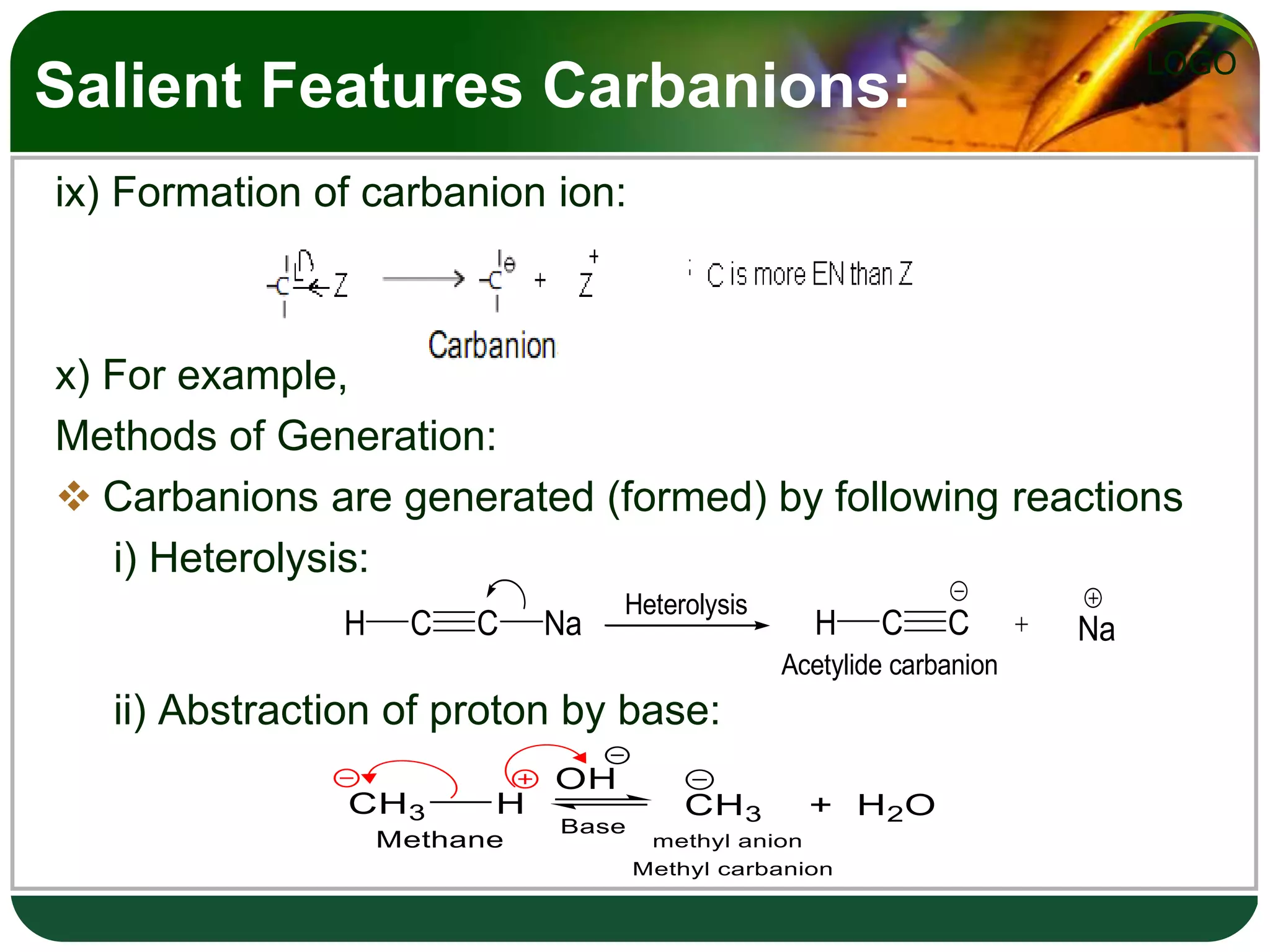
ix) Formation of carbanion ion:
x) For example,
Methods of Generation:
 Carbanions are generated (formed) by following reactions
i) Heterolysis:
ii) Abstraction of proton by base:
H C C Na H C C Na
Acetylide carbanion
Heterolysis
pramodpadole@gmail.com By Dr Pramod R Padole
Stability of Carbanions ( or Reactivity of Carbanions):
The stability of carbanions depends upon-
(i) Inductive effect,
(ii) Resonance effect and
(iii)s-character of orbital
(i) Inductive effect:
 Electron donating (releasing) alkyl groups or atoms,
i.e., + I effect, decreases the stability of carbanion and
electron withdrawing groups or atoms,
i.e., - I effect, increases the stability of carbanion.
 The order of stability ( Less Reactivity) of carbanion can be
explain on the basis of negative charge present on carbon.
Stability of Carbanions ( or Reactivity of Carbanions):
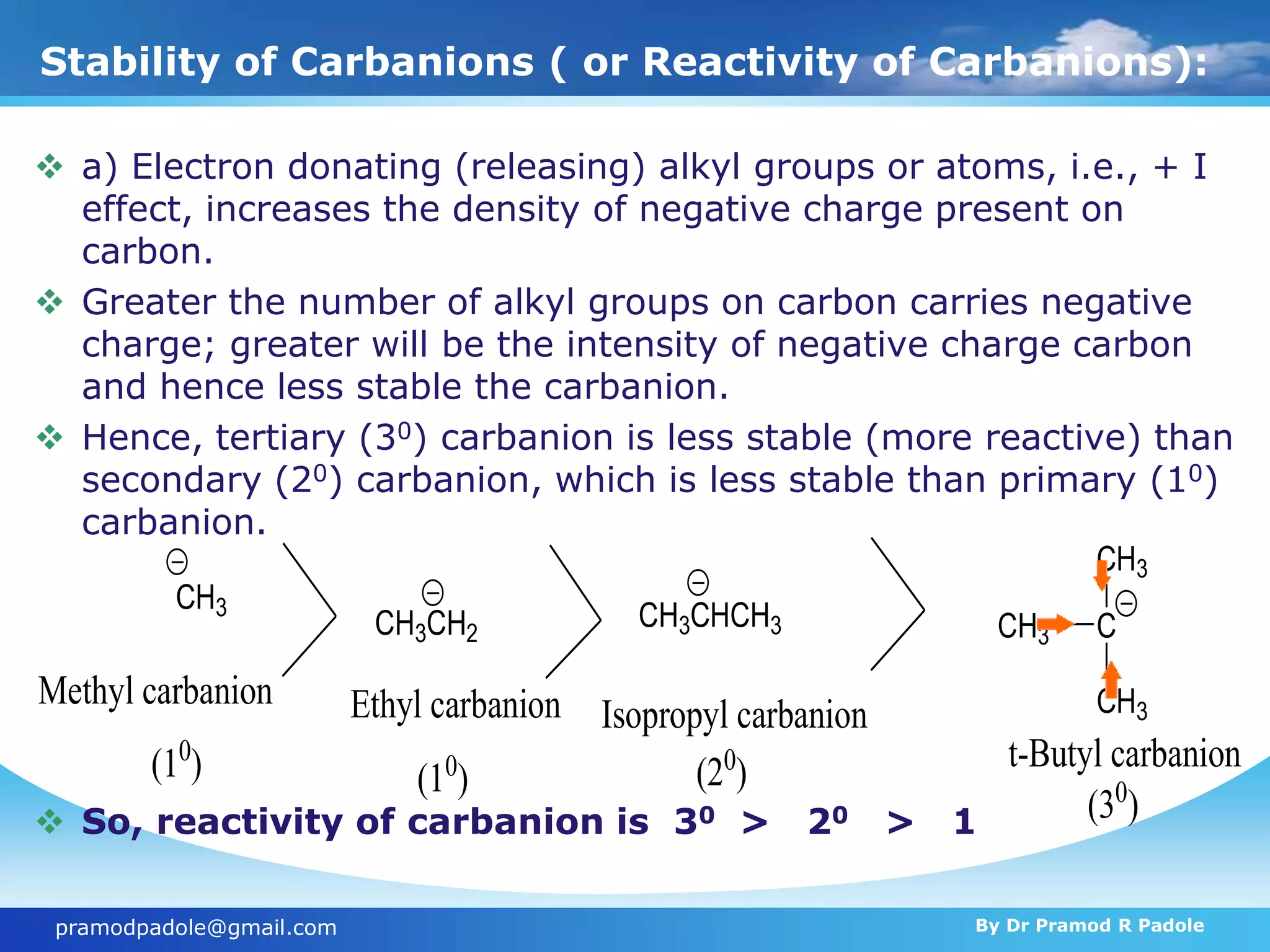
 a) Electron donating (releasing) alkyl groups or atoms, i.e., + I
effect, increases the density of negative charge present on
carbon.
 Greater the number of alkyl groups on carbon carries negative
charge; greater will be the intensity of negative charge carbon
and hence less stable the carbanion.
 Hence, tertiary (30) carbanion is less stable (more reactive) than
secondary (20) carbanion, which is less stable than primary (10)
carbanion.
 So, reactivity of carbanion is 30 > 20 > 1
CH3
CH3CH2
CH3CHCH3 C
CH3
CH3
CH3
Methyl carbanion Ethyl carbanion Isopropyl carbanion
t-Butyl carbanion
(10
) (10
) (20
)
(30
)
pramodpadole@gmail.com By Dr Pramod R Padole
Stability of Carbanions ( or Reactivity of Carbanions):
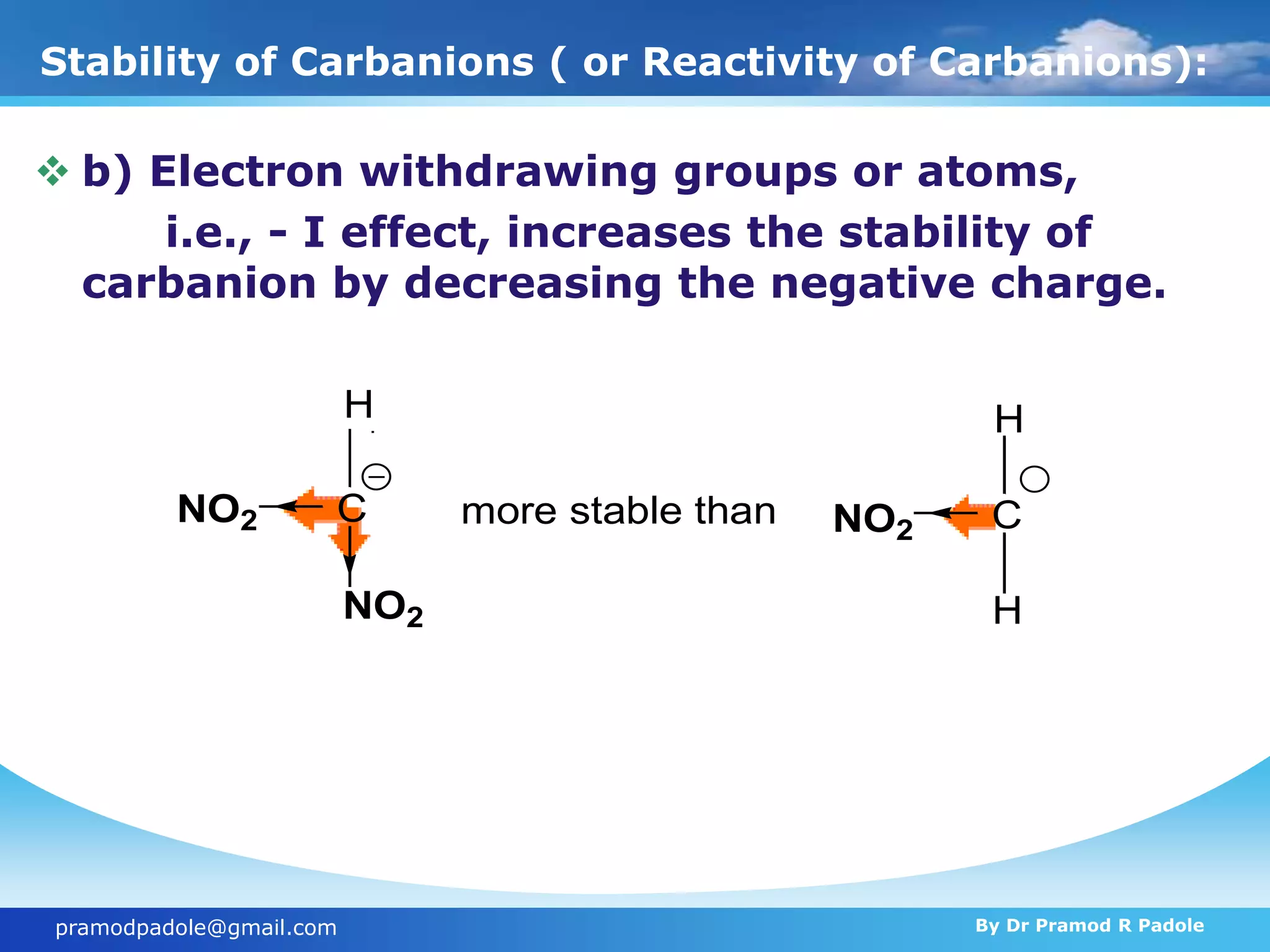
 b) Electron withdrawing groups or atoms,
i.e., - I effect, increases the stability of
carbanion by decreasing the negative charge.
pramodpadole@gmail.com By Dr Pramod R Padole
C
H
NO2
NO2 C
H
NO2
H
more stable than
Stability of Carbanions depends on Resonance effect:
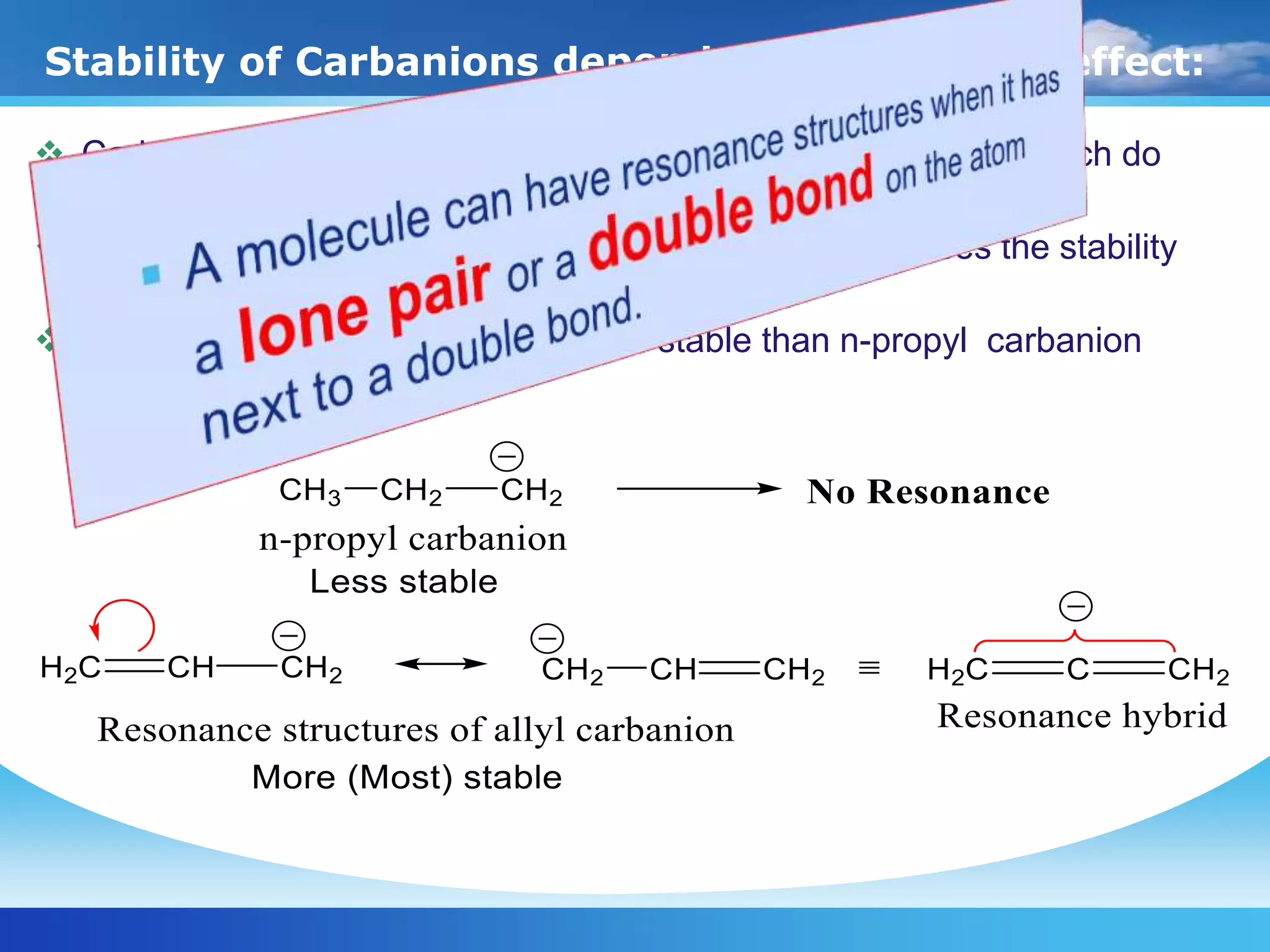
 Carbanions involving resonance are more stable than those which do
not involve resonance.
 The resonance delocalisation of negaive charge increases the stability
of carbocation.
 For example, allyl carbanion is more stable than n-propyl carbanion
Stability of Carbanions depends on Resonance effect:
 Carbanions involving resonance are more stable than those which do
not involve resonance.
 The resonance delocalisation of negaive charge increases the stability
of carbocation.
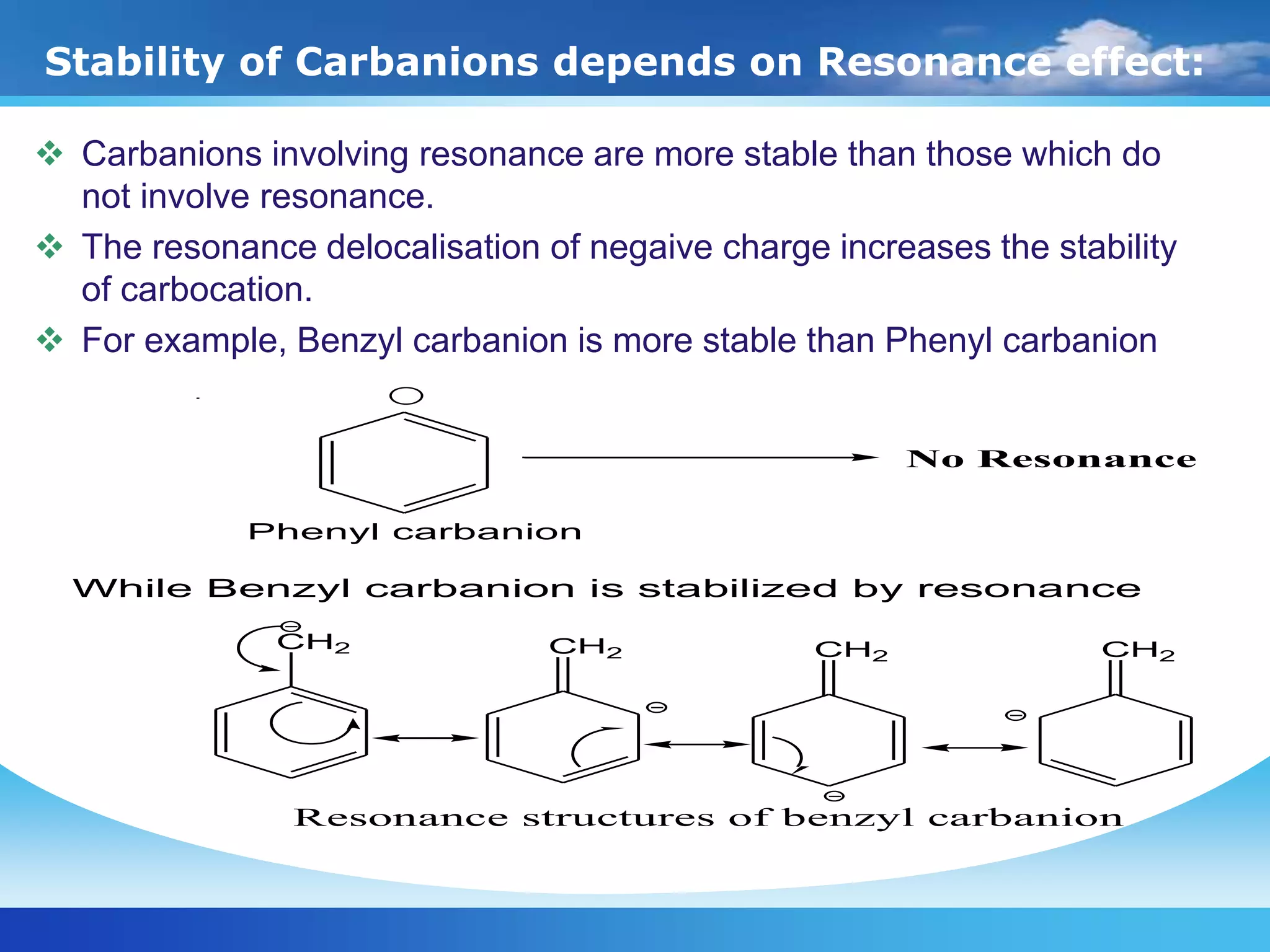
 For example, Benzyl carbanion is more stable than Phenyl carbanion
CH2 CH2 CH2 CH2
Resonance structures of benzyl carbanion
No Resonance
Phenyl carbanion
While Benzyl carbanion is stabilized by resonance
LOGO
iii) s-character of the orbital:
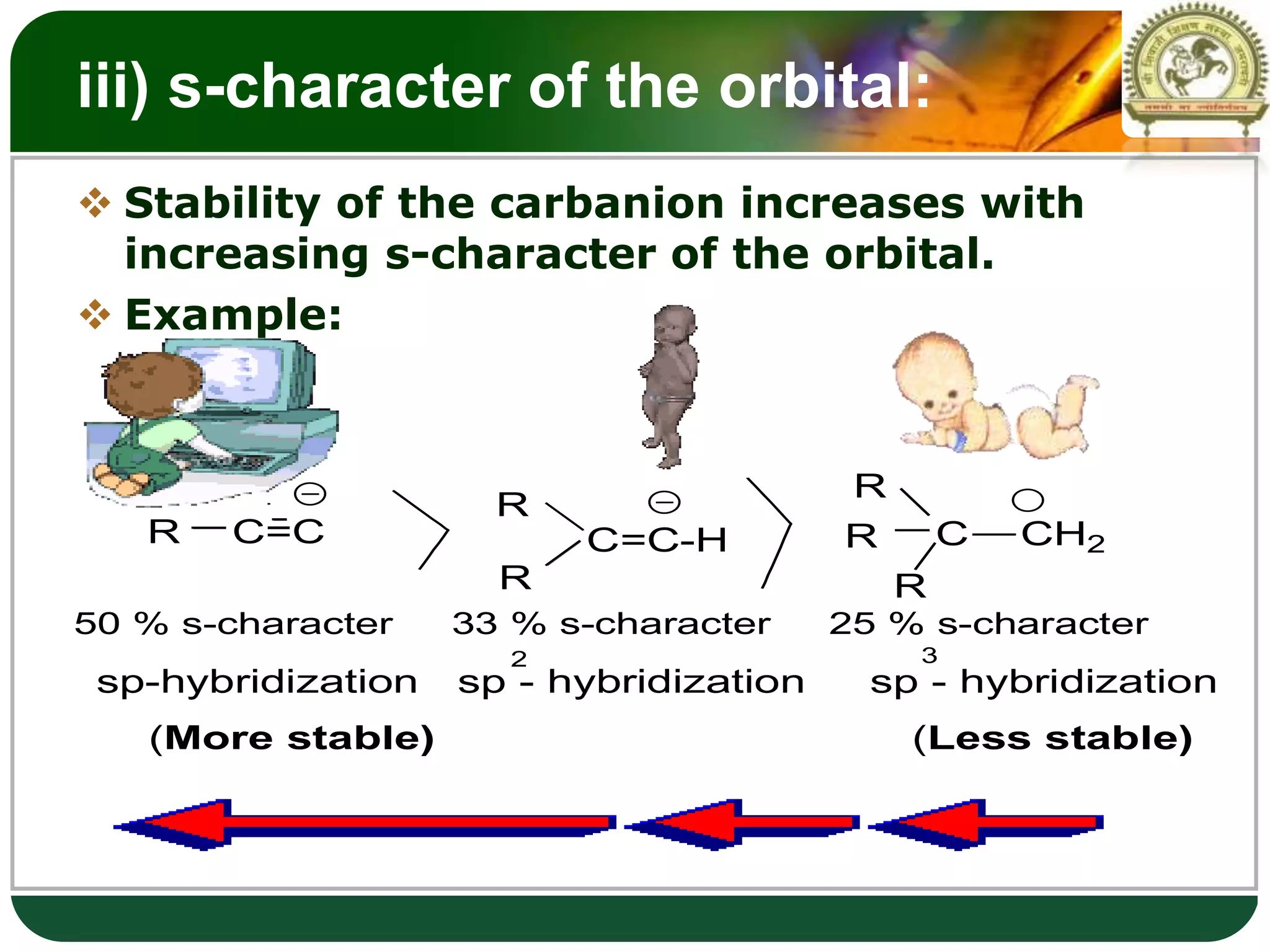
 Stability of the carbanion increases with
increasing s-character of the orbital.
 Example:
R C=C C=C-H
R
R
C CH2
R
R
R
50 % s-character 33 % s-character 25 % s-character
sp-hybridization sp - hybridization sp - hybridization
2 3
(More stable) (Less stable)
Company
LOGO
C) Free Radicals
or Carbon Free Radicals:
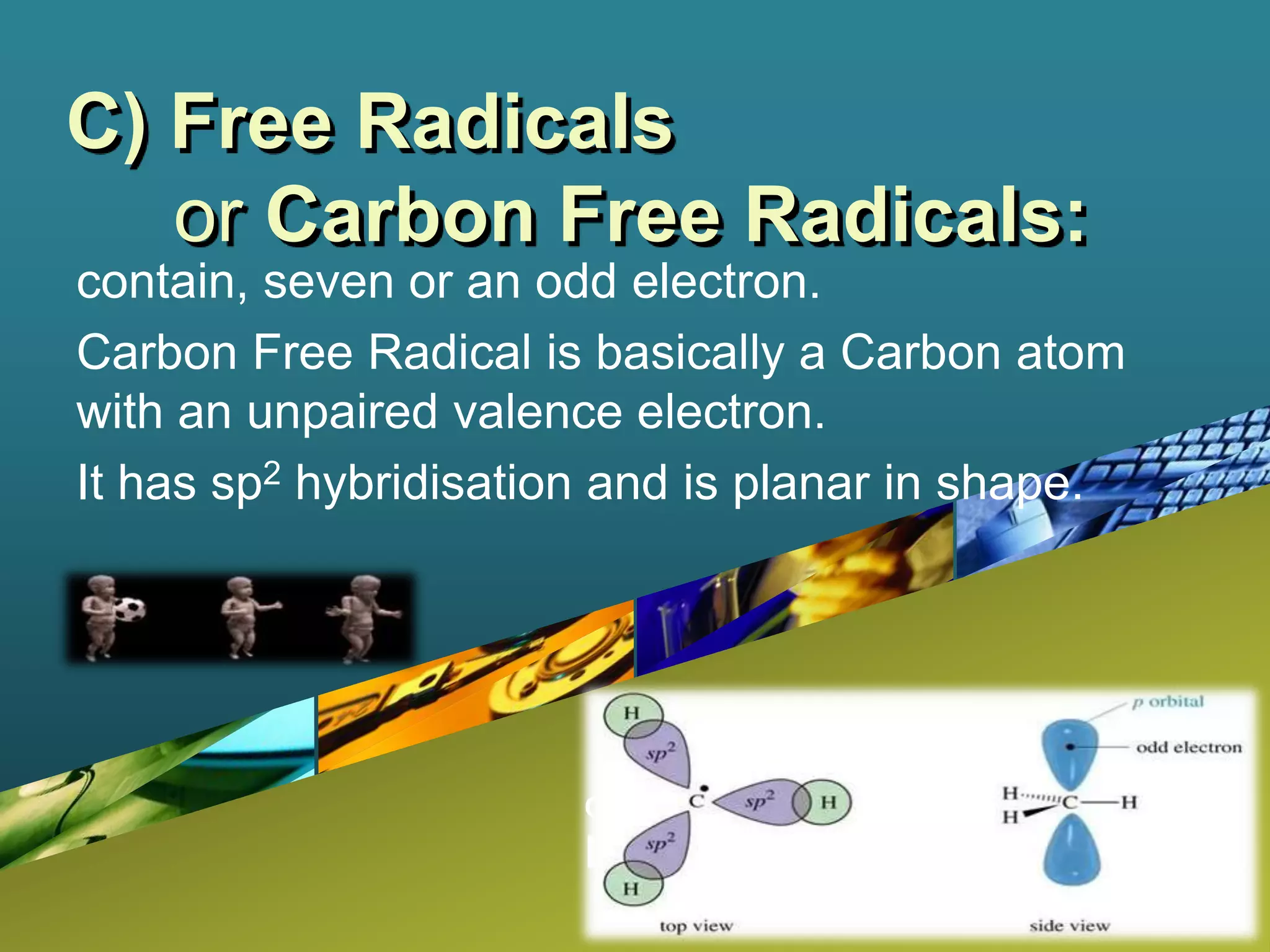
contain, seven or an odd electron.
Carbon Free Radical is basically a Carbon atom
with an unpaired valence electron.
It has sp2 hybridisation and is planar in shape.
C) Free Radicals
or Carbon Free Radicals:
Q.1) Define Free radical with example. (W-11, 2 Mark)
Q.2) What is/are free radicals? Explain their stability on the basis of resonance effect.
(S-13, 4 Mark)
Q.3) Free radicals are produced by _______ fission. (W-13, ½ Mark)
Q.4) The species containing odd electron or unpaired electron is/ are called as _______.
(S-15, W-17 & S-19, ½ Mark)
Q.5) Define Free radicals. Give two methods of generation of free radicals. ( W-16, 4 Mark)
Q.6) What are free radicals? Explain the stability of free radicals on the basis of resonance and
hyperconjugation effect. (W-17 & S-19, 4 Mark)
Q.7) What are Free radicals? Give two methods of generation. (W-18, 4 Mark)
Q.8) ______ contain, an odd electron. ( W-19, ½ Mark)
(a) Carbocation (b) Carbanion (c) Free radical (d) None of these
Q.9) Define Free radical. (W-19, 1 Mark)
Q.10) Explain the stability order for free radicals. (W-19, 4 Mark)
C) Free Radicals or Carbon Free Radicals:
Defination:
The species (atom or group of atoms) having an
odd or unpaired electron are called free radicals.
Salient features:
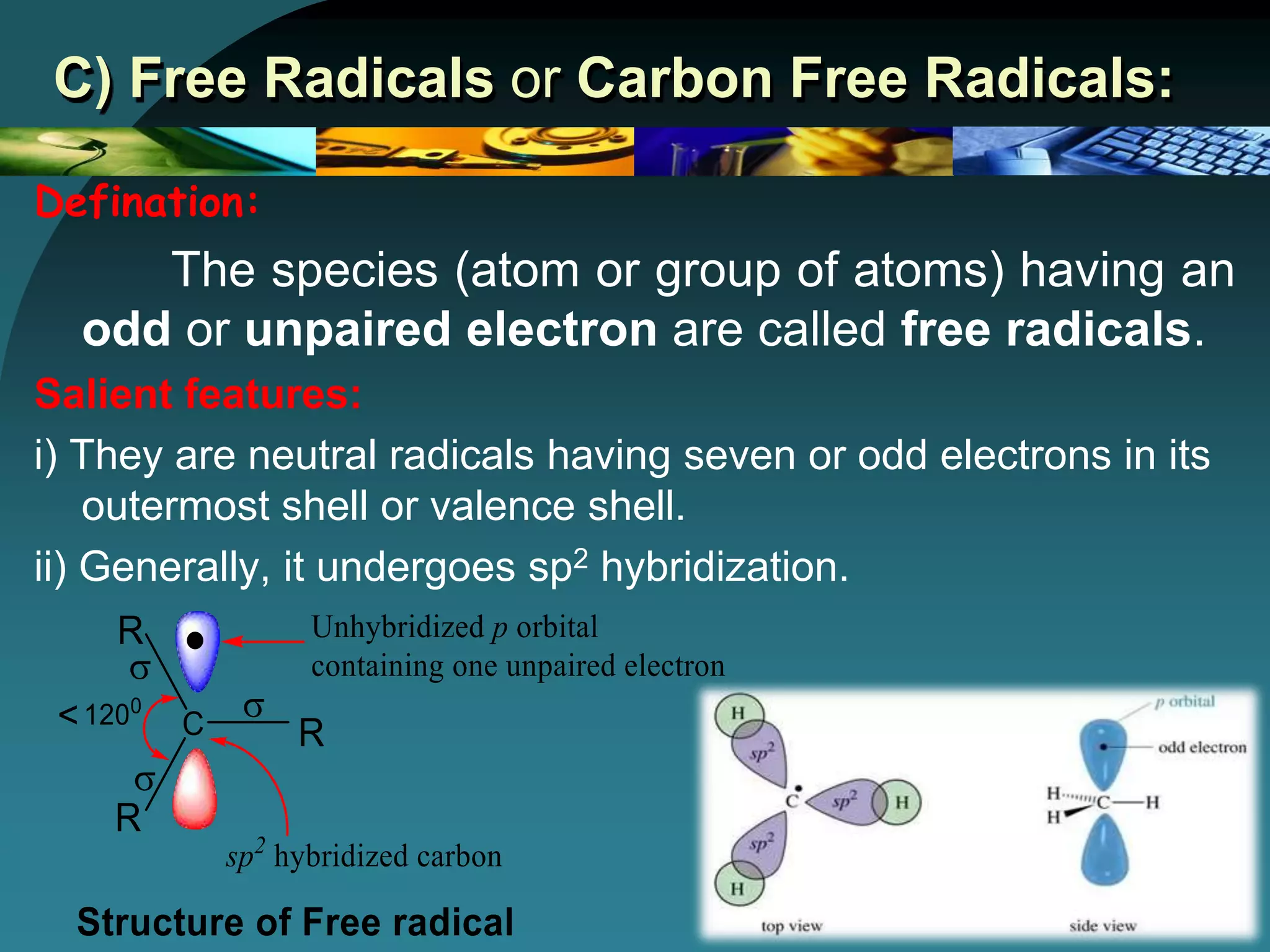
i) They are neutral radicals having seven or odd electrons in its
outermost shell or valence shell.
ii) Generally, it undergoes sp2 hybridization.
C) Free Radicals or Carbon Free Radicals:
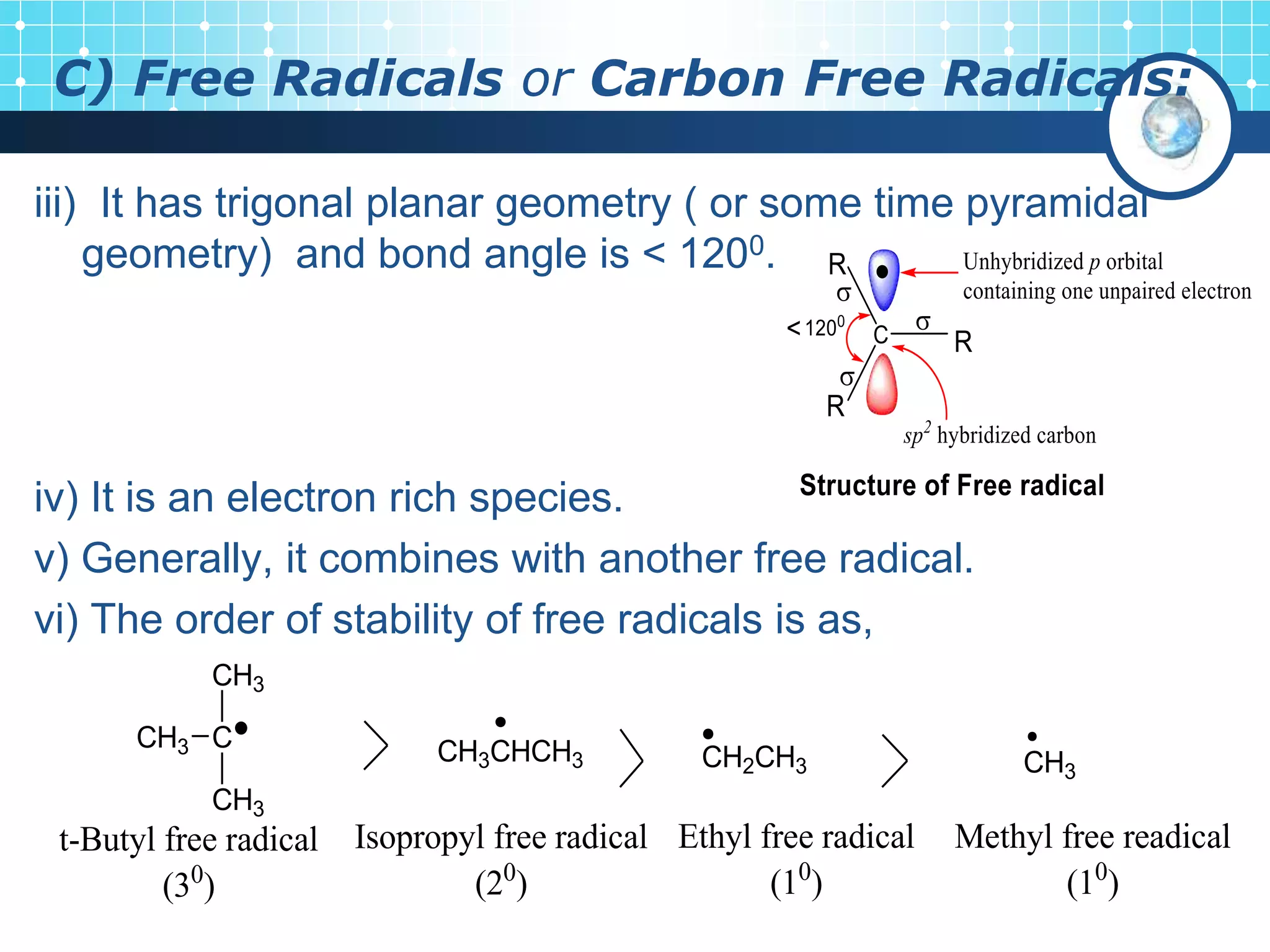
iii) It has trigonal planar geometry ( or some time pyramidal
geometry) and bond angle is < 1200.
iv) It is an electron rich species.
v) Generally, it combines with another free radical.
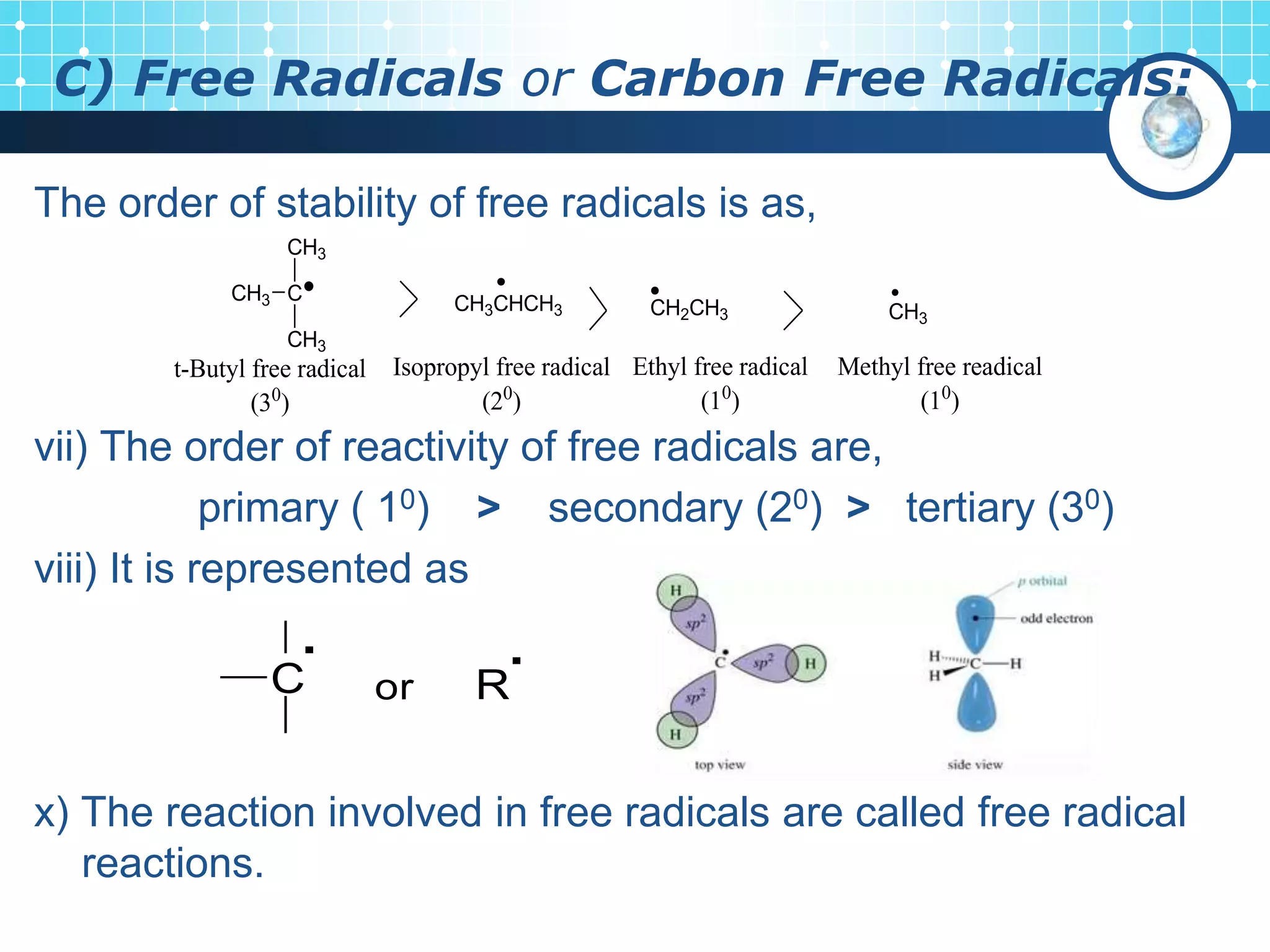
vi) The order of stability of free radicals is as,
CH3
CH2CH3
CH3CHCH3
C
CH3
CH3
CH3
Methyl free readical
(10
)
Ethyl free radical
(10
)
Isopropyl free radical
(20
)
t-Butyl free radical
(30
)
C) Free Radicals or Carbon Free Radicals:
The order of stability of free radicals is as,
vii) The order of reactivity of free radicals are,
primary ( 10) > secondary (20) > tertiary (30)
viii) It is represented as
x) The reaction involved in free radicals are called free radical
reactions.
CH3
CH2CH3
CH3CHCH3
C
CH3
CH3
CH3
Methyl free readical
(10
)
Ethyl free radical
(10
)
Isopropyl free radical
(20
)
t-Butyl free radical
(30
)
C) Free Radicals or Carbon Free Radicals:
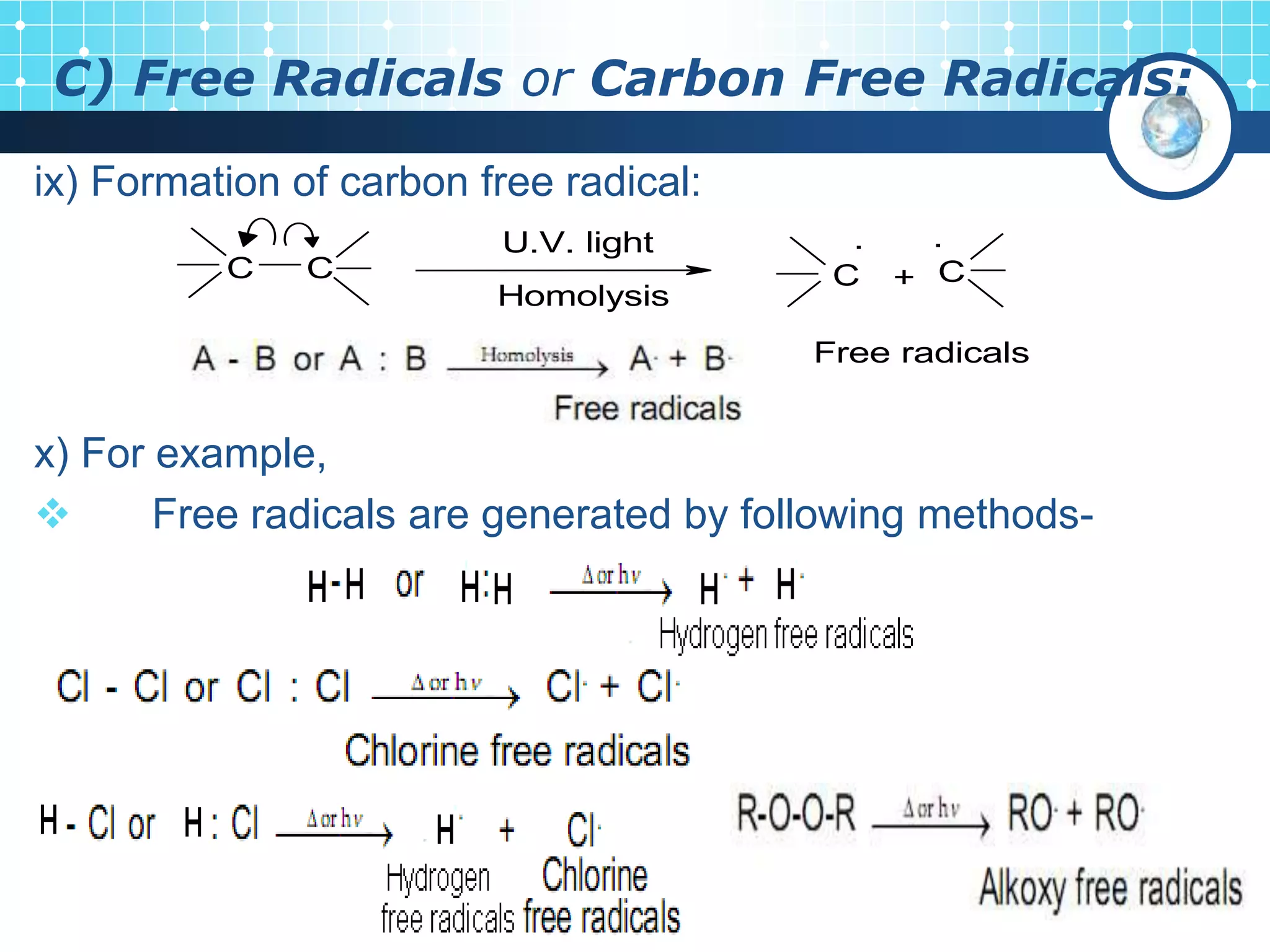
ix) Formation of carbon free radical:
x) For example,
 Free radicals are generated by following methods-
C C C C
U.V. light
Homolysis
. .
+
Free radicals
Stability of Free radicals depends on Resonance effect:
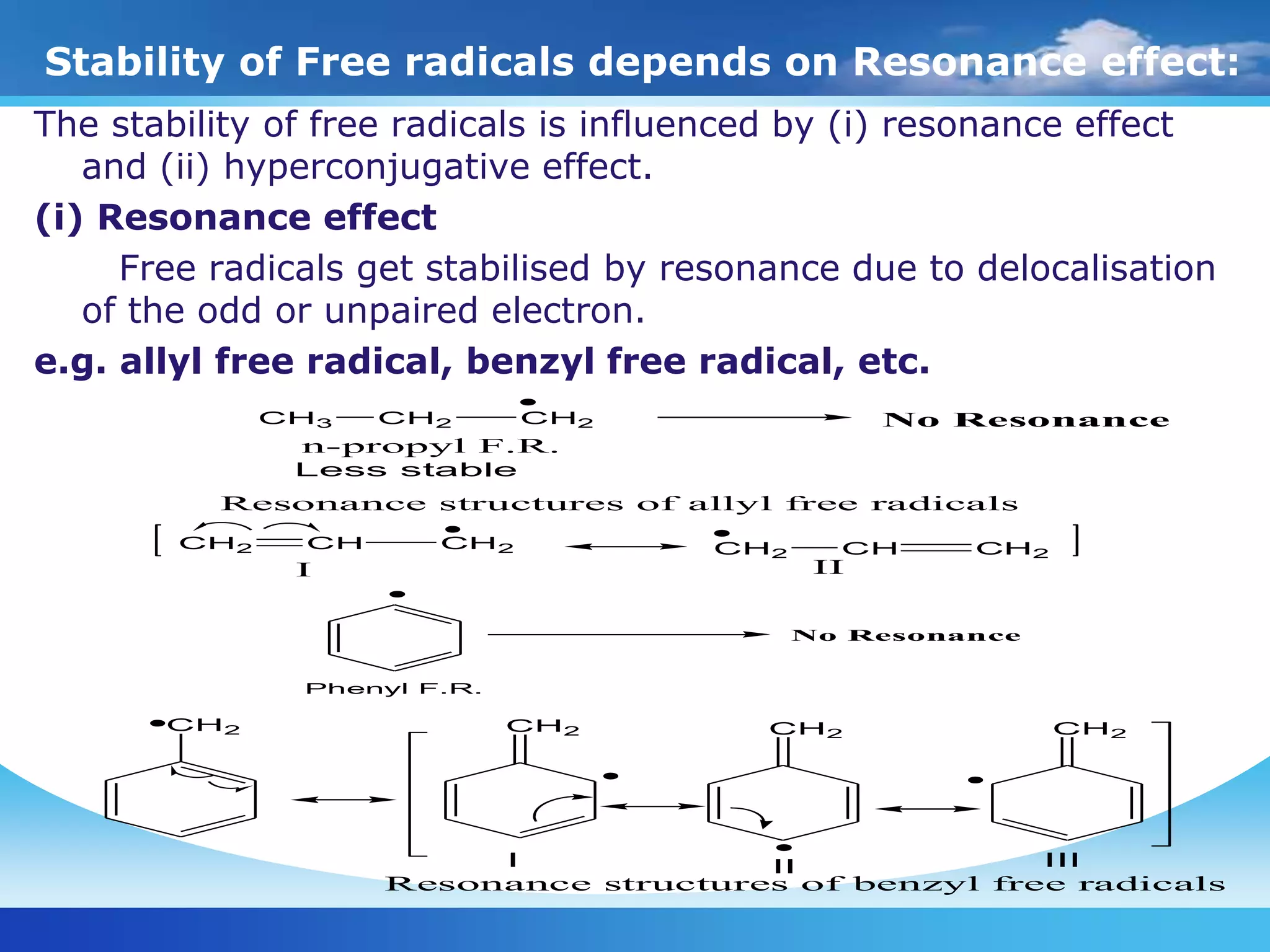
The stability of free radicals is influenced by (i) resonance effect
and (ii) hyperconjugative effect.
(i) Resonance effect
Free radicals get stabilised by resonance due to delocalisation
of the odd or unpaired electron.
e.g. allyl free radical, benzyl free radical, etc.
CH2 CH CH2 CH2 CH CH2
CH2 CH2 CH2 CH2
Resonance structures of benzyl free radicals
I II
Resonance structures of allyl free radicals
I II III
CH3 CH2 CH2
n-propyl F.R.
No Resonance
Less stable
No Resonance
Phenyl F.R.
Hyperconjugation:
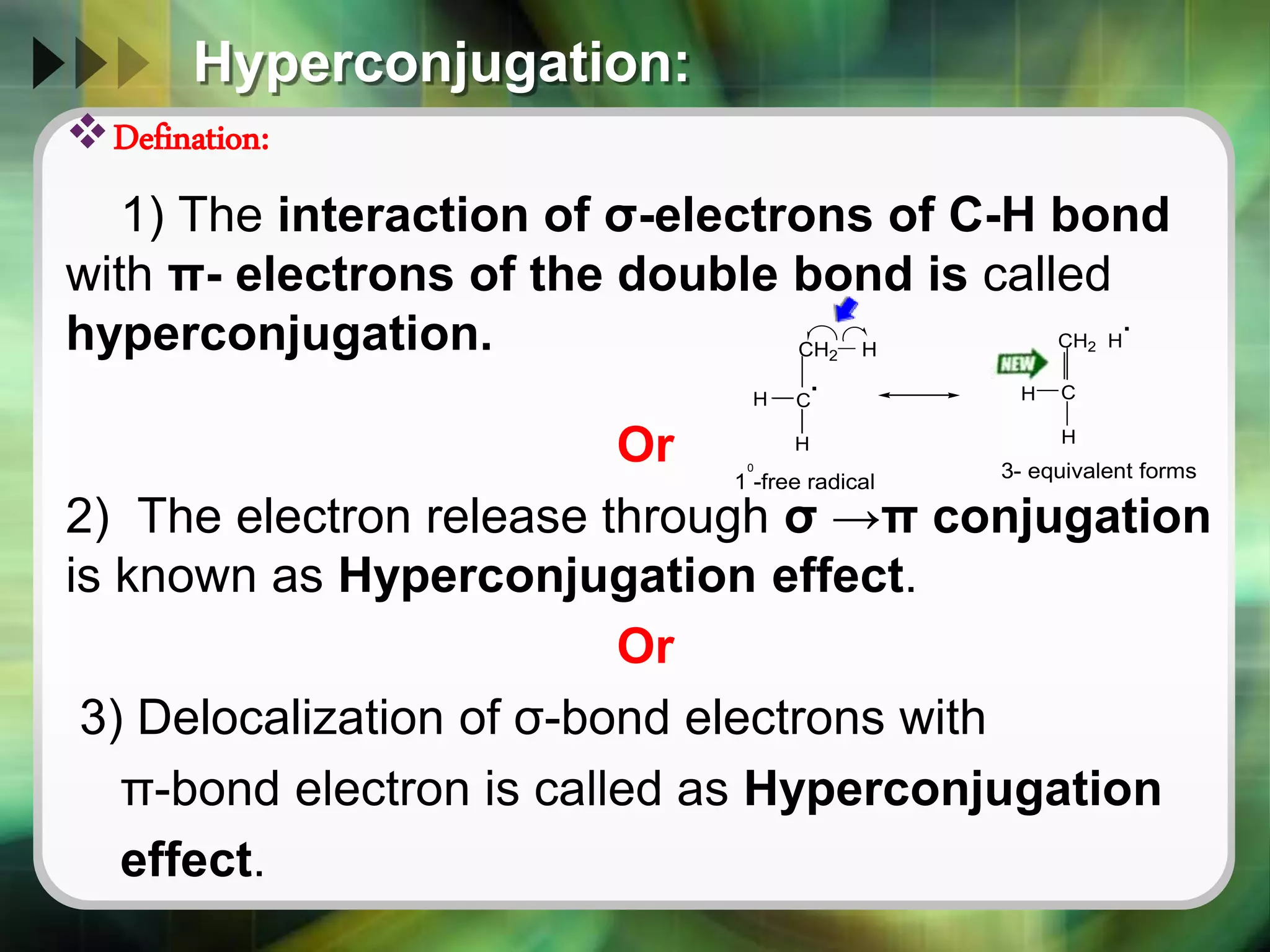
Defination:
1) The interaction of σ-electrons of C-H bond
with π- electrons of the double bond is called
hyperconjugation.
Or
2) The electron release through σ →π conjugation
is known as Hyperconjugation effect.
Or
3) Delocalization of σ-bond electrons with
π-bond electron is called as Hyperconjugation
effect.
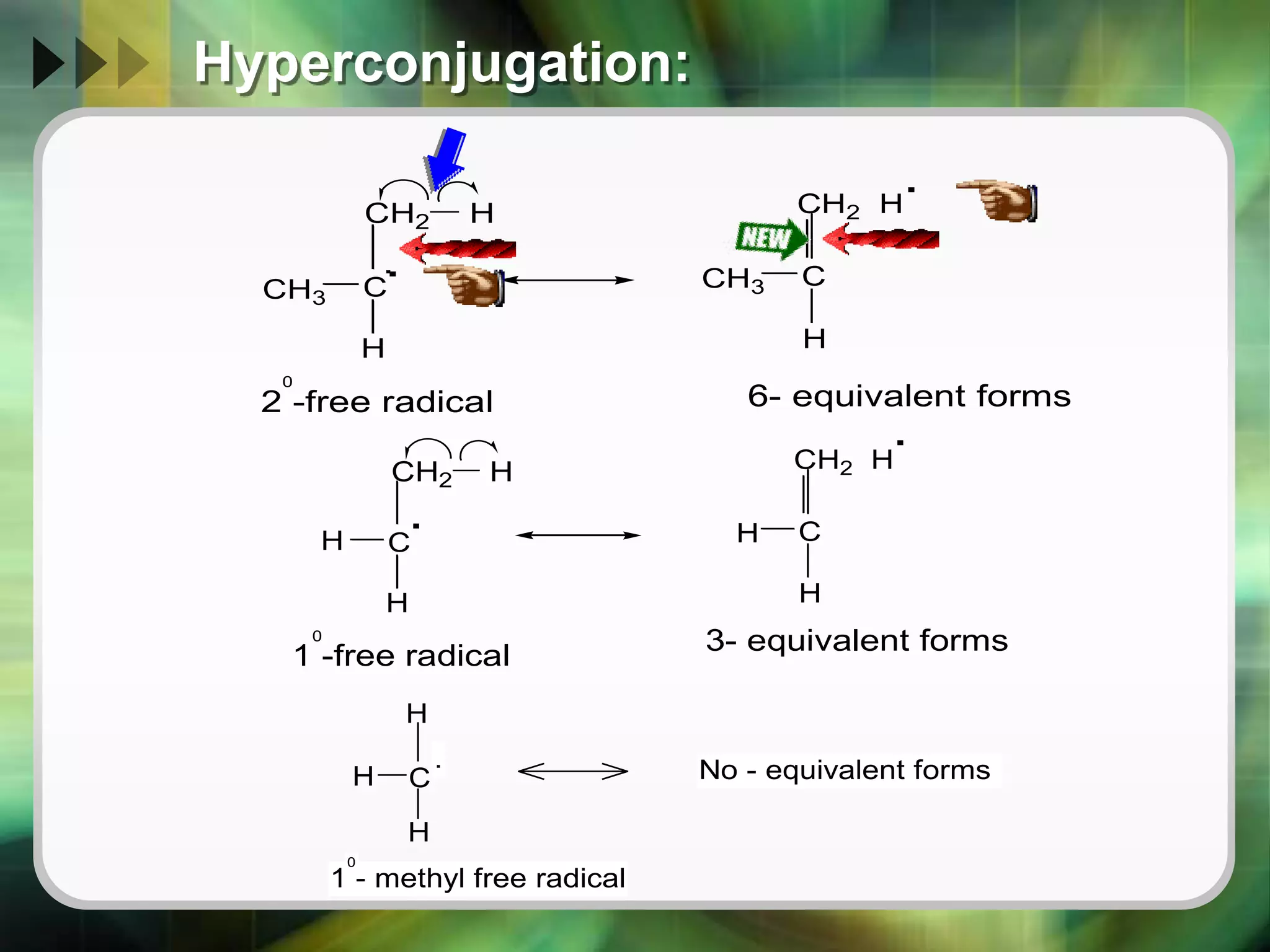
CH2 H
.
.
C
H C
CH2 H
H
H
H
1 -free radical
0
3- equivalent forms
Hyperconjugation:
CH2 H
.
.
C
CH3
C
CH2 H
CH3
H
H
.
2 -free radical
0
6- equivalent forms
CH2 H
.
.
C
H C
CH2 H
H
H
H
1 -free radical
0
3- equivalent forms
C
H
H
H
1 - methyl free radical
0
No - equivalent forms
.
LOGO
LOGO
www.themegallery.com
Reactive Intermediates by Dr Pramod R. Padole
Stay Home. Take Care

Semester - I B) Reactive Intermediates by Dr Pramod R Padole

  • 1.
    1 B.Sc. First year Students Semester– I Reactive Intermediates: by Dr Pramod R Padole
  • 2.
  • 4.
    Organic Chemisrtry Unit-III A) ElectronicDisplacements: B) Reactive Intermediates: C) Aliphatic Hydrocarbons:
  • 5.
    Company LOGO B) Reactive Intermediates: Mostorganic reactions occur through a intermediate, these are generally short lived and highly reactive.
  • 6.
    B) Reactive Intermediates: Shortlived and highly reactive
  • 7.
  • 8.
    Important reactive intermediatesare: Carbocations (Carbonium Ions): Carbanions: Free Radicals or Carbon Free Radicals:
  • 9.
    III B) ReactiveIntermediates: First Carbocations :their generation stability and reactions Second Carbanions :their generation stability and reactions Third Free Radicals :their generation stability and reactions
  • 10.
    III B) ReactiveIntermediates: First Carbocations (Carbonium Ions): :their generation stability and reactions Q.1) What are carbocations? How are they obtained? Write their stability order. (S-11, 5 Mark) Q.2) Define: Carbocations (Carbonium ion) with examples. (S-12 & S-17, 2 Mark) Q.3) What are carbocations? (W-13 & W-17, 1 Mark) Q.4) What are Carbocations? Give two methods of their formation. (S-14 & W-15, 4 Mark) Q.5) Carbocations have _____ geometry. (S-14, ½ Mark) Q.6) Explain the stability of carbocations on the basis of inductive effect and resonance effect. (W-14, W-16 & W-17, 4 Mark) Q.7) What are Carbocations? Give one method of their formation and stability order of alkyl carbocations. (S-15, 5 Mark) Q.8) Organic ions which containing positively charged carbon atoms are called _______. (W-15, ½ Mark) Q.9) The species containing positively charged carbon centre are called _______. (W-16, ½ Mark) Q.10) Define: Carbocation. Explain its stability on the basis of inductive effect. (W-18, 4 Mark)
  • 11.
    Carbocations (Carbonium Ions): Defination: Organic ions which contain a positively charged carbon atom are called carbocations or carbonium ions. Or A species contain the positively charged carbon is called carbocations or carbonium ions.
  • 12.
    Carbocations (Carbonium Ions): Salientfeatures: i) It is a positively charged carbon atom having six electrons in its outermost shell or valence shell. ii) Generally, it undergoes sp2 hybridization.
  • 13.
    Carbocations (Carbonium Ions): iii)In carbocation, the carbon atom is sp2 - hybridised. It uses three sp2 orbitals to form three σ-bonds with other atoms or group of atoms. An empty (vacant) p-orbital lies perpendicular to the plane of σ- bonds. Thus, it has trigonal planar geometry or flat ion and bond angle is 1200. iv) It is an electron deficient (electrophile). v) It combines with electron rich species. vi) The order of stability of carbonium ions are as, (W-12, 2 Mark)
  • 14.
    Carbocations (Carbonium Ions): vii)The order of reactivity of carbonium ions are as, primary ( 10) > secondary (20) > tertiary (30) viii) It is represented as ix) Formation of carbonium ion: C + or R + Heterolysis C X C + X Carbocation ; X is more EN than C
  • 15.
    Carbocations (Carbonium Ions): x)For example, Methods of Generation or Formation:  Carbocations can be generated (formed) in a variety of ways. (i) Heterolysis of alkyl halides: (ii) Protonation of alkenes:
  • 16.
    Carbocations (Carbonium Ions): x)For example, Methods of Generation or Formation:  Carbocations can be generated (formed) in a variety of ways. (iii) Protonation followed by dehydration of alcohols: xi) Stability ( or Reactivity): The stability of carbonium ions depends upon: (i) Inductive effect: (ii) Resonance effect (iii) Hyperconjugation:
  • 17.
    Stability of Carbocationdepends on Inductive effect: Inductive effect: Permanent polarization (polarity produced, i.e., of single covalent bond due to difference in electronegativity between two bonded atoms is known as Inductive effect.
  • 18.
    pramodpadole@gmail.com Types of InductiveEffect: Positive inductive effect (+I effect): I-effect Negative inductive effect (-I effect): By Dr. Pramod R. Padole
  • 19.
    pramodpadole@gmail.com By Dr.Pramod R. Padole Positive inductive effect (+I effect): Defination:  The atoms or group of atoms which donates ( or release or repel or pushes) shared pair of electron (bonded pair) from itself and thus acquires partial positive charge (+δ), called positive inductive effect (+I effect).  Note: i) +I group: Electron donating or releasing or repelling group show +I effect. ii) Representation: C CH3 C D Donar atom / group  
  • 20.
    ii) Negative inductiveeffect (-I effect):  The atoms or group of atoms which withdraw or attract shared pair of electron towards itself and thus acquires partial negative charge (-δ), called negative inductive effect (-I effect).  Note: i) -I group: Electron attracting or withdrawing or accepting group show -I effect. ii) Representation:  C Cl C W Withdrawing atom / group 
  • 21.
    Stability of Carbocationdepends on Inductive effect: Inductive effect: (i.e. on the basis of + I effect & -I effect) (a) Electron donating alkyl groups or atoms, i.e., +I effect, increases the stability of carbonium ion (by decreasing the intensity of the ‘+ve’ charge on the carbon atom). The order of stability (less reactivity) of carbonium ion can be explained on the basis of ‘+ve’ charge present on carbon. e.g. Stability of carbonium ions are, 30 > 20 > 10
  • 22.
    Stability of Carbocationdepends on Inductive effect: Inductive effect: Stability of carbonium ions are, 30 > 20 > 10 CH3 CH2CH3 CH3CHCH3 C CH3 CH3 CH3 Methyl carbocation Ethylcarbocation Isopropyl carbocation t-Butyl carbocation 30 20 10 10 The electron donating alkyl groups disperse the positive (+) charge present on carbon. The greater the number of alkyl groups, the greater is the dispersal of positive (+) charge and the greater is the stability of carbocation. Thus, tertiary (3°) carbocation is more stable than a secondary (2°) carbocation which in turn is more stable than a primary (1°) carbocation. (30 > 20 > 10 ) The reactivity of carbonium ion is, 10 > 20 > 30
  • 23.
    C Cl H H C Cl H Cl more stable than Stabilityof Carbocation depends on Inductive effect: Inductive effect: (b) Electron withdrawing groups or atoms, i.e., -I effect, decrease the stability of carbonium ion.
  • 24.
    Stability of Carbocationdepends on Resonance effect:  Carbocations involving resonance are more stable than those which do not involve resonance. The resonance delocalisation of positive charge increases the stability of carbocation.  For example, allyl carbocation is more stable than n-propyl carbocation. HC CH CH2 CH2 CH CH2  CH2 C CH2 Resonance structures of allyl carbocation Resonance hybrid CH3 CH2 CH2 n-propyl carbocation No Resonance
  • 25.
    Stability of Carbocationdepends on Resonance effect:  Carbocations involving resonance are more stable than those which do not involve resonance. The resonance delocalisation of positive charge increases the stability of carbocation.  For example, allyl carbocation is more stable than n-propyl carbocation. No Resonance CH2 CH2 CH2 CH2 Phenyl carbocation While Benzyl carbocation is stabilized by resonance Resonance structures of Benzyl carbocation I II III Hence Benzyl carbocation is more stable than phenyl carbocation
  • 26.
    Stability of Carbocationdepends on Hyperconjugation: :  The interaction of σ-electrons of C-H bond with π- electrons of the double bond is called hyperconjugation. Or 2) The electron release through σ →π conjugation is known as Hyperconjugation effect. Or 3) Delocalization of σ-bond electrons with π-bond electron is called as Hyperconjugation effect.  In general, more number of hyperconjugative structures; the greater is the stability of carbocation  Hence the decreasing order of stability of alkyl carbocations is,
  • 27.
    pramodpadole@gmail.com Hyperconjugation:  The abilityof alkyl groups to release electrons via hyperconjugative effect increases the stability of carbocation.  In general, more number of hyperconjugative structures; the greater is the stability of carbocation.  Hence the decreasing order of stability of alkyl carbocations is, C CH2-H CH3 CH3 C CH2 H CH3 CH3 + + 3 -butyl carbonium ion 0 9 equivalent forms
  • 28.
    pramodpadole@gmail.com Hyperconjugation:  Applications ofhyperconjugation: The concept of hyperconjugation is used to explain relative stabilities of alkenes, carbocations and free radicals. The greater the number of hyper conjugative structures the greater is the stability of the molecule or ion. C CH2-H CH3 C CH2 H CH3 H H + + 2 -carbonium ion 0 6- equivalent forms C CH2-H H C CH2 H H H H + + 1 -carbonium ion 0 3- equivalent forms C H H H + 1 - methyl carbonium ion 0 No - equivalent forms
  • 29.
  • 30.
    LOGO B) Carbanions: Q.1) DefineCarbanion with example. (S-11, W-11 & W-12, 2 Mark) Q.2) What is carbanion? Discuss it’s structure. (S-13, 4 Mark) Q.3) The organic ion which has unshared pair of electrons on central carbon atom is called _______. (W-14, ½ Mark) Q.4) What are Carbanions? Give two methods of their formation. (S-14 & W-19, 4 Mark) Q.5) What is Carbanion ion? Give one preparation of it and explain the structure of carbanion ion. (S-16, 4 Mark) Q.6) The organic ion containing negatively charged carbon center is called Carbanion. (W-17, ½ Mark) Q.7) What are Carbanions? Explain the stability of carbanions on the basis of resonance effect and inductive effect. (S-19, 4 Mark)
  • 31.
    LOGO B) Carbanions:  Organicions which contain a negatively charged carbon atom are called carbanions. Or A species contain the negatively charged carbon are called carbanions. Or The organic ion containing negatively charged carbon center is called Carbanion. Or The organic ion which has unshared pair of electrons on central carbon atom is called Carbanion. Defination: Defination:
  • 32.
    LOGO Salient Features Carbanions: i)It is a negatively charged carbon atom having eight electrons in its outermost shell or valence shell. ii) Generally, it undergoes sp3 hybridization.
  • 33.
    LOGO Salient Features Carbanions: iii)In carbanion, the carbon atom is sp3 – hybridized state. It uses three sp3 hybrid orbitals; to form three σ-bonds with other atoms or group of atoms. The fourth sp3 orbital contains an unshared electron pair (the nonbonding electron pair). Thus, it has distorted tetrahedral ion geometry (appears to have a pyramidal structure) and bond angle is <109.280. iv) It is an electron rich (nuclophile). v) It combines with electron deficient species. vi) The order of stability of carbanions is as, ( 10 > 20 > 30 )
  • 34.
    LOGO Salient Features Carbanions: vi)The order of stability of carbanions is as, ( 10 > 20 > 30 ) vii) The order of reactivity of carbanions are tertiary (30) > secondary (20) > primary ( 10) viii) It is represented as CH3 CH3CH2 CH3CHCH3 C CH3 CH3 CH3 Methyl carbanion Ethyl carbanion Isopropyl carbanion t-Butyl carbanion (10 ) (10 ) (20 ) (30 ) C or R
  • 35.
    LOGO Salient Features Carbanions: ix)Formation of carbanion ion: x) For example, Methods of Generation:  Carbanions are generated (formed) by following reactions i) Heterolysis: ii) Abstraction of proton by base: H C C Na H C C Na Acetylide carbanion Heterolysis
  • 36.
    pramodpadole@gmail.com By DrPramod R Padole Stability of Carbanions ( or Reactivity of Carbanions): The stability of carbanions depends upon- (i) Inductive effect, (ii) Resonance effect and (iii)s-character of orbital (i) Inductive effect:  Electron donating (releasing) alkyl groups or atoms, i.e., + I effect, decreases the stability of carbanion and electron withdrawing groups or atoms, i.e., - I effect, increases the stability of carbanion.  The order of stability ( Less Reactivity) of carbanion can be explain on the basis of negative charge present on carbon.
  • 37.
    Stability of Carbanions( or Reactivity of Carbanions):  a) Electron donating (releasing) alkyl groups or atoms, i.e., + I effect, increases the density of negative charge present on carbon.  Greater the number of alkyl groups on carbon carries negative charge; greater will be the intensity of negative charge carbon and hence less stable the carbanion.  Hence, tertiary (30) carbanion is less stable (more reactive) than secondary (20) carbanion, which is less stable than primary (10) carbanion.  So, reactivity of carbanion is 30 > 20 > 1 CH3 CH3CH2 CH3CHCH3 C CH3 CH3 CH3 Methyl carbanion Ethyl carbanion Isopropyl carbanion t-Butyl carbanion (10 ) (10 ) (20 ) (30 ) pramodpadole@gmail.com By Dr Pramod R Padole
  • 38.
    Stability of Carbanions( or Reactivity of Carbanions):  b) Electron withdrawing groups or atoms, i.e., - I effect, increases the stability of carbanion by decreasing the negative charge. pramodpadole@gmail.com By Dr Pramod R Padole C H NO2 NO2 C H NO2 H more stable than
  • 39.
    Stability of Carbanionsdepends on Resonance effect:  Carbanions involving resonance are more stable than those which do not involve resonance.  The resonance delocalisation of negaive charge increases the stability of carbocation.  For example, allyl carbanion is more stable than n-propyl carbanion
  • 40.
    Stability of Carbanionsdepends on Resonance effect:  Carbanions involving resonance are more stable than those which do not involve resonance.  The resonance delocalisation of negaive charge increases the stability of carbocation.  For example, Benzyl carbanion is more stable than Phenyl carbanion CH2 CH2 CH2 CH2 Resonance structures of benzyl carbanion No Resonance Phenyl carbanion While Benzyl carbanion is stabilized by resonance
  • 41.
    LOGO iii) s-character ofthe orbital:  Stability of the carbanion increases with increasing s-character of the orbital.  Example: R C=C C=C-H R R C CH2 R R R 50 % s-character 33 % s-character 25 % s-character sp-hybridization sp - hybridization sp - hybridization 2 3 (More stable) (Less stable)
  • 42.
    Company LOGO C) Free Radicals orCarbon Free Radicals: contain, seven or an odd electron. Carbon Free Radical is basically a Carbon atom with an unpaired valence electron. It has sp2 hybridisation and is planar in shape.
  • 43.
    C) Free Radicals orCarbon Free Radicals: Q.1) Define Free radical with example. (W-11, 2 Mark) Q.2) What is/are free radicals? Explain their stability on the basis of resonance effect. (S-13, 4 Mark) Q.3) Free radicals are produced by _______ fission. (W-13, ½ Mark) Q.4) The species containing odd electron or unpaired electron is/ are called as _______. (S-15, W-17 & S-19, ½ Mark) Q.5) Define Free radicals. Give two methods of generation of free radicals. ( W-16, 4 Mark) Q.6) What are free radicals? Explain the stability of free radicals on the basis of resonance and hyperconjugation effect. (W-17 & S-19, 4 Mark) Q.7) What are Free radicals? Give two methods of generation. (W-18, 4 Mark) Q.8) ______ contain, an odd electron. ( W-19, ½ Mark) (a) Carbocation (b) Carbanion (c) Free radical (d) None of these Q.9) Define Free radical. (W-19, 1 Mark) Q.10) Explain the stability order for free radicals. (W-19, 4 Mark)
  • 44.
    C) Free Radicalsor Carbon Free Radicals: Defination: The species (atom or group of atoms) having an odd or unpaired electron are called free radicals. Salient features: i) They are neutral radicals having seven or odd electrons in its outermost shell or valence shell. ii) Generally, it undergoes sp2 hybridization.
  • 45.
    C) Free Radicalsor Carbon Free Radicals: iii) It has trigonal planar geometry ( or some time pyramidal geometry) and bond angle is < 1200. iv) It is an electron rich species. v) Generally, it combines with another free radical. vi) The order of stability of free radicals is as, CH3 CH2CH3 CH3CHCH3 C CH3 CH3 CH3 Methyl free readical (10 ) Ethyl free radical (10 ) Isopropyl free radical (20 ) t-Butyl free radical (30 )
  • 46.
    C) Free Radicalsor Carbon Free Radicals: The order of stability of free radicals is as, vii) The order of reactivity of free radicals are, primary ( 10) > secondary (20) > tertiary (30) viii) It is represented as x) The reaction involved in free radicals are called free radical reactions. CH3 CH2CH3 CH3CHCH3 C CH3 CH3 CH3 Methyl free readical (10 ) Ethyl free radical (10 ) Isopropyl free radical (20 ) t-Butyl free radical (30 )
  • 47.
    C) Free Radicalsor Carbon Free Radicals: ix) Formation of carbon free radical: x) For example,  Free radicals are generated by following methods- C C C C U.V. light Homolysis . . + Free radicals
  • 48.
    Stability of Freeradicals depends on Resonance effect: The stability of free radicals is influenced by (i) resonance effect and (ii) hyperconjugative effect. (i) Resonance effect Free radicals get stabilised by resonance due to delocalisation of the odd or unpaired electron. e.g. allyl free radical, benzyl free radical, etc. CH2 CH CH2 CH2 CH CH2 CH2 CH2 CH2 CH2 Resonance structures of benzyl free radicals I II Resonance structures of allyl free radicals I II III CH3 CH2 CH2 n-propyl F.R. No Resonance Less stable No Resonance Phenyl F.R.
  • 49.
    Hyperconjugation: Defination: 1) The interactionof σ-electrons of C-H bond with π- electrons of the double bond is called hyperconjugation. Or 2) The electron release through σ →π conjugation is known as Hyperconjugation effect. Or 3) Delocalization of σ-bond electrons with π-bond electron is called as Hyperconjugation effect. CH2 H . . C H C CH2 H H H H 1 -free radical 0 3- equivalent forms
  • 50.
    Hyperconjugation: CH2 H . . C CH3 C CH2 H CH3 H H . 2-free radical 0 6- equivalent forms CH2 H . . C H C CH2 H H H H 1 -free radical 0 3- equivalent forms C H H H 1 - methyl free radical 0 No - equivalent forms .
  • 51.
  • 52.
    LOGO www.themegallery.com Reactive Intermediates byDr Pramod R. Padole Stay Home. Take Care