Submitted By – NIDHI SANKET
M.Sc Chemistry Semester II
Department Of Chemistry
S.P.C. Govt. College, Ajmer
ADSORPTION
CONTENTS
• ADSORPTION
• ADSORPTION AND ABSORPTION
• SOME BASIC TERMS WHICH ARE USED IN ADSORPTION
• MECHANISM OF ADSORPTION
• CHARACTERISTICS OF ADSORPTION
• TYPES OF ADSORPTION -
 PHYSISORPTION
CHEMISORPTION
• FACTORS AFFECTING ADSORPTION
• APPLICATIONS OF ADSORPTION
SOME BASIC TERMS WHICH ARE USED IN
ADSORPTION
ADSORBENT - Surface of a substance on which adsorbate adsorbs
. For e.g., charcoal, silica gel etc
ADSORBATE - Substance that is adsorbed . For e,g., N2 , O2 , H2
SORPTION
• A process in which both
adsorption and absorption take
place simultaneously , it is called
sorption. E.g., when hydrogen is
taken up by the charcoal , it first
condenses on its surface . This is
adsorption . After sometime ,
hydrogen diffuses slowly into the
interior of the charcoal forming a
true solid solution . This is
absorption . So , the charcoal
has absorbed as well as
adsorbed hydrogen gas .
OCCLUSION
• The adsorption of a gas on the
surface of a metal is called
occlusion . According to Graham
who introduced the term occlusion
said that it has a significance
similar to sorption .
• E.g., Hydrogen is adsorbed on
the surface of nickel or palladium .
FACTORS AFFECTING ADSORPTION
• Nature of adsorbent (solid) and adsorbate(gas) – In
general,easily liqueliable gases e.g.,CO2 ,NH3 ,Cl2 and
SO2 etc . are adsorbed to a greater extent than the
permanent gases e.g.,H2,O2,N2 etc
Porous and finely powdered solid e.g.,charcoal adsorb
more as compared to hard non porous material .
• Surface area of adsorbent - More the surface
area ,greater is the extent of adsorption .
• ACTIVATION OF( SOLID) ADSORBENT
• Increasing adsorbing power of adsorbent - making
surface rough / increasing surface area (powder)
- removing already adsorbed gases .
• EFFECT OF PRESSURE
•An increase in the pressure of adsorbate gas increases the extent of adsorption .
•At low temperature , the extent of adsorption increases rapidly with pressure .
•Moderate Pressure , the extent of adsorption is found to be directly proportional
to the pressure .
•At higher pressure , after a certain pressure(closer to saturation pressure) there
is no increase in adsorption .
• EFFECT OF TEMPERATURE
• As adsorption is exothermic , so according to Le- Chatelier’s
principle, adsorption increases with decrease in temperature.
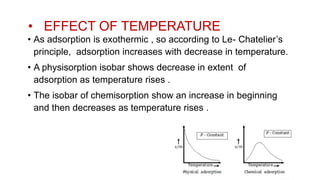
• A physisorption isobar shows decrease in extent of
adsorption as temperature rises .
• The isobar of chemisorption show an increase in beginning
and then decreases as temperature rises .
Reference
• Advance Physical Chemistry,22nd edition, Gurtu – Gurtu
• Keith J. Laidler, chemical Kinetics, Third edition, Pearson
Education, 2004
• Youtube

Adsorption

  • 1.
    Submitted By –NIDHI SANKET M.Sc Chemistry Semester II Department Of Chemistry S.P.C. Govt. College, Ajmer ADSORPTION
  • 2.
    CONTENTS • ADSORPTION • ADSORPTIONAND ABSORPTION • SOME BASIC TERMS WHICH ARE USED IN ADSORPTION • MECHANISM OF ADSORPTION • CHARACTERISTICS OF ADSORPTION • TYPES OF ADSORPTION -  PHYSISORPTION CHEMISORPTION • FACTORS AFFECTING ADSORPTION • APPLICATIONS OF ADSORPTION
  • 5.
    SOME BASIC TERMSWHICH ARE USED IN ADSORPTION ADSORBENT - Surface of a substance on which adsorbate adsorbs . For e.g., charcoal, silica gel etc ADSORBATE - Substance that is adsorbed . For e,g., N2 , O2 , H2
  • 6.
    SORPTION • A processin which both adsorption and absorption take place simultaneously , it is called sorption. E.g., when hydrogen is taken up by the charcoal , it first condenses on its surface . This is adsorption . After sometime , hydrogen diffuses slowly into the interior of the charcoal forming a true solid solution . This is absorption . So , the charcoal has absorbed as well as adsorbed hydrogen gas . OCCLUSION • The adsorption of a gas on the surface of a metal is called occlusion . According to Graham who introduced the term occlusion said that it has a significance similar to sorption . • E.g., Hydrogen is adsorbed on the surface of nickel or palladium .
  • 14.
    FACTORS AFFECTING ADSORPTION •Nature of adsorbent (solid) and adsorbate(gas) – In general,easily liqueliable gases e.g.,CO2 ,NH3 ,Cl2 and SO2 etc . are adsorbed to a greater extent than the permanent gases e.g.,H2,O2,N2 etc Porous and finely powdered solid e.g.,charcoal adsorb more as compared to hard non porous material . • Surface area of adsorbent - More the surface area ,greater is the extent of adsorption .
  • 15.
    • ACTIVATION OF(SOLID) ADSORBENT • Increasing adsorbing power of adsorbent - making surface rough / increasing surface area (powder) - removing already adsorbed gases .
  • 16.
    • EFFECT OFPRESSURE •An increase in the pressure of adsorbate gas increases the extent of adsorption . •At low temperature , the extent of adsorption increases rapidly with pressure . •Moderate Pressure , the extent of adsorption is found to be directly proportional to the pressure . •At higher pressure , after a certain pressure(closer to saturation pressure) there is no increase in adsorption .
  • 17.
    • EFFECT OFTEMPERATURE • As adsorption is exothermic , so according to Le- Chatelier’s principle, adsorption increases with decrease in temperature. • A physisorption isobar shows decrease in extent of adsorption as temperature rises . • The isobar of chemisorption show an increase in beginning and then decreases as temperature rises .
  • 18.
    Reference • Advance PhysicalChemistry,22nd edition, Gurtu – Gurtu • Keith J. Laidler, chemical Kinetics, Third edition, Pearson Education, 2004 • Youtube