Samrat Prithviraj Chauhan Government College
Ajmer
2021-2022
Department Of Chemistry
Photochemical Air Pollution
Submitted by Rohini Narwal
M.Sc. Chemistry Semester 3rd
TABLE OF CONTENTS
Introduction
Historical context
Formation of Photochemical smog
Chemistry of Photochemical Smog Formation
Major sources of Photochemical smog
Effect of Photochemical Air Pollution
Control of Photochemical Air Pollution
References
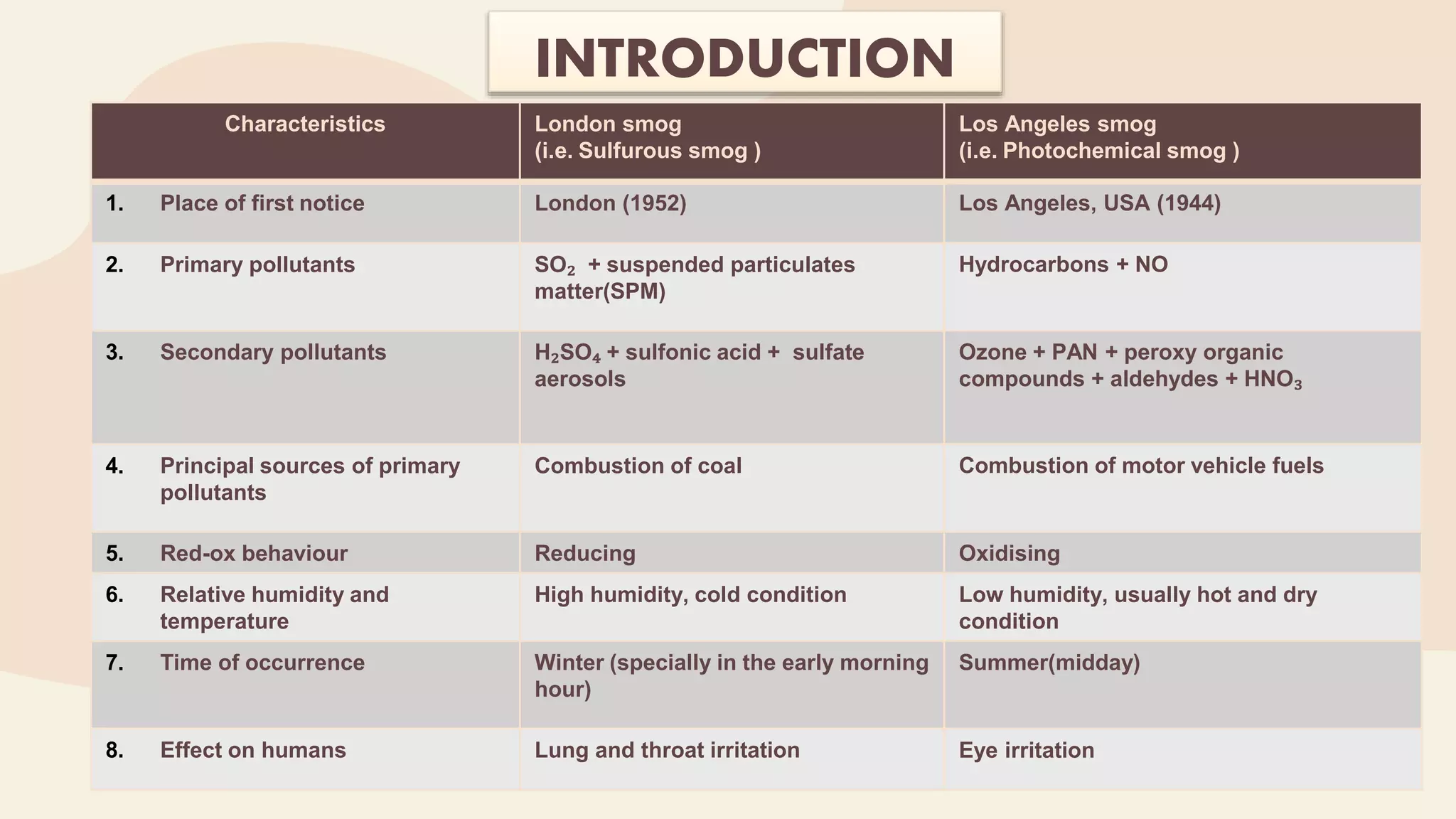
INTRODUCTION
Characteristics London smog
(i.e. Sulfurous smog )
1. Place of first notice London (1952)
2. Primary pollutants SO₂ + suspended particulates
matter(SPM)
3. Secondary pollutants H₂SO₄ + sulfonic acid + sulfate
aerosols
4. Principal sources of primary
pollutants
Combustion of coal
5. Red-ox behaviour Reducing
6. Relative humidity and
temperature
High humidity, cold condition
7. Time of occurrence Winter (specially in the early morning
hour)
8. Effect on humans Lung and throat irritation
Los Angeles smog
(i.e. Photochemical smog )
Los Angeles, USA (1944)
Hydrocarbons + NO
Ozone + PAN + peroxy organic
compounds + aldehydes + HNO₃
Combustion of motor vehicle fuels
Oxidising
Low humidity, usually hot and dry
condition
Summer(midday)
Eye irritation
 Photochemical smog was first detected through plant
damage in Los Angeles in 1944 and a chemist named Arie
Jan Haagen-Smit identified two major culprits responsible
for photochemical smog are:
1. VOCs (Volatile Organic Compounds)
2. Nitrogen Oxides (NOₓ)
He was the first to recognize that ozone was the primary
source of the haze. Ozone is created when partially
unburned exhaust from automobiles and the
hydrocarbons from oil refineries are hit by sunlight.
Haagen-Smit also demonstrated that the ozone was the
cause of the bleach smell L.A. residents were reporting, as
well as the source of their eye irritation and respiratory
problems.
HISTORICAL CONTEXT
https://www.cbsnews.com/pictures/top-10-smoggiest-cities-in-us/9/
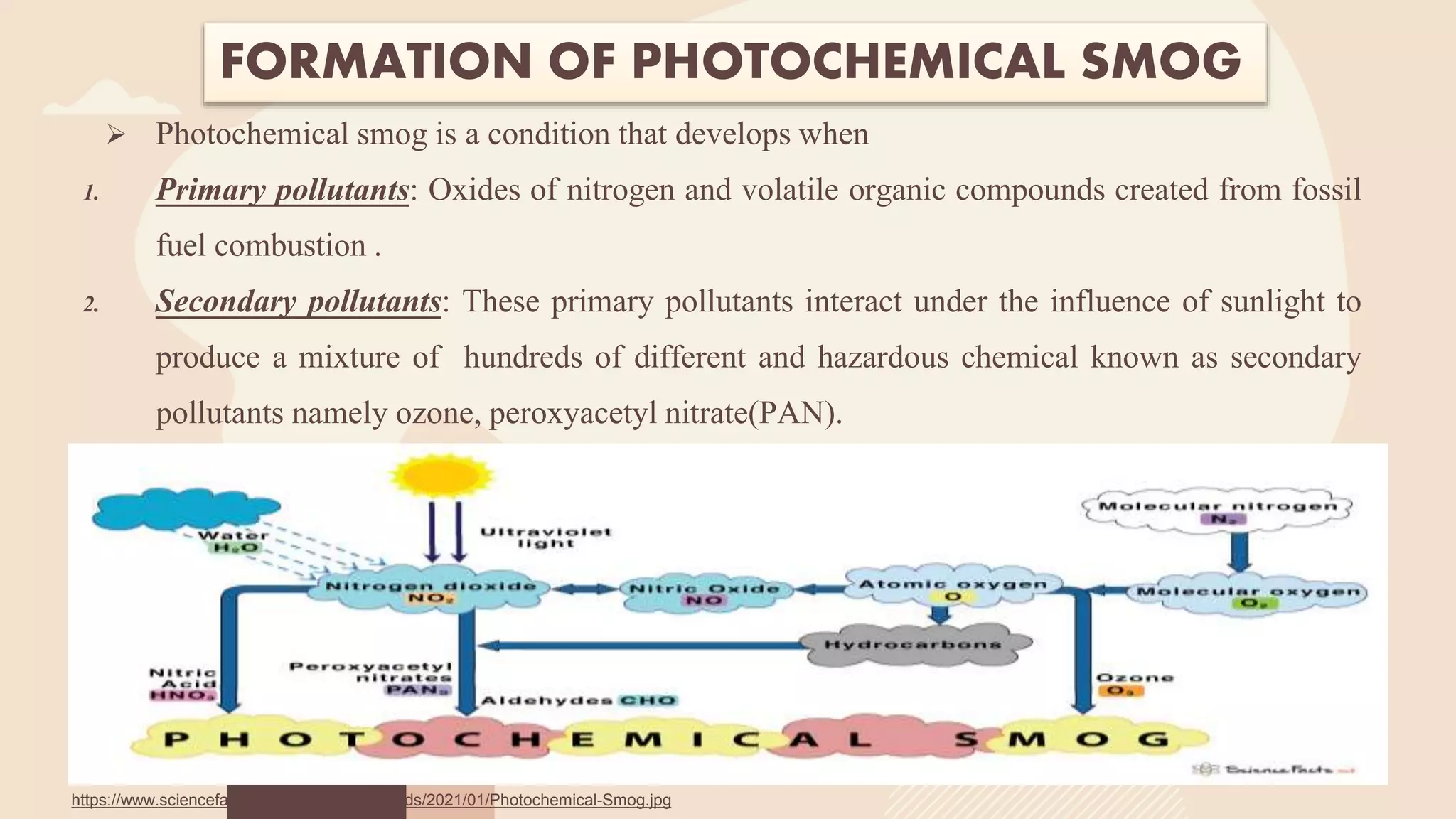
 Photochemical smog is a condition that develops when
1. Primary pollutants: Oxides of nitrogen and volatile organic compounds created from fossil
fuel combustion .
2. Secondary pollutants: These primary pollutants interact under the influence of sunlight to
produce a mixture of hundreds of different and hazardous chemical known as secondary
pollutants namely ozone, peroxyacetyl nitrate(PAN).
FORMATION OF PHOTOCHEMICAL SMOG
https://www.sciencefacts.net/wp-content/uploads/2021/01/Photochemical-Smog.jpg
CHEMISTRY OF PHOTOCHEMICAL SMOG FORMATION
 Photochemical smog cycles involving NO,NO₂, and O₃:
1. NO is produced in automobile engine and NO reacts with atmospheric oxygen to produce NO₂.
2. The produced NO₂ experiences photochemical dissociation to produce the reactive species NO
and atomic oxygen(O).
3. The rate of photo dissociation of NO is fairly high and this reaction triggers the production of O₃
in lower atmosphere.
4. Ozone formed can react with NO to regenerate NO₂ which can again participate in photo
dissociation.
N₂ + O₂ 2NO (engine cylinder)
2NO + O₂ 2NO₂
NO₂ + hv (<400nm) NO + O
O₂ + O O₃
O₃ + NO NO₂ + O₂(titration reaction)
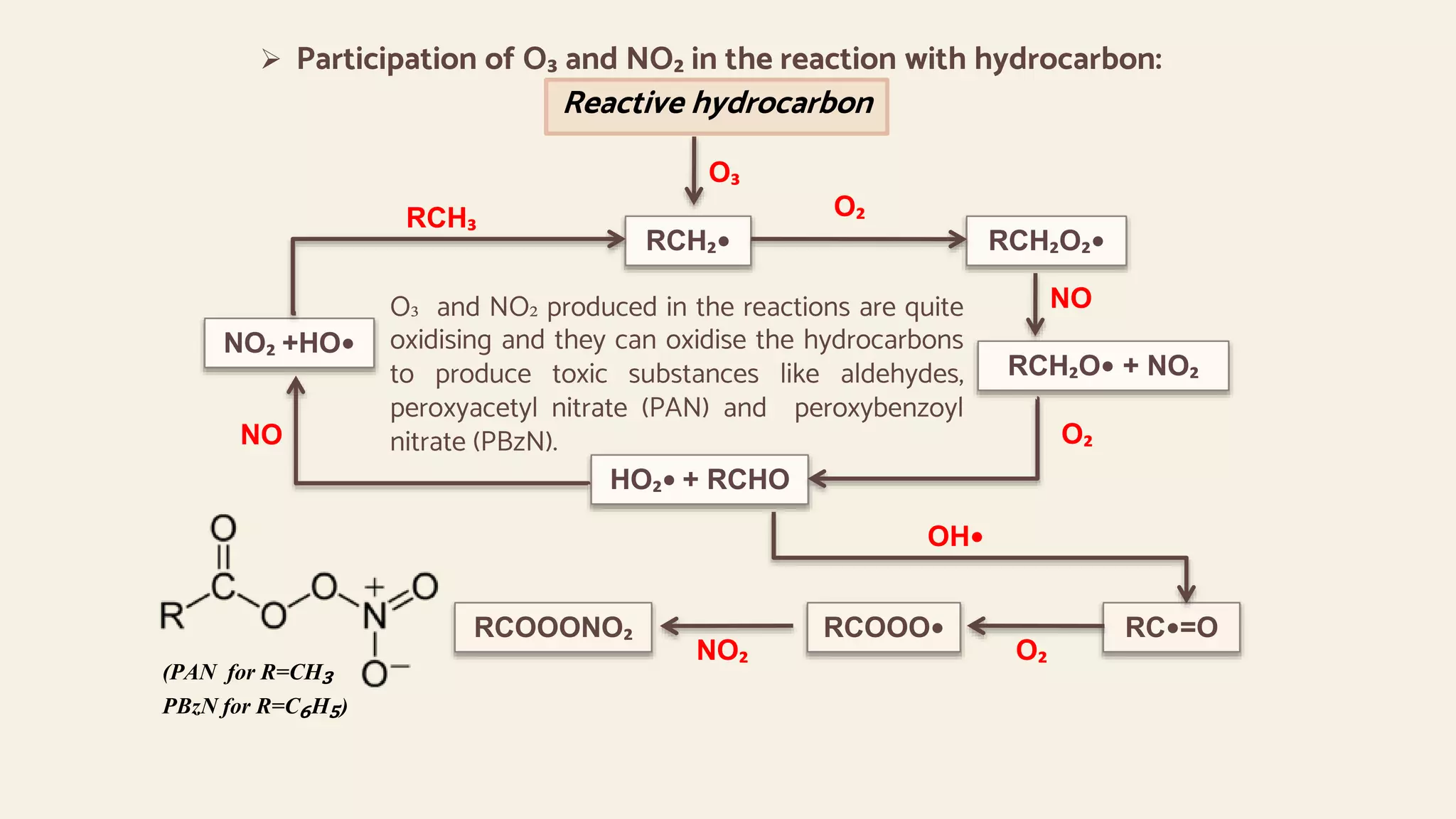
 Participation of O₃ and NO₂ in the reaction with hydrocarbon:
Reactive hydrocarbon
RCH₂• RCH₂O₂•
RCH₂O• + NO₂
HO₂• + RCHO
NO₂ +HO•
O₃
O₂
NO
O₂
NO
RCH₃
O₃ and NO₂ produced in the reactions are quite
oxidising and they can oxidise the hydrocarbons
to produce toxic substances like aldehydes,
peroxyacetyl nitrate (PAN) and peroxybenzoyl
nitrate (PBzN).
RC•=O
RCOOO•
OH•
O₂
NO₂
(PAN for R=CH₃
PBzN for R=C₆H₅)
RCOOONO₂
Given figure gives the relative concentration profile of NO,NO₂ and O₃ at different
times of a day:
http://perso.numericable.fr/vincent.hedberg/environment/environment.htm
a
b
c d
e
a. NO is a primary pollutant that is produced by automobiles during rush hour.
b. The NO is oxidised to NO₂ which makes the NO₂ levels up.
c. When the sun goes up the NO₂ is converted to O and NO so it goes downs. This is due to
the photochemical reaction.
d. The O is eventually to O₃ (ozone) which goes up.
e. VOCs are primary pollutants such as RH and RCH₃. They are converted to aldehydes
(RCHO) which in turn are converted to PAN. This is why these goes up when the VOC
goes down.
MAJOR SOURCES OF PHOTOCHEMICAL SMOG
Anthropogenic sources
Nitrogen oxides: They are produced
mainly from the combustion of fossil fuels,
particularly in power stations and motor
vehicles
Volatile Organic Compounds: VOCs are
formed from the incomplete combustion of
fossil fuels, from the evaporation of
solvents and fuels, and from burning plant
matter—such as backyard burning and
wood-burning stoves.
https://wellwo.es/en/the-consequences-of-air-pollution/
https://www.umweltbundesamt.de/en/press/pressinformation/real-nitrogen-oxide-emissions-of-diesel-passenger
Biogenic sources
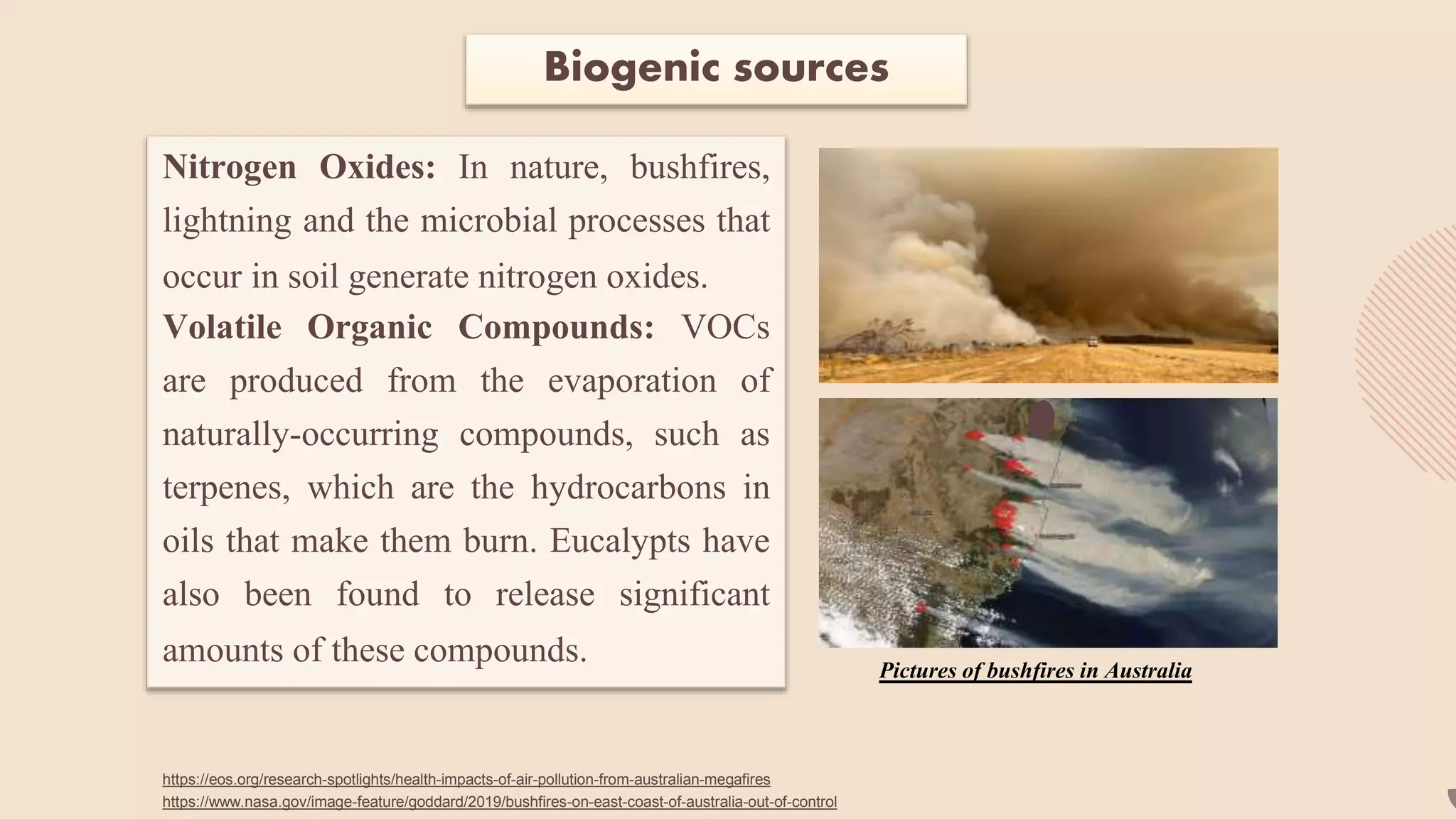
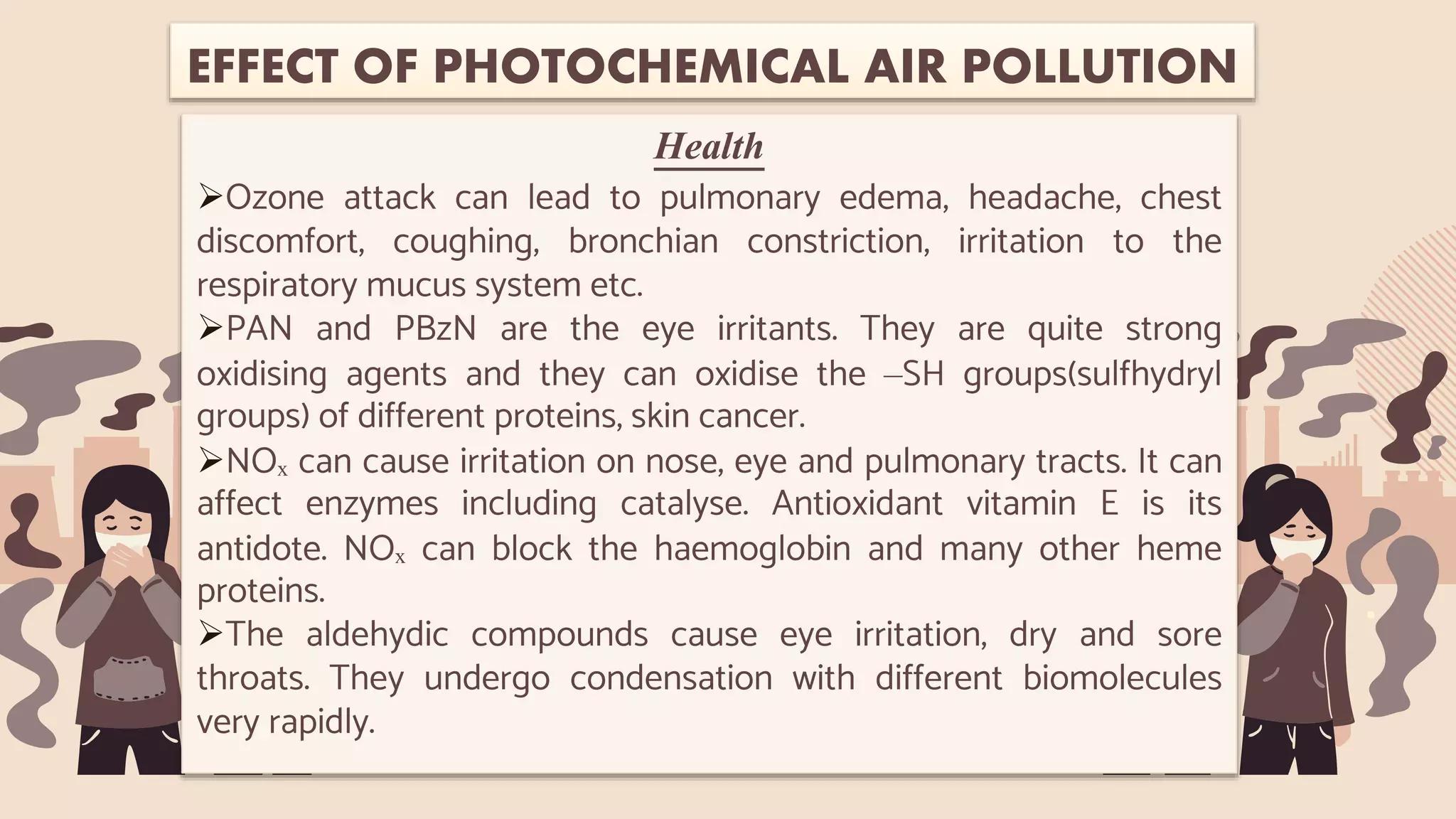
Nitrogen Oxides: In nature, bushfires,
lightning and the microbial processes that
occur in soil generate nitrogen oxides.
Volatile Organic Compounds: VOCs
are produced from the evaporation of
naturally-occurring compounds, such as
terpenes, which are the hydrocarbons in
oils that make them burn. Eucalypts have
also been found to release significant
amounts of these compounds. Pictures of bushfires in Australia
https://eos.org/research-spotlights/health-impacts-of-air-pollution-from-australian-megafires
https://www.nasa.gov/image-feature/goddard/2019/bushfires-on-east-coast-of-australia-out-of-control
EFFECT OF PHOTOCHEMICAL AIR POLLUTION
Health
Ozone attack can lead to pulmonary edema, headache, chest
discomfort, coughing, bronchian constriction, irritation to the
respiratory mucus system etc.
PAN and PBzN are the eye irritants. They are quite strong
oxidising agents and they can oxidise the –SH groups(sulfhydryl
groups) of different proteins, skin cancer.
NOₓ can cause irritation on nose, eye and pulmonary tracts. It can
affect enzymes including catalyse. Antioxidant vitamin E is its
antidote. NOₓ can block the haemoglobin and many other heme
proteins.
The aldehydic compounds cause eye irritation, dry and sore
throats. They undergo condensation with different biomolecules
very rapidly.
Plants
Ozone promotes excessive transpiration from the leaves of plants and
consequently, the plants experience dehydration. Ozone can also cause bronzing,
chlorosis and coloured flecks on the leaves. Overall the plants growth is retarded
severely in presence of O₃.
PAN can damage the plants by attacking the younger leaves causing bronzing and
glazing of their surfaces. PAN can probably prevent Hill reaction of photosynthesis.
The –SH groups of plants proteins are also attacked by PAN by its oxidising activity
and acetylating activity.
NOₓ is toxic to plant at higher concentration. It can cause chlorosis and bleaching in
leaves. It can induce leaf-drop.
https://www.ars.usda.gov/southeast-area/raleigh-nc/plant-science-research/docs/climate-changeair-quality-laboratory/ozone-effects-on-plants/
Materials
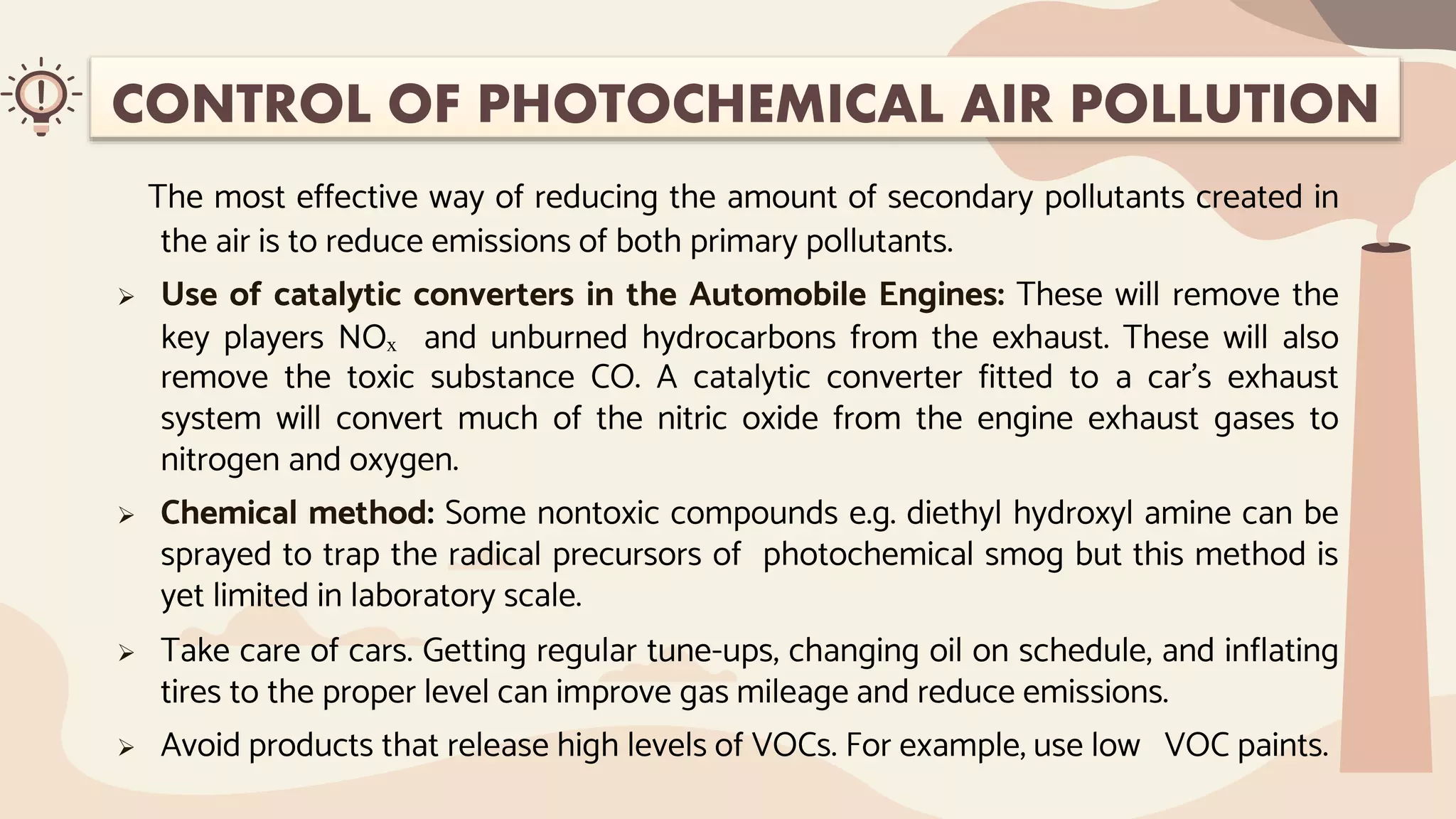
Ozone can damage several organic materials including textiles, fibres, dyes,
paints, polymers, etc. Ozone attack on natural rubber or synthetic polymers can
reduce their mechanical strength. Ozone can attack the carbon-carbon double
bond and ultimately the carbon-carbon bond experiences the oxidative
cleavage. It causes the cracking of rubber and damages the polymers and
makes rubber brittle.
Carbon-carbon double bond attacked by ozone
CONTROL OF PHOTOCHEMICAL AIR POLLUTION
The most effective way of reducing the amount of secondary pollutants created in
the air is to reduce emissions of both primary pollutants.
 Use of catalytic converters in the Automobile Engines: These will remove the
key players NOₓ and unburned hydrocarbons from the exhaust. These will also
remove the toxic substance CO. A catalytic converter fitted to a car’s exhaust
system will convert much of the nitric oxide from the engine exhaust gases to
nitrogen and oxygen.
 Chemical method: Some nontoxic compounds e.g. diethyl hydroxyl amine can be
sprayed to trap the radical precursors of photochemical smog but this method is
yet limited in laboratory scale.
 Take care of cars. Getting regular tune-ups, changing oil on schedule, and inflating
tires to the proper level can improve gas mileage and reduce emissions.
 Avoid products that release high levels of VOCs. For example, use low VOC paints.
 Chemistry of Atmosphere
Book By P.S. Sindhu
 Environmental Chemistry with Green Chemistry
Book By Asim K.Das
 Colbeck, I & Mackenzie, AR 1994, Air pollution by
photochemical oxidants, Air Quality Monographs Vol 1, Elsevier,
Netherlands.
 White, V 1998, Air emissions inventory for the Adelaide airshed
1995, Environment Protection Agency, South Australia.
REFERENCES
For Your Time and Attention
Thank You

Photochemical Air Pollution

  • 1.
    Samrat Prithviraj ChauhanGovernment College Ajmer 2021-2022 Department Of Chemistry Photochemical Air Pollution Submitted by Rohini Narwal M.Sc. Chemistry Semester 3rd
  • 2.
    TABLE OF CONTENTS Introduction Historicalcontext Formation of Photochemical smog Chemistry of Photochemical Smog Formation Major sources of Photochemical smog Effect of Photochemical Air Pollution Control of Photochemical Air Pollution References
  • 3.
    INTRODUCTION Characteristics London smog (i.e.Sulfurous smog ) 1. Place of first notice London (1952) 2. Primary pollutants SO₂ + suspended particulates matter(SPM) 3. Secondary pollutants H₂SO₄ + sulfonic acid + sulfate aerosols 4. Principal sources of primary pollutants Combustion of coal 5. Red-ox behaviour Reducing 6. Relative humidity and temperature High humidity, cold condition 7. Time of occurrence Winter (specially in the early morning hour) 8. Effect on humans Lung and throat irritation Los Angeles smog (i.e. Photochemical smog ) Los Angeles, USA (1944) Hydrocarbons + NO Ozone + PAN + peroxy organic compounds + aldehydes + HNO₃ Combustion of motor vehicle fuels Oxidising Low humidity, usually hot and dry condition Summer(midday) Eye irritation
  • 4.
     Photochemical smogwas first detected through plant damage in Los Angeles in 1944 and a chemist named Arie Jan Haagen-Smit identified two major culprits responsible for photochemical smog are: 1. VOCs (Volatile Organic Compounds) 2. Nitrogen Oxides (NOₓ) He was the first to recognize that ozone was the primary source of the haze. Ozone is created when partially unburned exhaust from automobiles and the hydrocarbons from oil refineries are hit by sunlight. Haagen-Smit also demonstrated that the ozone was the cause of the bleach smell L.A. residents were reporting, as well as the source of their eye irritation and respiratory problems. HISTORICAL CONTEXT https://www.cbsnews.com/pictures/top-10-smoggiest-cities-in-us/9/
  • 5.
     Photochemical smogis a condition that develops when 1. Primary pollutants: Oxides of nitrogen and volatile organic compounds created from fossil fuel combustion . 2. Secondary pollutants: These primary pollutants interact under the influence of sunlight to produce a mixture of hundreds of different and hazardous chemical known as secondary pollutants namely ozone, peroxyacetyl nitrate(PAN). FORMATION OF PHOTOCHEMICAL SMOG https://www.sciencefacts.net/wp-content/uploads/2021/01/Photochemical-Smog.jpg
  • 6.
    CHEMISTRY OF PHOTOCHEMICALSMOG FORMATION  Photochemical smog cycles involving NO,NO₂, and O₃: 1. NO is produced in automobile engine and NO reacts with atmospheric oxygen to produce NO₂. 2. The produced NO₂ experiences photochemical dissociation to produce the reactive species NO and atomic oxygen(O). 3. The rate of photo dissociation of NO is fairly high and this reaction triggers the production of O₃ in lower atmosphere. 4. Ozone formed can react with NO to regenerate NO₂ which can again participate in photo dissociation. N₂ + O₂ 2NO (engine cylinder) 2NO + O₂ 2NO₂ NO₂ + hv (<400nm) NO + O O₂ + O O₃ O₃ + NO NO₂ + O₂(titration reaction)
  • 7.
     Participation ofO₃ and NO₂ in the reaction with hydrocarbon: Reactive hydrocarbon RCH₂• RCH₂O₂• RCH₂O• + NO₂ HO₂• + RCHO NO₂ +HO• O₃ O₂ NO O₂ NO RCH₃ O₃ and NO₂ produced in the reactions are quite oxidising and they can oxidise the hydrocarbons to produce toxic substances like aldehydes, peroxyacetyl nitrate (PAN) and peroxybenzoyl nitrate (PBzN). RC•=O RCOOO• OH• O₂ NO₂ (PAN for R=CH₃ PBzN for R=C₆H₅) RCOOONO₂
  • 8.
    Given figure givesthe relative concentration profile of NO,NO₂ and O₃ at different times of a day: http://perso.numericable.fr/vincent.hedberg/environment/environment.htm a b c d e a. NO is a primary pollutant that is produced by automobiles during rush hour. b. The NO is oxidised to NO₂ which makes the NO₂ levels up. c. When the sun goes up the NO₂ is converted to O and NO so it goes downs. This is due to the photochemical reaction. d. The O is eventually to O₃ (ozone) which goes up. e. VOCs are primary pollutants such as RH and RCH₃. They are converted to aldehydes (RCHO) which in turn are converted to PAN. This is why these goes up when the VOC goes down.
  • 9.
    MAJOR SOURCES OFPHOTOCHEMICAL SMOG Anthropogenic sources Nitrogen oxides: They are produced mainly from the combustion of fossil fuels, particularly in power stations and motor vehicles Volatile Organic Compounds: VOCs are formed from the incomplete combustion of fossil fuels, from the evaporation of solvents and fuels, and from burning plant matter—such as backyard burning and wood-burning stoves. https://wellwo.es/en/the-consequences-of-air-pollution/ https://www.umweltbundesamt.de/en/press/pressinformation/real-nitrogen-oxide-emissions-of-diesel-passenger
  • 10.
    Biogenic sources Nitrogen Oxides:In nature, bushfires, lightning and the microbial processes that occur in soil generate nitrogen oxides. Volatile Organic Compounds: VOCs are produced from the evaporation of naturally-occurring compounds, such as terpenes, which are the hydrocarbons in oils that make them burn. Eucalypts have also been found to release significant amounts of these compounds. Pictures of bushfires in Australia https://eos.org/research-spotlights/health-impacts-of-air-pollution-from-australian-megafires https://www.nasa.gov/image-feature/goddard/2019/bushfires-on-east-coast-of-australia-out-of-control
  • 11.
    EFFECT OF PHOTOCHEMICALAIR POLLUTION Health Ozone attack can lead to pulmonary edema, headache, chest discomfort, coughing, bronchian constriction, irritation to the respiratory mucus system etc. PAN and PBzN are the eye irritants. They are quite strong oxidising agents and they can oxidise the –SH groups(sulfhydryl groups) of different proteins, skin cancer. NOₓ can cause irritation on nose, eye and pulmonary tracts. It can affect enzymes including catalyse. Antioxidant vitamin E is its antidote. NOₓ can block the haemoglobin and many other heme proteins. The aldehydic compounds cause eye irritation, dry and sore throats. They undergo condensation with different biomolecules very rapidly.
  • 12.
    Plants Ozone promotes excessivetranspiration from the leaves of plants and consequently, the plants experience dehydration. Ozone can also cause bronzing, chlorosis and coloured flecks on the leaves. Overall the plants growth is retarded severely in presence of O₃. PAN can damage the plants by attacking the younger leaves causing bronzing and glazing of their surfaces. PAN can probably prevent Hill reaction of photosynthesis. The –SH groups of plants proteins are also attacked by PAN by its oxidising activity and acetylating activity. NOₓ is toxic to plant at higher concentration. It can cause chlorosis and bleaching in leaves. It can induce leaf-drop. https://www.ars.usda.gov/southeast-area/raleigh-nc/plant-science-research/docs/climate-changeair-quality-laboratory/ozone-effects-on-plants/
  • 13.
    Materials Ozone can damageseveral organic materials including textiles, fibres, dyes, paints, polymers, etc. Ozone attack on natural rubber or synthetic polymers can reduce their mechanical strength. Ozone can attack the carbon-carbon double bond and ultimately the carbon-carbon bond experiences the oxidative cleavage. It causes the cracking of rubber and damages the polymers and makes rubber brittle. Carbon-carbon double bond attacked by ozone
  • 14.
    CONTROL OF PHOTOCHEMICALAIR POLLUTION The most effective way of reducing the amount of secondary pollutants created in the air is to reduce emissions of both primary pollutants.  Use of catalytic converters in the Automobile Engines: These will remove the key players NOₓ and unburned hydrocarbons from the exhaust. These will also remove the toxic substance CO. A catalytic converter fitted to a car’s exhaust system will convert much of the nitric oxide from the engine exhaust gases to nitrogen and oxygen.  Chemical method: Some nontoxic compounds e.g. diethyl hydroxyl amine can be sprayed to trap the radical precursors of photochemical smog but this method is yet limited in laboratory scale.  Take care of cars. Getting regular tune-ups, changing oil on schedule, and inflating tires to the proper level can improve gas mileage and reduce emissions.  Avoid products that release high levels of VOCs. For example, use low VOC paints.
  • 15.
     Chemistry ofAtmosphere Book By P.S. Sindhu  Environmental Chemistry with Green Chemistry Book By Asim K.Das  Colbeck, I & Mackenzie, AR 1994, Air pollution by photochemical oxidants, Air Quality Monographs Vol 1, Elsevier, Netherlands.  White, V 1998, Air emissions inventory for the Adelaide airshed 1995, Environment Protection Agency, South Australia. REFERENCES
  • 16.
    For Your Timeand Attention Thank You