By:
Dr. Farhat Saghir
Self reliance for better tomorrow
Organic reactions
 These are chemical reactions involving organic
compounds, in which carbon is linked with other atoms
through covalent bonds and found in cells (usually
hydrocarbons)
 Organic reaction types include:
 Addition reactions
 Elimination reactions
 Substitution reactions
 Pericyclic reactions
 Rearrangement reactions
 Photochemical reactions
 Redox reactions
 Organic reactions require the breaking of
strong covalent bonds, which takes a
considerable input of energy
 For relatively stable organic molecules to
react at a reasonable rate, they often need to
be modified with the use of highly reactive
materials or should be carried out in the
presence of catalyst
 A reaction shows reactants and products
Mechanism in organic chemistry
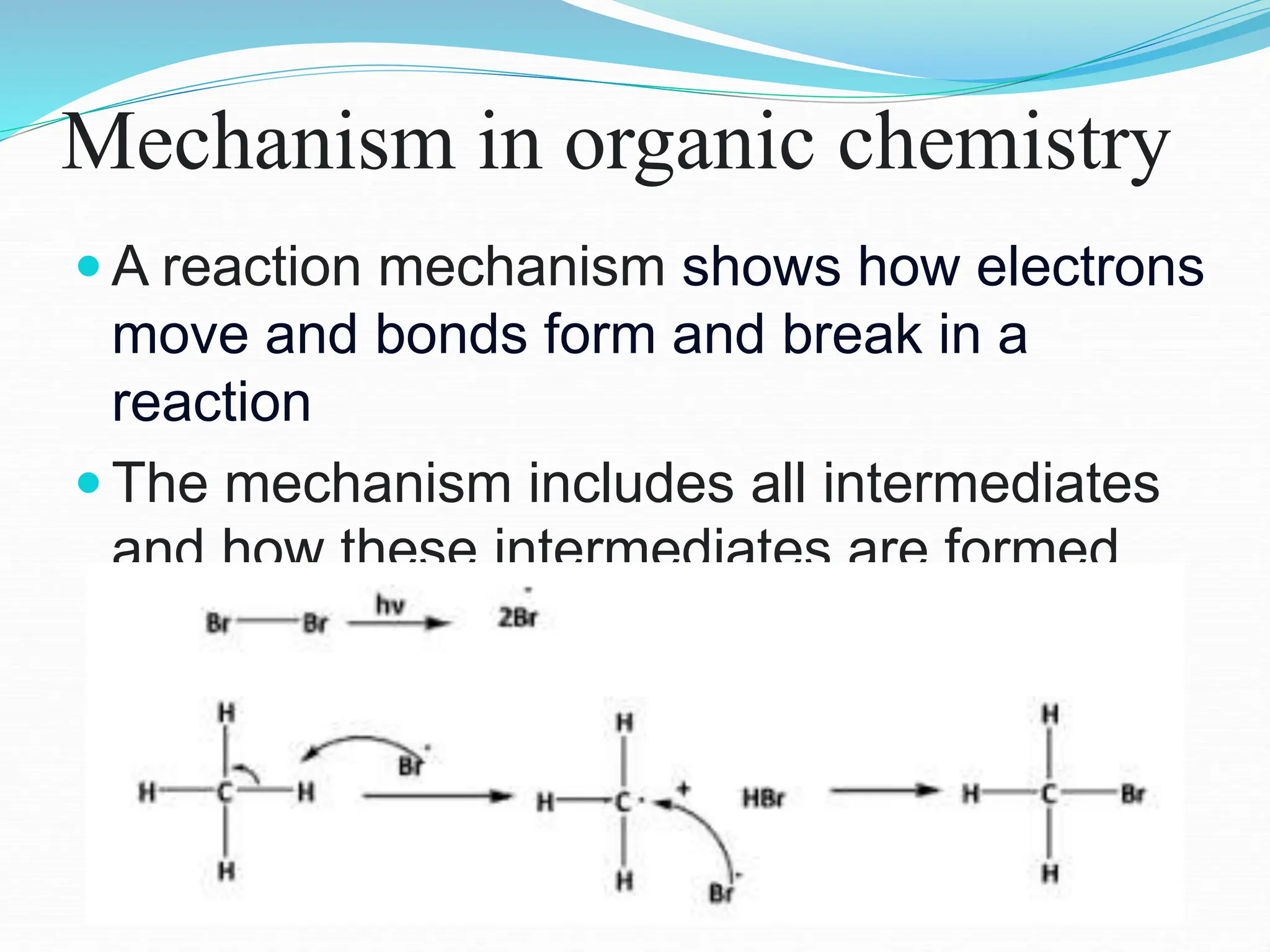
 A reaction mechanism shows how electrons
move and bonds form and break in a
reaction
 The mechanism includes all intermediates
and how these intermediates are formed
Reaction intermediate
 A reaction intermediate is a transient entity
within a multi-step reaction mechanism. It is
produced in the preceding step and consumed
in a subsequent step to ultimately generate the
final reaction product
 It may be an atom, a molecule, or an ion
Reaction intermediate has:
high-energy
High-reactivity
Short-life
It usually gets generated during a chemical
reaction which gets stabilized into a stable
molecule
 Most chemical reactions take more than one elementary
step to complete, and a reactive intermediate exists only
in one of the intermediate steps
 Usually, cannot be isolated but sometimes observable
only through fast spectroscopic methods
 Only in exceptional cases, these can be isolated and
stored
 Their existence helps to explain how a chemical
reaction takes place
 The series of steps together make a reaction mechanism
 It is stable in the sense that an elementary
reaction forms the reactive intermediate and the
elementary reaction in the next step is needed to
destroy it
 When a reactive intermediate is not observable,
its existence can be inferred through
experimentation
 This usually involves changing reaction
conditions such as temperature or concentration
and applying the techniques of chemical kinetics,
chemical thermodynamics, or spectroscopy
2-Diphenyl-1-picrylhydrazyl
Reaction
intermediates
Radicals
Carbonium
ions Carbanions
Carbene
Nitrene
Benzynes
Common Features
• Low concentration with respect to reactants and products
• Often generated on the chemical decomposition of a
chemical compound
• Often possible to prove their existence by spectroscopic
means or chemical trapping
• Cage effects - the cage effect illustrates how molecular
properties are affected by their surroundings- have to be
taken into account
• Often stabilized by conjugation or resonance
• Often difficult to distinguish from a transition state (along the
reaction coordinate, reactive intermediates are present not much lower in
energy from a transition state making it difficult to distinguish)
Covalent bond
 Equal sharing of electrons between the bonded atoms
 Energy is released when a covalent bond is formed-
exothermic process
 Energy is needed to break a covalent bond-
endothermic process
Fission
 Breakdown of a covalent bond, which is of 2
types;
 Homolytic fission
 Heterolytic fission
Homolytic Fission
 This is the bond fission in which each of the atoms or
fragments. It occurs when the electronegativity
difference between the bonded atoms is zero or nearly
zero. For example in Cl–Cl and RO–X. acquires one of
the bonding electrons. The fragments produced as a
result of homolytic fission carry unpaired electrons
and are electrically neutral. They are called as Free
Radicals. Free radicals are extremely reactive because
of the tendency of unpaired electrons to become
paired.
Self reliance for better tomorrow
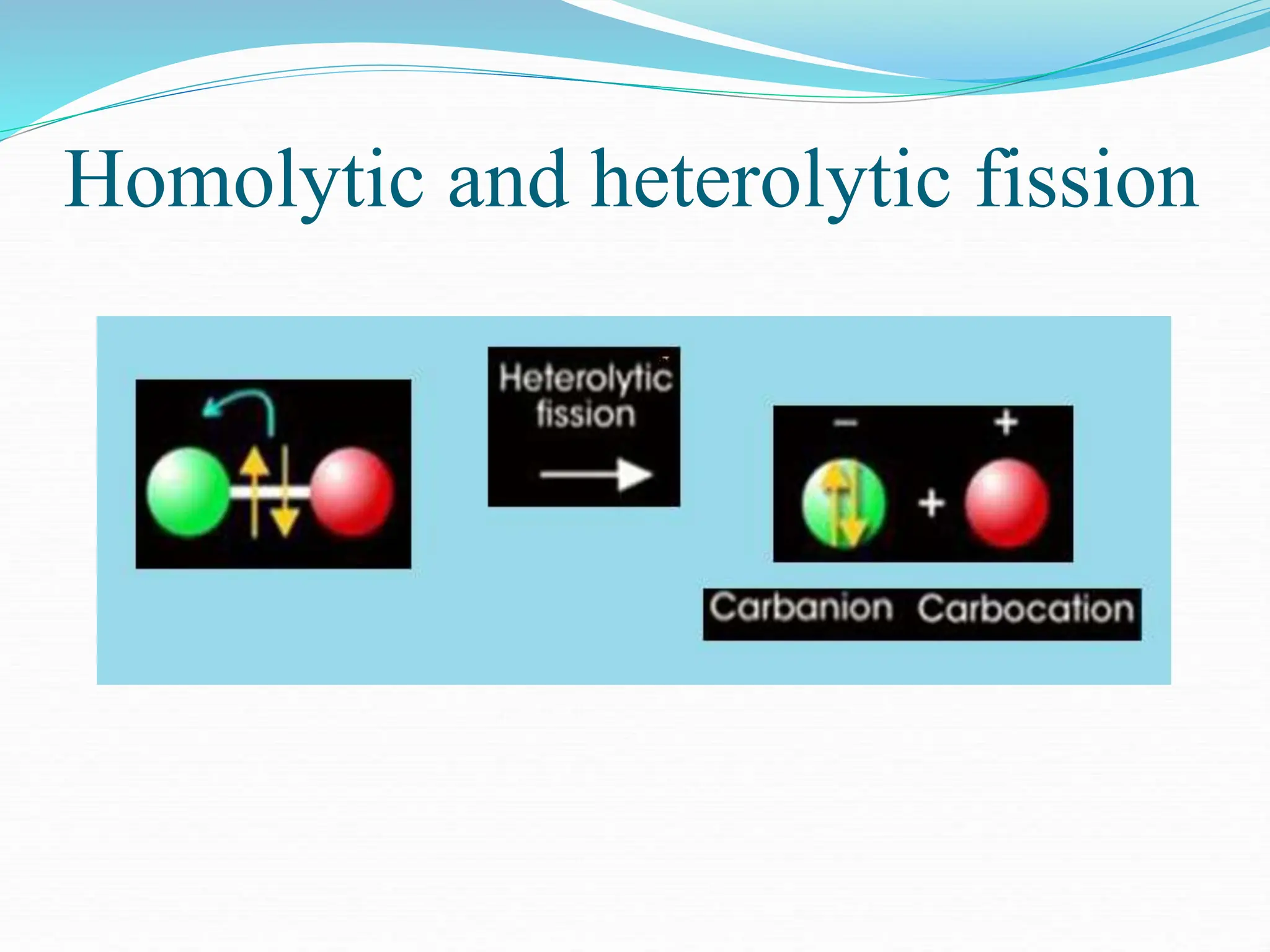
Heterolytic fission
 This is the bond fission in which one of the atoms or
fragments acquires both of the bonding electrons.
Self reliance for better tomorrow
Heterolytic fission reactions take place at measurable
rates (Non-spontaneous Reactions). Heterolytic fission
occurs most readily with polar compounds in polar
solvents. These reactions usually occur in solution phase.
 Heterolytic fission is favored when the
electronegativity difference between two bonded
atoms is significant. The more electronegative atom
acquires both of the bonding electrons and becomes
negatively charged. The less electronegative atom loses
both of the bonding electrons and becomes positively
charged. For example in H–Cl, R–X. The fragments
produced as a result of heterolytic fission are called as
‘ions’. The positively charged ions are called cations
and the negatively charged ions are called anions.
Self reliance for better tomorrow
Homolytic and heterolytic fission
 Fission is the breakdown of a covalent bond
 It occurs in 2-ways resulting in 3 possibilities:
H Cl H Cl
+
0 electrons 8 electrons in outer shell
water
H2O
H3O Cl
ONLY POSSIBLE IN SOLUTION
Conclusion
1. Free radical or radical
 Is an atom, molecule, or ion possessing an
unpaired electron in the outermost shell
 Radicals are highly reactive, always in search
of gaining an electron to become stable by
completing the outermost shell
Examples
2. Carbonium ion
 A positively charged carbon atom, electron-deficient, is
called a carbonium ion (Carbenium ion)
Structure of carbonium ion
Preparation
 Carbocation may be formed by several ways:
 By the heterolysis of the C–X bond in alkyl
halide:
 Carbocations are formed by heterolytic
cleavage of covalent bonds in which the
leaving group takes away the shared pair of
electrons of a covalent bond with it
Kinds of carbocations
 Primary carbocations
 In a primary (1°) carbocation, the carbon that carries the
positive charge is only attached to one other alkyl group
Secondary carbocations
 In a secondary (2°) carbocation, the carbon with the
positive charge is attached to two other alkyl groups,
which may be the same or different
 Examples:
Tertiary carbocation
 In a tertiary (3°) carbocation, the positive carbon atom is
attached to three alkyl groups, which may be any
combination of the same or different
Carbocation stability: Electron pushing effect
of alkyl groups
Electron pushing effect of alkyl groups
 Bromine is more electronegative than hydrogen
so that in a H-Br bond the electrons are held
closer to the bromine than the hydrogen
 A bromine atom attached to a carbon atom
would have precisely the same effect - the
electrons being pulled towards the bromine end
of the bond
 The bromine has a negative inductive effect
 Alkyl groups do precisely the opposite and, rather than
drawing electrons towards themselves, tend to "push"
electrons away
 This means that the alkyl group becomes slightly positive
(+) and the carbon they are attached to becomes slightly
negative (-)
 The alkyl group has a positive inductive effect
 This is sometimes shown as:
 The arrow shows the electrons being "pushed" away
from the CH3 group. The plus sign on the left-hand
end of it shows that the CH3 group is becoming
positive
 The spreading charge around makes ions stable
 The general rule of thumb is that if a charge is very
localized (all concentrated on one atom) the ion is much
less stable than if the charge is spread out over several
atoms
Applying that to carbocations of
various sorts
 The electron-pushing effect of the CH3 group is placing
more and more negative charges on the positive carbon
as we go from primary to secondary to tertiary
carbocations. The effect of this, of course, is to cut down
that positive charge
 At the same time, the region around the various CH3
groups is becoming somewhat positive. The net effect,
then, is that the positive charge is being spread out over
more and more atoms as you go from primary to
secondary to tertiary ions
 The more spread the charge around, the more stable the
ion becomes
Order of stability of carbocations
primary < secondary < tertiary
The stability of the carbocations in terms
of energetics
 When we talk about secondary carbocations being more
stable than primary ones, what exactly do we mean? We
are actually talking about energetic stability - secondary
carbocations are lower down an energy "ladder" than
primary ones
 This means that it is going to take more energy to make
a primary carbocation than a secondary one
 If there is a choice between making a secondary ion or a
primary one, it will be much easier to make the
secondary one
 Similarly, if there is a
choice between making a
tertiary ion or a secondary
one, it will be easier to
make the tertiary one
3.Carbanion
 A carbon atom having a negative charge, electron-rich, is
called a carbanion
Structure of carbanion
When the negatively charged carbon atom in a
carbanion is bonded to hydrogen or alkyl groups (e.g.,
methyl or ethyl groups etc.), it is sp3 -hybridized and
forms three σ-bonds. The unshared electron pair
resides in the fourth sp3 -hybridized orbital.
 When the negatively charged carbon atom in a
carbanion is bonded to an unsaturated group (e.g.,
in benzyl carbanion), it is sp2 -hybridized and
forms three σ-bonds. The unshared electron pair
resides in the unhybridized p-orbital. The
completely filled non-bonding sp3 or p-orbital
makes the carbon atom electron-rich and gives it a
formal negative charge. A carbanion will combine
with an electrophile in a reaction to donate its
electron pair thus making it a nucleophile.
Self reliance for better tomorrow
Stability of carbanion
In terms of inductive effect
Steric hinderance
Resonance
Hybridization
Inductive Effect
 The inductive effect, via which highly electronegative
substituent groups attached to the carbanion help subdue
the negative charge on it and make the molecule more
stable
 On the other hand, highly electropositive substituent
groups can increase the negative charge on the carbanion
and, therefore, decrease the overall stability of the
molecule
 The +I groups decrease the stability of carbanions while
the -I groups increase their stability
 For example, the alkyl groups (+I) donate electron density
to the negatively charged carbon resulting in the
destabilization of carbanion
 Thus the order of stability is as:
Size (Steric hindrance)
 The stability of a carbanion is also inversely
proportional to the size of the atom attached to
the carbanion
 In other words, the smaller the atom, the more
stable the carbanion
 The stability of a carbanion is directly
proportional to the number of resonance
structures that can be drawn for the carbanion
 The more resonance structures that can be
drawn, the more stable the carbanion
Resonance
 The resonance effect, via which the
delocalization of the electrons distributes the
negative charge all over the carbanion, adds
stability to the process
 Aromatic systems add a great deal of stability
to carbanions when they are present as a
substituent group as a result of the resonance
effect (and the greater extent of delocalization
of electrons over the aromatic system)
Hybridization of the Charge-bearing Atom
 The stability of a carbanion is directly proportional to
the s-character of the orbitals involved in the bond
between the carbon and the atom bearing the negative
charge. In other words, the more s-character in the
orbitals, the more stable the carbanion

organic chemistry leacture 01 uol.pptx

  • 1.
    By: Dr. Farhat Saghir Selfreliance for better tomorrow
  • 2.
    Organic reactions  Theseare chemical reactions involving organic compounds, in which carbon is linked with other atoms through covalent bonds and found in cells (usually hydrocarbons)  Organic reaction types include:  Addition reactions  Elimination reactions  Substitution reactions  Pericyclic reactions  Rearrangement reactions  Photochemical reactions  Redox reactions
  • 3.
     Organic reactionsrequire the breaking of strong covalent bonds, which takes a considerable input of energy  For relatively stable organic molecules to react at a reasonable rate, they often need to be modified with the use of highly reactive materials or should be carried out in the presence of catalyst  A reaction shows reactants and products
  • 4.
    Mechanism in organicchemistry  A reaction mechanism shows how electrons move and bonds form and break in a reaction  The mechanism includes all intermediates and how these intermediates are formed
  • 5.
    Reaction intermediate  Areaction intermediate is a transient entity within a multi-step reaction mechanism. It is produced in the preceding step and consumed in a subsequent step to ultimately generate the final reaction product  It may be an atom, a molecule, or an ion
  • 6.
    Reaction intermediate has: high-energy High-reactivity Short-life Itusually gets generated during a chemical reaction which gets stabilized into a stable molecule
  • 7.
     Most chemicalreactions take more than one elementary step to complete, and a reactive intermediate exists only in one of the intermediate steps  Usually, cannot be isolated but sometimes observable only through fast spectroscopic methods  Only in exceptional cases, these can be isolated and stored  Their existence helps to explain how a chemical reaction takes place  The series of steps together make a reaction mechanism
  • 8.
     It isstable in the sense that an elementary reaction forms the reactive intermediate and the elementary reaction in the next step is needed to destroy it  When a reactive intermediate is not observable, its existence can be inferred through experimentation  This usually involves changing reaction conditions such as temperature or concentration and applying the techniques of chemical kinetics, chemical thermodynamics, or spectroscopy
  • 9.
  • 10.
  • 11.
    Common Features • Lowconcentration with respect to reactants and products • Often generated on the chemical decomposition of a chemical compound • Often possible to prove their existence by spectroscopic means or chemical trapping • Cage effects - the cage effect illustrates how molecular properties are affected by their surroundings- have to be taken into account • Often stabilized by conjugation or resonance • Often difficult to distinguish from a transition state (along the reaction coordinate, reactive intermediates are present not much lower in energy from a transition state making it difficult to distinguish)
  • 12.
    Covalent bond  Equalsharing of electrons between the bonded atoms  Energy is released when a covalent bond is formed- exothermic process
  • 13.
     Energy isneeded to break a covalent bond- endothermic process
  • 14.
    Fission  Breakdown ofa covalent bond, which is of 2 types;  Homolytic fission  Heterolytic fission
  • 15.
    Homolytic Fission  Thisis the bond fission in which each of the atoms or fragments. It occurs when the electronegativity difference between the bonded atoms is zero or nearly zero. For example in Cl–Cl and RO–X. acquires one of the bonding electrons. The fragments produced as a result of homolytic fission carry unpaired electrons and are electrically neutral. They are called as Free Radicals. Free radicals are extremely reactive because of the tendency of unpaired electrons to become paired. Self reliance for better tomorrow
  • 16.
    Heterolytic fission  Thisis the bond fission in which one of the atoms or fragments acquires both of the bonding electrons. Self reliance for better tomorrow Heterolytic fission reactions take place at measurable rates (Non-spontaneous Reactions). Heterolytic fission occurs most readily with polar compounds in polar solvents. These reactions usually occur in solution phase.
  • 17.
     Heterolytic fissionis favored when the electronegativity difference between two bonded atoms is significant. The more electronegative atom acquires both of the bonding electrons and becomes negatively charged. The less electronegative atom loses both of the bonding electrons and becomes positively charged. For example in H–Cl, R–X. The fragments produced as a result of heterolytic fission are called as ‘ions’. The positively charged ions are called cations and the negatively charged ions are called anions. Self reliance for better tomorrow
  • 18.
  • 19.
     Fission isthe breakdown of a covalent bond  It occurs in 2-ways resulting in 3 possibilities:
  • 20.
    H Cl HCl + 0 electrons 8 electrons in outer shell water H2O H3O Cl ONLY POSSIBLE IN SOLUTION
  • 21.
  • 22.
    1. Free radicalor radical  Is an atom, molecule, or ion possessing an unpaired electron in the outermost shell
  • 23.
     Radicals arehighly reactive, always in search of gaining an electron to become stable by completing the outermost shell
  • 24.
  • 25.
    2. Carbonium ion A positively charged carbon atom, electron-deficient, is called a carbonium ion (Carbenium ion)
  • 26.
  • 27.
    Preparation  Carbocation maybe formed by several ways:  By the heterolysis of the C–X bond in alkyl halide:  Carbocations are formed by heterolytic cleavage of covalent bonds in which the leaving group takes away the shared pair of electrons of a covalent bond with it
  • 28.
    Kinds of carbocations Primary carbocations  In a primary (1°) carbocation, the carbon that carries the positive charge is only attached to one other alkyl group
  • 29.
    Secondary carbocations  Ina secondary (2°) carbocation, the carbon with the positive charge is attached to two other alkyl groups, which may be the same or different  Examples:
  • 30.
    Tertiary carbocation  Ina tertiary (3°) carbocation, the positive carbon atom is attached to three alkyl groups, which may be any combination of the same or different
  • 31.
    Carbocation stability: Electronpushing effect of alkyl groups
  • 32.
    Electron pushing effectof alkyl groups  Bromine is more electronegative than hydrogen so that in a H-Br bond the electrons are held closer to the bromine than the hydrogen  A bromine atom attached to a carbon atom would have precisely the same effect - the electrons being pulled towards the bromine end of the bond  The bromine has a negative inductive effect
  • 33.
     Alkyl groupsdo precisely the opposite and, rather than drawing electrons towards themselves, tend to "push" electrons away  This means that the alkyl group becomes slightly positive (+) and the carbon they are attached to becomes slightly negative (-)  The alkyl group has a positive inductive effect  This is sometimes shown as:
  • 34.
     The arrowshows the electrons being "pushed" away from the CH3 group. The plus sign on the left-hand end of it shows that the CH3 group is becoming positive  The spreading charge around makes ions stable  The general rule of thumb is that if a charge is very localized (all concentrated on one atom) the ion is much less stable than if the charge is spread out over several atoms
  • 35.
    Applying that tocarbocations of various sorts
  • 36.
     The electron-pushingeffect of the CH3 group is placing more and more negative charges on the positive carbon as we go from primary to secondary to tertiary carbocations. The effect of this, of course, is to cut down that positive charge  At the same time, the region around the various CH3 groups is becoming somewhat positive. The net effect, then, is that the positive charge is being spread out over more and more atoms as you go from primary to secondary to tertiary ions  The more spread the charge around, the more stable the ion becomes
  • 37.
    Order of stabilityof carbocations primary < secondary < tertiary
  • 38.
    The stability ofthe carbocations in terms of energetics  When we talk about secondary carbocations being more stable than primary ones, what exactly do we mean? We are actually talking about energetic stability - secondary carbocations are lower down an energy "ladder" than primary ones  This means that it is going to take more energy to make a primary carbocation than a secondary one  If there is a choice between making a secondary ion or a primary one, it will be much easier to make the secondary one
  • 39.
     Similarly, ifthere is a choice between making a tertiary ion or a secondary one, it will be easier to make the tertiary one
  • 40.
    3.Carbanion  A carbonatom having a negative charge, electron-rich, is called a carbanion
  • 41.
    Structure of carbanion Whenthe negatively charged carbon atom in a carbanion is bonded to hydrogen or alkyl groups (e.g., methyl or ethyl groups etc.), it is sp3 -hybridized and forms three σ-bonds. The unshared electron pair resides in the fourth sp3 -hybridized orbital.
  • 42.
     When thenegatively charged carbon atom in a carbanion is bonded to an unsaturated group (e.g., in benzyl carbanion), it is sp2 -hybridized and forms three σ-bonds. The unshared electron pair resides in the unhybridized p-orbital. The completely filled non-bonding sp3 or p-orbital makes the carbon atom electron-rich and gives it a formal negative charge. A carbanion will combine with an electrophile in a reaction to donate its electron pair thus making it a nucleophile. Self reliance for better tomorrow
  • 43.
    Stability of carbanion Interms of inductive effect Steric hinderance Resonance Hybridization
  • 44.
    Inductive Effect  Theinductive effect, via which highly electronegative substituent groups attached to the carbanion help subdue the negative charge on it and make the molecule more stable  On the other hand, highly electropositive substituent groups can increase the negative charge on the carbanion and, therefore, decrease the overall stability of the molecule
  • 45.
     The +Igroups decrease the stability of carbanions while the -I groups increase their stability  For example, the alkyl groups (+I) donate electron density to the negatively charged carbon resulting in the destabilization of carbanion  Thus the order of stability is as:
  • 46.
    Size (Steric hindrance) The stability of a carbanion is also inversely proportional to the size of the atom attached to the carbanion  In other words, the smaller the atom, the more stable the carbanion
  • 47.
     The stabilityof a carbanion is directly proportional to the number of resonance structures that can be drawn for the carbanion  The more resonance structures that can be drawn, the more stable the carbanion Resonance
  • 48.
     The resonanceeffect, via which the delocalization of the electrons distributes the negative charge all over the carbanion, adds stability to the process  Aromatic systems add a great deal of stability to carbanions when they are present as a substituent group as a result of the resonance effect (and the greater extent of delocalization of electrons over the aromatic system)
  • 49.
    Hybridization of theCharge-bearing Atom  The stability of a carbanion is directly proportional to the s-character of the orbitals involved in the bond between the carbon and the atom bearing the negative charge. In other words, the more s-character in the orbitals, the more stable the carbanion