S.P.C. GOVT COLLEGE
AJMER
NAME - NAVED AHMAD
CLASS - MSC 1st SEM
DEPT - CHEMISTRY
TOPIC - CARBOCATION
TOPICS
 Generation of Carbocation
 Strucutre of Carbocation
 Stability of Carbocation
 Reactivity of Carbocation
 Refrences of my seminar
INTRODUCTION
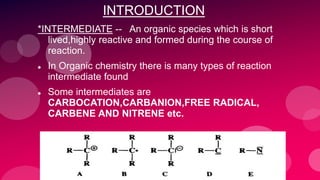
*INTERMEDIATE -- An organic species which is short
lived,highly reactive and formed during the course of
reaction.
 In Organic chemistry there is many types of reaction
intermediate found
 Some intermediates are
CARBOCATION,CARBANION,FREE RADICAL,
CARBENE AND NITRENE etc.
GENERATION OF CARBOCATION
Heterolytic cleavage is responsible for generation of
carbocations.
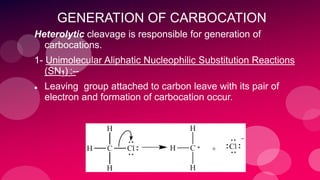
1- Unimolecular Aliphatic Nucleophilic Substitution Reactions
(SN1) :--
 Leaving group attached to carbon leave with its pair of
electron and formation of carbocation occur.
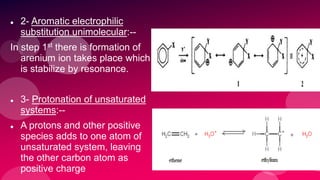
 2- Aromatic electrophilic
substitution unimolecular:--
In step 1st there is formation of
arenium ion takes place which
is stabilize by resonance.
 3- Protonation of unsaturated
systems:--
 A protons and other positive
species adds to one atom of
unsaturated system, leaving
the other carbon atom as
positive charge
STRUCTURE
 Carbon with positive
charge is sp2 hybridised.
 Electronoic configuration of
carbon with positive charge
is [He]2s1 2px
1 2py
1 2pz
0
 Bond angle is 1200.
 Three sp2 hybrid orbitals
are in same plane.
 Empty pz orbital at the
perpendicular to plane of
three hybrid orbitals.
Stability of Carbocation
 The more stable Carbocation have been
prepared in solution.
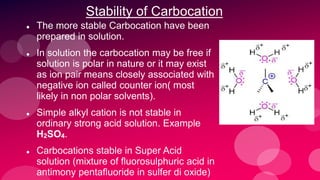
 In solution the carbocation may be free if
solution is polar in nature or it may exist
as ion pair means closely associated with
negative ion called counter ion( most
likely in non polar solvents).
 Simple alkyl cation is not stable in
ordinary strong acid solution. Example
H2SO4.
 Carbocations stable in Super Acid
solution (mixture of fluorosulphuric acid in
antimony pentafluoride in sulfer di oxide)
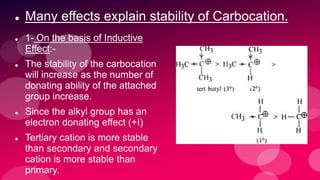
 1- On the basis of Inductive
Effect:-
 The stability of the carbocation
will increase as the number of
donating ability of the attached
group increase.
 Since the alkyl group has an
electron donating effect (+I)
 Tertiary cation is more stable
than secondary and secondary
cation is more stable than
primary.
 Many effects explain stability of Carbocation.
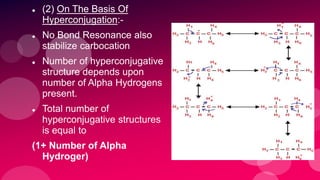
 (2) On The Basis Of
Hyperconjugation:-
 No Bond Resonance also
stabilize carbocation
 Number of hyperconjugative
structure depends upon
number of Alpha Hydrogens
present.
 Total number of
hyperconjugative structures
is equal to
(1+ Number of Alpha
Hydroger)
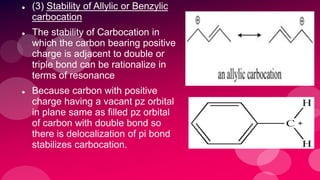
 (3) Stability of Allylic or Benzylic
carbocation
 The stability of Carbocation in
which the carbon bearing positive
charge is adjacent to double or
triple bond can be rationalize in
terms of resonance
 Because carbon with positive
charge having a vacant pz orbital
in plane same as filled pz orbital
of carbon with double bond so
there is delocalization of pi bond
stabilizes carbocation.
REACTIVITY
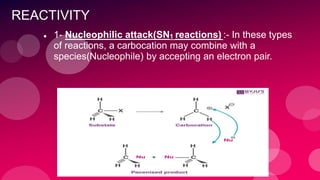
 1- Nucleophilic attack(SN1 reactions) :- In these types
of reactions, a carbocation may combine with a
species(Nucleophile) by accepting an electron pair.
(2) Rearrangement reaction:--
 1-2 methyl shift or 1-2 hydride shifts are very common
in carbocation chemistry to attain a more stable
counterpart.
 A primary carbocation will prefer to rearrange itself
into a more stable tertiary carbocation.
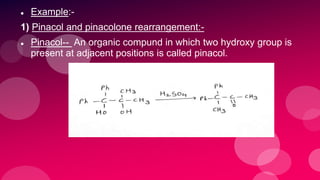
 Example:-
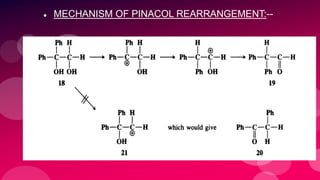
1) Pinacol and pinacolone rearrangement:-
 Pinacol-- An organic compund in which two hydroxy group is
present at adjacent positions is called pinacol.
 MECHANISM OF PINACOL REARRANGEMENT:--
REFRENCES
 Advance organic chemistry by Jerry March
 YouTube.
 Google Images etc.
THANKS.
THANKS

Reaction intermediate Carbocation ppt.ppt

  • 1.
    S.P.C. GOVT COLLEGE AJMER NAME- NAVED AHMAD CLASS - MSC 1st SEM DEPT - CHEMISTRY TOPIC - CARBOCATION
  • 2.
    TOPICS  Generation ofCarbocation  Strucutre of Carbocation  Stability of Carbocation  Reactivity of Carbocation  Refrences of my seminar
  • 3.
    INTRODUCTION *INTERMEDIATE -- Anorganic species which is short lived,highly reactive and formed during the course of reaction.  In Organic chemistry there is many types of reaction intermediate found  Some intermediates are CARBOCATION,CARBANION,FREE RADICAL, CARBENE AND NITRENE etc.
  • 4.
    GENERATION OF CARBOCATION Heterolyticcleavage is responsible for generation of carbocations. 1- Unimolecular Aliphatic Nucleophilic Substitution Reactions (SN1) :--  Leaving group attached to carbon leave with its pair of electron and formation of carbocation occur.
  • 5.
     2- Aromaticelectrophilic substitution unimolecular:-- In step 1st there is formation of arenium ion takes place which is stabilize by resonance.  3- Protonation of unsaturated systems:--  A protons and other positive species adds to one atom of unsaturated system, leaving the other carbon atom as positive charge
  • 6.
    STRUCTURE  Carbon withpositive charge is sp2 hybridised.  Electronoic configuration of carbon with positive charge is [He]2s1 2px 1 2py 1 2pz 0  Bond angle is 1200.  Three sp2 hybrid orbitals are in same plane.  Empty pz orbital at the perpendicular to plane of three hybrid orbitals.
  • 7.
    Stability of Carbocation The more stable Carbocation have been prepared in solution.  In solution the carbocation may be free if solution is polar in nature or it may exist as ion pair means closely associated with negative ion called counter ion( most likely in non polar solvents).  Simple alkyl cation is not stable in ordinary strong acid solution. Example H2SO4.  Carbocations stable in Super Acid solution (mixture of fluorosulphuric acid in antimony pentafluoride in sulfer di oxide)
  • 8.
     1- Onthe basis of Inductive Effect:-  The stability of the carbocation will increase as the number of donating ability of the attached group increase.  Since the alkyl group has an electron donating effect (+I)  Tertiary cation is more stable than secondary and secondary cation is more stable than primary.  Many effects explain stability of Carbocation.
  • 9.
     (2) OnThe Basis Of Hyperconjugation:-  No Bond Resonance also stabilize carbocation  Number of hyperconjugative structure depends upon number of Alpha Hydrogens present.  Total number of hyperconjugative structures is equal to (1+ Number of Alpha Hydroger)
  • 10.
     (3) Stabilityof Allylic or Benzylic carbocation  The stability of Carbocation in which the carbon bearing positive charge is adjacent to double or triple bond can be rationalize in terms of resonance  Because carbon with positive charge having a vacant pz orbital in plane same as filled pz orbital of carbon with double bond so there is delocalization of pi bond stabilizes carbocation.
  • 11.
    REACTIVITY  1- Nucleophilicattack(SN1 reactions) :- In these types of reactions, a carbocation may combine with a species(Nucleophile) by accepting an electron pair.
  • 12.
    (2) Rearrangement reaction:-- 1-2 methyl shift or 1-2 hydride shifts are very common in carbocation chemistry to attain a more stable counterpart.  A primary carbocation will prefer to rearrange itself into a more stable tertiary carbocation.
  • 13.
     Example:- 1) Pinacoland pinacolone rearrangement:-  Pinacol-- An organic compund in which two hydroxy group is present at adjacent positions is called pinacol.
  • 14.
     MECHANISM OFPINACOL REARRANGEMENT:--
  • 15.
    REFRENCES  Advance organicchemistry by Jerry March  YouTube.  Google Images etc.
  • 16.