Teaching of
Education
Presented By:
VIKAS MANKAD
M.Sc. Nursing
1st Year
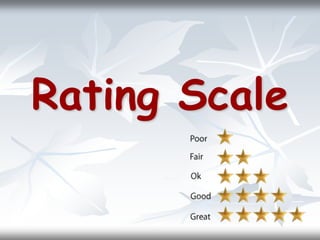
Rating Scale
Introduction
Rating means measuring an
attribute of objects or persons
by judgment in a continuum. For
eg: school marks or grades;
performance appraisal rating of
an employee in an organization.
Definition:
Rating scale refers to a
scale with a set of opinion,
which describes varying
degree of dimensions of an
attitude being observed.
TYPES OF RATING SCALE
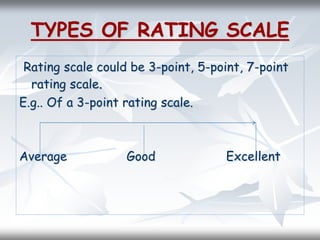
Rating scale could be 3-point, 5-point, 7-point
rating scale.
E.g.. Of a 3-point rating scale.
Average Good Excellent
Types of Rating Scale
Types of Rating Scales: Four types
 Graphic rating scale
 Descriptive rating scale
 Numerical rating scale
 Comparative rating scale
Contin..
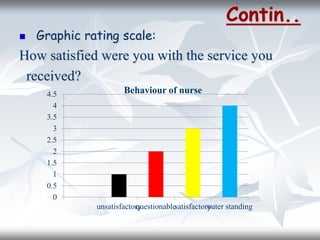
 Graphic rating scale:
How satisfied were you with the service you
received?
0
0.5
1
1.5
2
2.5
3
3.5
4
4.5
unsatisfactory
questionable
satisfactory
outer standing
Behaviour of nurse
Contd…
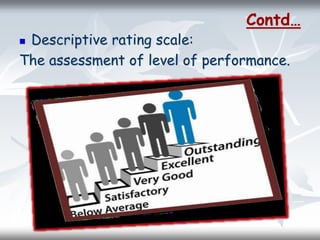
 Descriptive rating scale:
The assessment of level of performance.
Contin..
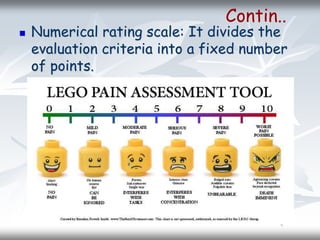
 Numerical rating scale: It divides the
evaluation criteria into a fixed number
of points.
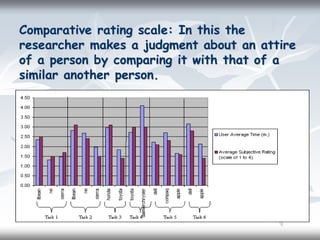
Comparative rating scale: In this the
researcher makes a judgment about an attire
of a person by comparing it with that of a
similar another person.
Principles for Preparing Rating
Scale
 It directly relates to learning objectives.
 Needs to be confined to performance
areas that can be observed.
 Clearly define the specific trait or mode
of behavior.
 The trait or behavior should be readily
observed in a number of situations.
 Allow some space in the Rating scale card
for the rater to give supplementary
remarks.
Continue..
 Uses of Rating Scale
 Advantages of Rating scale:
Disadvantages of Rating Scale
 It is difficult to fix up rating about
many aspects of an individual.
 Misuse can result in decrease in
objectivity.
 There are chances of subjective
evaluation, thus the scales may become
unscientific and unreliable.
Bibliography
 Sharma Suresh K. Rating Scale. Nursing
Research and Statistics. 1st ed.
Pennsylvania. Elsevier Publishers. 2011.
Pp: 201-204.
 Neeraja KP. Rating Scale. Text book of
Nursing Education. 1st ed. New Delhi.
Jay Pee Publishers. 2003. Pp: 430-432
RATING SCALE.ppt

RATING SCALE.ppt

  • 1.
    Teaching of Education Presented By: VIKASMANKAD M.Sc. Nursing 1st Year
  • 2.
  • 3.
    Introduction Rating means measuringan attribute of objects or persons by judgment in a continuum. For eg: school marks or grades; performance appraisal rating of an employee in an organization.
  • 4.
    Definition: Rating scale refersto a scale with a set of opinion, which describes varying degree of dimensions of an attitude being observed.
  • 5.
    TYPES OF RATINGSCALE Rating scale could be 3-point, 5-point, 7-point rating scale. E.g.. Of a 3-point rating scale. Average Good Excellent
  • 6.
    Types of RatingScale Types of Rating Scales: Four types  Graphic rating scale  Descriptive rating scale  Numerical rating scale  Comparative rating scale
  • 7.
    Contin..  Graphic ratingscale: How satisfied were you with the service you received? 0 0.5 1 1.5 2 2.5 3 3.5 4 4.5 unsatisfactory questionable satisfactory outer standing Behaviour of nurse
  • 8.
    Contd…  Descriptive ratingscale: The assessment of level of performance.
  • 9.
    Contin..  Numerical ratingscale: It divides the evaluation criteria into a fixed number of points.
  • 10.
    Comparative rating scale:In this the researcher makes a judgment about an attire of a person by comparing it with that of a similar another person.
  • 11.
    Principles for PreparingRating Scale  It directly relates to learning objectives.  Needs to be confined to performance areas that can be observed.  Clearly define the specific trait or mode of behavior.  The trait or behavior should be readily observed in a number of situations.  Allow some space in the Rating scale card for the rater to give supplementary remarks.
  • 12.
    Continue..  Uses ofRating Scale  Advantages of Rating scale: Disadvantages of Rating Scale  It is difficult to fix up rating about many aspects of an individual.  Misuse can result in decrease in objectivity.  There are chances of subjective evaluation, thus the scales may become unscientific and unreliable.
  • 13.
    Bibliography  Sharma SureshK. Rating Scale. Nursing Research and Statistics. 1st ed. Pennsylvania. Elsevier Publishers. 2011. Pp: 201-204.  Neeraja KP. Rating Scale. Text book of Nursing Education. 1st ed. New Delhi. Jay Pee Publishers. 2003. Pp: 430-432