



Good
evening
SELF AND PEER
EVALUATION
Ms. Ekta Upadhyay
M.Sc.(N) Ist Year
Key words
Evaluation:- an individual’s achievements or
characteristics.
Review :- a formal assessment of something with
the intention of instituting change if necessary.
Self :- a person's essential being that
distinguishes them from others
Peer :- peer is someone at your own level.
Evaluation
The term evaluation is derived from the
word ‘valoir’ which means ‘to be worth’.
• Thus evaluation is a process of judging
the value or worth of an individual’s
achievements or characteristics.
“It is an act or process that
involves the assignment of a
numerical index to whatever is
being assessed” “Evaluation is
an act or process that allows
one to make a judgment about
the desirability or value of a
measure”
DEFINITION
Self evaluation is defined
as judging the quality of one’s
work, based on evidence and
explicit criteria, for the purpose
of doing better work in the
future.
Benefits of self evaluation
• Increased confidence in their own learning.
• Enthusiasm for collaborative working, despite
initial anxieties .
• Improved team-work and greater flexibility in
their use of their skills
• Increased awareness of new techniques and
greater insight .
• To encourage continuing self- evaluation
CONT …….
• To encourage individual professional growth
• To improve morale and motivation
• To support employees as they experiment
TOOLS FOR SELF EVALUATION
Self evaluation is an
evaluation of one’s own
abilities and failings –
Reverse dictionary
• To encourage- innovative
approach.
• To encourage individual
professional growth in
areas of interest to the
employee
• To improve morale and
motivation by treating the
employee as a
professional.
• To encourage collegiality
and discussion about
practices among peers in
an organization
• Being observed and receiving
feedback
• Improved team-work and greater
flexibility in their use of their
skills
• Increased awareness of new
techniques and greater insight
into thinking•
• Enhanced planning skills to
ensure more effective task
management.
• Observation can involve experts;
can be informal or formal
procedures.
Checklist: provides guidance for collection of relevant evidence
1. Staff annual professional review procedures
2. Peer support
 Coaching
 Joint preparation of materials
 Planning
 Team building
3. Observation can involve experts; can be informal or formal procedures.
Feedback from such observation is very valuable, but must be handled
sensitively
4. Audit Checklist: provides guidance for collection of relevant evidence
used to determine the merits, worth or significance of a self.
STEPS IN SELF EVALUATION
Time:- Allow about an hour to complete the self‐evaluation.
Quiet:- Conduct the self‐evaluation in a quiet place without
interruptions so you can devote your full attention and
reflection to the process.
Relax: - Try to relax and reflect upon individual goals,
experiences, and incidents. No one is perfect, and it is very
likely that you will recall both good and bad experiences.
Highlight the highlights; - Don't be shy about letting your
supervisor know where you shone during the year. The
self‐evaluation is the place to boast with grace and
diplomacy.
Solicit feedback from coworkers:- Consider
asking your colleagues what they think of
your performance.
Be objective:- Instead of evaluating yourself
based on how you wished you’d performed,
offer the results and quantify them as much as
possible by using facts, figures, and specific
dates.
Use appropriate language:-Choose words that
demonstrate some objectivity and distance.
Suggest specific
improvements:-The
self‐evaluation is a good
opportunity to identify specific
ways to improve your
performance
Complete the Learning and
Career Development Action
Plan:-
Write more than one draft:-
you write, review, and revise your
self‐evaluation to ensure you
“Send Forward” your best work.
DISADVANTAGES
• Format based plan: Self-assessment can be
very time consuming, so as teachers we have
to plan it before and write an adequate
format, so it doesn’t take students too long to
answer it, and so it is easy to check.
• Consciousness: Students need to have a very
high degree of consciousness, so they can be
able to analyze the errors that they have
made.
• Teacher feedback: Students can be
undecided or If they haven’t received enough
feedback from the teacher, they may have
doubts regarding to the progress. Self-
evaluation only works if students have been
trained to self- assess themselves.
• Language: It implies knowledge
about language and learning which
most second language learners
don’t have. lack of maturity: Some
students are not ready to have a
self assessment task, mostly
because they aren’t aware of the
seriousness or importance of the
process.
• Lack of maturity: Some students
are not ready to have a self
assessment task, mostly because
they aren’t aware of the
seriousness or importance of the
process.
Peer Evaluation
ANA GUIDELINES FOR PEER REVIEW
• Nursing care delivered is evaluated by an individual of
same rank} according to established standards of
practice Standards of nursing practice provide means
for measuring} quality of nursing care.
• Assures consumer of continued competence, Identifies
weaknesses in practice that can guide continuing
education, Provides a quality assurance mechanism.
Assists nurses in improving documentation,
communication and productivity.
PEER REVIEW PRINCIPLES
• Peer is someone of the same rank
• Healthcare provider to healthcare provider
• Staff nurse to staff nurse
• Educator to educator
• APN to APN
• Unit Director to Unit Director
• Executive to Executive
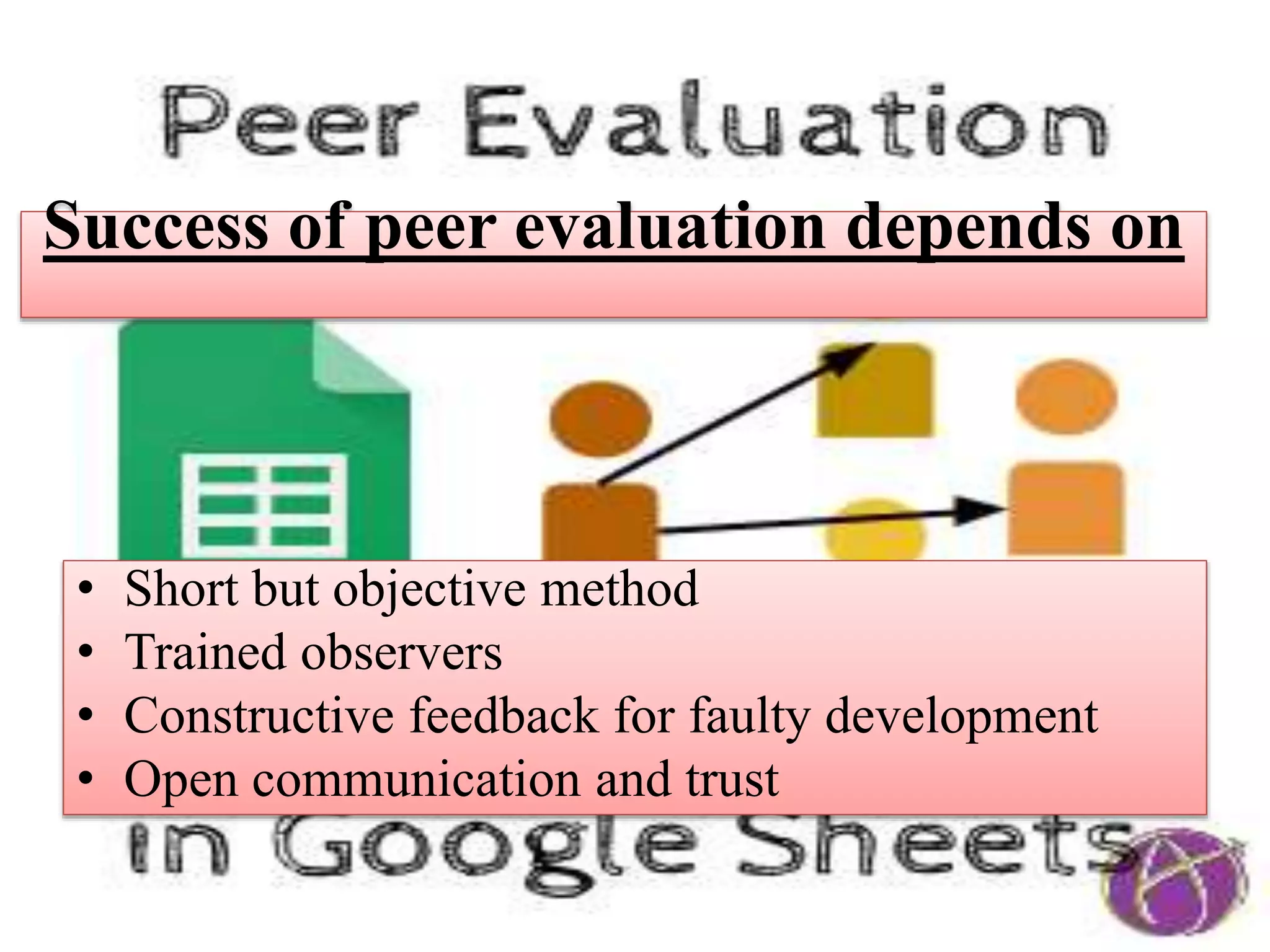
Success of peer evaluation depends on
• Short but objective method
• Trained observers
• Constructive feedback for faulty development
• Open communication and trust
Methods Of Peer
Evaluation
• Direct observation
• Videotaping
• Evaluation of course
materials
• Analysis of
portfolios
PROCESS OF PEER REVIEW
Establish a policy requiring peer reviews
Establish criteria for peer evaluations
Procedure for conducting peer evaluations
Conducting a review
• Initial steps
• Confidentiality
• Bias and competing interests
Types of peer review
• Single blind
• Double blind
• Open review
• Transparent
• Collaborative
Single blind review
In this type of peer review the author does
not know who the reviewers are. The reviewers
know that you are the author of the article, but
you don’t know the identities of the reviewers.
Single-blind review is most common for science
and medicine journals.
Double blind review
Under double-blind review, the
reviewers don’t know that you are the author
of the article. And you don’t know who the
reviewers are either. Double-blind review is
particularly common in the humanities and
some social sciences.
Open peer review
The identity of the author and the
reviewers are known by all participants. There
is a growing minority of journals using this
form of peer review but popularity among
reviewers is yet to be proven. Some journals
may also publish the reviews together with
final articles, and so readers see both the
identity of the reviewers and their comments.
Transparent peer review
The pilot program enables open publication of an
article’s entire peer review process in an easily accessible,
searchable, and citable format, in order to bring greater
transparency to the research process and recognition to the
work of peer reviewers
This is a fairly new form of peer review which
allows subject-related journals to transfer reviewed
manuscripts between each other. Typically, an author
submits their paper to a journal but after it has been
reviewed the editors decide that although not suitable for
their journal.
Collaborative review
This covers a broad variety of
approaches in which a team of people work
together to undertake the review. One format is
to have two or more reviewers work together
to review the paper, discuss their opinions and
submit a unified report.
ADVANTAGES OF PEER
EVALUATION
Improves team work
Encourage group members involvement and
responsibilities
Encourage peers to reflects on their role and
contribution to the process of group work.
Focuses on the development of judgment skills
Provides more relevant feed back to the students
as it is generated by their peers.
Give opportunities for the hidden leaders to be
selected
DISADVANTAGES OF PEER
EVALUATION
Threats to friendship bias
Time consuming
Artificially inflated.
Peers feels ill equipped to undertake the
assessment.
Reluctance to make judgement regarding their
peers.
THANK
YOU

Self and peer ppt

  • 1.
  • 2.
    SELF AND PEER EVALUATION Ms.Ekta Upadhyay M.Sc.(N) Ist Year
  • 3.
    Key words Evaluation:- anindividual’s achievements or characteristics. Review :- a formal assessment of something with the intention of instituting change if necessary. Self :- a person's essential being that distinguishes them from others Peer :- peer is someone at your own level.
  • 4.
    Evaluation The term evaluationis derived from the word ‘valoir’ which means ‘to be worth’. • Thus evaluation is a process of judging the value or worth of an individual’s achievements or characteristics.
  • 5.
    “It is anact or process that involves the assignment of a numerical index to whatever is being assessed” “Evaluation is an act or process that allows one to make a judgment about the desirability or value of a measure”
  • 6.
    DEFINITION Self evaluation isdefined as judging the quality of one’s work, based on evidence and explicit criteria, for the purpose of doing better work in the future.
  • 7.
    Benefits of selfevaluation • Increased confidence in their own learning. • Enthusiasm for collaborative working, despite initial anxieties . • Improved team-work and greater flexibility in their use of their skills • Increased awareness of new techniques and greater insight . • To encourage continuing self- evaluation
  • 8.
    CONT ……. • Toencourage individual professional growth • To improve morale and motivation • To support employees as they experiment
  • 9.
    TOOLS FOR SELFEVALUATION Self evaluation is an evaluation of one’s own abilities and failings – Reverse dictionary
  • 10.
    • To encourage-innovative approach. • To encourage individual professional growth in areas of interest to the employee • To improve morale and motivation by treating the employee as a professional. • To encourage collegiality and discussion about practices among peers in an organization
  • 11.
    • Being observedand receiving feedback • Improved team-work and greater flexibility in their use of their skills • Increased awareness of new techniques and greater insight into thinking• • Enhanced planning skills to ensure more effective task management. • Observation can involve experts; can be informal or formal procedures.
  • 12.
    Checklist: provides guidancefor collection of relevant evidence 1. Staff annual professional review procedures 2. Peer support  Coaching  Joint preparation of materials  Planning  Team building 3. Observation can involve experts; can be informal or formal procedures. Feedback from such observation is very valuable, but must be handled sensitively 4. Audit Checklist: provides guidance for collection of relevant evidence used to determine the merits, worth or significance of a self.
  • 13.
    STEPS IN SELFEVALUATION Time:- Allow about an hour to complete the self‐evaluation. Quiet:- Conduct the self‐evaluation in a quiet place without interruptions so you can devote your full attention and reflection to the process. Relax: - Try to relax and reflect upon individual goals, experiences, and incidents. No one is perfect, and it is very likely that you will recall both good and bad experiences. Highlight the highlights; - Don't be shy about letting your supervisor know where you shone during the year. The self‐evaluation is the place to boast with grace and diplomacy.
  • 14.
    Solicit feedback fromcoworkers:- Consider asking your colleagues what they think of your performance. Be objective:- Instead of evaluating yourself based on how you wished you’d performed, offer the results and quantify them as much as possible by using facts, figures, and specific dates. Use appropriate language:-Choose words that demonstrate some objectivity and distance.
  • 15.
    Suggest specific improvements:-The self‐evaluation isa good opportunity to identify specific ways to improve your performance Complete the Learning and Career Development Action Plan:- Write more than one draft:- you write, review, and revise your self‐evaluation to ensure you “Send Forward” your best work.
  • 16.
    DISADVANTAGES • Format basedplan: Self-assessment can be very time consuming, so as teachers we have to plan it before and write an adequate format, so it doesn’t take students too long to answer it, and so it is easy to check. • Consciousness: Students need to have a very high degree of consciousness, so they can be able to analyze the errors that they have made. • Teacher feedback: Students can be undecided or If they haven’t received enough feedback from the teacher, they may have doubts regarding to the progress. Self- evaluation only works if students have been trained to self- assess themselves.
  • 17.
    • Language: Itimplies knowledge about language and learning which most second language learners don’t have. lack of maturity: Some students are not ready to have a self assessment task, mostly because they aren’t aware of the seriousness or importance of the process. • Lack of maturity: Some students are not ready to have a self assessment task, mostly because they aren’t aware of the seriousness or importance of the process.
  • 18.
  • 19.
    ANA GUIDELINES FORPEER REVIEW • Nursing care delivered is evaluated by an individual of same rank} according to established standards of practice Standards of nursing practice provide means for measuring} quality of nursing care. • Assures consumer of continued competence, Identifies weaknesses in practice that can guide continuing education, Provides a quality assurance mechanism. Assists nurses in improving documentation, communication and productivity.
  • 20.
    PEER REVIEW PRINCIPLES •Peer is someone of the same rank • Healthcare provider to healthcare provider • Staff nurse to staff nurse • Educator to educator • APN to APN • Unit Director to Unit Director • Executive to Executive
  • 21.
    Success of peerevaluation depends on • Short but objective method • Trained observers • Constructive feedback for faulty development • Open communication and trust
  • 22.
    Methods Of Peer Evaluation •Direct observation • Videotaping • Evaluation of course materials • Analysis of portfolios
  • 23.
    PROCESS OF PEERREVIEW Establish a policy requiring peer reviews Establish criteria for peer evaluations Procedure for conducting peer evaluations
  • 24.
    Conducting a review •Initial steps • Confidentiality • Bias and competing interests
  • 25.
    Types of peerreview • Single blind • Double blind • Open review • Transparent • Collaborative
  • 26.
    Single blind review Inthis type of peer review the author does not know who the reviewers are. The reviewers know that you are the author of the article, but you don’t know the identities of the reviewers. Single-blind review is most common for science and medicine journals.
  • 27.
    Double blind review Underdouble-blind review, the reviewers don’t know that you are the author of the article. And you don’t know who the reviewers are either. Double-blind review is particularly common in the humanities and some social sciences.
  • 28.
    Open peer review Theidentity of the author and the reviewers are known by all participants. There is a growing minority of journals using this form of peer review but popularity among reviewers is yet to be proven. Some journals may also publish the reviews together with final articles, and so readers see both the identity of the reviewers and their comments.
  • 29.
    Transparent peer review Thepilot program enables open publication of an article’s entire peer review process in an easily accessible, searchable, and citable format, in order to bring greater transparency to the research process and recognition to the work of peer reviewers This is a fairly new form of peer review which allows subject-related journals to transfer reviewed manuscripts between each other. Typically, an author submits their paper to a journal but after it has been reviewed the editors decide that although not suitable for their journal.
  • 30.
    Collaborative review This coversa broad variety of approaches in which a team of people work together to undertake the review. One format is to have two or more reviewers work together to review the paper, discuss their opinions and submit a unified report.
  • 31.
    ADVANTAGES OF PEER EVALUATION Improvesteam work Encourage group members involvement and responsibilities Encourage peers to reflects on their role and contribution to the process of group work. Focuses on the development of judgment skills Provides more relevant feed back to the students as it is generated by their peers. Give opportunities for the hidden leaders to be selected
  • 32.
    DISADVANTAGES OF PEER EVALUATION Threatsto friendship bias Time consuming Artificially inflated. Peers feels ill equipped to undertake the assessment. Reluctance to make judgement regarding their peers.
  • 33.