Presentation
on
Checklist & Rating Scale
INTRODUCTION
• Checklist & Rating scale both are
the types of evaluation tools. These
are the tools which are used for the
evaluation of skills.
CHECKLIST
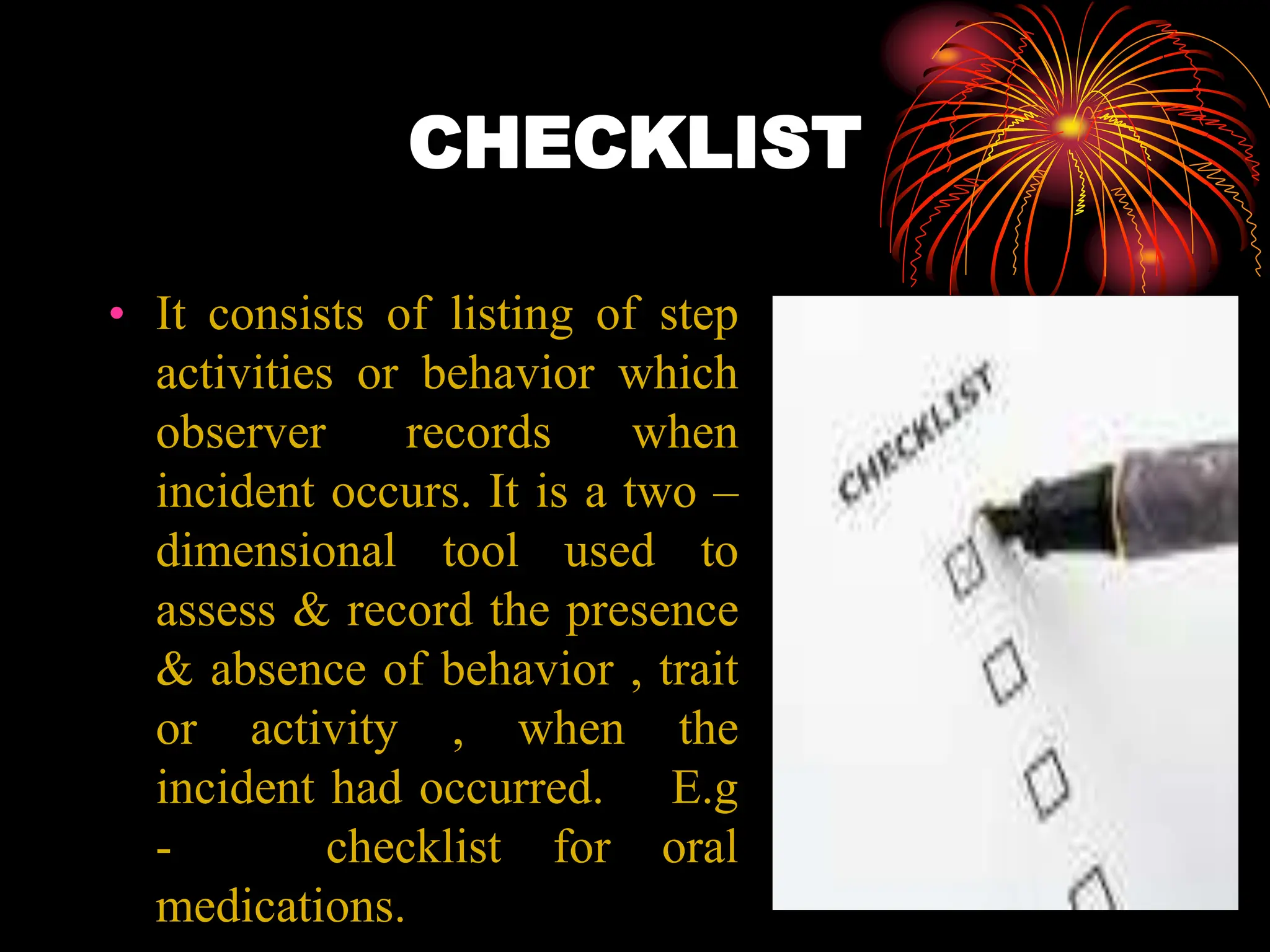
• It consists of listing of step
activities or behavior which
observer records when
incident occurs. It is a two –
dimensional tool used to
assess & record the presence
& absence of behavior , trait
or activity , when the
incident had occurred. E.g
- checklist for oral
medications.
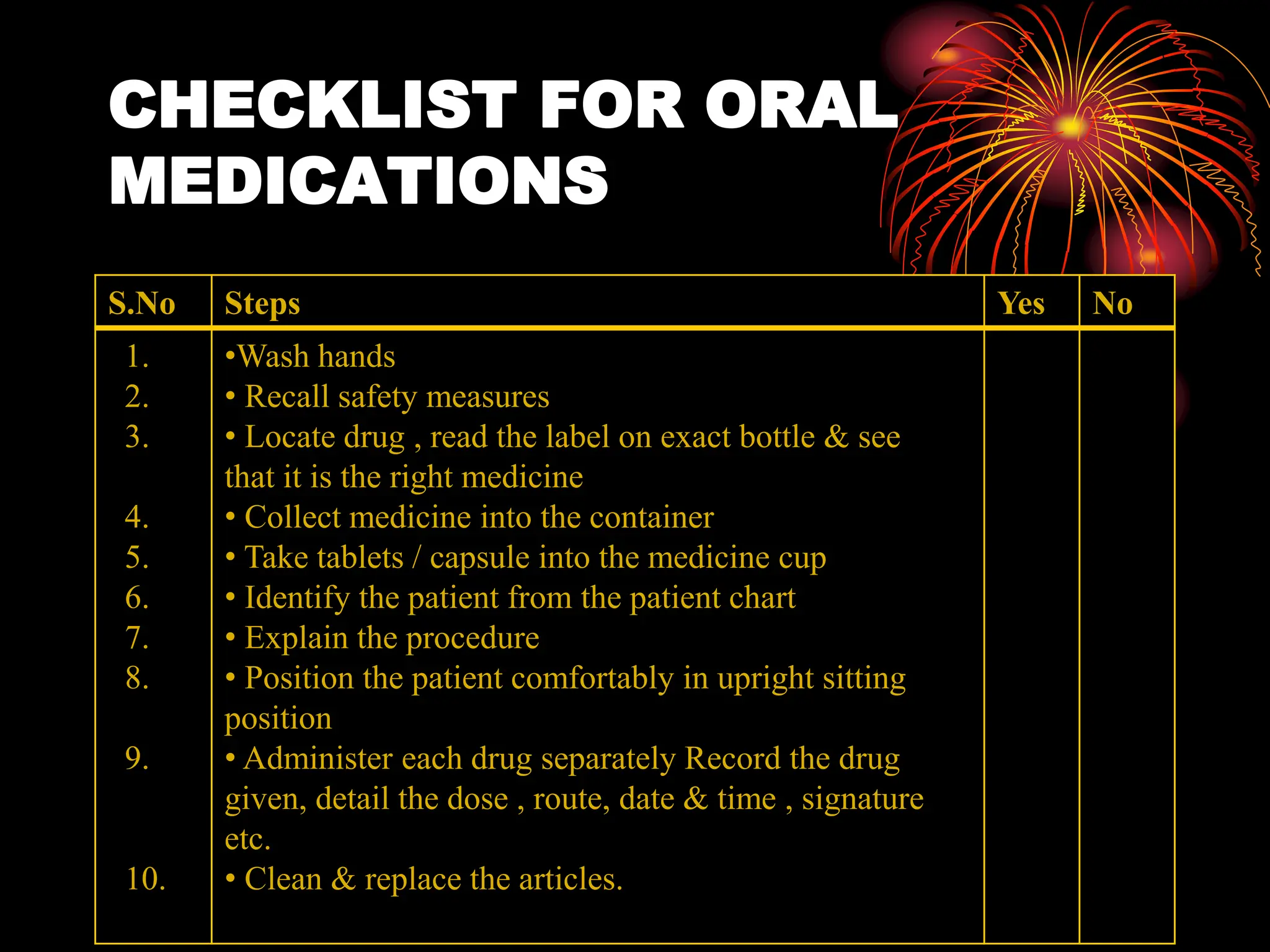
CHECKLIST FOR ORAL
MEDICATIONS
S.No Steps Yes No
1.
2.
3.
4.
5.
6.
7.
8.
9.
10.
•Wash hands
• Recall safety measures
• Locate drug , read the label on exact bottle & see
that it is the right medicine
• Collect medicine into the container
• Take tablets / capsule into the medicine cup
• Identify the patient from the patient chart
• Explain the procedure
• Position the patient comfortably in upright sitting
position
• Administer each drug separately Record the drug
given, detail the dose , route, date & time , signature
etc.
• Clean & replace the articles.
POINTS TO BE REMEMBER TO
PREPARE CHECKLIST
• Express each item in clear and
simple language.
• Avoid negative statements.
• Clearly specify characteristics of
behavior to be observed.
• Observe one student at time.
Cont……….
• Have a separate checklist
for each student.
• Observer must be trained
in WHO,WHAT & HOW
to record and observed.
ADVANTAGES OF CHECKLIST
• Adaptable to most subject matter that are
observable.
• Can evaluate learning activities in relation
to procedure , process , personal trait or
characteristics.
RATING SCALE
• Rating scale is the technique in which
individuals are rated on scale from low
to high with respect to particular trait.
Cont…….
• It is the judgment of one person by
another. It provides the scope of
quantification of the judgment in
relation to n observed behavior of
the student .
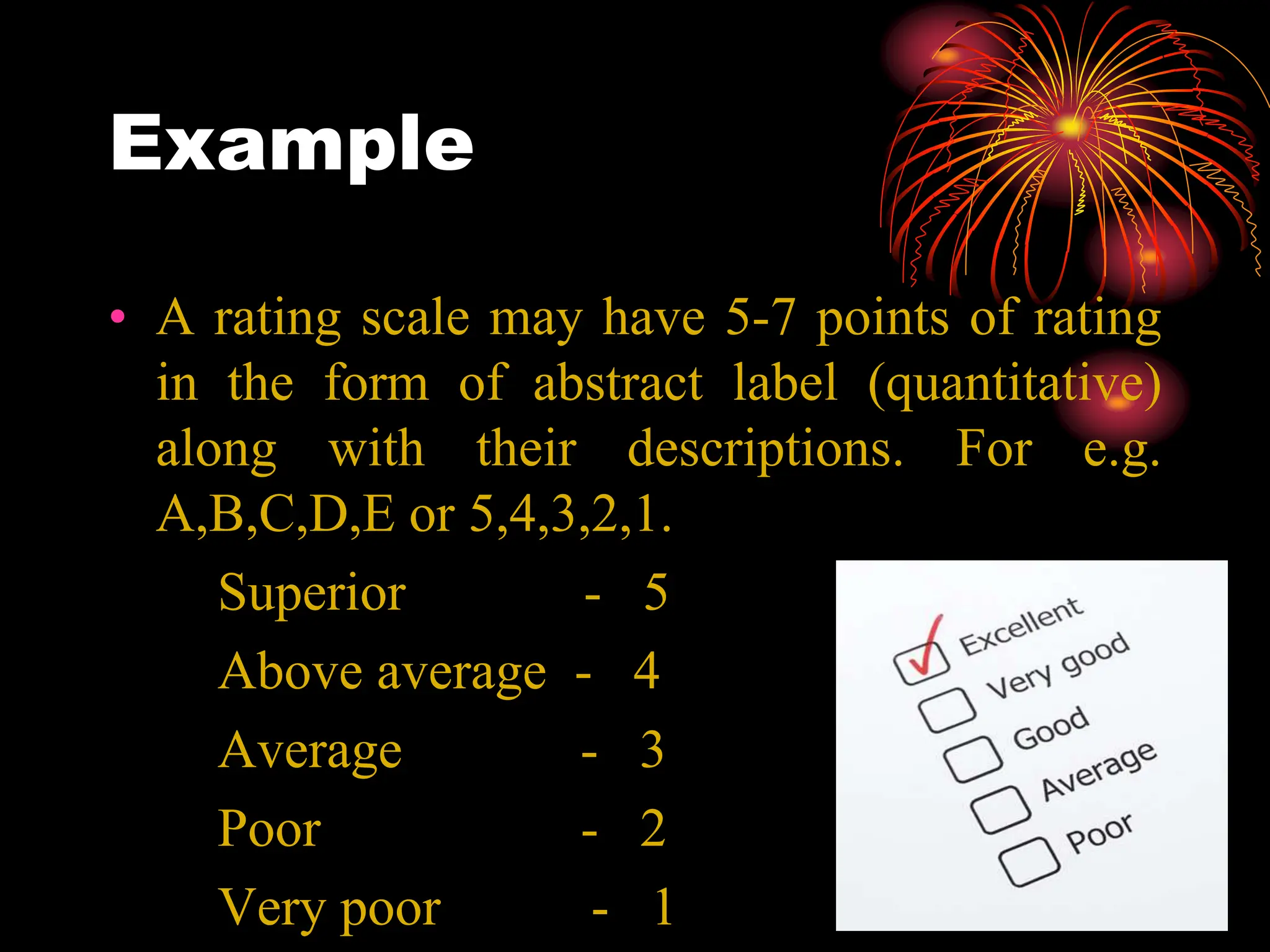
Example
• A rating scale may have 5-7 points of rating
in the form of abstract label (quantitative)
along with their descriptions. For e.g.
A,B,C,D,E or 5,4,3,2,1.
Superior - 5
Above average - 4
Average - 3
Poor - 2
Very poor - 1
TYPES OF RATING SCALE
There are three types of rating scale –
• Descriptive rating scale
• Numerical rating scale
• Graphic rating scale
1.DESCRIPTIVE RATING SCALE
• It provides for each trait a list of
descriptive phrases from which the
rater selects the one most
applicable to the student & records
his or her selection , usually by
means of a tick mark.
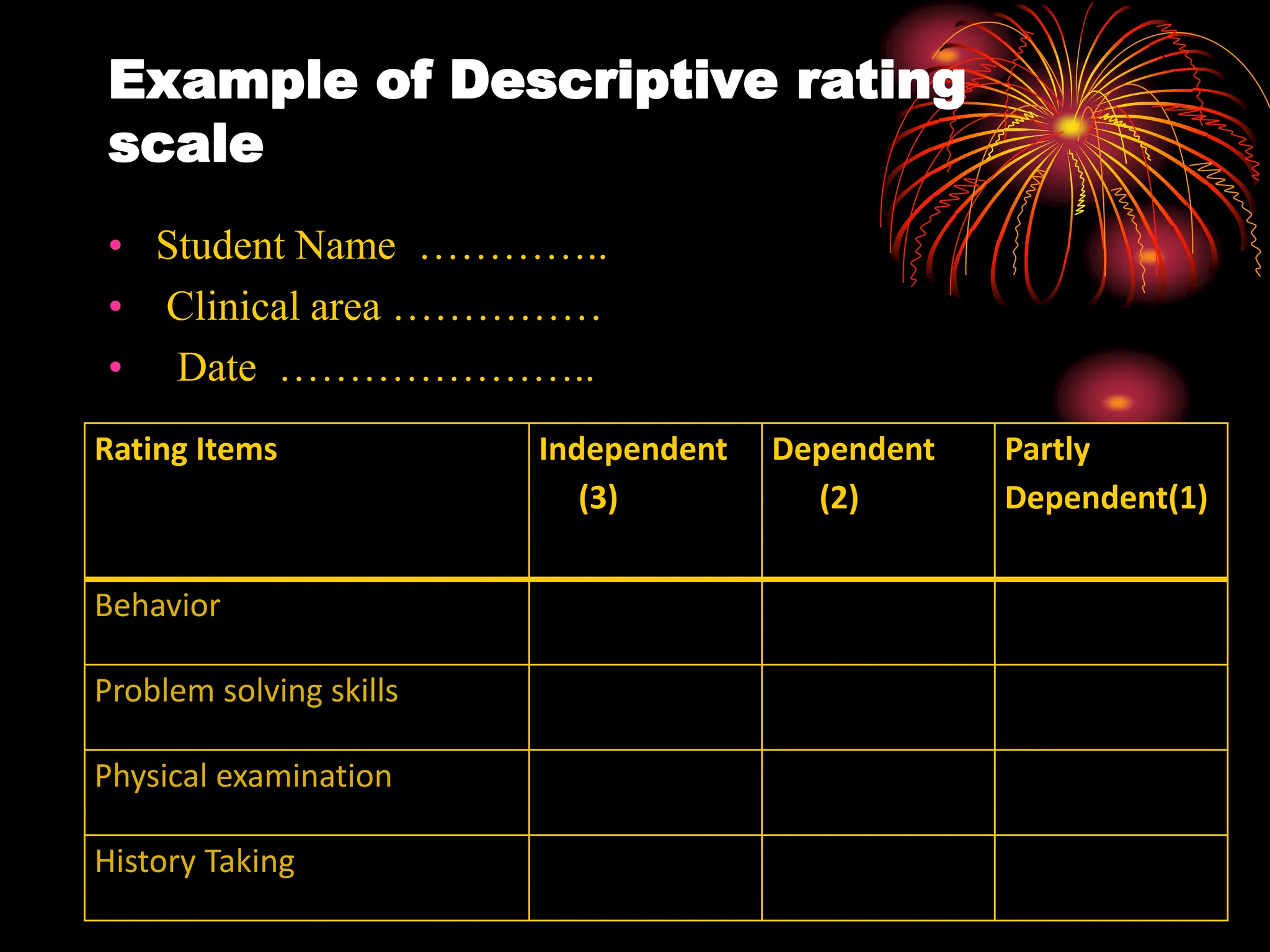
Example of Descriptive rating
scale
• Student Name …………..
• Clinical area ……………
• Date …………………..
Rating Items Independent
(3)
Dependent
(2)
Partly
Dependent(1)
Behavior
Problem solving skills
Physical examination
History Taking
Cont………
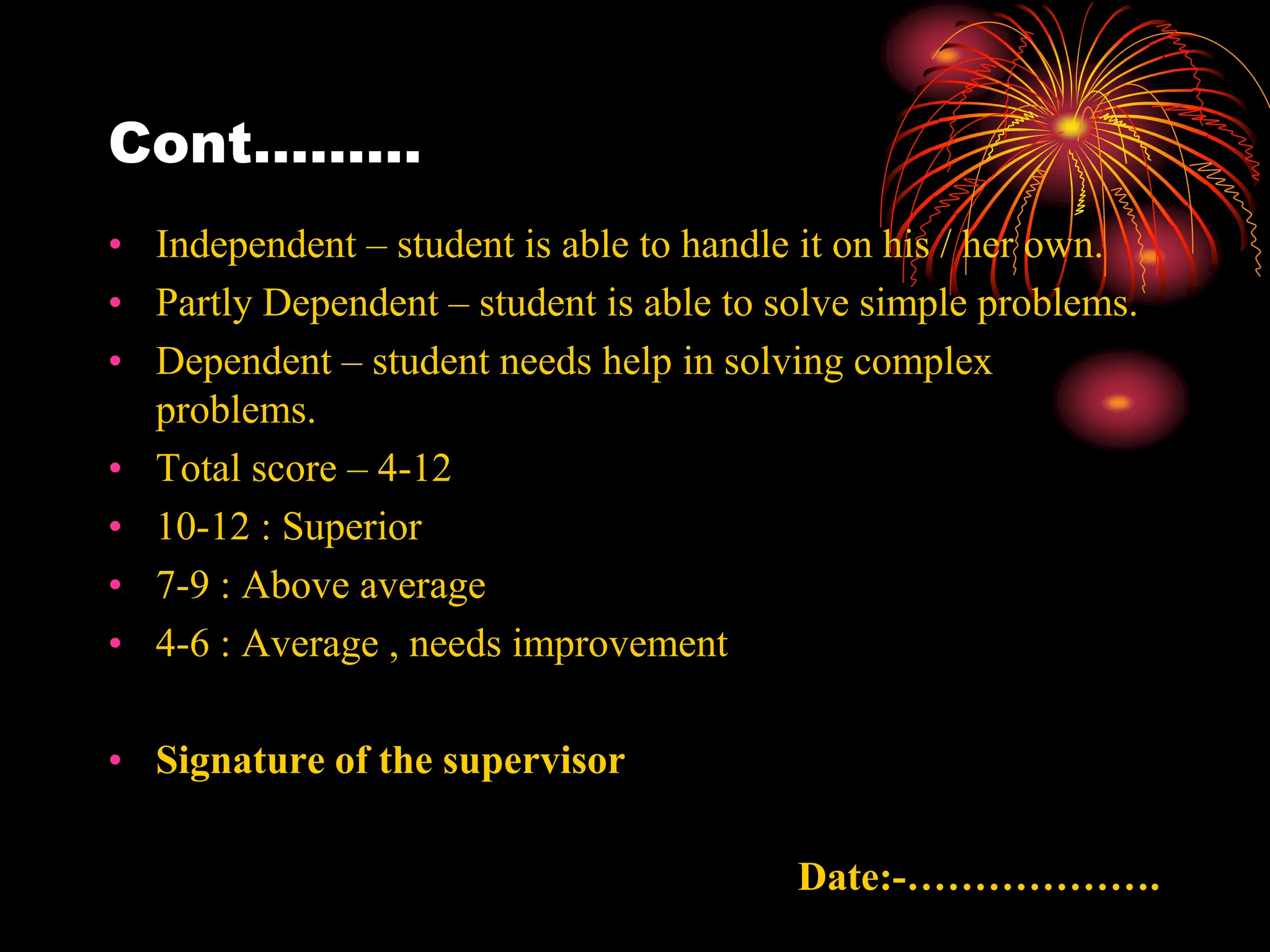
• Independent – student is able to handle it on his / her own.
• Partly Dependent – student is able to solve simple problems.
• Dependent – student needs help in solving complex
problems.
• Total score – 4-12
• 10-12 : Superior
• 7-9 : Above average
• 4-6 : Average , needs improvement
• Signature of the supervisor
Date:-……………….
2.NUMERICAL RATING SCALE
• The rater assigns a code number (which
refers to descriptive phrase ),to each trait
of a person being rated. Code numbers
are assigned to the descriptive phrases,
arranged in order of degree or level at
which they indicate lack of occurrence of
each trait.
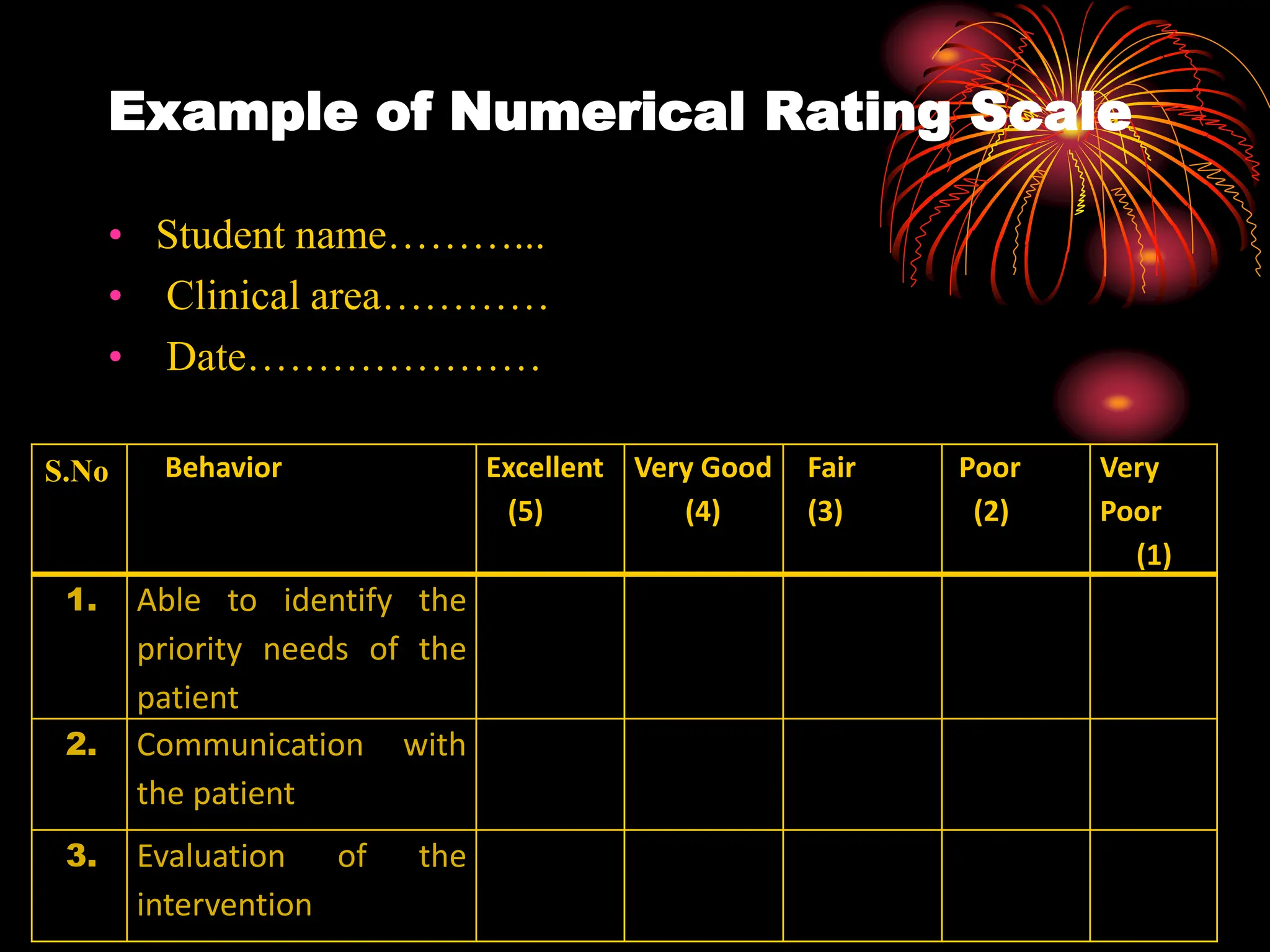
Example of Numerical Rating Scale
• Student name………...
• Clinical area…………
• Date…………………
S.No Behavior Excellent
(5)
Very Good
(4)
Fair
(3)
Poor
(2)
Very
Poor
(1)
1. Able to identify the
priority needs of the
patient
2. Communication with
the patient
3. Evaluation of the
intervention
Cont…….
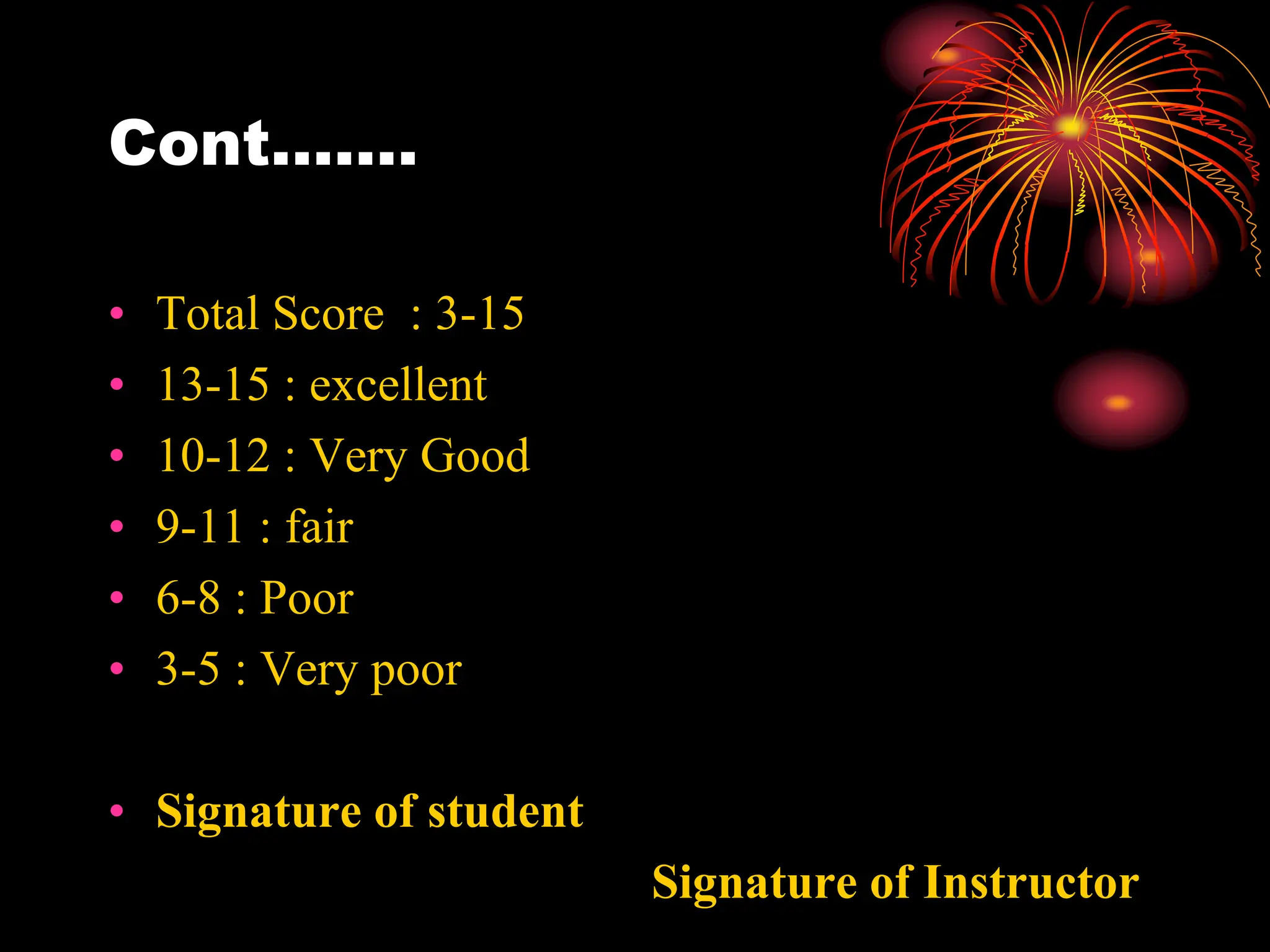
• Total Score : 3-15
• 13-15 : excellent
• 10-12 : Very Good
• 9-11 : fair
• 6-8 : Poor
• 3-5 : Very poor
• Signature of student
Signature of Instructor
3.GRAPHIC RATING SCALE
• It has descriptive phrases printed
horizontally at various points . The
rater indicates the performer’s
standing in respect of each trait by
placing a check mark at an
appropriate point along the line .
USES OF RATING SCALE
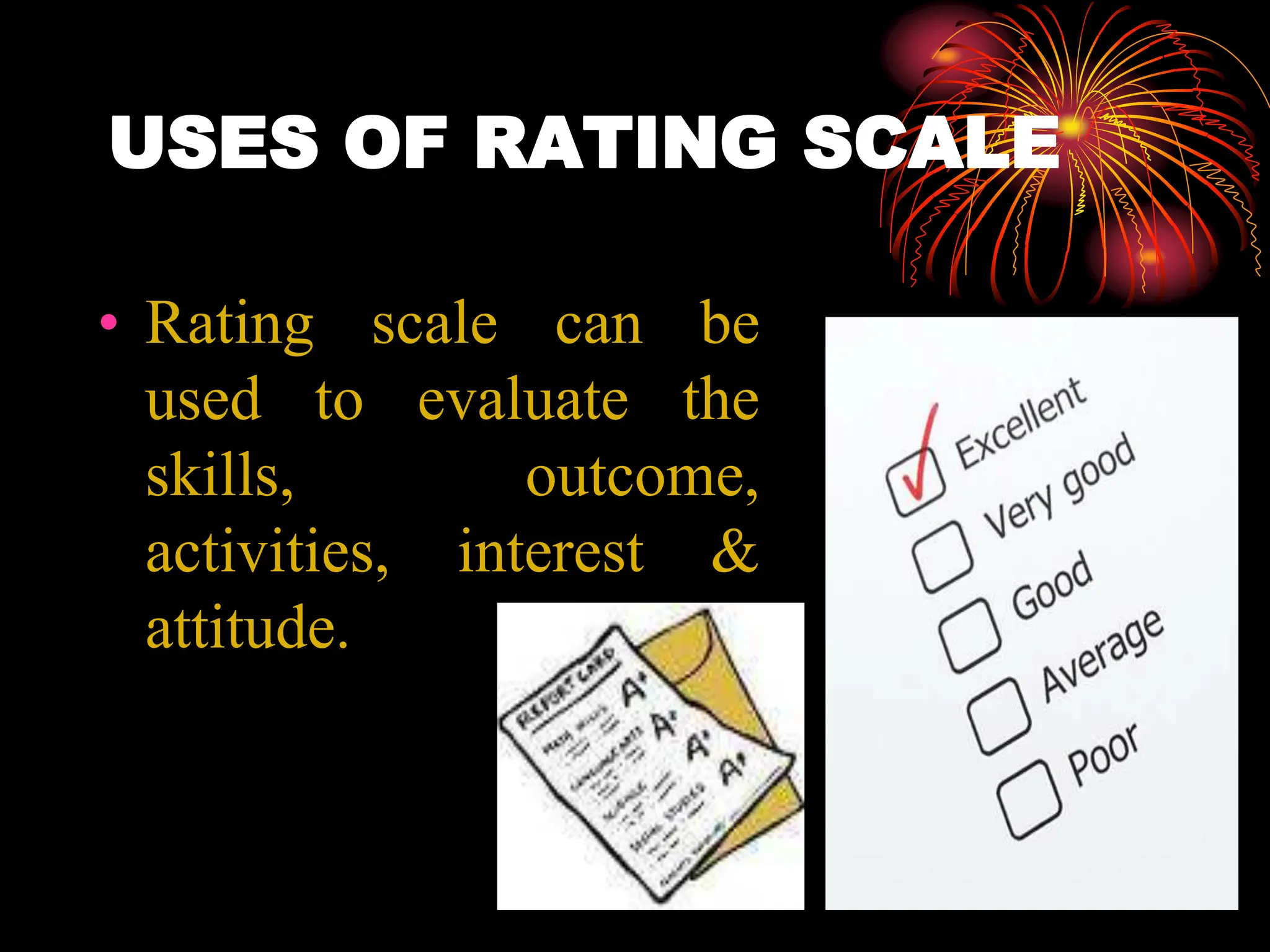
• Rating scale can be
used to evaluate the
skills, outcome,
activities, interest &
attitude.
ADVANTAGES
• Rating scale is a standard device which
records qualitative and quantitative
judgment of the observed performance.
• Measures specified outcome.
• It is easy to administer & score.
• It can be used for large group of students.
• Immediate feedback can be provided to
the students.
PRINCIPLES
• Directly related to
learning objectives.
• Be confined to those
performance areas that
can be observed.
• Provide 3 to 7 rating
positions.
Cont……
• Be oriented to specific scale as well as
the process of rating in general .
• The rater should be unbiased &
trained .
• Consider evaluation setting , feedback
& student participation.
• Have expert & well informed raters
SUMMARIZATION
Today we have discussed about –
• Introduction of checklist & rating scale
• Definition of checklist
• Points to be remember while preparing checklist
• Advantages of checklist
• Definition of rating scale
• Types of rating scale
• Uses of rating scale
• Advantages of rating scale
RECAPTUALIZATION
• Checklist is a ...................... tool.
• ................. ,.............. &................. are the
types of rating scale.
True/False
• Rating scale can be used for large group of
students.
( true/false)
BIBLIOGRAPHY
• Neeraja KP “Textbook of Nursing education” published by
JayPee publishers edition 7th , page no.- 206 to 211
• Sharma Suresh K. “Communication & Educational
Technology” published by Elsevier publications, edition 1st
,page no.- 295,301-302
• Patidar Anurag Bhai “Communication & Nursing
Education, published by Pearson publications, edition 1st ,
page no.- 166
• Dr. J.S.Walia “ Educational Technology” published by
Ahim Paul publishers, edition 2011, page no.- 47
THANK YOU

Power point presentation on CHECKLIST.ppt

  • 1.
  • 2.
    INTRODUCTION • Checklist &Rating scale both are the types of evaluation tools. These are the tools which are used for the evaluation of skills.
  • 3.
    CHECKLIST • It consistsof listing of step activities or behavior which observer records when incident occurs. It is a two – dimensional tool used to assess & record the presence & absence of behavior , trait or activity , when the incident had occurred. E.g - checklist for oral medications.
  • 4.
    CHECKLIST FOR ORAL MEDICATIONS S.NoSteps Yes No 1. 2. 3. 4. 5. 6. 7. 8. 9. 10. •Wash hands • Recall safety measures • Locate drug , read the label on exact bottle & see that it is the right medicine • Collect medicine into the container • Take tablets / capsule into the medicine cup • Identify the patient from the patient chart • Explain the procedure • Position the patient comfortably in upright sitting position • Administer each drug separately Record the drug given, detail the dose , route, date & time , signature etc. • Clean & replace the articles.
  • 5.
    POINTS TO BEREMEMBER TO PREPARE CHECKLIST • Express each item in clear and simple language. • Avoid negative statements. • Clearly specify characteristics of behavior to be observed. • Observe one student at time.
  • 6.
    Cont………. • Have aseparate checklist for each student. • Observer must be trained in WHO,WHAT & HOW to record and observed.
  • 7.
    ADVANTAGES OF CHECKLIST •Adaptable to most subject matter that are observable. • Can evaluate learning activities in relation to procedure , process , personal trait or characteristics.
  • 8.
    RATING SCALE • Ratingscale is the technique in which individuals are rated on scale from low to high with respect to particular trait.
  • 9.
    Cont……. • It isthe judgment of one person by another. It provides the scope of quantification of the judgment in relation to n observed behavior of the student .
  • 10.
    Example • A ratingscale may have 5-7 points of rating in the form of abstract label (quantitative) along with their descriptions. For e.g. A,B,C,D,E or 5,4,3,2,1. Superior - 5 Above average - 4 Average - 3 Poor - 2 Very poor - 1
  • 11.
    TYPES OF RATINGSCALE There are three types of rating scale – • Descriptive rating scale • Numerical rating scale • Graphic rating scale
  • 12.
    1.DESCRIPTIVE RATING SCALE •It provides for each trait a list of descriptive phrases from which the rater selects the one most applicable to the student & records his or her selection , usually by means of a tick mark.
  • 13.
    Example of Descriptiverating scale • Student Name ………….. • Clinical area …………… • Date ………………….. Rating Items Independent (3) Dependent (2) Partly Dependent(1) Behavior Problem solving skills Physical examination History Taking
  • 14.
    Cont……… • Independent –student is able to handle it on his / her own. • Partly Dependent – student is able to solve simple problems. • Dependent – student needs help in solving complex problems. • Total score – 4-12 • 10-12 : Superior • 7-9 : Above average • 4-6 : Average , needs improvement • Signature of the supervisor Date:-……………….
  • 15.
    2.NUMERICAL RATING SCALE •The rater assigns a code number (which refers to descriptive phrase ),to each trait of a person being rated. Code numbers are assigned to the descriptive phrases, arranged in order of degree or level at which they indicate lack of occurrence of each trait.
  • 16.
    Example of NumericalRating Scale • Student name………... • Clinical area………… • Date………………… S.No Behavior Excellent (5) Very Good (4) Fair (3) Poor (2) Very Poor (1) 1. Able to identify the priority needs of the patient 2. Communication with the patient 3. Evaluation of the intervention
  • 17.
    Cont……. • Total Score: 3-15 • 13-15 : excellent • 10-12 : Very Good • 9-11 : fair • 6-8 : Poor • 3-5 : Very poor • Signature of student Signature of Instructor
  • 18.
    3.GRAPHIC RATING SCALE •It has descriptive phrases printed horizontally at various points . The rater indicates the performer’s standing in respect of each trait by placing a check mark at an appropriate point along the line .
  • 19.
    USES OF RATINGSCALE • Rating scale can be used to evaluate the skills, outcome, activities, interest & attitude.
  • 20.
    ADVANTAGES • Rating scaleis a standard device which records qualitative and quantitative judgment of the observed performance. • Measures specified outcome. • It is easy to administer & score. • It can be used for large group of students. • Immediate feedback can be provided to the students.
  • 21.
    PRINCIPLES • Directly relatedto learning objectives. • Be confined to those performance areas that can be observed. • Provide 3 to 7 rating positions.
  • 22.
    Cont…… • Be orientedto specific scale as well as the process of rating in general . • The rater should be unbiased & trained . • Consider evaluation setting , feedback & student participation. • Have expert & well informed raters
  • 23.
    SUMMARIZATION Today we havediscussed about – • Introduction of checklist & rating scale • Definition of checklist • Points to be remember while preparing checklist • Advantages of checklist • Definition of rating scale • Types of rating scale • Uses of rating scale • Advantages of rating scale
  • 24.
    RECAPTUALIZATION • Checklist isa ...................... tool. • ................. ,.............. &................. are the types of rating scale. True/False • Rating scale can be used for large group of students. ( true/false)
  • 25.
    BIBLIOGRAPHY • Neeraja KP“Textbook of Nursing education” published by JayPee publishers edition 7th , page no.- 206 to 211 • Sharma Suresh K. “Communication & Educational Technology” published by Elsevier publications, edition 1st ,page no.- 295,301-302 • Patidar Anurag Bhai “Communication & Nursing Education, published by Pearson publications, edition 1st , page no.- 166 • Dr. J.S.Walia “ Educational Technology” published by Ahim Paul publishers, edition 2011, page no.- 47
  • 26.