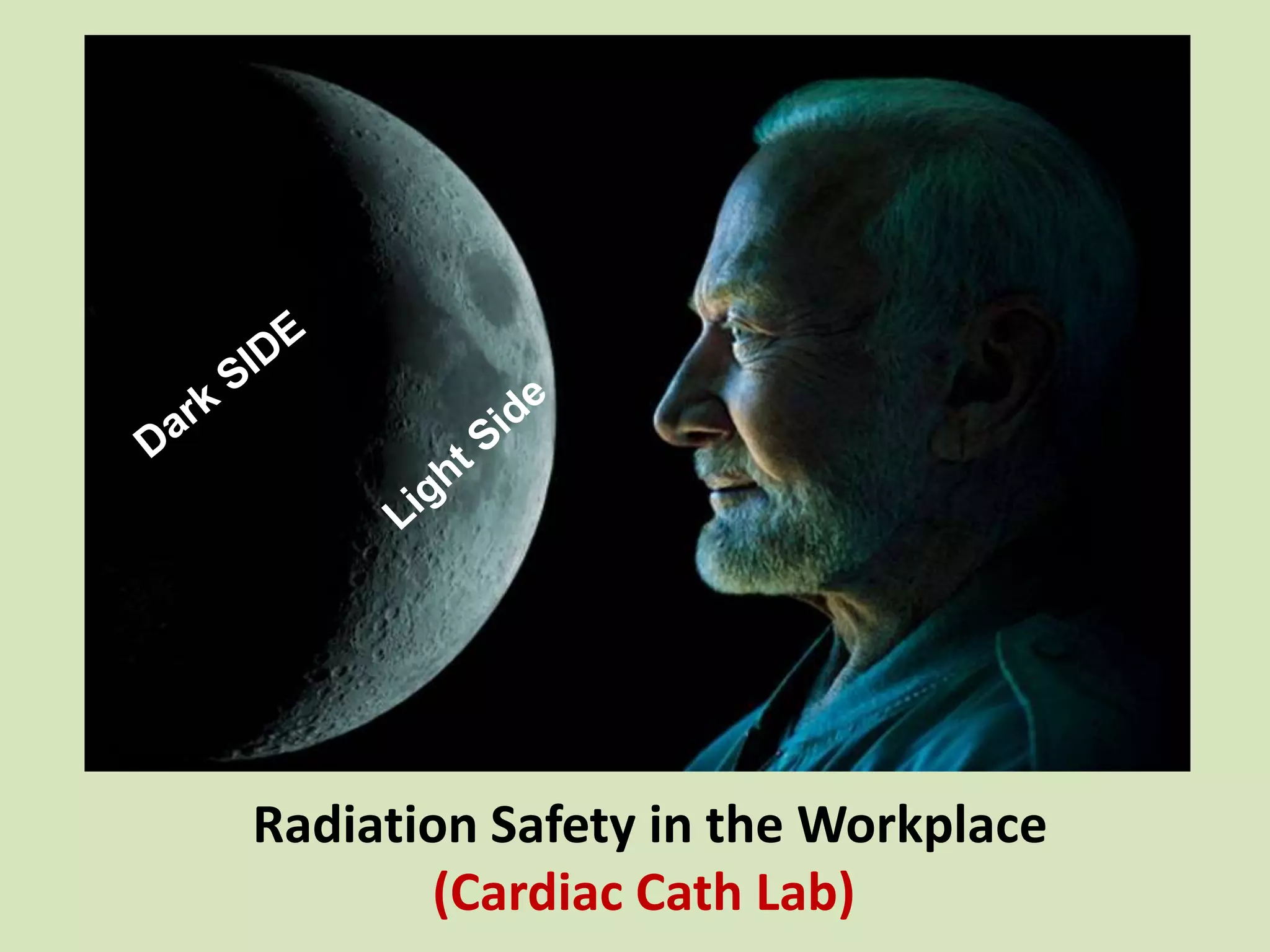
Radiation Safety in the Workplace
(Cardiac Cath Lab)
Magdy El-Masry
Prof. of Cardiology
Tanta University
Ionizing Radiation Can be
Harmful: Nothing New
What you need to know?
Quick ABC’s of X-ray
Occupational Risks In Cath Lab
Radiation Safety Basics
Optimizing Radiation Safety in Cath Lab
What you need to know?
Quick ABC’s of X-ray
Occupational Risks In Cath Lab
Radiation Safety Basics
Optimizing Radiation Safety in Cath Lab
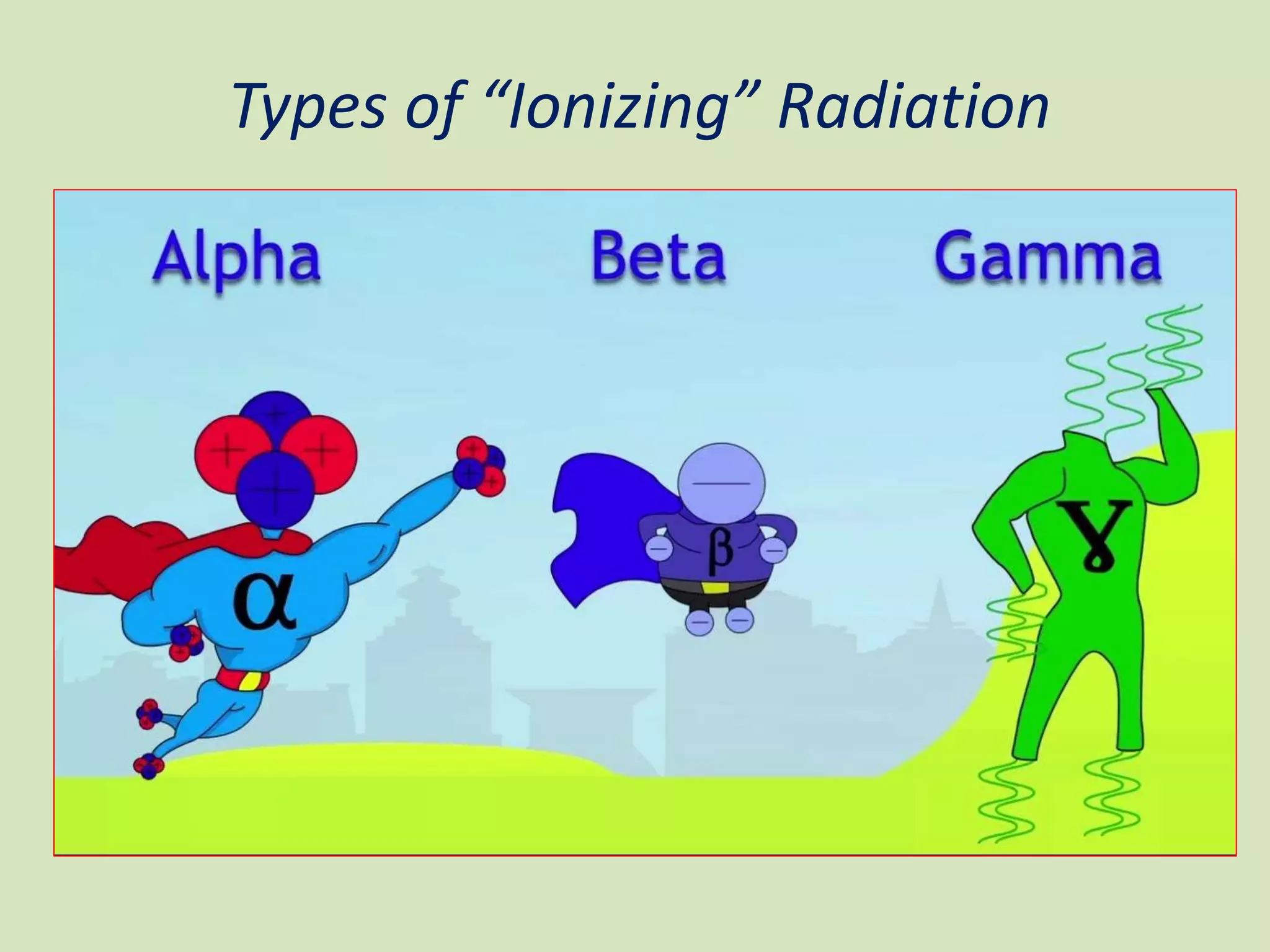
Types of “Ionizing” Radiation
These types of radiation are called “ionizing” radiation, because they have
enough energy to knock an electron out of its orbit around an atom – creating an ion.
Penetrating capacity of different types of radiation
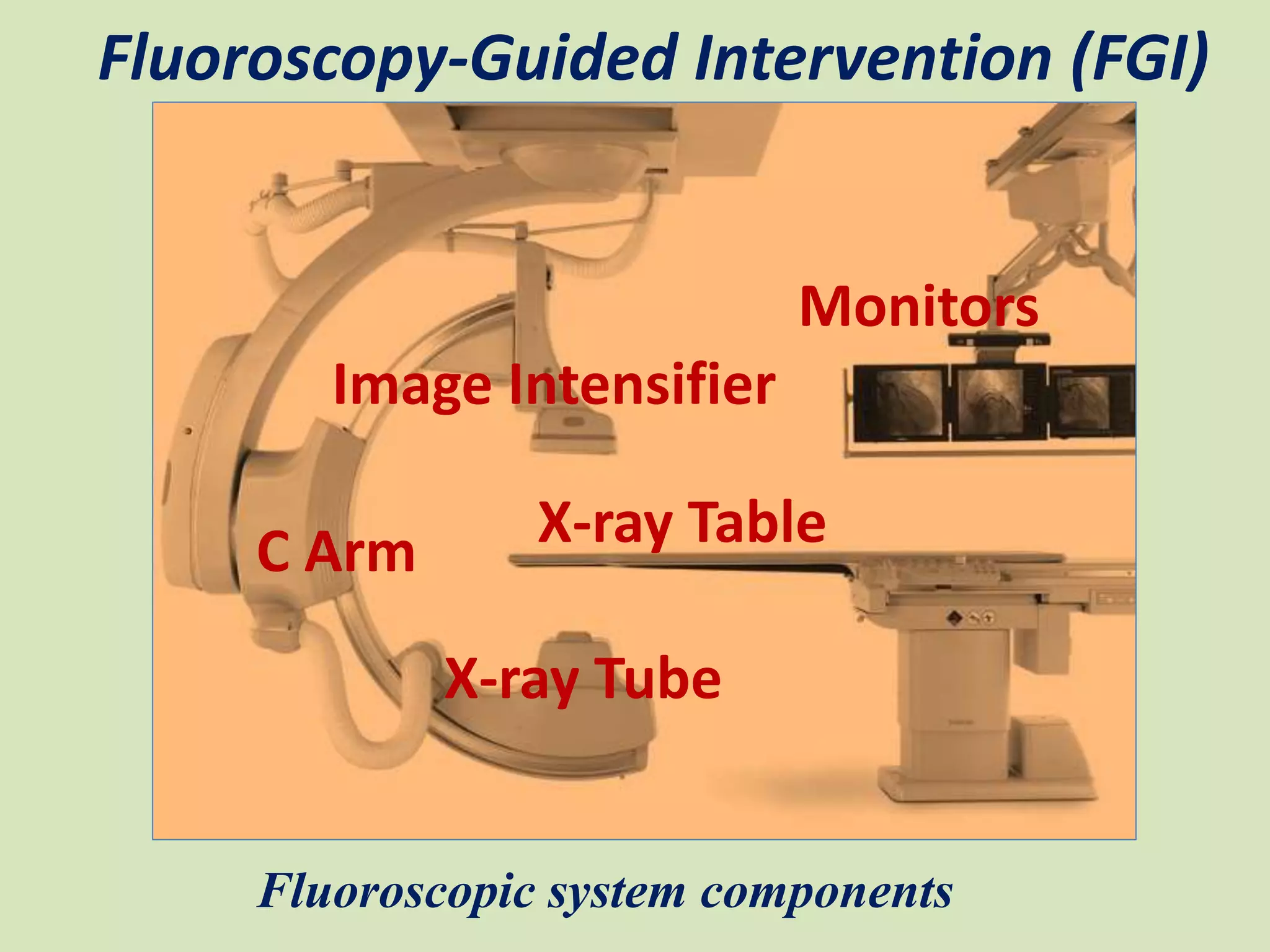
Fluoroscopic system components
C Arm
Image Intensifier
X-ray Tube
Monitors
X-ray Table
Fluoroscopy-Guided Intervention (FGI)
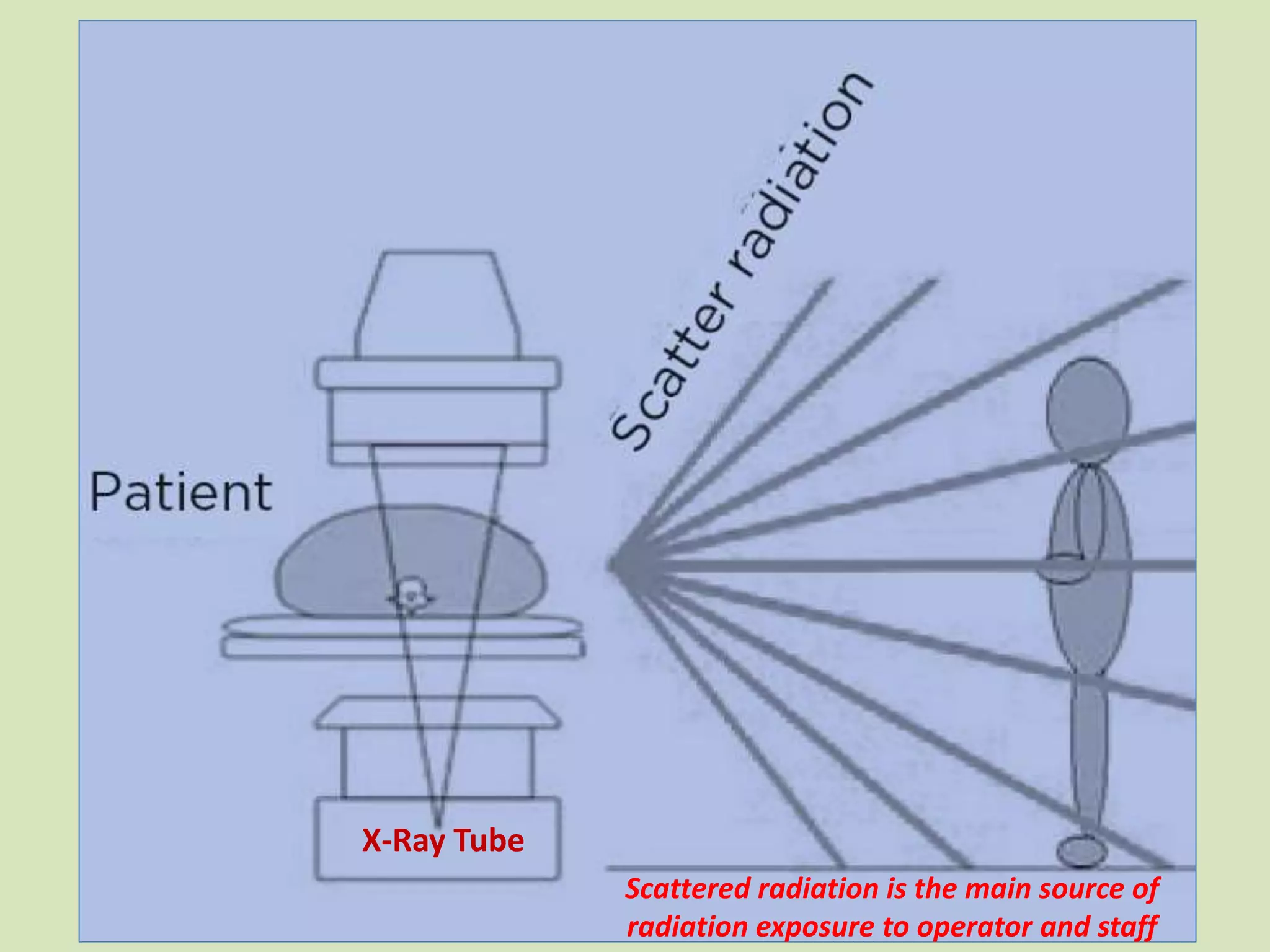
X-Ray Tube
Scattered radiation is the main source of
radiation exposure to operator and staff
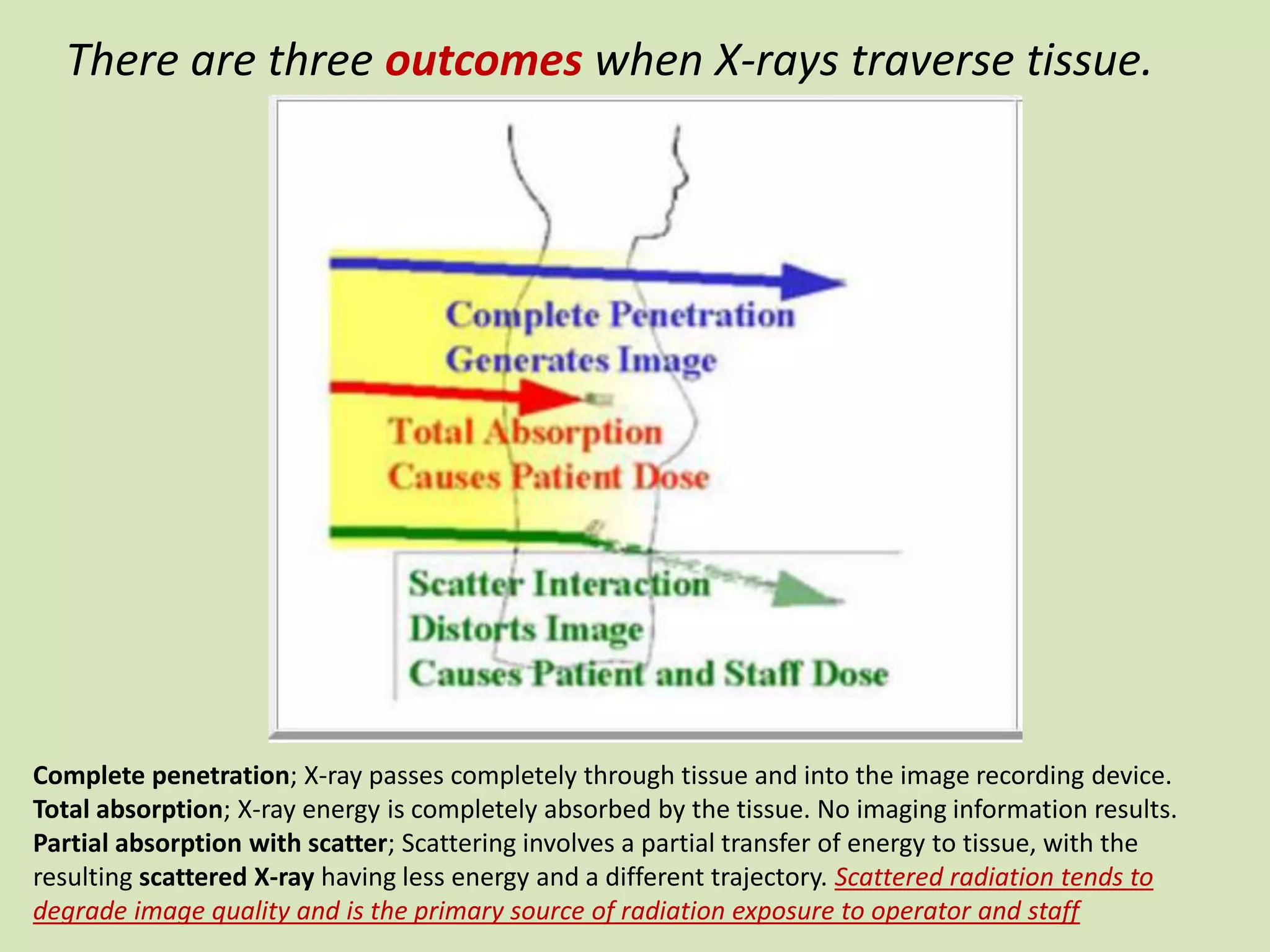
Complete penetration; X-ray passes completely through tissue and into the image recording device.
Total absorption; X-ray energy is completely absorbed by the tissue. No imaging information results.
Partial absorption with scatter; Scattering involves a partial transfer of energy to tissue, with the
resulting scattered X-ray having less energy and a different trajectory. Scattered radiation tends to
degrade image quality and is the primary source of radiation exposure to operator and staff
There are three outcomes when X-rays traverse tissue.
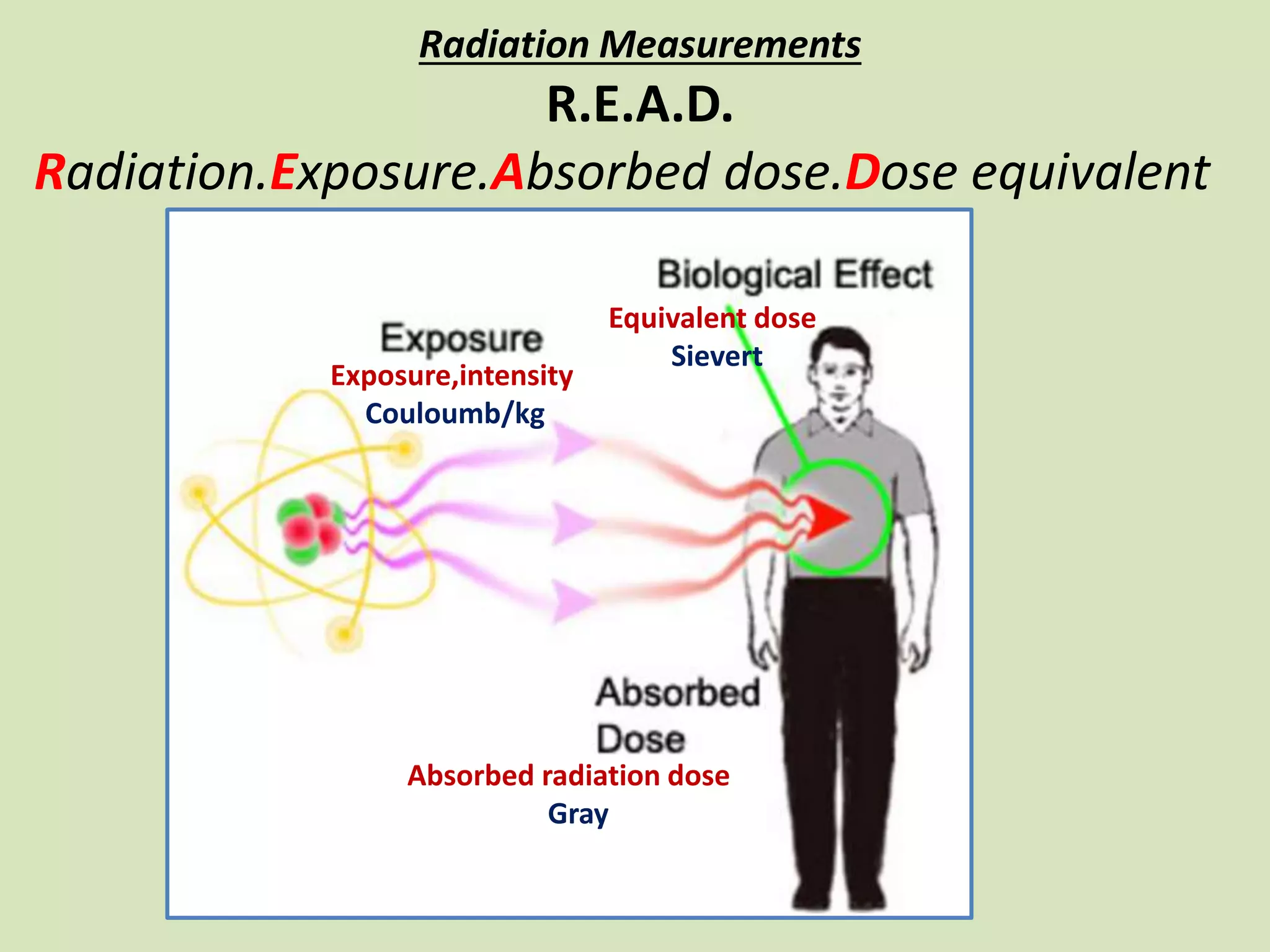
Exposure,intensity
Couloumb/kg
Absorbed radiation dose
Gray
Equivalent dose
Sievert
Radiation Measurements
R.E.A.D.
Radiation.Exposure.Absorbed dose.Dose equivalent
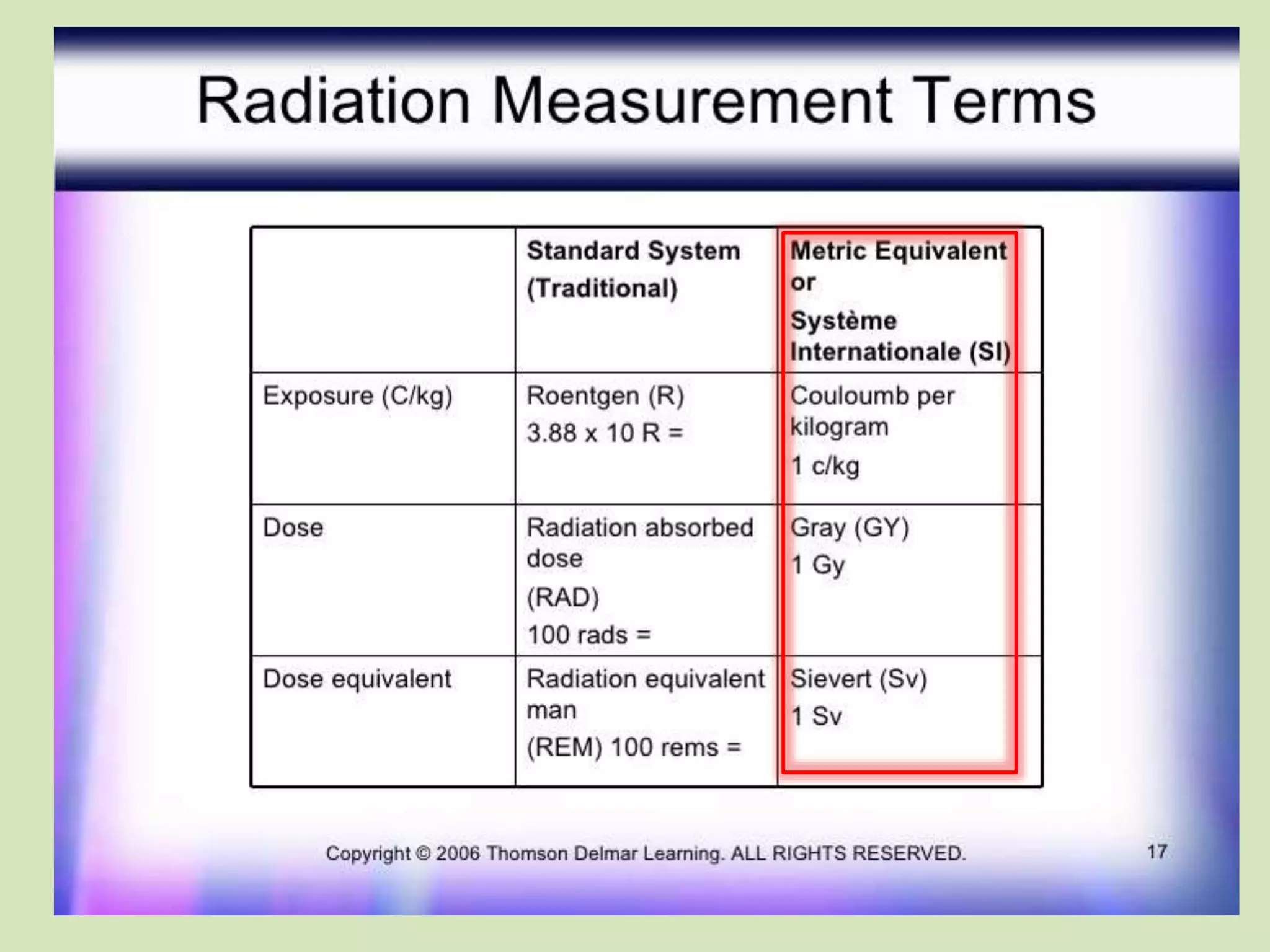
SI
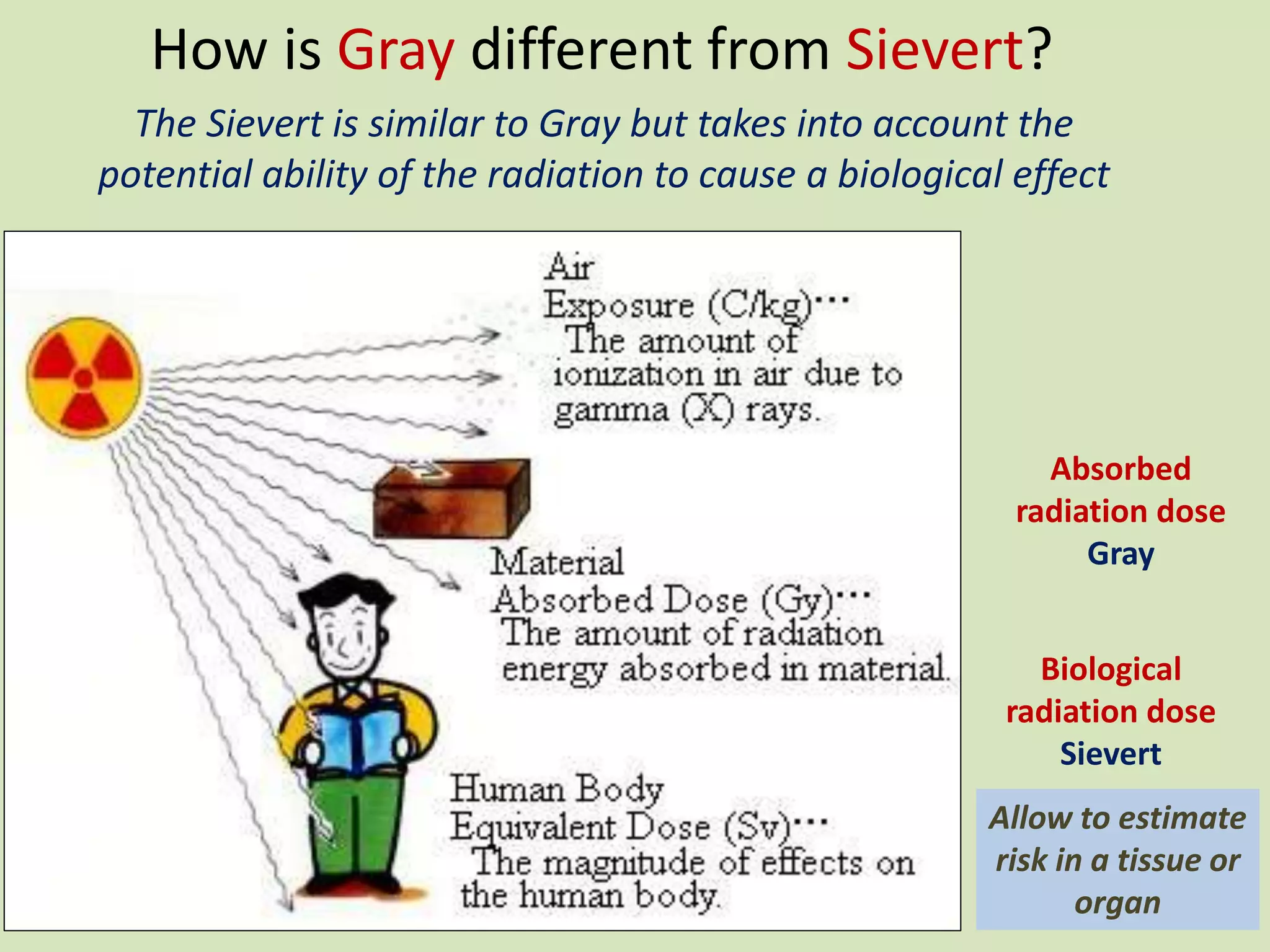
How is Gray different from Sievert?
Absorbed
radiation dose
Gray
Biological
radiation dose
Sievert
Allow to estimate
risk in a tissue or
organ
The Sievert is similar to Gray but takes into account the
potential ability of the radiation to cause a biological effect
What you need to know?
Quick ABC’s of X-ray
Occupational Risks In Cath Lab
Radiation Safety Basics
Optimizing Radiation Safety in Cath Lab
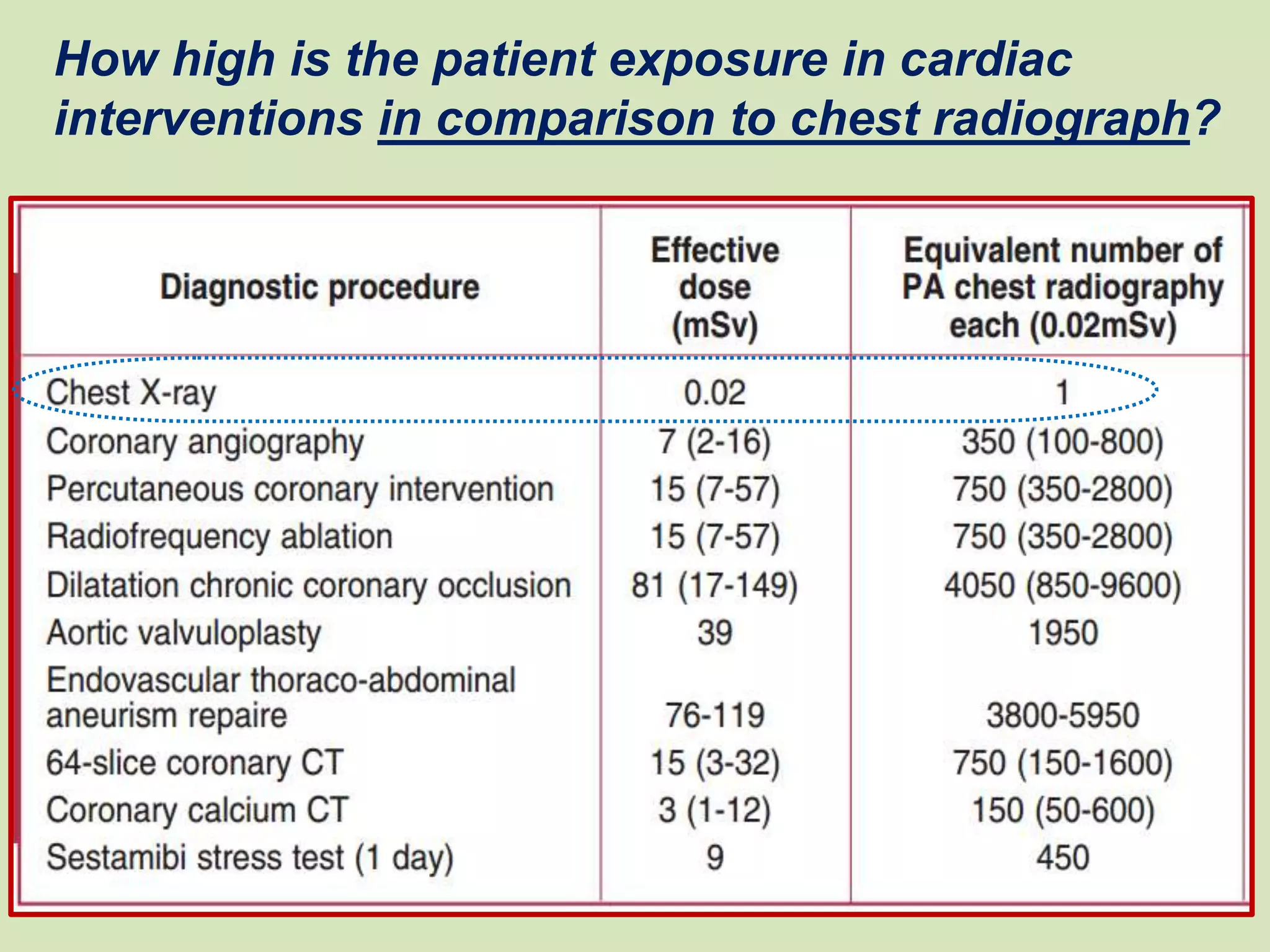
How high is the patient exposure in cardiac
interventions in comparison to chest radiograph?
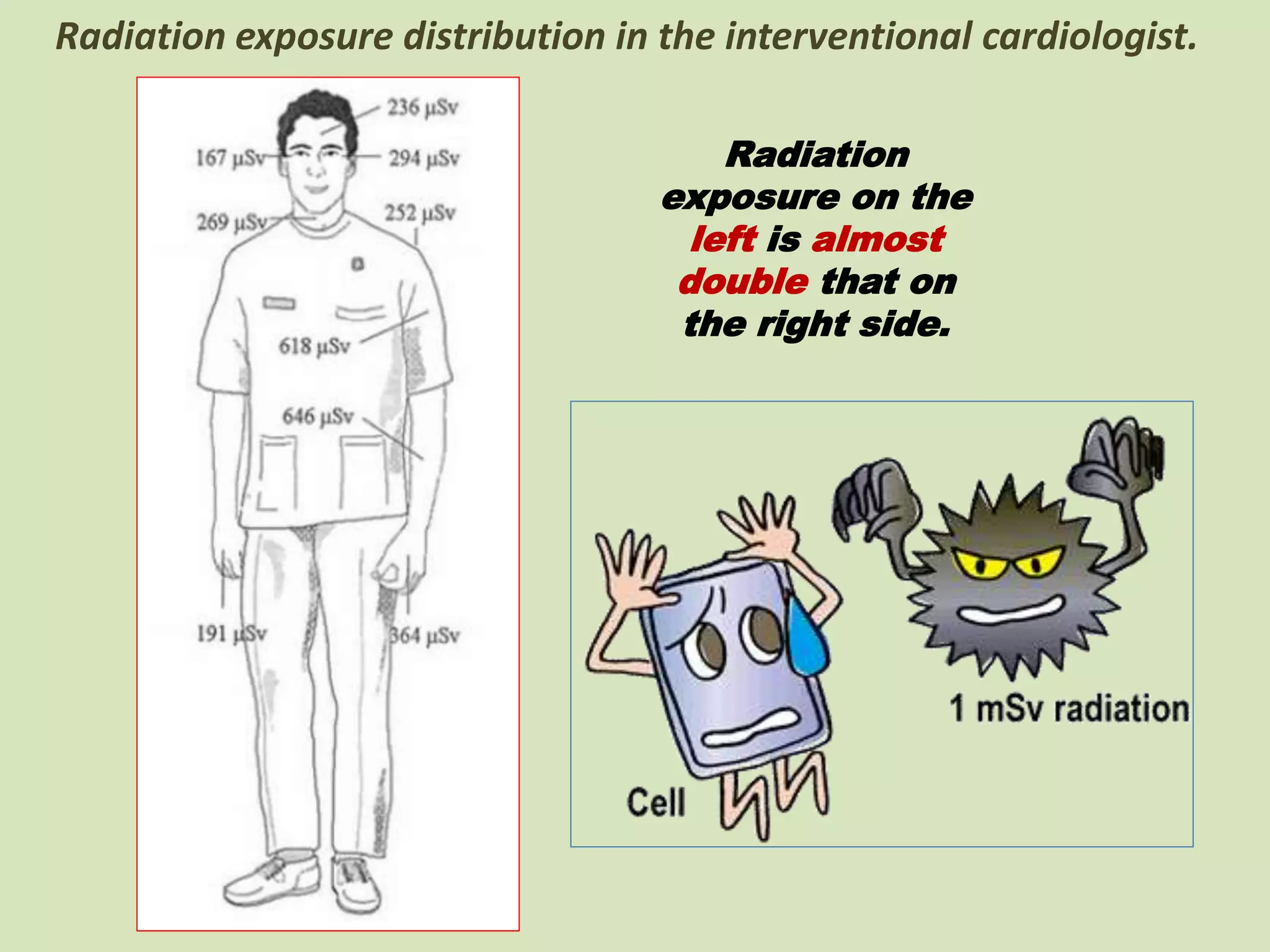
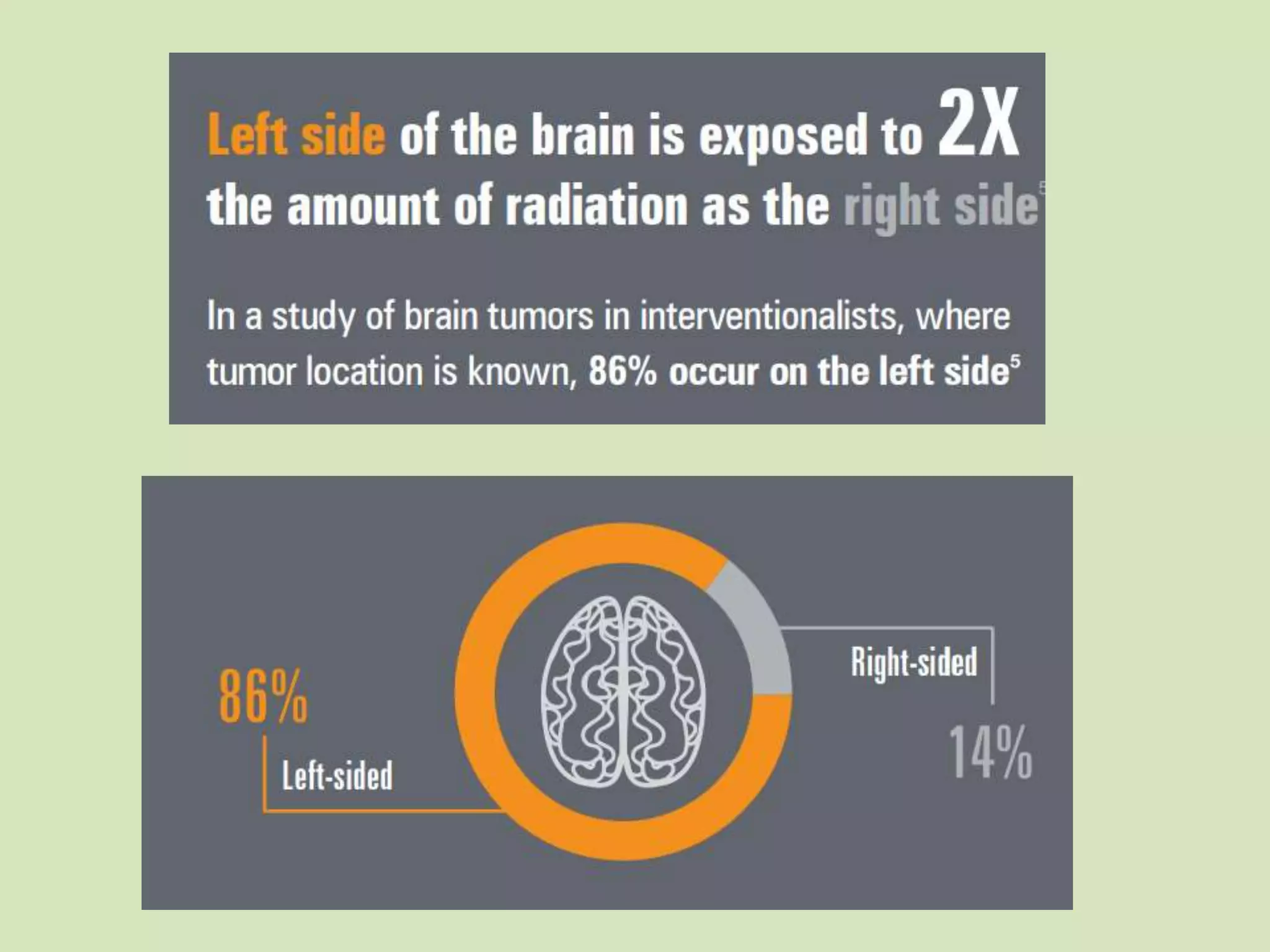
Radiation exposure distribution in the interventional cardiologist.
Radiation
exposure on the
left is almost
double that on
the right side.
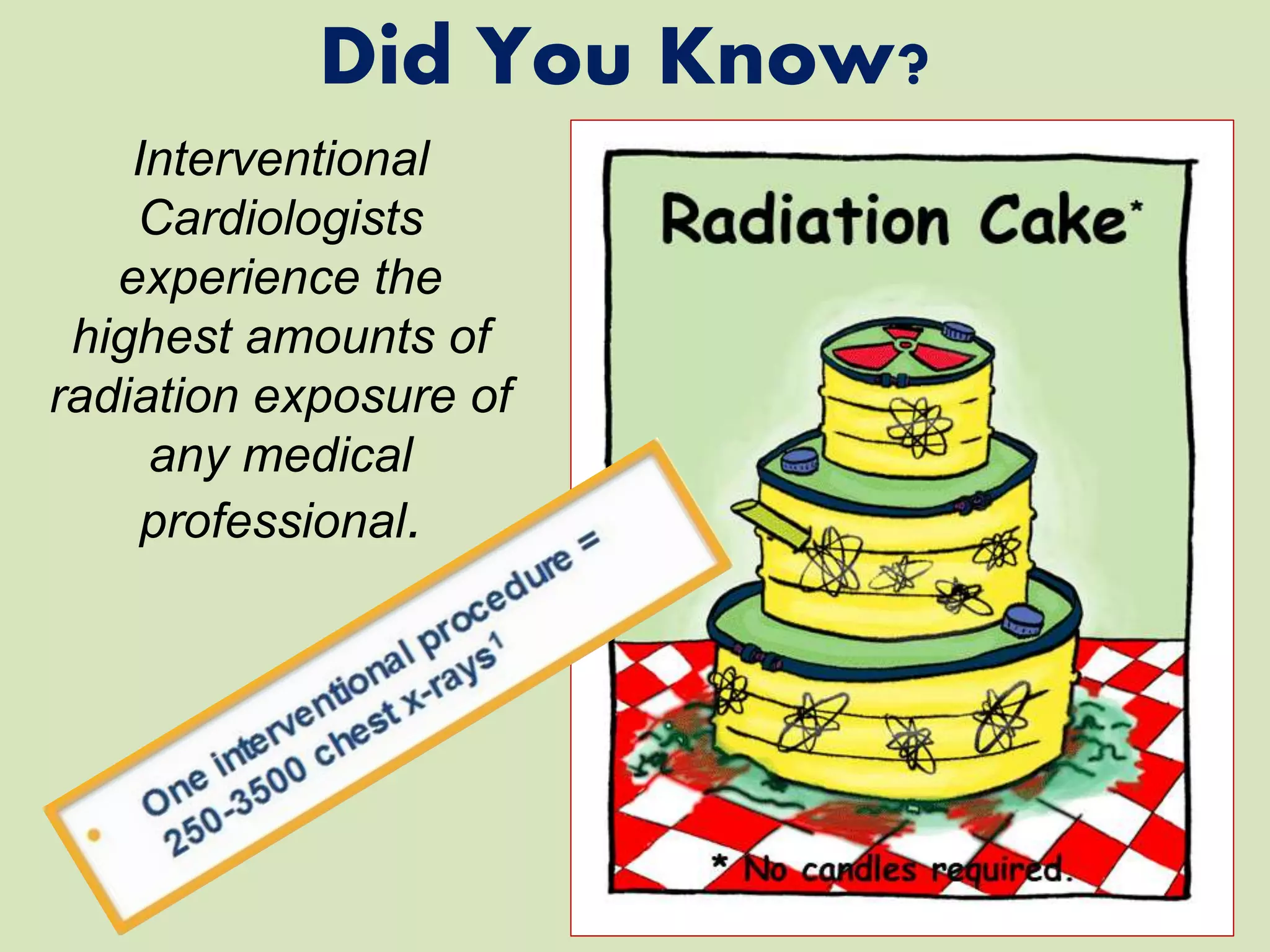
Did You Know?
Interventional
Cardiologists
experience the
highest amounts of
radiation exposure of
any medical
professional.
Cardiac cath lab work carries multiple risks
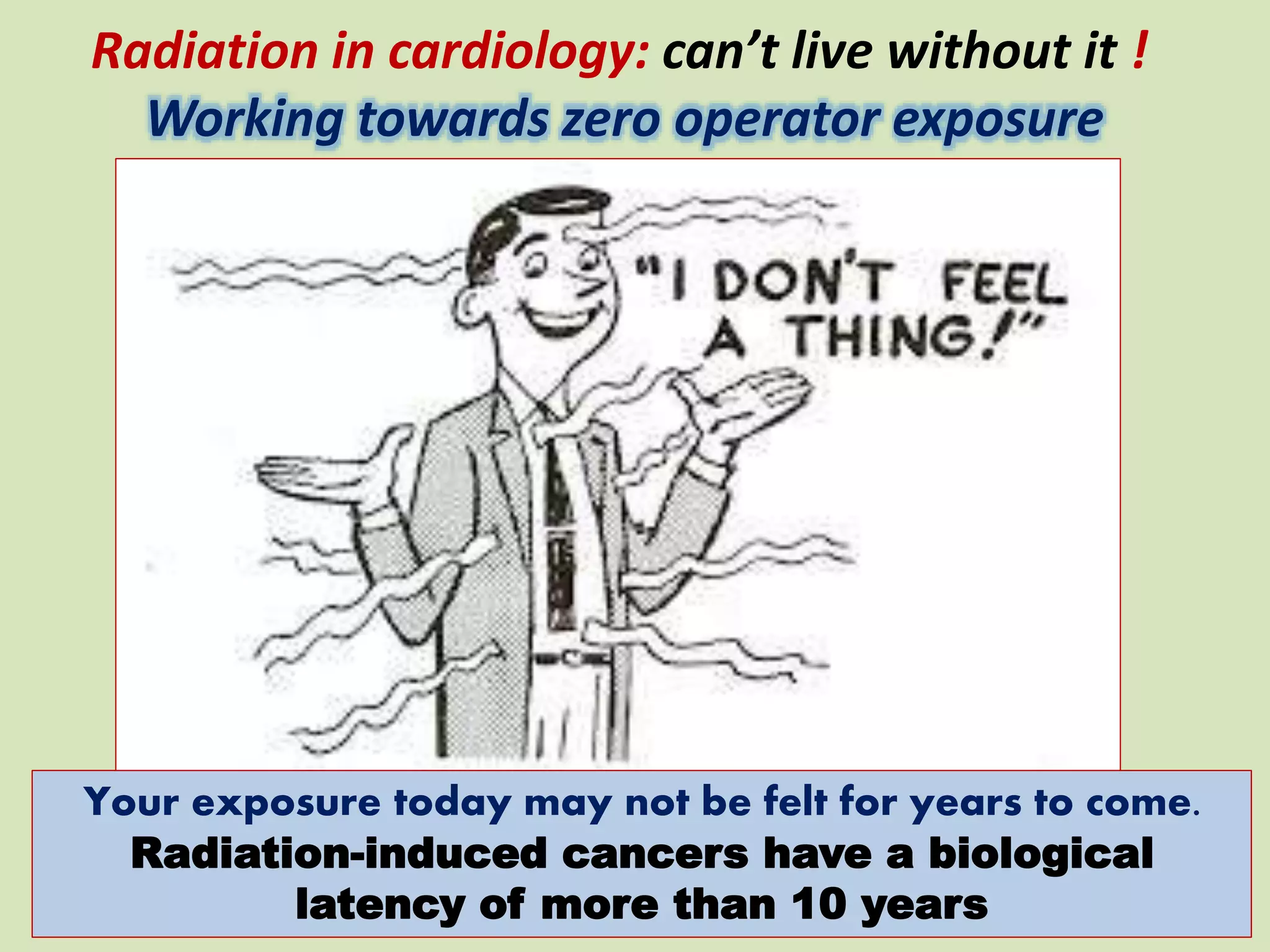
Your exposure today may not be felt for years to come.
Radiation-induced cancers have a biological
latency of more than 10 years
Radiation in cardiology: can’t live without it !
Working towards zero operator exposure
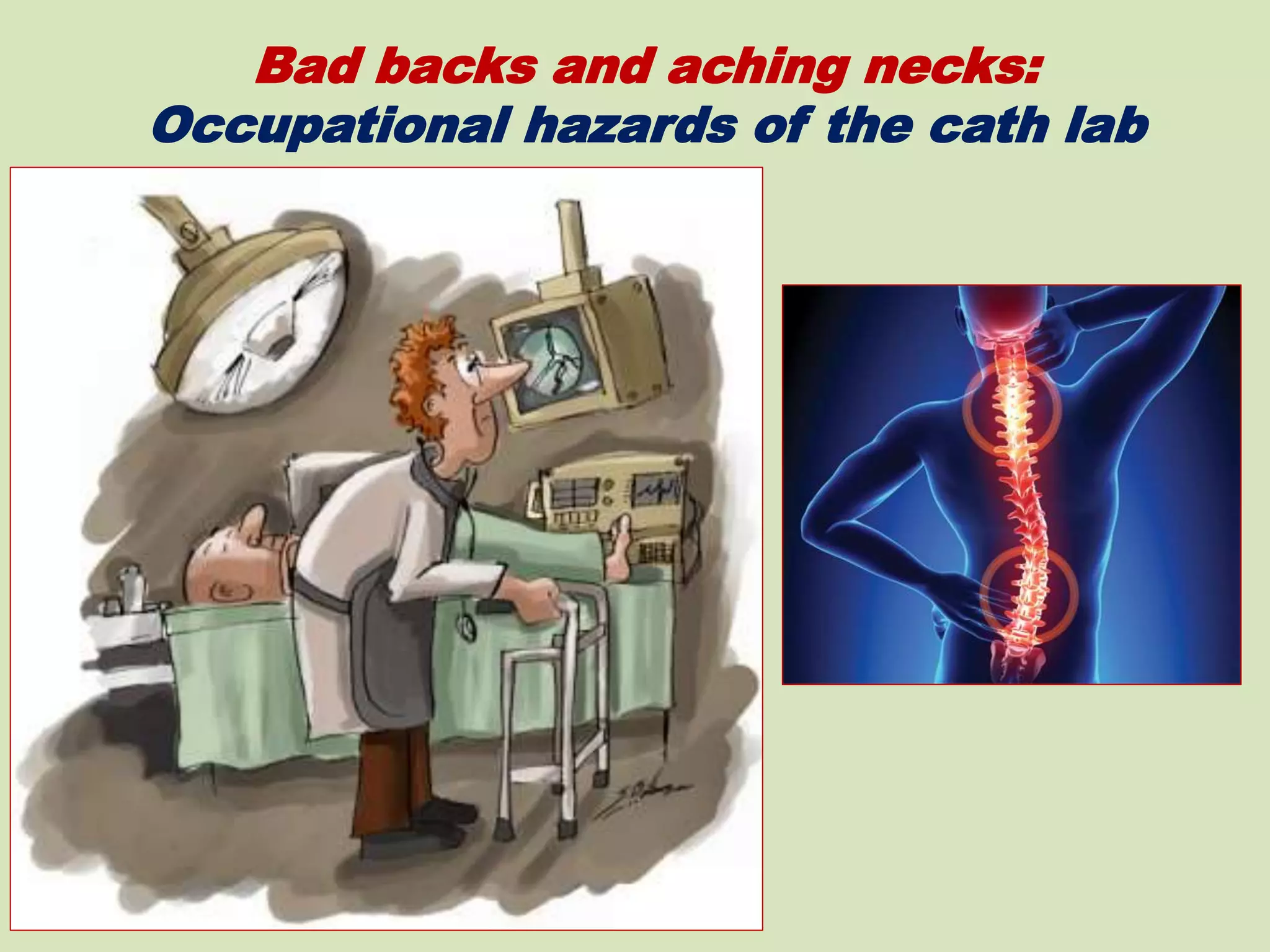
Bad backs and aching necks:
Occupational hazards of the cath lab
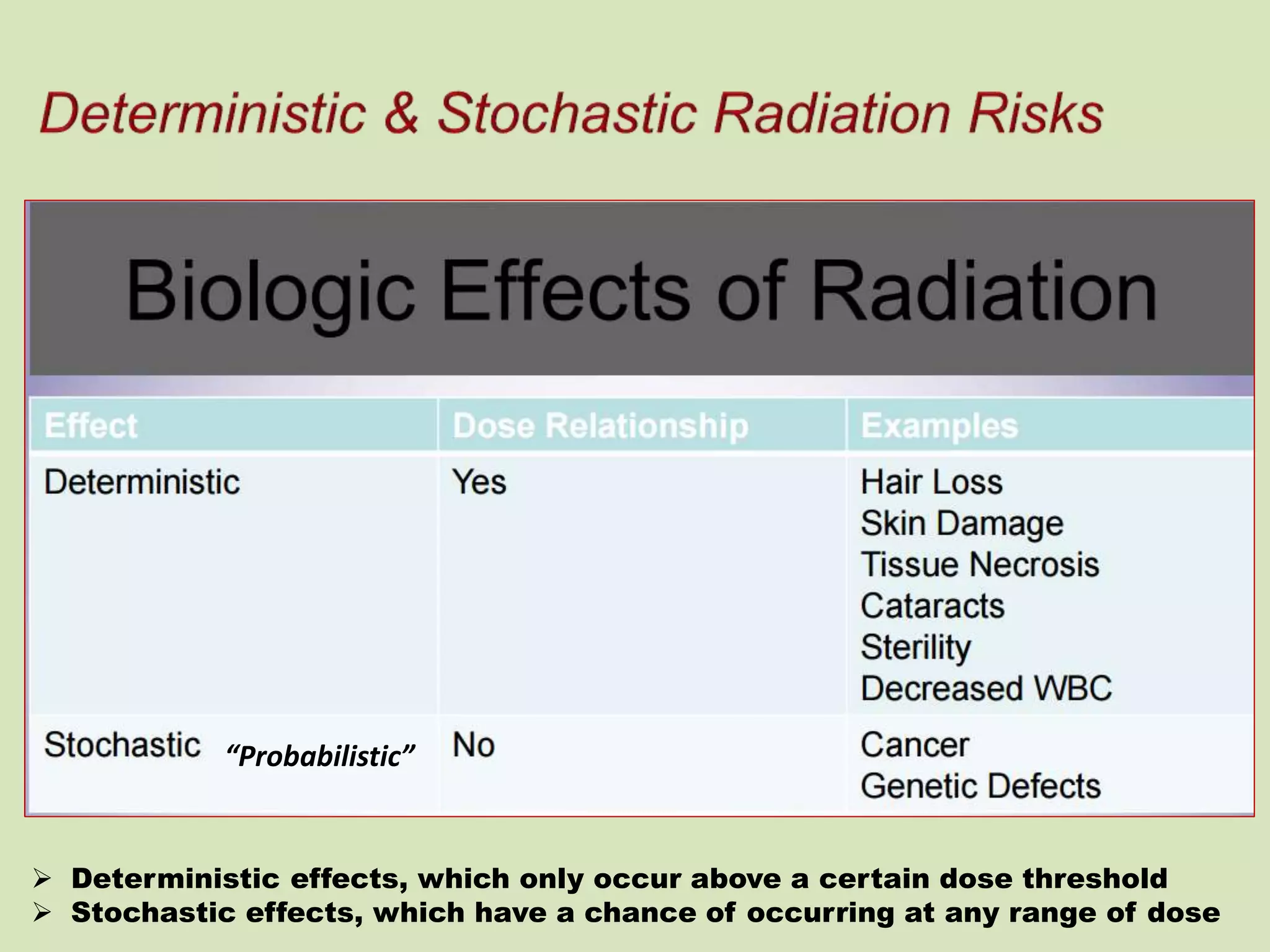
“Probabilistic”
 Deterministic effects, which only occur above a certain dose threshold
 Stochastic effects, which have a chance of occurring at any range of dose
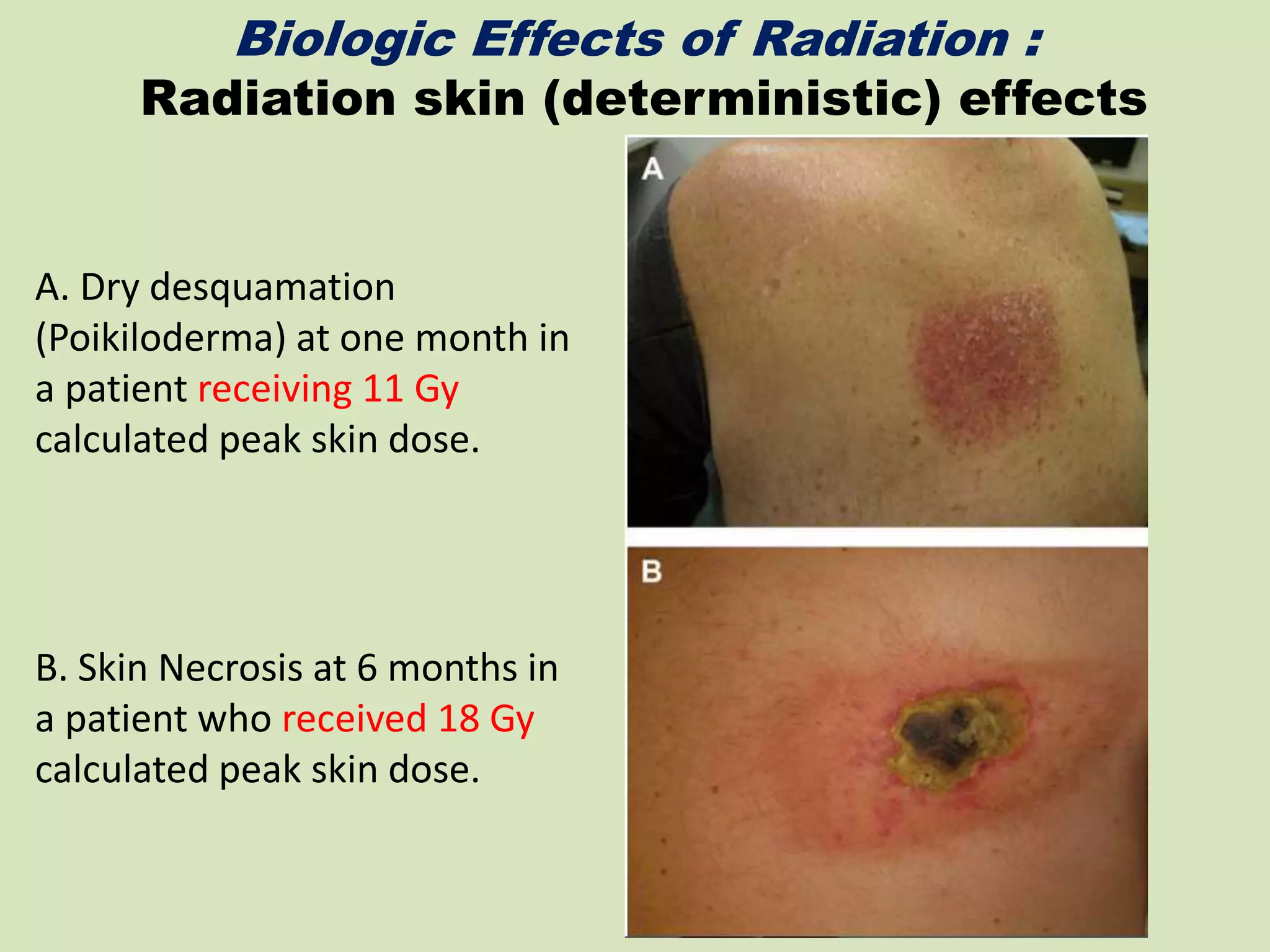
Biologic Effects of Radiation :
Radiation skin (deterministic) effects
A. Dry desquamation
(Poikiloderma) at one month in
a patient receiving 11 Gy
calculated peak skin dose.
B. Skin Necrosis at 6 months in
a patient who received 18 Gy
calculated peak skin dose.
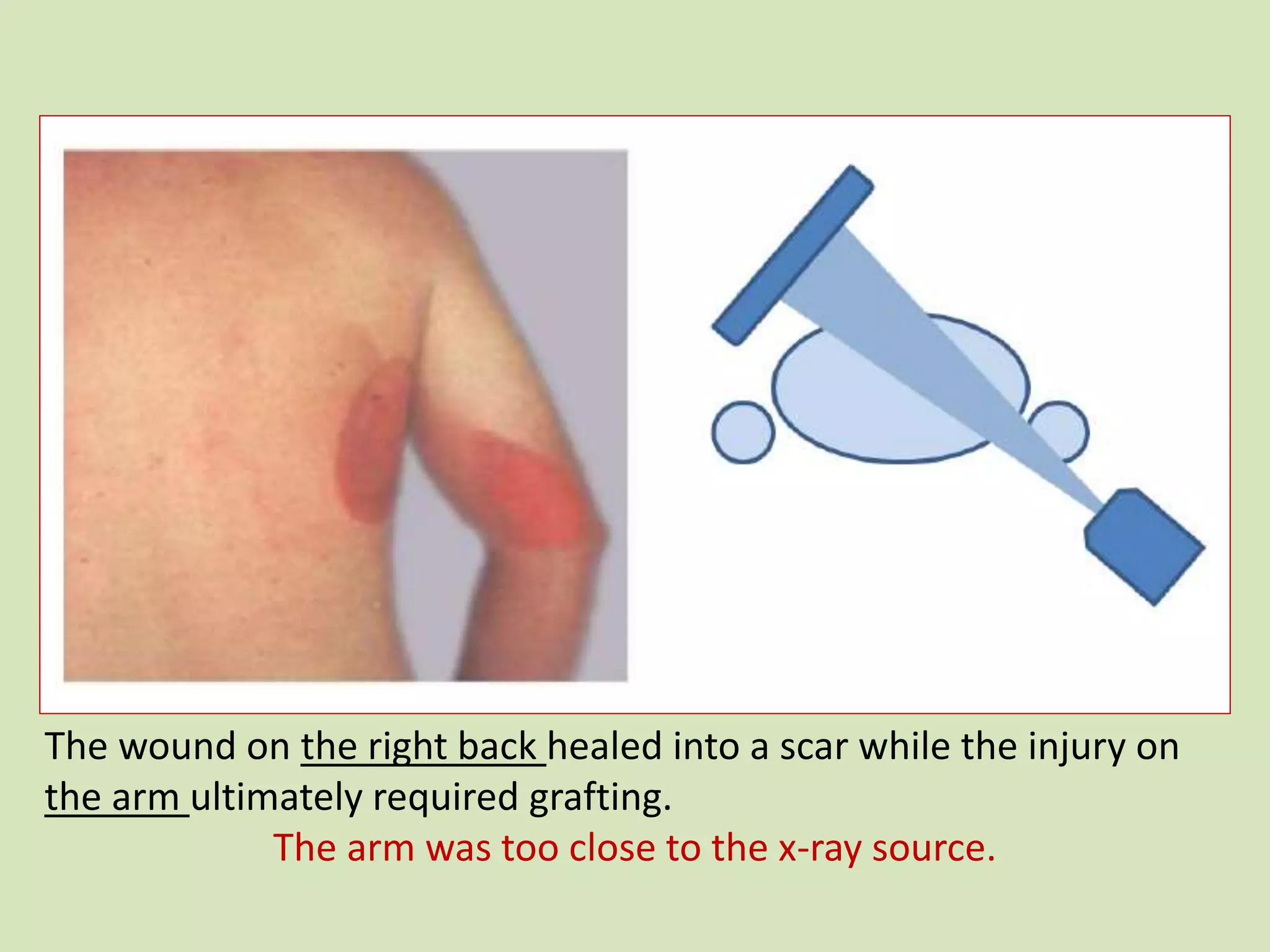
The wound on the right back healed into a scar while the injury on
the arm ultimately required grafting.
The arm was too close to the x-ray source.
Radiation can harm biological systems by damaging the DNA of cells.
If this damage is not properly repaired, the cells may divide in an uncontrolled
manner and cause cancer.
Biologic Effects of Radiation :
Cancer-inducing (Stochastic)
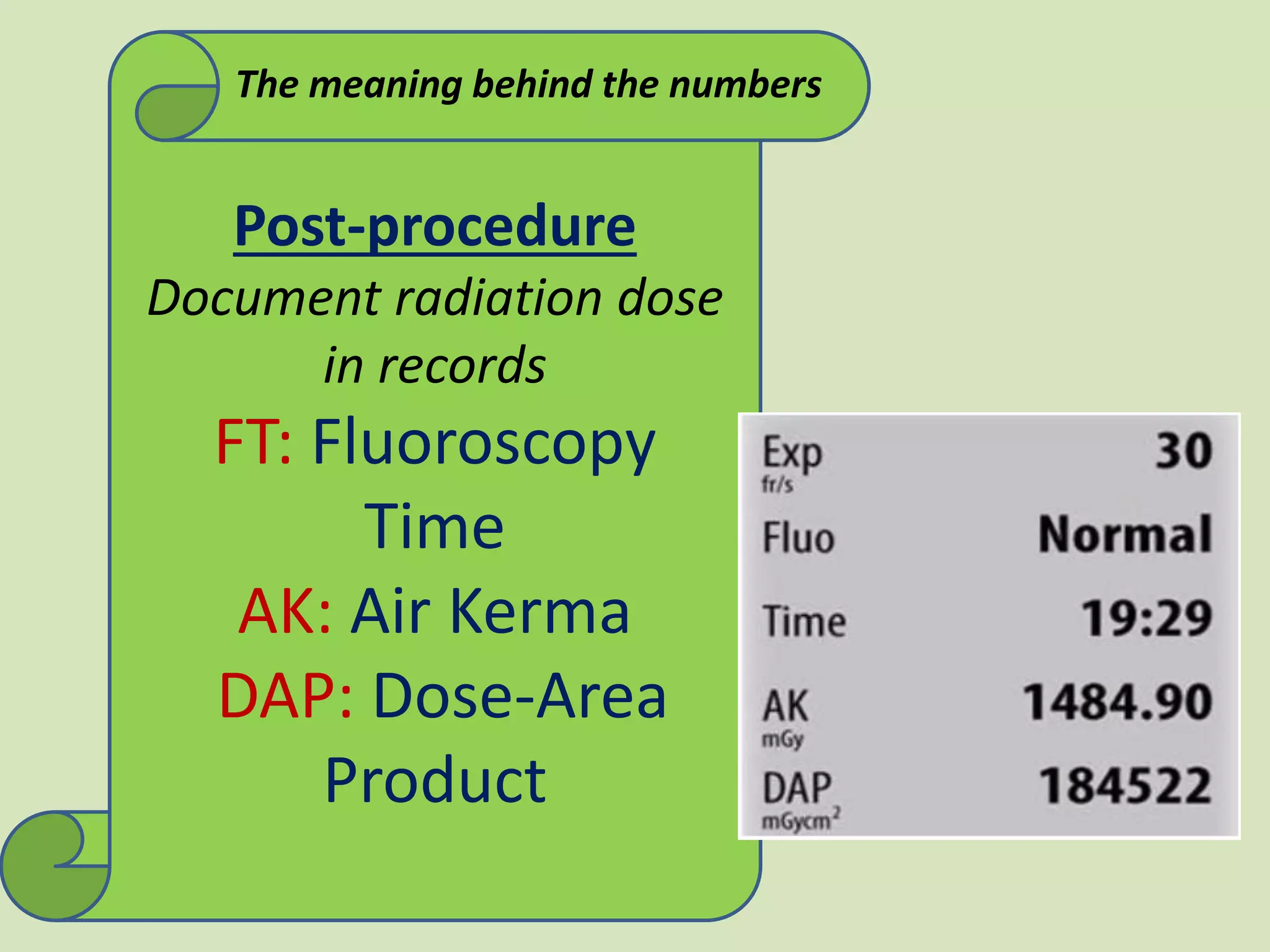
Post-procedure
Document radiation dose
in records
FT: Fluoroscopy
Time
AK: Air Kerma
DAP: Dose-Area
Product
The meaning behind the numbers
Dose exposure is described in terms of the following
parameters
Fluoroscopic Time (min): This is the time during a procedure that fluoroscopy
is used but does not include cine acquisition imaging. Therefore,
considered alone, it tends to underestimate the total
radiation dose received.
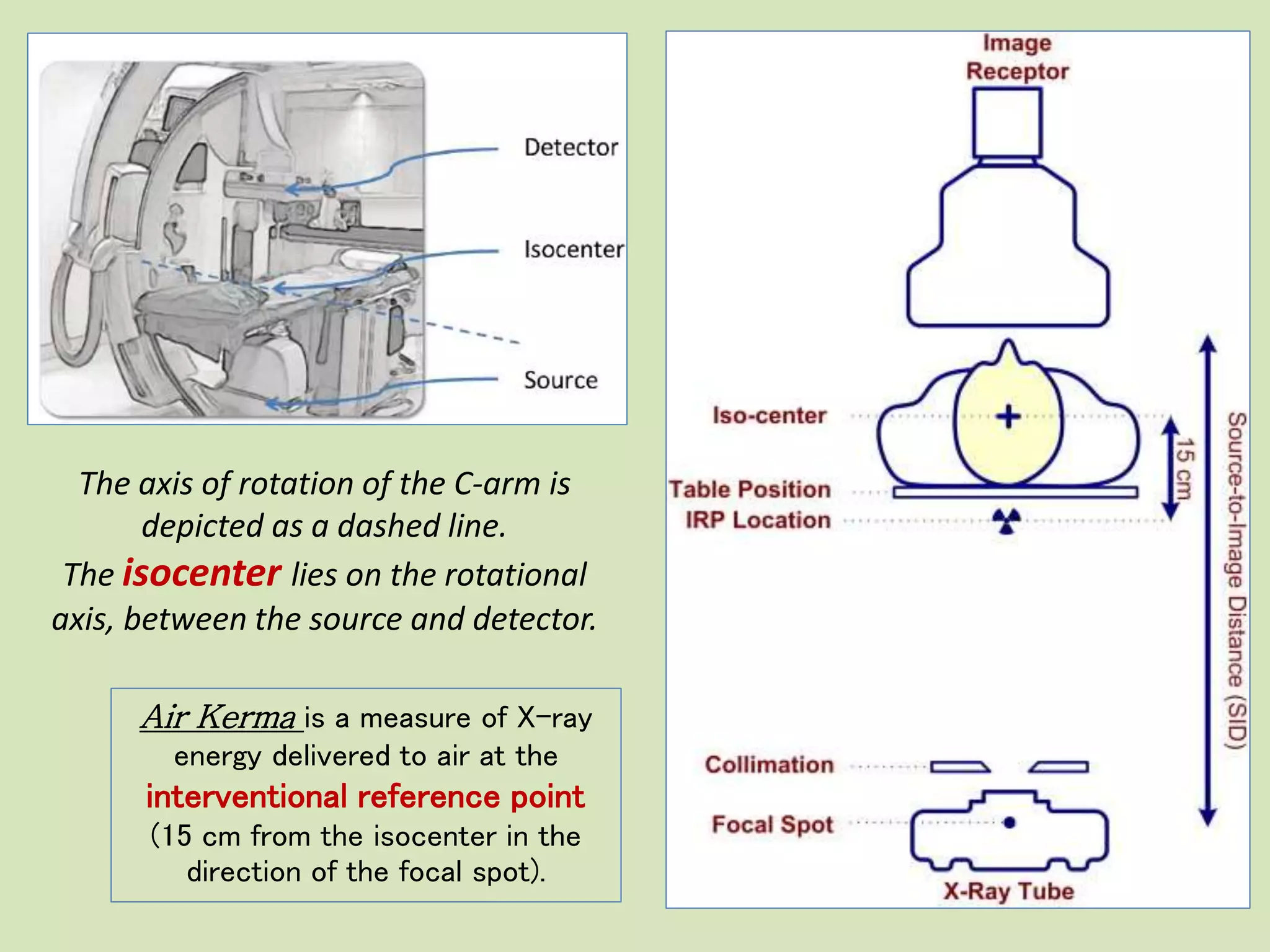
Air Kerma (Gy): The cumulative air kerma is a measure of X-ray energy
delivered to air at the interventional reference point (15 cm from the
isocenter in the direction of the focal spot). Kerma (Kinetic Energy Released in MAtter)
This measurement has been closely associated with
deterministic skin effects
Dose-Area Product (Gy.cm2): This is the cumulative sum of the instantaneous
air kerma and the X-ray field area.
This monitors the patient dose burden and is a good
indicator of stochastic effects.
The axis of rotation of the C-arm is
depicted as a dashed line.
The isocenter lies on the rotational
axis, between the source and detector.
Air Kerma is a measure of X-ray
energy delivered to air at the
interventional reference point
(15 cm from the isocenter in the
direction of the focal spot).
What you need to know?
Quick ABC’s of X-ray
Occupational Risks In Cath Lab
Radiation Safety Basics
Optimizing Radiation Safety in Cath Lab
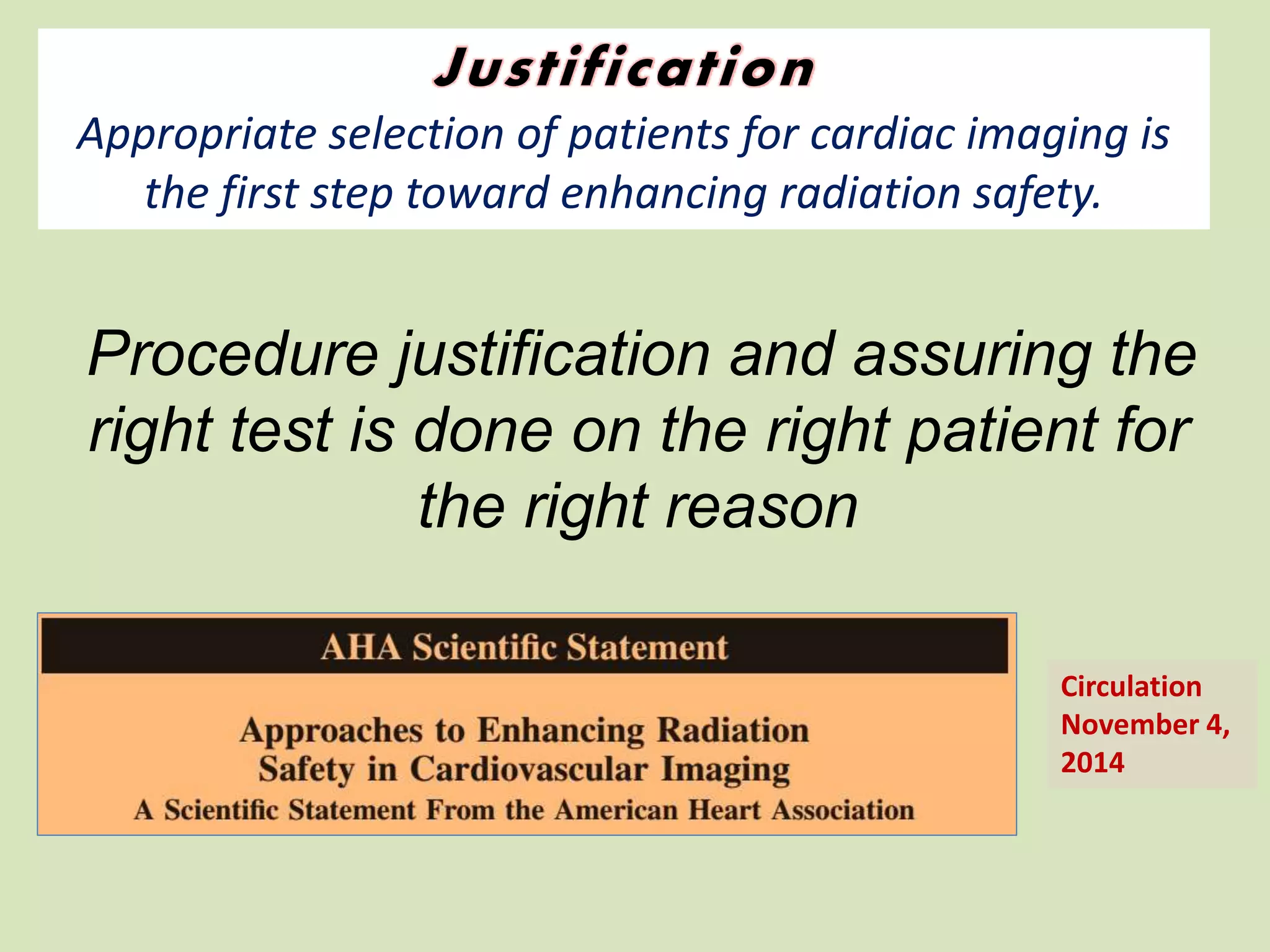
Justification
Appropriate selection of patients for cardiac imaging is
the first step toward enhancing radiation safety.
Circulation
November 4,
2014
Procedure justification and assuring the
right test is done on the right patient for
the right reason
No Idea What I’m DoingAs Low As Reasonably Achievable
I Have ”No Idea What I'm Doing”
ALARA
NIWID
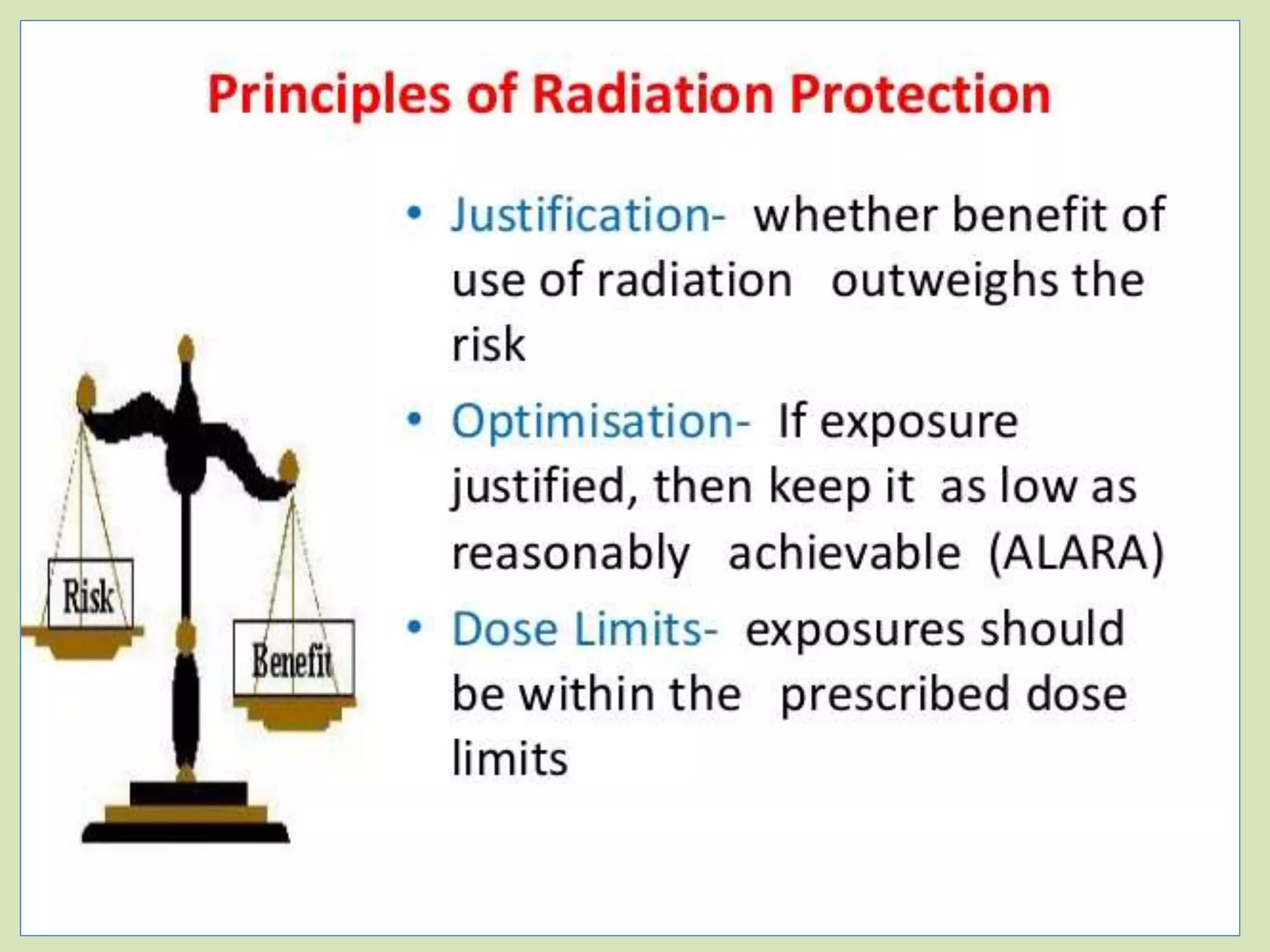
Using appropriate shielding, keeping a distance as safely as possible and
reducing radiation time are essential principles for radiation reduction
TDS
What you need to know?
Quick ABC’s of X-ray
Occupational Risks In Cath Lab
Radiation Safety Basics
Optimizing Radiation Safety in Cath Lab
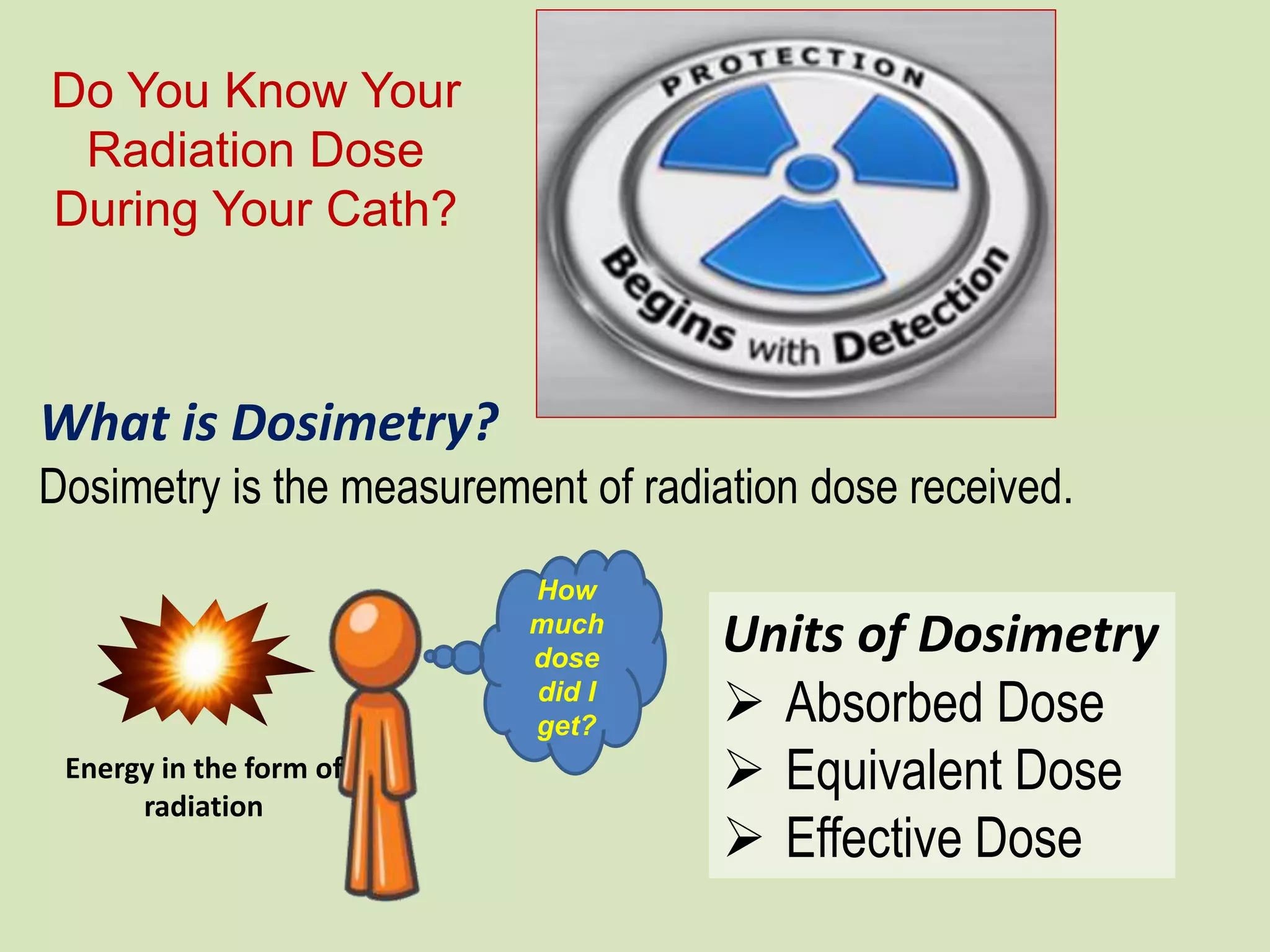
What is Dosimetry?
Dosimetry is the measurement of radiation dose received.
How
much
dose
did I
get?
Energy in the form of
radiation
Units of Dosimetry
 Absorbed Dose
 Equivalent Dose
 Effective Dose
Do You Know Your
Radiation Dose
During Your Cath?
Summary of dose quantities commonly used in medical
imaging dosimetry with definitions and units.
Equivalent Dose (H) is the
absorbed dose (D)
multiplied by a radiation
weighting factor (WR)
H = D x WR
Effective Dose (E) is the
equivalent dose (H)
multiplied by a tissue
weighting factor (WT)
E = H x WT
Recommended use of at least two dosimeters, one above and one underneath the lead
apron. They allow risk estimation for the deterministic effects (such as cataract) and the
stochastic effects (such as cancer risks), respectively.
Dosimetry
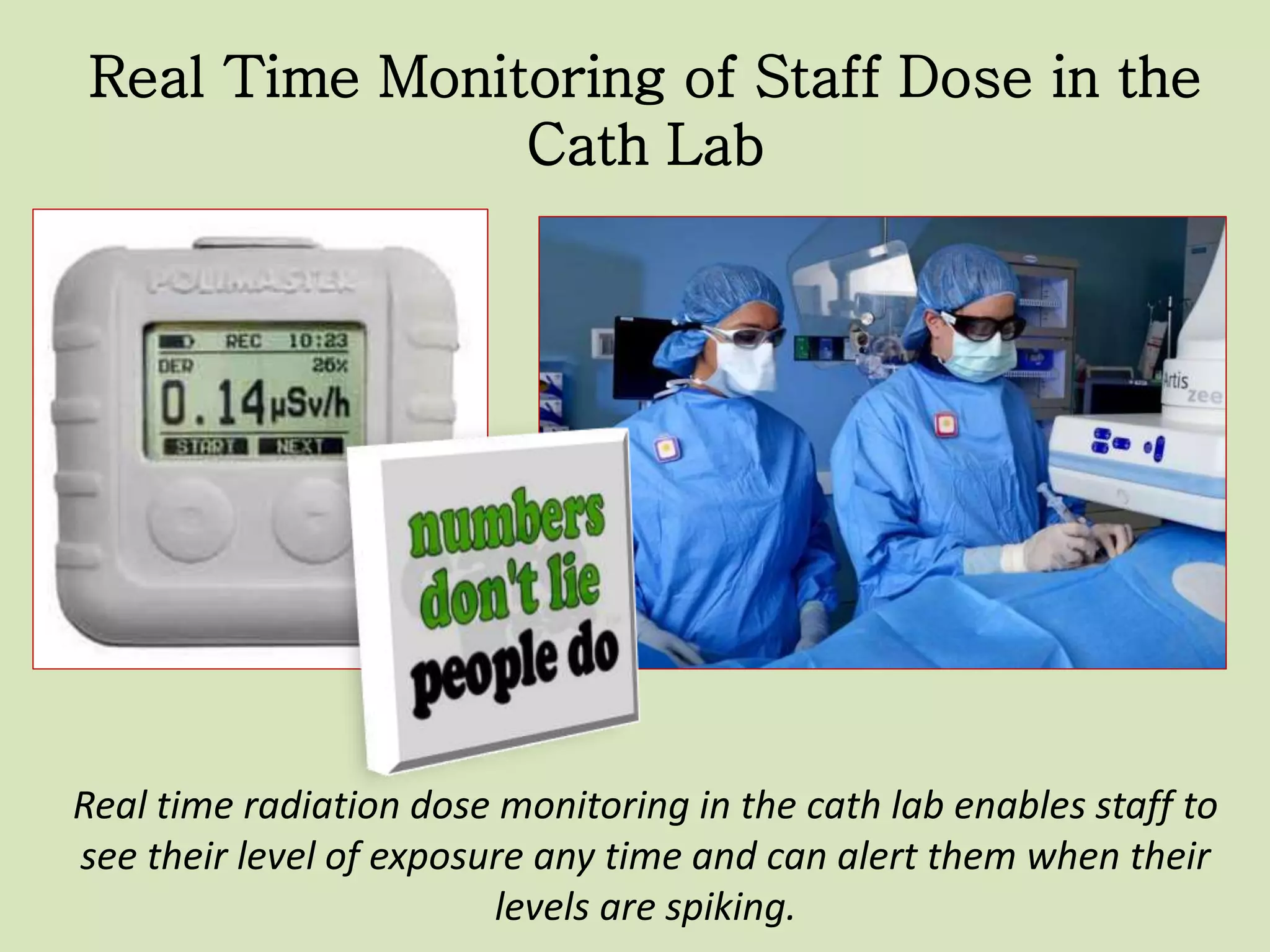
Real Time Monitoring of Staff Dose in the
Cath Lab
Real time radiation dose monitoring in the cath lab enables staff to
see their level of exposure any time and can alert them when their
levels are spiking.
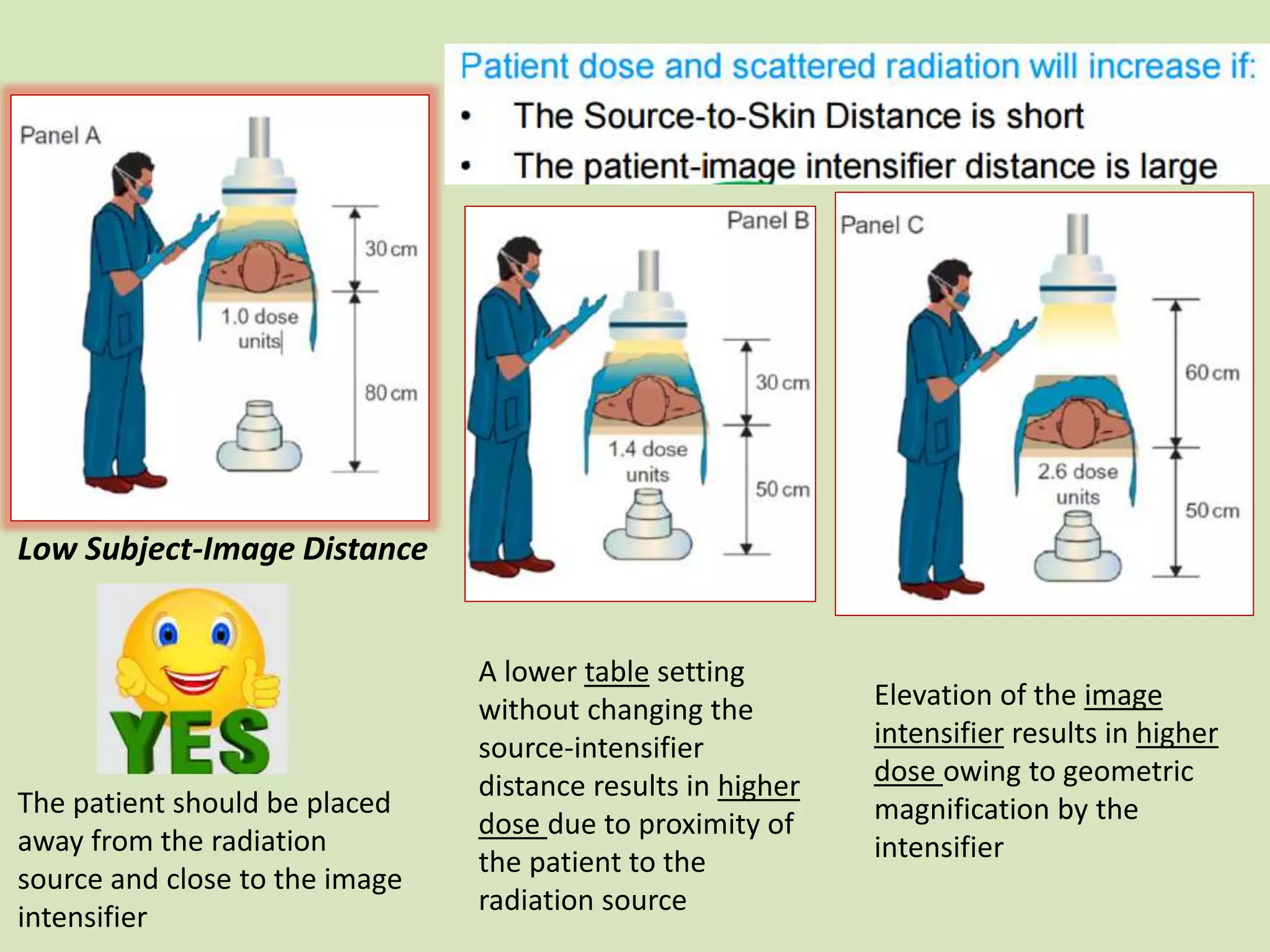
The patient should be placed
away from the radiation
source and close to the image
intensifier
A lower table setting
without changing the
source-intensifier
distance results in higher
dose due to proximity of
the patient to the
radiation source
Elevation of the image
intensifier results in higher
dose owing to geometric
magnification by the
intensifier
Low Subject-Image Distance
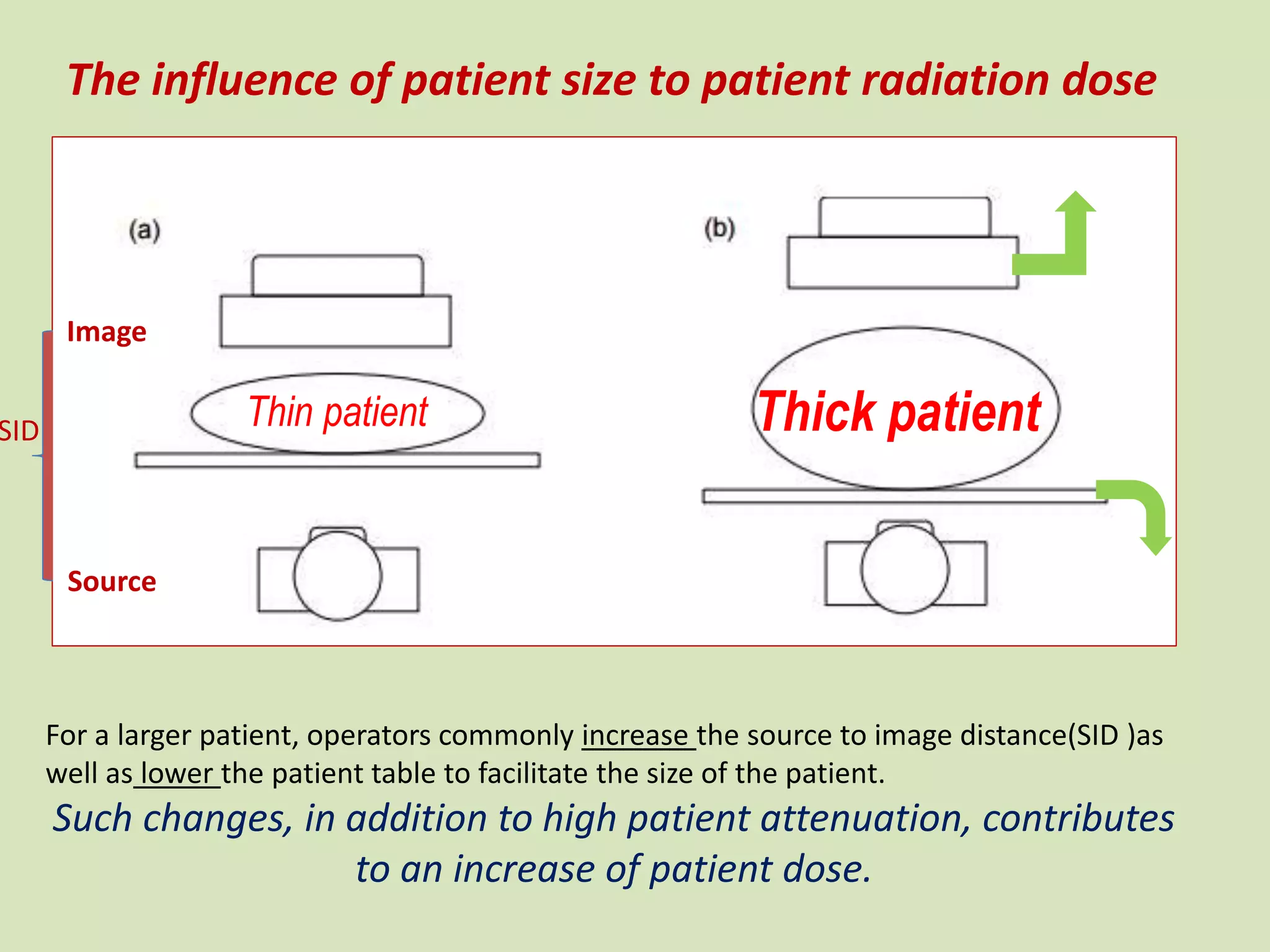
The influence of patient size to patient radiation dose
Thin patient Thick patient
For a larger patient, operators commonly increase the source to image distance(SID )as
well as lower the patient table to facilitate the size of the patient.
Such changes, in addition to high patient attenuation, contributes
to an increase of patient dose.
Source
Image
SID
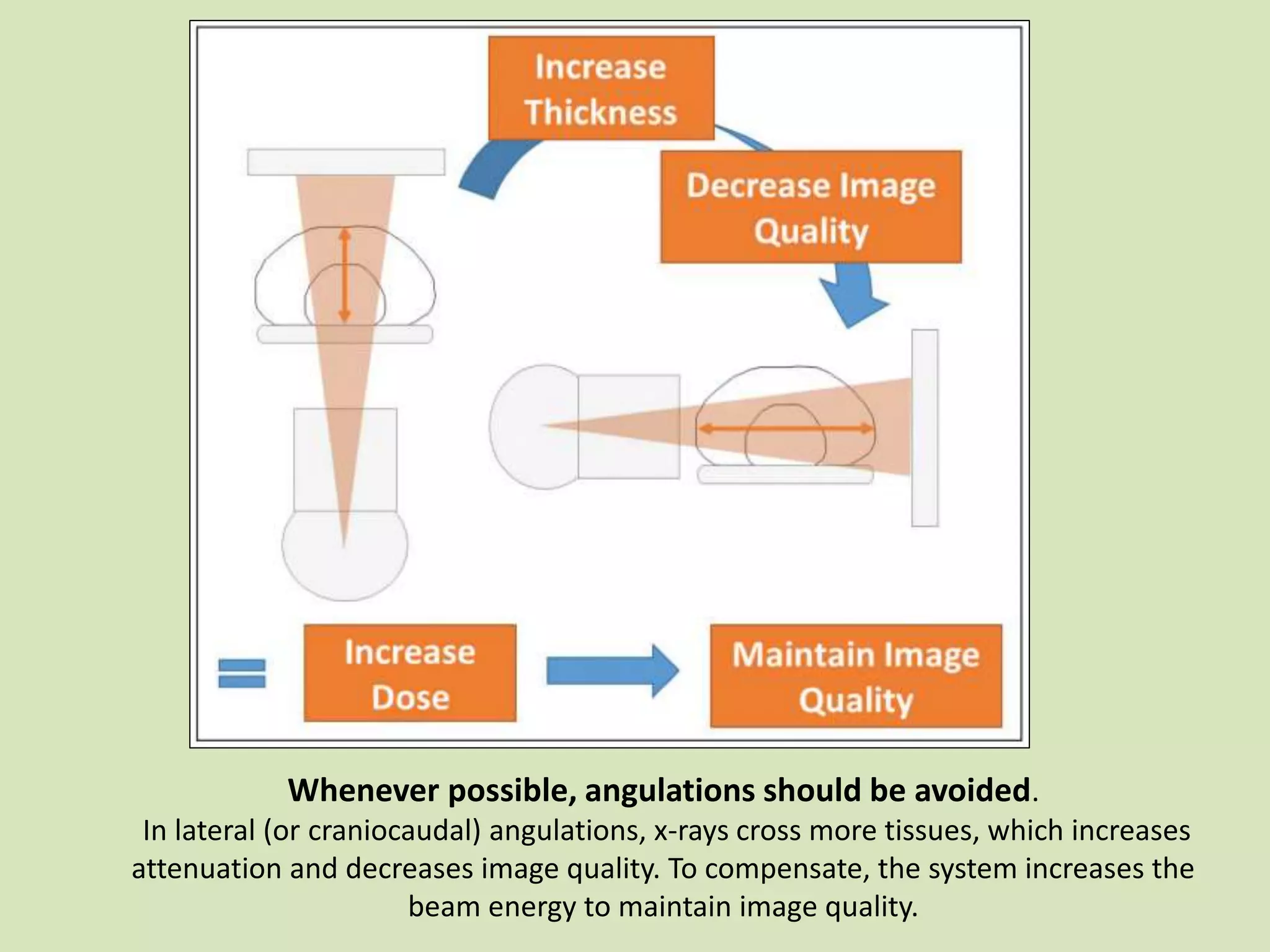
Whenever possible, angulations should be avoided.
In lateral (or craniocaudal) angulations, x-rays cross more tissues, which increases
attenuation and decreases image quality. To compensate, the system increases the
beam energy to maintain image quality.
( a ) Posteroanterior projection where the dose rate is less than the oblique angulation ( b )
Effect of angulation on patient dose.
Magnification
increases the
dose
*Field of view, diameter 17 cm
Dose rate = 0.6 mGy/s
*Field or view, diameter 12 cm
Dose rate = 1.23 mGy/s.
Normal mode Mag mode
*Field of view, diameter 25 cm
Dose rate= 0.3 mGy/s
The FOV will decrease,
and the dose delivered
to the patient’s skin
will increase
Benefits from using collimation
Optimal collimation on the area of interest allows significant dose reduction
 The collimator is an adjustable lead shutter attached to the beam exit port of the x-ray
source that can be closed down to limit the area of the body that is irradiated.
 By collimating the beam to the diagnostically appropriate field of view, you will minimize
radiation to the patient, as well as to yourself.
Does moving the X ray beam to different areas of the patient’s body during a
procedure have an effect on the exposure to the patient?
The peak skin dose is the absorbed dose at the skin location that has received the
highest dose. This quantity is used to predict a skin injury.
Spread the Dose
Minimize frame rate of fluoroscopy
Lower pulse rates lead to greater dose reduction per unit time.
(pulses per second)
A reduction of the fluoroscopic pulse rate from 15 frames/sec to 7.5 frames/sec
with a fluoroscopic mode to low dose reduces the radiation exposure by 67%.
The diagrams depict scatter radiation for a C-arm fluoroscopy system with the x-ray tube
under the table (left) and in lateral projection on the same side as the operator (right).
 Note the high dose to the operator when standing on the same side of the patient as the
tube.
 If the operator stands upright, scattered radiation to the face is perhaps one-fourth as
great as when the operator is leaning down toward the patient.
 Short operators receive more radiation to the face than do tall operators. They may wish
to stand on a platform.
The lateral projection is not
recommended when the lead
shield is not protecting the
operator.
The lateral projection is
recommended when the
lead shield is protecting the
operator.
Do not step on fluoroscopy pedal
when not looking at screen
Decrease Cine Use
Thyroid collar
Lead
Apron
Radiation shields
A – image intensifier;
B – Articulated, ceiling-
mounted radiation
protection screen;
C – patient position;
D – table-side shields.
Patient position and shielding in the cath lab.
A – digital flat panel
detector mounted
on C-arm;
B – ceiling-mounted
articulated
protection screen;
C – monitors;
D – patient;
E – C-arm and image
control panel;
F – tableside
protective shielding.
Your Lead is Cracked?
The “Interventionalist disc disease”:
How to protect against it?
The Zero-Gravity™ radiation protection system
The future Robots Moving Into The Cath Lab
Robotic-Assisted PCI
The CorPath 200 cath lab robotic system is designed for more precise
movements and less radiation exposure to physicians during PCI.
Radiation
Protection in
Cardiovascular
Interventions:
What Can We Do?
Implementing a Culture and Philosophy of Radiation Safety
1
•Precautions to Minimize
Exposure to Patient and Operator
2
•Precautions to Specifically
Minimize Exposure to Operator
3
•Precautions to Specifically
Minimize Exposure to Patient
Precautions to Minimize Exposure to Patient and Operator
 Utilize radiation only when imaging is necessary .Avoid the”heavy foot“
 Minimize use of cine.
 Minimize use of steep angles of X-ray beam.( LAO Cr – AP Cr )
 Minimize use of magnification modes.
 Minimize frame rate of fluoroscopy and cine.(7.5 frames/sec fluoroscopy
setting)
 Keep the image detector close to the patient (low subject-image
distance)
 Utilize collimation to the fullest extent possible.
 Monitor radiation dose in real time.
Precautions to Specifically Minimize Exposure to Operator
 Use and maintain appropriate protective lead garments.
 Maximize distance of operator from X-ray source and patient.
 Keep above-table (hanging) and below-table shields in optimal
position at all times.
 Keep all body parts out of the field of view at all times
 A robotic PCI system may be considered
Precautions to Specifically Minimize Exposure to Patient
 Keep table height as high as comfortably possible for the operator.
 Every 30 minutes, vary the imaging beam angle to minimize exposure to
any specific skin area .
 Keep the patient's extremities out of the beam.
Commonly employed strategies to minimize radiation exposure
End of Presentation
Thank you for your attention

Radiation Safety In The Cath Lab

  • 2.
    Radiation Safety inthe Workplace (Cardiac Cath Lab)
  • 3.
    Magdy El-Masry Prof. ofCardiology Tanta University
  • 5.
    Ionizing Radiation Canbe Harmful: Nothing New
  • 6.
    What you needto know? Quick ABC’s of X-ray Occupational Risks In Cath Lab Radiation Safety Basics Optimizing Radiation Safety in Cath Lab
  • 7.
    What you needto know? Quick ABC’s of X-ray Occupational Risks In Cath Lab Radiation Safety Basics Optimizing Radiation Safety in Cath Lab
  • 8.
  • 9.
    These types ofradiation are called “ionizing” radiation, because they have enough energy to knock an electron out of its orbit around an atom – creating an ion.
  • 10.
    Penetrating capacity ofdifferent types of radiation
  • 11.
    Fluoroscopic system components CArm Image Intensifier X-ray Tube Monitors X-ray Table Fluoroscopy-Guided Intervention (FGI)
  • 12.
    X-Ray Tube Scattered radiationis the main source of radiation exposure to operator and staff
  • 13.
    Complete penetration; X-raypasses completely through tissue and into the image recording device. Total absorption; X-ray energy is completely absorbed by the tissue. No imaging information results. Partial absorption with scatter; Scattering involves a partial transfer of energy to tissue, with the resulting scattered X-ray having less energy and a different trajectory. Scattered radiation tends to degrade image quality and is the primary source of radiation exposure to operator and staff There are three outcomes when X-rays traverse tissue.
  • 14.
    Exposure,intensity Couloumb/kg Absorbed radiation dose Gray Equivalentdose Sievert Radiation Measurements R.E.A.D. Radiation.Exposure.Absorbed dose.Dose equivalent
  • 16.
  • 17.
    How is Graydifferent from Sievert? Absorbed radiation dose Gray Biological radiation dose Sievert Allow to estimate risk in a tissue or organ The Sievert is similar to Gray but takes into account the potential ability of the radiation to cause a biological effect
  • 18.
    What you needto know? Quick ABC’s of X-ray Occupational Risks In Cath Lab Radiation Safety Basics Optimizing Radiation Safety in Cath Lab
  • 19.
    How high isthe patient exposure in cardiac interventions in comparison to chest radiograph?
  • 20.
    Radiation exposure distributionin the interventional cardiologist. Radiation exposure on the left is almost double that on the right side.
  • 21.
    Did You Know? Interventional Cardiologists experiencethe highest amounts of radiation exposure of any medical professional.
  • 22.
    Cardiac cath labwork carries multiple risks
  • 23.
    Your exposure todaymay not be felt for years to come. Radiation-induced cancers have a biological latency of more than 10 years Radiation in cardiology: can’t live without it ! Working towards zero operator exposure
  • 25.
    Bad backs andaching necks: Occupational hazards of the cath lab
  • 26.
    “Probabilistic”  Deterministic effects,which only occur above a certain dose threshold  Stochastic effects, which have a chance of occurring at any range of dose
  • 27.
    Biologic Effects ofRadiation : Radiation skin (deterministic) effects A. Dry desquamation (Poikiloderma) at one month in a patient receiving 11 Gy calculated peak skin dose. B. Skin Necrosis at 6 months in a patient who received 18 Gy calculated peak skin dose.
  • 28.
    The wound onthe right back healed into a scar while the injury on the arm ultimately required grafting. The arm was too close to the x-ray source.
  • 29.
    Radiation can harmbiological systems by damaging the DNA of cells. If this damage is not properly repaired, the cells may divide in an uncontrolled manner and cause cancer. Biologic Effects of Radiation : Cancer-inducing (Stochastic)
  • 30.
    Post-procedure Document radiation dose inrecords FT: Fluoroscopy Time AK: Air Kerma DAP: Dose-Area Product The meaning behind the numbers
  • 31.
    Dose exposure isdescribed in terms of the following parameters Fluoroscopic Time (min): This is the time during a procedure that fluoroscopy is used but does not include cine acquisition imaging. Therefore, considered alone, it tends to underestimate the total radiation dose received. Air Kerma (Gy): The cumulative air kerma is a measure of X-ray energy delivered to air at the interventional reference point (15 cm from the isocenter in the direction of the focal spot). Kerma (Kinetic Energy Released in MAtter) This measurement has been closely associated with deterministic skin effects Dose-Area Product (Gy.cm2): This is the cumulative sum of the instantaneous air kerma and the X-ray field area. This monitors the patient dose burden and is a good indicator of stochastic effects.
  • 32.
    The axis ofrotation of the C-arm is depicted as a dashed line. The isocenter lies on the rotational axis, between the source and detector. Air Kerma is a measure of X-ray energy delivered to air at the interventional reference point (15 cm from the isocenter in the direction of the focal spot).
  • 34.
    What you needto know? Quick ABC’s of X-ray Occupational Risks In Cath Lab Radiation Safety Basics Optimizing Radiation Safety in Cath Lab
  • 37.
    Justification Appropriate selection ofpatients for cardiac imaging is the first step toward enhancing radiation safety. Circulation November 4, 2014 Procedure justification and assuring the right test is done on the right patient for the right reason
  • 38.
    No Idea WhatI’m DoingAs Low As Reasonably Achievable I Have ”No Idea What I'm Doing” ALARA NIWID
  • 40.
    Using appropriate shielding,keeping a distance as safely as possible and reducing radiation time are essential principles for radiation reduction TDS
  • 41.
    What you needto know? Quick ABC’s of X-ray Occupational Risks In Cath Lab Radiation Safety Basics Optimizing Radiation Safety in Cath Lab
  • 43.
    What is Dosimetry? Dosimetryis the measurement of radiation dose received. How much dose did I get? Energy in the form of radiation Units of Dosimetry  Absorbed Dose  Equivalent Dose  Effective Dose Do You Know Your Radiation Dose During Your Cath?
  • 44.
    Summary of dosequantities commonly used in medical imaging dosimetry with definitions and units. Equivalent Dose (H) is the absorbed dose (D) multiplied by a radiation weighting factor (WR) H = D x WR Effective Dose (E) is the equivalent dose (H) multiplied by a tissue weighting factor (WT) E = H x WT
  • 45.
    Recommended use ofat least two dosimeters, one above and one underneath the lead apron. They allow risk estimation for the deterministic effects (such as cataract) and the stochastic effects (such as cancer risks), respectively. Dosimetry
  • 46.
    Real Time Monitoringof Staff Dose in the Cath Lab Real time radiation dose monitoring in the cath lab enables staff to see their level of exposure any time and can alert them when their levels are spiking.
  • 47.
    The patient shouldbe placed away from the radiation source and close to the image intensifier A lower table setting without changing the source-intensifier distance results in higher dose due to proximity of the patient to the radiation source Elevation of the image intensifier results in higher dose owing to geometric magnification by the intensifier Low Subject-Image Distance
  • 48.
    The influence ofpatient size to patient radiation dose Thin patient Thick patient For a larger patient, operators commonly increase the source to image distance(SID )as well as lower the patient table to facilitate the size of the patient. Such changes, in addition to high patient attenuation, contributes to an increase of patient dose. Source Image SID
  • 49.
    Whenever possible, angulationsshould be avoided. In lateral (or craniocaudal) angulations, x-rays cross more tissues, which increases attenuation and decreases image quality. To compensate, the system increases the beam energy to maintain image quality.
  • 50.
    ( a )Posteroanterior projection where the dose rate is less than the oblique angulation ( b ) Effect of angulation on patient dose.
  • 51.
    Magnification increases the dose *Field ofview, diameter 17 cm Dose rate = 0.6 mGy/s *Field or view, diameter 12 cm Dose rate = 1.23 mGy/s. Normal mode Mag mode *Field of view, diameter 25 cm Dose rate= 0.3 mGy/s The FOV will decrease, and the dose delivered to the patient’s skin will increase
  • 52.
    Benefits from usingcollimation Optimal collimation on the area of interest allows significant dose reduction  The collimator is an adjustable lead shutter attached to the beam exit port of the x-ray source that can be closed down to limit the area of the body that is irradiated.  By collimating the beam to the diagnostically appropriate field of view, you will minimize radiation to the patient, as well as to yourself.
  • 53.
    Does moving theX ray beam to different areas of the patient’s body during a procedure have an effect on the exposure to the patient? The peak skin dose is the absorbed dose at the skin location that has received the highest dose. This quantity is used to predict a skin injury. Spread the Dose
  • 54.
    Minimize frame rateof fluoroscopy Lower pulse rates lead to greater dose reduction per unit time. (pulses per second) A reduction of the fluoroscopic pulse rate from 15 frames/sec to 7.5 frames/sec with a fluoroscopic mode to low dose reduces the radiation exposure by 67%.
  • 55.
    The diagrams depictscatter radiation for a C-arm fluoroscopy system with the x-ray tube under the table (left) and in lateral projection on the same side as the operator (right).  Note the high dose to the operator when standing on the same side of the patient as the tube.  If the operator stands upright, scattered radiation to the face is perhaps one-fourth as great as when the operator is leaning down toward the patient.  Short operators receive more radiation to the face than do tall operators. They may wish to stand on a platform.
  • 56.
    The lateral projectionis not recommended when the lead shield is not protecting the operator. The lateral projection is recommended when the lead shield is protecting the operator.
  • 57.
    Do not stepon fluoroscopy pedal when not looking at screen Decrease Cine Use
  • 58.
  • 59.
    Radiation shields A –image intensifier; B – Articulated, ceiling- mounted radiation protection screen; C – patient position; D – table-side shields.
  • 60.
    Patient position andshielding in the cath lab. A – digital flat panel detector mounted on C-arm; B – ceiling-mounted articulated protection screen; C – monitors; D – patient; E – C-arm and image control panel; F – tableside protective shielding.
  • 61.
    Your Lead isCracked?
  • 62.
    The “Interventionalist discdisease”: How to protect against it? The Zero-Gravity™ radiation protection system
  • 63.
    The future RobotsMoving Into The Cath Lab Robotic-Assisted PCI The CorPath 200 cath lab robotic system is designed for more precise movements and less radiation exposure to physicians during PCI.
  • 64.
    Radiation Protection in Cardiovascular Interventions: What CanWe Do? Implementing a Culture and Philosophy of Radiation Safety
  • 65.
    1 •Precautions to Minimize Exposureto Patient and Operator 2 •Precautions to Specifically Minimize Exposure to Operator 3 •Precautions to Specifically Minimize Exposure to Patient
  • 66.
    Precautions to MinimizeExposure to Patient and Operator  Utilize radiation only when imaging is necessary .Avoid the”heavy foot“  Minimize use of cine.  Minimize use of steep angles of X-ray beam.( LAO Cr – AP Cr )  Minimize use of magnification modes.  Minimize frame rate of fluoroscopy and cine.(7.5 frames/sec fluoroscopy setting)  Keep the image detector close to the patient (low subject-image distance)  Utilize collimation to the fullest extent possible.  Monitor radiation dose in real time.
  • 67.
    Precautions to SpecificallyMinimize Exposure to Operator  Use and maintain appropriate protective lead garments.  Maximize distance of operator from X-ray source and patient.  Keep above-table (hanging) and below-table shields in optimal position at all times.  Keep all body parts out of the field of view at all times  A robotic PCI system may be considered
  • 68.
    Precautions to SpecificallyMinimize Exposure to Patient  Keep table height as high as comfortably possible for the operator.  Every 30 minutes, vary the imaging beam angle to minimize exposure to any specific skin area .  Keep the patient's extremities out of the beam.
  • 69.
    Commonly employed strategiesto minimize radiation exposure
  • 70.
    End of Presentation Thankyou for your attention