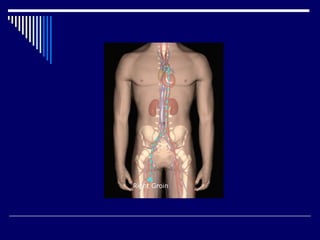
Angiography/ Interventional Basics What do we visualize with an angiographic procedure?
Personnel in the Angio Room http://www.heartsite.com/html/cardiac_cath.html Radiologist/ Specialist Cardiovascular nurse 2-3 Radiologic Technologists (CV) Sometimes Anesthesiologist
Angiography/ Interventional/ Cardiovascular Procedure Room (Suite) Room size- 400-600 square feet Easily cleaned  Why? Outlets needed for O2, suction, crash cart 3 means of access to the room (Bushong, p. 374) What are they?
Control Room 100-150 square feet Easy access and communication to procedure room Computers, monitors and un sterile personnel Storage area- guide wires, catheters and needles
Equipment found in all Advanced Procedure Rooms X-ray generators Controls X-ray Tubes System to record events of procedure Automatic Injectors
Generator  700MA- 1500MA Short exposure times Able to generate 80- 100 KW power Limit motion Provide max. contrast
X-Ray Tube Requirements Detail Withstand high heat- rapid exposure sequences Tube rating charts posted Need max. detail for vessels Use smallest possible focal spot Decrease target angle, p.13…line focus principle
Equipment Requirements High heat load tubes w/ rapid cooling Series imaging, intense heat SPEED UP THE ANODE RPM 1-2 Track mounted tubes Analog- to- Digital Conversion System Programmable digital image acquisition system (rate,sequencing, processing) PACS
Electromagnetic Injectors Monitoring Equipment- BP & ECG Island Tables- access from all sides, height adjustments, floor controls Where are the cables? Tables do not usually tilt
Digital Acquisition 2 types 1. Analog-to-Digital Radiation-pt-intensifier-light-TV-light to electrical signal- analog-to-digital converter- image processor 2.  Flat detectors Charged coupled devices (CCD) computer chip Direct digital conversion
Charge Coupled Device (CCD) Silicon computer chips Converts light to digital image Lower noise Better contrast Lower patient dose Advantage to this type system- images produced in low light w/o loss of resolution
Digital Imaging- Analog VS Digital Concepts Analog- image seen after chemical process Digital- image manipulated by software Relates to numbers Number table called an array Information changed through use of computer algorithm Advantages of Digital Angiography, p.30
Digital Subtraction Angiography (DSA) Computer “ subtracts” out all anatomy except contrast-filled vessels Looks like a reverse image Can be more diagnostic for vessels ( clots, constrictions) Imaging systems below now mostly replaced by digital Cut Film Changer Cine Fluoro( Cardiac Cath Camera)
Electromechanical Injector Used in Angio, CT, MRI Overcome arterial pressure + maintains bolus Maintains flow rate Flow rate affected by Viscosity Length + diameter catheter Injection pressure Vessel selected
Components Control panel Syringe Heating Device High- pressure mechanism Safety Devices Acceleration regulators Pressure- limiting devices MRI- non- ferrous material
Vocabulary Terms Arteriosclerosis- vessels hardened Atherosclerosis- plaque like cholesterol Thrombus Embolus Occlusion Tumor Stenosis Angioplasty-angio procedure dilates stenosed vessel
Lithotripsy Stent- cage like metal device placed in vessel to maintain blood flow Thrombolysis Filter Embolization- stop bleeding, cease blood flow to site of pathology Ante grade Retrograde
Seldinger Technique Method for catheterization of vessels Developed 1950’s still popular today Percutaneous (through the skin)  3 vessels considered: Femoral –preferred site for arterial (size + accessibility) Brachial Axillary
 
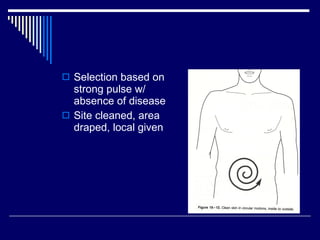
Selection based on strong pulse w/ absence of disease Site cleaned, area draped, local given
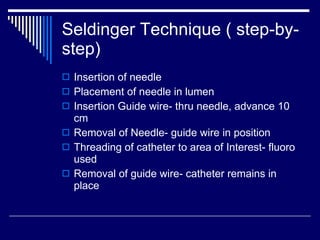
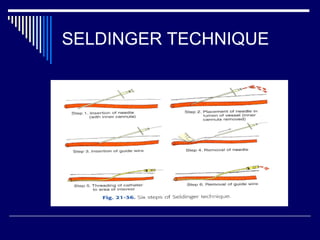
Seldinger Technique ( step-by-step) Insertion of needle Placement of needle in lumen Insertion Guide wire- thru needle, advance 10 cm Removal of Needle- guide wire in position Threading of catheter to area of Interest- fluoro used Removal of guide wire- catheter remains in place
SELDINGER TECHNIQUE
Two less common methods used Cut down- minor surgical procedure to expose vessel of interest Translumbar- patient prone, long needle passed thru T12- L2 into aorta
Contents of Procedure Tray Variety items 3 basic groups of equipment Prep Group Anesthetic Group Insertion and removal Contrast Accessories Adaptors Connectors Manifolds, Stopcocks
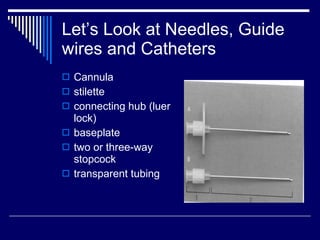
Let’s Look at Needles, Guide wires and Catheters Cannula stilette connecting hub (luer lock) baseplate two or three-way stopcock transparent tubing
Guidewires Guide catheter for placement in vessel Diameter large enough so blood  can not flow back for too long a time Tips at the end of GW Straight  J- tipped longer G.W. for selective angio vessels Short used for shorter direct vascular approach
CATHETERS Straight Pigtail Sidewinder Cobra
The more holes at the end / the more contrast / large vessels Catheter with only end hole/ smaller vessels/ carotid Combo end and side holes reduce risk of trauma to vessel, enhances contrast
Vascular/ Non- Vascular Studies Embolization pg 711, Bontrager Stent Placements PTA pg 712 , Bontrager Vena Cava Filters Thrombolysis Biopsies Fluid Drainage Injection of Medicines Tube Placement in Organs or Cavities Bontrager, pg 716
Interventional Imaging Procedures Intervene w/ disease, provide therapeutic outcome Purpose/ benefits Lower risk compared to surgery Less $ Shorter hospital stay and recovery Alternative for non surgical patient
Post Procedure Care Catheter removed – compression  Bed rest- min 4 hrs/ head up 30 degrees Vital signs Extremity watch Some angiographic procedures: angioplasty, venography, angiocardiography, lymphography
Radiation Protection Proximity to patient Radiation protection devices Leaded glasses pulled into place Minimal fluoro use  Collimation Wear badges and ring monitors
Risks/ Complications Bleeding at puncture site Thrombus formation Embolus formation –plaque dislodged  Dissection of vessel Puncture site infection ( contaminated sterile field) Contrast reaction

Angiography basics

  • 1.
    Angiography/ Interventional BasicsWhat do we visualize with an angiographic procedure?
  • 2.
    Personnel in theAngio Room http://www.heartsite.com/html/cardiac_cath.html Radiologist/ Specialist Cardiovascular nurse 2-3 Radiologic Technologists (CV) Sometimes Anesthesiologist
  • 3.
    Angiography/ Interventional/ CardiovascularProcedure Room (Suite) Room size- 400-600 square feet Easily cleaned Why? Outlets needed for O2, suction, crash cart 3 means of access to the room (Bushong, p. 374) What are they?
  • 4.
    Control Room 100-150square feet Easy access and communication to procedure room Computers, monitors and un sterile personnel Storage area- guide wires, catheters and needles
  • 5.
    Equipment found inall Advanced Procedure Rooms X-ray generators Controls X-ray Tubes System to record events of procedure Automatic Injectors
  • 6.
    Generator 700MA-1500MA Short exposure times Able to generate 80- 100 KW power Limit motion Provide max. contrast
  • 7.
    X-Ray Tube RequirementsDetail Withstand high heat- rapid exposure sequences Tube rating charts posted Need max. detail for vessels Use smallest possible focal spot Decrease target angle, p.13…line focus principle
  • 8.
    Equipment Requirements Highheat load tubes w/ rapid cooling Series imaging, intense heat SPEED UP THE ANODE RPM 1-2 Track mounted tubes Analog- to- Digital Conversion System Programmable digital image acquisition system (rate,sequencing, processing) PACS
  • 9.
    Electromagnetic Injectors MonitoringEquipment- BP & ECG Island Tables- access from all sides, height adjustments, floor controls Where are the cables? Tables do not usually tilt
  • 10.
    Digital Acquisition 2types 1. Analog-to-Digital Radiation-pt-intensifier-light-TV-light to electrical signal- analog-to-digital converter- image processor 2. Flat detectors Charged coupled devices (CCD) computer chip Direct digital conversion
  • 11.
    Charge Coupled Device(CCD) Silicon computer chips Converts light to digital image Lower noise Better contrast Lower patient dose Advantage to this type system- images produced in low light w/o loss of resolution
  • 12.
    Digital Imaging- AnalogVS Digital Concepts Analog- image seen after chemical process Digital- image manipulated by software Relates to numbers Number table called an array Information changed through use of computer algorithm Advantages of Digital Angiography, p.30
  • 13.
    Digital Subtraction Angiography(DSA) Computer “ subtracts” out all anatomy except contrast-filled vessels Looks like a reverse image Can be more diagnostic for vessels ( clots, constrictions) Imaging systems below now mostly replaced by digital Cut Film Changer Cine Fluoro( Cardiac Cath Camera)
  • 14.
    Electromechanical Injector Usedin Angio, CT, MRI Overcome arterial pressure + maintains bolus Maintains flow rate Flow rate affected by Viscosity Length + diameter catheter Injection pressure Vessel selected
  • 15.
    Components Control panelSyringe Heating Device High- pressure mechanism Safety Devices Acceleration regulators Pressure- limiting devices MRI- non- ferrous material
  • 16.
    Vocabulary Terms Arteriosclerosis-vessels hardened Atherosclerosis- plaque like cholesterol Thrombus Embolus Occlusion Tumor Stenosis Angioplasty-angio procedure dilates stenosed vessel
  • 17.
    Lithotripsy Stent- cagelike metal device placed in vessel to maintain blood flow Thrombolysis Filter Embolization- stop bleeding, cease blood flow to site of pathology Ante grade Retrograde
  • 18.
    Seldinger Technique Methodfor catheterization of vessels Developed 1950’s still popular today Percutaneous (through the skin) 3 vessels considered: Femoral –preferred site for arterial (size + accessibility) Brachial Axillary
  • 19.
  • 20.
    Selection based onstrong pulse w/ absence of disease Site cleaned, area draped, local given
  • 21.
    Seldinger Technique (step-by-step) Insertion of needle Placement of needle in lumen Insertion Guide wire- thru needle, advance 10 cm Removal of Needle- guide wire in position Threading of catheter to area of Interest- fluoro used Removal of guide wire- catheter remains in place
  • 22.
  • 23.
    Two less commonmethods used Cut down- minor surgical procedure to expose vessel of interest Translumbar- patient prone, long needle passed thru T12- L2 into aorta
  • 24.
    Contents of ProcedureTray Variety items 3 basic groups of equipment Prep Group Anesthetic Group Insertion and removal Contrast Accessories Adaptors Connectors Manifolds, Stopcocks
  • 25.
    Let’s Look atNeedles, Guide wires and Catheters Cannula stilette connecting hub (luer lock) baseplate two or three-way stopcock transparent tubing
  • 26.
    Guidewires Guide catheterfor placement in vessel Diameter large enough so blood can not flow back for too long a time Tips at the end of GW Straight J- tipped longer G.W. for selective angio vessels Short used for shorter direct vascular approach
  • 27.
  • 28.
    The more holesat the end / the more contrast / large vessels Catheter with only end hole/ smaller vessels/ carotid Combo end and side holes reduce risk of trauma to vessel, enhances contrast
  • 29.
    Vascular/ Non- VascularStudies Embolization pg 711, Bontrager Stent Placements PTA pg 712 , Bontrager Vena Cava Filters Thrombolysis Biopsies Fluid Drainage Injection of Medicines Tube Placement in Organs or Cavities Bontrager, pg 716
  • 30.
    Interventional Imaging ProceduresIntervene w/ disease, provide therapeutic outcome Purpose/ benefits Lower risk compared to surgery Less $ Shorter hospital stay and recovery Alternative for non surgical patient
  • 31.
    Post Procedure CareCatheter removed – compression Bed rest- min 4 hrs/ head up 30 degrees Vital signs Extremity watch Some angiographic procedures: angioplasty, venography, angiocardiography, lymphography
  • 32.
    Radiation Protection Proximityto patient Radiation protection devices Leaded glasses pulled into place Minimal fluoro use Collimation Wear badges and ring monitors
  • 33.
    Risks/ Complications Bleedingat puncture site Thrombus formation Embolus formation –plaque dislodged Dissection of vessel Puncture site infection ( contaminated sterile field) Contrast reaction