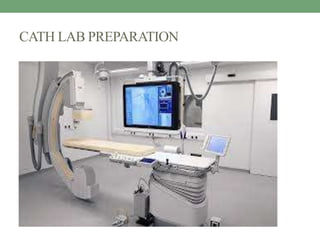
CATH LAB PREPARATION
(Prepared - Mestawot Wondimu)
BSC, MSc Cardiovascular,Cath.lab
nurse.
Outline
• Cath lab preparation
• Sterile table Setup (sterile field), Maintenance and Percutaneous
Access, Sterile Draping.
• Cath lab procedures.
Learning Objective
• At the end of this class student will be
• To identify different Cath lab. Sterile table Setup (sterile field),
Maintenance and Percutaneous Access, Sterile Draping.
Cath lab. preparation
Before receiving of patient to catheterization room:
• Arrange equipment’s properly.
• Crash trolley should be checked .
• Things need for emergency treatment should be kept ready eg.
difblilator infusion pump.
Emergency drugs preparation:
• Atropine1mL=1mg no dilution.
• Adrenaline 1mg /1mL will be dilute with 9ml N/S or D5W
• NTG 10mg/10ml (1mg/1ml), dilute with N/S 90 ml
• Amiodarone150mg/3ml loading dose 300mg (2amp) dilute with
20_30ml of D5W push over a minimum of 3 mints,
Con…
Heparin flushes preparation:
• 5000lU heparin dilute with 500ml of N/S.
Con…
Upon receiving of patient
• Proper receiving of the patient will enhance the safety of
the patient.
• brief initial assessment of patient history performed by cath lab
nurse.
• proper identification of patient.
• Patient understand the procedure to be performed as written
consent by the physician.
Con…
• Allergen history of iodine shall be asked.
• Patient functional status and mobility.
• Patient psychological and emotional status.
• Check diagnostic test( ECG, Echo.)
• and laboratory result.(CBC, renal function, serology test)
• Undergarments to be removed before shifting the patient for
catheterization.
Surgical scrubbing procedure:
• Step 1: Remove all rings, watches and jewelers. Wet hands with
water.
• Step 2: Apply antiseptic solution again and spread over hands
and forearms.
• Step 3: Clean the hands again paying particular attention to
finger tips.
Con…
• Step 4: Thoroughly cleanse nails, fingers, inter digital spaces,
palms and back of hands. Wash each finger as if it has four
sides.
• Step 5: Scrub the wrists.
• Step 6: Once wrists have been scrubbed, scrub the forearm,
being sure to move from forearm towards elbow.
Con…
• Repeat the same process with the other forearm.
• Step 7: Thoroughly rinse hands and forearms being sure to hold
hands higher then elbows.
• Step 8: Allow excess water to drip off at elbows. Dry with a
sterile absorbent towel
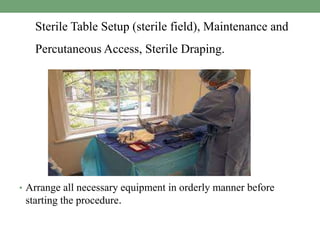
Sterile Table Setup (sterile field), Maintenance and
Percutaneous Access, Sterile Draping.
• Arrange all necessary equipment in orderly manner before
starting the procedure.
Con…
It needs
• Clean person- clean person is designated to open and touch
non sterile items to maintain of the straile person .
• Sterile person - designated to handle all sterile instruments and
materials that will be used.
Con…
Purpose
• Preparation for diagnostic/intervention
• Time management.
• Prevent hazard/cross infection.
Con…
Pre procedure care
• Clean the trolley and check sterilization indicator.
• If it is pre packed check expire date.
Con…
Equipment require
• Surgical table
• Straile surgical drape
• Straile surgical instrument packs or complete sterile kit.
• Sterile surgical towel.
• Fenestrated drape
• Straile gauze , glove and basin.
Con…
How to prepare a sterile field
1. Position all packages on tray away from your body.
2. Open the top flap of the package first open it away from you.
3. Then open the flap on the right side with right hand and the
flap on your left side with your left hand
4. Open the last flap towards your body.
Con…
Con…
Nursing alerts
• When dropping items in to a sterile fields hold the packaging
about three inch above the sterile tray.
Con…
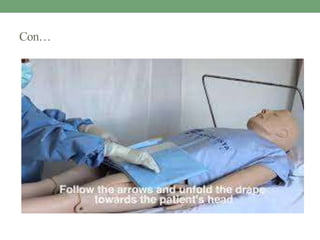
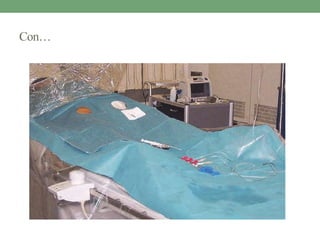
Sterile Draping
• Sterile drape Should be placed on the patient , the furniture and
equipment to be included in the sterile field.
• Sterile drape Should be handled as little as possible.
• Never reach across the operating table to drape the opposite
side.
Con…
• Draping materials should be higher than the OR bed .
• draped from operative site to the periphery.
• Once the sterile drape is positioned , it should not be removed
because shifting the drape can compromise the sterility of the
field.
Con…
• If the drape contaminated , discard.
• If in doubt to sterility , consider it become contaminated.
Con…
Con…
Sterile Table Setup in Cardiac catheterization lab.
• A cardiac catheterization lab, also known as a “cardiac cath
lab,” is a special hospital room where doctors perform
minimally invasive tests and procedures to diagnose and treat
cardiovascular disease.
Con…
• Cardiac catheterization -is one of the invasive procedures used
to visualized the hearths chambers , valves and great vessels in
order to diagnose and treat disease related to abnormalities of
the coronary arteries.
Con…
• In Cardiac catheterization lab. Diagnostic and interventional
procedures done
• like : angiogram, angioplasty and implantation of pacemakers /
ICD,EP study and ablation.
Con…
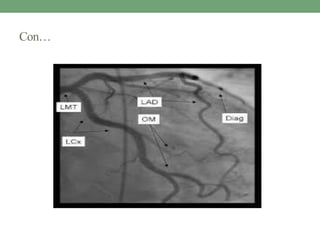
Coronary angiogram (CAG):
• Coronary angiogram is a diagnostic invasive procedure to
visualize the coronary arteries under fluoroscopy by using a
contrast media.
Con…
Con…
 Indications:
• IHD
• variant Angina.
• Following coronary artery bypass grafting.
• Stress test results that is very suggestive of myocardial
ischemia.
• Recurrent chest pain of undetermined cause.
Con…
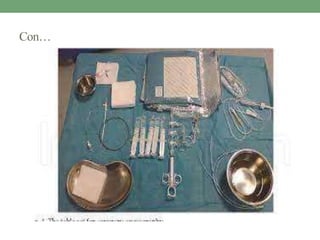
Trolley Preparation ,a sterile trolley containing:
• A bowl containing antiseptic solution
• Sponge holding forceps to clean the patient.
• Sterile gauze pieces.
• Blade handles with Blade No 11.
Con…
• Artery forceps, Bowel with Heparin flush
• Needles and syringes 2% Lidocaine for local anesthesia
• Catheter introducer set (Dilator, sheath, guide wire, needle No
18).
• Sterile drapes
Con…
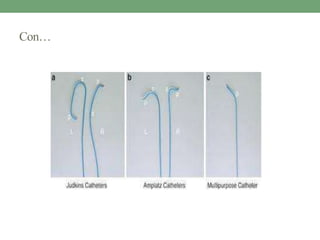
• Catheters 6F- JL 4,
• 6F – JR 4, Guide wire 0.038 – J- tip – 150cm
• IV Set ,Manifold ,Pressure line ,Inj. Heparin 3000 IU.
Preparation of the Patient:
• Explain the procedure to the patient.
• Make the Patient to lie down on supine position.
Con…
• Connect 4 lead ECG,BP and saturation probe.
• Clean the patient with antiseptic solution from umbilicus to
mid-thigh.
• Drape the patient with sterile drapes.
Con…
Con…
percutaneous trans luminal coronary angioplasty
(PTCA)
• To do percutaneous trans luminal coronary angioplasty.
• Implantation of inter coronary stents for relieving coronary
narrowing to relieve symptoms
Con…
Con…
Indications
• Patient with asymptotic ischemia or mild angina with one or
more significant lesions in one or two coronary artery lesions.
• Patient with moderate or severe symptoms with one or more
significant lesions in one or more coronary arteries.
Con…
Trolley preparation:
• Same to CAG +
• Guiding catheter
• Guide wire 0.038inch, J tip,150cm.
• Y-Connector with extension.
• Torque and introducing needle
Con…
• PTCA guide wire range from 0.014-0.038 inch
• PTCA Balloon and stent.
• Inflation device (in deflator)
• Diluted Contrast (1:3 ionic contrast).
Con…
Con…
Preparation of the patient:
• Same to CAG +
• Load the patient with 300mg ASA and 600mg Plavix.
Con…
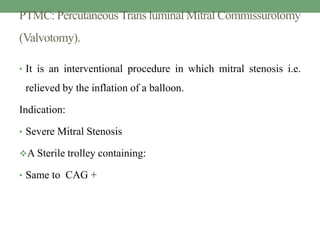
PTMC: PercutaneousTrans luminal Mitral Commissurotomy
(Valvotomy).
• It is an interventional procedure in which mitral stenosis i.e.
relieved by the inflation of a balloon.
Indication:
• Severe Mitral Stenosis
A Sterile trolley containing:
• Same to CAG +
Con…
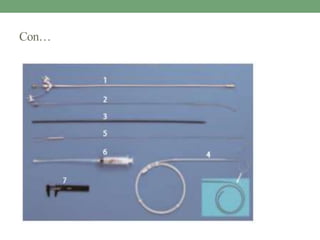
• Small bowl with diluted ionic contrast
• Undiluted contrast in 5ml syringe for septal puncture needle.
• Catheter introduces set (2 sheaths (6F & 7F) dilators 2 guide
wire,
• 3 way stopcock
• Patient drape
Con…
• Multipurpose catheter (pig tail)
• 0.032 guide wire
• Mullen’s sheath
• Broken brought needle
• LA guide wire
• Dilator
Con…
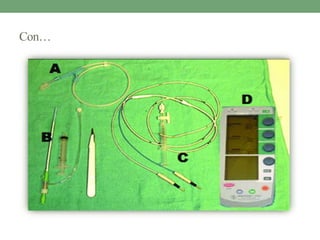
• Balloon with diluted contrast in 50 cc syringe and attachment
• L.V. styllet, scale meter
• Pressure line `
• Wet gauze in a bowl
Con…
How to select balloon size?
• Reference size (RS) (mm)
• Height (cm) × 1/10 + 10, e.g. height = 150 cm
• RS = 150 × 1/10 + 10 = 25 mm
• Echocardiography-to check valve condtion.
Con…
Con…
Con…
Preparation of the Patient:
• Same to CAG
Temporary pacemaker
• an intervention that helps the heartbeat get back to a normal
pace if it has been temporarily out of rhythm.
• It consists of a trans venous catheter electrodes attached to an
external pulse generator.
Con…
Indication:
• Complete heart block with slow ventricular escape.
• Sinus bradycardia, asystole.
• Acute anterior myocardial infarction with complete heart block,
type II AV block.
• Malfunction of implanted pacemaker.
Con…
Trolley preparation:
• same to CAG +
• Pacing catheter
• Pacemaker generator [keep ready outside]
• Suturing materials to fix the pacing wire.
Preparing of the patient:
• same to CAG
Con…
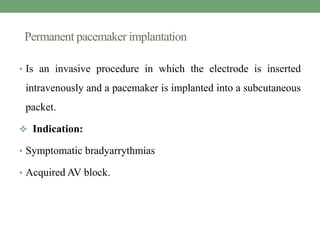
Permanent pacemaker implantation
• Is an invasive procedure in which the electrode is inserted
intravenously and a pacemaker is implanted into a subcutaneous
packet.
 Indication:
• Symptomatic bradyarrythmias
• Acquired AV block.
Con…
A sterile trolley containing:
• Sponge holding forceps.
• Bowl with antiseptic solution (Betadine iodine).
• A bowl with NS.
Con…
• One B. handles with No 10 Blade.
• Scissors – Mayo scissors / Straight scissors.
• Curved & Straight artery forceps.
• Needle holder
• Retractor
• Toothed & Noon toothed forceps.
Con…
• J-Tip safety guide wire 0.035 inches.
• Towel clips
• Tissue forceps
• Sterile gauze pieces.
• 18 gauze subclavian needle.
Con…
• Vein dilator with peel away sheath
• Ventricular leads.
• Atrial leads
• Pulse generator
• Suturing material (silk and vicryl)
Con…
• Syringe and needles ,Lidocane
• Cautery pencil with cautery machine
• Antibiotic Inj. Gentamycin for subclavian pocket and
Pacemaker programmer.
Con…
Preparation of the Patient:
• Explain the procedure to the patient
• Connect ECG leads BP , saturation prove
• Clean the patient from the chin to till the umbilicus including hands and axilla.
• prepare femoral site for TPI [use betadine and
• Cover the patient with sterile drapes.
Con…
Con…
Patient education
Home care Patient permanent pacemaker instructions
• Avoid infection at the insertion site of the device.
• Leave the incision uncovered and observe it daily for redness,
increased swelling, and heat.
• Take temperature at same time each day; report any increase.
Con…
• Avoid wearing tight restrictive clothing that may cause friction
over the insertion site.
• Initially avoid soaking in the tub and lotion, creams, or powders
in the area of the device.
Con…
Adhere to activity restrictions.
• Restrict movement of arm until incision heals; do not raise arm
above head for 2 weeks.
• Avoid heavy lifting for a few weeks.
• Discuss safety of activities (eg, driving) with physician.
Con…
• Avoid contact sports.
• up to 2 to 3 weeks to resume normal activities, physical activity
does not usually have to be curtailed, with the exception of
contact sports
Con…
• Electromagnetic interference:
• Magnetic fields may deactivate the device,
• At security gates at airports, government buildings, or other
secured areas, show identification card .
Con…
• Some electrical devices, contain magnets (eg, cellular phones),
may interfere with the functioning of the cardiac device .
• if the electrical device is placed very close to it. place cellular
phone on opposite side of cardiac device.
Con…
Promote safety:
• Carry medical identification with physician’s name, type and
model number of the device,
• manufacturer’s name, and hospital where device was inserted.
Sheath removal
A tray containing:
• Inj. Atropine [1 ampule loaded in 2cc syringe]
• Sterile gauze pieces, IV set, IV F-NS
• Betadine solution
• Plaster
• Sterile gloves
Con…
Procedure:
• Explain the procedure to the patient.
• BP should be checked.
• Patient should be on cardiac monitor
• If Heart rate is below 50 beat/min iv fluid should be started and
Inj. Atropine .3mg iv should be administered.
Con…
• Feel the femoral pulse by using middle finger and index finger.
[1-2 inch above the puncture site]
• Ask the patient to hold the breath.
• Slowly loose the finger and remove the sheath.
• As soon as the sheath comes out, allow the 1-2 drop of blood to
flow out.
Con…
• Establish adequate hemostasis with 10 minute of manual
pressure.
• It will help to prevent puncture site complications.
• Compression should not be too forceful [It will occlude the flow
and risk femoral artery thrombosis.
Con…
• Check the distal pulse to confirm flow.
• Once hemostasis is established by manual compression,
• Mechanical device should not be used [sand bags, clamps].
Con…
PCI sheath removal:
• For PCI sheath should be taken out after 4 hrs
• After 10-15 minutes check the site for bleeding, hematoma and
oozing.
• To make sure that the bleeding is stopped, ask the patient to
cough once.
Con…
• Check the dorsalis pedis pulse.
• Clean the area with betadine solution.
• Prepare gauze roll and apply over the site.
• Put a tight pressure bandage over the site with plaster.
Con…
Instructions to the patient:
• Keep the affected leg straight fir 6 hours.
• Warm feeling, numbness over the site should be informed to the
allocated staff.
 Instructions to the allocated nurse:
• Check the pedal pulse every 15 minutes for 3-4 hours.
• Check the dressed area for bleeding.
Patient education
• After discharge from the hospital for cardiac catheterization,
self-care include:
• For the next 24 hours, do not bend at the waist lift heavy
objects.
• Avoid tub baths, but shower as desired.
Con…
• Talk with your physician about when you may return to work,
drive, or resume strenuous activities.
• Bleeding, swelling, new bruising or pain from your puncture
site, temperature of 38.6 C (101.5 F) contact physcian.
Con…
 If CAG test results show that patient have coronary artery
disease:
• Talk with patient about lifestyle changes to reduce risk for
further heart problems, such as quitting smoking, lowering
cholesterol level, initiating dietary changes, beginning an
exercise program, or losing weight.
Thank you!

PPt Cath lab preparation (1) (1).pptx

  • 1.
  • 2.
    CATH LAB PREPARATION (Prepared- Mestawot Wondimu) BSC, MSc Cardiovascular,Cath.lab nurse.
  • 3.
    Outline • Cath labpreparation • Sterile table Setup (sterile field), Maintenance and Percutaneous Access, Sterile Draping. • Cath lab procedures.
  • 4.
    Learning Objective • Atthe end of this class student will be • To identify different Cath lab. Sterile table Setup (sterile field), Maintenance and Percutaneous Access, Sterile Draping.
  • 5.
    Cath lab. preparation Beforereceiving of patient to catheterization room: • Arrange equipment’s properly. • Crash trolley should be checked . • Things need for emergency treatment should be kept ready eg. difblilator infusion pump.
  • 6.
    Emergency drugs preparation: •Atropine1mL=1mg no dilution. • Adrenaline 1mg /1mL will be dilute with 9ml N/S or D5W • NTG 10mg/10ml (1mg/1ml), dilute with N/S 90 ml • Amiodarone150mg/3ml loading dose 300mg (2amp) dilute with 20_30ml of D5W push over a minimum of 3 mints,
  • 7.
    Con… Heparin flushes preparation: •5000lU heparin dilute with 500ml of N/S.
  • 8.
    Con… Upon receiving ofpatient • Proper receiving of the patient will enhance the safety of the patient. • brief initial assessment of patient history performed by cath lab nurse. • proper identification of patient. • Patient understand the procedure to be performed as written consent by the physician.
  • 9.
    Con… • Allergen historyof iodine shall be asked. • Patient functional status and mobility. • Patient psychological and emotional status. • Check diagnostic test( ECG, Echo.) • and laboratory result.(CBC, renal function, serology test) • Undergarments to be removed before shifting the patient for catheterization.
  • 10.
    Surgical scrubbing procedure: •Step 1: Remove all rings, watches and jewelers. Wet hands with water. • Step 2: Apply antiseptic solution again and spread over hands and forearms. • Step 3: Clean the hands again paying particular attention to finger tips.
  • 11.
    Con… • Step 4:Thoroughly cleanse nails, fingers, inter digital spaces, palms and back of hands. Wash each finger as if it has four sides. • Step 5: Scrub the wrists. • Step 6: Once wrists have been scrubbed, scrub the forearm, being sure to move from forearm towards elbow.
  • 12.
    Con… • Repeat thesame process with the other forearm. • Step 7: Thoroughly rinse hands and forearms being sure to hold hands higher then elbows. • Step 8: Allow excess water to drip off at elbows. Dry with a sterile absorbent towel
  • 13.
    Sterile Table Setup(sterile field), Maintenance and Percutaneous Access, Sterile Draping. • Arrange all necessary equipment in orderly manner before starting the procedure.
  • 14.
    Con… It needs • Cleanperson- clean person is designated to open and touch non sterile items to maintain of the straile person . • Sterile person - designated to handle all sterile instruments and materials that will be used.
  • 15.
    Con… Purpose • Preparation fordiagnostic/intervention • Time management. • Prevent hazard/cross infection.
  • 16.
    Con… Pre procedure care •Clean the trolley and check sterilization indicator. • If it is pre packed check expire date.
  • 17.
    Con… Equipment require • Surgicaltable • Straile surgical drape • Straile surgical instrument packs or complete sterile kit. • Sterile surgical towel. • Fenestrated drape • Straile gauze , glove and basin.
  • 18.
    Con… How to preparea sterile field 1. Position all packages on tray away from your body. 2. Open the top flap of the package first open it away from you. 3. Then open the flap on the right side with right hand and the flap on your left side with your left hand 4. Open the last flap towards your body.
  • 19.
  • 20.
    Con… Nursing alerts • Whendropping items in to a sterile fields hold the packaging about three inch above the sterile tray.
  • 21.
    Con… Sterile Draping • Steriledrape Should be placed on the patient , the furniture and equipment to be included in the sterile field. • Sterile drape Should be handled as little as possible. • Never reach across the operating table to drape the opposite side.
  • 22.
    Con… • Draping materialsshould be higher than the OR bed . • draped from operative site to the periphery. • Once the sterile drape is positioned , it should not be removed because shifting the drape can compromise the sterility of the field.
  • 23.
    Con… • If thedrape contaminated , discard. • If in doubt to sterility , consider it become contaminated.
  • 24.
  • 25.
  • 26.
    Sterile Table Setupin Cardiac catheterization lab. • A cardiac catheterization lab, also known as a “cardiac cath lab,” is a special hospital room where doctors perform minimally invasive tests and procedures to diagnose and treat cardiovascular disease.
  • 27.
    Con… • Cardiac catheterization-is one of the invasive procedures used to visualized the hearths chambers , valves and great vessels in order to diagnose and treat disease related to abnormalities of the coronary arteries.
  • 28.
    Con… • In Cardiaccatheterization lab. Diagnostic and interventional procedures done • like : angiogram, angioplasty and implantation of pacemakers / ICD,EP study and ablation.
  • 29.
    Con… Coronary angiogram (CAG): •Coronary angiogram is a diagnostic invasive procedure to visualize the coronary arteries under fluoroscopy by using a contrast media.
  • 30.
  • 31.
    Con…  Indications: • IHD •variant Angina. • Following coronary artery bypass grafting. • Stress test results that is very suggestive of myocardial ischemia. • Recurrent chest pain of undetermined cause.
  • 32.
    Con… Trolley Preparation ,asterile trolley containing: • A bowl containing antiseptic solution • Sponge holding forceps to clean the patient. • Sterile gauze pieces. • Blade handles with Blade No 11.
  • 33.
    Con… • Artery forceps,Bowel with Heparin flush • Needles and syringes 2% Lidocaine for local anesthesia • Catheter introducer set (Dilator, sheath, guide wire, needle No 18). • Sterile drapes
  • 34.
    Con… • Catheters 6F-JL 4, • 6F – JR 4, Guide wire 0.038 – J- tip – 150cm • IV Set ,Manifold ,Pressure line ,Inj. Heparin 3000 IU. Preparation of the Patient: • Explain the procedure to the patient. • Make the Patient to lie down on supine position.
  • 35.
    Con… • Connect 4lead ECG,BP and saturation probe. • Clean the patient with antiseptic solution from umbilicus to mid-thigh. • Drape the patient with sterile drapes.
  • 36.
  • 37.
  • 38.
    percutaneous trans luminalcoronary angioplasty (PTCA) • To do percutaneous trans luminal coronary angioplasty. • Implantation of inter coronary stents for relieving coronary narrowing to relieve symptoms
  • 39.
  • 40.
    Con… Indications • Patient withasymptotic ischemia or mild angina with one or more significant lesions in one or two coronary artery lesions. • Patient with moderate or severe symptoms with one or more significant lesions in one or more coronary arteries.
  • 41.
    Con… Trolley preparation: • Sameto CAG + • Guiding catheter • Guide wire 0.038inch, J tip,150cm. • Y-Connector with extension. • Torque and introducing needle
  • 42.
    Con… • PTCA guidewire range from 0.014-0.038 inch • PTCA Balloon and stent. • Inflation device (in deflator) • Diluted Contrast (1:3 ionic contrast).
  • 43.
  • 44.
    Con… Preparation of thepatient: • Same to CAG + • Load the patient with 300mg ASA and 600mg Plavix.
  • 45.
  • 46.
    PTMC: PercutaneousTrans luminalMitral Commissurotomy (Valvotomy). • It is an interventional procedure in which mitral stenosis i.e. relieved by the inflation of a balloon. Indication: • Severe Mitral Stenosis A Sterile trolley containing: • Same to CAG +
  • 47.
    Con… • Small bowlwith diluted ionic contrast • Undiluted contrast in 5ml syringe for septal puncture needle. • Catheter introduces set (2 sheaths (6F & 7F) dilators 2 guide wire, • 3 way stopcock • Patient drape
  • 48.
    Con… • Multipurpose catheter(pig tail) • 0.032 guide wire • Mullen’s sheath • Broken brought needle • LA guide wire • Dilator
  • 49.
    Con… • Balloon withdiluted contrast in 50 cc syringe and attachment • L.V. styllet, scale meter • Pressure line ` • Wet gauze in a bowl
  • 50.
    Con… How to selectballoon size? • Reference size (RS) (mm) • Height (cm) × 1/10 + 10, e.g. height = 150 cm • RS = 150 × 1/10 + 10 = 25 mm • Echocardiography-to check valve condtion.
  • 51.
  • 52.
  • 53.
    Con… Preparation of thePatient: • Same to CAG
  • 54.
    Temporary pacemaker • anintervention that helps the heartbeat get back to a normal pace if it has been temporarily out of rhythm. • It consists of a trans venous catheter electrodes attached to an external pulse generator.
  • 55.
    Con… Indication: • Complete heartblock with slow ventricular escape. • Sinus bradycardia, asystole. • Acute anterior myocardial infarction with complete heart block, type II AV block. • Malfunction of implanted pacemaker.
  • 56.
    Con… Trolley preparation: • sameto CAG + • Pacing catheter • Pacemaker generator [keep ready outside] • Suturing materials to fix the pacing wire. Preparing of the patient: • same to CAG
  • 57.
  • 58.
    Permanent pacemaker implantation •Is an invasive procedure in which the electrode is inserted intravenously and a pacemaker is implanted into a subcutaneous packet.  Indication: • Symptomatic bradyarrythmias • Acquired AV block.
  • 59.
    Con… A sterile trolleycontaining: • Sponge holding forceps. • Bowl with antiseptic solution (Betadine iodine). • A bowl with NS.
  • 60.
    Con… • One B.handles with No 10 Blade. • Scissors – Mayo scissors / Straight scissors. • Curved & Straight artery forceps. • Needle holder • Retractor • Toothed & Noon toothed forceps.
  • 61.
    Con… • J-Tip safetyguide wire 0.035 inches. • Towel clips • Tissue forceps • Sterile gauze pieces. • 18 gauze subclavian needle.
  • 62.
    Con… • Vein dilatorwith peel away sheath • Ventricular leads. • Atrial leads • Pulse generator • Suturing material (silk and vicryl)
  • 63.
    Con… • Syringe andneedles ,Lidocane • Cautery pencil with cautery machine • Antibiotic Inj. Gentamycin for subclavian pocket and Pacemaker programmer.
  • 64.
    Con… Preparation of thePatient: • Explain the procedure to the patient • Connect ECG leads BP , saturation prove • Clean the patient from the chin to till the umbilicus including hands and axilla. • prepare femoral site for TPI [use betadine and • Cover the patient with sterile drapes.
  • 65.
  • 66.
  • 67.
    Patient education Home carePatient permanent pacemaker instructions • Avoid infection at the insertion site of the device. • Leave the incision uncovered and observe it daily for redness, increased swelling, and heat. • Take temperature at same time each day; report any increase.
  • 68.
    Con… • Avoid wearingtight restrictive clothing that may cause friction over the insertion site. • Initially avoid soaking in the tub and lotion, creams, or powders in the area of the device.
  • 69.
    Con… Adhere to activityrestrictions. • Restrict movement of arm until incision heals; do not raise arm above head for 2 weeks. • Avoid heavy lifting for a few weeks. • Discuss safety of activities (eg, driving) with physician.
  • 70.
    Con… • Avoid contactsports. • up to 2 to 3 weeks to resume normal activities, physical activity does not usually have to be curtailed, with the exception of contact sports
  • 71.
    Con… • Electromagnetic interference: •Magnetic fields may deactivate the device, • At security gates at airports, government buildings, or other secured areas, show identification card .
  • 72.
    Con… • Some electricaldevices, contain magnets (eg, cellular phones), may interfere with the functioning of the cardiac device . • if the electrical device is placed very close to it. place cellular phone on opposite side of cardiac device.
  • 73.
    Con… Promote safety: • Carrymedical identification with physician’s name, type and model number of the device, • manufacturer’s name, and hospital where device was inserted.
  • 74.
    Sheath removal A traycontaining: • Inj. Atropine [1 ampule loaded in 2cc syringe] • Sterile gauze pieces, IV set, IV F-NS • Betadine solution • Plaster • Sterile gloves
  • 75.
    Con… Procedure: • Explain theprocedure to the patient. • BP should be checked. • Patient should be on cardiac monitor • If Heart rate is below 50 beat/min iv fluid should be started and Inj. Atropine .3mg iv should be administered.
  • 76.
    Con… • Feel thefemoral pulse by using middle finger and index finger. [1-2 inch above the puncture site] • Ask the patient to hold the breath. • Slowly loose the finger and remove the sheath. • As soon as the sheath comes out, allow the 1-2 drop of blood to flow out.
  • 77.
    Con… • Establish adequatehemostasis with 10 minute of manual pressure. • It will help to prevent puncture site complications. • Compression should not be too forceful [It will occlude the flow and risk femoral artery thrombosis.
  • 78.
    Con… • Check thedistal pulse to confirm flow. • Once hemostasis is established by manual compression, • Mechanical device should not be used [sand bags, clamps].
  • 79.
    Con… PCI sheath removal: •For PCI sheath should be taken out after 4 hrs • After 10-15 minutes check the site for bleeding, hematoma and oozing. • To make sure that the bleeding is stopped, ask the patient to cough once.
  • 80.
    Con… • Check thedorsalis pedis pulse. • Clean the area with betadine solution. • Prepare gauze roll and apply over the site. • Put a tight pressure bandage over the site with plaster.
  • 81.
    Con… Instructions to thepatient: • Keep the affected leg straight fir 6 hours. • Warm feeling, numbness over the site should be informed to the allocated staff.  Instructions to the allocated nurse: • Check the pedal pulse every 15 minutes for 3-4 hours. • Check the dressed area for bleeding.
  • 82.
    Patient education • Afterdischarge from the hospital for cardiac catheterization, self-care include: • For the next 24 hours, do not bend at the waist lift heavy objects. • Avoid tub baths, but shower as desired.
  • 83.
    Con… • Talk withyour physician about when you may return to work, drive, or resume strenuous activities. • Bleeding, swelling, new bruising or pain from your puncture site, temperature of 38.6 C (101.5 F) contact physcian.
  • 84.
    Con…  If CAGtest results show that patient have coronary artery disease: • Talk with patient about lifestyle changes to reduce risk for further heart problems, such as quitting smoking, lowering cholesterol level, initiating dietary changes, beginning an exercise program, or losing weight.
  • 85.