www.studymafia.org
Submitted To: Submitted By:
www.studymafia.org www.studymafia.org
Seminar
On
Radar
Content
 Introduction
 History
 What is Radar?
 Function of Radar
 Types
 Application
 Principle
 Advantages
 Disadvantages
 Conclusion
Introduction
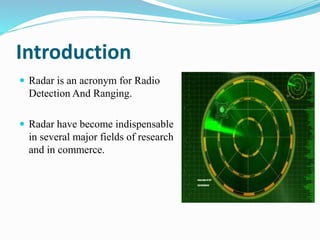
 Radar is an acronym for Radio
Detection And Ranging.
 Radar have become indispensable
in several major fields of research
and in commerce.
History
 Radar was developed for military purposes during W. W. II.
 The British and US Military used radar to locate ships and
airplanes.
 During the war, radar operators found annoying blips
continually appearing on the radar screen. Scientists had not
known that radar would be sensitive enough to detect
precipitations.
 Today, radar is an essential tool for predicting and analyzing
the weather.
What is Radar?
 RADAR (Radio Detection And Ranging) is a way to detect and
study far off targets by transmitting a radio pulse in the
direction of the target and observing the reflection of the wave.
 It’s basically radio echo.
Functions of Radar
 RADAR is a method of using electromagnetic waves to
remote-sense the position, velocity and identifying
characteristics of targets.
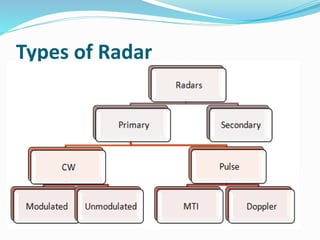
Types of Radar
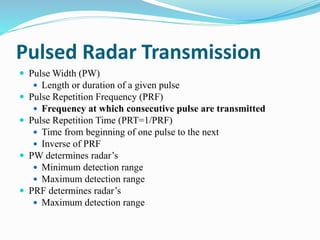
Pulsed Radar Transmission
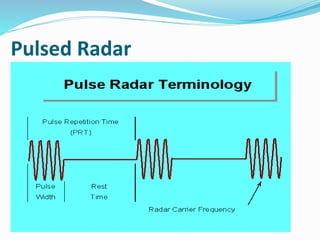
 Pulse Width (PW)
 Length or duration of a given pulse
 Pulse Repetition Frequency (PRF)
 Frequency at which consecutive pulse are transmitted
 Pulse Repetition Time (PRT=1/PRF)
 Time from beginning of one pulse to the next
 Inverse of PRF
 PW determines radar’s
 Minimum detection range
 Maximum detection range
 PRF determines radar’s
 Maximum detection range
Pulsed Radar
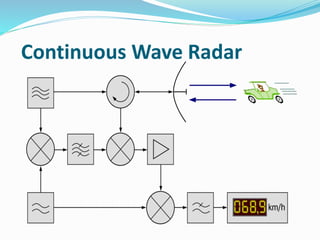
Continuous Wave Radar
 Continual energy transmission
 Separate transmit/receive antennas
 Relies on “DOPPLER SHIFT
Continuous Wave Radar
Application
 The first use of radar was for military purposes: to locate air,
ground and sea targets.
 In aviation, aircraft are equipped with radar devices that warn
of obstacles in or approaching their path and give accurate
altitude readings.
 Police forces use radar guns to monitor vehicle speeds on the
roads.
Application
 Marine radars are used to measure the bearing and distance of
ships to prevent collision with other ships, to navigate, and to
fix their position at sea when within range of shore or other
fixed references such as islands, buoys, and lightships.
 Meteorologists use radar to monitor precipitation and wind.
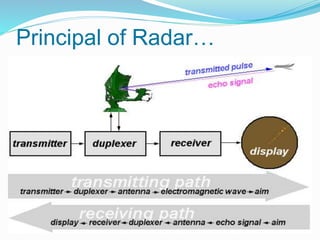
Principal of Radar
 Transmitter
The radar transmitter produces the short duration high-power rf
pulses of energy that are into space by the antenna.
 Duplexer
The duplexer alternately switches the antenna between the
transmitter and receiver so that only one antenna need be used.
 Receiver
The receivers amplify and demodulate the received RF-signals.
Principal of Radar
 Radar Antenna
The Antenna transfers the transmitter energy to signals in space
with the required distribution and efficiency. This process is
applied in an identical way on reception.
 Indicator
The indicator should present to the observer a continuous,
easily understandable, graphic picture of the relative position of
radar targets.
Principal of Radar…
Advantages
 The main advantage of RADAR, is that it provide superior
penetration capability through any type of weather condition,
and can be used in the day or night time.
 Very flexible - can be used in a number of ways !
 Stationary mode
 Moving mode
 Two Directional mode
 Beam spread can incorporate many targets !
Disadvantages
 Time - Radar can take up to 2 seconds to lock on !
 Large targets close to radar can saturate receiver !
 Hand-held modulation can falsify readings !
 More interference sources.
Conclusion
 There are many improvements that we can make to our system
in order to create better results.
 We were able to detect the range for objects that were fairly
close, and calculate the velocity for objects moving extremely
fast.
Reference
 www.studymafia.org
 www.google.com
 www.wikipedia.com
Thanks

Radar ppt.pptx

  • 1.
    www.studymafia.org Submitted To: SubmittedBy: www.studymafia.org www.studymafia.org Seminar On Radar
  • 2.
    Content  Introduction  History What is Radar?  Function of Radar  Types  Application  Principle  Advantages  Disadvantages  Conclusion
  • 3.
    Introduction  Radar isan acronym for Radio Detection And Ranging.  Radar have become indispensable in several major fields of research and in commerce.
  • 4.
    History  Radar wasdeveloped for military purposes during W. W. II.  The British and US Military used radar to locate ships and airplanes.  During the war, radar operators found annoying blips continually appearing on the radar screen. Scientists had not known that radar would be sensitive enough to detect precipitations.  Today, radar is an essential tool for predicting and analyzing the weather.
  • 5.
    What is Radar? RADAR (Radio Detection And Ranging) is a way to detect and study far off targets by transmitting a radio pulse in the direction of the target and observing the reflection of the wave.  It’s basically radio echo.
  • 6.
    Functions of Radar RADAR is a method of using electromagnetic waves to remote-sense the position, velocity and identifying characteristics of targets.
  • 7.
  • 8.
    Pulsed Radar Transmission Pulse Width (PW)  Length or duration of a given pulse  Pulse Repetition Frequency (PRF)  Frequency at which consecutive pulse are transmitted  Pulse Repetition Time (PRT=1/PRF)  Time from beginning of one pulse to the next  Inverse of PRF  PW determines radar’s  Minimum detection range  Maximum detection range  PRF determines radar’s  Maximum detection range
  • 9.
  • 10.
    Continuous Wave Radar Continual energy transmission  Separate transmit/receive antennas  Relies on “DOPPLER SHIFT
  • 11.
  • 12.
    Application  The firstuse of radar was for military purposes: to locate air, ground and sea targets.  In aviation, aircraft are equipped with radar devices that warn of obstacles in or approaching their path and give accurate altitude readings.  Police forces use radar guns to monitor vehicle speeds on the roads.
  • 13.
    Application  Marine radarsare used to measure the bearing and distance of ships to prevent collision with other ships, to navigate, and to fix their position at sea when within range of shore or other fixed references such as islands, buoys, and lightships.  Meteorologists use radar to monitor precipitation and wind.
  • 14.
    Principal of Radar Transmitter The radar transmitter produces the short duration high-power rf pulses of energy that are into space by the antenna.  Duplexer The duplexer alternately switches the antenna between the transmitter and receiver so that only one antenna need be used.  Receiver The receivers amplify and demodulate the received RF-signals.
  • 15.
    Principal of Radar Radar Antenna The Antenna transfers the transmitter energy to signals in space with the required distribution and efficiency. This process is applied in an identical way on reception.  Indicator The indicator should present to the observer a continuous, easily understandable, graphic picture of the relative position of radar targets.
  • 16.
  • 17.
    Advantages  The mainadvantage of RADAR, is that it provide superior penetration capability through any type of weather condition, and can be used in the day or night time.  Very flexible - can be used in a number of ways !  Stationary mode  Moving mode  Two Directional mode  Beam spread can incorporate many targets !
  • 18.
    Disadvantages  Time -Radar can take up to 2 seconds to lock on !  Large targets close to radar can saturate receiver !  Hand-held modulation can falsify readings !  More interference sources.
  • 19.
    Conclusion  There aremany improvements that we can make to our system in order to create better results.  We were able to detect the range for objects that were fairly close, and calculate the velocity for objects moving extremely fast.
  • 20.
  • 21.

Editor's Notes