Microstrip and Printed
Antenna Design
Second Edition
Randy Bancroft
SciTech Publishing, Inc.
Raleigh, NC
www.scitechpub.com
© 2009 by SciTech Publishing Inc.
All rights reserved. No part of this book may be reproduced or used in
any form whatsoever without written permission except in the case of
brief quotations embodied in critical articles and reviews. For
information, contact SciTech Publishing, Inc.
Printed in the U.S.A.
10 9 8 7 6 5 4 3 2 1
ISBN13: 9781891121739
SciTech President: Dudley R. Kay
Production Director: Susan Manning
Production Coordinator: Robert Lawless
Cover Design: Kathy Gagne
This book is available at special quantity discounts to use as premiums
and sales promotions, or for use in corporate training programs. For
more information and quotes, please contact:
Director of Special Sales
SciTech Publishing, Inc.
911 Paverstone Dr.—Ste. B
Raleigh, NC 27613
Phone: (919)847-2434
E-mail: sales@scitechpub.com
http://www.scitechpub.com
Library of Congress Cataloging-in-Publication Data
Bancroft, Randy.
Microstrip and printed antenna design / Randy Bancroft.—2nd ed.
p. cm.
ISBN 978-1-891121-73-9 (hbk. : alk. paper)
1. Microstrip antennas. I. Title.
TK7871.67.M5B35 2008
621.382′4—dc22
2008022523
Preface to Second Edition
As with the first edition of this book, it is written for designers of planar
microstrip antennas who develop antennas for wireless applications, and
should also be useful to those who design antennas for the aerospace industry.
Many of the subjects chosen for examination reflect those found to be useful
by the author during his career. The text includes the most useful recent
work available from researchers in the microstrip and printed antenna field.
This book is intended to be used as a succinct, accessible handbook which
provides useful, practical, simple, and manufacturable antenna designs
but also offers references which allow the reader to investigate more complex
designs.
The second edition has numerous additions to the earlier text which I hope
will make the concepts presented clearer. New cavity model analysis equations
of circular polarization bandwidth, axial ratio bandwidth and power fraction
bandwidth have been included. The section on omnidirectional microstrip
antennas is expanded with further design options and analysis. This also true
of the section on Planar Inverted F (PIFA) antennas. The discovery and descrip-
tion of the “fictious resonance” mode of a microstrip slot antenna has been
added to that section. Appendix A on microstrip antenna substrates has been
expanded to provide more detail on the types of substrate and their composi-
tion. This is often neglected in other texts. An appendix on elementary imped-
ance matching techniques has been added as these methods have proven useful
in my industrial work.
Numerous books have been published about microstrip antenna design
which have an intimidating variety of designs. This volume attempts to distill
these designs down to those which have considerable utility and simplicity. It
also attempts to present useful new research results and designs generally not
emphasized in other volumes.
xi
In the last ten years, computer methods of electromagnetic analysis such as
the Finite Difference Time Domain (FDTD) method, Finite Element Method
(FEM) and Method of Moments (MoM) have become accessible to most antenna
designers. This book introduces elementary analysis methods which may be
used to estimate design dimensions. These methods should be implementable
with relative ease. Full wave methods may then be used to refine the initial
designs.
When mathematics beyond algebra is presented, such as integrations and
infinite sums, appendices are provided which explain how to undertake their
numerical computation. Results from advanced methods such as FDTD, FEM
or MoM are presented with input dimensions and parameters which were used
to generate them. This is so the reader can reproduce and alter them to aid
their understanding. These results are used to provide insight into a design.
The author’s preferred method of analysis is the Finite Difference Time Domain
method which is generously represented in this volume. In the second edition
Ansoft HFSS has provided a larger share of the analysis.
I would like to thank Paul Cherry for his generous assistance and discus-
sions which allowed me to implement FDTD analysis code and his thermal
viewing software whose images grace these pages.
xii Preface to Second Edition
Contents
Preface to Second Edition . . . . . . . . . . . . . . . . . . . . . . . . . . . . . . . . . . . . . . . . . . . xi
Acknowledgment. . . . . . . . . . . . . . . . . . . . . . . . . . . . . . . . . . . . . . . . . . . . . . . . . . xiii
Chapter 1 Microstrip Antennas . . . . . . . . . . . . . . . . . . . . . . . . . . . . . . . . . . . . . . 1
1.1 The Origin of Microstrip Radiators. . . . . . . . . . . . . . . . . . . . . . . . . . . . . . 1
1.2 Microstrip Antenna Analysis Methods . . . . . . . . . . . . . . . . . . . . . . . . . . . 4
1.3 Microstrip Antenna Advantages and Disadvantages . . . . . . . . . . . . . . . 5
1.4 Microstrip Antenna Applications . . . . . . . . . . . . . . . . . . . . . . . . . . . . . . . 6
References . . . . . . . . . . . . . . . . . . . . . . . . . . . . . . . . . . . . . . . . . . . . . . . . . . . . . . . 7
Chapter 2 Rectangular Microstrip Antennas . . . . . . . . . . . . . . . . . . . . . . . . . . 10
2.1 The Transmission Line Model . . . . . . . . . . . . . . . . . . . . . . . . . . . . . . . . . 10
2.2 The Cavity Model. . . . . . . . . . . . . . . . . . . . . . . . . . . . . . . . . . . . . . . . . . . . 19
2.2.1 The TM10 and TM01 Mode . . . . . . . . . . . . . . . . . . . . . . . . . . . . . . . 24
2.3 Radiation Pattern and Directivity of a Linear Rectangular
Microstrip Patch Antenna . . . . . . . . . . . . . . . . . . . . . . . . . . . . . . . . . . . . 28
2.4 Quarter-Wave Rectangular Microstrip Antenna . . . . . . . . . . . . . . . . . . 34
2.5 λ
–4
× λ
–4
Rectangular Microstrip Antenna . . . . . . . . . . . . . . . . . . . . . . . . . . 36
2.6 Circular Polarized Rectangular Microstrip Antenna Design. . . . . . . . 38
2.6.1 Single-Feed Circularly Polarized Rectangular
Microstrip Antenna Design . . . . . . . . . . . . . . . . . . . . . . . . . . . . . 38
2.6.2 Dual-Feed Circularly Polarized Rectangular
Microstrip Antenna Design . . . . . . . . . . . . . . . . . . . . . . . . . . . . . 49
2.6.3 Quadrature (90º) Hybrid. . . . . . . . . . . . . . . . . . . . . . . . . . . . . . . . 50
2.7 Impedance and Axial Ratio Bandwidth . . . . . . . . . . . . . . . . . . . . . . . . . 52
2.8 Efficiency . . . . . . . . . . . . . . . . . . . . . . . . . . . . . . . . . . . . . . . . . . . . . . . . . . 54
2.9 Design of a Linearly Polarized Microstrip Antenna with
Dielectric Cover. . . . . . . . . . . . . . . . . . . . . . . . . . . . . . . . . . . . . . . . . . . . . 56
vii
viii Contents
2.10 Design Guidelines for a Linearly Polarized Rectangular
Microstrip Antenna . . . . . . . . . . . . . . . . . . . . . . . . . . . . . . . . . . . . . . . . . . 60
2.11 Design Guidelines for a Circularly Polarized Rectangular
Microstrip Antenna . . . . . . . . . . . . . . . . . . . . . . . . . . . . . . . . . . . . . . . . . . 64
2.12 Electromagnetically Coupled Rectangular Microstrip
Antenna. . . . . . . . . . . . . . . . . . . . . . . . . . . . . . . . . . . . . . . . . . . . . . . . . . . . 65
2.13 Ultrawide Rectangular Microstrip Antenna. . . . . . . . . . . . . . . . . . . . . . 67
References . . . . . . . . . . . . . . . . . . . . . . . . . . . . . . . . . . . . . . . . . . . . . . . . . . . . . . 70
Chapter 3 Circular Microstrip Antennas. . . . . . . . . . . . . . . . . . . . . . . . . . . . . . 76
3.1 Circular Microstrip Antenna Properties. . . . . . . . . . . . . . . . . . . . . . . . . 76
3.2 Directivity . . . . . . . . . . . . . . . . . . . . . . . . . . . . . . . . . . . . . . . . . . . . . . . . . . 80
3.3 Input Resistance and Impedance Bandwidth . . . . . . . . . . . . . . . . . . . . 81
3.3.1 Gain, Radiation Pattern, and Efficiency. . . . . . . . . . . . . . . . . . . 82
3.4 Circular Microstrip Antenna Radiation Modes . . . . . . . . . . . . . . . . . . . 83
3.4.1 The TM11 Bipolar Mode. . . . . . . . . . . . . . . . . . . . . . . . . . . . . . . . . 83
3.4.2 The TM11 Bipolar Mode Circular Polarized Antenna
Design . . . . . . . . . . . . . . . . . . . . . . . . . . . . . . . . . . . . . . . . . . . . . . . 84
3.4.3 The TM21 Quadrapolar Mode . . . . . . . . . . . . . . . . . . . . . . . . . . . . 88
3.4.4 The TM02 Unipolar Mode . . . . . . . . . . . . . . . . . . . . . . . . . . . . . . . 91
3.5 Microstrip Antenna Cross Polarization . . . . . . . . . . . . . . . . . . . . . . . . . 92
3.6 Annular Microstrip Antenna . . . . . . . . . . . . . . . . . . . . . . . . . . . . . . . . . . 97
References . . . . . . . . . . . . . . . . . . . . . . . . . . . . . . . . . . . . . . . . . . . . . . . . . . . . . 100
Chapter 4 Broadband Microstrip Antennas . . . . . . . . . . . . . . . . . . . . . . . . . . 102
4.1 Broadband Microstrip Antennas . . . . . . . . . . . . . . . . . . . . . . . . . . . . . . 102
4.2 Microstrip Antenna Broadbanding . . . . . . . . . . . . . . . . . . . . . . . . . . . . 103
4.2.1 Microstrip Antenna Matching with Capacitive Slot . . . . . . . . 105
4.2.2 Microstrip Antenna Broadband Matching with
Bandpass Filter . . . . . . . . . . . . . . . . . . . . . . . . . . . . . . . . . . . . . . 106
4.2.3 Microstrip Antenna Broadband Matching Using
Lumped Elements . . . . . . . . . . . . . . . . . . . . . . . . . . . . . . . . . . . . 111
4.2.4 Lumped Elements to Transmission Line Section
Conversion . . . . . . . . . . . . . . . . . . . . . . . . . . . . . . . . . . . . . . . . . . 113
Contents ix
4.2.5 Real Frequency Technique Broadband Matching. . . . . . . . . . 119
4.2.6 Matching Network Optimization Using Genetic
Algorithms . . . . . . . . . . . . . . . . . . . . . . . . . . . . . . . . . . . . . . . . . . 119
4.3 Patch Shape for Optimized Bandwidth . . . . . . . . . . . . . . . . . . . . . . . . 120
4.3.1 Patch Shape Bandwidth Optimization Using Genetic
Algorithms . . . . . . . . . . . . . . . . . . . . . . . . . . . . . . . . . . . . . . . . . . 121
References . . . . . . . . . . . . . . . . . . . . . . . . . . . . . . . . . . . . . . . . . . . . . . . . . . . . . 123
Chapter 5 Dual-Band Microstrip Antennas. . . . . . . . . . . . . . . . . . . . . . . . . . . 126
5.0 Dual-Band Microstrip Antennas . . . . . . . . . . . . . . . . . . . . . . . . . . . . . . 126
5.1 Single-Resonator Rectangular Microstrip Dual-Band
Antenna. . . . . . . . . . . . . . . . . . . . . . . . . . . . . . . . . . . . . . . . . . . . . . . . . . . 126
5.2 Multiple Resonator Dual-Band Antennas. . . . . . . . . . . . . . . . . . . . . . . 131
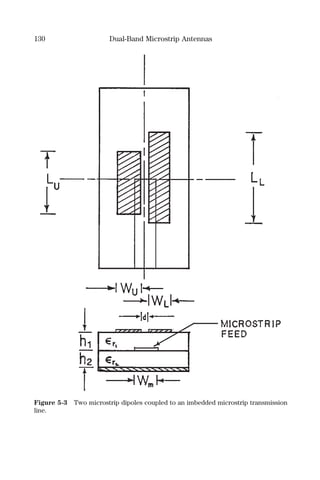
5.2.1 Coupled Microstrip Dipoles. . . . . . . . . . . . . . . . . . . . . . . . . . . . 131
5.2.2 Stacked Rectangular Microstrip Antennas . . . . . . . . . . . . . . . 131
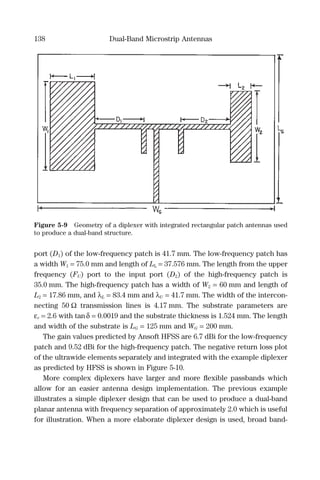
5.3 Dual-Band Microstrip Antenna Design Using a Diplexer . . . . . . . . . 134
5.3.1 Example Dual-Band Microstrip Antenna Design
Using a Diplexer . . . . . . . . . . . . . . . . . . . . . . . . . . . . . . . . . . . . . 137
5.4 Multiband Microstrip Design Using Patch Shaping and a
Genetic Algorithm . . . . . . . . . . . . . . . . . . . . . . . . . . . . . . . . . . . . . . . . . . 140
References . . . . . . . . . . . . . . . . . . . . . . . . . . . . . . . . . . . . . . . . . . . . . . . . . . . . . 141
Chapter 6 Microstrip Arrays . . . . . . . . . . . . . . . . . . . . . . . . . . . . . . . . . . . . . . . 142
6.0 Microstrip Arrays. . . . . . . . . . . . . . . . . . . . . . . . . . . . . . . . . . . . . . . . . . . 142
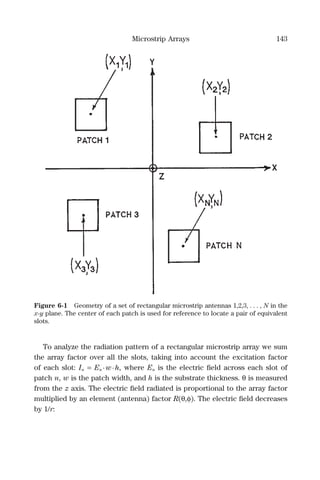
6.1 Planar Array Theory . . . . . . . . . . . . . . . . . . . . . . . . . . . . . . . . . . . . . . . . 142
6.2 Rectangular Microstrip Antenna Array Modeled Using Slots. . . . . . 146
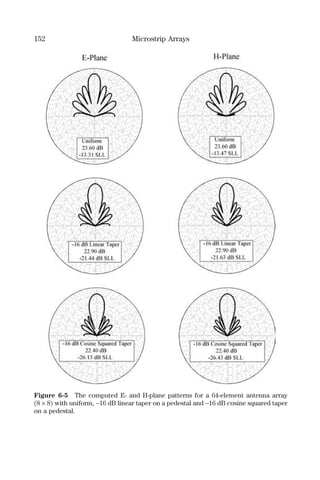
6.3 Aperture Excitation Distribution . . . . . . . . . . . . . . . . . . . . . . . . . . . . . 148
6.4 Microstrip Array Feeding Methods. . . . . . . . . . . . . . . . . . . . . . . . . . . . 154
6.4.1 Corporate Fed Array. . . . . . . . . . . . . . . . . . . . . . . . . . . . . . . . . . 154
6.4.2 Series Fed Array . . . . . . . . . . . . . . . . . . . . . . . . . . . . . . . . . . . . . 157
6.5 Phase and Amplitude Error . . . . . . . . . . . . . . . . . . . . . . . . . . . . . . . . . . 163
6.6 Mutual Coupling. . . . . . . . . . . . . . . . . . . . . . . . . . . . . . . . . . . . . . . . . . . . 165
6.6.1 Mutual Coupling Between Square Microstrip Antennas . . . . 170
References . . . . . . . . . . . . . . . . . . . . . . . . . . . . . . . . . . . . . . . . . . . . . . . . . . . . . 176
x Contents
Chapter 7 Printed Antennas . . . . . . . . . . . . . . . . . . . . . . . . . . . . . . . . . . . . . . . 178
7.0 Printed Antennas . . . . . . . . . . . . . . . . . . . . . . . . . . . . . . . . . . . . . . . . . . . 178
7.1 Omnidirectional Microstrip Antenna . . . . . . . . . . . . . . . . . . . . . . . . . . 178
7.1.1 Low Sidelobe Omnidirectional Microstrip Antenna. . . . . . . . 186
7.1.2 Element Shaping of Omnidirectional Microstrip
Antenna. . . . . . . . . . . . . . . . . . . . . . . . . . . . . . . . . . . . . . . . . . . . . 188
7.1.3 Single-Short Omnidirectional Microstrip Antenna . . . . . . . . . 191
7.2 Stripline Fed Tapered Slot Antenna . . . . . . . . . . . . . . . . . . . . . . . . . . . 192
7.2.1 Stripline Fed Vivaldi Antenna . . . . . . . . . . . . . . . . . . . . . . . . . . 197
7.3 Meanderline Antenna . . . . . . . . . . . . . . . . . . . . . . . . . . . . . . . . . . . . . . . 199
7.3.1 Electrically Small Antennas. . . . . . . . . . . . . . . . . . . . . . . . . . . . 199
7.3.2 Meanderline Antenna Design. . . . . . . . . . . . . . . . . . . . . . . . . . . 203
7.3.2.1 Meanderline Antenna Impedance Bandwidth . . . . . 203
7.3.2.2 Meanderline Antenna Radiation Patterns. . . . . . . . . 207
7.4 Half-Patch with Reduced Short Circuit Plane. . . . . . . . . . . . . . . . . . . 211
7.4.1 Dual-Band PIFA . . . . . . . . . . . . . . . . . . . . . . . . . . . . . . . . . . . . . . 217
7.5 Rectangular Microstrip Fed Slot Antenna . . . . . . . . . . . . . . . . . . . . . . 219
7.5.1 Slot Antenna “Fictitious Resonance” . . . . . . . . . . . . . . . . . . . . 222
7.6 Microstrip Fed Log Periodic Balun Printed Dipole . . . . . . . . . . . . . . 225
7.7 Microstrip Fed Tapered Balun Printed Dipole . . . . . . . . . . . . . . . . . . 228
References . . . . . . . . . . . . . . . . . . . . . . . . . . . . . . . . . . . . . . . . . . . . . . . . . . . . . 232
Appendix A: Microstrip Antenna Substrates . . . . . . . . . . . . . . . . . . . . . . . . 235
Appendix B: Numerical Methods . . . . . . . . . . . . . . . . . . . . . . . . . . . . . . . . . . 243
Appendix C: Microstrip Transmission Line Design
and Discontinuities. . . . . . . . . . . . . . . . . . . . . . . . . . . . . . . . . . . . . . . . . . . . 249
Appendix D: Antenna Topics . . . . . . . . . . . . . . . . . . . . . . . . . . . . . . . . . . . . . 257
Appendix E: Impedance Matching Techniques . . . . . . . . . . . . . . . . . . . . . . 268
Index . . . . . . . . . . . . . . . . . . . . . . . . . . . . . . . . . . . . . . . . . . . . . . . . . . . . . . . . . . . . 284
Chapter 1
Microstrip Antennas
1.1 The Origin of Microstrip Radiators
The use of coaxial cable and parallel two wire (or “twin lead”) as a transmis-
sion line can be traced to at least the 19th century. The realization of radio
frequency (RF) and microwave components using these transmission lines
required considerable mechanical effort in their construction. The advent of
printed circuit board techniques in the mid-20th century led to the realization
that printed circuit versions of these transmission lines could be developed
which would allow for much simpler mass production of microwave compo-
nents. The printed circuit analog of a coaxial cable became known as stripline.
With a groundplane image providing a virtual second conductor, the printed
circuit analog of two wire (“parallel plate”) transmission line became known
as microstrip. For those not familiar with the details of this transmission line,
they can be found in Appendix B at the end of this book.
Microstrip geometries which radiate electromagnetic waves were originally
contemplated in the 1950s. The realization of radiators that are compatible with
microstrip transmission line is nearly contemporary, with its introduction in
1952 by Grieg and Englemann.[1]
The earliest known realization of a microstrip-
like antenna integrated with microstrip transmission line was developed in
1953 by Deschamps[2,3]
(Figure 1-1). By 1955, Gutton and Baissinot patented a
microstrip antenna design.[4]
Early microstrip lines and radiators were specialized devices developed in
laboratories. No commercially available printed circuit boards with controlled
dielectric constants were developed during this period. The investigation of
microstrip resonators that were also efficient radiators languished. The theo-
retical basis of microstrip transmission lines continued to be the object of
academic inquiry.[5]
Stripline received more interest as a planar transmission
1
2 Microstrip Antennas
line at the time because it supports a transverse electromagnetic (TEM) wave
and allowed for easier analysis, design, and development of planar microwave
structures. Stripline was also seen as an adaptation of coaxial cable and
microstrip as an adaptation of two wire transmission line. R. M. Barrett opined
in 1955 that the “merits of these two systems [stripline and microstrip] are
essentially the merits of their respective antecedents [coaxial cable and two
wire].”[6]
These viewpoints may have been some of the reasons microstrip did
not achieve immediate popularity in the 1950s. The development of microstrip
transmission line analysis and design methods continued in the mid to late
1960s with work by Wheeler[7]
and Purcel et al.[8,9]
In 1969 Denlinger noted rectangular and circular microstrip resonators
could efficiently radiate.[10]
Previous researchers had realized that in some
cases, 50% of the power in a microstrip resonator would escape as radiation.
Denlinger described the radiation mechanism of a rectangular microstrip reso-
nator as arising from the discontinuities at each end of a truncated microstrip
transmission line. The two discontinuities are separated by a multiple of a half
wavelength and could be treated separately and combined to describe the
complete radiator. It was noted that the percentage of radiated power to the
Figure 1-1 Original conformal array designed by Deshamps [2] in 1953 fed with
microstrip transmission line.
Microstrip Antennas 3
total input power increased as the substrate thickness of the microstrip radia-
tor increased. These correct observations are discussed in greater detail in
Chapter 2. Denlinger’s results only explored increasing the substrate thickness
until approximately 70% of the input power was radiated into space. Denlinger
also investigated radiation from a resonant circular microstrip disc. He observed
that at least 75% of the power was radiated by one circular resonator under
study. In late 1969, Watkins described the fields and currents of the resonant
modes of circular microstrip structures.[11]
The microstrip antenna concept finally began to receive closer examination
in the early 1970s when aerospace applications, such as spacecraft and mis-
siles, produced the impetus for researchers to investigate the utility of con-
formal antenna designs. In 1972 Howell articulated the basic rectangular
microstrip radiator fed with microstrip transmission line at a radiating edge.[12]
The microstrip resonator with considerable radiation loss was now described
as a microstrip antenna. A number of antenna designers received the design
with considerable caution. It was difficult to believe a resonator of this type
could radiate with greater than 90% efficiency. The narrow bandwidth of the
antenna seemed to severely limit the number of possible applications for which
the antenna could prove useful. By the late 1970s, many of these objections
had not proven to derail the use of microstrip antennas in numerous aerospace
applications. By 1981, microstrip antennas had become so ubiquitous and
studied that they were the subject of a special issue of the IEEE Transactions
on Antennas and Propagation.[13]
Today a farrago of designs have been developed, which can be bewildering
to designers who are new to the subject. This book attempts to explain basic
concepts and present useful designs. It will also direct the reader who wishes
to research other microstrip antenna designs, which are not presented in this
work, to pertinent literature.
The geometry which is defined as a microstrip antenna is presented in
Figure 1-2. A conductive patch exists along the plane of the upper surface of
a dielectric slab. This area of conductor, which forms the radiating element, is
generally rectangular or circular, but may be of any shape. The dielectric
substrate has groundplane on its bottom surface.
4 Microstrip Antennas
1.2 Microstrip Antenna Analysis Methods
It was known that the resonant length of a rectangular microstrip antenna is
approximately one-half wavelength with the effective dielectric constant of the
substrate taken into account. Following the introduction of the microstrip
antenna, analysis methods were desired to determine the approximate
resonant resistance of a basic rectangular microstrip radiator. The earliest
useful model introduced to provide approximate values of resistance at
the edge of a microstrip antenna is known as the transmission line model,
introduced by Munson.[14]
The transmission line model provides insight into
the simplest microstrip antenna design, but is not complete enough to be
useful when more than one resonant mode is present. In the late 1970s
Lo et al. developed a model of the rectangular microstrip antenna as a
lossy resonant cavity.[15]
Microstrip antennas, despite their simple geometry,
proved to be very challenging to analyze using exact methods. In the 1980s,
the method of moments (MoM) became the first numerical analysis method
that was computationally efficient enough so that contemporary computers
Figure 1-2 Geometry of a microstrip antenna.
Microstrip Antennas 5
could provide enough memory and CPU speed to practically analyze microstrip
antennas.[16–19]
Improvements in computational power and memory size of personal com-
puters during the 1990s made numerical methods such as the finite difference
time domain (FDTD) method and finite element method (FEM), which require
much more memory than MoM solutions, workable for everyday use by design-
ers. This book will generally use FDTD as a full-wave analysis method as well
as Ansoft HFSS.[20,21]
1.3 Microstrip Antenna Advantages and Disadvantages
The main advantages of microstrip antennas are:
• Low-cost fabrication.
• Can easily conform to a curved surface of a vehicle or product.
• Resistant to shock and vibration (most failures are at the feed probe solder
joint).
• Many designs readily produce linear or circular polarization.
• Considerable range of gain and pattern options (2.5 to 10.0 dBi).
• Other microwave devices realizable in microstrip may be integrated with a
microstrip antenna with no extra fabrication steps (e.g., branchline hybrid
to produce circular polarization or corporate feed network for an array of
microstrip antennas).
• Antenna thickness (profile) is small.
The main disadvantages of microstrip antennas are
• Narrow bandwidth (5% to 10% [2:1 voltage standing wave ratio (VSWR)] is
typical without special techniques).
• Dielectric and conductor losses can be large for thin patches, resulting in
poor antenna efficiency.
• Sensitivity to environmental factors such as temperature and humidity.
6 Microstrip Antennas
1.4 Microstrip Antenna Applications
A large number of commercial needs are met by the use of microstrip and
printed antennas, these include the ubiquitous Global Positioning System
(GPS), Zigbee, Bluetooth, WiMax, WiFi applications, 802.11a,b,g, and others.
The most popular microstrip antenna is certainly the rectangular patch (Chapter
2). GPS applications, such as asset tracking of vehicles as well as marine uses,
have created a large demand for antennas. The majority of these are rectangu-
lar patches that have been modified to produce right-hand circular polarization
(RHCP) and operate at 1.575 GHz. Numerous vendors offer patches designed
using ceramics with a high dielectric constant (εr = 6, 20, 36) to reduce the
rectangular microstrip antenna to as small a footprint as possible for a given
application. The patches are provided ready for circuit board integration with
low noise amplifiers. Rectangular patch antennas are also used for Bluetooth
automotive applications (2.4 GHz) with RHCP.
In recent years Satellite Digital Audio Radio Services (SDARS) have become
a viable alternative to AM and FM commercial broadcasts in automobiles. The
system has strict radiation pattern requirements which have been met with a
combination of a printed monopole and a TM21 mode annular microstrip antenna
that has been altered with notches to produce left-hand circular polarization at
2.338 GHz.[22]
The annular microstrip antenna is addressed in Chapter 3.
Wireless local area networks (WLAN) provide short-range, high-speed data
connections between mobile devices (such as a laptop computer) and wireless
access points. The range for wireless data links is typically around 100 to 300
feet indoors and 2000 feet outdoors. Wireless data links use the IEEE Stan-
dards 802.11a,b,g. The majority of WLANs use the unlicensed 2.4 GHz band
(802.11b and 802.11g). The 802.11a standard uses the 5 GHz unlicensed fre-
quency band. Multiband printed antennas that are integrated into ceiling tiles
use a microstrip diplexer (Chapter 5) to combine the signal from Global System
for Mobile communication (GSM) cell phones (860 MHz band), personal com-
munications services (PCS) cell phones (1.92 GHz band), and 802.11a WLAN
service (2.4 GHz band) provided by two integrated microstrip dipoles.[23]
Wireless local area network systems sometimes require links between build-
ings that have wireless access points. This is sometimes accomplished using
microstrip phased arrays at 5 GHz (Chapter 6).
Microstrip Antennas 7
In other applications, such as warehouse inventory control, a printed
antenna with an omnidirectional pattern is desired (Chapter 7). Omnidirec-
tional microstrip antennas are also of utility for many WiMax applications
(2.3, 2.5, 3.5, and 5.8 GHz are some of the frequencies currently of interest for
WiMax applications) and for access points. Microstrip fed printed slot antennas
have proven useful to provide vertical polarization and integrate well into
laptop computers (Chapter 7) for WLAN.
The advantages of using antennas in communication systems will continue
to generate new applications which require their use. Antennas have the advan-
tage of mobility without any required physical connection. They are the device
which enables all the “wireless” systems that have become so ubiquitous in
our society. The use of transmission line, such as coaxial cable or waveguide,
may have an advantage in transmission loss for short lengths, but as distance
increases, the transmission loss between antennas becomes less than any
transmission line, and in some applications can outperform cables for shorter
distances.[24]
The material costs for wired infrastructure also encourages the
use of antennas in many modern communication systems.
References
[1] Grieg, D. D., and Englemann, H. F., “Microstrip—a new transmission technique
for the kilomegacycle range,” Proceedings of the IRE, 1952, Vol. 40, No. 10, pp.
1644–1650.
[2] Deschamps, G. A., “Microstrip Microwave Antennas,” Third Symposium on the
USAF Antenna Research and Development Program, University of Illinois, Monti-
cello, Illinois, October 18–22, 1953.
[3] Bernhard, J. T., Mayes, P. E., Schaubert, D., and Mailoux, R. J., “A commemoration
of Deschamps’ and Sichak’s ‘Microstrip Microwave Antennas’: 50 years of develop-
ment, divergence, and new directions,” Proceedings of the 2003 Antenna Applica-
tions Symposium, Monticello, Illinois, September 2003, pp. 189–230.
[4] Gutton, H., and Baissinot, G., “Flat aerial for ultra high frequencies,” French Patent
no. 703113, 1955.
[5] Wu, T. T., “Theory of the microstrip,” Journal of Applied Physics, March 1957, Vol.
28, No. 3, pp. 299–302.
[6] Barrett, R. M., “Microwave printed circuits—a historical survey,” IEEE Transac-
tions on Microwave Theory and Techniques, Vol. 3, No. 2, pp. 1–9.
8 Microstrip Antennas
[7] Wheeler, H. A., “Transmission line properties of parallel strips separated by a
dielectric sheet,” IEEE Transactions on Microwave Theory of Techniques, March
1965, Vol. MTT-13, pp. 172–185.
[8] Purcel, R. A., Massé, D. J., and Hartwig, C. P., “Losses in microstrip,” IEEE Trans-
actions on Microwave Theory and Techniques , June 1968, Vol. 16, No. 6, pp.
342–350.
[9] Purcel, R. A., Massé, D. J., and Hartwig, C. P., “Errata: ‘Losses in microstrip,’” IEEE
Transactions on Microwave Theory and Techniques, December 1968, Vol. 16, No.
12, p. 1064.
[10] Denlinger, E. J., “Radiation from microstrip radiators,” IEEE Transactions on
Microwave Theory of Techniques, April 1969, Vol. 17, No. 4, pp. 235–236.
[11] Watkins, J., “Circular resonant structures in microstrip,” Electronics Letters, Vol.
5, No. 21, October 16, 1969, pp. 524–525.
[12] Howell, J. Q., “Microstrip antennas,” IEEE International Symposium on Antennas
and Propagation, Williamsburg Virginia, 1972, pp. 177–180.
[13] IEEE Transactions on Antennas and Propagation, January 1981.
[14] Munson, R. E., “Conformal microstrip antennas and microstrip phased arrays,”
IEEE Transactions on Antennas and Propagation, January 1974, Vol. 22, No. 1,
pp. 235–236.
[15] Lo, Y. T., Solomon, D., and Richards, W. F., “Theory and experiment on microstrip
antennas,” IEEE Transactions on Antennas and Propagations, 1979, AP-27, pp.
137–149.
[16] Hildebrand, L. T., and McNamara, D. A., “A guide to implementational aspects of
the spatial-domain integral equation analysis of microstrip antennas,” Applied
Computational Electromagnetics Journal, March 1995, Vol. 10, No. 1, ISSN 1054-
4887, pp. 40–51.
[17] Mosig, J. R., and Gardiol, F. E., “Analytical and numerical techniques in the Green’s
function treatment of microstrip antennas and scatterers,” IEE Proceedings, March
1983, Vol. 130, Pt. H., No. 2, pp. 175–182.
[18] Mosig, J. R., and Gardiol, F. E., “General integral equation formulation for microstrip
antennas and scatterers,” IEE Proceedings, December 1985, Vol. 132, Pt. H, No. 7,
pp. 424–432.
[19] Mosig, J. R., “Arbitrarily shaped microstrip structures and their analysis with a
mixed potential integral equation,” IEEE Transactions on Microwave Theory and
Techniques, February 1988, Vol. 36, No. 2. pp. 314–323.
[20] Tavlov, A., and Hagness, S. C., Computational Electrodynamics: The Finite-
Difference Time-Domain Method, 2nd ed., London: Artech House, 2000.
[21] Tavlov, A., ed., Advances in Computational Electrodynamics: The Finite Differ-
ence Time-Domain Method, London: Artech House, 1998.
Microstrip Antennas 9
[22] Licul, S., Petros, A., and Zafar, I., “Reviewing SDARS antenna requirements,”
Microwaves & RF, September 2003, ED Online ID #5892.
[23] Bateman, B. R., Bancroft, R. C., and Munson, R. E., “Multiband flat panel antenna
providing automatic routing between a plurality of antenna elements and an input/
output port,” U.S. Patent No. 6,307,525.
[24] Milligan, T., Modern Antenna Design, New York: McGraw Hill, 1985, pp. 8–9.
Chapter 2
Rectangular Microstrip Antennas
2.1 The Transmission Line Model
The rectangular patch antenna is very probably the most popular microstrip
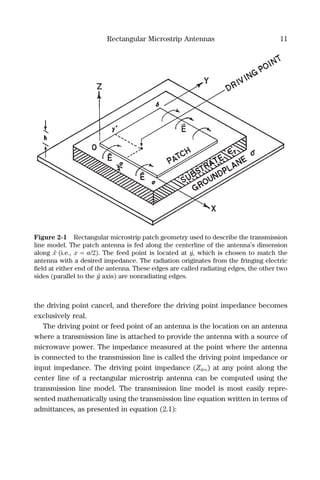
antenna design implemented by designers. Figure 2-1 shows the geometry of
this antenna type. A rectangular metal patch of width W = a and length L = b
is separated by a dielectric material from a groundplane by a distance h. The
two ends of the antenna (located at 0 and b) can be viewed as radiating due
to fringing fields along each edge of width W (= a). The two radiating edges
are separated by a distance L (= b). The two edges along the sides of length L
are often referred to as nonradiating edges.
Numerous full-wave analysis methods have been devised for the rectangular
microstrip antenna.[1–4]
Often these advanced methods require a considerable
investment of time and effort to implement and are thus not convenient for
computer-aided design (CAD) implementation.
The two analysis methods for rectangular microstrip antennas which are
most popular for CAD implementation are the transmission line model and the
cavity model. In this section I will address the least complex version of the
transmission line model. The popularity of the transmission line model may
be gauged by the number of extensions to this model which have been
developed.[5–7]
The transmission line model provides a very lucid conceptual picture of the
simplest implementation of a rectangular microstrip antenna. In this model,
the rectangular microstrip antenna consists of a microstrip transmission line
with a pair of loads at either end.[8,9]
As presented in Figure 2-2(a), the resistive
loads at each end of the transmission line represent loss due to radiation.
At resonance, the imaginary components of the input impedance seen at
10
Rectangular Microstrip Antennas 11
the driving point cancel, and therefore the driving point impedance becomes
exclusively real.
The driving point or feed point of an antenna is the location on an antenna
where a transmission line is attached to provide the antenna with a source of
microwave power. The impedance measured at the point where the antenna
is connected to the transmission line is called the driving point impedance or
input impedance. The driving point impedance (Zdrv) at any point along the
center line of a rectangular microstrip antenna can be computed using the
transmission line model. The transmission line model is most easily repre-
sented mathematically using the transmission line equation written in terms of
admittances, as presented in equation (2.1):
Figure 2-1 Rectangular microstrip patch geometry used to describe the transmission
line model. The patch antenna is fed along the centerline of the antenna’s dimension
along xˆ (i.e., x = a/2). The feed point is located at y´, which is chosen to match the
antenna with a desired impedance. The radiation originates from the fringing electric
field at either end of the antenna. These edges are called radiating edges, the other two
sides (parallel to the yˆ axis) are nonradiating edges.
12 Rectangular Microstrip Antennas
Zdrv
jBe
L1
jBeGe Ge
L2
Ydrv
Yo YoYe
(a) Feed point between radiating edges
(b) Transmission line feed at radiating edge
Ye
L1 L2
YoYdrv YeYe
Lf
L
L
Figure 2-2 (a) The transmission line model of a rectangular microstrip antenna is a
transmission line separating two loads. A driving point is chosen along the antenna
length L which can be represented as a sum of L1 and L2. The two transmission line
sections contribute to the driving point impedance. The antenna is readily analyzed
using a pair of edge admittances (Ye) separated by two sections of transmission line of
characteristic admittance (Y0). (b) The microstrip antenna may be fed at one of its
radiating edges using a transmission line. In this case, the transmission line model is
augmented with a feed line of characteristic admittance Yf of length Lf connected to a
radiating edge. The driving point admittance Ydrv is then computed at the end of this
feed line.
Rectangular Microstrip Antennas 13
Y Y
Y jY L
Y jY L
in
L
L
=
+
+
0
0
0
tan( )
tan( )
β
β
(2.1)
Yin is the input admittance at the end of a transmission line of length L
(= b), which has a characteristic admittance of Y0, and a phase constant of β
terminated with a complex load admittance, YL. In other words, the microstrip
antenna is modeled as a microstrip transmission line of width W (= a), which
determines the characteristic admittance, and is of physical length L (= b) and
loaded at both ends by an edge admittance Ye which models the radiation loss.
This is shown in Figure 2-2(a).
Using equation (2.1), the driving point admittance Ydrv = 1/Zdrv at a driving
point between the two radiating edges is expressed as:
Y Y
Y jY L
Y jY L
Y jY L
Y jY
drv
e
e
e
e
=
+
+
+
+
+
0
0 1
0 1
0 2
0
tan( )
tan( )
tan( )
ta
β
β
β
nn( )βL2



 (2.2)
Ye is the complex admittance at each radiating edge, which consists of an
edge conductance Ge and edge susceptance Be as related in equation (2.3). The
two loads are separated by a microstrip transmission line of characteristic
admittance Y0:
Y G jBe e e= + (2.3)
Approximate values of Ge and Be may be computed using equation (2.4) and
equation (2.5).[10]
G
W
e = 0 00836
0
.
λ
(2.4)
B
l
h
W
e e= 0 01668
0
.
∆
λ
ε (2.5)
The effective dielectric constant (W/h ≥ 1) is given as
ε
ε ε
e
r r h
W
=
+
+
−
+



−
1
2
1
2
1 12
1 2
(2.6)
14 Rectangular Microstrip Antennas
The fringing field extension normalized to the substrate thickness h is
∆l
h
W h
W h
e
e
=
+ +
− +
0 412
0 3 0 264
0 258 0 8
.
( . )( / . )
( . )( / . )
ε
ε
(2.7)
The value ∆l is the line extension due to the electric field fringing at the edge
of the patch antenna. The physical size of a resonant microstrip patch antenna
would be λεe/2 were it not for the effect of fringing at the end of the rectangular
microstrip antenna.1
Equation (2.7) can be used to correct for this effect and
compute the physical length of a rectangular microstrip antenna which will
resonate at a desired design frequency fr.
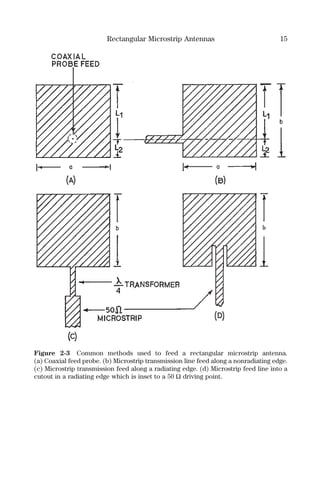
Figure 2-3 presents four common methods used to directly feed a microstrip
antenna. The first method is often called a coaxial probe feed (Figure 2-3(a)).
The outer shield of a coaxial transmission line is connected to the groundplane
of the microstrip antenna. Metal is removed from the groundplane which is
generally the same radius as the inside of the coaxial shield. The coaxial center
conductor then passes through the dielectric substrate of the patch antenna
and connects to the patch. Feeding the antenna in the center (i.e., at a/2) sup-
presses the excitation of a mode along the width of the antenna. This feed
symmetry enforces the purest linear polarization along the length of the patch
which can be achieved with a single direct feed.
The second feed method, shown in Figure 2-3(b), drives the antenna with a
microstrip transmission line along a nonradiating edge. This feed method is
modeled in an identical manner to the coaxial probe feed when using the
transmission line model; in practice, it can often excite a mode along the width
of the patch when a ≈ b and cause the antenna to radiate with an elliptical
polarization. The advantage of this feed method is that it allows one to use a
50 Ω microstrip transmission line connected directly to a 50 Ω driving point
impedance which eliminates the need for impedance matching.
The third feed method, shown in Figure 2-3(c), is to drive the antenna at
one of its radiating edges with a microstrip transmission line. This disturbs the
field distribution along one radiating edge, which causes slight changes in the
1
This fringing is similar to the fringing at the end of a dipole antenna. The extra electrical length
causes a dipole antenna to resonate at a length which is closer to 0.48λ rather than the 0.50λ
expected if no end capacitance were present.
Rectangular Microstrip Antennas 15
Figure 2-3 Common methods used to feed a rectangular microstrip antenna.
(a) Coaxial feed probe. (b) Microstrip transmission line feed along a nonradiating edge.
(c) Microstrip transmission feed along a radiating edge. (d) Microstrip feed line into a
cutout in a radiating edge which is inset to a 50 Ω driving point.
16 Rectangular Microstrip Antennas
radiation pattern. The impedance of a typical resonant rectangular (a < 2b)
microstrip antenna at a radiating edge is around 200 Ω. This edge resistance
Rin is 1/(2Ge) at resonance. In general, one must provide an impedance trans-
formation to 50 Ω for this feed method. This is often accomplished using a
quarter-wave impedance transformer between the radiating edge impedance
and a 50 Ω microstrip feed line. A quarter-wave transformer has a larger band-
width than the antenna element and therefore does not limit it. It is possible
to widen a rectangular microstrip antenna (a > b) so the edge resistance at
resonance is 50 Ω. In this special case, no impedance transformer is required
to feed the antenna with a 50 Ω microstrip transmission line at a radiating
edge.
A fourth feed method, illustrated in Figure 2-3(d), is to cut a narrow notch
out of a radiating edge far enough into the patch to locate a 50 Ω driving point
impedance. The removal of the notch perturbs the patch fields. A study by
Basilio et al. indicates that a probe fed patch antenna has a driving point resis-
tance that follows an Rincos2
(πL2/L), while a patch with an inset feed is mea-
sured to follow an Rincos4
(πL2/L) function, where 0 < L2 < L/2.[11]
One can
increase the patch width, which increases the edge conductance, until at reso-
nance the edge impedance is 50 Ω. The inset distance into the patch goes to
zero, which allows one to directly feed a patch for this special case using a
50 Ω microstrip line at a radiating edge. The patch width is large enough in this
case to increase the antenna gain considerably.
Equation (2.8) may be used to compute the resonant length (L) of a rectan-
gular microstrip antenna:
L
c
f
l
l
r e
e
= −
= −
2
2
2
2
ε
λε
∆
∆ (2.8)
λ
λ
ε
εe
e
= 0
(2.9)
Equation (2.2) provides a predicted input impedance at the desired design
frequency fr. Numerical methods for obtaining the roots of an equation such
Rectangular Microstrip Antennas 17
as the Bisection Method (Appendix B) may be used with equation (2.2) to
determine the value of L1 and L2, which correspond to a desired input resis-
tance value. The initial guesses are along b at b1 = 0 (Rin = 1/2Ge) and b2 = b/2
(Rin ≈ 0).
The predicted position of a desired driving point impedance to feed the
antenna is generally close to measurement as long as the substrate height is
not larger than about 0.1λ0. A good rule of thumb for an initial guess to the
location of a 50 Ω feed point when determining the position in an empirical
manner is 1/3 of the distance from the center of the antenna to a radiating edge,
inward from a radiating edge.
Early investigation of the rectangular microstrip antenna, viewed as a linear
transmission line resonator, was undertaken by Derneryd.[12]
The input imped-
ance characteristics of the transmission line model were altered by Derneryd
in a manner which allows for the influence of mutual conductance between
the radiating edges of the patch antenna. This model further allows for the
inclusion of higher order linear transmission line modes.
In 1968, an experimental method to investigate the electric fields near sur-
rounding objects was developed which used a liquid crystal sheet backed with
a resistive thin film material.[13,14]
Derneryd used a liquid crystal field detector
of this type to map the electric field of a narrow microstrip antenna. Derneryd’s
results are reproduced in Figure 2-4, along with thermal (electric field magni-
tude) plots produced using the finite difference time domain (FDTD) method.
The FDTD patch analysis used a = 10.0 mm, b = 30.5 mm, εr = 2.55, h = 1.5875 mm
(0.0625 inches), and tan δ = 0.001. The feed point location is 5.58 mm from the
center of the patch antenna along the centerline. The groundplane is 20 mm ×
42 mm.
Figure 2-4(a) is the antenna without an electric field present. Figure 2-4(b)
is Derneryd’s element analyzed with a thermal liquid crystal display (LCD)
which shows the first (lowest order) mode of this antenna. The frequency for
this first mode is reported to be 3.10 GHz. A sinusoidal source at 3.10 GHz with
FDTD was used to model this antenna. The FDTD plot is of the total magnitude
of the electric field in the plane of the antenna. The FDTD simulation thermal
plot is very similar to the shape of the measured LCD thermal pattern. We see
two radiating edges at either end of the antenna in the lowest mode, with two
nonradiating edges on the sides.
18 Rectangular Microstrip Antennas
Figure 2-4(c) has Derneryd’s measured LCD results with the antenna driven
at 6.15 GHz. The LCD visualization shows the next higher order mode one
would expect from transmission line theory. The electric field seen at either
side of the center of the patch antenna along the nonradiating edges still con-
tribute little to the antenna’s radiation. In the far field, the radiation contribu-
Figure 2-4 Electric field distribution surrounding a narrow patch antenna as com-
puted using FDTD analysis and measured using a liquid crystal sheet: (a) patch without
fields, (b) 3.10 GHz, (c) 6.15 GHz, and (d) 9.15 GHz. After Derneryd [12].
Rectangular Microstrip Antennas 19
tions from each side of the nonradiating edges cancel.* The FDTD thermal plot
result in Figure 2-4(c) is once again very similar in appearance to Derneryd’s
LCD thermal measurement at 6.15 GHz.
The next mode is reported by Derneryd to exist at 9.15 GHz. The measured
LCD result in Figure 2-4(d) and the theoretical FDTD thermal plot once again
have good correlation. As before, the radiation from the nonradiating edges
will cancel in the far field.
The LCD method of measuring the near fields of microstrip antennas is still
used, but other photographic and probe measurement methods have been
developed as an aid to the visualization of the fields around microstrip
antennas.[15–18]
2.2 The Cavity Model
The transmission line model is conceptually simple, but has a number of draw-
backs. The transmission line model is often inaccurate when used to predict
the impedance bandwidth of a rectangular microstrip antenna for thin sub-
strates. The transmission line model also does not take into consideration the
possible excitation of modes which are not along the linear transmission line.
The transmission line model assumes the currents flow in only one direction
along the transmission line. In reality, currents transverse to these assumed
currents can exist in a rectangular microstrip antenna. The development of the
cavity model addressed these difficulties.
The cavity model, originated in the late 1970s by Lo et al., views the rectan-
gular microstrip antenna as an electromagnetic cavity with electric walls at the
groundplane and the patch, and magnetic walls at each edge.[19,20]
The fields
under the patch are the superposition of the resonant modes of this two-
* The far field of an antenna is at a distance from the antenna where a transmitted
(spherical) electromagnetic wave may be considered to be planar at the receive
antenna. This distance R is generally accepted for most practical purposes to be
R ≥
2 2
d
λ
. The value d is the largest linear dimension of transmit or receive antenna and
λ is the free-space wavelength. The near field is a distance very close to an antenna where
the reactive (nonradiating) fields are very large.
20 Rectangular Microstrip Antennas
dimensional radiator. (The cavity model is the dual of a very short piece of
rectangular waveguide which is terminated on either end with magnetic walls.)
Equation (2.10) expresses the (Ez) electric field under the patch at a location
(x,y) in terms of these modes. This model has undergone a considerable
number of refinements since its introduction.[21,22]
The fields in the lossy cavity
are assumed to be the same as those that will exist in a short cavity of this
type. It is assumed that in this configuration, where (h << λ0), only a vertical
electric field will exist (Ez) which is assumed to be constant along zˆ, and only
horizontal magnetic field components (Hx and Hy) exist. The magnetic field is
transverse to the zˆ axis (Figure 2-5) and the modes are described as TMmn
modes (m and n are integers). The electric current on the rectangular patch
antenna is further assumed to equal zero normal to each edge. Because the
electric field is assumed to be constant along the zˆ direction, one can multiply
equation (2.10) by h to obtain the voltage from the patch to the groundplane.
The driving point current can be mathematically manipulated to produce the
ratio of voltage to current on the left side of equation (2.10). This creates an
Figure 2-5 Rectangular microstrip patch geometry used for cavity model analysis.
Rectangular Microstrip Antennas 21
expression which can be used to compute the driving point impedance [equa-
tion (2.15)] at an arbitrary point (x´,y´), as illustrated in Figure 2-5.
E A x yz mn mn
nm
=
=
∞
=
∞
∑∑ Φ ( ),
00
(2.10)
A j
J
k k
mn
z mn
mn mn c mn
=
< >
< > −



ωµ
,
,
Φ
Φ Φ
1
2 2
(2.11)
Φmn
eff eff
x y
m x
a
n y
b
( ) cos cos, =








π π
(2.12)
The cavity walls are slightly larger electrically than they are physically due
to the fringing field at the edges, therefore we extend the patch boundary
outward and the new dimensions become aeff = a + 2∆ and beff = b + 2∆, which
are used in the mode expansion. The effect of radiation and other losses is
represented by lumping them into an effective dielectric loss tangent [equation
(2.19)].
k j kc r eff
2
0
2
1= −ε δ( ) (2.13)
k
m
a
n
b
mn
eff eff
2
=



 +




π π
(2.14)
The driving point impedance at (x´,y´) may be calculated using
Z
j
j
drv
mn
mn effnm
=
− −=
∞
=
∞
∑∑
ωα
ω δ ω2 2
00 1( )
(2.15)
ω
ε
mn
mn
r
c k
= 0
(2.16)
α
δ δ
ε ε
π π
mn
m n
eff eff r eff eff
h
a b
m x
a
n y
b
=








0
2 2
cos cos s
′ ′
iinc2
2
m w
a
p
eff
π


 (2.17)
22 Rectangular Microstrip Antennas
wp is the width of the feed probe.
δi
i
i
=
=
≠{1 0
2 0
if
if
(2.18)
The effective loss tangent for the cavity is computed from the total Q of the
cavity.
δeff
T d c r swQ Q Q Q Q
= = + + +
1 1 1 1 1
(2.19)
The total quality factor of the cavity QT consists of four components: Qd, the
dielectric loss; Qc, the conductor loss; Qr, the radiation loss; and Qsw, the
surface wave loss.
Qd =
1
tanδ
(2.20)
Q
k h
R
c r
s
=




1
2
0
0
η µ (2.21)
R
w
s =
µ
σ
0
2
(2.22)
Q
wW
P
r
es
r
=
2
(2.23a)
where Wes is the energy stored:
W
abV
h
es
r
=
ε ε0 0
2
8
(2.23b)
The power radiated into space is Pr.[23]
P
V A
B
A A B A A
r = − − +



 + − +






0
2 4 2 2 2
23040
1 1
15 420 5
2
7 189
π
( )

 (2.24)
Rectangular Microstrip Antennas 23
A
a
=




π
λ0
2
(2.25a)
B
b
=




2
0
2
λ
(2.25b)
V0 is the input (driving point) voltage.
The Q of the surface wave loss (Qsw) is related to the radiation quality
factor (Qr):[24]
Q Q
e
e
sw r
r
hed
r
hed
=
−




1
(2.26)
e
P
P P
r
hed r
hed
r
hed
sw
hed
=
+
(2.27)
P
k h c
r
hed r
=
( ) ( )0
2 2 2
1
0
2
80π µ
λ
(2.28a)
c
n n
1
1
2
1
4
1
1 2
5
= − + (2.28b)
n r r1 = ε µ (2.29)
P
k x
x k h x x
sw
hed r
r r
=
−
+ + − +
η ε
ε ε
0 0
2
0
2 3 2
1 0 0
2 2
1
8
1
1 1 1
( )
( ) ( )
(2.30)
x
x
xr
1
0
2
0
2
1
=
−
−ε
(2.31)
x r r r
r
0
2
0 1
2
0 1 0
2
2
1
2
1
2
= +
− + + − +
−
ε α α ε ε α α α
ε α( )
(2.32)
α ε ε0 01 1= − −r rk htan( ) (2.33)
24 Rectangular Microstrip Antennas
α
ε
ε
ε
ε
1
0
0
2
0
1
1
1
1
= −
− +
−
−
−












tan( )
cos ( )
k h
k h
k h
r
r
r
r
(2.34)
The cavity model is conceptually accessible and readily implemented, but
its accuracy is limited by assumptions and approximations that are only valid
for electrically thin substrates. The self-inductance of a coaxial probe used to
feed the rectangular microstrip antenna is not included in this model. The
cavity model is generally accurate in its impedance prediction and is within 3%
of measured resonant frequency for a substrate thickness of 0.02λ0 or less.
When it is thicker than this, anomalous results may occur.[25]
2.2.1 The TM10 and TM01 Mode
When a rectangular microstrip antenna has its dimension a wider than dimen-
sion b and is fed along the centerline of dimension b, only the TM10 mode may
be driven. When it is fed along the centerline of dimension a, only the TM01
mode may be driven.
When the geometric condition a > b is met, the TM10 mode is the lowest
order mode and possesses the lowest resonant frequency of all the time har-
monic modes. The TM01 mode is the next highest order mode and has the next
lowest resonant frequency (Figure 2-6).
When b > a, the situation is reversed, TM01 becomes the mode with the
lowest resonant frequency and TM10 has the next lowest resonant frequency.
If a = b, the two modes TM10 and TM01 maintain their orthogonal nature, but
have identical resonant frequencies.
The integer mode index m of TMmn is related to half-cycle variations of the
electric field under the rectangular patch along a. Mode index n is related to
the number of half-cycle electric field variations along b. In the case of the TM10
mode, the electric field is constant across any slice through b (i.e., the yˆ direc-
tion) and a single half-cycle variation exists in any cut along a (i.e., the xˆ direc-
tion). Figure 2-4 shows a narrow patch driven in the TM01, TM02, and TM03
modes according to cavity model convention.
Rectangular Microstrip Antennas 25
One notes that the electric field is equal to zero at the center of a rectangular
patch for both the TM10 and TM01 modes. This allows a designer the option of
placing a shorting pin in the center of the rectangular patch without affecting
the generation of either of the two lowest order modes. This shorting pin or
via forces the groundplane and rectangular patch to maintain an equivalent
direct current (DC) electrostatic potential. In many cases the buildup of static
charge on the patch is undesirable from an electrostatic discharge (ESD) point
of view, and a via may be placed in the center of the rectangular patch to
address the problem.
Figure 2-7(a) shows the general network model used to represent a rectan-
gular microstrip antenna. The TM00 mode is the static (DC) term of the series.[26]
As described previously, the TM10 and/or TM01 are the two lowest order modes
that are generally driven in most applications. When this is the case, the other
higher order modes are below cut-off and manifest their presence as an infinite
Figure 2-6 When a > b, the TM10 mode is the lowest order mode (lowest resonant
frequency) for a rectangular microstrip antenna. The TM01 mode has the next highest
resonant frequency.
26 Rectangular Microstrip Antennas
number of small inductors which add in series with the driving point imped-
ance. The convergent sum of these inductances may be lumped into a single
series inductor which represents the contribution of the higher order modes
to the driving point impedance. As the substrate thickness h of a microstrip
Figure 2-7 Network models used to represent a rectangular microstrip antenna.
(a) General model. (b) Narrowband model which is valid for the TM10 mode.
Table 2-1 A 2.45 GHz linear microstrip antenna.
a b h εr tanδ x´ y´
34.29 mm 30.658 mm 3.048 mm 3.38 0.0027 a/2 7.734 mm
Groundplane Dimensions = 63.5 mm × 63.5 mm
Rectangular Microstrip Antennas 27
patch increases, the contribution of the equivalent series inductance of the
higher order modes to the driving point impedance becomes larger and larger,
which produces a larger and larger mismatch, until the patch antenna can no
longer be matched by simply choosing an appropriate feed point location. The
cavity model does not include the small amount of intrinsic self-inductance
introduced by a coaxial feed probe.[27]
Increasing the thickness of the substrate
also increases the impedance bandwidth of the element. These two properties
(impedance bandwidth and match) may need to be traded off in a design.
The cavity model is accurate enough to use for many engineering designs.
Its advantage is that it is expressed with closed form equations, which allow
efficient computation and ease of implementation. Its disadvantage is its
accuracy when compared with more rigorous methods.
The cavity model equations presented previously were implemented
for a rectangular patch antenna with a = 34.29 mm and a resonant length of
b = 30.658 mm (TM01). The feed point is 7.595 mm from the center of the patch,
Figure 2-8 Comparison to measurement of predicted negative return loss of a rect-
angular microstrip patch (of parameters in Table 2-1) by the cavity model and FDTD
analysis.
28 Rectangular Microstrip Antennas
x´ = a/2 and y´ = 7.734 mm. The dielectric thickness is h = 3.048 mm (0.120
inches) with εr = 3.38 and tan δ = 0.0027 (these values are in Table 2-1). The
measured maximum return loss of a patch fabricated using these dimensions
is 30.99 dB at 2.442 GHz. The FDTD method was also used to analyze this patch
antenna. The impedance results for the cavity model, FDTD, and measurement
are presented in Figure 2-8. The cavity model predicts a maximum return loss
at 2.492 GHz, which is about a 2% error versus measurement. FDTD analysis
predicts 2.434 GHz, which is a 0.33% error. These resonance values are pre-
sented in Table 2-2. The cavity model predicts a larger bandwidth for the first
resonance than is actually measured, it is fairly good at predicting the next
higher resonance, but then deviates significantly. The groundplane size of the
fabricated antenna, also used in the FDTD analysis, is 63.5 mm × 63.5 mm with
the dielectric flush to each groundplane edge.
2.3 Radiation Pattern and Directivity of a Linear Rectangular
Microstrip Patch Antenna
The transmission line model, combined with the measured and computed
thermal plots, suggests a model for the computation of radiation patterns of a
rectangular microstrip patch antenna in the TM01 mode. The fringing fields at
the edge of a microstrip antenna which radiate are centered about each edge
of the antenna. This implies that the radiation pattern would be comparable to
a pair of radiating slots centered about each radiating edge of the patch driven
in phase. These slots can be viewed as equivalent to slots in a groundplane
with a uniform electric field across them. This is illustrated in Figure 2-9(a).
Figure 2-9(b) shows an FDTD thermal plot of the magnitude of the electric field
Table 2-2 Resonance values.
Analysis Method Resonant Frequency (GHz)
Cavity Model 2.492
Measurement 2.442
FDTD 2.434
Rectangular Microstrip Antennas 29
distribution of a microstrip antenna cut through the xˆ-yˆ plane. We can see that
the two radiating edges, and the fields which radiate, form a semicircle about
each edge. The electric field extends outward from each edge along the dielec-
tric substrate about the same amount as the dielectric thickness.
The radiating slots have a length b and are estimated to be of h (the substrate
thickness) across. The two slots form an array. When the dielectric substrate is
air, εr ≈ 1.0, the resonant length a is nearly λ0/2. When a pair of radiation sources
Figure 2-9 (a) Top view of a rectangular microstrip patch with a pair of equivalent
slots located at a distance a apart. The electric fields across the slots radiate in phase.
(b) Side view FDTD thermal plot of the electric field for the patch analyzed in Figure
2-8 fed with a square coaxial cable. This plot demonstrates the radiating electric fields
are approximately constant at each radiating edge of the patch and extend for a distance
that is nearly the thickness of the substrate. (Note the virtual short circuit at the center
of the patch under the antenna is clearly visible.)
30 Rectangular Microstrip Antennas
have this spacing in free space, the array produces a maximum directivity.
As the dielectric constant increases, the resonant length of the patch along
a decreases, which decreases the spacing between the radiating slots. The
slots no longer optimally add broadside to the rectangular microstrip antenna,
which decreases the directivity and hence increases the pattern beamwidth.
The electric field from a single slot with a voltage across the slot of V0 is
given as[28]
E j V bk
e
r
F
jk r
φ
π
θ φ= −
−
2
4
0 0
0
( ), (2.35)
Eθ = 0 (2.36)
F
k h
k h
k b
( )
sin( ( / )sin cos )
( / )sin cos
sin( ( / )cos
θ φ
θ φ
θ φ
θ
, = ⋅0
0
02
2
2 ))
( / )cos
sin
k b0 2 θ
θ (2.37)
k0
0
2
=
π
λ
(2.38)
For two slots spaced at a distance a apart, the E-plane radiation pattern is
F
k h
k h
k bE( )
sin( ( / )cos )
( / )cos
cos( / cos )φ
φ
φ
φ= 0
0
0
2
2
2 (2.39)
The H-plane pattern is independent of the slot spacing a and is given by
F
k b
k b
H( )
sin( cos )
cos
sinθ
θ
θ
θ= 0
0
(2.40)
The angle θ is measured from the zˆ axis and φ is measured from the xˆ axis.
The directivity of a microstrip antenna can be approximated by starting with
the directivity of a single slot:[29]
D
b
I
=
4 2 2
1 0
2
π
λ
(2.41)
Rectangular Microstrip Antennas 31
I
k b
d1
2 0 2
0 2
= 


∫ sin
cos
tan sin
θ
θ θ θ
π
(2.42)
In the case of a microstrip antenna with a pair of radiating slots, the direc-
tivity Ds is
D
D
g
s =
+
2
1 12
(2.43)
g
b
J
a
G
d12 2
2
0
2
0
0
0
1
120
2
=








π
π θ
λ
θ θ
π
λ
θ
θ
sin
cos
tan sin sin
ππ
∫ (2.44)
J0(x) is the zeroth-order Bessel function with argument x.
G
Rr
=
1
(2.45)
where Rr is the radiation resistance:
R
I
r =
120 2
1
π
(2.46)
The integrations in equation (2.42) and equation (2.44) may be accurately
evaluated numerically with Gaussian quadrature (Appendix B). The directivity
estimates and pattern functions do not take groundplane effects into account
and are often lower than measured. These equations are very useful for esti-
mating the directivity and radiation pattern of a rectangular microstrip antenna.
It is always best to use a more powerful technique of analysis, such as FDTD
or the finite element method (FEM), to refine the pattern prediction of a given
design.
Figure 2-10 shows measured E- and H-plane patterns of the 2.45 GHz
microstrip antenna of Table 2-1 plotted with results from the slot pair model
and results using FDTD. The FDTD method results were obtained using a
single-frequency square coaxial source and the patterns calculated using the
32 Rectangular Microstrip Antennas
Figure 2-10 Comparison of the measured and predicted radiation pattern of the
2.45 GHz linear microstrip antenna of Table 2-1 using FDTD analysis and the slot model
for the TM01 mode.
Rectangular Microstrip Antennas 33
surface equivalence theorem.[30,31]
One can see the measured and FDTD results
are very similar for the upper hemisphere in both the E- and H-plane patterns.
Equation (2.43) was used to compute the directivity for the slot model. The E-
plane slot model pattern results are close for ±45º, but begin to deviate at low
angles. The H-plane slot model is close up to about ±60º. The slot model does
not take groundplane affects into account, but is clearly very accurate consid-
ering the simple model used.
The important parameter which determines the directivity of a microstrip
antenna is the relative dielectric constant εr of the substrate. When the sub-
strate is air (εr ≈ 1.0), the two antenna edges are approximately half of a free
space wavelength apart (λ0/2). This spacing produces an array spacing for the
slot model which produces maximum directivity. It is possible to achieve a
directivity of almost 10 dB with an air loaded rectangular microstrip patch
antenna. As the dielectric constant of the substrate is increased, the slots
become closer in terms of free space wavelengths and no longer array to
produce as high a directivity as in the free space case. As the substrate dielec-
tric constant of a rectangular microstrip antenna increases, the directivity of
a patch antenna decreases. Table 2-3 presents a comparison of the directivity
predicted by the slot model and FDTD method for a square microstrip antenna.
For low values of relative dielectric constant (εr < 4.0), the slot model is within
approximately 1 dB. For εr > 4.0, the directivity of the slot model is still within
about 1.5 dB. The slot model can be useful for estimating directivity.
Table 2-3 Directivity (dB) of a square linear microstrip
antenna vs. εr (2.45 GHz, h = 3.048 mm, tanδ = 0.0005).
εr Slot Model FDTD
1.0 8.83 8.00
2.6 6.56 7.11
4.1 5.93 6.82
10.2 5.24 6.54
20.0 5.01 6.45
Square Groundplane Dimensions for FDTD = 63.5 mm ×
63.5 mm
(Antenna Centered)
34 Rectangular Microstrip Antennas
2.4 Quarter-Wave Rectangular Microstrip Antenna
Understanding the electric field distribution under a rectangular microstrip
antenna allows us to develop useful variations of the original λ/2 rectangular
microstrip antenna design. In the case where a microstrip antenna is fed to
excite the TM01 mode exclusively, a virtual short-circuit plane exists in the
center of the antenna parallel to the x axis centered between the two radiating
edges. This virtual shorting plane can be replaced with a physical metal short-
ing plane to create a rectangular microstrip antenna that is half of its original
length (approximately λeff/4), as illustrated in Figure 2-11. Only a single radiat-
ing edge remains with this design, which reduces the radiation pattern directiv-
ity compared with a half-wavelength patch. This rectangular microstrip antenna
design is known as a quarter-wave microstrip patch or half-patch antenna. The
use of a single shorting plane to create a quarter-wave patch antenna was first
described by Sanford and Klein in 1978.[32]
Later, Post and Stephenson[33]
Figure 2-11 A quarter-wave microstrip antenna has a shorting wall which replaces
the virtual short found in a half-wave microstrip antenna.
Rectangular Microstrip Antennas 35
described a transmission line model to predict the driving point impedance of
a λ/4 microstrip antenna.
The length of a quarter-wavelength patch antenna for a given operating
frequency fr is
L
c
f
l
r e
= −
4 ε
∆ (2.47)
= −
λεe
l
4
∆ (2.48)
Y Y
Y jY L
Y jY L
jY Ldrv
e
e
=
+
+
−0
0 2
0 2
0 1
tan( )
tan( )
cot( )
β
β
β (2.49)
The transmission line model of a quarter-wave microstrip antenna is pre-
sented in Figure 2-12. Equation (2.49) represents the driving point admittance
at a point along L represented by L = L1 + L2. The final term in equation (2.49)
is a pure susceptance at the driving point which is due to the shorted transmis-
sion line stub. The admittance at the driving point from the section of transmis-
sion line that translates the edge admittance Ye along a transmission line of
length L2 resonates when its susceptance cancels the susceptance of the
shorted stub. The 50 Ω input resistance location may be found from equation
(2.49), with an appropriate root finding method such as the bisection method
(Appendix B). The 50 Ω driving point impedance location is not exactly at the
same position relative to the center short as the 50 Ω driving point location of
a half-wavelength patch is to its virtual shorting plane. This is because, for the
case of the half-wavelength patch, two radiators exist and have a mutual cou-
pling term that disappears in the quarter-wavelength case. Equation (2.49) does
not take this difference into account, but provides a good engineering starting
point. This change in mutual coupling also affects the cavity Q, which in turn
reduces the impedance bandwidth of a quarter-wavelength patch to approxi-
mately 80% of the impedance bandwidth of a half-wavelength patch.[34]
The short circuit of the quarter-wave patch antenna is critical. To maintain
the central short, considerable current must exist within it. Deviation from a
low impedance short circuit will result in a significant change in the resonant
36 Rectangular Microstrip Antennas
frequency of the antenna and modify the radiation characteristics.[35]
A design
of this type often uses a single piece of metal with uniform width which is
stamped into shape and utilizes air as a dielectric substrate.
2.5 λ/4 × λ/4 Wavelength Rectangular Microstrip Antenna
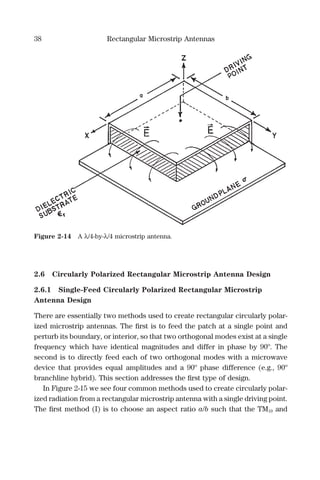
When a = b, the TM01 and TM10 modes have the same resonant frequency
(square microstrip patch). If the patch is fed along the diagonal, both modes
can be excited with equal amplitude and in phase. This causes all four edges
to become radiating edges. The two modes are orthogonal and therefore inde-
Ydrv
L1
jBe Ge
L2
Ydrv
L1
Yo Yo
L2
Ye
L
Figure 2-12 Transmission line model of a quarter-wave microstrip antenna.
Rectangular Microstrip Antennas 37
pendent. Because they are in phase, the resultant of the electric field radiation
from the patch is slant linear along the diagonal of the patch.
When a square microstrip patch is operating with identical TM01 and TM10
modes, a pair of shorting planes exist centered between each of the pairs of
radiating slots (Figure 2-13). We can replace the virtual shorting planes, which
divide the patch into four sections, with physical shorting planes. We can
remove one section (i.e., quadrant) and drive it separately due to the symmetry
of the modes (Figure 2-14). This produces an antenna that has one-fourth the
area of a square patch antenna.[36]
This provides a design option for applica-
tions where volume is restricted.
Figure 2-13 Development of a λ/4-by-λ/4 microstrip antenna from a square microstrip
antenna. When a square microstrip antenna is driven along the diagonal, two virtual
shorting planes appear. Replacing the virtual shorting planes with physical shorting
planes allows one to remove a quarter section of the original antenna and drive it
independently.
38 Rectangular Microstrip Antennas
2.6 Circularly Polarized Rectangular Microstrip Antenna Design
2.6.1 Single-Feed Circularly Polarized Rectangular Microstrip
Antenna Design
There are essentially two methods used to create rectangular circularly polar-
ized microstrip antennas. The first is to feed the patch at a single point and
perturb its boundary, or interior, so that two orthogonal modes exist at a single
frequency which have identical magnitudes and differ in phase by 90º. The
second is to directly feed each of two orthogonal modes with a microwave
device that provides equal amplitudes and a 90º phase difference (e.g., 90º
branchline hybrid). This section addresses the first type of design.
In Figure 2-15 we see four common methods used to create circularly polar-
ized radiation from a rectangular microstrip antenna with a single driving point.
The first method (I) is to choose an aspect ratio a/b such that the TM10 and
Figure 2-14 A λ/4-by-λ/4 microstrip antenna.
Rectangular Microstrip Antennas 39
TM01 modes both exist at a single frequency where their magnitudes are identi-
cal and their phases differ by 90º. The two orthogonal modes radiate indepen-
dently and sum in the far field to produce circular polarization.
The second method presented in Figure 2-15(II) is essentially the same as
(I), but uses two rectangular tabs and two rectangular indentations to perturb
a
a > b
RHCP
∆S
S
∆S
∆L
2S
LHCP
LHCP
(I)
RHCP RHCP
LHCP
(III) (IV)
(II)
b
Figure 2-15 Four methods for generating circular polarization from a rectangular
microstrip antenna using a single feed. (I) Using the aspect ratio of a patch to generate
two orthogonal modes with equal amplitude and 90º out of phase. (II) Use of indenta-
tions and/or tabs. (III) Cutting off corners to create orthogonal modes. (IV) Introduction
of a diagonal slot.
40 Rectangular Microstrip Antennas
the modes to have a 90º phase difference. This situation is the most general
geometry describing this type of circularly polarized patch. One could use a
single tab, a single indent, a pair of tabs, or a pair of indents to perturb a rect-
angular microstrip antenna and produce circular polarization.
The third method illustrated in Figure 2-15(III) is to remove a pair of corners
from the microstrip antenna. This creates a pair of diagonal modes (no longer
TM10 and TM01 as the shape of the patch has been altered) that can be adjusted
to have identical magnitudes and a 90º phase difference between these modes.
The fourth method in Figure 2-15(IV) is to place a slot diagonally across the
patch. The slot does not disturb the currents flowing along it, but electrically
lengthens the patch across it. The dimensions of the slot can be adjusted to
produce circular polarization. It is important to keep the slot narrow so that
radiation from the slot will be minimal. One only wishes to produce a phase
shift between modes, not create a secondary slot radiator. Alternatively, one
can place the slot across the patch and feed along the diagonal.[37]
Figure 2-16 illustrates how one designs a patch of type I. Figure 2-16(a)
shows a perfectly square patch antenna probe fed in the lower left along
the diagonal. This patch will excite the TM10 and TM01 modes with identical
amplitudes and in phase. The two radiating edges which correspond to each
of the two modes have a phase center that is located at the center of the
patch. Therefore the phase center of the radiation from the TM10 and TM01
modes coincide and are located in the center of the patch. When a = b, the
two modes will add in the far field to produce slant linear polarization
along the diagonal. If the aspect ratio of the patch is changed so that a > b, the
resonant frequency of each mode shifts. The TM10 mode shifts down in fre-
quency and the TM01 mode shifts up compared with the original resonant
frequency of the slant linear patch. Neither mode is exactly at resonance.
This slightly nonresonant condition causes the edge impedance of each mode
to possess a phase shift. When the phase angle of one edge impedance is +45º
and the other is −45º, the total difference of phase between the modes is 90º.
This impedance relationship clearly reveals itself when the impedance versus
frequency of the patch is plotted on a Smith chart. The frequency of optimum
circular polarization is the point on a Smith chart which is the vertex of a
V-shaped kink.
Figure 2-17 presents the results of a cavity model analysis of a patch radiat-
ing left-hand circular polarization (LHCP) using a rectangular microstrip
Rectangular Microstrip Antennas 41
Figure 2-16 Development of a rectangular patch with circular polarization from a
square patch. (a) Square patch fed along a diagonal produces TM10 and TM01 modes
which are equal in magnitude and identical in phase. These two modes add together
and produce linear polarization along the diagonal of the patch antenna. (b) The ratio
of a/b may be adjusted to detune each mode slightly so that at a single frequency the
amplitudes of each mode are equal, but their phase differs by 90º, producing a rotating
electric field phasor.
Figure 2-17 A Smith chart shows the impedance kink formed when the aspect ratio
a/b has been adjusted to properly produce circular polarization. The rectangular plot
shows the impedance as real and imaginary. The TM10 and TM01 mode resonant peaks
which combine to produce circular polarization are clearly identifiable.
42 Rectangular Microstrip Antennas
antenna with an appropriate a/b ratio. The antenna operates at 2.2 GHz, its
substrate thickness is 1.5748 mm, with εr = 2.5, tan δ = 0.0019, a = 40.945 mm,
and b = 42.25 mm. The patch is fed at x´ = 13.5 mm, y´ = 14.5 mm, and Wp =
1.3 mm. The approximate a/b ratio was arrived upon using trial and error with
equation (2.54).
The design of a rectangular circularly polarized patch is difficult to realize
due to the sensitivity of the patch to physical dimensions and dielectric con-
stant. One method is to start with the case of the slant linear patch. The slant
linear patch has a = b and is therefore square and has its dimensions chosen
to produce resonance at a desired design frequency. The ratio of a/b when the
square patch aspect ratio has been adjusted to produce circular polarization
has been derived using a perturbation technique:[38]
a
b Q
= +1
1
0
(2.50)
The Q of the unperturbed slant linear patch (Q0) is given by
1 1 1 1 1
0Q Q Q Q Qd c r sw
= + + + (2.51)
The Q of a square rectangular microstrip antenna driven as a slant linear patch
or as a linear patch are essentially identical. When a patch is square, the TM10
and TM01 modes are degenerate, the energy storage in the TM10 and TM01 modes
are identical, as is the amount of energy loss in each for the slant linear case.
If all the energy is stored in a single TM10 or TM01, as occurs when the patch is
driven in the linear case, the same total amount of energy will be lost as in the
slant linear case. In both situations, the energy stored per cycle versus energy
lost is the same, and therefore so is the Q.
If the slant linear patch has the dimension á (= b´), the new dimensions of
the circularly polarized patch will be
a a L= ′ + ∆ (2.52a)
b a L= ′ − ∆ (2.52b)
Rectangular Microstrip Antennas 43
We can write
∆L
a
Q
=
+
′
2 0 1
(2.53)
The use of equation (2.50) is illustrated by using the circularly polarized
patch of Table 2-4, which has the proper impedance relationship to produce
LHCP. The design values for that example were developed by adjusting the
patch aspect ratio by trial and error until a circular polarization kink appeared.
The center frequency of LHCP operation is 2.2 GHz.
We arrive at a slant linear patch design by taking the average of the
values used to create the circularly polarized patch of Table 2-4: (a + b)/2
= (42.250 mm + 40.945 mm)/2 ≈ 41.6 mm. This average gives us a value of
a slant linear patch on which we can apply equation (2.50) to compute an
aspect ratio which should produce circular polarization. The new patch has a
resonance at 2.2 GHz with a resistance of 88 Ω. The total Q (i.e., Q0) from the
cavity model is computed to be 29.3 at 2.2 GHz. Equation (2.53) allows us to
compute the length change required to produce circular polarization:
∆L =
⋅( )+
=
41 6
2 29 3 1
0 698
.
.
.
mm
mm
We can now find the values of a and b:
a = 41.6 mm + 0.698 mm = 42.298 mm
b = 41.6 mm − 0.698 mm = 40.902 mm.
Table 2-4 2.2 GHz LHCP microstrip antenna trial and error design.
a b h εr tanδ
40.945 mm 42.250 mm 1.5748 mm 2.5 0.0019
x´ y´ Wp
13.5 mm 14.5 mm 1.3 mm
Groundplane Dimensions = 63.5 mm × 63.5 mm
44 Rectangular Microstrip Antennas
The driving point impedance of the slant linear patch and the patch modified
to have circular polarization using the a and b values computed with equation
(2.52a) and equation (2.52b) are plotted in Figure 2-18. Again, the cavity model
has been used to compute the driving point impedance. It can be seen that
in this case the computation has the advantage that it produces a better
match for the circularly polarized patch which has been modified to produce
circular polarization than the trial and error method of the original patch.
The input impedance at 2.2 GHz for the patch modified to produce circular
polarization is 46.6 + j1.75 Ω. This is about half the input resistance value
of the slant linear patch. This calculation provides some insight into the sen-
sitivity of the driving point impedance location of the design to physical para-
meters of the patch.
The cavity model can be used to compute the axial ratio of a circularly
polarized rectangular patch.[39]
The relationship between electric field and axial
ratio is[40]
Figure 2-18 The rectangular patch antenna of Figure 2-17 has its dimensions aver-
aged to create a slant linear patch which resonates at 2.2 GHz using cavity model analy-
sis (dashed lines). Next, equation (2.52a) and equation (2.52b) are used to compute the
values of a and b required to produce circular polarization at 2.2 GHz, which is then
analyzed using the cavity model (solid lines).
Rectangular Microstrip Antennas 45
AR
E E T
E E T
x y
x y
=
+ +
+ −
1
1
2
2
(2.54)
where AR is the axial ratio and
T
E
E
E
E
x
y
x
y
= + +1 2 2
4 2
cos( )ψ (2.55)
where ψ is the phase of Ex/Ey.
The ratio of electric field components Ex and Ey from the cavity model may
be approximated by
E
E
b k k
a k k
x a
y b
w
a
x
y
c
c
p
≈
−
−


( )
( )
cos(
cos( )
sin
2
01
2
2
10
2
2
π
π
π′/ )
′/
c 
 (2.56)
E
E
j
j
x
y
=
−{ RHCP
LHCP
(2.57)
The input impedance calculated with the values in Table 2-4 using the
cavity model is plotted with the axial ratio as a function of frequency and
presented in Figure 2-19. We can see the minimum axial ratio occurs between
the resonant peaks and where the imaginary value flattens out. Table 2-5
illustrates that often the driving point location which produces optimum axial
ratio performance and driving point match is not exactly along the patch
diagonal.
The sensitivity of this type of design is such that we need accurate values
of Q to obtain the most accurate value of ∆L possible. The cavity model often
does not produce as accurate values for the Q of the slant linear patch as does
the FDTD method or direct measurement. When the antenna is matched and
driven in a single RLC-type impedance mode, the frequency of the maximum
return loss, f0, divided by the bandwidth between 3 dB values will provide a
good approximation for the Q of a patch using measured or simulated data
from a full-wave analysis method. Equation (2.53) works well with the cavity
model, but experience indicates that
46 Rectangular Microstrip Antennas
∆L
a
Q
=
+
′
3 395 10.
is more appropriate when using measured or computed (e.g., FDTD) S11 dB
results of a slant linear patch to design a circularly polarized element.
Figure 2-19 The rectangular CP patch antenna of Table 2-4 analyzed using the cavity
model. The real and imaginary components of the driving point impedance are plotted
with the computed axial ratio (in dB).
Table 2-5 2.2 GHz LHCP microstrip antenna (Wp = 1.3 mm).
a b h εr tanδ
42.298 mm 40.902 mm 1.5748 mm 2.50 0.0019
x´ y´
13.5 mm 14.5 mm
Rectangular Microstrip Antennas 47
Equation (2.53) also shows that as the antenna Q increases, ∆L decreases.
When a high dielectric constant is used as a substrate, the Q of the antenna
becomes larger, which means the impedance bandwidth has become narrower.
The high dielectric constant also decreases the size of the patch, which
drives down the value of ∆L, which tightens any manufacturing tolerances
considerably.
A more complex iterative approach that uses the cavity model to compute
single-feed circularly polarized rectangular patch designs is presented by
Lumini et al.[41]
Another design approach is to use a genetic algorithm optimi-
zation with the cavity model to develop a circularly polarized rectangular
microstrip antenna design.[42]
This method has the advantage that it optimizes
for driving point match and axial ratio simultaneously. This eliminates first
developing a slant linear patch and then using equation (2.52a) and equa-
tion (2.52b) to compute the dimensions to produce circular polarization.
Experience with genetic algorithms indicates that it produces a design which
is no better than the more straightforward method previously described.
Figure 2-15(II) uses indentation tabs to produce circular polarization. This
type of design is undertaken experimentally.
Figure 2-15(III) has a pair of corners cut off to produce circular polarization.
This creates a pair of diagonal modes (no longer TM10 and TM01, as the shape
of the patch has been altered) that can be adjusted to have identical magni-
tudes and a 90º phase difference between these modes. The antenna is fed
along the centerline in this case so it will excite each of the diagonal modes
with equal amplitude. In Figure 2-15 we see that if the upper right-hand corner
and lower left-hand corner are reduced, we can view the situation as reducing
the capacitance along that diagonal, making it more inductive. The opposite
diagonal from lower right to upper left remains unchanged and has a larger
capacitance by comparison. The amount of the area removed can be adjusted
so the phase of the chopped corner diagonal is 45º and the phase of the unmodi-
fied diagonal is −45º. This situation creates right-hand circular polarization
(RHCP). Leaving the feed point position unchanged and removing the opposite
pair of corners reverses the phase, and thus the polarization sense.
We will define the total area removed to perturb the patch so it produces
circular polarization as ∆S (Figure 2-15). The total area S of the unperturbed
square patch prior to the corner removal to produce circular polarization is
48 Rectangular Microstrip Antennas
S = a · b = á2
(a = b = á). It has been reported that the ratio of the change in
area ∆S to the original area of the patch S is related to the Q of the uncut
antenna Q0 computed using equation (2.51) by[43]
∆S
S Q
=
1
2 0
(2.58)
The area to be cut from each corner of the unperturbed patch, as shown in
Figure 2-15(III), is half of the perturbation area S calculated using equation
(2.58) or ∆S/2S. In terms of the length along each edge which is cut off we have
∆L
a
Q
=
′
0
(2.59)
Figure 2-15(IV) uses a diagonal slot to produce circular polarization. A
guideline for choosing the slot area is to make it equal to ∆S/S.
45° –45° –45° 45°
RHCP LHCP
Figure 2-20 One may cut off a pair of opposing corners of a rectangular microstrip
antenna to produce circular polarization. One can view cutting off a corner as reducing
the capacitance of that diagonal mode. This will produce a more inductive impedance
across the two chopped corners which will cause the electric field to have a phase of
45º compared with the −45º of the electric field with the capacitive impedance across
the uncropped corners. Reversing the position of the corners reverses the polarization
sense.
Rectangular Microstrip Antennas 49
Figure 2-21 (a) Circular polarization may be synthesized using a 90º branchline
hybrid.
2.6.2 Dual-Feed Circularly Polarized Rectangular Microstrip
Antenna Design
Figure 2-21(a) shows the use of a 90º branchline hybrid to feed a microstrip
antenna and create circular polarization. In this case, one begins with a square
microstrip antenna. The TM01 and TM10 modes will have the same resonant
frequency and are orthogonal. Each mode is fed independently using the
branchline hybrid, which provides equal amplitude and the required 90º
phase shift at the hybrid’s center frequency to produce circular polarization.
Figure 2-21(a) shows the branchline hybrid inputs that will produce LHCP
and RHCP. In practice, if the antenna is fed RHCP, the LHCP port is terminated
in a matched load, and vice versa.
The branchline hybrid will enforce equal amplitudes and nearly correct
phase over a wide bandwidth, but as the patch edge impedance mismatches
with frequency, the rejected power will appear at the terminated port, and
power is lost to maintain good circular polarization compared with a single-
feed design. The input impedance bandwidth and axial ratio bandwidth are far
greater than the single-feed design, but when antenna efficiency is taken into
account, the amount of power lost into the load of the hybrid is approximately
the same as the power lost from impedance and polarization mismatch in a
single-feed circular polarization antenna design. This design can also be imple-
mented using a pair of probe feeds (one for the TM10 mode and one for the
TM01 mode), and an external branchline 90º hybrid realized with coaxial
cable.
50 Rectangular Microstrip Antennas
2.6.3 Quadrature (90º) Hybrid
The design of a rectangular patch with circular polarization (Section 2.6.2)
requires a branchline hybrid, also known as a quadrature hybrid. A branchline
quadrature hybrid provides a 3 dB power split between a pair of output ports
with a 90º difference between them. The left-hand illustration of Figure 2-21(b)
shows a branchline hybrid as it would appear realized in stripline or microstrip.
The shunt branches have a characteristic impedance Zs and the through or
series branch has a characteristic impedance of Zt.
At the branchline hybrid design frequency, the scattering parameters
are[44]
S j
Z
Z
t
21
0
= − (2.60a)
Figure 2-21 (b) A 90º branchline hybrid realized in microstrip or stripline and as often
packaged commercially.
Rectangular Microstrip Antennas 51
S
Z
Z
t
s
31 = − (2.60b)
S11 0 0= . (2.60c)
S41 0 0= . (2.60d)
The illustration on the right of Figure 2-21(b) shows how a commercial
hybrid appears with coaxial connectors. Some hybrids have a built-in load on
one port, as shown, while others require the user to provide a load. This allows
one to have one input that produces RHCP and another that produces LHCP,
as shown in Figure 2-21(a). This allows a system to switch between polariza-
tion if desired.
When a 3 dB split between ports is desired with a reference impedance of
Z0 (generally 50 Ω), the shunt branches should have Zs = Z0 and the through
branches Zt = Z0/ 2 (35.4 Ω for a 50 Ω system). The lengths of the branches
are all λ/4. When port 1 is used as an input port, then port 2 receives half of
the input power and is the phase reference for port 3. Port 3 receives half of
the input port power with a phase that is 90º behind port 2. The split waves
cancel at port 4, which is called the isolated port. A load is generally placed
on this port to absorb any imbalance, which stabilizes the phase difference
between port 2 and 3. If port 4 is the input port, port 1 becomes the isolation
port, port 3 is the 0º phase port with half the power, and port 2 becomes the
−90º port.
In practice, there is often a slight imbalance in the power split between ports
2 and 3. We note that equation (2.60b) has Zs in its denominator. This allows
one to change the characteristic impedance of the shunt branches slightly and
obtain a more even power split.
The bandwidth of a branchline hybrid is limited by the quarter-wave length
requirement on the branches to 10–20%. One must also take the discontinuities
at the transmission line junctions into account to produce a design which
operates as desired. One can increase the bandwidth of a branchline coupler
by adding cascading sections.[45]
Recently Qing added an extra section to
produce a three-stub hybrid coupler and created a microstrip antenna design
with 32.3% 2:1 voltage standing wave ratio (VSWR) bandwidth and 42.6% 3 dB
52 Rectangular Microstrip Antennas
axial ratio bandwidth.[46]
Quadrature hybrids that have unequal power division
and/or unequal characteristic impedances at each port can also be
designed.[47]
2.7 Impedance and Axial Ratio Bandwidth
The impedance bandwidth of a rectangular microstrip antenna can be deter-
mined with the total Q used in the cavity model. For a linear rectangular
microstrip antenna, driven in a single mode, the normalized impedance band-
width is related to the total Q by[48]
BW
S
Q S
Linear
T
=
−1
(S:1 VSWR) (2.61)
When a linear microstrip antenna design is very close to achieving an imped-
ance bandwidth design goal, one can obtain a tiny amount of extra impedance
bandwidth by designing the antenna to have a 65 Ω driving point resistance at
resonance rather than a perfectly matched 50 Ω input resistance. The perfect
match at one frequency is traded for a larger overall 2:1 VSWR bandwidth.[49]
The impedance bandwidth also increases slightly when the width of the rect-
angular microstrip antenna is increased. The largest bandwidth increase occurs
as the substrate dielectric constant εr is decreased and/or the substrate thick-
ness is increased. The effect substrate thickness and dielectric constant have
on impedance bandwidth as computed with the cavity model is illustrated in
Figure 2-22 for a square linearly polarized microstrip antenna.
One must recall that as the substrate thickness is increased, higher order
modes provide a larger and larger contribution to an equivalent series induc-
tance, which in turn produces a larger and larger driving point mismatch. A
desirable driving point impedance must be traded for impedance bandwidth.
Equation (2.62) and equation (2.63) have been developed to relate the imped-
ance bandwidth of a rectangular patch antenna radiating circular polarization
to total Q as well as its expected axial ratio bandwidth. We can substitute
S = 2 in equation (2.61) and equation (2.62), forming the ratio of circular to
linear bandwidth. This reveals that the impedance bandwidth of a circularly
Rectangular Microstrip Antennas 53
polarized microstrip antenna compared to a linear antenna is larger by a factor
of two. The two detuned resonances which sum to create circular polarization
increase the total impedance bandwidth.
BW
S
Q
circular
T
=
−2 1( )
(2.62)
BW
AR
Q AR
axialratio
T
=
−1
(2.63)
The received power (PR) bandwidth of a patch is independent of polarization
and given by
BW
Q
p
p
P
T
R
=
−2 1 min
min
(2.64)
Figure 2-22 Normalized bandwidth of a square microstrip antenna as a function of
substrate thickness and relative dielectric constant predicted by the cavity model.
54 Rectangular Microstrip Antennas
where p is the fraction of power received by a matched load (load resistance
is equal to driving point resistance at resonance), to the power received by the
antenna at its resonant frequency (0 < p < 1). The received power reaches
maximum when p = 1 and becomes zero when p = 0. In equation (2.64), pmin is
the minimum acceptable receive power coefficient for a given design.
Langston and Jackson have written the above expressions in terms of a
normalized frequency variable for comparison.[50]
The axial ratio bandwidth
is the smallest for a transmitting single-feed circularly polarized patch.
The receive power bandwidth is larger than the axial ratio or impedance
bandwidth.
2.8 Efficiency
The antenna efficiency e relates the gain and directivity of an antenna:
G eD= (2.65)
where G is the antenna gain and D is directivity.
The efficiency of a rectangular microstrip antenna can be calculated from
the cavity model in terms of the cavity Qs.[51]
The radiated efficiency is the
power radiated divided by the total power, which is the sum of the radiated,
surface wave, conductor loss, and dielectric loss. The stored energy is identical
for all the cavity Qs. This allows us to write:
e
Q
Q
T
r
= (2.66)
which expanded out is
e
Q Q Q
Q Q Q Q Q Q Q Q Q Q Q Q
d c sw
sw c d sw c r sw r d r d c
=
+ + +
(2.67)
When multiplied by 100%, equation (2.66) gives the antenna efficiency in
percent as predicted by the cavity model. We can readily see from equation
Rectangular Microstrip Antennas 55
2.67 that as Qsw, Qc, and Qd become large compared with Qr, the antenna’s effi-
ciency approaches 100%. In other words, we desire to minimize the radiation
Q and maximize Qsw, Qc, and Qd, the surface wave Q, conductor Q, and dielec-
tric Q, respectively, for maximum efficiency.
It is instructive to calculate the losses from each of the mechanisms sepa-
rately. We can calculate ηr = QT/Qr for radiation efficiency, ηsw = QT/Qsw for the
surface wave efficiency, ηc = QT/Qc for the conductor efficiency, and ηd = QT/Qd
for the dielectric efficiency. When these are added together, we are able to
account for 100% of the power in the antenna.
In order to obtain some understanding of the contribution of each of the
loss mechanisms of a rectangular microstrip antenna with respect to substrate
thickness h and dielectric constant εr, we have computed these for three typical
dielectric values (εr = 1.1, 2.6, and 10.2).
Table 2-6 shows the efficiency components ηr (radiation), ηsw (surface
wave), ηc (conductor), and ηd (dielectric) for a square linear microstrip antenna
operated at 2.45 GHz with a very low dielectric constant substrate (εr = 1.1).
We note the loss contribution from surface waves is insignificant in this case.
The next largest loss is that due to the dielectric, and then the conductors.
As the thickness h of the antenna is increased, the radiation efficiency
increases.
The next analysis case is for εr = 2.6 (Table 2-7), where we can see the
surface wave contribution has increased significantly compared with εr = 1.1
in Table 2-6. The surface wave loss increases in proportion to the thickness of
the substrate; the conductor and dielectric losses decrease as the thickness
increases. If a designer wants to maximize the space wave contribution in this
case, then the 2.286 mm substrate would appear to be a good choice.
Table 2-6 Losses in a square linear microstrip antenna versus h (2.45 GHz, a = b =
56.46 mm, tanδ = 0.0025, εr = 1.1).
h ηr ηsw ηc ηd
(0.030″) 0.762 mm 83.41% 0.01% 6.86% 9.71%
(0.060″) 1.524 mm 92.67% 0.03% 1.91% 5.39%
(0.090″) 2.286 mm 95.38% 0.05% 0.87% 3.70%
(0.120″) 3.048 mm 96.63% 0.06% 0.50% 2.81%
56 Rectangular Microstrip Antennas
When the dielectric constant is increased to εr = 10.2 (Table 2-8), we see the
surface wave power increases significantly compared with the εr = 2.6 case in
Table 2-7. The thinnest substrate only radiates 53.75% into the space wave.
As h increases from 0.762 mm to 1.524 mm, the amount lost to the conductor
and dielectric loss approximately reverse contributions. The best compromise
to maximize the losses due to the space wave, and minimize the conductor and
dielectric losses, is the 2.286 mm thickness. Computing the losses separately
can be very useful to a designer when evaluating the choice of substrate thick-
ness for a given design. This is often a good design path to use because of the
difficulty involved in making experimental efficiency measurements.[52]
2.9 Design of a Linearly Polarized Microstrip Antenna with
Dielectric Cover
Microstrip antennas are often enclosed in dielectric covers (i.e., radomes) to
protect them from harsh environments. These can range from vacuum-molded
Table 2-7 Losses in a square linear microstrip antenna versus h (2.45 GHz, a =
b = 37.62 mm, tanδ = 0.0025, εr = 2.6).
h ηr ηsw ηc ηd
(0.030″) 0.762 mm 76.28% 2.43% 8.82% 12.47%
(0.060″) 1.524 mm 85.15% 5.43% 2.46% 6.96%
(0.090″) 2.286 mm 85.96% 8.25% 1.10% 4.68%
(0.120″) 3.048 mm 84.99% 10.93% 0.61% 3.47%
Table 2-8 Losses in a square linear microstrip antenna versus h (2.45 GHz, a = b =
19.28 mm, tanδ = 0.0025, εr = 10.2)
h ηr ηsw ηc ηd
(0.030″) 0.762 mm 53.75% 24.71% 17.47% 4.07%
(0.060″) 1.524 mm 68.09% 10.73% 5.53% 15.65%
(0.090″) 2.286 mm 69.31% 17.56% 2.50% 10.62%
(0.120″) 3.048 mm 66.27% 24.76% 1.35% 7.62%
Rectangular Microstrip Antennas 57
or injection-molded plastic enclosures which leave an air gap between the
radiating patch and the radome, to bonding a plastic material directly to the
antenna.
Bonding dielectric material directly to the antenna can provide a high degree
of hermetic sealing. When the substrate material is Teflon based, the bonding
process to produce good adhesion can be very involved. In some commercial
applications, the injection molding of a plastic radome which surrounds the
antenna element and seals it has been implemented. In these cases, the use of
a full-wave simulator such as Ansoft HFSS is best for the refinement of a
design prior to prototyping, but the use of a quick quasi-static analysis can
provide initial design geometry for refinement and design sensitivity prior to
optimization.
A number of approaches have been forwarded to analyze a microstrip
antenna with a dielectric cover.[53–56]
Here we will utilize the transmission line
model to analyze a rectangular microstrip antenna with a dielectric cover.
A quasi-static analysis of a microstrip transmission line with a dielectric
cover forms the basis of this analysis.[57]
An effective dielectric constant for
the geometry shown in Figure 2-23 is defined in equation (2.68) and the
characteristic impedance is related in equation (2.69).
ε ε
e
C
C
r
=
0
(2.68)
Z
Zair
e
0 =
ε
(2.69)
Z
cC
air =
1
0
(2.70)
where
εe = effective dielectric constant of microstrip line
Z0 = characteristic impedance of microstrip line
Zair = characteristic impedance of microstrip line with no dielectrics
present
58 Rectangular Microstrip Antennas
Cεr
= capacitance per unit length with dielectrics present
C0 = capacitance per unit length with only free space present
c = speed of light in a vacuum.
Using the substitution of α = βh1 in Bahl et al.[58]
, we are able to write the
capacitance as
1 1
1 6
2
2
2 4 2
2
0
1
1
1
2
0C
W h
W h
W h
W
= +

 ⋅−
∞
∫πε
α
α
α
α
.
sin( / )
( / )
. ( / )
cos( / hh
W h
W h
W h W h1
1
1
2
1 1
22 2
2
4 4)
sin( / )
( / )
sin ( / ) ( / )− + ⋅






−α
α
α α
22
⋅
ε
ε α
ε α
ε α αr
r
r
r
h h
h h2
2
2
1
2 1
2 1
1tanh( / )
tanh( / )
coth( )
+
+
+










−1
dα (2.71)
Figure 2-23 Rectangular microstrip patch geometry of a dielectric covered microstrip
antenna analyzed with the transmission line model. The patch antenna is fed along
the centerline of the antenna’s width (i.e., W/2). The feed point is represented by the
black dot.
Rectangular Microstrip Antennas 59
where
W = width of microstrip transmission line (patch width)
h1 = thickness of dielectric substrate
εr1 = relative dielectric constant of substrate
h2 = thickness of dielectric superstrate (dielectric cover/radome)
εr2 = relative dielectric constant of radome dielectric superstrate (dielectric
cover/radome).
The integration of equation (2.71) is efficiently computed using Gaussian
quadrature, as presented in Appendix B. The slot admittance is modified when
a dielectric cover is added to a rectangular microstrip antenna design. The
modification is slight and is best computed using equation (2.4), when com-
pared with the accuracy of more complicated alternatives.[59,60]
The edge
susceptance may be written as
B jwCe slot= (2.72a)
The capacitance of the radiating slot for a rectangular microstrip antenna
with a cover layer is obtained using
C
W L
cZ L
L
h
slot
e
air
r= −



2
0
1
ε
ε ε
( )
( )
(2.72b)
εe(L) and Zair(L) are the effective dielectric constant with dielectrics
present and the characteristic impedance of a microstrip line of width L with
only air, respectively. Equation (2.72a) provides the edge capacitance of a
microstrip transmission line with a dielectric superstrate of width L rather
than W. The left-hand term inside of equation (2.72b) is the transmission
line capacitance and the right-hand term is the capacitance per unit length
of a parallel plate capacitor of width L. The fringing field capacitance is
computed by the difference, which is used as an approximation of the slot
capacitance.
When a microstrip antenna is covered with a dielectric substrate in practice,
an air gap may exist. This air gap has a strong effect on the effective dielectric
60 Rectangular Microstrip Antennas
constant of the patch, which in turn affects the characteristic impedance and
resonant frequency of the antenna.
The resonant frequency of the microstrip antenna with a dielectric cover is
computed using
f
c
L l e
=
+2 2( )∆ ε
(2.73a)
∆l h
W h
W h
e
e
=
+ +
− +
0 412
0 3 0 264
0 258 0 8
1
1
1
.
( . )( / . )
( . )( / . )
ε
ε
(2.73b)
2.10 Design Guidelines for a Linearly Polarized Rectangular
Microstrip Antenna
There are a number of antenna performance trade-offs with respect to sub-
strate dielectric constant and thickness to consider when designing a linear
rectangular microstrip antenna.[61]
Clearly if one needs to feed a patch with a
coaxial transmission line, then a probe feed is a good choice. If the design
requires a microstrip feed, a nonradiating edge feed may make sense, but the
patch needs to be narrow enough to decrease any excitation of a secondary
mode. A narrower patch has slightly decreased bandwidth compared with a
wide patch. If the impedance bandwidth requirement is greater than a narrow
patch can provide, then one can turn to a feed along a radiating edge. A quarter-
wave transformer feed on a radiating edge produces the least amount of per-
turbation of the patch radiation, but if the design constraints do not allow for
enough area to implement the transformer, an inset feed can be utilized. In
either case, if the patch is fed along a centerline which drives the lowest order
mode, the driving point impedance presented by the next dominant mode is
along a shorting plane for that next mode and mismatched (not driven), even
if the patch is square.
A useful beginning patch width for a linear microstrip antenna is
W
c
fr
r
=
+



−
2
1
2
1 2
ε
/
(2.74)
Rectangular Microstrip Antennas 61
Patch thickness is an important parameter to consider. If the patch thick-
ness is too thin, the efficiency and impedance bandwidth are decreased. When
the patch is too thick, it can efficiently generate surface waves and produce
a series inductive mismatch at the driving point from higher order cavity
modes.
The lowest order surface wave (TM0), which can propagate in any direction
along a conducting sheet coated with a dielectric slab, has no cutoff frequency
for dielectric substrates with εr > 1. This means there will always be some
amount of power in the lowest order surface wave mode independent of
frequency when εr > 1. For a given maximum frequency of operation, a good
compromise between these conflicting parameters is to choose the substrate
thickness according to
h
c
f r
≤
0 3
2
.
π εmax
(2.75)
At higher frequencies, Gopinath has presented an analysis which allows one
to choose a substrate thickness that maximizes the Q of a microstrip line at a
given frequency.[62]
When a very thick substrate or a dielectric cover layer
(radome) is present, more efficient generation of surface waves is possible than
in the normal microstrip antenna geometry with a thin substrate and no cover
layer over the patch.
The resonant length of a rectangular microstrip antenna is computed with
L
c
f
l
r e
= −
2
2
ε
∆ (2.76)
When designing a square microstrip patch one can use
L
c
fr r
0
2
=
ε
(2.77)
to provide an initial length L0. This value can then be equated to the width of
the antenna, W, to produce a new resonant length L1 using equation (2.76),
equation (2.6), and equation (2.7). This process is continued until the value
62 Rectangular Microstrip Antennas
becomes fixed. The solution generally becomes fixed by the fifth iteration [L5]
(Appendix B, Section B.3).
If electrostatic discharge (ESD) is a consideration, one can place an electri-
cal short at the center of the patch using a via or soldered shorting pin. Gold
flashing can be used to protect a copper element from many environmental
hazards. Tin immersion is another alternative which is useful in some situa-
tions to prevent copper degradation.
In some designs, a higher frequency resonance of a rectangular microstrip
antennamaycoincidewithabandwhichistobeisolatedforsystemdesignreasons.
This problem can sometimes be resolved by using a circular microstrip patch
which has resonances with different spacings than those of a rectangular patch.
The desired feed point impedance may be located using the transmission
line model with a root finding algorithm such as the bisection method (Appen-
dix B, Section B.4). Experience indicates the relationships used to compute
the wall admittance, equation (2.4) and equation (2.5), predict accurate values
for the feed point location when the dielectric constant is 2.2 < εr < 3.8, which
is often encountered in practice, and have proven more accurate than alterna-
tive expressions for uncovered rectangular microstrip antennas. In other situ-
ations, the feed point will require experimental determination. One can also
use the cavity model to predict the location of a desired driving point imped-
ance, but its results are somewhat sensitive to the effective probe diameter
used in the computation.
The directivity of a linear rectangular microstrip antenna can be estimated
using equation (2.43), which is generally within 1 to 2 dB of measurement for
most groundplane sizes. A more accurate directivity can be computed with a
more powerful technique such as FDTD or FEM. The antenna efficiency can
be computed from equation (2.66) and used to calculate the antenna gain.
As discussed previously, the directivity of a linear rectangular microstrip
antenna depends on the substrate’s relative dielectric constant, εr. Directivity
increases as the dielectric constant decreases and will decrease, in an asymp-
totic fashion, as the dielectric constant is increased (see Table 2-3).
In some design environments, a microstrip antenna must survive a consider-
able amount of shock and vibration. When a patch is probe fed, the solder joint
on the top of a microstrip patch that connects the feed probe to the patch is
vulnerable to failure. Under large vibrational shock, the probe can punch itself
Rectangular Microstrip Antennas 63
through the upper solder joint, leaving a microscopic ring-shaped gap between
the solder and the feed probe. Often this ring-shaped gap is too small to be
seen without a microscope, but will produce antenna failure. One solution to
this problem is to use a pair of thin metal strips soldered along the feed probe
and whose ends are bent at right angles with a small amount of slack and sol-
dered to the patch. The feed pin with soldered strips on either side pass
through a hole that is large enough to allow the feed pin to move axially without
interference. The small amount of extra slack that is left as a small radius at
the right-angle bend of the strip before the end of the strip is soldered allows
for movement. This is illustrated in Figure 2-24.
Cross-polarization is produced by the existence of higher order modes on
the patch. This is discussed in greater detail in Chapter 3.
In the case of a linearly polarized rectangular microstrip antenna, we gener-
ally feed the antenna in the center (x = 0). This will drive the TM01 mode and
theoretically not excite the TM10 mode, which is mismatched.
When a square patch is used to produce circular polarization with two
orthogonal (microstrip or probe) feeds, any error in centering the feeds along
the y-axis and x-axis will increase cross-polarization. A square microstrip
antenna has the property that both TM01 and TM10 modes have the same reso-
nant frequency and the undesired mode may be readily excited by error in the
driving point location.
PATCH
SURFACE
METAL STRIP
SOLDERED TO
PATCH AND
PROBE FEED
PROBE
FEED
Figure 2-24 Vulnerability of a probe feed to shock and vibration can be mitigated by
the use of two (or more) small metal strips. Each strip is soldered to the feed pin,
extending through a minute gap along the pin, which is provided by a slightly larger
than required hole in the dielectric substrate. The strips are then soldered to the patch
with a small radius of slack. This slack allows the feed pin to move up and down without
solder failure.
64 Rectangular Microstrip Antennas
A resonant cavity model may be used to estimate the amount of cross-
polarization produced by probe placement error.[63]
These computations were
undertaken by Mishra and Milligan.[64]
For a square patch to have no less than
25 dB cross-polarization, the feed probe must not vary more than 0.75% of the
antenna width (a). A square patch designed on a substrate with a 2.32 relative
dielectric constant and a 3.0 GHz operating frequency with an approximately
3 cm width must be within 0.22 mm to achieve 25 dB cross-polarization.
When only linear polarization is desired, one can increase the 25 dB cross-
polarization driving point location tolerance by using a rectangular patch
(a > b). By shifting the TM10 resonance to a frequency twice that of the 2:1
VSWR band-edge location, the tolerance increases from 0.75% to 2% of the
patch width (a).
These examples demonstrate that when feeding a patch with a probe feed,
the feed point location tolerance for low cross-polarization is very tight and
small location errors will quickly increase cross-polarization levels.
2.11 Design Guidelines for a Circularly Polarized Rectangular
Microstrip Antenna
The design of a circularly polarized microstrip antenna that uses a rectangular
patch with an aspect ratio begins with designing a square microstrip antenna.
Equation (2.8) and equation (2.6) may be iterated (Appendix B, Section B.3) to
create a square patch. The resonant frequency tends to be slightly low when
the iterated converged value is used. The cavity model may be used to refine
the patch size and make it more accurate. The Q of a single mode, TM01 or
TM10, of a square patch can be determined with measurement or computed
using the cavity model to determine QT. The cavity model can then be used to
compute a driving point location that has an input resistance at resonance of
about 88 Ω. Equation (2.52) is then used to compute the patch dimensions to
produce circular polarization.
Experimental optimization is generally required to complete the design of a
circularly polarized rectangular patch antenna. The Smith chart of Figure 2-18
illustrates the impedance trace one needs in order to achieve circular polariza-
tion. The frequency which exists at the vertex of a kink in the Smith chart
impedance, which forms a 90º angle, is the point at which the optimum circular
polarization occurs. The polarization sense of the antenna may be determined
Rectangular Microstrip Antennas 65
by consulting Figure 2-15(I). Often the impedance at the kink of the impedance
trace is not well matched and frequently has a capacitive component. In the
case of a probe fed circularly polarized rectangular microstrip antenna, one
can move the driving point location off the patch diagonal and often match the
antenna at the circular polarization frequency.
When a dielectric superstrate (radome) covers a microstrip antenna
(Figure 2-23) that generates circular polarization, the axial ratio bandwidth
will remain unchanged.[65]
A variety of Global Positioning System (GPS) RHCP rectangular microstrip
antenna designs that use high dielectric constant ceramic material as a sub-
strate are offered by a number of manufacturers. A common GPS antenna
design has substrate dimensions of 25 mm × 25 mm × 4 mm with εr = 20 which
are optimized to operate on a 70 mm × 70 mm groundplane. This antenna
design is electrically small at 1.575 GHz and its performance is strongly affected
by electrically small groundplane dimensions. The groundplane dimensions
affect the resonant frequency and radiation patterns adversely and these effects
must be included in the design. The limitations of electrically small antennas
are discussed in Chapter 7, Section 7.3.1.
2.12 Electromagnetically Coupled Rectangular Microstrip Antenna
One may use a rectangular microstrip patch that is fed with a microstrip
transmission line which is electromagnetically coupled to the patch. The
geometry of this design is defined in Figure 2-25. Microstrip antennas of this
configuration are very difficult to directly analyze and most designs are em-
pirical or designed by trial and error with a full-wave simulator.[66]
One can use
equations (2.68) through (2.71) to determine the width that corresponds to a
50 Ω microstrip line embedded between two dielectrics, εr1 and εr2. Alterna-
tively, many full-wave electromagnetic simulation programs allow one to
compute the characteristic impedance of an embedded microstrip trans-
mission line. Altering the width of a patch generally allows one to match the
antenna to the transmission line, and patch length determines the resonant
frequency.
An example electromagnetically coupled patch designed to operate at
2.45 GHz has substrate heights of h1 = h2 = 1.524 mm. The dielectric constant
66 Rectangular Microstrip Antennas
Figure 2-25 Rectangular microstrip patch with an electromagnetically coupled
feed.
Rectangular Microstrip Antennas 67
of both layers εr1 and εr2 = 2.6, with tan δ = 0.0025. The patch width is W =
44.0 mm and the resonant length is L = 34.0 mm. The width of the 50 Ω microstrip
feed line is Wm = 4.0 mm. The groundplane width and length are 128.0 mm and
130.0 mm. respectively. The patch is centered on the substrate and the feed
line extends under the patch to the patch center. The antenna has about 3.2%
impedance bandwidth, with 7.3 dBi gain. We can see from this design example
that another advantage of this geometry is the ability to feed a rectangular
microstrip antenna directly with a 50 Ω microstrip transmission line.
2.13 Ultrawide Rectangular Microstrip Antennas
In Chapter 4 we will investigate the use of a matching network to broadband
a microstrip antenna. The example used requires a microstrip antenna with an
edge resistance of 92.5 Ω. This antenna is obtained by increasing the width of
the patch beyond that generally suggested.[67]
The symmetry of the feed is such
that driving a mode along the length of the patch does not occur when it is
driven at the frequency of the TM01 mode. Rectangular microstrip antennas that
are very wide compared with their resonant length are referred to as ultrawide
rectangular microstrip antennas (UWMSAs).
Ultrawide microstrip antennas have useful properties compared with
microstrip antennas that possess typical widths. First, one can control the edge
resistance at resonance to make the development of a broadband matching
network easier. Second, one can choose a patch width that produces an edge
resistance of 50 Ω and vanquishes the need for matching when the patch is fed
with a 50 Ω microstrip transmission line. Third, the gain of a wide microstrip
antenna is very large compared with typical microstrip antennas.
A special case of a UWMSA is the 50 Ω microstrip patch. This patch has a
width that is chosen so the edge resistance at resonance is 50 Ω. A 50 Ω trans-
mission line can be used to directly feed a radiating edge so that no matching
network (e.g., quarter-wave transformer) is required. The patch aperture is
larger than a conventional patch and so has enhanced gain when compared
with a typical patch antenna design.
The geometry of a UWMSA 50 Ω patch is presented in Figure 2-26. The
antenna has a width W50 and length L. The patch is fed with a 50 Ω microstrip
68 Rectangular Microstrip Antennas
transmission line whose width is designated as WM. As was discussed previ-
ously, the gain of a microstrip antenna is dependent upon the relative dielectric
constant εr of the substrate. We will examine the radiation patterns and band-
width of the UWMSA for εr = 1.0 and 2.6 and the special case of a 50 Ω patch.
The substrate thickness is 2.286 mm (0.090 inches). The operating frequency
is 5.25 GHz. For εr = 1.0, W50 = 68.0 mm, L = 24.76 mm, and WM = 11.0 mm, and
when εr = 2.6, W50 = 54.0 mm, L = 15.10 mm, and WM = 6.2 mm.
Figure 2-26 A 50 Ω ultrawide microstrip antenna geometry.
Rectangular Microstrip Antennas 69
Figure 2-27 Predicted radiation pattern of the 2.45 GHz 50 Ω UWMSA of Table 2-9
using FDTD analysis for εr = 1.0 (top) and εr = 2.6 (bottom).
70 Rectangular Microstrip Antennas
The computed radiation patterns of the ultrawide microstrip antenna are
presented in Figure 2-27. The top polar plot is of a patch with an air dielectric
(εr = 1.0). The bottom patch has a dielectric substrate with (εr = 2.6). Table 2-9
presents the single element gain of UWMSA examples. The air loaded UWMSA
has as much gain as a typical 2 × 2 rectangular patch array on a dielectric
substrate.
References
[1] Hildebrand, L. T., and McNamara, D. A., “A guide to implementational aspects of
the spacial-domain integral equation analysis of microstrip antennas,” Applied
Computational Electromagnetics Journal, March 1995, Vol. 10, No. 1, ISSN 1054-
4887, pp. 40–51.
[2] Mosig, J. R., and Gardiol, F. E. “Analytical and numerical techniques in the Green’s
function treatment of microstrip antennas and scatterers,” IEE Proceedings, March
1983, Vol. 130, Pt. H, No. 2, pp. 175–182.
[3] Mosig, J. R., and Gardiol, F. E., “General integral equation formulation for microstrip
antennas and scatterers,” IEE Proceedings, December 1985, Vol. 132, Pt. H, No. 7,
pp. 424–432.
[4] Mosig, J. R., “Arbitrarily Shaped microstrip structures and their analysis with a
mixed potential integral equation,” IEEE Transactions on Microwave Theory and
Techniques, February 1988, Vol. 36, No. 2, pp. 314–323.
[5] Pues, H., and Van de Capelle, A., “Accurate transmission-line model for the rect-
angular microstrip antenna,” IEE Proceedings, December 1984, Vol. 131, Pt. H, No.
6, pp. 334–340.
[6] Dearnley, R. W., and Barel, A. R. F., “A broad-band transmission line model
for a rectangular microstrip antenna,” IEEE Transactions on Antennas and
Propagations, January 1989, Vol. 37, No. 1, pp. 6–15.
[7] Bhattacharyya, A. K., and Garg, R., “Generalized transmission line model for
microstrip patches,” IEE Proceedings, April 1985, Vol. 132, Pt. H, pp. 93–98.
Table 2-9 Single-element gain of the UWMSA
examples.
εr Gain (dBi)
1.00 12.84
2.60 10.29
Rectangular Microstrip Antennas 71
[8] Derneryd, A., “Linearly polarized microstrip antennas,” IEEE Transactions on
Antennas and Propagations, November 1976, Vol. AP-24, pp. 846–851.
[9] Munsen, R. E., “Conformal microstrip antennas and microstrip phased arrays,”
IEEE Transactions on Antennas and Propagations, January 1974, Vol. AP-22,
pp. 74–78.
[10] Bahl, I. J., and Bhartia, P., Microstrip Antennas, London: Artech House, 1980,
p. 46.
[11] Basilio, L., Khayat, M., Williams, J., and Long, S., “The dependence of the input
impedance on feed position of probe and microstrip line-fed patch antennas,”
IEEE Transactions on Antennas and Propagation, January 2001, Vol. 49, No. 1,
pp. 45–47.
[12] Derneryd, A. G., “A theoretical investigation of the rectangular microstrip antenna
element,” IEEE Transactions on Antennas and Propagations, July 1978, Vol.
AP-26, pp. 532–535.
[13] Augustine, C. F., “Field detector works in real time,” Electronics, June 24, 1968,
pp. 118–122.
[14] Fergason, J. L., “Liquid crystals,” Scientific American, August 1964, Vol. 211,
No. 2, pp. 77–85.
[15] Yang, K., Gerhard, D., Yook, J. G., Papapolymerou, I., Katehi, L. P. B., and Whitaker,
J. F., “Electrooptic mapping and finite-element modeling of the near-field pattern
of a microstrip patch antenna,” IEEE Transactions on Microwave Theory and
Techniques, February 2000, Vol. 48, No. 2, pp. 288–294.
[16] Bokhari, S. A., Zurcher, J.-F., Mosig, J. R., and Gardiol, F. E., “Near fields of
microstrip antennas,” IEEE Transactions on Antennas and Propagation, Febru-
ary 1995, Vol. 43, No. 2, pp. 188–197.
[17] Levine, E., “Special measurement techniques for printed antennas,” in Handbook
of Microstrip Antennas, James, J. R., and Hall, P. S., eds. Stevenage, UK: Peter
Peregrinus, Ltd., 1989.
[18] Frayne, P. G., “Microstrip field diagnostics,” in Handbook of Microstrip
Antennas, James, J. R., and Hall, P. S., eds. Stevenage, UK: Peter Peregrinus, Ltd.,
1989.
[19] Lo, Y. T., Solomon, D., and Richards, W. F., “Theory and experiment on microstrip
antennas,” IEEE Transactions on Antennas and Propagations, March 1979, Vol.
AP-27, pp. 137–149.
[20] Richards, W. F., Lo, Y. T., and Harrison, D. D., “An improved theory for microstrip
antennas and applications,” IEEE Transactions on Antennas and Propagations,
January 1981, Vol. AP-29, pp. 38–46.
[21] Lee, H. F., and Chen, W., eds., Advances in Microstrip and Printed Antennas, New
York: John Wiley and Sons, 1997, pp. 223–242.
72 Rectangular Microstrip Antennas
[22] Gan, Y.-B., Chua, C.-P., and Li, L.-W., “An enhanced cavity model for microstrip
antennas,” Microwave and Optical Technology Letters, March 2004, Vol. 40, No. 6,
pp. 520–523.
[23] Thouroude, D., Himdi, M., and Daniel, J. P., “CAD-oriented cavity model for rect-
angular patches,” Electronics Letters, June 1990, Vol. 26, No. 13, pp. 842–844.
[24] Pozar, D. M., “Rigorous closed-form expressions for the surface wave loss of
printed antennas,” Electronics Letters, June 1990, Vol. 26, No. 13, pp. 954–956.
[25] Schaubert, D. H., Pozar, D. M., and Adrian, A., “Effect of microstrip antenna sub-
strate thickness and permittivity: comparison of theories with experiment,” IEEE
Transactions on Antennas and Propagation, June 1989, Vol. 37, No. 6, pp.
677–682.
[26] Cabedo-Fabres, M., Antonino-Daviu, E., Valero-Nogueira, A., and Bataller, M. F.,
“The theory of characteristic modes revisited: a contribution to the design of anten-
nas for modern applications,” IEEE Antennas and Propagation Magazine, October
2007, Vol. 49, No. 5, pp. 52–67.
[27] Schaubert, D. H., Pozar, D. M., and Adrian, A., “Effect of microstrip antenna sub-
strate thickness and permittivity: comparison of theories with experiment,” IEEE
Transactions on Antennas and Propagation, June 1989, Vol. 37, No. 6, pp.
677–682.
[28] Bahl, I. J., and Bhartia, P., Microstrip Antennas, London: Artech House, 1980,
pp. 48–50.
[29] Bahl, I. J., and Bhartia, P., Microstrip Antennas, London: Artech House, 1980,
p. 64.
[30] Tavlov, A., Computational Electrodynamics: The Finite-Difference Time Domain
Method, London: Artech House, 1995, pp. 213–218.
[31] Kunz, K. S., and Luebbers, R. J., The Finite Difference Time Domain Method for
Electromagnetics, Boca Raton, FL: CRC Press, 1993, p. 109.
[32] Sanford, G. E, and Klein, L., “Recent developments in the design of conformal
microstrip phased arrays,” IEE Conference on Maritime and Aeronautical Satellites
for Communication and Navigation, IEE Conference Publication 160, London, pp.
105–108.
[33] Post, R. E., and Stephenson, D. T., “The design of microstrip antenna array for a
UHF space telemetry link,” IEEE Transactions on Antennas and Propagations,
January 1981, Vol. AP-29, pp. 129–134.
[34] James, J. R., Hall, P. S., and Wood, C., Microstrip Antenna Theory and Design,
Stevenage, UK: Peter Peregrinus, Ltd., 1981, p. 106.
[35] Milligan, T., Modern Antenna Design, New York: McGraw Hill, 1985, p. 118.
[36] Bancroft, R., Unpublished Witnessed/Notarized Engineering Notebook, October
23, 1998.
Rectangular Microstrip Antennas 73
[37] Lu, J.-H., and Yang, K.-P., “A simple design for single-feed circularly polarized
microstrip antennas,” Proceedings of the National Science Council ROC(A), 2000,
Vol. 24, No. 2, pp. 130–133.
[38] Richards, W. F., Lo Y. T., and Harrison, D. D., “An improved theory for microstrip
antennas and applications,” IEEE Transactions on Antennas and Propagation,
January 1981, Vol. AP-29, pp. 38–46.
[39] Lumini, F., Cividanes, L., and Lacava, J. C. S., “Computer aided design algorithm
for singly fed circularly polarized rectangular microstrip patch antennas,” Inter-
national Journal of RF & Microwave Computer-Aided Engineering, January
1999, Vol. 9, No. 1, pp. 32–41.
[40] Balanis, C. A., Antenna Theory Analysis and Design, New York: Harper & Row,
1982, p. 51.
[41] Lumini, F., Cividanes, L., and Lacava, J. C. S., “Computer aided design algorithm
for singly fed circularly polarized rectangular microstrip patch antennas,” Inter-
national Journal of RF and Microwave Computer-Aided Engineering, January
1999, Vol. 9, No. 1, pp. 32–41.
[42] Lee, D., and Lee, S., “Design of a coaxially fed circularly polarized rectangular
microstrip antenna using a genetic algorithm,” Microwave and Optical Technology
Letters, September 2000, Vol. 26, No. 5, pp. 288–291.
[43] Suzuki, Y., “Key points in the design and measurement of microstrip antennas,”
in Analysis, Design, and Measurement of Small and Low-Profile Antennas,
Hirasawa, K., and Haneishi, M., eds., London: Artech House, 1992, pp. 144–
145.
[44] Mongia, R., Bahl, I., and Bhartia, P., RF and Microwave Coupled-Line Circuits,
London: Artech House, 1999, pp. 244–247.
[45] Malherbe, J. A. G., Microwave Transmission Line Coupler, London: Artech House,
1988.
[46] Qing, X. M., “Broadband aperture-coupled circularly polarized microstrip antenna
fed by a three-stub hybrid coupler,” Microwave and Optical Technology Letters,
January 2004, Vol. 40, No. 1, pp. 38–41.
[47] Sainati, R. A., CAD of Microstrip Antennas for Wireless Applications, London:
Artech House, 1996, pp. 124–129.
[48] Langston, W. L., and Jackson, D. R., “Impedance, axial ratio, and receive power
bandwidths of microstrip antennas,” IEEE International Symposium, San Antonio,
Texas, June 16–21 2002, pp. 882–885.
[49] Milligan, T., Modern Antenna Design, New York: McGraw Hill, 1985, p. 104.
[50] Langston, W. L., and Jackson, D. R., “Impedance, axial ratio, and receive power
bandwidths of microstrip antennas,” IEEE Transactions on Antennas and Propa-
gation, October 2004, Vol. 52, No. 10, pp. 2769–2773.
74 Rectangular Microstrip Antennas
[51] Sainati, R. A., CAD of Microstrip Antennas for Wireless Applications, London:
Artech House, 1996, p. 54.
[52] Pozar, D., “Comparison of three methods for the measurement of printed antenna
efficiency,” IEEE Transactions on Antennas and Propagation, January 1988, Vol.
36, No. 1, pp. 136–139.
[53] Roudot, B., Mosig, J. R., and Gardiol, F. E., “Radome effects on microstrip antenna
parameters,” 17th European Microwave Conference, Rome, Italy, September 1987,
pp. 771–777.
[54] Verma, A. K., Bhupal, A., Rostamy, Z., and Srivastava, G. P., “Analysis of rectangular
patch antenna with dielectric cover,” IEICE Transactions, May 1991, Vol. E-74,
No. 5, pp. 1270–1276.
[55] Bernhard, J. T., and Tousignant, C. J., “Resonant frequencies of rectangular
microstrip antennas with flush and spaced dielectric substrates,” IEEE
Transactions on Antennas and Propagation, February 1999, Vol. 47, No. 2,
pp. 302–308.
[56] Zhong, S. Z., Liu, G., and Qasim, G., “Closed form expressions for resonant fre-
quency of rectangular patch antennas with multidielectric layers,” IEEE Transac-
tions on Antennas and Propagation, September 1994, Vol. 42, No. 9, pp.
1360–1363.
[57] Bahl, I. J., and Stuchly, S. S., “Variational method for the analysis of microstrip-like
transmission lines,” IEEE Transactions on Microwave Theory and Techniques,
August 1968, Vol. MTT-16, No. 8, pp. 529–535.
[58] Bahl, I. J., and Stuchly, S. S., “Analysis of a microstrip covered with a lossy dielec-
tric,” IEEE Transactions on Microwave Theory and Techniques, February 1980,
Vol. MTT-28, No. 2, pp. 104–109.
[59] Shavit, R., “Dielectric cover effect on rectangular microstrip antenna array,” IEEE
Transactions on Antennas and Propagation, August 1994, Vol. 42, No. 8, pp.
1180–1184.
[60] Sainati, R. A., CAD of Microstrip Antennas for Wireless Applications, London:
Artech House, 1996, pp. 70–71.
[61] James, J. R., Henderson, A., and Hall, P. S., “Microstrip antenna performance is
determined by substrate constraints,” Microwave System News (MSN), August
1982, pp. 73–84.
[62] Gopinath, A., “Maximum Q-factor of microstrip resonators,” IEEE Transactions
on Microwave Theory and Techniques, February 1981, Vol. MTT-29, No. 2, pp.
128–131.
[63] Benalia, A., and Gupta, K. C., “Faster computation of Z-matrices for rectangular
segments in planar microstrip circuits,” IEEE Transactions on Microwave Theory
and Techniques, June 1986, Vol. MTT-34, No. 6, pp. 733–736.
Rectangular Microstrip Antennas 75
[64] Mishra, R. K., and Milligan, T., “Cross-polarization tolerance requirements of square
microstrip patches,” IEEE Antennas and Propagation Magazine, April 1996, Vol.
38, No. 2, pp. 56–58.
[65] Chen, W., Wong, K., and Row, J., “Superstrate loading effects on the circular polar-
ization and crosspolarization characteristics of a rectangular microstrip antenna,”
IEEE Transactions on Antennas and Propagation, February 1994, Vol. 42, No. 2,
pp. 260–264.
[66] Waterhouse, R. B., ed., Microstrip Antennas: A Designer’s Guide, Boston: Kluwer
Academic Publishers, 2003, pp. 52–54.
[67] Bahl, I. J., and Bhartia, P., Microstrip Antennas, London: Artech House, 1980,
p. 57.
Chapter 3
Circular Microstrip Antennas
3.1 Circular Microstrip Antenna Properties
In Chapter 2 we saw that the rectangular microstrip antenna has a number
of useful designs. The circular microstrip antenna offers a number of
radiation pattern options not readily implemented using a rectangular patch.
The fundamental mode of the circular microstrip patch antenna is the TM11.
This mode produces a radiation pattern that is very similar to the lowest
order mode of a rectangular microstrip antenna. The next higher order
mode is the TM21, which can be driven to produce circularly polarized radia-
tion with a monopole-type pattern. This is followed in frequency by the TM02
mode, which radiates a monopole pattern with linear polarization. In the
late 1970s, liquid crystals were used to experimentally map the electric field
of the driven modes surrounding a circular microstrip antenna and optimize
them.[1]
In Figure 3-1, the geometry of a circular microstrip antenna is defined. The
circular metallic patch has a radius a and a driving point located at r at an
angle φ measured from the xˆ axis. As with the rectangular microstrip antenna,
the patch is spaced a distance h from a groundplane. A substrate of εr separates
the patch and the groundplane.
An analysis of the circular microstrip antenna, which is very useful for
engineering purposes, has been undertaken by Derneryd and will be utilized
here.[2]
The electric field under the circular microstrip antenna is described
by:
E E J kr nz n= 0 ( )cos( )φ (3.1)
The magnetic field components are described as
76
Circular Microstrip Antennas 77
H
j n
k r
E J kr nr n= −
ωε
φ2 0 ( )sin (3.2)
H
j
k
E J kr nnφ
ωε
φ= − 0
′ ( )cos (3.3)
where k is the propagation constant in the dielectric which has a dielectric
constant ε = ε0εr. Jn is the Bessel function of the first kind of order n. J´n is the
derivative of the Bessel function with respect to its argument, ω is the angular
frequency (ω = 2πf). The open circuited edge condition requires that J´n(ka) =
0. For each mode of a circular microstrip antenna there is an associated radius
which is dependent on the zeros of the derivative of the Bessel function. Bessel
functions in this analysis are analogous to sine and cosine functions in rectan-
gular coordinates. E0 is the value of the electric field at the edge of the patch
across the gap.
Figure 3-1 Circular microstrip antenna geometry. The circular microstrip antenna is
a metal disk of radius a and has a driving point location at r which makes an angle φ
with the xˆ axis. The thickness of the substrate is h, where h << λ0, which has a relative
dielectric constant of εr.
78 Circular Microstrip Antennas
The resonant frequency, fnm, for each TM mode of a circular microstrip
antenna is given by
f
A c
a
nm
nm
eff r
=
⋅
2π ε (3.4)
where Anm is the mth zero of the derivative of the Bessel function of order n.
The constant c is the speed of light in free space and aeff is the effective
radius of the patch. A list of the first four Bessel function zeros used with
equation (3.4) are presented in Table 3-1. (In the case of a rectangular microstrip
antenna, the modes are designated by TMmn, where m is related to x and n is
related to y. The modes for a circular microstrip antenna were introduced
as TMnm, where n is related to φ and m is related to r (often designated ρ). The
reversal of indices can be a source of confusion.)
aeff is the effective radius of the circular patch, which is given by
a a
h
a
a
h
eff
r
= ⋅ + { }+






1
2
2
1 7726
1 2
π ε
π
ln .
/
(3.5)
a h/ >> 1
where a is the physical radius of the antenna.
Equation (3.4) and equation (3.5) can be combined to produce:
a
A c h
a
a
f h
nm
r r nm
=
⋅
+ { }+








−
2
1
2
2
1 7726
1 2
π ε π ε
π
ln .
/
(3.6)
Table 3-1 First four Bessel function zeros used with
equation (3.4).
Anm TMnm
1.84118 1,1
3.05424 2,1
3.83171 0,2
4.20119 3,1
Circular Microstrip Antennas 79
The form of equation (3.6) is
a f a= ( ) (3.7)
which can be solved using fixed point iteration (Appendix B, Section B.3) to
compute a design radius given a desired value of Anm from Table 3-1, which
determines the mode TMnm, and given the desired resonant frequency fnm at
which the antenna is to operate.[3]
An initial approximation for the radius a0 to begin the iteration is
a
A c
f
nm
nm r
0
2
=
⋅
π ε
(3.8)
The initial value a0 is placed into the right-hand side of equation (3.6) to
produce a value for a. This value is designated a1, then is placed into the right-
hand side to produce a second, more refined value for a designated a2, and so
on. Experience indicates that no more than five iterations are required to
produce a stable solution.
The lowest order mode, TM11, is the bipolar mode, which is analogous to
the lowest order mode of a rectangular microstrip antenna. In Figure 3-2 we
can see the electric field concentrated at each end of the antenna for the n =
1 mode with a sign reversal. The mode number n corresponds to the number
of sign reversals in π radians of φ.
The next resonant mode is the TM21 mode, which is called the quadrapolar
mode. Figure 3-2 shows the electric field distribution for the n = 2 mode. Note
the four concentrations of electric field with alternating signs. This mode is the
first of a family of modes that may be used to create a circularly polarized
monopole-type pattern.
The third mode is the TM02 unipolar mode. In this situation, the mode index
n is zero, which implies that no sign reversals occur because the cosine in
equation (3.1) becomes unity for all values of φ, and it therefore is independent
of the angle φ. Figure 3-2 shows the n = 0 mode and illustrates the uniform
electric field around the edge of the circular antenna. This mode radiates
a monopole-type pattern. Following the introduction of the mathematical
80 Circular Microstrip Antennas
analysis equations for directivity, driving point impedance, and efficiency, we
will examine these modes in more detail.
3.2 Directivity
A very useful formulation for the directivity of the fundamental mode of a cir-
cular microstrip antenna was presented by Derneryd.[4]
The radiation conduc-
tance of a circular microstrip antenna is given by
G
k a
B k a B k a drad n M P= +ε θ θ θ θ θ
π
0
0
2
2
0
2
0
2
0
2
480
( )
[ ( sin ) ( sin )cos ]sin∫∫ (3.9)
Figure 3-2 Electric and magnetic field patterns of a circular microstrip antenna at
resonance.
Circular Microstrip Antennas 81
where
εn
n
n
0
2 0
1 0
=
=
≠{ ( )
( )
and
B X J X J XP n n( ) ( ) ( )= +− +1 1
B X J X J XM n n( ) ( ) ( )= −− +1 1
The directivity of a circular patch for the n = 1 mode is expressed as
D
k a
Grad
=
( )0
2
120
(3.10)
The losses associated with the dielectric may be expressed as
G
hf
ka nr
n
mn
ε
ε δ
µ
= −0
0
2 2
4
tan
[( ) ] (3.11)
The ohmic loss associated with the conductors is
G
f
h
ka ncu
n mn
=
⋅
−
−
ε π π µ
σ
0 0
3 2
2
2 2
4
( )
[( ) ]
( )/
(3.12)
The total conductance is
G G G Grad cur
= + +ε (3.13)
3.3 Input Resistance and Impedance Bandwidth
The input resistance at resonance as a function of radius r is
Z r
G
J kr
J ka
in
n
n
( )
( )
( )
=
1 2
2
(3.14)
82 Circular Microstrip Antennas
The cavity Q’s, which allow us to compute the impedance bandwidth of a
circular microstrip antenna, may be defined as the following:
The radiation Q is
Q
ka n
h f k a I
R
r
=
−240 2 2
0
2
1
[( ) ]
( )µ
(3.15)
where
I J k a J k a
J k a
n n
n
1 1 0 1 0
2
0
2
1 0
= − +
−
+ −
+
∫ [{ ( sin ) ( sin )}
cos { ( sin )
θ θ
θ θ
π
JJ k a dn−1 0
2
( sin )} ]sinθ θ θ (3.16)
The dielectric Q is
QD =
1
tanδ
(3.17)
The conductor Q is
Q h fC r c= µ π σ0 (3.18)
As related previously:
1 1 1 1
Q Q Q QT R D C
= + +
The impedance bandwidth [S:1 voltage standing wave ratio (VSWR)] of a
circular microstrip antenna is given by
BW
S
Q ST
=
−100 1( )
% (3.19)
3.3.1 Gain, Radiation Pattern, and Efficiency
The antenna efficiency is
e
Q Q
Q Q Q Q Q Q
C D
C D C R D R
=
+ +
(3.20)
Circular Microstrip Antennas 83
The radiation patterns may be calculated using
E j
Vak e
r
n J k a J k an
jk r
n nθ φ θ θ= −
−
+ −
0
1 0 1 0
2
0
cos [ ( sin ) ( sin )] (3.21)
E j
Vak e
r
n J k a J k an
jk r
n nφ θ φ θ θ= +
−
+ −
0
1 0 1 0
2
0
cos sin [ ( sin ) ( sin )] (3.22)
where V is the edge voltage at φ = 0:
V hE J kan= 0 ( ) (3.23)
when n = 1 [equation (3.10)] may be used to compute the antenna directivity.
One must numerically integrate equation (3.21) and equation (3.22) to obtain
directivity estimates of a circular patch when n ≠ 1. The efficiency obtained
from equation (3.20) allows one to compute the gain of a circular microstrip
antenna.
3.4 Circular Microstrip Antenna Radiation Modes
3.4.1 The TM11 Bipolar Mode
The TM11 mode of a circular microstrip antenna is analogous to the lowest
order mode of a rectangular patch antenna. This can be seen in Figure 3-2 for
the n = 1 mode. This mode is essentially similar in design utility to a rectangular
microstrip antenna driven in the TM10 mode. The impedance bandwidth is
slightly smaller for a circular patch than its rectangular counterpart. The center
of a circular patch driven in the TM11 mode may be shorted if a direct current
(DC) short is required.
We will use a circular microstrip antenna with a radius of 21.21 mm on a
dielectric substrate that is 1.524 mm thick and has a relative dielectric constant
of εr = 2.6 and tanδ = 0.0025 to illustrate the properties of the TM11 mode. A
finite difference time domain (FDTD) analysis of this antenna placed on a cir-
cular groundplane that has a 33.43 mm radius produces a resonant frequency
of 2.435 GHz. Equation (3.4) predicts the resonant frequency to be 2.467 GHz
84 Circular Microstrip Antennas
for the TM11 mode. The antenna is fed 7 mm from the center of the antenna at
φ = 0. Figure 3-3 shows the E-plane and H-plane radiation patterns. The direc-
tivity of the antenna is computed to be 7.12 dB by FDTD analysis. Using equa-
tion (3.20), the antenna efficiency is computed to be 78.37%, which reduces the
directivity peak by 1.06 dB for a gain of 6.06 dBi. As is the case with the rect-
angular patch, the pattern directivity of a TM11 circular patch antenna decreases
as the relative dielectric constant of the substrate increases.
The TM11 bipolar mode has a virtual short at a plane along its center in the
same way a rectangular microstrip patch has one. This allows one to place a
shorting plane in the center of the circular patch antenna and create a half-
patch circular antenna.[5]
This antenna is analogous to the quarter-wave patch
antenna of Section 2.4 in Chapter 2.
3.4.2 TM11 Bipolar Mode Circular Polarized Antenna Design
Lo and Richards developed a perturbation relationship to design circularly
polarized rectangular and circular microstrip antennas using the TM11 mode.[6]
They extended their work on rectangular microstrip antennas and demon-
strated that a circular microstrip antenna may be stretched into an ellipse,
Figure 3-3 E-plane and H-plane patterns of a circular microstrip antenna driven in
the TM11 mode.
Circular Microstrip Antennas 85
which will produce circular polarization from the superposition of the radia-
tion of a pair of orthogonal modes when it is fed at φ = ±45º. The ratio of
the semimajor to semiminor axes that will produce circular polarization
is given by equation (3.24). As with the design of a circularly polarized rectan-
gular microstrip antenna, the Q of the unperturbed circular patch is first
obtained to compute the a/b ratio of a patch which will produce circular
polarization.
a
b Q
= +1
1 0887.
(3.24)
The value of antenna Q can be computed using the cavity model equation
(3.15), equation (3.17), and equation (3.18) with equation (3.25).
1 1 1 1
Q Q Q QR D C
= + + (3.25)
One can also measure the Q of the antenna experimentally, or use results from
a full-wave analysis such as FDTD with equation (3.26) to estimate Q:[7]
Q
f
f
≈ =0
3∆
( )
( )
resonance frequency
bandwidth dB
(3.26)
where
f0 is the resonant frequency of the patch antenna, and
∆f is the bandwidth between 3 dB return loss points.
The antenna must have a single apparent resonance with reasonable symmetry
for this equation to apply.
If the radius of the unperturbed circular patch which operates at the desired
design frequency f0 is designated as á, the semimajor axis a and semiminor
axis b of the ellipse which produce circular polarization (Figure 3-4) may be
written as
a a L= +′ ∆ (3.27)
b a L= −′ ∆ (3.28)
86 Circular Microstrip Antennas
Using equation (3.27) and equation (3.28) with equation (3.24), we can write
∆L
a
Q
=




+
′
2
1 0887
1
.
(3.29)
The FDTD analysis of the circular patch example produced a negative return
loss plot from which we use equation (3.26) to obtain a value of 13.08 for Q.
We can compute ∆L as
∆L =
⋅
+





=
21 21
2 13 08
1 0887
1
0 84742
.
( . )
.
.
mm
mm
and from equation (3.27) and equation (3.28), because we used the radius
we obtain the semimajor and semiminor axis values:
a/ mm mm mm2 21 21 0 84742 22 057= + =. . .
b/ mm mm mm2 21 21 0 84742 20 363= − =. . .
An FDTD analysis was undertaken to evaluate the circular polarization
produced using equation (3.24). The patch feed point location is x = 15.0 mm
Figure 3-4 Circular microstrip antenna and the antenna perturbed into an ellipse to
produce circular polarization (heavy dot is RHCP feed).
Circular Microstrip Antennas 87
and y = −15.0 mm with the ellipse centered in the x-y plane, with a circular
groundplane with a 33.43 mm radius.
Figure 3-5 provides synthesized rotating linear principle plane patterns from
an FDTD analysis driven with a sinusoidal source with a square coaxial probe
at 2.45 GHz.[8]
The performance of the antenna is very good, and in a practical
design one could further optimize the antenna experimentally.
A branchline hybrid is an alternative method one may use to generate
circular polarization from a circular patch. Figure 3-6 shows a TM11 mode
Figure 3-5 Rotating linear plots of an elliptical patch antenna which produces circu-
lar polarization designed using equation (3.24). On the left is a cut through the minor
axis of the ellipse (x-z) and on the right is a cut through the major axis of the ellipse
(y-z). The axial ratio at θ = 0 is 2 dB.
Figure 3-6 (a) Circular polarization using a TM11 mode circular patch may be synthe-
sized using a 90º branchline hybrid feeding the patch edges at a spatial angle of 90º.
88 Circular Microstrip Antennas
patch fed at orthogonal points to create circular polarization. This is analogous
to the use of a branchline hybrid to generate circular polarization with a square
patch. The right- and left-hand circular polarization (RHCP and LHCP) inputs
are labeled. In practice, the unused port would be terminated with a load.
3.4.3 The TM21 Quadrapolar Mode
The TM21 mode has the next highest frequency of operation (after TM11). This
particular mode is useful in creating a monopole radiation pattern that has
circular polarization, as described by Huang.[9]
The electric field pattern for the
n = 2 mode in Figure 3-2 shows the four electric field reversals which give this
mode its name. One can produce circular polarization from this mode by
providing two probe feeds to the patch; one is physically located at φ = 0º and
the other at φ = 45º. The feed at φ = 0º is fed with zero electrical phase. The
feed at φ = 45º is fed with a 90º electrical phase with an identical amplitude
(Figure 3-7). This angular spacing produces two modes driven orthogonal to
each other, as is their radiation. The 90º phase difference with identical ampli-
tude using orthogonal modes is the usual manner of creating circular polariza-
tion. The combination of these feeds produces a resultant quadrapolar electric
field, as seen in Figure 3-2, which rotates about the center of the patch antenna.
This has been verified with FDTD simulation.
Figure 3-7 A TM21 mode circular microstrip antenna driven with two probe feeds
(heavy dots) 90º out of phase with equal amplitudes spatially separated by 45º. This
antenna produces a monopole pattern with circular polarization.
Circular Microstrip Antennas 89
One may obtain better circular polarization (axial ratio) by feeding the
antenna in four probe locations rather than two. These locations are diametri-
cally across from the two original feed points. In the case of an even mode,
n = 2, 4, 6, . . . (TM21, TM41, TM61, . . .), the diametric feeds have the same phase
as their original counterparts. The feeds have a phase arrangement around the
patch counterclockwise of 0º, 90º, 0º, 90º. In the case of an odd mode, n = 1,
3, 5, . . . (TM11, TM31, TM51, . . .) the diametric feeds have a phase arrangement
around the patch counterclockwise starting at the top of the patch of 0º, 90º,
180º, 270º. These relationships are related in detail by Huang.[9]
As the resonant mode index n increases (n > 1) with m = 1, the peak direc-
tivity of the radiation pattern becomes more and more broadside. The pattern
will also move further broadside with increasing relative dielectric constant.
Huang has reported the pattern peak may be moved from broadside over a
range of 35º to 74º by use of a combination of a chosen higher order mode and
substrate relative dielectric constant adjustment.
In commercial applications, a complex feed structure with its required feed
network may be untenable as a design. It is possible to drive a patch in the
TM21 mode with a single feed which will produce circular polarization.[10]
One
may cut a pair of notches in a circular microstrip antenna driven in the TM21
mode in accordance with:
∆S
S Q
=
⋅
1
2 5014.
∆S
a
Q
=
⋅
π 2
2 5014.
(3.30)
We will use a patch of radius 20.26 mm as a design example. Each notch
area is ∆S/2 for each of the notches in Figure 3-8(a). The substrate thickness
is 1.524 mm, εr = 2.6, tanδ = 0.0025, with a resonate frequency of 4.25 GHz
computed using FDTD analysis. The feed point radius is 16.0 mm. Equation
(3.4) predicts 4.278 GHz for the TM21 mode. FDTD was used to analyze a cir-
cular patch antenna with the previous parameters and produce a negative
return loss plot. The Q was computed to be 22.83 from the negative return loss
plot −3 dB points using (3.26). We then find |∆S| using (3.30)
90 Circular Microstrip Antennas
∆S =
⋅
=
π( . )
. .
.
20 26
2 5014 22 83
0 022578 2mm
mm
which is a square with sides of length L = 4.75 mm. Each notch in this example
is L/2 × L, which corresponds to |∆S|/2 for each notch in Figure 3.8(a). The
radiation patterns computed with an FDTD simulation of this design is pre-
sented in Figure 3-9. The patterns are synthesized rotating linear plots. Figure
3.8(b) shows an alternative method using tabs and indents which perturb the
patch to produce circular polarization from the TM21 mode.
Figure 3-8 (a) A TM21 circular microstrip antenna is modified with a pair of slots
using equation (3.30) with a single probe feed (heavy dots) at φ = ± 22.5º. This antenna
produces a monopole pattern with circular polarization. (b) A TM21 circular microstrip
antenna with indents and tabs spaced 45º apart. The feed is at φ = ±22.5º, which also
produces a monopole pattern with circular polarization.
Circular Microstrip Antennas 91
3.4.4 The TM02 Unipolar Mode
The next mode in order of increasing frequency is the TM02 mode. This mode
has the useful characteristic that the electric field around the circular microstrip
antenna is uniform. This is seen in Figure 3-2 for the n = 0 mode, which we
note has no electric field reversal [(cos(0φ) = 1 for all φ in equation (3.21)]. The
TM02 mode has the useful property that it produces a vertically polarized (Eθ)
monopole-type pattern. This can be very useful for replacing a quarter-wave
monopole antenna, which can be easily damaged in a hostile mechanical envi-
ronment, with a conformal version.
We will use a patch of radius 21.21 mm as an example. The substrate thick-
ness is 1.524 mm, εr = 2.6, tanδ = 0.0025, on a circular groundplane of radius
33.43 mm with a resonate frequency of 5.02 GHz computed using FDTD analy-
sis. The patch is probe fed with a square coaxial transmission line. Equation
(3.4) predicts 5.13 GHz for the TM02 mode. The feed point radius is 7.52 mm.
The maximum directivity computed by FDTD analysis is 5.30 dB. The efficiency
computed using equation (3.20) is 87.88%, which is a loss of 0.561 dB, for a
predicted antenna gain of 4.74 dBi. The computed radiation patterns are pre-
sented in Figure 3-10.
Figure 3-9 Synthesized rotating linear radiation patterns of TM21 circular microstrip
antenna modified with a pair of slots using equation (3.30) with a single probe feed.
92 Circular Microstrip Antennas
A thermal plot of the total electric field just above the circular patch element
is presented in Figure 3-11. We see the electric field is uniform around the edge
of the element, which is consistent with Figure 3-2 for n = 0. The small square
is the probe feed.
The description of driving point impedance is given in equation (3.14). The
driving point impedance for the TM02 mode passes through a short at a radial
position where the Bessel function J0(kr) passes through zero and then
increases to the edge resistance value at r = a. Figure 3-12 presents a thermal
plot of the total electric field just below the circular patch element. We see a
ring of zero field corresponding to the short in the driving point impedance
predicted by equation (3.14).
3.5 Microstrip Antenna Cross-Polarization
The cross-polarization performance of microstrip antennas is considered to be
rather poor. The permittivity and thickness of the substrate used to create a
microstrip antenna determines its cross-polarization performance. It has been
Figure 3-10 A TM02 circular microstrip antenna pattern as computed by FDTD analy-
sis. The pattern on the left is a cut in a plane perpendicular to the plane which contains
the probe feed. On the right is a cut through the plane of the probe. The maximum
pattern directivity is 5.30 dB.
Circular Microstrip Antennas 93
Figure 3-11 A TM02 circular microstrip antenna thermal plot of the total electric field
just above the element (computed with FDTD analysis). One can see the uniform elec-
tric field distribution which is consistent with the n = 0 mode of Figure 3-2.
Figure 3-12 A TM02 circular microstrip antenna thermal plot of the total electric field
distribution just below the element (computed by FDTD analysis). The ring of zero
electric field is consistent with the electric field as predicted by Derneryd [2].
94 Circular Microstrip Antennas
related previously that the gain and impedance bandwidth of a microstrip
antenna can be increased by decreasing the permittivity of the substrate. When
a low dielectric constant is used to design a microstrip antenna element, it also
increases the radiated cross-polarization level.[11]
A higher permittivity sub-
strate will produce better cross-polarization performance, but at the expense
of impedance bandwidth. The cross-polarization performance of a linearly
polarized patch is dependent on substrate thickness, feed point location, and
substrate permittivity.
The origin of the radiated cross-polarization is associated with the genera-
tion of higher order modes on the patch.[12]
When a circular microstrip patch
is driven in the TM11 with a single driving point, the next highest frequency
TM21 mode is consistent with the measured cross-polarization patterns.[13]
Table 3-1 shows the modes occur in order of increasing frequency as TM11,
TM21, TM01, etc. Garcia-Garcia states that when an antenna is driven in the
fundamental mode TM11, this mode is mostly perturbed by the TM21 mode.
When a patch is designed to be driven in the TM21 mode, the radiation purity
is disturbed by the dominant TM11 and next higher TM01 mode.
Figure 3-13 presents sketches of the current of (a) a TM21 mode circular
patch antenna and (b) a TM11 mode circular patch antenna. When a patch is
driven in the fundamental TM11 mode, and the majority of the cross-polariza-
tion radiation is due to TM21, we note that in the x-z plane (H-plane), the
copolarized radiation Ey dominates the pattern. The cross-polarized pattern
in the H-plane Ez has two lobes approximately −15 dB below the copolarized
pattern maximum. The cross-polarization pattern is consistent with the
pattern shape expected from the TM21 mode. In the E-plane, the radiated field
of the driven TM11 and the TM21 mode are in parallel, which means whatever
cross-polarization exists is of uncertain origin. It could be from an im-
perfect generation of the TM21 mode, other modes, or due to a different
mechanism.
An illustrative example was analyzed with the FDTD method. The substrate
is vacuum εr = 1 with a thickness of h = 1.524 mm (0.060 inches). The patch
has a radius of a = 14.71 mm. The probe feed is 5.5 mm below the center of
the patch, which has a resonant frequency of 5.35 GHz. The FDTD analysis
results are presented in Figure 3-14(a) and (b). We note the H-plane pattern
has the expected TM21 mode pattern shape. The E-plane pattern has a small
Circular Microstrip Antennas 95
amount of cross-polarized radiation which has a peak magnitude that is
approximately −30 dB below the copolarized maximum. The E-plane cross-
polarized pattern has a shape consistent with the TM11 mode. The geometry
of a circular patch does not enforce a single direction for the TM11 mode
as a square patch does for the TM10 mode. It is very possible the computed
cross-polarization is from the generation of a TM11 mode with very small
amplitude.
Figure 3-13 (a) Sketch of the theoretical current distribution of the TM21 mode of a
circular patch antenna. (b) Sketch of the theoretical current distribution of the TM11
mode of a circular patch antenna.
96 Circular Microstrip Antennas
Figure 3-14 Circular patch co- and cross-polarization of the (a) H-plane and
(b) E-plane.
Circular Microstrip Antennas 97
3.6 Annular Microstrip Antenna
When a concentric circle of conductor is removed from the interior of a circu-
lar microstrip antenna it forms an annulus. The ring-shaped microstrip conduc-
tor which is formed has its geometry defined in Figure 3-15. We assume the
Figure 3-15 Annular microstrip antenna geometry. The outer radius is b, the inner
radius is a, with a probe feed at radius r at angle φ.
98 Circular Microstrip Antennas
thickness of the substrate is small compared with a wavelength H << λ0, which
implies no variation of the electric field in the z direction. The cavity model
with magnetic walls on the edges of the annulus may be used to obtain solu-
tions for the fields beneath the annulus. The fields are assumed to be TMnm in
cylindrical coordinates:[14,15]
E E J kr Y ka J ka Y kr nz n n n n= −0[ ( ) ( ) ( ) ( )]cos′ ′ φ (3.31)
H
j
k r
E
r
z
=
ωε
φ2
∂
∂
(3.32)
H
j
k
E
r
z
φ
ωε
=
−
2
∂
∂
(3.33)
The Bessel functions (Jn and Yn) are of the first and second kind of order n.
The prime signs signify the first derivative of the Bessel functions. The wave
number k is in the dielectric substrate k r
=
2
0
π ε
λ
, where ε is the substrate
permittivity and λ0 is the wavelength in free space. The mode integer n is
associated with the variation along φ, and mode integer m is associated with
the variation of fields along the radial direction.
The surface currents on the annulus may be computed using Kφ = −Hr and
Kr = Hφ. The radial component of the surface current will disappear at an
edge:
K r b H r br( ) ( )= = = =φ 0 (3.34)
It follows from equation (3.31), equation (3.33), and equation (3.34) that the
wave number must obey:
[ ( ) ( ) ( ) ( )]J kb Y ka J ka Y kbn n n n
′ ′ ′ ′− = 0 (3.35)
Equation (3.35) may be solved to obtain the modes associated with a
given inner radius a and outer radius b. J´n and Ýn are the derivatives of the
Circular Microstrip Antennas 99
TM02 TM11
TM21 TM31
J
H
q
Figure 3-16 (a) Sketch of the theoretical current distribution of the TM21 mode of a
circular patch antenna. (b) Sketch of the theoretical current distribution of the TM11
mode of a circular patch antenna. (From [14], copyright 1973, IEEE. Reprinted with
permission.)
100 Circular Microstrip Antennas
Bessel functions with respect to kr. Approximate values for k may be
obtained with
k
n
a b
≈
+
2
(3.36)
where (b − a)/(b + a) ≤ 0.35 and n ≤ 5.
The resonant frequency of the annular microstrip antenna may be computed
with
f
ck
r
e
=
2π ε
(3.37)
The effective dielectric constant εe is for a microstrip transmission line of
conductor width W = b − a (Appendix C). The resonant frequencies predicted
by equation (3.37) are within 3% of experimental values.
The first few modes of an annular microstrip antenna are presented in
Figure 3-16. We note they are very similar to the modes of a circular micro-
strip, as shown in Figure 3-2. The patterns produced by the modes are
also very similar to those produced by a circular microstrip antenna. Slot
insets may be used to create circular polarization in the same manner as in
Section 3.4.2.[16]
While the rectangular patch antenna is perhaps the most commonly imple-
mented microstrip antenna, the circular patch antenna can offer pattern options
that are generally much more flexible in a single element. We have seen that
it is possible to have a broadside radiation pattern with linear or circular polar-
ization, a monopole-like pattern with linear polarization, or a monopole-like
pattern which is circularly polarized.
References
[1] Kernweis, N. P., and McIlvenna, J. F., “Liquid crystal diagnostic techniques an
antenna design aid,” Microwave Journal, October 1977, Vol. 20, pp. 47–58.
[2] Derneryd, A. G., “Analysis of the microstrip disk antenna element,” IEEE Transac-
tions on Antennas and Propagation, September 1979, Vol. AP-27, No. 5, pp.
660–664.
Circular Microstrip Antennas 101
[3] Burden, R. L., Faires, J. D., and Reynolds, A. C., Numerical Analysis, Boston:
Prindle, Weber, and Schmidt, 1978, pp. 31–38.
[4] Derneryd, A. G., “Analysis of the microstrip disk antenna element,” IEEE Transac-
tions on Antennas and Propagation, September 1979, Vol. AP-27, No. 5, pp.
660–664.
[5] Hirasawa, K., and Haneishi, M., eds., Analysis, Design, and Measurement of Small
and Low-Profile Antennas, London: Artech House, 1992, p. 69.
[6] Lo, Y. T., and Richards, W. F., “Perturbation approach to design of circularly
polarized microstrip antennas,” Electronics Letters, May 28, 1981, pp. 383–385.
[7] Reference Data for Radio Engineers, 6th ed., Indianapolis, IN: Howard W. Sams
& Co., 1982, p. 9–7.
[8] Marino, R. A., and Hearst, W., “Computation and measurement of the polarization
ellipse,” Microwave Journal, November 1999, Vol. 42, pp. 132–140.
[9] Huang, J., “Circularly polarized conical patterns from circular microstrip
antennas,” IEEE Transactions on Antennas and Propagation, September 1984,
Vol. AP-32, No. 9, pp. 991–994.
[10] Du, B., and Yung, E., “A single-feed TM21-mode circular patch antenna with circular
polarization,” Microwave Optics Technology Letters, May 2002, Vol. 33, No. 3, pp.
154–156.
[11] Hanson, R. C., “Cross polarization of microstrip patch antennas,” IEEE Transac-
tions on Antennas and Propagation, June 1987, Vol. AP-35, No. 6, pp. 731–732.
[12] Lee, K. F., Luk, K. M., and Tam, P. Y., “Crosspolarization characteristics of circular
patch antennas,” Electronics Letters, March 1992, Vol. 28, No. 6, pp. 587–589.
[13] Garcia-Garcia, Q., “Radiated cross-polar levels and mutual coupling in patch radia-
tors,” International Journal of RF and Microwave Computer-Aided Design,
December 2000, Vol. 10, No. 6, pp. 342–352.
[14] Wu, Y. S., and Rosenbaum, F. J., “Mode chart for microstrip ring resonators,” IEEE
Transactions on Microwave Theory and Techniques, July 1973, Vol. MTT-21, No.
No. 7, pp. 487–489.
[15] Bahl, I. J., Stuchly, S. S., and Stuchly, M. A., “A new microstrip radiator for medical
applications,” IEEE Transactions on Microwave Theory and Techniques, Decem-
ber 1980, Vol. MTT-28, No. 12, pp. 1464–1468.
[16] Licul, S., Petros, A., and Zafar, I., “Reviewing SDARS antenna requirements,”
Microwaves & RF September 2003, Vol. 43, pp. 51–62.
Chapter 4
Broadband Microstrip Antennas
4.1 Broadband Microstrip Antennas
Microstrip antennas are inherently narrowband. The typical bandwidth of a
microstrip antenna is around 4% to 7%. A considerable number of experimental
approaches have been undertaken to develop microstrip antennas that have a
broader impedance bandwidth than a single microstrip element achieves
without external matching.
The methods employed to increase impedance bandwidth are essentially
variations of three approaches: 1) Increasing the antenna volume. This is
accomplished by geometry changes that increase the volume under the patch
(e.g., increasing the thickness h), decreasing the substrate dielectric constant,
or adding additional coupled resonators. 2) The implementation of a matching
network. 3) Perturbing the antenna geometry to create or relocate resonances
using shorts and slots in the antenna. Kumar and Ray have compiled a consid-
erable number of microstrip antenna design variations that utilize these
approaches[1]
, as has Wong.[2]
One approach is the use of a groundplane slot, which is excited by a
microstrip line below the groundplane, which in turn couples to a microstrip
patch which is above the groundplane. This configuration can be adjusted to
produce an elegant matching network, low dielectric constant substrate for the
patch, and maximized substrate thickness which provides a broadband input
impedance match and a large impedance bandwidth. One implementation of
this type of antenna is called a strip slot foam inverted patch (SSFIP), devel-
oped by Zurcher and Gardiol in the mid-1990s. The design of these antennas
is experimental in nature. The researchers state: “Since the various parts of
the antenna interact, determining the best design is a long and tedious process,
even when carried out systematically.” The parameters which may be used to
102
Broadband Microstrip Antennas 103
guide this type of design are found in the literature.[3–5]
Some possible alter-
natives to SSFIP matching network/thick patch design are explored in this
chapter.
4.2 Microstrip Antenna Broadbanding
The broadbanding of a microstrip antenna is often accomplished by increas-
ing the thickness of a microstrip antenna. This broadbanding reaches a
limit when the series inductance produced by higher order modes produces
an unacceptable mismatch in the driving point impedance. One can also use
a matching network to increase the impedance bandwidth of a microstrip
antenna.
The normalized bandwidth of a microstrip antenna can be written as
BW
f f
f
H L
R
=
−
(4.1)
where fH is the upper frequency where the impedance match is S:1
voltage standing wave ratio (VSWR) and fL is the lower frequency where the
impedance match is also S:1 VSWR. The VSWR is less than S:1 over (fH − fL).
fR is the resonant frequency of the patch. Generally S = 2 for most practical
applications.
At the resonant frequency of a patch, the driving point impedance is pure
real. This resistance is designated as R0. When the patch is connected to a
transmission line of characteristic impedance Z0, the impedance bandwidth is
predicted using
BW
Q
TS S T
S
=
− −1 1( )( )
(4.2)
where Q is the total Q of the patch antenna, S is the VSWR S:1 value, and
T = R0/Z0. When a microstrip antenna is fed with a transmission line where
R0 = Z0, the bandwidth equation reduces to the bandwidth equation for a linear
patch antenna [equation (2.61)]:
104 Broadband Microstrip Antennas
BW
S
Q S
SLinear
T
=
−1
1( : )VSWR
To maximize the impedance bandwidth for a given S:1 VSWR mismatch
between the resonant resistance R0 and the feeding transmission line charac-
teristic impedance Z0 we must satisfy this relationship:
T S
S
opt = +



1
2
1
(4.3)
For example, in the case of a 50 Ω coaxial transmission line probe feeding
a rectangular microstrip patch antenna, we can compute the driving point
impedance we must choose for a maximized 2:1 VSWR bandwidth. To obtain
this value we compute the optimum T value:
T
R
Z
opt = +



= =
1
2
2
1
2
1 25 0
0
. (4.4)
which implies the resonant driving point impedance R0 = 1.25, Z0 = 62.5 Ω,
or the driving point location should be chosen where 62.5 Ω exists.
This value is near the approximate optimum value of 65 Ω reported by
Milligan.[6]
When we use equation (4.4), we trade a perfect match at a single frequency
for wider bandwidth at the expense of a larger mismatch. The equation describes
an elementary form of a broadband matching network. The bandwidth obtained
when Topt is used may be related to the S:1 bandwidth by
BW
Q
S
S
Topt
=
−1
2
14
(4.5)
For the case of 2:1 VSWR, we can take the ratio of equation (4.5) to equa-
tion (2.61) to obtain a bandwidth increase factor. The 2:1 VSWR bandwidth is
computed to be 1.38 times larger than the bandwidth of a perfectly matched
microstrip antenna. Experiment, FDTD, and cavity model data all indicate that
in practice the best increase in bandwidth is about 1.1 times the original band-
Broadband Microstrip Antennas 105
width of the matched element. This bandwidth increase produced using simple
impedance mismatch is often so small it is not of practical use.
If we allow the use of a perfect matching network, with an unrestricted
extent, the maximum impedance bandwidth obtainable is
BW
Q S S
max
ln[( ) ( )]
=
+ −
1
1 1
π
/
(4.6)
This relationship allows us to compare the maximum bandwidth attainable
using a broadband matching network with the normally obtained bandwidth
of equation (2.61) by taking the ratio of equation (2.61) to equation (4.6) which
produces a bandwidth increase factor F:
F
S
S S S
=
− + −
π
( )ln[( ) ( )]1 1 1/
(4.7)
For the case of 2:1 VSWR, the bandwidth increase factor F is 4.044, or
approximately four times the bandwidth of a single element without matching.
This provides a fundamental limit against which we can compare designs.
4.2.1 Microstrip Antenna Matching with Capacitive Slot
Increasing the thickness of a microstrip antenna increases its impedance band-
width. As the thickness increases, higher order modes produce an equivalent
series inductance which mismatches a rectangular microstrip antenna. The
straightforward solution to this problem is to introduce series capacitance
to cancel the inductive reactance that appears at the driving point. A cost-
effective method is to provide capacitance by modifying the patch geometry.
Researchers have used a rectangular or circular slot surrounding the feed
probe (Figure 4-1(a)) to provide the required series matching capacitance.[7,8]
The values of the slot dimensions for the circular or rectangular slots which
bound the probe feed are determined experimentally.
Another approach used to provide series capacitance is to place a narrow
slot directly in front of the feed point and adjust its length until a match is
provided (Figure 4-1(b)).
106 Broadband Microstrip Antennas
As an example of the use of matching with a slot, we will use a rectangular
microstrip antenna that has a substrate thickness of 6.096 mm, a relative dielec-
tric constant of εr = 2.6, and a tanδ = 0.0025. The patch dimensions are
a = 38.0 mm by b = 34.72 mm. The 50 Ω driving point location is 6.0 mm from
the patch center along the centerline of the width. FDTD analysis computes a
resonance at 2.31 GHz (maximum real impedance) with a driving point im-
pedance of 46 + j35.35 Ω. h/λ0 = 0.047, which is electrically thick for a patch
antenna. A narrow slot, t = 1 mm across and W = 14 mm in width, matches
the antenna with a driving point impedance of 49.71 + j5.79 Ω at 2.31 GHz.
The impedance with and without slot matching is plotted on a Smith chart in
Figure 4-2. After matching, the antenna has a respectable 7% impedance
bandwidth.
4.2.2 Microstrip Antenna Broadband Matching with Bandpass Filter
It must be noted up front, that generally, the design of a broadband impedance
matching network is a very difficult network synthesis problem. The prototype
element values used in this section for creating an impedance matching network
using lumped elements are taken from previous work.[9]
The synthesis pre-
sented works better for lower frequency microstrip antennas where lumped
Figure 4-1 (a) Series matching capacitance provided using a circular slot. (b) Series
matching capacitance created using a rectangular slot near the driving point.
Broadband Microstrip Antennas 107
elements may be incorporated with relative ease. It will be demonstrated that
the realization of lumped element models using microwave transmission line
structures is quite challenging, but not insurmountable.
A rectangular microstrip antenna fed to excite only one dominant mode
(TM10 or TM01) has a single resonance which may be modeled as a parallel RLC
circuit. These values are designated Ra, La, and Ca in Figure 4-3. When the patch
is probe fed and becomes electrically thick, a series inductor must also be
taken into account, which is designated Ls. In some rare cases, feed geometries
can produce a series capacitance Cs rather than Ls, but generally it is Ls that
Figure 4-2 (a) Driving point impedance without (circles) and with (squares) a capaci-
tive slot. The series capacitance provided by the rectangular slot cancels the inductive
reactance of thick microstrip antennas.
108 Broadband Microstrip Antennas
exists for a typical patch. The resonant angular frequency, ω0, is the frequency
at which the maximum value of the real part of the driving point impedance
occurs. The maximum value of the real part at resonance can be obtained
directly from a measured impedance plot or a full-wave analysis method. At
resonance, the relationship between the resonant angular frequency ω0 and the
patch model values La and Ca is
ω0
2 1
=
L Ca a
(4.8)
When the patch is resonant, the inductive and capacitive reactance of La
and Ca cancel each other, and the maximum value of resistance occurs. If the
patch is probe fed and thick, the impedance at resonance will have a series
inductive reactance term Ls:
Figure 4-3 (a) A microstrip antenna may be modeled as a parallel RLC circuit with
a series inductance or capacitance. (b) A bandpass filter has a similar model and may
be used to impedance match a microstrip antenna over a larger frequency range than
that covered by a single element.
Broadband Microstrip Antennas 109
Z R j La sin = + ω0 (4.9)
In order to obtain the values of Ca and La from measured or computed data
one must subtract the series inductive reactance from the impedance. Choose
two points on either side of ω0 in frequency:
ω ω ω1 0 1= − ∆ (4.10)
ω ω ω2 0 2= + ∆ (4.11)
With the subtraction of the series inductance, the reactance now changes sign
on either side of ω0. The admittance at each frequency may be expressed as
Y
R
j C
j L
G jB
a
a
a
1 1
1
1 1
1 1
= + + = +ω
ω
(4.12)
Y
R
j C
j L
G jB
a
a
a
2 2
2
2 2
1 1
= + + = +ω
ω
(4.13)
The susceptance at each frequency is
B C
L
a
a
1 1
1
1
= −ω
ω
(4.14)
B C
L
a
a
2 2
2
1
= −ω
ω
(4.15)
Solving the equations for C we obtain
C
B B
a =
−
−
ω ω
ω ω
1 1 2 2
1
2
2
2
(4.16)
Solving the equations for L we obtain
L
C B
a
a
=
−
1
1
2
1 1ω ω
(4.17)
110 Broadband Microstrip Antennas
We have now computed Ra, La, Ca, and Ls (or Cs in some rare cases). The
similarity of the model to a bandpass filter allows one to use filter synthesis
techniques to evaluate optimal component values for broadband matching.
This method was first articulated by Paschen.[10]
Optimum values may be found
in the literature.[11]
With a requirement of 1.8:1 VSWR (0.35 dB insertion loss)
the gi values for an N = 2 bandpass filter network are
g1 1 50= .
g2 0 455= .
g3 1 85= .
The component values of the bandpass filter are given by
C
g
RL U L
1
1
=
−( )ω ω
(4.18)
where ωU is the upper radian frequency band limit and ωL is the lower radian
frequency band limit. The filter bandwidth is
Fbw = ωU − ωL.
L
C
1
0
2
1
1
=
ω
(4.19)
L
g RL
U L
2
2
=
−( )ω ω
(4.20)
C
L
2
0
2
2
1
=
ω
(4.21)
Rin = RL/g3 (4.22)
We desire a 50 Ω input resistance, which requires that the load resistance
RL = g3 · 50 Ω = 92.5 Ω for this case. We now have all the equations required to
compute a matching example.
Broadband Microstrip Antennas 111
We need to provide Ra = 92.5 Ω, which is then equated with RL of the filter
circuit. We will do this by using a patch fed in the center of a radiating edge
with a microstrip transmission line. The patch width is adjusted to provide a
92.5 Ω edge resistance at resonance. We can compute the value of Ls from
measured or simulated data using the inductive reactance value XL:
L
X
s
L
=
ω0
(4.23)
When the inductive reactance is subtracted from two frequencies on either
side of resonance, we use equation (4.16) and equation (4.17) to compute Ca
and La. The value of Ca is equated with C1, which allows one to determine the
expected filter bandwidth Fbw using equation (4.18):
F
g
R Ca a
bw = 1
(4.24)
This computation can be used to decide if the bandwidth is acceptable for
a given design requirement. If the bandwidth is within the design requirement,
we next compute L2 using equation (4.20). This value needs to be larger than
the series inductance of the microstrip antenna Ls to realize the design. The
series inductance consists of two components, Lm and Lp. which are the series
inductance attributable to higher order modes and feed probe self-inductance,
respectively. While the majority of the series inductance Ls is due to the excita-
tion of higher order modes, a coaxial probe feed also contributes its self-induc-
tance Lp to the total series inductance. In some cases the diameter of this probe
may be used to adjust the series inductance to conform to a realizable design.[12]
Next, the value of C2 is computed from equation (4.21).
4.2.3 Example Microstrip Antenna Broadband Matching with
Lumped Elements
A microstrip antenna was designed, analyzed, and refined using FDTD to
create an element fed at a radiating edge with a 50 Ω microstrip transmission
line that has a 94.16 Ω impedance at resonance. This resistance is close
enough to realize an impedance matching design as detailed previously. The
112 Broadband Microstrip Antennas
antenna dimensions are a = 100.0 mm and b = 37.16 mm, the substrate thick-
ness is h = 1.524 mm, εr = 2.6, and tanδ = 0.0025, with a 130 mm × 75 mm
groundplane.
The FDTD data have a maximum resistance value at 2.3317 GHz and an
input impedance of 94.61 + j7.54 Ω. Figure 4-5 shows the impedance plot for
the antenna which is to be matched. At resonance we can compute an equiva-
lent series inductance to be Ls = 0.5147 nH using equation (4.23).
The effectiveness of this matching method is dependent upon how well the
load can be modeled as a parallel RLC circuit. Equation (4.16) and equation
(4.17) provide values of Ca = 26.67 pF and La = 175.195 pH. When plotted with
the FDTD data on a Smith chart, the computed RLC circuit can be improved
upon. Computer optimization using a random search computes a very good fit
to the FDTD data. This is illustrated in Figure 4-6. The computer optimized
values are Ra = 95.55 Ω, Ca = 28.64 pF, La = 163.04 pH, and the series inductance
is Ls = 1.017 nH. These values clearly model the FDTD data better than the
curve fit values. These values are used with equation (4.20) and equation (4.21)
to compute L2 = 77.39 nH and C2 = 0.0602 pF. The value of C2 is clearly very
difficult to realistically implement with a lumped element. We can still use
Figure 4-4 Bandwidth of the original element matched using a quarter-wave trans-
former and matched using lumped element matching (marked with triangle).
Broadband Microstrip Antennas 113
Figure 4-5 Rectangular impedance plot of a rectangular microstrip antenna used to
illustrate matching network design.
these values to illustrate the theoretical match produced by this analysis com-
pared with a single frequency match using a quarter-wave transformer.
The expected bandwidth from equation (4.24) is 88.1 MHz. In Figure 4-4, the
bandwidth using a quarter-wave transformer is 41 MHz and the computed
bandwidth using the synthesized impedance matching network implemented
with discrete elements produces a bandwidth of 92 MHz. The bandwidth
increase factor F is a respectable 2.24 in this implementation. The value of C2
is unrealizable in this example, however, we will continue with the implemen-
tation of this method for illustration. One must also keep in mind this method
is sensitive to the tolerance of the components used.
4.2.4 Lumped Elements to Transmission Line Section Conversion
At microwave frequencies, it is often desirable to implement a matching
network using microstrip transmission line sections in place of lumped ele-
ments. One may use admittance and impedance inverters to realize the design
of the example in Section 4.2.3 with transmission line.
114 Broadband Microstrip Antennas
Figure 4-6 Rectangular microstrip antenna impedance from FDTD analysis with a
curve fit RLC circuit and a computer optimized fit.
Figure 4-7 Admittance inverter and impedance inverter.
Broadband Microstrip Antennas 115
An admittance inverter is an ideal quarter-wave transmission line section of
characteristic admittance J and an impedance inverter is an ideal quarter-wave
transmission line section of characteristic impedance K.
Y
J
Y
2
2
1
= ( )admittance inverter
Z
K
Z
2
2
1
= ( )impedance inverter
A series admittance may be represented with a shunt admittance sand-
wiched between two J inverters. This is illustrated in Figure 4-8. A shunt
impedance may be represented with a series impedance sandwiched between
two K inverters, as shown in Figure 4-9. This property of J and K inverters
Figure 4-8 Series admittance and its equivalent circuit as a shunt admittance sand-
wiched between a pair of admittance inverters.
Figure 4-9 Shunt impedance and its equivalent circuit as a series impedance sand-
wiched between a pair of impedance transformers.
116 Broadband Microstrip Antennas
allows us to take series inductances and capacitances and convert them
into shunt capacitances and inductances between a pair of quarter-wave
transformers.
Once the series elements have been converted into shunt elements, the
shunt capacitance and inductance can be approximated with transmission
line sections. Lengths of transmission line provide reactance which is an
approximation to a capacitor or inductor, but over a narrower bandwidth
than the original elements. The bandwidth of the matching network is
decreased because of this difference between transmission line sections and
lumped elements. Often these transmission line sections are realized using
microstrip transmission line. One must further compensate for physical
microstrip transmission line discontinuities that produce deviations from
idealized transmission line theory (Appendix C). With all these factors which
can introduce error included, often considerable experimental optimizing
must be undertaken to realize a design, which decreases the utility of this
matching method considerably. This technique is most useful at low fre-
quencies where lumped elements may be used to implement the matching
network directly, as in the example in Section 4.2.3.
Figure 4-10(a) shows a microstrip patch antenna which is ideally designed
to have a resonant edge resistance of 92.5 Ω. The example we have been using
has an input impedance of 94.16 Ω at a reference plane 1 mm from a radiating
edge along a 50 Ω microstrip transmission line as computed using FDTD analy-
sis (∆ = 1 mm). The patch width W = 100.0 mm, the patch length L = 37.16 mm,
substrate thickness h = 1.524 mm, εr = 2.6, and WT = 4.12 mm (50 Ω). The physi-
cal values for the transmission line matching network computed with FDTD
refinement are
L1 = 26.56 mm
L2 = 11.44 mm
L3 = 53.08 mm
L4 = 52.84 mm
Broadband Microstrip Antennas 117
Figure 4-10 (a) Microstrip patch antenna that has a 92.5 Ω reference plane a very
short electrical distance from the patch edge impedance. (b) Matching network topol-
ogy synthesized using J-inverters.
118 Broadband Microstrip Antennas
These values were obtained by using the transmission line topology devel-
oped in this section (synthesized using J and K inverters with the lumped
element solution) with the use of computer optimization to develop an improved
transmission line realization, which requires less experimental intervention
than a direct application of J inverters to realize a matching network. A small
lengthening of the microstrip transmission line stubs compared with prediction
allowed for the development of a design which when analyzed with FDTD has
less than 2.25:1 VSWR over a 100 MHz bandwidth. A Smith chart plot of the
analysis results is found in Figure 4-11.
Figure 4-11 Microstrip transmission line matching network design FDTD analysis.
The design is below 2.25:1 VSWR over 100 MHz.
Broadband Microstrip Antennas 119
4.2.5 Real Frequency Technique Broadband Matching
Another powerful matching method is the real frequency technique. Carlin
realized and demonstrated that traditional broadband matching methods
involving Chebyshev functions are optimum for purely resistive loads, but are
not optimum for complex loads.[13]
Carlin and Yarman introduced an alternate
version known as the simplified real frequency technique (SRFT), which they
demonstrated to be a very powerful method for the matching of microwave
circuits.[14]
The SRFT is much more flexible than using bandpass filter theory as a
matching method. With filter theory, one must choose the value of the resis-
tance in the RLC circuit based on achieving a 50 Ω input. The SRFT has the
flexibility that it can match any complex load whether it is a theoretical or
measured load impedance. Implementation of the SRFT is very involved.[15]
It
produces lumped element networks which are very effective, but conversion
to a transmission line realization remains very difficult. The SRFT has been
used to match microstrip antennas by Hongming et al.[16]
4.2.6 Matching Network Optimization Using Genetic Algorithms
When computer optimization is chosen as a method to develop a broadband
impedance matching network for a microstrip antenna, the choice of driving
point impedance of the patch antenna can be arbitrary. A popular contempo-
rary optimization method is the use of genetic algorithms.[17]
This optimization
method has the advantage that it is not difficult to implement and is conceptu-
ally accessible to the average designer. In an analogy with evolution, the limits
of the parameters to be optimized are coded into binary “genes” and concate-
nated to form “chromosomes.” A population of chromosomes is created with
the bits (ones and zeros) chosen by a random number generator. Generally a
random number generator produces numbers between zero and one. If the
value is below 0.5, the bit is set to zero, if it is greater than or equal to 0.5, the
bit is set to one. Each of the members of this initial population is evaluated
and assigned a normalized fitness value. The chromosomes are sorted and
ranked. An arbitrary percentage of chromosomes with the highest values of
fitness are retained. The chromosome with the highest fitness is “mated” with
120 Broadband Microstrip Antennas
the other chromosomes with lower fitness values. A point is randomly chosen
along each binary string which represents each gene. This point is called a
crossover. The crossover point is used as a boundary at which the bit strings
of the two mated genes exchange bits. A percentage of the lower ranked
population has their bits mutated or randomized. The new population is ranked
and then mated to produce a number of generations. The difficult decision
is what normalized “fitness” function best describes the parameters to be opti-
mized which will produce a desired outcome. One can directly implement the
optimization of a transmission line matching network with little difficulty.
When implemented with our previous example, the transmission line values
for a matching network generated by a genetic algorithm, and using random
optimization, are presented in Table 4-2. A plot of the theoretical VSWR from
each of these optimizations is presented in Figure 4-12. In order to make a fair
comparison, the quarter-wave sections (J inverters) were kept constant and
only the length of the matching stubs were varied in both optimizations. The
two methods produced different matching stub lengths (L2 and L4).
4.3 Patch Shape for Optimized Bandwidth
We noted in Chapter 2, section 2.7 that rectangular microstrip antennas that
are linearly polarized have an impedance bandwidth that is half of the imped-
ance bandwidth of a circularly polarized rectangular microstrip antenna. The
superposition of two detuned TM10 and TM01 modes stretch out the bandwidth
when compared with a single TM10 or TM01 mode. In general, a microstrip patch
antenna may be of any shape: oval, rectangular, star, cross, circle with slot,
pentagon, etc. Consideration of this property of microstrip antennas leads one
to a basic question about microstrip antennas which has not been answered
by theory: What microstrip patch shape provides maximum impedance band-
width? Subsets of this question are
Table 4-2 Matching network designs.
Optimization L2 L4
Random 12.65 mm 56.07 mm
Genetic 55.92 mm 11.63 mm
Broadband Microstrip Antennas 121
• What microstrip patch shape provides maximum impedance bandwidth with
maximum linear polarization bandwidth allowing the linear polarization to
vary in direction over the bandwidth?
• What microstrip patch shape provides maximum impedance bandwidth with
maximum linear polarization bandwidth without rotation?
• What microstrip patch shape provides maximum impedance bandwidth with
maximum axial ratio bandwidth for a circularly polarized antenna.
One restriction on shape is to have a single continuous patch without
apertures (holes). One can relax this restriction and apply the same questions
previously stated.
4.3.1 Patch Shape Bandwidth Optimization Using Genetic
Algorithms
Delabie et al. proposed sectioning a plane in which a microstrip patch antenna
is to be created into a set of small square subpatches.[18]
Each subpatch is
metalized if represented by a one and no metal is present if represented by a
Figure 4-12 VSWR versus frequency using a genetic algorithm (marked with triangle)
and using a random search method to produce a matching network for the example
microstrip antenna. The quarter-wave sections were kept constant and only the length
of the transmission line stubs were varied in both cases.
122 Broadband Microstrip Antennas
zero. A set of chromosome representations of candidate patches are selected,
mated, and mutated using appropriate electromagnetic analysis technique.
The use of genetic algorithms to develop shapes which have increased
impedance bandwidths compared with a square microstrip patch has been
investigated by Choo et al.[19]
Each antenna is described by a grid of connected
squares with no internal voids. The patch antennas they developed use 1.6 mm
thick FR-4 substrate. Their groundplane size is 72 mm × 72 mm. Two cases
were examined, one using a 16 × 16 grid of squares; the second is a 32 × 32
grid of squares. The latter case is shown in Figure 4-13.
This patch is reported to have a fourfold increase in bandwidth improve-
ment when compared with a square microstrip antenna. This increase in band-
width is very close to the fundamental limit of increased bandwidth factor
(Section 4.1) when a matching network is implemented (Section 4.2).
32 × 32
72mm
Figure 4-13 Patch shape produced by a genetic algorithm using a 32 × 32 grid of
squares on a 72 mm × 72 mm groundplane. The substrate is 1.6 mm thick FR-4. (From
[19], copyright 2000, IEE. Reprinted with permission.)
Broadband Microstrip Antennas 123
The center frequency of the design bandwidth is 2.0 GHz. Simulation by the
method of moments predicted 8.04% bandwidth, and 8.10% was measured as
seen in Figure 4-14.
An FDTD analysis reveals this antenna combines two separate resonances
and creates circular polarization (LHCP) at 2.0 GHz. It is interesting to note
the genetic algorithm selected circular polarization. It was related in
Chapter 2, Section 2.7, that the impedance bandwidth of a patch with circular
polarization is two times that of a linear antenna. The patch shaping and
area apparently contribute to produce a further doubling of the impedance
bandwidth.
References
[1] Kumar, G., and Ray, K. P., Broadband Microstrip Antennas, London: Artech
House, 2003.
[2] Wong, K.-L., Compact and Broadband Microstrip Antennas, New York: John
Wiley & Sons, 2002.
–5
CH1 A/R log MAG 2.5 dB/ REF 0 dB 3; –10.374 dB
START 1 900 . 000 000 MHz STOP 2 200 . 000 000 MHz
2 039.950 002 MHz
–10
–15
–20
S11(dB)
1; –10.057 dB
2; –9.7897 dB
2.123 GHz
2
1.957 GHz
1
3
Figure 4-14 S11 versus frequency of the patch in Figure 4-13. (From [19], copyright
2000, IEE. Reprinted with permission.)
124 Broadband Microstrip Antennas
[3] Zurcher, J.-F., and Gardiol, F. E., Broadband Patch Antennas, London: Artech
House, 1995.
[4] Zurcher, J.-F., “The SSFIP: a global concept for high-performance broadband
planar antennas,” Electronics Letters, November 10, 1988, Vol. 24, No. 23, pp.
1433–1435.
[5] Zurcher, B., Zurcher, J.-F., and Gardiol, F. E., “Broadband microstrip radiators: the
SSFIP concept,” Electromagnetics, November 1989, Vol. 9, No. 4, pp. 385–393.
[6] Milligan, T., Modern Antenna Design, New York: McGraw-Hill, 1985, p. 104.
[7] Hall, P. S., “Probe compensation in thick microstrip patch antennas,” Electronics
Letters, May 21, 1987, Vol. 23, No. 11, pp. 606–607.
[8] Bernard, R., Tchanguiz, R., and Papiernik, A., “Capacitors provide input matching
of microstrip antennas,” Microwaves & RF, July 1994, Vol. 33, No. 7, pp.
103–106.
[9] Matthaei, G., Young, L., and Jones, E. M. T., Microwave Filters, Impedance-Match-
ing Networks, and Coupling Structures, New York: McGraw Hill, 1964, pp. 120–
130, 681–686.
[10] Paschen, D. A., “Practical examples of integral broadband matching of microstrip
elements,” Proceedings of the 1986 Antenna Applications Symposium, Monticello,
Illinois, September 17–19, 1986, pp. 199–217.
[11] Matthaei, G. L., Young, L., and Jones, G. M. T., Microwave Filters, Impedance-
Matching Networks, and Coupling Structures, New York: McGraw Hill, 1964, pp.
123–129.
[12] Schaubert, D. H., Pozar, D. M., and Adrian, A., “Effect of microstrip antenna sub-
strate thickness and permittivity: comparison of theories with experiment,” IEEE
Transactions on Antennas and Propagation, June 1989, Vol. 37, No. 6, pp.
677–682.
[13] Carlin, H. J., and Amstutz, P., “On optimum broad-band matching,” IEEE
Transactions of Circuits and Systems, May 1981, Vol. CAS-28, No. 5, pp.
401–405.
[14] Yarman, B. S., “A simplified real frequency technique for broadband matching a
complex generator to a complex load,” RCA Review, September 1982, Vol. 43, pp.
529–541.
[15] Gerkis, A. N., “Broadband impedance matching using the ‘real frequency’ network
synthesis technique,” Applied Microwave & Wireless, July/August 1998, pp.
26–36.
[16] Hongming, A., Nauwelaers, B. K. J. C., and Van de Capelle, A. R., “Broadband
microstrip antenna design with the simplified real frequency technique,” IEEE
Transactions on Antennas and Propagation, February 1994, Vol. 42, No. 2, pp.
129–136.
Broadband Microstrip Antennas 125
[17] Rahmat-Samii, Y., and Michielssen, E., eds., Electromagnetic Optimization by
Genetic Algorithms, New York: John Wiley & Sons, 1999.
[18] Delabie, C., Villegas, M., and Picon, O., “Creation of new shapes for resonant
microstrip structures by means of genetic algorithms,” Electronics Letters, August
28, 1997, Vol. 33, No. 18, pp. 1509–1510.
[19] Choo, H., Hutani, A., Trintinalia, L. C., and Ling, H., “Shape optimization of broad-
band microstrip antennas using genetic algorithm,” Electronics Letters, December
7, 2000, Vol. 36, No. 25, pp. 2057–2058.
Chapter 5
Dual-Band Microstrip Antennas
5.0 Dual-Band Microstrip Antennas
Dual-band microstrip antennas are generally of two types: 1) separate microstrip
resonators coupled to a transmission line, or 2) perturbed microstrip resona-
tors where their original resonant frequencies are shifted by geometrical
alteration of a basic resonator.[1,2]
Dual-band microstrip antenna designs
which allow for independent frequency selection have the most design utility.
A good overview of dual-band microstrip antennas is given by Maci and
Gentili.[3]
5.1 Single-Resonator Rectangular Microstrip Dual-Band Antenna
If one requires a single element, dual-band microstrip antenna that has a
broadside radiation pattern at each of the dual-band design frequencies with
the same polarization, one must drive the TM10 and TM30 modes. When these
restrictions are chosen, the upper frequency must be approximately three
times the lower frequency of operation. For a rectangular microstrip antenna,
the pattern and polarization restrictions which have been previously imposed,
severely limit the number of applications for which this design may be
utilized.
In Section 2.6.1, a rectangular microstrip antenna is used to create circular
polarization by allowing the TM10 and TM01 modes to overlap in frequency. A
similar approach can be used to create a single resonator (element), dual-band
microstrip antenna by separating the modes until they are isolated. If a designer
can allow orthogonal linear polarization for each of the dual-band frequencies,
and desires broadside radiation patterns, one can choose rectangular patch
126
Dual-Band Microstrip Antennas 127
dimensions a and b so the TM10 and TM01 modes correspond to a desired upper
and lower frequency pair (FU, FL). This allows one to choose the two frequen-
cies of operation in an independent fashion. One can choose the patch dimen-
sions a and b to produce the desired frequency pair using methods from
Chapter 2. The feed point location (Xp, Yp) is the place which will optimally
match the two modes simultaneously. The transmission line model of a rect-
angular microstrip antenna allows one to feed a patch antenna anywhere along
a plane that is 50 Ω. A 50 Ω driving point impedance plane exists for each of
the two modes generated. Where the impedance planes intersect is an optimum
point to feed a dual-band patch of this type.[4]
The geometry of a dual-band
patch antenna of this type is illustrated in Figure 5-1.
In order to avoid the inaccuracies that can occur using the transmission line
model, one can use the cavity model with genetic optimization to design a
dual-band patch based on the use of TM01 and TM10. This approach allows us
to study the feasibility of designs using different frequency separations.
For ease of analysis, we can define a midpoint frequency Fm which is cen-
tered between the dual-band frequencies FL and FU:
F
F F
m
L U
=
+
2
We can define a frequency separation factor:
F
F
F
s
m F
m F
=
+
−
∆
∆
with
∆F
U L
m
s
s
F F
F
F
F
=
−
=
−
+2
1
1
( )
( )
Multiplying the lower frequency by this factor produces the upper frequency:
F F F FU s L m F= ⋅ = + ∆
128 Dual-Band Microstrip Antennas
F FL m F= − ∆
As a design example, we choose a midpoint frequency (Fm) of 2.0 GHz and
use a genetic algorithm optimization with the cavity model to obtain designs
for Fs = 1.05, 1.1, 1.2 with ε = 4.1 and h = 1.524 mm. The fitness function used
for the genetic optimization is
Y
b
a
50Ω
50Ω
TM01
TM10
DUAL–BAND
RECTANGULAR
MICROSTRIP
ANTENNA
(XP,YP)
X
Figure 5-1 Optimization using a genetic algorithm with the cavity model allows for
the design of a rectangular dual-band antenna with a single feed point by matching the
TM10 and TM01 modes with the desired upper and lower design frequencies and simul-
taneously determining a matched driving point location at (Xp,Yp).
Dual-Band Microstrip Antennas 129
Fit L U
L U
L U= ⋅ − + −
Min
Max
( , )
( , )
[( ) ( )]
Γ Γ
Γ Γ
Γ Γ1 1
where
|ΓL| = magnitude of the driving point reflection coefficient at the lower center
frequency
|ΓU| = magnitude of the driving point reflection coefficient at the upper center
frequency.
We note in Figure 5-2 that as the frequency separation becomes larger, the
genetic algorithm produces designs that are very close to the desired design
frequencies and well matched (>20 dB return loss). An Fs of 1.05 is a design in
which genetic optimization is unable to match both frequencies. When Fs > 1.2,
genetic optimization produces well-matched dual-band designs for the rectan-
gular patch geometry.
Figure 5-2 Single-feed dual-band solutions for a rectangular microstrip antenna using
a genetic algorithm optimization with the cavity model.
130 Dual-Band Microstrip Antennas
Figure 5-3 Two microstrip dipoles coupled to an imbedded microstrip transmission
line.
Dual-Band Microstrip Antennas 131
5.2 Multiple Resonator Dual-Band Antennas
5.2.1 Coupled Microstrip Dipoles
A second dual-band antenna design option is to place a pair of parallel narrow
microstrip elements (microstrip dipoles) in close proximity with a separation
of d and feed them with a single coupled microstrip line, as illustrated in
Figure 5-3. The two resonators are in the same plane, which makes this a
coplanar dual-band design. This type of design allows one to more easily
control FL and FU and maintain a good match. A microstrip line extends under
the microstrip dipoles ending at the center of each microstrip dipole (i.e., at
LU/2 and LL/2). The width of each dipole affects the match of each antenna.
The lengths LU and LL change the upper and lower frequencies. The match
is fairly stable as the resonator lengths are altered when compared to the
sensitive nature of a single resonator, dual-band antenna. This is illustrated
by the negative return loss plot of Figure 5-4 and Table 5-1, which describes
the design. The length of each element can be adjusted to produce frequency
separations Fs from 1.25 to 2.0 without altering other dimensions. The antenna
patterns at each frequency are squinted by the presence of the nondriven
element, which is the trade-off one must accept when using this antenna
design.
5.2.2 Stacked Rectangular Microstrip Antennas
One can stack microstrip resonators to produce a dual-band antenna. The
geometry of this design is illustrated in Figure 5-5. The upper patch is the high-
frequency element of the dual-band antenna. The lower patch is larger than the
upper patch and acts as a groundplane for the upper patch when it is resonant
at FU. When the lower patch is excited at the lower dual-band frequency (FL),
the upper patch has little affect on the lower patch. The groundplane of the
structure acts as the groundplane for the lower patch.
Generally, a single feed probe passes through the bottom patch without
connection (a small circle of the lower patch is removed for this purpose) and
connects to the upper patch. This excitation geometry is sometimes called a
common feed. When the upper patch is resonant, the lower patch produces
negligible reactance, and vice versa. Another approach is parasitic feeding. The
132 Dual-Band Microstrip Antennas
feed probe connects to the lower patch, and the upper patch is electromagneti-
cally coupled. Parasitic feeding is often used to broaden the bandwidth of the
upper patch rather than produce a dual-band antenna. When used to broaden
antenna bandwidth, the upper patch is larger than the lower patch.[5]
When the upper patch is directly fed, the feed point location for a set of
stacked linear rectangular microstrip antennas is close to the location of each
patch separately. A shorting pin can be placed through the center of both
Figure 5-4 Microstrip dipole dual-band designs of Table 5-1 analyzed with FDTD.
Table 5-1 Coupled dual-band microstrip antenna parameters.
Fs LL (mm) LU (mm) WL (mm) WU (mm)
2.15 31.20 13.52 9.50 6.20
1.60 25.73 15.00 9.50 6.20
1.25 21.78 16.83 9.50 6.20
εr1
= εr2
= 4.1 tanδ = 0.005 h1 = h2 = 1.524 mm d = 2 mm
Microstrip Line Width = 2.98 mm
Dual-Band Microstrip Antennas 133
patches to the groundplane. This helps to enforce the driven mode and elimi-
nate many electrostatic discharge (ESD) problems.
The upper and lower patches may have their aspect ratios adjusted to
produce circular polarization at each of the two dual-band frequencies. One
can also stack quarter-wave patch elements to create dual-band stacked
Figure 5-5 Stacked patch antennas.
134 Dual-Band Microstrip Antennas
element configurations with a smaller footprint than required by half-wave
elements.
As stated previously, the upper and lower patches may have their aspect
ratios adjusted so the upper and lower patches can have their TM01 and TM10
modes driven at distinct frequencies. This allows one to create a pair of stacked
patches that will operate at four separate frequencies.
One can create a quad-band stacked patch antenna using the cavity model
with genetic algorithms, as detailed in Section 5.1. A dual-band patch design,
as shown in Figure 5-1, is the starting point. The two lowest frequencies are
assigned to the bottom patch antenna and the two highest frequencies are
assigned to the upper rectangular patch antenna. Lengths aL and bL are chosen
to resonate the TM10 and TM01 of the lower patch at the desired lower set of
design frequencies. Lengths aH and bH are chosen to resonate the TM10 and TM01
of the upper patch at the desired high set of design frequencies.
A pair of 50 Ω impedance planes, as shown in Figure 5-1, will exist for
each of the two antennas. The point of intersection of the impedance
planes of the upper patch antenna (XPU,YPU) is aligned with the lower patch’s
intersection point (XPL,YPL). The two points are colocated as (XP,YP) in
Figure 5-6. Experimental optimizing of the antenna is required to produce a
final design.
5.3 Dual-Band Microstrip Antenna Design Using a Diplexer
An alternative to using a stacked patch to create a dual-band microstrip antenna
is to use a diplexer with two single-frequency elements. A diplexer separates
a pair of frequency bands that are originally combined at the input port and
presents each frequency at each of a pair of output ports which are isolated
from one another. The classic lumped element version of a diplexer consists
of a high-pass filter and low-pass filter with a common input.
The exact and approximate design of diplexers and multiplexers is pre-
sented in the literature.[6,7]
This design process can be rather extensive when
developing microwave diplexers. If the frequency ratio between bands is
approximately 2:1, one can use a diplexer circuit, introduced by de Haaij et
al. and presented in Figure 5-7.[8]
Dual-Band Microstrip Antennas 135
Figure 5-6 Stacked patch antenna fed to drive four separate modes to create a quad-
band antenna.
136 Dual-Band Microstrip Antennas
The three-port microstrip circuit has a 50 Ω input port with a length of
transmission line that forms a T-junction with a pair of 50 Ω transmission lines.
The upper and lower frequency ports are designated FU and FL for the upper
and lower frequency bands, respectively.
When the center frequency FL of the lower frequency band is presented to
the input port, the quarter-wavelength open circuit stub (λL/4) produces a short
circuit one quarter-wavelength (λL/4) from the T-junction, which becomes an
open circuit at the T-junction. λL is the guide wavelength of the microstrip
transmission line at the center of the lower frequency band. The short circuited
stub at the lower frequency band becomes an open circuit at the microstrip
transmission line. This allows the low-frequency signal to pass through to the
FL port unrestricted. This occurs because λU/2 = λL/4 when a 2:1 frequency
ratio is assumed.
When the center frequency FU of the upper frequency band is presented to
the diplexer’s input port, the open circuit stub on the right-hand side is one-half
guide wavelength (λL/4 = λU/2) and presents an open circuit to the transmission
line. This allows the signal to pass to the FU output port. The short-circuited
stub becomes a short circuit at the microstrip transmission line at a location
Figure 5-7 Diplexer for combining two bands which have an approximate 2:1 center
frequency ratio.
Dual-Band Microstrip Antennas 137
one-quarter wavelength from the T-junction, which produces an open circuit
at the T-junction.
5.3.1 Example Dual-Band Microstrip Antenna Design Using
a Diplexer
In Figure 5-8, a diplexer of the form found in Figure 5-7 is realized using Ansoft
HFSS and passes 2.38 and 4.77 GHz. This diplexer has limited utility in practice,
but offers a succinct design for illustration of the use of a diplexer in a dual-
band microstrip antenna design. The diplexer is used to feed a pair of rec-
tangular microstrip antennas that are wide enough to directly match a 50 Ω
microstrip transmission line. Two ultrawide rectangular microstrip antennas
with 50 Ω edge resistance were designed to have resonant frequencies of 2.38
and 4.77 GHz, respectively.
The two patches integrated with the diplexer are shown in Figure 5-9. The
physical values of the distance from the low frequency (FL) port to the input
Figure 5-8 Diplexer designed to feed a pair of rectangular patches to produce a dual-
band radiating structure for Example 5.3.1.
138 Dual-Band Microstrip Antennas
port (D1) of the low-frequency patch is 41.7 mm. The low-frequency patch has
a width W1 = 75.0 mm and length of LL = 37.576 mm. The length from the upper
frequency (FU) port to the input port (D2) of the high-frequency patch is
35.0 mm. The high-frequency patch has a width of W2 = 60 mm and length of
L2 = 17.86 mm, and λL = 83.4 mm and λU = 41.7 mm. The width of the intercon-
necting 50 Ω transmission lines is 4.17 mm. The substrate parameters are
εr = 2.6 with tanδ = 0.0019 and the substrate thickness is 1.524 mm. The length
and width of the substrate is LG = 125 mm and WG = 200 mm.
The gain values predicted by Ansoft HFSS are 6.7 dBi for the low-frequency
patch and 9.52 dBi for the high-frequency patch. The negative return loss plot
of the ultrawide elements separately and integrated with the example diplexer
as predicted by HFSS is shown in Figure 5-10.
More complex diplexers have larger and more flexible passbands which
allow for an easier antenna design implementation. The previous example
illustrates a simple diplexer design that can be used to produce a dual-band
planar antenna with frequency separation of approximately 2.0 which is useful
for illustration. When a more elaborate diplexer design is used, broad band-
Figure 5-9 Geometry of a diplexer with integrated rectangular patch antennas used
to produce a dual-band structure.
Dual-Band Microstrip Antennas 139
Figure 5-10 (a) Negative return loss plots of high- and low-frequency patches
analyzed separately and the response of the diplexer and patches predicted by HFSS.
Figure 5-10 (b) Negative return loss plots predicted by HFSS and measured.
140 Dual-Band Microstrip Antennas
width planar antenna element designs allow one to develop designs with up
to 20% bandwidth per band by using planar antennas (i.e., monopole-type
elements).
5.4 Multiband Microstrip Design Using Patch Shaping and a Genetic
Algorithm
In Section 4.3, the creation of microstrip antennas with a large impedance
bandwidth using patch shaping guided with a genetic algorithm was discussed.
This method has been used by Choo and Ling to design a microstrip antenna
patch shape using the method of moments, which produces multiband anten-
nas on FR-4.[9,10]
An antenna shape was created which operates at 900 MHz
(GSM), 1.6 GHz (GPS/L1), 1.8 GHz (DCS), and 2.45 GHz (ISM/Bluetooth).
This design is reproduced in Figure 5-11. This method offers the possibility
–5
Cor
CH1 A/R log MAG 2.5 dB/ REF 0 dB 4; –14.29 dB
144mm
0.80 1.16 1.52 1.88 2.24 2.60
Frequency (GHz)
897.510 MHz
0.004 MHz
–10
–15
–20
S11(dB)
2; –9.4059 dB
1; –18.944 dB
3; –22.270 dB
1.608 GHz
1.611 GHz
Figure 5-11 Patch shape of a microstrip antenna that has been optimized for quad-
band operation. The dashed lines are simulation and the solid line is measurement.
(From [9], copyright 2002, IEEE. Reprinted with permission.)
Dual-Band Microstrip Antennas 141
of developing low-cost single-layer multiband antennas with arbitrary
frequencies.
References
[1] Kumar, G., and Ray, K. P., Broadband Microstrip Antennas, London: Artech
House, 2003.
[2] Wong, K.-L., Compact and Broadband Microstrip Antennas, New York: John
Wiley & Sons, 2002.
[3] Maci, S., and Gentili, G. B., “Dual-frequency patch antennas,” IEEE Antennas and
Propagation Magazine, December 1997, Vol. 39, No. 6, pp. 13–20.
[4] Chen, J.-S., and Wong, K.-L., “A single-layer dual-frequency rectangular microstrip
patch antenna using a single probe feed,” Microwave and Optical Technology
Letters, February 5, 1996, Vol. 11, No. 2, pp. 83–84.
[5] James, J. R., and Hall, P. S., Handbook of Microstrip Antennas, Vol. 1, Stevenage,
UK: Peter Peregrinus, Ltd., 1989, pp. 324–325.
[6] White, J. F., High Frequency Techniques, New York: John Wiley & Sons, 2004,
pp. 364–369.
[7] Malherbe, J. A. G., Microwave Transmission Line Filters, London: Artech House,
1979, chap. 7.
[8] de Haaij, D. M., Joubert, J., and Odendaal, J. W., “Diplexing feed network for
wideband dual-frequency stacked microstrip patch antenna,” Microwave and
Optical Technology Letters, January 20, 2003, Vol. 36, No. 2, pp. 100–103.
[9] Choo, H., and Ling, H., “Design of multiband microstrip antennas using a genetic
algorithm,” IEEE Microwave and Wireless Components Letters, September 2002,
Vol. 12, No. 9, pp. 345–347.
[10] Choo, H., and Ling, H., “Design of dual-band microstrip antennas using the genetic
algorithm,” Proceedings of the 17th Annual Review of Progress in Applied
Computational Electromagnetics, Session 15, Monterey, CA, May 19–23, 2001,
pp. 600–605.
Chapter 6
Microstrip Arrays
6.0 Microstrip Arrays
A single microstrip antenna utilizing an air dielectric substrate (εr ≈ 1) is able
to provide a maximum gain of about 10 dBi. When larger gains are required,
and a microstrip antenna solution is the best choice, a number of microstrip
elements may be connected together to form an array of antennas. An array of
elements provides a much larger effective aperture and therefore gain com-
pared to a single microstrip element. This chapter will discuss elementary
methods used to design microstrip antenna arrays.
6.1 Planar Array Theory
Classic linear and planar array analysis papers were presented by Elliot in
the early 1960s which are very useful for the analysis of rectangular microstrip
antenna arrays.[1–3]
In Figure 6-1, a number of rectangular microstrip antennas
are located in the x-y plane. The z axis is directed out from the paper.
Each microstrip antenna can be modeled as a pair of radiating slots in a
groundplane. Assuming a TM01 mode, the antennas are polarized along the y
axis. A patch with its center located at (Xn,Yn) is effectively modeled as
a pair of slots located at (Xn,Yn + L/2) and (Xn,Yn − L/2) of width W and
thickness H and identical excitation amplitude for each pair as shown in
Figure 6-2.
The array factor for a number of point sources (Np) in free space is
A I en
jk X Y
n
N
n n
p
( , ) sin [ cos sin ]
θ φ θ φ φ
= +
=
∑
1
(6.1)
142
Microstrip Arrays 143
To analyze the radiation pattern of a rectangular microstrip array we sum
the array factor over all the slots, taking into account the excitation factor
of each slot: In = En ·w·h, where En is the electric field across each slot of
patch n, w is the patch width, and h is the substrate thickness. θ is measured
from the z axis. The electric field radiated is proportional to the array factor
multiplied by an element (antenna) factor R(θ,φ). The electric field decreases
by 1/r:
Figure 6-1 Geometry of a set of rectangular microstrip antennas 1,2,3, . . . , N in the
x-y plane. The center of each patch is used for reference to locate a pair of equivalent
slots.
144 Microstrip Arrays
E A R( , ) ( , ) ( , )θ φ θ φ θ φ= ⋅ (6.2)
The θ and φ components of the electric field are
E A Rθ θ φ θ φ φ θ φ( , ) ( , )sin ( , )= ⋅ (6.3)
E A Rφ θ φ θ φ θ φ θ φ( , ) ( , )cos cos ( , )= ⋅ (6.4)
The element factor for a rectangular aperture is[4]
Y
L
W
Φ
h
(Xn,Yn)
(Xn,Yn + –)
2
L
(Xn,Yn – –)
2
L
XZ
Figure 6-2 The radiation from each patch of Figure 6-1 is modeled as a pair of
slots.
Microstrip Arrays 145
R
kw u
kw u
kh v
kh v
( , )
sin[( / ) ]
( / )
sin[( / ) ]
( / )
θ φ =
2
2
2
2
(6.5)
where
u = sin cosθ φ (6.6)
v = sin cosθ φ (6.7)
The power at any point in space is
P r
E
r
E
r
( , , )θ φ θ φ
= +
2
2
2
2
(6.8)
We can multiply equation (6.8) by r2
, which gives us the power per unit solid
angle or the radiation intensity U:
U E E( , )θ φ θ φ= +
2 2
(6.9)
The expression for radiation intensity can be used to compute the array
directivity using numerical techniques:[5]
D
U
Prad
0
4
=
π max
(6.10)
P
N M
Urad i j i
i
N
j
M
= 













==
∑∑
π π
θ φ θ
2
11
( , )sin (6.11)
where
θ
π
i i
N
= 



(6.12)
θ
π
j j
M
= 



2
(6.13)
146 Microstrip Arrays
The radiation sphere is divided into N and M sections. Microstrip antennas
only radiate into the upper half of the space (θ < π/2), so the radiation intensity
is zero for θ > π/2. These equations produce reliable estimates of the directivity
of a planar microstrip array.
6.2 Rectangular Microstrip Antenna Array Modeled Using Slots
The gain of an antenna is directly proportional to its effective aperture. As the
gain of an antenna increases, so does its effective aperture. When microstrip
antennas are arranged in an x-y plane, one can assume each of the separate
antennas radiate only into the region above the x-y plane. If we have a single
microstrip antenna with a gain of, say, 6.0 dBi and then connect a second
identical antenna that is spaced at one wavelength center to center (approxi-
mately 0.5 wavelength edge to edge, εr = 1), we will increase the effective
aperture by approximately a factor of 2. This aperture doubling translates into
approximately a 3 dB increase in the maximum gain of the two elements. The
gain of the two antennas is approximately 9.0 dBi. If we continue this line of
reasoning we have a rule of thumb to predict the approximate gain of a planar
array of microstrip antennas. If a single element has 8.0 dBi of gain, then a pair
of these elements can have approximately 11.0 dBi maximum gain. We need to
double the aperture again to increase the gain by 3 dB, so we add two more
elements for a total of four. This 4 × 4 array should have up to 14.0 dBi gain.
To obtain 3 dB more, we double from four elements to eight elements to obtain
17.0 dBi. One can quickly estimate the maximum theoretical gain (or directiv-
ity) of a uniformly fed microstrip array by noting the approximate gain of a
single element and adding 3 dB for each doubling of the number of elements
until one reaches the total number of elements. This procedure is illustrated
in Figure 6-3.
As an example, we will use the equations of Section 6.1 to compute the
directivity of the array configurations depicted in Figure 6-3. The frequency
chosen is 5.3 GHz with a patch width and length (W and L) of 15.70 mm. The
center to center distance between patches is 29.66 mm. The substrate thick-
ness (h) is 1.524 mm.
In Table 6-1 we have computed and estimated the directivity of the arrays
of Figure 6-3. The direction of the E-plane of the antennas is from top to bottom
Microstrip Arrays 147
Figure 6-3 Relationship between array aperture and directivity. Each time the
aperture is doubled (for a properly spaced array) the directivity is increased by
approximately 3 dB.
Table 6-1 Computed directivity versus estimated
directivity.
Elements Directivity (dB) Estimate (dB)
1 6.25 6.25
2 8.32 9.25
4 11.81 12.25
8 14.67 15.25
16 17.64 18.25
32 20.57 21.25
148 Microstrip Arrays
of the page. The H-plane is from left to right, as illustrated in Figure 6-2. The
difference between the directivity computations for a uniformly illuminated
planar array and the estimates based on aperture are less than 1 dB.
The computed patterns of Figure 6-4 offer some insight into how microstrip
antennas array. Pattern (a) is a single element. The E-plane pattern is hemi-
spherical and the H-plane diminishes to zero as θ approaches 90˚. In (b), when
two elements are placed side by side along the antennas’ H-planes, we note
they array along the H-plane and narrow the beamwidth. The E-plane pattern
remains unchanged. When two more patch antennas are added below along
the E-plane, for a total of four, we see the E-plane now arrays leaving the H-
plane unchanged in (c). Repeating the same selections in (d), (e), and finally
(f), we get an understanding of how element and array factors interact to
narrow the beamwidth as the effective aperture increases, which increases the
antenna gain.
6.3 Aperture Excitation Distribution
Figure 6-4 shows that a number of sidelobes appear in an array of 32 elements
with equal amounts of current (or equivalent voltage) driven in each element.
This type of distribution is often referred to as uniform. When the array excita-
tion distribution of a planar microstrip array is uniform and electrically large,
the gain of the main beam of the array is maximized, and the first sidelobe is
13.2 dB below the gain of the main beam. The value of the gain of the first
sidelobe below the gain of the main beam of an array is known as the first
sidelobe level. The maximum sidelobe value compared with the main beam is
the sidelobe level of the array.
In many applications, a −13.2 dB sidelobe level is not acceptable. The side-
lobe level of an array can be controlled by tapering the excitation amplitudes
of the array elements from a maximum value in the center to lower levels as
one reaches the outside.
When the array excitation values are chosen to correspond with binomial
coefficients, all sidelobes can be completely suppressed, in theory. The beam-
width of the main beam of the array will widen, which decreases the gain of the
array. Between the maximum gain of a uniform array with −13.2 dB sidelobes
Microstrip Arrays 149
Figure 6-4 The computed patterns for the geometry of Figure 6-3. The E-plane
patterns have dashed lines, the H-plane patterns are solid. (a) Single antenna element.
(b) Two antenna elements. (c) Four antenna elements. (d) Eight antenna elements.
(e) Sixteen antenna elements. (f) Thirty-two antenna elements.
150 Microstrip Arrays
and the minimized gain of a binomial array with −∞ dB sidelobes is an optimum
choice known as a Dolph-Chebyshev distribution.[6]
The realization of a Dolph-
Chebyshev distribution, however, can prove to be very challenging. Often, in
practice, nonoptimum aperture distributions relinquish only a small amount of
gain and are more readily realizable than an optimum distribution. A normal-
ized linear taper on a pedestal is one which has a maximum value of one at the
center of the array and tapers to a value of C at the maximum extent of the
array. Because the distribution tapers to a nonzero value at its edge, it is said to
be on a pedestal. A cosine on a pedestal distribution superimposes a cosine
curve which has a nonzero value of C at the edges of an array. The expressions
that describe these distributions are summarized below:
• Uniform
In = 1 (6.14)
• Linear taper on a pedestal
I C C
x
L
n
n
A
= + − −



( )1 1 (6.15)
• Cosine taper on a pedestal
I C C
x
L
n
n
A
= + −



( )cos1
2
π
(6.16)
• Cosine squared taper on a pedestal
I C C
x
L
n
n
A
= + −



( )cos1
2
2 π
(6.17)
• Quadratic taper on a pedestal
I C C
x
L
n
n
A
= + − −









( )1 1
2
(6.18)
Microstrip Arrays 151
xn is the location of the nth element along the x axis, as shown in Figure 6-6
for a linear taper. The length of the array is 2LA. In is the excitation value for
each element n. For an array with an odd number of elements, the element at
the center of the array is located at x0 and has a normalized value equal to one
(I0 = 1). When an array has an even number of elements, the I0 element is
removed and only the even elements remain. Figure 6-6 illustrates a linear taper
on a pedestal of value C. The excitation distribution is linear in Figure 6-6 and
is on a pedestal of value C. The value of C may be expressed as a decibel level
with respect to the unity excitation value in the center:
C CdB
= 10 20 0( / . )
(6.19)
For a −16 dB taper we compute C = 0.1585, which may be used in equations
(6.15) through (6.18). Figure 6-5 contains patterns computed with a uniform,
linear, and cosine taper computed with equation (6.15) and equation (6.16) and
using the values of the 5.3 GHz patches in the previous section. We can see
that for a 64-element, 8 × 8 array, the uniform distribution provides the maximum
main beam gain of 23.60 dBi (assuming 100% efficiency). We can reduce the
sidelobe level to −21.7 dB with a −16 dB linear taper, and the gain of the main
beam decreases by 0.70 dB, which is the trade-off one makes for a lower side-
lobe level. A −16 dB cosine squared on a pedestal reduces the main beam gain
by −1.20 dB compared with a uniform distribution, but the sidelobe level is
now approximately −26 dB. Figure 6-6 presents an illustration of how the aper-
ture functions are sampled to determine the excitation values, In. The origin
of the coordinate system is on the center of patch 1. A vector to the center-most
patch is formed. For an even array—2 × 2, 4 × 4, etc.—rc is a vector to the
center of the array. In the geometry of Figure 6-7, equation (6.20) describes the
location of rc. The vector from each patch to the array center patch, rd [equa-
tion (6.21)], is used to provide the distance dn(= xn) [equation (6.22)]. The value
LA is defined with equation (6.23). The values of dn and LA are placed into equa-
tion (6.15) for a linear taper on a pedestal and equation (6.16) for a cosine taper
on a pedestal for each n patch element.
r
L
i
L
jc
x y
= +
2 2
ˆ ˆ (6.20)
152 Microstrip Arrays
Figure 6-5 The computed E- and H-plane patterns for a 64-element antenna array
(8 × 8) with uniform, −16 dB linear taper on a pedestal and −16 dB cosine squared taper
on a pedestal.
Microstrip Arrays 153
r r rd c n= − (6.21)
d rn d= (6.22)
L rA c= (6.23)
The distributions of equations (6.14) through (6.18) are useful for most array
implementations. When choosing a distribution, one first obtains designs that
meet the directivity and sidelobe requirements. The pedestal value C deter-
mines the sidelobe level of the array in each case. Generally it is easiest to
realize a distribution with the minimum taper which meets the pattern require-
ments. This choice also minimizes the beamwidth which keeps the pattern
directivity maximized. The quadratic and cosine squared distributions have the
most gentle variation of the non-uniform distributions presented. The linear
distribution has an aperture taper which decreases at the highest rate of the
given distributions.
Figure 6-6 Linear taper on a pedestal.
154 Microstrip Arrays
6.4 Microstrip Array Feeding Methods
6.4.1 Corporate Fed Microstrip Array
The array feed methods that are most popular are corporate feeding and series
feeding. Series feeding has a number of difficulties involved in its implementa-
tion. The beam direction is sensitive to frequency, and producing a desired
Figure 6-7 The distribution values In for a linear taper on a pedestal and cosine on a
pedestal may be obtained by using equation (6.15) and equation (6.16). The distance
from the center of the array rc to the center of patch n (rn) determines the scalar value
dn = |rc − rn| the value of LA = rc.
Microstrip Arrays 155
amplitude taper can prove to be difficult. The design details of series fed arrays
will be addressed in the next section.[7]
To illustrate an elementary corporate feed network we will feed a linear
array of four patch antennas, as illustrated in Figure 6-8. Each of the identical
square patch antennas has an element input resistance Rin at resonance [Rin =
Re/2 = 1/(2Ge)]. This element resistance at each patch may be matched to
connecting transmission line impedances Z1, Z2, Z3, Z4, which will be used to
provide a desired power split. This is accomplished with a number of quarter-
wave transformers: Zq
1
, Zq
2
, Zq
3
, Zq
4
.
To simplify this design we will feed the linear array with a 50 Ω microstrip
transmission line into a pair of 100 Ω lines. This will split the power in an equal
manner to Za and Zb quarter-wave transformers. These transformers are used
to match between the 100 Ω feed line and the pair of transmission lines used
to divide the incident power between each pair of patches (i.e., 1 and 2, 3 and
4). In the case of patch 1 and patch 2, we wish to provide them with current
Figure 6-8 Four patch linear array fed with a microstrip corporate feed network.
156 Microstrip Arrays
I1 and I2. We obtain these desired currents by realizing that the voltage at the
junction of Z1 and Z2 is common. The power propagated in each transmission
line can be equated to the power in each patch to produce the desired current
I1 and I2:
I R
I R
V Z
V Z
e
e
1
2
2
2
0
2
1
0
2
2
=
/
/
(6.24)
The ratio of I1 to I2 is controlled by the ratio of Z2 and Z1:
I
I
Z
Z
1
2
2
2
2
1
= (6.25)
Once we have chosen the desired ratio of the current we can choose the ratio
of the transmission line impedances.
As an example, let us choose an operating frequency of 5.25 GHz. A square
patch with a = b = 15.7 mm on a 1.524 mm thick substrate εr = 2.6 has an
element edge resistance of Rin ≈ 271.21 Ω.
When etching microstrip circuits, most printed circuit board shops do not
like to have line widths smaller than 152 µm (0.006 inches). This provides us
with a maximum line impedance that may be used. For this substrate this value
is 180 Ω. If I1 = I4 = 0.50 and I2 = I3 = 0.75:
Z
Z
2
1
2
2
0 50
0 75
1
2 25
= =
( . )
( . ) .
We know the element resistance of the patch antenna at resonance (Rin)
and may choose the quarter-wave transformer for patch 1 (Zq
1
) to be the
maximum impedance of 180 Ω, thus we can compute the value of Z1:
( )
.
Z
R
Zq
in
1 2
1 119 5= = Ω
This allows us to compute Z2 = 53.11 Ω with equation (6.25), which then may
be used to compute Zq
2
:
Microstrip Arrays 157
Z Z Rq in
2
2 53 11 271 21 120 02= ⋅ = ⋅ =. . . .Ω
The impedance at the power split is Z1||Z2 = 36.77 Ω. The quarter-wave trans-
former Za is found as 36 77 100 0. .⋅ = 60.64 Ω.
In this case we have chosen a symmetric array distribution so the values of
the impedances for both sides have been evaluated. The loss in a corporate
fed array will increase as substrate height increases and dielectric constant
decreases. The loss also increases as the feed line impedances decrease.[8]
As
the dimensions of an array increase, the length of the corporate feed network
extends further and further. The microstrip line losses increase and decrease
the realized gain of the array and also add to the antenna noise figure. One can
reach a point of diminishing return. As the number of array elements (and thus
the effective aperture) are increased, the losses from the feed network become
larger and larger. The increase in gain produced by a larger aperture can be
balanced by the losses in the feed lines or overtaken.
This method of creating a feed network can be used to design the feed
network of a planar array. Figure 6-9 has a 4 × 4 (16 elements) planar array fed
with a corporate network. This antenna can be sectioned into four 2 × 2 sub-
arrays. The distribution can be computed for a subarray and the subarrays can
be arrayed to create a planar array.
6.4.2 Series Fed Microstrip Array
A set of microstrip patches may be fed in series with microstrip transmission
line connecting their radiating edges.[9,10]
This is illustrated in Figure 6-10(a).
The microstrip realization of the series array is on the left in Figure 6-10. The
patches are separated by microstrip transmission line which has a λ/2 guide
wavelength. In theory the characteristic impedance of the transmission line is
not critical because each of the loads created by the edges of a microstrip
radiator are all one-half wavelength in spacing. This is shown in the illustration
of Figure 6-10(b). At resonance, the pair of slots of each rectangular microstrip
element may be combined to form an equivalent admittance. A load that rep-
resents each patch is separated by half-wavelength sections of microstrip
transmission line. This is illustrated in Figure 6-10(c). This separation allows
one to compute the input resistance of the series fed array at resonance as
158 Microstrip Arrays
R Gin n
n
N
=




=
−
∑2
1
1
(6.26)
where Gn is the edge conductance at each edge of each patch. For example, if
all the patches in a series fed array have the same slot conductance Ge at
resonance, we may express the input resistance as
R
NG
in
e
=
1
2
(6.27)
Figure 6-9 Four-by-four patch planar array fed with a microstrip corporate feed
network. Heavy dot in the center is the feed point.
Microstrip Arrays 159
Figure 6-10 (a) Series fed microstrip array. (b) Transmission line representation of
series microstrip array. (c) Microstrip elements represented as lumped resistive loads
between half-wave sections of transmission line.
160 Microstrip Arrays
This expression allows one to choose a value of Ge that allows for the design
of a series fed array with uniform distribution that has a desired input
resistance.
As an example, we choose a series fed array with four elements (N = 4).
When a 50 Ω input resistance is chosen, the edge resistance of each slot
(Re = 1/Ge) is 400 Ω. We can then use equation (2.4) to approximate the width
of a patch that produces this edge resistance. One can use full-wave analysis
methods to refine this patch width to produce an element that has an edge
resistance closer to the desired value of 400 Ω (Rin = 200 Ω) than these approxi-
mate expressions can provide. When the antennas are connected, there will be
a slight shift in frequency from the loading of the radiating edges.
For the example above we use a dielectric substrate with εr = 2.6 and a
substrate thickness of H = 1.524 mm. The width (W) of each patch is 19.4 mm
with a resonant length of 17.0 mm. The patches are interconnected with 100 Ω
transmission line. This is done to minimize the influence of the interconnects
on the design.
The design of a single patch was accomplished using the finite difference
time domain (FDTD). A single patch antenna was developed which was of an
approximate size to produce a 200 Ω element resistance (Re = 400 Ω, Rin = Re/2
= 1/2Ge). This was connected through a 100 Ω quarter-wave transformer to a
50 Ω feed line. When this patch is well matched to the transformer and feed
line it should have a 200 Ω element resistance Rin.
A four patch series array was designed using the patch design obtained
using FDTD analysis. The array is matched at 5.09 GHz with a 1.35% (2:1)
voltage standing wave ratio (VSWR) bandwidth. The substrate thickness is
1.524 mm (0.060 inches) with εr = 2.6 and tanδ = 0.0025. The length of each
patch is L =17.0 mm with a width W = 19.4 mm. The four patches are connected
with 0.8 mm wide (Z0 = 100 Ω) microstrip transmission line of length 19.08 mm.
The bottom-most patch is fed with one of these line sections, which are λ/2
and fed with a 4.12 mm (Z0 = 50 Ω) feed line. The groundplane is 44 mm ×
128 mm.
The E-plane and H-plane patterns computed using FDTD analysis are pre-
sented in Figure 6-11. The maximum directivity is 12.74 dB. One can see the
elements array along the E-plane and maintain their individual element pat-
terns in the H-plane.
Microstrip Arrays 161
The main beam of a series array is broadside to the array at resonance with
proper spacing. The main beam will squint from broadside with frequency. The
bandwidth of this type of array is rather narrow and in general only about 1 %
to 2%.[11]
As additional patches are added, the impedance bandwidth of a series
array narrows.
The previous design example has patches of identical width. When this is
the case, all the elements have the same excitation amplitude.
If we wish to produce an amplitude taper to decrease the array sidelobe
level we can change the widths of each patch to accept a designated amount
of power. The power accepted by the nth element of a series array is
P g Vn n= 2 2
(6.28)
The value gn is the conductance of each antenna n normalized to the desired
driving point resistance, which in this case is 50 Ω:
Figure 6-11 Four-by-four patch with uniform element excitation planar array.
162 Microstrip Arrays
g G Z
G
G
n n drv
n
drv
= ⋅ =2
2
(6.29)
V is the voltage across each element. The power radiated by an element is
proportional to the square of the electric field. The electric field is proportional
to the excitation coefficient In. We can produce an amplitude distribution along
a series fed array by choosing the patch conductivities proportional to the
amplitude excitation coefficients:
g K In n= 2
(6.30)
where K is a constant of proportionality. The elements are all spaced between
half-wavelength microstrip transmission line sections so the input conduc-
tance (normalized) of the array is the sum of the element conductances:
g gin n
n
N
=
=
∑
1
(6.31)
where gn = 2.0·50.0 Ω·Gen
and N is the number of elements in the series array.
For normalized conductances the condition for input match is
g gin n
n
N
= =
=
∑
1
1 (6.32)
We can substitute equation (6.30) into equation (6.32) and obtain K as
K In
n
N
=




=
−
∑ 2
1
1
(6.33)
The value of K allows one to compute the element conductances gn using
the desired amplitude values In. The element conductances allow one to
compute the patch widths required to present these desired conductances and
in turn the designated amplitude distribution values.
A simple illustration of how to introduce an aperture taper into a series array
is to begin with the uniform array example examined previously. The uniform
array has four elements, each element contributes the same conductance (i.e.,
Microstrip Arrays 163
Gn = constant). A realistic taper for the physical realization of a four-element
series array is to widen the two center elements by a factor of 1.5 and reduce
the outer elements to one-half of the original width. When this is done, the sum
of the conductances remains constant and the series array remains matched
as it was in the uniform conductance example. FDTD analysis results demon-
strate the input match and the resonant frequency of 5.09 GHz remain constant
when the array is modified in this way. The modified array is shown in
Figure 6-12. This tapering of the patch widths translates to a −4.04 dB linear
taper. The array directivity is 12.86 dB.
The pattern computed by FDTD analysis is shown in Figure 6-13. We can
see the sidelobe on the left side at approximately 45˚ has all but vanished, and
the sidelobe on the right at approximately 30˚ has been reduced considerably.
If one chooses to widen the inner two patches further and narrow the outer
two patches so a 50 Ω driving point impedance is maintained, the narrow
patches will be more affected by the feed lines as their dimension decreases.
A second option for a series fed array is to feed the antennas along nonra-
diating edges. One can choose the position of each input and output location
on each patch to provide a desired amplitude taper. The design of this type
of array is very involved mathematically and details may be found in the
literature.[12–14]
6.5 Phase and Amplitude Error
The arrays examined in this chapter all assume the currents in the radiating
elements of an array are excited in phase (i.e., In∠0˚) with the proper ampli-
tudes. In any physically realized array, the phase of the excitation current of
the elements in the array will deviate from the desired phase values. The
sources of error are numerous. The dielectric constant and thickness of a
substrate material can vary with location in a given sheet. This changes the
propagation constant of the microstrip lines as well as their impedance values.
The driving point impedance of elements will be affected as well. When ele-
ments are closely located, mutual coupling can introduce amplitude and phase
error. A good introduction to the effects encountered because of mutual cou-
pling is given by Malherbe.[15]
Although corrections for microstrip discontinui-
ties are presented in Appendix C, their relative accuracy can produce phase
164 Microstrip Arrays
Figure 6-12 Four patch series fed planar array of Figure 6-10 with the center two
elements widened to 2W and the outer-most elements reduced to a width of W/2. This
modification creates a −4.04 dB amplitude taper. The radiation patterns of this array
are presented in Figure 6-13.
Microstrip Arrays 165
and amplitude errors for different power splits in a corporate fed array. Deter-
ministic amplitude errors generally fill in pattern nulls and increase sidelobe
level. Random amplitude and phase errors are associated with a minor increase
in sidelobe level and a decrease in gain. Large corporate fed microstrip phased
arrays have numerous junctions and bends which can be sources of undesired
radiation that can increase sidelobes. One must also use elements that are
matched as perfectly as possible to maintain the best phase and amplitude
relationship to theory as possible.
6.6 Mutual Coupling
When multiple microstrip antenna elements are arrayed, the elements will
couple to one another. One mechanism by which coupling occurs is surface
Figure 6-13 Four-by-four patch planar array modified to have a −4.04 dB linear
taper.
166 Microstrip Arrays
wave generation. One can use the analysis presented in Section 2.8 to minimize
surface wave generation.
Often with element spacings encountered in practice, the amount of cou-
pling between microstrip elements is small enough to be neglected. When
interelement coupling is significant enough to be included, often in practice,
measured values of coupling are used in place of analysis. The availability of
full-wave analysis methods allow one to compute mutual coupling with relative
ease compared with the approximate analysis offered here.
One can analyze the effects of mutual coupling using network methods. The
voltage and current at the driving point of each element in an antenna array with
the coupling of all the other elements included is related by equation (6.34).
V
V
V
V
V
Z Z Z Z
Z Z Z Z
Z Z Z Z
N
N
N
N
N
1
2
3
1
11 12 13 1
21 22 23 2
31 32 33 3
−
=
ZZ Z Z Z
I
I
I
I
I
N N N N N
N
N
, , , ,1 2 3
1
2
3
1−
(6.34)
Each row of the matrix equation can be written out. The voltage at the driving
point of element 1 of an array of N elements becomes
V Z I Z I Z I Z IN N1 11 1 12 2 13 3 1= + + + +. . . (6.35)
We can divide both sides of equation (6.35) by I1, which produces an equa-
tion that relates the driving point impedance of element 1 in terms of the ratio
of currents in each of the other elements to the current in element 1. This
equation is called the active impedance of element 1 (Za1):
Za Z Z
I
I
Z
I
I
Z
I
I
N
N
1 11 12
2
1
13
3
1
1
1
= + + + +. . . (6.36)
In general, for each element n with m = 1, 2, 3, . . . N´ we write
Za
V
I
I
I
Z Zn
n
n
m
nm
N
mn nn= = +
=
∑
1
′
(6.37)
Microstrip Arrays 167
The N´ in equation (6.37) means the sum which excludes the m = n
term.
The currents at each of the elements is unknown initially, but we can use
equation (6.37) to iterate to a solution starting with an initial guess at the
driving point currents. The starting current for the array can be computed by
dividing the driving point voltages by each antenna’s self-impedance neglecting
coupling:
I
E
Z Z
n
s n
nn
1
0
=
+
(6.38)
We can then use equation (6.37) to calculate a new active impedance.
After the active impedance has been calculated, we calculate a new current
distribution, keeping the voltage distribution constant. The current at the kth
iteration is
I
E
Z Z
n
fk n
an
=
+ 0
(6.39)
The superscript f is the final current for iteration k and which drives
element n.
A new starting current for iteration k + 1 is found with
I I In
s k
n
sk
n
fk( )+
= +1 1
2
(6.40)
At each iteration an error is evaluated using
Error = − + −
=
∑ Re Re Im Im[ ] [ ] [ ] [ ]I I I Ii
fk
i
sk
i
fk
i
sk
i
N
2 2
1
(6.41)
The mutual coupling terms may be computed using the cavity model as
related in Section 6.6.1 After the currents have been calculated, the techniques
of sections 6.1, 6.2, and 6.3 are used to compute the radiation pattern of the
array.
168 Microstrip Arrays
Example: We will use a seven-element linear array of rectangular
microstrip antennas to illustrate the effects of mutual coupling.
The geometry of the elements is illustrated in Figure 6-14. The polariza-
tion is directed along the y axis. The patches all have identical dimen-
sions. The resonant length of each patch is a = 50.0 mm with a width of
b = 60.0 mm. The substrate thickness is H = 1.575 mm with εr = 2.50 and
tanδ = 0.0018. The frequency is 1.560 GHz. These values are consistent
with those presented by Jedlinka and Carver.
The computation of mutual coupling between rectangular microstrip
elements using the cavity model is very sensitive to the value of the wall
admittance used in the computation. In many practical cases one can
measure the mutual coupling of a fabricated prototype array or employ
a full-wave analysis method to determine more accurate mutual coupling
values.
We will illustrate the effects of mutual coupling on the radiation pattern
of a seven-element array using the cavity model. Section 6.6.1 provides
an outline of the computation of mutual coupling between a pair of rect-
angular microstrip antennas using the cavity model.
In Figure 6-15(a), the seven-element array is excited with a uniform
voltage distribution. When no mutual coupling is present, the directivity
is maximum. When mutual coupling is included with an edge-to-edge
spacing of ∆ = 0.8a (where a is the patch width), the directivity decreases,
as does the sidelobe level. This trend continues as the spacing between
nonradiating edges is decreased to 0.6a.
Figure 6-15(b) presents the patterns of the seven-element array with a
voltage excitation that has a −6 dB linear taper on a pedestal. The pattern
computed with no mutual coupling is shown, and when the coupling has
Figure 6-14 Seven-element rectangular microstrip array with H-plane mutual cou-
pling (electric field in y direction) (dots show feed points).
Microstrip Arrays 169
Figure 6-15 (a) Seven patch rectangular microstrip array with uniform excitation
with effects of mutual coupling computed with the cavity model.
Figure 6-15 (b) Seven patch rectangular microstrip array with −6 dB tapered excita-
tion with effects of mutual coupling computed with the cavity model.
170 Microstrip Arrays
an edge-to-edge separation of 0.8a we see that, as before, the directivity
decreases but the sidelobe level increases. At ∆ = 0.6a, the coupling is
such that the current distribution is almost identical to that without
mutual coupling. When the spacing is decreased to 0.4a, the directivity
decreases.
6.6.1 Mutual Coupling Between Square Microstrip Antennas
The mutual coupling between two microstrip antennas may be calculated using
the following relationship:[16]
Z
I I
H M dlpatch patch
21
1 2
1 2
2
1
= ∫ i (6.42)
One can use the cavity model with equation (6.42) to obtain the mutual imped-
ance between probe fed microstrip antennas. I1 and I2 are the currents at the
feeds of the patches. Hpatch1
is the magnetic field on antenna 2 produced by
antenna number 1. Mpatch2
is the linear magnetic current density on antenna 2
when it has been self-excited. The integration is over the perimeter of antenna
2. The dimensions for this analysis are defined in Figure 6-16.
The patches are located in the x-y plane. The center of patch 1 is the origin
of the coordinate system. The center of patch two is at r0 = X0iˆ + Y0 jˆ. We cal-
culate Hpatch1
from the magnetic current at the edge of patch 1. The equivalent
magnetic line currents at the edge of the cavity are related to the field at the
boundary of the cavity by
M HE x y z npatch
z
2
2= ×( , ) ˆ ˆ (6.43)
The unit vector nˆ is an outward normal at the cavity boundary and H is the
substrate thickness. The interior electric field is calculated using the cavity
model. This relationship is given by
E x y
jI
y
b
y
b
ab j
z
p
r i
( , )
cos cos
[ ( ) ]
=
− +
2 0
2 2
ω
π π
ε ω ω ω*
(6.44)
Microstrip Arrays 171
where
ε* = εr(1 − jtanδ)
ω = angular frequency (radians/sec)
a = width of patch in x plane
b = width of patch in y plane
yp = y coordinate of feed probe position
I0 = driving point (i.e., feed point) current
(ωr + jωi) = complex resonant frequency.
The normal vectors, magnetic current directions, and numbering of patch
edges is illustrated in Figure 6-16. The resulting magnetic current about the
patches is shown in Figure 6-17.
Figure 6-16 Geometry of the cavity model of two rectangular microstrip patch anten-
nas in the x-y plane, with distance between antenna centers, used to compute the
mutual coupling using the cavity model.
172 Microstrip Arrays
The magnetic field radiated by a small zˆ directed magnetic current M of
length ∆z is given by[17]
H r jw
M z
jkr jkr
e
r
j
M z
jkr
( , ) = + +
( )
sin +θ ε
π
θθ
ωε
∆
∆
4
1
1 1
2
2




−
ˆ
ππ
θ1
1
2
+
( )
cos
jkr
e
r
r
jkr




−
ˆ (6.45)
For a magnetic current of differential length dz, the differential magnetic
field simply becomes
dH r jw
Mdz
jkr jkr
e
r
j
Mdz
jkr
( , ) = + +
( )
sin +θ ε
π
θθ
ωε
4
1
1 1
2




−
ˆ
22
1
1
2
π
θ+
( )
cos
jkr
e
r
r
jkr




−
ˆ (6.46)
Figure 6-17 Direction of magnetic current on each side of a rectangular microstrip
patch antenna defined by equation (6.43) with the cavity model.
Microstrip Arrays 173
The magnetic field radiated by patch 1 along some vector r may be calcu-
lated by integrating the field contributions of the magnetic current from each
of its sides:
H r j
w
M z
jkr jkr
e
r
dz
jkr
patch
( , ) = ( ) + +
( )
sinθ
ε
π
θ θ
4
1
1 1
2
1




−
ˆ
eedges
patch edges
j M z
jkr
e
r
dzr
jkr
∫




−
+
( ) +
( )
cos
ωε
π
θ
2
1
1
2
1
ˆ∫∫ (6.47)
The zˆ directed current has fields expressed in spherical coordinates. In order
to facilitate the dot product with the magnetic current around patch 2, rectan-
gular coordinate values are calculated using the expressions below (with
Hφ = 0 and φ = 90 when r is in the magnetic currents zˆ − yˆ plane):
Figure 6-18 Magnetic current around rectangular patch 1, which with equation (6.37)
describes the magnetic field at any point along the perimeter of patch 2. With the mag-
netic field at patch 2 due to patch 1 and the magnetic current of patch 2, equation (6.42)
is used to compute Z21.
174 Microstrip Arrays
H H Hy r= +sin cosθ θθ (6.48a)
H H Hz r= +cos sinθ θθ (6.48b)
For side I or III of patch 1, the zˆ directed current is placed along the edge
in the direction of the yˆ axis of the coordinate system for patch 1. In this
situation,
H Hx
M
z→
H Hy
M
x→
H Hz
M
y→
For side II or IV of patch 1, the zˆ directed current is placed along the xˆ axis
of the coordinate system of patch 1. In this situation the transformation to the
patch coordinate system is accomplished using
H Hx
M
z→
Figure 6-19 Coordinate transformations that facilitate the computation of mutual
coupling using equation (6.42).
Microstrip Arrays 175
− →H Hy
M
y
H Hz
M
x→
Now that we have calculated the magnetic field from the center of patch 1
at any given distance r, we may now dot it with the magnetic current around
the edge of patch 2 and integrate the resulting function. This completes the
evaluation of equation (6.42).
Figure 6-20 Comparison of experimental results of Jedlicka and Carver [16] with
those computed with equation (6.42) using the cavity model: f = 1.56 GHz, εr = 2.50,
a1 = a2 = 50.0 mm, b1 = b2 = 60.0 mm, H = 1.57 mm. The probe feed is located at
the center x = a/2 of each patch with the probe fed at 8.25 mm from the center
(Rin = 50.125 Ω).
176 Microstrip Arrays
The coupling between a pair of rectangular microstrip antennas has been
evaluated and compared with the experimental results of Jedlicka and Carver.[18]
The theoretical results are plotted with the experimental results of Jedlicka
and Carver in Figure 6-20. The correlation between experiment and theory is
good overall and very good from 0.3 to 0.6 λ edge separation.
References
[1] Elliot, R. S., “Bandwidth and directivity of large scanning arrays, first of two parts,”
Microwave Journal, December 1963, Vol. 6, No. 12, pp. 53–60.
[2] Elliot, R. S., “Beamwidth and directivity of large scanning arrays, last of two parts,”
Microwave Journal, January 1964, Vol. 7, No. 1, pp. 74–82.
[3] Hansen, R. C., Significant Phased Array Papers, London: Artech House, 1973.
[4] Stutzman, W. L., and Thiele, G. A., Antenna Theory and Design, John Wiley & Sons,
1981, pp. 385–391.
[5] Balanis, C. A., Antenna Theory Analysis and Design, New York: Harper & Row,
1982, pp. 37–42.
[6] Dolph, C. L., “A current distribution for broadside arrays which optimizes the
relationship between beamwidth and sidelobe level,” Proceedings IRE, June 1946,
Vol. 34, No. 6, pp. 335–348.
[7] Sainati, R. A., CAD of Microstrip Antennas for Wireless Applications, London:
Artech House, 1996, pp. 191–199.
[8] Hall, P. S., and Hall, C. M., “Coplanar corporate feed effects in microstrip
patch array design” IEE Proceedings, June 1988, Vol. 135, Pt. H, No. 3, pp.
180–186.
[9] Sainati, R. A., CAD of Microstrip Antennas for Wireless Applications, London:
Artech House, 1996, pp. 210–220.
[10] Collin, R. E., Antennas and Radiowave Propagation, New York: McGraw-Hill,
1985, pp. 266–268.
[11] Derneryd, A. G., “Linearly polarized microstrip antennas,” IEEE Transactions on
Antennas and Propagation, November 1976, Vol. 24, No. 6, pp. 846–851.
[12] Derneryd, A. G., “A two port rectangular microstrip antenna element,” Scientific
Report No. 90, Electromagnetics Laboratory, University of Colorado, Boulder, CO,
July 1987.
[13] Gupta, K. C., and Benalla, A., “Transmission-line model for two-port rectangular
microstrip patches with ports at the nonradiating edges,” Electronics Letters,
August 13, 1987, Vol. 23, No. 17, pp. 882–884.
Microstrip Arrays 177
[14] Gupta, K. C., and Benalla, A., “Two-port transmission characteristics of circular
microstrip patch antennas,” Antennas and Propagation Society International
Symposium, June 1986, Vol. 24, pp. 821–824.
[15] Malherbe, A., and Johannes, G., “Analysis of a linear antenna array including
the effects of mutual coupling,” IEEE Transactions on Education, February 1989,
Vol. 32, No. 1, pp. 29–34.
[16] Huynh, T., Lee, K. F., and Chebolu, S. R., “Mutual coupling between rectangular
microstrip patch antennas,” Microwave and Optical Technology Letters, October
1992, Vol. 5, No. 11, pp. 572–576.
[17] Stutzman, W. L., and Thiele, G., Antenna Theory and Design, New York: John
Wiley & Sons, 1981, p. 98.
[18] Jedlicka, R. P., and Carver, K. R., “Mutual coupling between microstrip antennas,”
Workshop on Printed Circuit Antenna Technology, Physical Science Laboratory,
New Mexico State University, Las Cruces, NM, October 17–19, 1979.
Chapter 7
Printed Antennas
7.0 Printed Antennas
Microstrip antennas have a large number of applications despite their limita-
tions. In some cases, pattern or bandwidth requirements can only be met with
planar antennas, which are not a traditional microstrip configuration. These
are generally referred to as printed or planar antennas. In some cases, microstrip
transmission line may be integrated with an antenna, and often these are still
called microstrip antennas. In this chapter we will investigate a number of
useful printed/microstrip antenna designs.
7.1 Omnidirectional Microstrip Antenna
An antenna with an omnidirectional pattern is desired for a number of wireless
applications.[1]
An omnidirectional antenna design which is easily scaled to
produce a range of gain values, does not require a balun when fed with a
coaxial transmission line, and has a 50 Ω driving point impedance was pre-
sented by Bancroft and Bateman.[2]
Design details for dual-shorted rectangular
omnidirectional microstrip antennas (OMAs) are presented in the literature.[3]
Aspects of this design were anticipated by Jasik et al.[4,5]
in the early 1970s and
by Hill[6]
, as a traveling wave antenna, in the late 1970s. A similar geometry was
related by Ono et al. in 1980.[7]
The geometry of the OMA is presented in Figure 7-1. The antenna consists
of a bottom trace that begins with width We and length Le. The trace narrows
to Wm and length Lm and alternates between wide and narrow until the final
wide section. Both wide end sections are shorted in their center to the upper
trace. The upper trace begins at the bottom short with a narrow trace that is
178
Printed Antennas 179
of width Wm which alternates between wide and narrow sections complement-
ing the upper trace. The final upper trace terminates at the upper short. The
short at each end connects the upper and lower trace. The driving point is
shown in Figure 7-1. The outer shield of a coaxial line is soldered to the wide
bottom trace and the center conductor drives the upper trace.
The OMA may be viewed as a set of λ/2 microstrip transmission lines, which
is illustrated in Figure 7-2. The top illustration is of a microstrip transmission
Figure 7-1 Five section rectangular dual-short OMA.
180 Printed Antennas
line with its currents. Each half-wavelength section of microstrip transmission
line is flipped so the groundplane is connected to the trace and the trace is
connected to the groundplane of the next section. Each section is a 50 Ω
microstrip transmission line, but at each junction the reversal of the ground-
plane and trace produces a mismatch of the field mode desired by each section.
This set of discontinuities encourages radiation. The electric field is maximum
at each of the junctions, and the surface current is maximum in the center of
each wide section (along the groundplane edges).
The shorting pin at the bottom of the antenna adds a negative 180˚ phase
shift to a downward traveling wave produced by the voltage source (Ld = 0)
which is 90˚ behind the driving point phase at the short. As it travels back to
the driving point it adds another 90˚ (360˚ total) which causes the wave reflected
from the lower short to arrive in phase with a wave that is traveling upward
along the antenna generated at the driving point. The upper short operates in
the same manner so that upward and downward traveling waves are in phase.
This creates a resonant structure where the current on each wide groundplane
(and the traces) are all in phase, which produces an omnidirectional antenna
pattern.
The shorting pins also minimize the amount of current that appears below
the short on the driving point end. The outer shield of the coaxial feed line is
generally soldered from the driving point edge on the groundplane side to the
Figure 7-2 Current on a microstrip transmission line (top). Current on flipped
sections of microstrip transmission line which make up a seven section OMA
(bottom).
Printed Antennas 181
short. This short decouples the feed line from the antenna below the short
(single conductor) so that only a minute amount of current is driven on the
outer conductor of the coaxial cable and no balun is required.
The driving point impedance is maximum at the junction of elements 1 and
2 in Figure 7-1. The magnitude of this maximum impedance is inversely pro-
portional to the width (We) of the elements. As the width of the elements is
decreased, the maximum impedance at the junction increases; when We is
increased, the impedance maximum decreases. Generally one can find a 50 Ω
driving location between the bottom short (0 Ω) and the maximum driving
point resistance at the junction.
The total number of sections making up the total length of the antenna may
be altered to provide a desired gain. The gain of a rectangular dual-short OMA
versus the number of elements for We = 10 mm and 20 mm is shown in Figure
7-3 and Figure 7-4, respectively. The antennas were analyzed using Ansoft
Figure 7-3 Gain of 10 mm wide (WE) elements.
182 Printed Antennas
HFSS with H = 0.762 mm, εr = 2.6, Wm = 2 mm, and a = 0.5 mm operating at
2.45 GHz. One can see the gain steadily increases as the total number of ele-
ments increases.
The wider the elements, the higher the antenna efficiency, but at the expense
of pattern shape. When the antenna elements are narrow (10 mm), the antenna
patterns are symmetric and omnidirectional. As the width is increased (20 mm),
a lower frequency resonance moves upward and produces a superposition of
modes. The lower frequency mode has a butterfly type of radiation pattern
which increases the sidelobe level of the design. This is illustrated in Figure 7-3
and Figure 7-4.
The impedance bandwidth for the dual-short rectangular OMA driven in a
pure omnidirectional mode is about 3% to 4%, almost independent of the
length.
The antenna efficiency is very stable for We = 20 mm versus the number of
elements (96.5% for N = 2 and 94.7% for N = 7 as predicted by HFSS), but drops
Figure 7-4 Gain of 20 mm wide (WE) elements.
Printed Antennas 183
with length as the number of elements is increased for We = 10 mm (91.3% for
N = 2 and 87.6% for N = 7).
A seven-section OMA was designed to operate at 2.45 GHz on 0.762 mm
(0.030 inches) laminate material. The relative dielectric constant of the sub-
strate is εr = 2.6 with tanδ = 0.0025. The dimensions of the antenna are Wm =
2.06 mm, We = 16.25 mm, Le = Lm = 36.58 mm. Shorting pins located on either
end of the antenna have a 0.5 mm radius (a). The antenna is fed with a probe
at the junction where the first narrow line and the next wide section meet (i.e.,
Ld = 0) in Figure 7-1. The dielectric material extends out 2.0 mm from each side
and 2.0 mm from each end.
The finite difference time domain (FDTD) method was used to compute the
expected radiation patterns.[8]
A sinusoidal 2.586 GHz source was utilized to
compute the radiation patterns of the antenna. They are presented in Figures
7-5(a–c) with corresponding measured radiation patterns. The best antenna
Figure 7-5 (a) The y-z plane radiation patterns of an OMA computed using FDTD
analysis (dashed) and measured (solid) for 2.586 GHz.
184 Printed Antennas
Figure 7-5 (b) The x-y plane radiation patterns of an OMA computed using FDTD
analysis (dashed) and measured (solid) for 2.586 GHz.
Figure 7-5 (c) The x-z plane radiation patterns of an OMA computed using FDTD
analysis (dashed) and measured (solid) for 2.586 GHz.
Printed Antennas 185
performance is at the high end of the band. The measured patterns are slightly
squinted downward compared with the FDTD analysis. It appears the attached
feeding cable slightly affects the phase relationship along the array and is the
cause of this beam squint. The small cable used to feed the array was impracti-
cal to model with FDTD. The maximum gain was predicted to be 6.4 dBi versus
4.6 dBi measured at 2.586 GHz. The antenna sidelobes are approximately
−11 dB below the main lobe.
The optimum match for the antenna is at 2.4 GHz with a 371 MHz 2:1 voltage
standing wave ratio (VSWR) impedance bandwidth. The normalized bandwidth
is 15.45%, which is very good for a printed antenna. However, the pattern
bandwidth is only 5% to 6%. The driving point is unbalanced and thus balun is
not required when feeding this antenna with a coaxial cable.
The radiation of the OMA originates from the currents at each edge of the
rectangular elements. When We is small, the pair of currents become almost
colinear and the antenna pattern has very little variation in the omniplane. As
We becomes large, the two currents begin to array and the pattern deviates
significantly from a circle. One can use a set of uniform amplitude sinusoids
(UAS) to model the radiation from an OMA. The pattern results of this analysis
are presented in Figure 7-6. The predicted pattern variation correlates well with
Figure 7-6 The effect of We on the pattern variation of an OMA in the azimuth (omni)
and elevation plane modeled with uniform amplitude sinusoids. The gain variation
changes from 0.0 dB to 2.77 dB as We varies from 0.0λ0 to 0.25λ0.
186 Printed Antennas
HFSS computations.[9]
The predicted pattern variation value is 0.0 dB to 2.77 dB
as We ranges from 0.0λ0 to 0.25λ0.
7.1.1 Low Sidelobe Omnidirectional Microstrip Antenna
The OMA presented in Section 7.1 has a uniform illumination along its length.
A uniform amplitude distribution along an array produces sidelobes that are
−13.2 dB below the main beam. The example uniform OMA has sidelobes that
are as high as −11 dB. The uniform OMA has radiating elements of identical
widths. We can control the amount of radiation from each of the elements by
varying their widths.[10]
Figure 7-7 shows a seven-section OMA that has ele-
ments of different widths. The relative width of each element corresponds with
a −6 dB linear taper on a pedestal using equation (6.15).
Finite difference time domain analysis was used to vary the center width W4
(with the other widths dependent upon W4) until the desired distribution to
produce a −22.5 dB sidelobe level is obtained. The design uses a 0.762 mm
(0.030 inches) thick dielectric substrate with εr = 2.6 and tanδ = 0.0025. The
element widths are W1 = 3.0 mm, W2 = 7.32 mm, W3 = 11.66 mm, and W4 =
16.0 mm with 50 Ω interconnects of 2.03 mm width. The length of each element
is 36.15 mm. An antenna with the dimensions from the previous FDTD analysis
(Section 7.1) was fabricated with the altered element widths. The antenna pat-
terns were optimum at 2.628 GHz, but the input impedance has a slight series
inductive reactance which produced an unacceptable mismatch (2.5:1 VSWR).
A 1.0 pF capacitor was used as a via at the driving point to match the antenna
with a return loss of better than 25 dB. The normalized impedance bandwidth
of the matched −6 dB taper OMA is 3.8%, which is smaller than the 14.58%
bandwidth of the uniform design.
The directivity predicted by FDTD analysis is 5.39 dB. The measured gain
of the fabricated antenna is 5.0 dBi. The measured and predicted radiation
patterns are presented in Figure 7-8(a) and Figure 7-8(b).
The FDTD patterns have a −22.5 dB sidelobe level. The measured patterns
are close to the −20 dB sidelobe level. This is approximately a 9 dB improve-
ment over the −11 dB sidelobe level of the uniform OMA design.
When designing an omnidirectional antenna, it is often useful to know the
approximate directivity of an omnidirectional pattern versus the half-power
Printed Antennas 187
beamwidth (HPBW). Pozar developed a curve-fit equation based on a sinN
θ
pattern to relate the HPBW of an omnidirectional pattern without sidelobes to
its directivity:[11]
D
HPBW
= + −



10 191 0 0 818
1
172 410log . . . dB
Figure 7-7 Seven section OMA with linear taper.
188 Printed Antennas
where HPBW is the elevation-plane half-power beamwidth (in degrees). This
equation is valid up to a beamwidth of 140˚. When sidelobes are present with
an assumed uniform current distribution, McDonald has developed a relation-
ship that uses a sin(bθ)/(bθ) pattern as its basis:[12]
D
HPBW HPBW
=
−



10
101 5
0 00272
10 2
log
.
. ( )
dB
7.1.2 Element Shaping of an Omnidirectional Microstrip Antenna
The OMAs discussed thus far all have rectangular elements. The use of other
shapes can provide some advantages in the design of an OMA. Figure 7-9 shows
five combinations of circular, rectangular, and elliptical elements.
Figure 7-8 (a) Omniplane radiation patterns of a seven section OMA with linear
taper. Eφ (φ = 0) x-z plane. The dashed line is from FDTD analysis. The solid line is
measured.
Printed Antennas 189
Figure 7-8 (b) Elevation plane radiation patterns of a seven section OMA with linear
taper. Upper: Eφ (θ = 90˚) x-y plane; lower: Eθ (φ = 90˚) y-z plane. The dashed line is
from FDTD analysis. The solid line is measured.
190 Printed Antennas
We have seen previously with rectangular elements that as the width of the
element is increased, the efficiency of the antenna also increases. For a 4.9 GHz
design, HFSS predicts that the efficiency of each design decreases from left to
right in Figure 7-9. The efficiency of the circular OMA design (a) is 96.8%, (b)
is 95.8%, (c) is 93.5%, (d) is 92.52%, and (e) is 92.5%, as predicted using HFSS.
The efficiency change from the element shape changes is only 0.2 dB. The gain
of the designs changes, decreasing from left to right in Figure 7-9. The gain of
the circular OMA design (a) is 7.7 dBi, (b) is 6.7 dBi, (c) is 6.8 dBi, (d) is 6.7 dBi,
Figure 7-9 Seven-section dual-short shaped element OMA designs.
Printed Antennas 191
and (e) is 6.2 dBi. In all five cases the physical antenna length is approximately
equal for equivalent operating frequency, but there appears to be approxi-
mately a 1.0 to 1.5 dB advantage in gain by using circular elements as opposed
to all rectangular elements.
The sidelobe levels predicted by HFSS indicate that the combination of
ellipses and rectangles produces the lowest sidelobe level with elements of
uniform width. The predicted sidelobe levels for (a) is 11.8 dB, (b) is 11.3 dB,
(c) is 13.1 dB, (d) is 14.5 dB, and (e) is 11.8 dB.
The driving point impedance is proportional to the element widths, as seen
in the case of the rectangular designs. The driving point impedance at reso-
nance is the lowest for the circular elements (a) and increases to a maximum
value with the rectangular elements (d). The impedance bandwidth of the
omnidirectional mode is approximately the same for all the element widths for
a dual-short design.
7.1.3 Single-Short Omnidirectional Microstrip Antenna
The dual-short OMA design presented in Section 7.1 has the advantage that one
can directly connect a coaxial transmission line and match the driving point
impedance with the proper choice of element width and driving point location.
A second option is to use a single short at the top of the antenna and use the
bottom section of the antenna as a platform for broadband impedance
matching.
An illustration of a single-short OMA with circular elements and a broadband
impedance matching network is shown in Figure 7-10. A number of useful
impedance matching techniques are presented in Appendix E. This design uses
a theoretical driving point impedance with transmission line analysis software
to design a broadband matching network. This network was input into a full-
wave analysis package (HFSS) and optimized. A prototype antenna was realized
and its VSWR and the prediction made by HFSS are plotted in Figure 7-11(a).
This OMA has an impressive 25% 2:1 VSWR impedance bandwidth. This
bandwidth covers many commercial frequency bands in a single antenna.
The theoretical antenna gain ranges from 6.4 dBi to 7.6 dBi. The elevation
pattern of this antenna as predicted by HFSS is shown in Figure 7-11(b). The
single-short OMA offers more design options than the dual-short antenna.
192 Printed Antennas
7.2 Stripline Fed Tapered Slot Antenna
A printed antenna with a very large impedance bandwidth (approximately 70%)
is a stripline fed linear tapered slot antenna (LTSA). The geometry of this type
of antenna is shown in Figure 7-12. The antenna has dual metallization which
is etched away in an identical manner in the top and bottom metallization. A
slot is used as a feed to the tapered elements on either side of the 50 Ω stripline
feed. The 50 Ω stripline feed protrudes between and past the feed slots, which
act as a transition from the stripline to the slots on each metallization plane.
Figure 7-10 Single-short omnidirectional antenna with broadband matching
network.
Printed Antennas 193
Figure 7-11 (a) VSWR of a single-short OMA with broadband matching network.
Figure 7-11 (b) Elevation pattern of a single-short OMA with broadband matching
network.
194 Printed Antennas
The values of the slot width and length to feed the tapered slot antenna are
determined experimentally.
An illustrative design example of an LTSA has a stripline width of WM =
0.6 mm with a slot width of WS = 1.0 mm. The stripline passes through the
slot at the point defined by L1 = L2 = 5.0 mm and extends past the slots by
a length L3 = 5.9 mm. The tapered antenna section has a length L = 40.0 mm
and width W = 30.0 mm. The groundplane separation between the dielectric
material is H = 1.524 mm, with dielectric constant ε1 = ε2 = 2.17. The ground-
Figure 7-12 Stripline fed tapered slot antenna.
Printed Antennas 195
plane dimensions are 60 mm × 65 mm. The stripline is 10.7 mm from the left
edge. FDTD analysis shows the antenna has a better than 2:1 VSWR [−9.54 dB
negative return loss (NRL)] from 3.19 GHz to 6.81 GHz, as shown in
Figure 7-13.
The gain of the stripline linear tapered slot antenna versus frequency is
presented in Table 7-1. Over the band of operation in Figure 7-13, the gain
ranges from 5.17 dBi to 8.87 dBi.
Figure 7-13 Negative return loss of stripline fed linear tapered slot antenna.
Table 7-1 Stripline linear tapered slot antenna example
gain versus frequency.
Frequency (GHz) Gain (dBi)
3.190 5.17
4.000 5.49
5.250 7.50
5.650 7.93
6.810 8.87
196 Printed Antennas
The tapered notch design is the simplest geometrical implementation of this
type of design. A variation of this design is the use of an exponential taper
rather than a linear one. Careful adjustment of the slot length and stripline
overlap (extension past the center slot) with an optimized taper can produce
an even larger bandwidth than that obtained with a linear taper.
Radiation patterns for our design example predicted with FDTD analysis at
3.19 GHz, 4.00 GHz, 5.65 GHz, and 6.81 GHz are presented in Figure 7-14.
Figure 7-14 Radiation patterns of the tapered slot antenna example (FDTD). The
dashed lines are E-plane patterns and the solid are H-plane patterns.
Printed Antennas 197
7.2.1 Stripline Fed Vivaldi Antenna
The LTSA is a special case of an exponentially tapered slot antenna (ETSA)
which was introduced by Gibson in 1979 and called the Vivaldi antenna.[13]
Vivaldi antennas have been optimized for very large impedance bandwidths
(6:1).
The taper that describes the limits of the ETSA or Vivaldi is
y AeBx
= ±
where
A
Sw
=
2
B
a S
L
w
a
=
ln( / )
and a is the antenna aperture at La and Sw is the slot width at the antenna
origin.
The exponential taper of a Vivaldi antenna is the common geometry of
several designs which differ in their method of providing a transition from
a driving point to the exponential slots. One geometry which is used to
create Vivaldi elements is presented in Figure 7-15.[14]
Metallization on either
side of the substrate of thickness H is removed to create the transition and
antenna element. A circular open circuit with a radius of R0 is attached to a
slot of length Ls and width Sw. The exponential taper begins after this slot
and extends for length LA, which is the length of the element. The aperture of
the element is a. The board length and width are L and W, respectively. The
stripline feed is of width Ws terminates in a radial stub with an angle of α and
radius Rs.
Early work on Vivaldi antennas used simpler transitions, as shown in
Figure 7-12 for the LTSA. Considerable work has been undertaken to maximize
the impedance bandwidth of the Vivaldi antenna. Figure 7-15 is a refinement
198 Printed Antennas
of the original transition. Another approach has been to feed the antenna
from the left side with microstrip along the centerline, narrow the microstrip
groundplane to create a balun, and form a Vivaldi notch after the balun transi-
tion between the two layers.[15]
This approach has created an antenna element
with a very wide bandwidth. A large impedance bandwidth helps to preserve
the shape of pulses required by ultra-wideband (UWB) systems. The design of
Vivaldi antennas is empirical and is suited to the use of analysis to optimize
their design prior to fabrication.
Figure 7-16 is a negative return loss plot from an FDTD analysis of a Vivaldi
antenna with geometry as defined in Figure 7-15. The antenna parameters are
W = 30.0 mm, Sw = 1.0 mm, LA = 45.0 mm, Ls = 5.0 mm, R0 = 4.5 mm, Rs = 8.0 mm,
α = 80 mm, Ws = 0.5 mm, εr = 2.2, W = 40.0 mm, L = 63.0 mm, and H = 1.524 mm.
The antenna has better than 2:1 VSWR (−9.54 dB NRL) from 2.69 GHz to
10.18 GHz.
Figure 7-15 Geometry of a Vivaldi antenna (exponential tapered slot antenna).
Printed Antennas 199
7.3 Meanderline Antennas
7.3.1 Electrically Small Antennas
In some applications, an electrically small planar antenna can be an appropri-
ate solution. Electrically small antennas (ESAs) have fundamental limitations
to their bandwidth. The definition of an ESA is an antenna whose maximum
dimension is less than λ/2π.[16]
This relation is often expressed as
ka < 1 (7.1)
where
k = 2π/λ (in radians/meter)
λ = free space wavelength (in meters)
a = radius of sphere enclosing the maximum dimension of the antenna (in
meters).
Figure 7-16 Negative return loss plot of the Vivaldi antenna example computed with
FDTD analysis.
200 Printed Antennas
An ESA has an inherent minimum value of Q. This places a limit on the
attainable impedance bandwidth of an ESA. The higher the antenna Q, the
smaller the impedance bandwidth.
The efficiency of an ESA is determined by the amount of losses in the con-
ductors, dielectrics, and other materials of which the antenna is constructed
compared with the radiation loss. This can be expressed as
ηa
r
r m
R
R R
=
+
(7.2)
where
ηa = efficiency of the ESA
Rr = radiation resistance (in Ω)
Rm = material loss resistance (in Ω).
The input impedance of an ESA is capacitive, and in order to provide the
maximum transfer of power into the antenna’s driving point, a matching
network is required. The efficiency of the antenna and its matching network is
expressed as
η η ηs a m= (7.3)
where
ηs = efficiency of the system (i.e., antenna and matching network)
ηm = efficiency of the matching network.
Using common assumptions, the efficiency of the matching network is
approximately
η
η
m
a
a
m
Q
Q
≈
+1
(7.4)
where
Qa = Q of the ESA
Qm = Q of the matching network.
Printed Antennas 201
In 1996 McLean refined and corrected earlier work on the minimum Q of an
ESA.[17]
The minimum Q for an electrically small linear antenna in free space
is expressed as
Q
k a ka
L = +
1 1
3 3
(7.5)
The minimum Q for an ESA that is circularly polarized is
Q
k a ka
cp = +



1
2
1 2
3 3 (7.6)
Equation (7.5) and equation (7.6) assume a perfect lossless matching
network.
The minimum Q relationship was originally derived for the case of an ESA
in free space. In any practical environment an ESA is near some type of ground-
plane or other structure. In 2001 Sten et al. evaluated the limits on the funda-
mental Q of an ESA near a groundplane.[18]
These relationships provide useful
guidelines on theoretical limits to the development of an ESA with a desired
impedance bandwidth.
The Q for the case of a horizontal current element and a vertical current
element over a groundplane are analyzed as illustrated in Figure 7-17. The for-
mulas for the Q of both instances are found in Sten et al.[18]
Figure 7-17 Vertical and horizontal ESAs (current) over a large groundplane and
their enclosing spheres.
202 Printed Antennas
The approximate bandwidth for an RLC-type circuit in terms of Q is
BW
S
Q S
=
−1
(7.7)
where
S = S:1 VSWR
BW = normalized bandwidth.
Figure 7-18 presents these impedance bandwidth results in a graphical form.
The maximum (normalized) percent impedance bandwidth for the vertical and
horizontal polarization cases with respect to the radius of a sphere which
encloses the ESA can be determined with Figure 7-18. In the situation of a
vertical ESA over a groundplane, we find its Q is equivalent to the free space
case. When a horizontal current is over a groundplane the radiation efficiency
is reduced. The tangential electric field at the surface of a perfect conductor
Figure 7-18 Fundamental bandwidth limits of a vertical and horizontal current.
Printed Antennas 203
is zero. As a horizontal ESA is moved closer and closer to the surface of a
conductor, the radiation decreases, the energy in the stored near fields
increases, the Q becomes large, and the bandwidth becomes small. In many
practical cases, the proximity of a groundplane will decrease the attainable
bandwidth of an ESA.
7.3.2 Meanderline Antenna Design
7.3.2.1 Meanderline Antenna Impedance Bandwidth
Figure 7-19 shows the basic meanderline antenna geometry. The antenna itself
is a rectangular meandering conductor trace of width Wc with separation Ws
and is of overall length L and width W. An electrically small matching network
(λ/10) using microstrip transmission line of length LM and width WM is just
below the ESA’s driving point. The characteristic impedance of this transmis-
sion line section can be determined using computer optimization to provide
enough series inductive reactance to cancel the large capacitive reactance of
the meanderline ESA. This matching section is attached to a 50 Ω microstrip
line that is fed with a coaxial probe. The antenna is above a groundplane of
width WG and length LG.
The meanderline antenna operates in a manner analogous to a self-resonant
inductor. The capacitance between the windings of an inductor and the parallel
inductance of each coil winding form an equivalent resonant LC circuit. When
an inductor is driven at its self-resonant frequency it radiates electromagnetic
waves. The meanderline antenna element’s vertical sections act like inductors
that are in parallel with each pair of horizontal traces which act like capacitors.
The current on each pair of horizontal traces flows in opposite directions and
cancels in the far field. The radiation is produced by each of the short vertical
sections. The electric field polarization in the far field is along the Y axis.
We will assume that even though the meanderline resonator and ground-
plane section are thin, the minimum Q restrictions for a vertically polarized
ESA over an infinite groundplane will approximately apply to this geometry.
We will now use a 1.575 GHz (λ = 190.48 mm) meanderline antenna to estimate
the best-case impedance bandwidth we can expect to obtain for this geometry.
The substrate is H = 0.762 mm (0.030 inches) FR-4 with εr = 3.9 and tanδ = 0.02.
204 Printed Antennas
The groundplane dimensions are WG = 16.7 mm and LG = 39.0 mm. The mean-
derline antenna dimensions are Wc = 1.07 mm and Ws = 1.71 mm (L = 13.91 mm
and W = 14.552 mm). The matching network values are WM = 0.660 mm and LM
= 10.27 mm. The 50 Ω microstrip transmission line dimensions are Wf = 1.65 mm
and Lf = 8.02 mm.
The radius of a sphere that can enclose the meanderline antenna assuming
an infinite groundplane is a = 15.63 mm. We calculate the free space wave-
length and wave number which allows us to evaluate ka = 0.515.
Figure 7-19 Electrically small meanderline antenna geometry.
Printed Antennas 205
We can see that ka is less than one and this 1.575 GHz meanderline antenna
is by definition an ESA. This antenna is known to be linear and polarized verti-
cally to the groundplane, so we easily calculate the radiation Q using equation
(7.5) to be QL = 9.22.
We choose a 2:1 VSWR limit and compute the bandwidth:
BW
QL
= = =
1
2
0 0291 7 66( . ) . %
Unfortunately this does not match with the computed percent bandwidth of
17.4% from FDTD analysis. At first glance this antenna appears to violate a
fundamental limit of ESAs. We can better understand the situation by comput-
ing the Q value, which corresponds to a 17.4% (0.174) impedance bandwidth.
We obtain QL = 4.06 for this bandwidth. We next determine what ka value is
required to produce a 4.06 value for QL. The value is ka ≈ 0.72, which is still
electrically small and should be restricted by minimum Q. We know the value
of k at 1.575 GHz. The value of the enclosing radius is
a = ⋅ =−
0 72 32 987 10 21 833
. /( . / ) .radians mm mm
In the case where we have an ESA with vertical polarization over a ground-
plane, the radius of the antenna appears to be expanded from 15.63 mm to
21.83 mm. The explanation for this is that the radiation of the meanderline
structure includes about 6.2 mm of the groundplane. These extra currents are
seen in the FDTD analysis results presented in Figure 7-20 on the upper left
and upper right vertical edges of the groundplane. These patches of current
are in phase with the four vertical high current radiating sections on the
meander line. One can see the horizontal currents on the meander line sections
cancel. The complement of currents on the groundplane cancel with the cur-
rents on the upper microstrip to form a transmission line.
If one increases the width of the meanderline antenna groundplane, the
impedance bandwidth will decrease until it reaches a limit. When the band-
width limit is reached, the dimensions of the groundplane have become large
enough so that the vertical currents on the meanderline do not drive currents
along the edges of the groundplane. FDTD analysis confirms this occurs. The
206 Printed Antennas
Figure 7-20 Surface current on the meanderline element and its groundplane as
computed by FDTD analysis. The two sets of parasitically driven currents on the narrow
groundplane are clearly visible. These are responsible for the measurement of a larger
bandwidth than expected for a meanderline on a narrow groundplane ESA. The square
section is a square coaxial probe feed.
Printed Antennas 207
FDTD results of Figure 7-21(a) and Figure 7-21(b) show the meanderline ESA
with it’s original groundplane width. The thermal plots show the magnitude of
the edge current, which correlates to the direction shown in Figure 7-20
(WG = 66.7 mm). One can see by comparison with Figure 7-21(d) that no sig-
nificant currents exist on the edges when the groundplane is widened. The
width of the electrically small matching section had to be increased
(WM = 4.8 mm) to cancel the increased capacitive reactance of the meanderline
antenna driving point as the antenna’s Q increased.
The main difference between the narrow and wide groundplane meander-
line ESA antennas is the impedance bandwidth. When the groundplane width
is increased to 66.7 mm, the bandwidth of the element decreases to 5.19% of
the bandwidth. This value is in fair agreement with our computed estimate of
7.66%. Realizing the fundamental bandwidth limit in practice has proven elusive.
Theoretical work by Thiele et al. suggests that this theoretical limit is based
on a current distribution that is not obtainable in practice.[19]
Figure 7-22 shows the computed impedance bandwidth change for the base-
line antenna groundplane width (WG = 16.7 mm) and after 25 mm of extra
groundplane are added to each side. The reduction in impedance bandwidth
is clearly illustrated.
A pair of antennas were constructed using the dimensions obtained with
FDTD analysis. Figure 7-23 shows the measured impedance bandwidth change
for the baseline antenna and with 25 mm of extra groundplane. We note the
measurements correlate very well with the predicted FDTD analysis. The mea-
sured antennas had a slightly higher resonant frequency than the analysis.
One must realize that when an ESA is used in an application, the ground-
plane and environment have a considerable affect on the bandwidth and what
the extent of the actual antenna is versus what one might assume.
7.3.2.2 Meanderline Antenna Radiation Patterns
The antenna patterns computed using FDTD analysis are nearly equivalent for
the small and large groundplane (2.0 dB directivity). Computed radiation pat-
terns for the wide groundplane case are presented in Figure 7-24. The elevation
plane radiation pattern in Figure 7-24 is similar to that of a dipole and matches
the direction of the radiating currents of Figure 7-20. The pattern is omnidirec-
tional in the x-z plane, consistent with the radiating current. FDTD modeling
208 Printed Antennas
Figure 7-21 Magnitude of the surface current on (a) ESA conductor, (b) ESA ground-
plane, (c) ESA conductor + 25 mm groundplane, (d) ESA groundplane + 25 mm
groundplane.
Printed Antennas 209
Figure 7-22 Meanderline baseline antenna S11 dB with baseline groundplane width
and with 25 mm added to each side predicted by FDTD analysis. The plot demonstrates
that as the width of the groundplane is increased, the sides no longer contribute to the
radiation and the bandwidth reduces to that predicted by ESA fundamental limits.
Figure 7-23 Meanderline baseline antenna S11 dB with baseline groundplane width
and with 25 mm added to each side measured on a fabricated antenna. The bandwidth
plot is consistent with Figure 7-22 which uses FDTD analysis.
210 Printed Antennas
allows for “perfect” feeding of the antenna, which minimizes perturbation from
a coaxial feed line.
In practice, the gain of an ESA is bounded. This limitation has been expressed
by Harrington as[20]
G ka ka= +( ) ( )2
2 (7.8)
When applied to the meanderline antenna, the maximum attainable gain for
the antenna on a large groundplane (a = 15.63 mm) is 1.13 dBi; when the
Figure 7-24 Radiation patterns of the narrow groundplane baseline (solid lines)
meanderline ESA computed with FDTD analysis and the antenna with 25 mm wide
groundplane width added (dashed lines).
Figure 7-25 The measured radiation patterns of the baseline (narrow groundplane)
meanderline ESA (dashed lines) and the antenna with 25 mm groundplane width added
(solid lines).
Printed Antennas 211
groundplane is reduced (a = 21.83 mm) we have a maximum possible gain of
2.9 dBi.
Meanderline antennas were fabricated and found to match at 1.655 GHz
(4.83% from 1.575 GHz). When measured, the maximum gain of the meander-
line antenna with a large groundplane is 0.3 dBi. The measured gain value of
the antenna with a smaller groundplane is 0.5 dBi. The smaller groundplane
meanderline antenna generated more current along the coaxial cable that con-
nects the antenna to the ESA than the wider antenna. This makes measuring
the small groundplane antenna in isolation difficult and adds loss. This mea-
surement problem has been noted and discussed by Staub et al.[21]
An ESA has
a combination of balanced and unbalanced modes which makes pattern mea-
surement particularly problematic when using a coaxial (unbalanced) cable to
feed the ESA.
7.4 Half-Patch with Reduced Short-Circuit Plane
In 1987 Taga et al. introduced a modified version of a half-patch (λ/4) microstrip
antenna in which the width of the shorting plane was altered to reduce the
resonant frequency of the antenna.[22]
The geometry of a planar inverted-F
(type) antenna (PIFA) is presented in Figure 7-26. The antenna is fed along
one edge at location F. The short is reduced in width with respect to the
edge opposite that of the feed to width W. The element is of dimensions
L1 and L2 and thickness H. The original PIFA uses air as its dielectric
substrate.[23]
When W = L1, the antenna becomes a quarter-wave microstrip (half-patch)
antenna (Figure 2-11). As the width W becomes small enough to be equivalent
to a shorting post, the antenna has the appearance of an inverted-F antenna
with a conductive plane attached to one side. The element was called a PIFA
from this view of the geometry.
The resonant frequency of the antenna decreases as the value of W decreases.
When W/L1 = 0.125, it has been reported that the resonant frequency is about
40% of a half-patch. When L1/L2 = 2.0, for a ratio of L1/L2 = 1.0, the resonant
frequency is about 60% of the half-patch. When L1/L2 = 0.5, it is lowered to about
70% of a normal quarter-wavelength patch antenna.
212 Printed Antennas
Taga computed the input impedance for a PIFA and then widened the short
to create a quarter-wave microstrip antenna. In both cases the impedance was
computed using an infinite groundplane. The antenna parameters are L1 =
30.0 mm, L2 = 45.0 mm, and H = 9.0 mm. The PIFA (case A) has a feed point at
F = 3.0 mm and a shorting plane width of W = 6.0 mm. The quarter-wave
microstrip antenna (QWMSA) has a feed point located at F = 15.0 mm and a
shorting plane W = L1 = 30.0 mm (case B).
The FDTD method was used to analyze these antennas. The resonant fre-
quency of the QWMSA is 1.450 GHz, and the PIFA has a resonant frequency of
1.020 GHz. The frequency of the PIFA is 29.7% lower than the QWMSA. The
negative return loss plot for each case is presented in Figure 7-27. We note that
the QWMSA has a normalized impedance bandwidth of 10.35% and the PIFA
has a 2.77% bandwidth. The reduction in resonant frequency comes at a con-
siderable penalty in bandwidth.
One must keep in mind that these examples of a QWMSA and PIFA are both
ESAs. The QWMSA has ka = 0.865 and the PIFA has ka = 0.608, which are both
Figure 7-26 A PIFA version of a half-patch with a reduced short-circuit plane. One
patch edge has a probe feed. This same patch edge is the termination of a short circuit
of width W.
Printed Antennas 213
less than one. The impedance bandwidth of a PIFA can be increased by increas-
ing H, which increases the volume of the antenna.[24]
One can decrease the size
of the groundplane upon which the PIFA is constructed until the groundplane
itself becomes part of the radiating structure and increases the impedance
bandwidth.[25]
This was illustrated earlier with the meanderline antenna. One
must trade off the decrease in resonant frequency as W is decreased, with an
associated decrease in impedance bandwidth for a given application.
One can create a PIFA-type structure where the back shorting plane is cen-
tered and the feed is positioned along the centerline (CPIFA). This is illustrated
in Figure 7-28. If the width of the shorting plane is that of case A (W = 6.0 mm)
with the CPIFA geometry, the resonant frequency is a slightly higher 1.112 GHz
with 2.79% bandwidth.
When the shorting plane width is small (W << L1), the resonant frequency of
a PIFA (εr = 1) is approximately
F
c
L L
r =
+4 1 2( )
(7.9)
Figure 7-27 The negative return loss of a λ/4 microstrip antenna (baseline PIFA W =
L1) and PIFA (W = 6 mm) versus frequency.
214 Printed Antennas
When the shorting plane width is large, correcting for the width produces a
more accurate expression for resonant frequency:
F
c
L L W
r =
+ − ⋅4 0 9781 2( . )
(7.10)
A PIFA may be viewed as an LC circuit where the upper conductor is a
capacitor and the shorting plane is an inductor. The inductance increases as
the width of the shorting plane decreases, which lowers the resonant frequency
of the circuit. A PIFA is also analogous to a microstrip antenna which has
an edge resistance (see Section 2.4). The edge resistance increases as the
electrical width of the antenna decreases. The position of the 50 Ω location
thus moves toward the shorting plane in a manner consistent with the half-
patch transmission line model of Figure 2-12. Figure 7-29 illustrates this driving
point location change (black dot) as the shorting plane is decreased and
the corresponding resonant frequency decreases (as computed with FDTD
analysis). The PIFA dimensions H, L1, and L2 are the same as Taga’s with a
Figure 7-28 Centered short version of a half-patch with a reduced short-circuit
plane. The probe feed is placed along the patch centerline. The short-circuit plane is of
width W.
Printed Antennas 215
63 mm × 63 mm groundplane. The impedance bandwidth of a PIFA with a
finite-size groundplane is generally smaller than that predicted for an infinite
groundplane. This finding is consistent with the results for a centered shorting
plane PIFA reported by Huynh and Stutzman.[26]
The movement of the 50 Ω feed point location toward the shorting plane as
W is decreased for a centered shorting plane is shown in Figure 7-30. The
results are very similar to those for the standard PIFA geometry.
In practice, a PIFA is often realized using a shorting post rather than a short-
ing plane. FDTD analysis demonstrates that as the radius of the shorting post
decreases, so does the resonant frequency. As the resonant frequency decreases,
the 50 Ω driving point position moves closer to the shorting post, as seen previ-
ously with the shorting planes.
HFSS analysis illustrates that a contour of 50 Ω driving point locations exists
for the case of a PIFA realized with a shorting post (Figure 7-31). The PIFA
dimensions H, L1, and L2 are the same as Taga’s with a 63 mm × 63 mm ground-
plane and 2 mm radius shorting post. As the shorting plane width or shorting
post radius is decreased, the location of the 50 Ω driving point can become so
close to the short as to be unrealizable.
Figure 7-29 The operating frequency of a PIFA is decreased as the width of the short-
ing plane is decreased. The edge resistance of the patch increases because the electrical
width of the antenna narrows. Because of this edge resistance increases and the loca-
tion of a 50 Ω driving point moves toward the shorting plane. This is illustrated with
electric field magnitude plots for a normal PIFA using FDTD analysis.
216 Printed Antennas
Figure 7-30 The operating frequency of a PIFA is decreased as the width of the cen-
tered shorting plane is decreased. The edge resistance of the patch increases because
the electrical width of the antenna narrows. Because of this edge resistance increase,
the location of a 50 Ω driving point moves toward the shorting plane. This is illustrated
with electric field magnitude plots for a normal PIFA using FDTD analysis.
Figure 7-31 The 50 Ω driving point locations for PIFA with centered (2 mm radius)
shorting post (left) and offset shorting post (right). The 50 Ω contour is longer for the
centered shorting post case, but the resonant frequency is also higher. The resonant
frequency for the centered shorting post is 1.267 GHz, whereas the resonant frequency
of the offset shorting post is 1.090 GHz.
Printed Antennas 217
In many practical applications the groundplane and PIFA dimensions can
produce a driving point antiresonance that renders the antenna unrealizable.
The currents on the feed center conductor, which have upward and downward
currents that tend to cancel, can begin to couple to the PIFA shorting post/
plate. When the feed probe is close enough, the coupling increases to the point
where the current on the feed and shorting post/plate travel in phase, and in
practice produce an antiresonance.
The main advantage of using a PIFA is that it is a very compact ESA. The
majority of the radiation is from the vertical current on the shorting plane
(post) which is between two thin conductive plates. The impedance bandwidth
and gain of a PIFA are consistent with the fundamental limits of an ESA with
a vertical current as described by equation (7.5) and equation (7.8). Other
comparable printed antenna designs (such as a half slot) must be physically
thicker than a PIFA for the same effective height because the radiating length
is less than the physical height.
Alternative methods of decreasing the resonant frequency of a patch without
the use of a short exist. Slots and rectangular apertures have been cut into
rectangular microstrip antenna elements to reduce the resonant frequency.
Details of these designs may be found in the literature.[27]
7.4.1 Dual-Band PIFA
The PIFA has proved popular as a dual-band antenna for mobile devices. Often
a slot is cut into the planar conductor to create a dual-band element. A radiat-
ing and balanced mode analysis of a dual-band PIFA performed by Boyle and
Ligthart revealed important insight into this design.[28]
The dual-band PIFA
design geometry is shown in Figure 7-32. The slot introduces an additional
resonance that is proportional to the length of the slot. As the slot length
becomes approximately one-half wavelength, the currents on each side of the
slot shift from cophase to antiphase. The natural resonant mode of the radiator
is between the two modes. The proper choice of dimensions allows for dual-
band operation. A long slot is required to create a dual-band PIFA of this
geometry. The PIFA is analyzed on a circuit board which represents a mobile
device. The half-wave resonances of the circuit board need to be understood
and taken into account for a workable design.
218 Printed Antennas
LP
WP
FS
WS
a
a
a
T
SHORT
FEED
LA
LS
WA
Figure 7-32 Geometry of a dual-band PIFA antenna on a metal plate which represents
a mobile device.
Printed Antennas 219
The radiating/balanced mode analysis reveals there is an impedance band-
width trade-off between the two desired frequencies. As the impedance band-
width of one resonance increases, it is at the expense of the second resonance
bandwidth. The dual-band PIFA may be represented by a series (one reso-
nance) or parallel (second resonance) pair of resonance circuits in series. Both
bandwidths are maximized when the two circuits resonate at the geometric
mean between the two desired design frequencies. If either resonant frequency
differs from the geometric mean a bandwidth trade-off occurs.
If a dual-band PIFA design has a short circuit (vertical current) that is so
electrically small (i.e., T is very small) that the radiation from the horizontal
(planar) current dominates over the vertical current at both frequencies, the
radiation efficiency from the cophase mode will be much larger than that of
the antiphase mode. For many systems, this large decrease in radiation effi-
ciency renders the antenna unusable at the antiphase frequency.
Boyle and Ligthart designed a dual-band PIFA to operate at 920 MHz (GSM)
and 1800 MHz (DCS). The design parameters are Fs = 2 mm, a = 4 mm,
LA = 30 mm, WA = 20 mm, Ls = 23 mm, Ws = 1 mm, T = 8 mm, Lp = 100 mm, and
Wp = 40 mm.
7.5 Rectangular Microstrip Fed Slot Antenna
A slot antenna fed with a microstrip transmission line is shown in Figure 7-33.
The radiating slot has a width WS and length LS. The slot antenna may be viewed
as a slot in the groundplane of a microstrip transmission line that is shorted
to the back side of the slot radiator. The microstrip transmission line is offset
from the center of the slot by XS. This is done to match the transmission line
to the driving point impedance of the antenna.
A λ/2 slot antenna is complimentary to a λ/2 dipole antenna. The relationship
between the input resistance of a slot antenna (ZS) in an infinite groundplane
and a dipole antenna (Zd) is
Z Zd S =
η
4
(7.11)
220 Printed Antennas
The input impedances of round λ/2 dipoles have been extensively computed.
The equivalent radius of a round wire dipole is about one-half of the strip width
of the complimentary (flat) dipole. If we restrict ourselves to a thin flat dipole
(WS << λ), its resonant resistance is approximately 67 Ω. Using equation (7.11),
we compute a typical value for the resonant resistance of a slot:
RS =
⋅
≈
( . )
( )
376 73
4 67
530
2
Ω
The driving point resistance is maximum at the center of the slot and
decreases to zero as the driving point moves toward the end of the slot. The
current increases in a sinusoidal manner as one moves from the center of the
slot toward an edge. The voltage decreases in a sinusoidal manner as one
Figure 7-33 A λ/2 slot antenna of width WS and length LS is fed with a microstrip
transmission line that is shorted to the backside of the slot. The position of the microstrip
feed line is placed at a location XS between the center and an edge which provides a
driving point impedance that matches the microstrip transmission line.
Printed Antennas 221
moves from the center of the slot to an edge. This implies the driving point
resistance (Rdrv) will vary as[29]
R R k
L
Xdrv S
s
S≈ −


sin2
2
Ω (7.12)
This allows us to compute the approximate position of a 50 Ω (Rdrv = 50 Ω)
driving point:
X
L R
R
S
s drv
S
= − −
2 2
1λ
π
sin (7.13)
For a slot that is at resonance with Ls = 0.46λ and RS = 530 Ω, the 50 Ω driving
point location Xs is
XS = − =−0 46
2 2
50
530
0 1801.
sin .
λ λ
π
λ
which is 0.050λ from the end of the slot.
As an example rectangular slot antenna design, we use a substrate with εr
= 3.5 and a tanδ = 0.0055. The thickness of the substrate is H = 0.5 mm. The
slot dimensions are Ls = 22 mm and Ws = 1.0 mm. The feed point is Xs = 8.0 mm.
The microstrip line width is 1.0 mm.
The predicted negative return loss plot of the rectangular slot antenna is
presented in Figure 7-34. The antenna is seen to have an 18.78% (2:1VSWR)
impedance bandwidth.
The current has a maximum value along the ends of the slot radiator. These
currents are directed parallel with the yˆ axis. The electric field of the radiator
is across the narrow dimension of the slot which produces yˆ-directed polariza-
tion. The maximum driving point impedance at the center of the slot antenna
allows one to cut the slot radiator in half to produce a λ/4 version. A single
yˆ-directed current then becomes the radiation source. Further reducing the
groundplane surrounding the λ/4 slot produces a printed circuit version of an
inverted F antenna (IFA).[30]
222 Printed Antennas
Figure 7-35 shows the E- and H-plane radiation patterns of the example
microstrip fed slot antenna computed using FDTD analysis. The pattern direc-
tivity is 4.66 dB.
7.5.1 Microstrip Slot Antenna “Fictitious Resonance”
One may have noted the considerable bandwidth and pair of negative return
loss minimums of the previous microstrip slot antenna design example. It was
noted by Behdad and Sarabandi that a slot fed in this manner can contain two
resonances.[31,32]
The first resonance is the expected normal resonance of the
full slot, but a second “fictitious” resonance may also exist in some slot designs.
The fictitious resonance occurs when the tangential electric field component
of the feed conductor is in a position along the slot which cancels the electric
field of the slot excited by the groundplane return current. The width of the
feed line, the slot width, and the distance from the edge of the slot to the center
of the feed line (Ls) determines the existence and location of the fictitious reso-
Figure 7-34 Negative return loss (in dB) of the example slot antenna.
Printed Antennas 223
nance. The frequency of the fictitious resonance may be increased by increas-
ing Ls, which increases the total impedance bandwidth or produces dual-band
operation. The overall length of the slot L determines the frequency of the
lower resonance. The length of the microstrip line Lm above the slot feed con-
ductor allows for matching. The magnetic current distribution illustrated in
Figure 7-36 is similar at both resonances, producing a relatively stable radiation
pattern over the impedance bandwidth. A parametric study of the design of
this slot antenna is available in the literature.[33]
Figure 7-35 Radiation pattern of the example rectangular microstrip fed slot antenna
computed with FDTD analysis. The solid line is the E-plane pattern, the dashed line is
the H-plane pattern.
224 Printed Antennas
In light of the results obtained by Behdad and Sarabandi, FDTD analysis of
the design example slot antenna presented above (and in the first edition) was
undertaken at the two negative return loss minimums. A sinusoidal source was
used at 5.189 GHz and 5.744 GHz. The results are presented in Figure 7-37(a)
and Figure 7-37(b). Although the researchers indicated that a fictitious reso-
nance was best driven by using a thin conductive strip across the slot, it
appears in this case that the fictitious resonance was at work to produce a
wideband slot antenna.
This design method was implemented to create a multiband antenna for
laptop use. A half slot is used for 802.11b (2.4 to 2.5 GHz) band and a full dual-
band slot (with normal and “fictitious” resonances) covers multiple high-fre-
quency bands (4.9 to 5.875 GHz). The use of a half slot for the low band
removes the odd-numbered resonances F1, F3, . . . (F0 = 2.45 GHz) by removing
the required short-circuit boundary condition for these slot resonances. The
L
W
Lm
Ls
110 W Microstrip Feed
0.2 mm wide
50 W Microstrip Feed
Slot Antenna
L
W
Lm
110 W Microstrip Feed
0.2 mm wide
50 W Microstrip Feed
Slot Antenna
Figure 7-36 Magnetic current distribution of the normal (top) and “fictitious” (bottom)
resonance of a slot antenna fed with a narrow line from a microstrip transmission line
and impedance matched using an open microstrip line. (From [32], copyright 2004,
IEEE. Reprinted with permission.)
Printed Antennas 225
Figure 7-37 (a) Electric field magnitude (linear) for 5.189 GHz resonance of the
example design.
removal of the F1 resonance allows the bottom full dual-band slot antenna to
operate from 4.9 to 5.875 GHz without interference from the upper slot’s driving
point impedance.[34]
7.6 Microstrip Fed Log-Periodic Balun Printed Dipole
A printed dipole antenna fed using microstrip is illustrated in Figure 7-38.[35]
Microstrip is an unbalanced transmission line and requires a balun to produce
the desired balanced transmission line mode for the printed twin-lead transmis-
sion line, which in turn feeds the dipole. The microstrip input is at the bottom
of the figure and connects to the input port of a two-section log-periodic
microstrip balun described by Al Basraoul and Shastry.[36]
The two 50 Ω
microstrip transmission lines are of opposite phase and equal magnitude as
226 Printed Antennas
they emerge from the balun. They connect to flat balanced twin-lead transmis-
sion line which feeds the printed dipole.
A planar dipole of this design can have as much as a 25% normalized imped-
ance bandwidth. An example design that operates with a center frequency of
2.22 GHz, has a substrate with εr = 3.2, and a thickness of 1.524 mm (0.060
inches) is used for illustration. The 50 Ω microstrip line that forms the balun
has a width of W = 3.64 mm. The value of L = 19.09 mm, which is a λ/4 guide
wavelength at the center frequency. The width of the delay section of the balun
is W1 = 33.30 mm, which is an approximately λ/2 guide wavelength at the center
frequency. The delay section produces a 180˚ phase shift. L1 = 30.61 mm, which
is an approximately λ/4 free space wavelength from the edge of the ground-
plane. Each dipole element is L2 = 30.77 mm, W2 = 2.0 mm, W3 = 1.374 mm, and
W4 = 2.0 mm. The last horizontal section of microstrip has an edge that is
5.0 mm below LG (LG = 55.907 mm). The width of the groundplane section is
Figure 7-37 (b) Electric field magnitude (linear) for 5.744 GHz resonance of the
example design. The fictitious resonance as described by Behdad and Sarabandi is
clearly visible.
Printed Antennas 227
WG = 78.0 mm. The total length of the antenna board is LT = 91.0 mm, L3 = 5 mm,
and L4 = 9.545 mm.
In Figure 7-39, the negative return loss plot of the printed dipole with
microstrip balun example is plotted. We can see the dipole example has
(approximately) a 25% (2:1 VSWR) impedance bandwidth. The maximum
directivity of the example dipole design varies from 5.52 dB to 4.82 dB over the
2:1 VSWR bandwidth. The wave radiated by the dipole in the direction of the
groundplane edge is reflected back toward the dipole. The quarter-wave spacing
of the dipole from the groundplane edge causes the wave to add in phase with
the wave radiating outward away from the groundplane. This produces a direc-
Figure 7-38 Geometry of a printed dipole antenna with microstrip balun.
228 Printed Antennas
tivity that is larger than that of a dipole in free space. Figure 7-40 shows the
antenna radiation patterns computed using FDTD, HFSS, and measured at
2.222 GHz.
7.7 Microstrip Fed Tapered Balun Printed Dipole
The printed dipole of Section 7.6 uses the groundplane as a reflector to increase
the gain of the antenna. A more traditional printed dipole may be created using
a microstrip line with a tapered groundplane which acts as a balun.
The geometry of the microstrip fed tapered balun dipole antenna (MFTBA)
is found in Figure 7-41. The taper chosen is generally exponential, as expressed
in equation (7.14):
± = ± −
x W e ay
0 (7.14)
Figure 7-39 Negative return loss of the printed dipole antenna with microstrip balun
example predicted by HFSS and FDTD analysis compared with measurement.
Printed Antennas 229
Figure 7-40 (a) E-plane radiation patterns of the printed dipole antenna with
microstrip balun example at 2.222 GHz measured and predicted by FDTD analysis and
HFSS.
Figure 7-40 (b) H-plane radiation patterns of the printed dipole antenna with
microstrip balun example at 2.222 GHz measured and predicted by FDTD analysis and
HFSS.
230 Printed Antennas
a
W W
L We
m
=
−
+
ln( / )
( )
0
0
(7.15)
An example antenna was analyzed with HFSS and FDTD and realized using
Taconic TLC-32 substrate. The thickness H is 1.5748 mm (0.062 inches) with
εr = 3.2 and tanδ = 0.003. The antenna dimensions are W = 62.97 mm, L =
40.96 mm, Le = 27.0 mm, We = 1.794 mm, L0 = 34.68 mm, W0 = 15.536 mm, and
Wm = 1.794 mm (width of microstrip transmission line). The design frequency
is 2.20 GHz.
The negative return loss predicted by FDTD, HFSS, and measured is found
in Figure 7-42. The best match was measured at 2.207 GHz; FDTD predicted
2.212 GHz and HFSS predicted 2.200 GHz. The measured value essentially
splits the predicted ones. The impedance match was found to be better for
increased values of W0 for this design.
L
W
Wo
WM
WE
LE
Lo
Figure 7-41 The geometry of a microstrip fed tapered balun dipole (MFTBA).
Printed Antennas 231
Figure 7-42 Negative return loss of a printed dipole antenna with microstrip tapered
balun as predicted by FDTD analysis, HFSS, and measured.
Figure 7-43 Radiation patterns of a printed dipole antenna with microstrip tapered
balun as predicted by FDTD analysis, HFSS, and measured.
The radiation patterns of the MFTBA are presented in Figure 7-43. The
directivity predicted by FDTD analysis is 2.54 dB; HFSS predicts 2.30 dB direc-
tivity and 2.15 dBi gain. The measured gain is 2.53 dBi. The FDTD patterns are
closer to measurement than the HFSS predictions.
232 Printed Antennas
The tapered balun of the MFTBA produces a pattern with some beam squint,
but still reduces the current on a coaxial connection line to small values. This
dipole design is useful when a dipole is required that does not have as pure
dipole patterns as a Roberts dipole, but is required for a test fixture or other
purpose where the ease of fabrication may be of greater importance.[37–39]
References
[1] Nesic, A., and Nesic, D., “Omnidirectional uniplanar electromagnetically coupled
antenna array,” Microwave and Optical Technology Letters, March 20, 2004, Vol.
40, No. 6, pp. 516–518.
[2] Bancroft, R., and Bateman, B. “An omnidirectional microstrip antenna,” IEEE
Transactions on Antennas and Propagation, November 2004, Vol. 52, No. 11, pp.
3151–3153.
[3] Bancroft, R., “Design parameters of an omnidirectional planar microstrip antenna,”
Microwave and Optical Technology Letters, December 5, 2005, Vol. 47, No. 5, pp.
414–418.
[4] Jasik, H., Myslicki, R. L., and Rudish, R. M., “Sheet antenna array structure,” U.S.
Patent 3,757,342.
[5] Rudish, R. M., “Comments on ‘An omnidirectional planar microstrip antenna’,”
IEEE Transactions on Antennas and Propagation, November 2005, Vol. 53, No.
11, p. 3855.
[6] Hill, R., “A twin line omni-directional aerial configuration,” 8th European Micro-
wave Conference, September 1978, pp. 307–311.
[7] Ono, M., Numazaki, T., and Mizusawa, M., “A high-gain omnidirectional antenna
made of a printed element,” Transactions of the IECE of Japan, January 1980, Vol.
E63, No. 1, pp. 58–60.
[8] Yee, K. S., “Numerical solution of initial boundary value problems involving Max-
well’s equations in isotropic media,” IEEE Transactions on Antennas and Propa-
gation, May 1966, Vol. 14, No. 3, pp. 302–307.
[9] Bancroft, R., “Radiation properties of an omnidirectional planar microstrip
antenna,” Microwave and Optical Technology Letters, January 2008, Vol. 50, No.
1, pp. 55–58.
[10] Bancroft, R., and Bateman, B., “An omnidirectional microstrip antenna with low
sidelobes,” Microwave and Optical Technology Letters, July 5, 2004, Vol. 42, No.
1, pp. 68–69.
[11] Pozar, D., “Directivity of omnidirectional antennas,” IEEE Transactions on Anten-
nas and Propagation, October 1993, Vol. 35, No. 5, pp. 50–51.
Printed Antennas 233
[12] McDonald, N., “Omnidirectional pattern directivity in the presence of minor lobes:
revisited,” IEEE Transactions on Antennas and Propagation, April 1999, Vol. 41,
No. 2, pp. 63–65.
[13] Gibson, P. J., “The Vivaldi aerial,” 9th European Microwave Conference, Brighton,
UK, 1979, pp. 101–105.
[14] Shin, J., and Schaubert, D. H., “A parameter study of stripline-fed Vivaldi notch-
antenna arrays,” IEEE Transactions on Antennas and Propagation, May 1999,
Vol. 47, No. 5, pp. 879–886.
[15] Noronha, J. A. N., Bielawa, T., Anderson, C. R., Sweeney, D. G., Licul, S., and Davis,
W. A., “Designing antennas for UWB systems,” Microwaves & RF, June 2003, pp.
53–61.
[16] Wheeler, H. A., “Fundamental limits of small antennas,” Proceedings IRE, Decem-
ber 1947, pp. 1479–1484.
[17] McLean, J. S., “A re-examination of the fundamental limits on the radiation Q of
electrically small antennas,” IEEE Transactions on Antennas and Propagation,
May 1996, Vol. 44, No. 5, pp. 672–675.
[18] Sten, J. C.-E., Hujanen, A., and Koivisto, P. K., “Quality factor of an electrically
small antenna radiating close to a conducting plane,” IEEE Transactions on
Antennas and Propagation, May 2001, Vol. 49, No. 5, pp. 829–837.
[19] Thiele, G. A., Detweiler, P. L., and Penno, R. P., “On the lower bound of the radia-
tion Q for electrically small antennas,” IEEE Transactions on Antennas and
Propagation, June 2003, Vol. 51, No. 6, pp. 1263–1268.
[20] Harrington, R. F., “Effect of antenna size on gain, bandwidth, and efficiency,”
Journal of Research of the National Bureau of Standards-D, Radio Propagation,
January–February 1960, Vol. 64D, No. 1, pp. 1–12.
[21] Staub, O., Zurcher, J. F., and Skrivervlk, A., “Some considerations on the correct
measurement of the gain and bandwidth of electrically small antennas,” Micro-
wave and Optical Technology Letters, February 20, 1998, Vol. 17, No. 3, pp.
156–160.
[22] Taga, T., Tsunekawa, K., and Sasaki, A., “Antennas for detachable mobile
radio units,” Review of the ECL, NTT, Japan, January 1987, Vol. 35, No. 1,
pp. 59–65.
[23] Taga, T., “Analysis of planar inverted-F antennas and antenna design for portable
radio equipment,” in Analysis, Design, and Measurement of Small and Low-
Profile Antennas, Hirasawa, K., and Haneishi, M., eds., London: Artech House,
1992, pp. 160–180.
[24] Taga, T., Tsunekawa, K., and Sasaki, A., “Antennas for detachable mobile
radio units,” Review of the Electrical Communications Laboratories, Nippon
Telegraph and Telephone Corporation, Japan, January 1987, Vol. 35, No. 1, pp.
59–65.
234 Printed Antennas
[25] Zurcher, J. F., Staub, O., and Skrivervlk, A. K., “SMILA: a compact and efficient
antenna for mobile communications,” Microwave and Optical Technology Letters,
November 5, 2000, Vol. 27, No. 3, pp. 155–157.
[26] Huynh, M. C., and Stutzman, W., “Ground plane effects on planar inverted-F
antenna (PIFA) performance,” IEE Proceedings on Microwave, Antennas and
Propagation, August 2003, Vol. 150, No. 4, pp. 209–213.
[27] Deshmukh, A. A., and Kumar, G., “Formulation of resonant frequency for compact
rectangular microstrip antennas,” Microwave and Optical Technology Letters,
February 2007, Vol. 49, No. 2, pp. 498–501.
[28] Boyle, K. R., and Ligthart, L. P., “Radiating and balanced mode analysis of PIFA
antennas,” IEEE Transactions on Antennas and Propagation, January 2006, Vol.
54, No. 1, pp. 231–237.
[29] Milligan, T. A., Modern Antenna Design, New York: McGraw-Hill, 1985, pp. 83–84.
[30] Wong, K.-L., Planar Antennas for Wireless Communications, New York: John
Wiley & Sons, 2003, p. 10.
[31] Behdad, N., and Sarabandi, K., “A novel approach for bandwidth enhancement of
slot antennas,” Proceedings of the 2003 Antenna Applications Symposium, Allerton
Park, Monticello, IL, September 17–19, 2003, pp. 176–188.
[32] Behdad, N., and Sarabandi, K., “Dual resonator slot antennas for wireless applica-
tions,” IEEE AP-S International Symposium Digest, Monterey, CA, June 20–25,
2004.
[33] Behdad, N., and Sarabandi, K., “A wide-band slot antenna design employing a ficti-
tious short circuit concept,” IEEE Transactions on Antennas and Propagation,
January 2005, Vol. 53, No. 1, pp. 475–482.
[34] Bancroft, R., “A commercial perspective on the development and integration of an
802.11a/b/g HiperLan/WLAN antenna into laptop computers,” IEEE Antennas and
Propagation Magazine, August 2006, Vol. 48, No. 4, pp. 12–18.
[35] Bancroft, R., “Microstrip antenna,” U.S. Patent 7,098,863.
[36] Al Basraoui, M., and Shastry, P. N., “Wideband planar log-periodic balun,”
International Journal of RF and Microwave Computer-Aided Design, October
2001, Vol. 11, No. 6, pp. 343–353.
[37] Roberts, W. K., “A new wide-band balun,” Proceedings IRE, December 1957,
pp. 1628–1631.
[38] Fitzgerrell, R. C., “Standard linear antennas, 30 to 1000 MHz,” IEEE Transactions
on Antennas and Propagation, December 1986, Vol. AP-34, No. 12, p. 131.
[39] McLean, J., and Sutton, R., “The minimization of spurious radiation from the baluns
and feed regions of Roberts dipole antennas,” Antenna Measurement Techniques
Association 23rd Annual Meeting & Symposium, Denver, CO, October 21–26, 2001,
pp. 217–223.
Appendix A
Microstrip Antenna Substrates
A.1 Microstrip Antenna/Transmission Line Substrates
The selection of a substrate material is a balance between the required electri-
cal, mechanical, and environmental performance required by a design versus
economic constraints. Generally, if one has the available design volume to use
air as a substrate for a microstrip antenna, this is a good choice. The antenna
efficiency is high and the gain is maximized, as is the impedance bandwidth of
a conventional microstrip antenna. The surface wave loss when air is used as
a substrate is minimal.
When a dielectric substrate is selected, one is often interested in a material
with the lowest loss tangent (tan δ) available. The loss tangent is a metric of
the quantity of electrical energy that is converted to heat by a dielectric. The
lowest possible loss tangent maximizes the antenna efficiency (decreases the
losses); this was discussed in Section 2.8 of Chapter 2.
The relative dielectric constant, εr, of the substrate determines the physical
size of a patch antenna. The larger the dielectric constant, the smaller the
element size, but also the smaller the impedance bandwidth and directivity,
and the surface wave loss increases. The use of substrates with higher dielec-
tric constants also tightens fabrication tolerances.[1]
The tolerance of the dielectric value is also of significant importance in
manufacturing yield. A Monte Carlo-type analysis using the cavity model is a
good method for estimating antenna manufacturing yield for a rectangular
microstrip antenna when etching tolerance, substrate thickness tolerance, feed
point location tolerance, and dielectric tolerances are known. Substrate electri-
cal and physical parameters also vary with temperature. Recent work by
Kabacik and Bialkowski indicates that Teflon/fiberglass substrates can have
significant variations in dielectric constants for many airborne and space-borne
235
236 Microstrip Antenna Substrates
applications.[2]
The dielectric constants and loss tangents of Teflon and fiber-
glass often differed from what was quoted by manufacturers in their data
sheets compared with measurements and were valid over a much narrower
temperature range than encountered in many aerospace applications.
The performance variations are due to changes in the material dielectric
properties—thermal expansion had a minor effect on microstrip antenna
performance.
Generally the metal cladding attached to the dielectric substrate material is
copper. Two types of copper foil are used as cladding, rolled foil and electro-
deposited foil. Rolled foil is passed through a rolling mill a number of times
until the desired physical dimensions are obtained and is then bonded to the
substrate. Rolled copper has a polished mirror-like appearance. It is generally
used for flexible circuitry. Electrodeposited foil is created by electrodeposition
of copper onto an inert form which is generally a rolling titanium or steel drum.
A thin layer of copper is continuously removed from the form then bonded to
the substrate.[3]
Oxidation of copper traces is the primary cause of copper bond failure over
time. The copper traces oxidize on both sides (top and bottom) of the trace.
The diffusion of oxygen in the substrate material causes the bottom side of the
trace to oxidize. Continuous ambient temperatures above 250˚F will ultimately
degrade the copper bonds on the surface of the board. The most effective way
to mitigate this oxidation is to use an effective high-temperature conformal
coating. This coating will provide a barrier between the air and the surface of
the resin and copper traces.[4]
The computation of characteristic impedance and losses of a microstrip
transmission line (see Appendix C) depend on the copper foil thickness. The
copper cladding is described in terms of weight per square foot. The thickness
of the cladding may then be derived and is listed in Table A-1.[5]
Thinner copper
traces have smaller etching undercut than thicker traces. This allows for fine
(narrow) traces as compared with thicker copper. Thicker copper has higher
power-handling capability. This is important where the small cross section of
a trace could produce heat buildup and eventual failure.
Generally, the dielectric constant (εr) and loss tangent (tan δ) increase with
temperature. In space applications, moisture outgassing produces a lower
dielectric constant and loss tangent.
Microstrip Antenna Substrates 237
Table A-2 lists some common substrate materials used in the design of
microstrip antennas and typical dielectric constant and loss tangent values.
Teflon [polytetrafluoroethylene (PTFE)] has very desirable electrical
qualities, but is not recommended for many space applications. An extensive
discussion of PTFE substrates and their fabrication may be found in the
literature.[6]
Rexolite 1422 (cross-linked polystyrene) is among the earliest materials
used to create planar transmission line.[7]
Rexolite 1422 is a very good material
for space applications and has many desirable mechanical properties.[8]
Rexo-
lite 1422 is easily machined, and its dielectric constant remains stable up to
100 GHz. Rexolite 2200 is a fiberglass-reinforced version that has similar prop-
erties to unfilled Rexolite 1422, but it is more rigid and dimensionally stable.
Noryl (modified polyphenylene oxide) is suitable for many commercial micro-
wave applications. It has a much lower loss than FR-4 and is relatively cost
effective, but it is soft and melts at a relatively low temperature, which can
create soldering complications, and sometimes has unsuitable mechanical
properties for some applications.
Table A-1 Standard copper foil weights and foil
thicknesses.
Foil Weight Foil Thickness
1/2 oz (14 g) 0.0007 in (0.01778 mm)
1 oz (28 g) 0.0014 in (0.03556 mm)
2 oz (57 g) 0.0028 in (0.07112 mm)
4 oz (142 g) 0.0056 in (0.14224 mm)
Table A-2 Common substrate materials.
Material εr tanδ
Teflon (PTFE) 2.1 0.0005
Rexolite 1422 2.55 0.0007
Noryl 2.6 0.0011
FR-4 4.1 0.02
Alumina (99.5%) 9.8 0.0003
238 Microstrip Antenna Substrates
FR-4 is inexpensive and is used in many commercial applications (usually
below 1 GHz).2
FR-4 can be used for some wireless applications, but great care
must be taken to budget and minimize the losses when it is used as a substrate
above 1 GHz. The dielectric constant of FR-4 formulations varies considerably
from 3.9 to 4.6.[9]
Alumina has desirable microwave properties for applications that require a
relatively high dielectric constant (εr ≈ 10.0) and a low loss tangent. Its draw-
backs are the difficulty involved in machining it and its brittleness. Alumina has
good thermal conductivity, and in some aerospace applications it more readily
dissipates heat and remains cooler than other common microwave substrates.
In some missile applications where high temperatures may compromise solder
joints, alumina is a viable option for the dissipation of heat. Alumina’s dielectric
constant is very sensitive to the processing used to produce it.
All commercially available substrates and laminates have different require-
ments for processing. Details of fabrication issues and methods can be found
in the literature and directly from manufacturers.[10]
Other fabrication options,
such as screen printing conductive inks directly on substrates, have also been
investigated.[11]
In some commercial applications a planar antenna may be enclosed in an
injection-molded radome. The dielectric properties of the resins used are a very
important consideration in injection-molded radome design. The resin should
have known moisture absorption characteristics. Low moisture absorption is
important in maintaining a stable resonance frequency and loss characteristics
in environments that have humidity changes.
Plastic materials commonly are of two types: thermoset and thermoplastic.
When exposed to heat, thermoset materials undergo a chemical change that is
irreversible. When reheated, thermoset materials do not melt, but generally
begin charring. FR-4 is an example of a substrate made from a thermoset mate-
rial. When exposed to heat, thermoplastic materials melt, but do not undergo
an irreversible chemical change. They may be remelted after molding. Thermo-
plastic materials can be reprocessed a number of times, however, the polymer
will degrade after a large number of reprocessing cycles. Noryl is an example
of a thermoplastic substrate.
2
FR-4 is a flame retardant version of G-10. FR-4 can generally be used in applications which call
for G-10, but G-10 should not be used when FR-4 is specified. G-10 and FR-4 are rated at 285˚F.
FR-4 does not melt above its rated temperature, but instead begins charring.
Microstrip Antenna Substrates 239
When glass is drawn into thin fibers (which can be 1/100 the width of a
human hair) it becomes flexible enough to combine into a yarn.[12]
These yarns
may then be woven into a fiberglass cloth. A common glass cloth is Type 7628,
in which each filament is specified to have a diameter of 9.40 µm (0.37 mil).
Each yarn has 408 filaments. When woven into cloth, Type 7628 is 44 yarns/inch
(warp) × 32 yarns/inch (weft). Therefore this glass cloth has 17,952 filaments/
inch (warp) × 13,056 filaments/inch. The typical thickness of Type 7628 is 0.006
to 0.0078 inches. Ten layers of Type 7628 material can be impregnated with a
resin, then stacked and laminated to create a 0.062 inch thick woven fiberglass
material.
Type 7628 is created using E-glass, which is an electrical-grade glass.[13]
This
is considered a general-purpose glass fiber. The relative dielectric constant is
εr = 6.1 at 10 GHz with a tan δ = 0.0026.[14]
The effective dielectric constant of
the material depends on the ratio of the fiberglass to the material impregnated
into the glass cloth. In the case where Teflon (PTFE) is filled to produce a
dielectric constant of 6.0, the laminate is almost isotropic. This is because
E-glass has a dielectric constant of 6.1 and the material consists of mostly glass
fibers.[15]
Figure A-1 Cross section of ½ inch thick FR-4 showing the resin (dark) and glass
cloth (lighter) layers.
240 Microstrip Antenna Substrates
When fiberglass is being drawn, air bubbles may be present in the
glass, which end up as capillaries in the glass fibers. These are often referred
to as “hollow fibers.” These hollow fibers can provide a conductive path
which can create a conductive filament and possibly lead to board
failure.[16,17]
Microwave Substrate Manufacturers
Arlon
1100 Governor Lea Road
Bear, DE 19701
(302) 834-2100
www.arlonmed.com
CoorsTek
17750 W. 32nd Avenue
Golden, Co 80401
(303) 277-4779
www.coorsceramics.com
Park Electrochemical Corporation (ParkNelco)
5 Dakota Drive
Lake Success, NY 11042
(516) 354-4100
www.parknelco.com
Polyflon Company
One Willard Road
Norwalk, CT 06851
(203) 840-7555
www.polyflon.com
Rogers Corporation
One Technology Drive
P.O. Box 188
Rogers, CT 06263-0188
(860) 779-9605
www.rogerscorporation.com
Microstrip Antenna Substrates 241
Sheldahl
1150 Sheldahl Road
Northfield, MN 55057
(507) 663-8000
www.sheldahl.com
Taconic Advanced Dielectric Division
136 Coonbrook Road
Petersburgh, NY 12138
(518) 658-3202
www.taconic-add.com
References
[1] James, J. R., Henderson, A., and Hall, P. S., “Microstrip antenna performance is
determined by substrate constraints,” Microwave System News (MSN), August
1982, pp. 73–84.
[2] Kabacik, P., and Bialkowski, M. E., “The temperature dependence of substrate
parameters and their effect on microstrip antenna performance,” IEEE Transac-
tions on Antennas and Propagation, June 1999, Vol. 47, No. 6, pp. 1042–1049.
[3] James, J. R., and Hall P. S., eds., Handbook of Microstrip Antennas, Vol. 2,
Stevenage, UK: Peter Peregrinus, Ltd., 1989, chap. 15.
[4] Guiles, C. L., Everything You Ever Wanted To Know About Laminates . . . But
Were Afraid To Ask, 8th ed., Version 3.0, Rancho Cucamonga, CA: Arlon Inc.,
2000.
[5] Bahl, I. J., and Bhartia, P., Microstrip Antennas, London: Artech House, 1980,
Appendix C.
[6] James, J. R., and Hall, P. S., eds., Handbook of Microstrip Antennas, Vol. 2,
Stevenage, UK: Peter Peregrinus, Ltd., 1989, chap. 15.
[7] Howe, Jr., H., “Dielectric material development,” Microwave Journal, November
1978, pp. 39–40.
[8] Bouquet, F. L., Price, W. E., and Newell, D. M., “Designer’s guide to radiation effects
on materials for use on Jupiter fly-bys and orbiters,” IEEE Transactions on Nuclear
Science, August 1979, Vol. NS-26, No. 4, pp. 4660–4669.
[9] Wang, C., “Determining dielectric constant and loss tangent in FR-4,” UMR EMC
Laboratory Technical Report TR00-1-041, University of Missouri, Rolla, MO, March
2000.
242 Microstrip Antenna Substrates
[10] Laverghetta, T. S., Microwave Materials and Fabrication Techniques, 3rd ed.,
London: Artech House, 2000.
[11] Bancroft, R., “Conductive ink a match for copper antenna,” Microwaves & RF,
February 1987, Vol. 26, No. 2, pp. 87–90.
[12] Lamm, M., “The fiberglass story,” Invention and Technology, Spring 2007,
pp. 8–16.
[13] Wallenberger, F. T., Watson, J. C., and Li, H., “Glass fibers,” in ASM Handbook,
Vol. 21, Composites (#06781G), www.asminternational.org.
[14] Hartman, D., Greenwood, M., and Miller, D., “High strength glass fibers,” Technical
Paper, AGY Inc., 1996, Table 3.
[15] Olyphant, M., and Nowicki, T. E., “MIC substrates—a review,” Paper prepared for
presentation at ELECTRO-80, May 13, 1980, Boston, MA, p. 5.
[16] Rogers, K., Van Den Driessche, P., and Pecht, M., “Do you know that your laminates
may contain hollow fibers?,” Printed Circuit Fabrication, April 1999, Vol. 22.
No. 4, pp. 34–38.
[17] Rogers, K., Hillman, C., and Pecht, M., “Hollow fibers can accelerate conductive
filament formation,” ASM International Practical Failure Analysis, August 2001,
Vol. 1, No. 4, pp. 57–60.
INDEX
Index Terms Links
A
Active Impedance 166–167
Antenna 1 3–7 10–20
24–49 51–68 70
76–80 82–95 97–100
102–108 111–114 116–117
110–123 126–129 131–135
137–138 140–141 142–143
146 148–149 152
155–157 160–161 163
165 166–168 170–172
176 178 180–183
185–186 188 190–192
194–201 203–207 200–225
227–232 235–238 243
245–247 257–258 260–266
277 281–283
Axial Ratio 44–47 49 52
54 65 87
89 121
B
Bandwidth 3 5 16
19 27–28 35
This page has been reformatted by Knovel to provide easier navigation.
Index Terms Links
This page has been reformatted by Knovel to provide easier navigation.
Bandwidth (Cont.)
45 47 49
51–54 60–61 65
67–68 81–83 85
94 102–106 110–113
116 118 120–123
132 140 160–161
178 182 185–186
191–192 196–203 205–207
209 212–213 215
217 219 221–223
226–227 235 266
277 280–281
axial ratio 44–47 49 52
54 65 87
89 121
circular polarization 5–6 39–44 47–50
52–53 63–65 85–90
100 123 126
133
electrically small antenna (ESA) 65 99
fundamental limit 105 122 199
205 209 217
Impedance 10–12 14 16–17
19 21 24
26–28 35 40–41
43–54 57 59–62
64–65 67 80–83
92 94 102–109
111–117 119–123 127
Index Terms Links
This page has been reformatted by Knovel to provide easier navigation.
Bandwidth (Cont.)
124 140 155–157
161 163 166–167
170 178 181–182
185–186 191–192 197–198
200–203 206 207
212–213 215 217
219–221 223–227 230
235–236 245 247
249 252 254
268–283
linear polarization 14 40–41 64
76 100 121
126
Pattern 5–7 16–17 28
30–34 65 68–70
76 79–80 82–84
87–92 94–95 100
143 148–149 151–153
160 163–165 167–168
180 182–189 191
193 196 207
210–211 222–223 228–229
231–232
received power 53–54
C
Cavity Model 10 19–20 24
27–28 40 43–47
52–54 62 64
Index Terms Links
This page has been reformatted by Knovel to provide easier navigation.
Cavity Model (Cont.)
85 98 104
127–129 134 167–172
175 235 245
Characteristic Admittance 12–13 115
Circular Polarization 5–6 39–14 47–50
52–53 63–65 85–90
100 122 126
133
Circular Patch 78 81 83–87
89 92 94–96
99–100 246
Rectangular Patch 6 10 20
24–25 27 41
44 47 50
52 62 64
70 76 83–84
100 126 129
134 137–138 173
Single Feed Design 49
TM11 76 79 83–84
87–89 94–95 99
TM21 6 76 79
88–91 94–95 99
cross polarization 63–64 92 94–96
D
Dielectric 1 3–6 10
13 14 21–22
28–30 33 36
Index Terms Links
This page has been reformatted by Knovel to provide easier navigation.
Dielectric (Cont.)
42 47 52–65
68 70 77
81–84 89 94
98 100 102
106 142 157
160 163 183
186 194 200
211 235–241 251–253
Directivity 28 30–31 33–34
54 62 86–81
83–84 89 91–92
145–148 153 160
163 168 170
186–187 207 222
227 231 235
243 262 264–265
Driving Point 11–17 20–21 23
26–27 35 38
44–47 52 54
60–65 76–77 80
92 94 103–108
119 127–129 161
163 166–167 171
178–181 185–186 191
197 200 203
207 214–217 219–221
225 245 247
262–263 265–266 281–283
Index Terms Links
This page has been reformatted by Knovel to provide easier navigation.
Driving Point Impedance 11–12 14 16–17
21 26–27 35
44 46 52
60 62 80
92 103–104 106–108
119 127 163
166 178 181
191 210–221 225
245 247 281–282
E
edge 3–4 10–21 28–29
33–36 40 48–40
59–60 64 67
77 79 83
87 92 98
111 116–117 127
146 150 156–158
160 163 168
170–171 173–176 180
185 195 205
207 211–212 214–216
220–222 226–227 247
conductance 13 16–17 158
Non-radiating 11 14–15 17–19
60 163 168
radiating 3 10–17 28–29
34 36 40
60 67 111
Index Terms Links
This page has been reformatted by Knovel to provide easier navigation.
edge (Cont.)
116 157 160
247
suceptance 13 59
effective dielectric constant 4 13 57
59 100 239
251 253
Efficiency 3 5 49
54–56 59 61–62
80 82–84 91
182 190 200
202 219 235
264–265 275
electrically small antenna (ESA) 65 99
E-Plane 30 84 94–96
146 148–140 160
196 223 220
G
Gain 5 16 19
44 54 62
67–68 70 82–84
91 94 105
138 142 146
148 150–151 157
166 178 181–182
185–186 190–191 195
210–211 217 228
231 225 245
Index Terms Links
This page has been reformatted by Knovel to provide easier navigation.
Gain (Cont.)
257–258 260–264 276
279–281
H
H-Plane 30–31 33 84
94 96 148–149
152 160 168
196 222–223 229
J
J inverter 115 118 120
K
K inverter 115 118
L
liquid crystal field detector 17
Loss Tangent 21–22 235–238
effective 4 13 21–22
57 6l–62 78
100 119 142
146 148 157
217 236–237 239
251 253 257–258
282
Index Terms Links
This page has been reformatted by Knovel to provide easier navigation.
M
Magnetic Current 170–173 175 223–224
Microstrip Antennas 1 3–5 7
10 19 38
56 62 65
67 76 84
92 102 106–107
119–120 126 131–132
137 140 142–143
146 148 168
170 176 178
237
annular 6 97 l00
Circular 2–3 5–6 39–44
47–50 52–53 62–65
76–97 99–100 105–106
123 126 133
188 190–191 197
243 246
dipole 6 14 130–132
207 219–220 225–232
264
elliptical 14 87 188
omnidirectional 7 178 180
182 186–188 191–192
207 282
Quarter Wave 16 24–26 51
67 84 91
112–113 115–116 120–121
Index Terms Links
This page has been reformatted by Knovel to provide easier navigation.
Microstrip Antennas (Cont.)
133 136–137 155–157
160 211–212 227
268 270–271 273
278
Quarter by Quarter Wave Patch 34–35 84 133
Rectangular 2–6 10–12 14–17
19–20 24–31 33–34
36 38–42 44–50
52–55 57–67 70
76–79 83–85 100
104 106–107 113–114
120 126–129 131–132
134 137–138 142–144
146 157 168–160
171–173 176 178–179
181–182 185 188
190–191 203 217
219 221 223
235 243 245
247 281
with dielectric cover (radome) 56
Microstrip 1–7 10–17 19–20
24–43 46–70 76–86
88–94 97 100
102–108 111–114 116–122
126–132 134 136–137
140 142–143 146
148 154–160 162–163
165–166 168–172 178–180
Index Terms Links
This page has been reformatted by Knovel to provide easier navigation.
Microstrip (Cont.)
186 188 191
198 203–205 211–214
217 219 226–231
235–237 243 245
247 249–255 268
270 281–282
modes 2 17 19–20
24–27 36–42 47
49 52 61
63 76 78–80
83 85 88
94 98 100
103 105 111
120 126–128 134–135
182 211 217
245
Annular Patch 6 97 100
Circular Patch 78 81 83–87
89 92 94–96
99–100 246
Rectangular Patch 6 10 20
24 25 27
41 44 47
50 52 62
64 70 76
82–84 100 126
129 134 137–138
173
Index Terms Links
This page has been reformatted by Knovel to provide easier navigation.
modes (Cont.)
TM10 24–26 36–38 40–42
47 49 63–64
83 95 107
120 126–128 134
O
Omnidirectional Variation 7 178 180
182 186–188 191–192
207 282
P
Polarization 5 6 14
39–44 47–51 53
63–65 76 85–90
94 100 121
123 126 133
168 202–203 205
221 265
Circular 2–3 5–6 39–44
46–50 52–53 62–65
76–97 99 105–106
123 126 133
188 190–191 197
243 246
Linear 5 14 17
19 26 28
32–33 37 40–47
52–53 55–56 60
Index Terms Links
This page has been reformatted by Knovel to provide easier navigation.
Polarization (Cont.)
62 64 76
87 90–91 100
102 120–121 123
126 132 142
150–155 162 165
168 170 185–189
192 195–196 201
205 225 258
Slant Linear 37 40 42–47
Q
Q 22–28 25 42–43
45 47–48 52
55 61 64
82 85–86 89
103 200–203 205
207 243 271–275
277–278 281–282
and Bandwidth 68
conductor 1 3 5
14 22 54–56
81–82 97 100
170 181 200
202–203 208 214
217 222–223 249
252
dielectric 1 3–6 10
13–14 21–22 28–30
33 36 42
Index Terms Links
This page has been reformatted by Knovel to provide easier navigation.
Q (Cont.)
47 52–65 68
70 77 81–84
89 94 98
100 102 106
142 157 160
163 183 186
194 200 211
235–239 251–253
and efficiency
estimate 29 31 62
64 83 85
146–148 203 207
244 258 262
264
minimum and electrically small
antenna 65 199
radiation 2–3 6 10–11
13 16 18
19 21–23 28–32
34 36–38 40
55 60 65
68–70 76 80
82–85 88–91 94–95
100 126 143–146
164–165 167–168 180
182–186 188–189 196
200 202–203 205
207 209–210 217
Index Terms Links
This page has been reformatted by Knovel to provide easier navigation.
Q (Cont.)
219 221–223 228–220
231 243 262–265
surface wave 22–23 54–56 61
166 235
Quadrature Hybrid 50 52
Quarter Wave Patch 34–35 84 133
R
Radiation Pattern 6 16 28
30–32 34 65
68–70 76 82–84
88–91 100 126
143 164 167–168
182–184 186 188–189
196 207 210
222–223 228–229 231
262–264
Radiation Resistance 31 200
Resonant Frequency 24–25 28 36
40 49 54
60 63–65 78–79
83 85 94
100 103 163
171 203 207
211–217 219
S
Stripline 1–2 50 192–197
Index Terms Links
This page has been reformatted by Knovel to provide easier navigation.
Surface Wave Loss 22–28 55 235
T
tolerence
Transmission Line Equation 11 91 269
Transmission line model 4 10–12 14
17 19 28
35–36 57–58 62
127 214 247
252

1891121731 microstrip

  • 1.
    Microstrip and Printed AntennaDesign Second Edition Randy Bancroft SciTech Publishing, Inc. Raleigh, NC www.scitechpub.com
  • 2.
    © 2009 bySciTech Publishing Inc. All rights reserved. No part of this book may be reproduced or used in any form whatsoever without written permission except in the case of brief quotations embodied in critical articles and reviews. For information, contact SciTech Publishing, Inc. Printed in the U.S.A. 10 9 8 7 6 5 4 3 2 1 ISBN13: 9781891121739 SciTech President: Dudley R. Kay Production Director: Susan Manning Production Coordinator: Robert Lawless Cover Design: Kathy Gagne This book is available at special quantity discounts to use as premiums and sales promotions, or for use in corporate training programs. For more information and quotes, please contact: Director of Special Sales SciTech Publishing, Inc. 911 Paverstone Dr.—Ste. B Raleigh, NC 27613 Phone: (919)847-2434 E-mail: sales@scitechpub.com http://www.scitechpub.com Library of Congress Cataloging-in-Publication Data Bancroft, Randy. Microstrip and printed antenna design / Randy Bancroft.—2nd ed. p. cm. ISBN 978-1-891121-73-9 (hbk. : alk. paper) 1. Microstrip antennas. I. Title. TK7871.67.M5B35 2008 621.382′4—dc22 2008022523
  • 3.
    Preface to SecondEdition As with the first edition of this book, it is written for designers of planar microstrip antennas who develop antennas for wireless applications, and should also be useful to those who design antennas for the aerospace industry. Many of the subjects chosen for examination reflect those found to be useful by the author during his career. The text includes the most useful recent work available from researchers in the microstrip and printed antenna field. This book is intended to be used as a succinct, accessible handbook which provides useful, practical, simple, and manufacturable antenna designs but also offers references which allow the reader to investigate more complex designs. The second edition has numerous additions to the earlier text which I hope will make the concepts presented clearer. New cavity model analysis equations of circular polarization bandwidth, axial ratio bandwidth and power fraction bandwidth have been included. The section on omnidirectional microstrip antennas is expanded with further design options and analysis. This also true of the section on Planar Inverted F (PIFA) antennas. The discovery and descrip- tion of the “fictious resonance” mode of a microstrip slot antenna has been added to that section. Appendix A on microstrip antenna substrates has been expanded to provide more detail on the types of substrate and their composi- tion. This is often neglected in other texts. An appendix on elementary imped- ance matching techniques has been added as these methods have proven useful in my industrial work. Numerous books have been published about microstrip antenna design which have an intimidating variety of designs. This volume attempts to distill these designs down to those which have considerable utility and simplicity. It also attempts to present useful new research results and designs generally not emphasized in other volumes. xi
  • 4.
    In the lastten years, computer methods of electromagnetic analysis such as the Finite Difference Time Domain (FDTD) method, Finite Element Method (FEM) and Method of Moments (MoM) have become accessible to most antenna designers. This book introduces elementary analysis methods which may be used to estimate design dimensions. These methods should be implementable with relative ease. Full wave methods may then be used to refine the initial designs. When mathematics beyond algebra is presented, such as integrations and infinite sums, appendices are provided which explain how to undertake their numerical computation. Results from advanced methods such as FDTD, FEM or MoM are presented with input dimensions and parameters which were used to generate them. This is so the reader can reproduce and alter them to aid their understanding. These results are used to provide insight into a design. The author’s preferred method of analysis is the Finite Difference Time Domain method which is generously represented in this volume. In the second edition Ansoft HFSS has provided a larger share of the analysis. I would like to thank Paul Cherry for his generous assistance and discus- sions which allowed me to implement FDTD analysis code and his thermal viewing software whose images grace these pages. xii Preface to Second Edition
  • 5.
    Contents Preface to SecondEdition . . . . . . . . . . . . . . . . . . . . . . . . . . . . . . . . . . . . . . . . . . . xi Acknowledgment. . . . . . . . . . . . . . . . . . . . . . . . . . . . . . . . . . . . . . . . . . . . . . . . . . xiii Chapter 1 Microstrip Antennas . . . . . . . . . . . . . . . . . . . . . . . . . . . . . . . . . . . . . . 1 1.1 The Origin of Microstrip Radiators. . . . . . . . . . . . . . . . . . . . . . . . . . . . . . 1 1.2 Microstrip Antenna Analysis Methods . . . . . . . . . . . . . . . . . . . . . . . . . . . 4 1.3 Microstrip Antenna Advantages and Disadvantages . . . . . . . . . . . . . . . 5 1.4 Microstrip Antenna Applications . . . . . . . . . . . . . . . . . . . . . . . . . . . . . . . 6 References . . . . . . . . . . . . . . . . . . . . . . . . . . . . . . . . . . . . . . . . . . . . . . . . . . . . . . . 7 Chapter 2 Rectangular Microstrip Antennas . . . . . . . . . . . . . . . . . . . . . . . . . . 10 2.1 The Transmission Line Model . . . . . . . . . . . . . . . . . . . . . . . . . . . . . . . . . 10 2.2 The Cavity Model. . . . . . . . . . . . . . . . . . . . . . . . . . . . . . . . . . . . . . . . . . . . 19 2.2.1 The TM10 and TM01 Mode . . . . . . . . . . . . . . . . . . . . . . . . . . . . . . . 24 2.3 Radiation Pattern and Directivity of a Linear Rectangular Microstrip Patch Antenna . . . . . . . . . . . . . . . . . . . . . . . . . . . . . . . . . . . . 28 2.4 Quarter-Wave Rectangular Microstrip Antenna . . . . . . . . . . . . . . . . . . 34 2.5 λ –4 × λ –4 Rectangular Microstrip Antenna . . . . . . . . . . . . . . . . . . . . . . . . . . 36 2.6 Circular Polarized Rectangular Microstrip Antenna Design. . . . . . . . 38 2.6.1 Single-Feed Circularly Polarized Rectangular Microstrip Antenna Design . . . . . . . . . . . . . . . . . . . . . . . . . . . . . 38 2.6.2 Dual-Feed Circularly Polarized Rectangular Microstrip Antenna Design . . . . . . . . . . . . . . . . . . . . . . . . . . . . . 49 2.6.3 Quadrature (90º) Hybrid. . . . . . . . . . . . . . . . . . . . . . . . . . . . . . . . 50 2.7 Impedance and Axial Ratio Bandwidth . . . . . . . . . . . . . . . . . . . . . . . . . 52 2.8 Efficiency . . . . . . . . . . . . . . . . . . . . . . . . . . . . . . . . . . . . . . . . . . . . . . . . . . 54 2.9 Design of a Linearly Polarized Microstrip Antenna with Dielectric Cover. . . . . . . . . . . . . . . . . . . . . . . . . . . . . . . . . . . . . . . . . . . . . 56 vii
  • 6.
    viii Contents 2.10 DesignGuidelines for a Linearly Polarized Rectangular Microstrip Antenna . . . . . . . . . . . . . . . . . . . . . . . . . . . . . . . . . . . . . . . . . . 60 2.11 Design Guidelines for a Circularly Polarized Rectangular Microstrip Antenna . . . . . . . . . . . . . . . . . . . . . . . . . . . . . . . . . . . . . . . . . . 64 2.12 Electromagnetically Coupled Rectangular Microstrip Antenna. . . . . . . . . . . . . . . . . . . . . . . . . . . . . . . . . . . . . . . . . . . . . . . . . . . . 65 2.13 Ultrawide Rectangular Microstrip Antenna. . . . . . . . . . . . . . . . . . . . . . 67 References . . . . . . . . . . . . . . . . . . . . . . . . . . . . . . . . . . . . . . . . . . . . . . . . . . . . . . 70 Chapter 3 Circular Microstrip Antennas. . . . . . . . . . . . . . . . . . . . . . . . . . . . . . 76 3.1 Circular Microstrip Antenna Properties. . . . . . . . . . . . . . . . . . . . . . . . . 76 3.2 Directivity . . . . . . . . . . . . . . . . . . . . . . . . . . . . . . . . . . . . . . . . . . . . . . . . . . 80 3.3 Input Resistance and Impedance Bandwidth . . . . . . . . . . . . . . . . . . . . 81 3.3.1 Gain, Radiation Pattern, and Efficiency. . . . . . . . . . . . . . . . . . . 82 3.4 Circular Microstrip Antenna Radiation Modes . . . . . . . . . . . . . . . . . . . 83 3.4.1 The TM11 Bipolar Mode. . . . . . . . . . . . . . . . . . . . . . . . . . . . . . . . . 83 3.4.2 The TM11 Bipolar Mode Circular Polarized Antenna Design . . . . . . . . . . . . . . . . . . . . . . . . . . . . . . . . . . . . . . . . . . . . . . . 84 3.4.3 The TM21 Quadrapolar Mode . . . . . . . . . . . . . . . . . . . . . . . . . . . . 88 3.4.4 The TM02 Unipolar Mode . . . . . . . . . . . . . . . . . . . . . . . . . . . . . . . 91 3.5 Microstrip Antenna Cross Polarization . . . . . . . . . . . . . . . . . . . . . . . . . 92 3.6 Annular Microstrip Antenna . . . . . . . . . . . . . . . . . . . . . . . . . . . . . . . . . . 97 References . . . . . . . . . . . . . . . . . . . . . . . . . . . . . . . . . . . . . . . . . . . . . . . . . . . . . 100 Chapter 4 Broadband Microstrip Antennas . . . . . . . . . . . . . . . . . . . . . . . . . . 102 4.1 Broadband Microstrip Antennas . . . . . . . . . . . . . . . . . . . . . . . . . . . . . . 102 4.2 Microstrip Antenna Broadbanding . . . . . . . . . . . . . . . . . . . . . . . . . . . . 103 4.2.1 Microstrip Antenna Matching with Capacitive Slot . . . . . . . . 105 4.2.2 Microstrip Antenna Broadband Matching with Bandpass Filter . . . . . . . . . . . . . . . . . . . . . . . . . . . . . . . . . . . . . . 106 4.2.3 Microstrip Antenna Broadband Matching Using Lumped Elements . . . . . . . . . . . . . . . . . . . . . . . . . . . . . . . . . . . . 111 4.2.4 Lumped Elements to Transmission Line Section Conversion . . . . . . . . . . . . . . . . . . . . . . . . . . . . . . . . . . . . . . . . . . 113
  • 7.
    Contents ix 4.2.5 RealFrequency Technique Broadband Matching. . . . . . . . . . 119 4.2.6 Matching Network Optimization Using Genetic Algorithms . . . . . . . . . . . . . . . . . . . . . . . . . . . . . . . . . . . . . . . . . . 119 4.3 Patch Shape for Optimized Bandwidth . . . . . . . . . . . . . . . . . . . . . . . . 120 4.3.1 Patch Shape Bandwidth Optimization Using Genetic Algorithms . . . . . . . . . . . . . . . . . . . . . . . . . . . . . . . . . . . . . . . . . . 121 References . . . . . . . . . . . . . . . . . . . . . . . . . . . . . . . . . . . . . . . . . . . . . . . . . . . . . 123 Chapter 5 Dual-Band Microstrip Antennas. . . . . . . . . . . . . . . . . . . . . . . . . . . 126 5.0 Dual-Band Microstrip Antennas . . . . . . . . . . . . . . . . . . . . . . . . . . . . . . 126 5.1 Single-Resonator Rectangular Microstrip Dual-Band Antenna. . . . . . . . . . . . . . . . . . . . . . . . . . . . . . . . . . . . . . . . . . . . . . . . . . . 126 5.2 Multiple Resonator Dual-Band Antennas. . . . . . . . . . . . . . . . . . . . . . . 131 5.2.1 Coupled Microstrip Dipoles. . . . . . . . . . . . . . . . . . . . . . . . . . . . 131 5.2.2 Stacked Rectangular Microstrip Antennas . . . . . . . . . . . . . . . 131 5.3 Dual-Band Microstrip Antenna Design Using a Diplexer . . . . . . . . . 134 5.3.1 Example Dual-Band Microstrip Antenna Design Using a Diplexer . . . . . . . . . . . . . . . . . . . . . . . . . . . . . . . . . . . . . 137 5.4 Multiband Microstrip Design Using Patch Shaping and a Genetic Algorithm . . . . . . . . . . . . . . . . . . . . . . . . . . . . . . . . . . . . . . . . . . 140 References . . . . . . . . . . . . . . . . . . . . . . . . . . . . . . . . . . . . . . . . . . . . . . . . . . . . . 141 Chapter 6 Microstrip Arrays . . . . . . . . . . . . . . . . . . . . . . . . . . . . . . . . . . . . . . . 142 6.0 Microstrip Arrays. . . . . . . . . . . . . . . . . . . . . . . . . . . . . . . . . . . . . . . . . . . 142 6.1 Planar Array Theory . . . . . . . . . . . . . . . . . . . . . . . . . . . . . . . . . . . . . . . . 142 6.2 Rectangular Microstrip Antenna Array Modeled Using Slots. . . . . . 146 6.3 Aperture Excitation Distribution . . . . . . . . . . . . . . . . . . . . . . . . . . . . . 148 6.4 Microstrip Array Feeding Methods. . . . . . . . . . . . . . . . . . . . . . . . . . . . 154 6.4.1 Corporate Fed Array. . . . . . . . . . . . . . . . . . . . . . . . . . . . . . . . . . 154 6.4.2 Series Fed Array . . . . . . . . . . . . . . . . . . . . . . . . . . . . . . . . . . . . . 157 6.5 Phase and Amplitude Error . . . . . . . . . . . . . . . . . . . . . . . . . . . . . . . . . . 163 6.6 Mutual Coupling. . . . . . . . . . . . . . . . . . . . . . . . . . . . . . . . . . . . . . . . . . . . 165 6.6.1 Mutual Coupling Between Square Microstrip Antennas . . . . 170 References . . . . . . . . . . . . . . . . . . . . . . . . . . . . . . . . . . . . . . . . . . . . . . . . . . . . . 176
  • 8.
    x Contents Chapter 7Printed Antennas . . . . . . . . . . . . . . . . . . . . . . . . . . . . . . . . . . . . . . . 178 7.0 Printed Antennas . . . . . . . . . . . . . . . . . . . . . . . . . . . . . . . . . . . . . . . . . . . 178 7.1 Omnidirectional Microstrip Antenna . . . . . . . . . . . . . . . . . . . . . . . . . . 178 7.1.1 Low Sidelobe Omnidirectional Microstrip Antenna. . . . . . . . 186 7.1.2 Element Shaping of Omnidirectional Microstrip Antenna. . . . . . . . . . . . . . . . . . . . . . . . . . . . . . . . . . . . . . . . . . . . . 188 7.1.3 Single-Short Omnidirectional Microstrip Antenna . . . . . . . . . 191 7.2 Stripline Fed Tapered Slot Antenna . . . . . . . . . . . . . . . . . . . . . . . . . . . 192 7.2.1 Stripline Fed Vivaldi Antenna . . . . . . . . . . . . . . . . . . . . . . . . . . 197 7.3 Meanderline Antenna . . . . . . . . . . . . . . . . . . . . . . . . . . . . . . . . . . . . . . . 199 7.3.1 Electrically Small Antennas. . . . . . . . . . . . . . . . . . . . . . . . . . . . 199 7.3.2 Meanderline Antenna Design. . . . . . . . . . . . . . . . . . . . . . . . . . . 203 7.3.2.1 Meanderline Antenna Impedance Bandwidth . . . . . 203 7.3.2.2 Meanderline Antenna Radiation Patterns. . . . . . . . . 207 7.4 Half-Patch with Reduced Short Circuit Plane. . . . . . . . . . . . . . . . . . . 211 7.4.1 Dual-Band PIFA . . . . . . . . . . . . . . . . . . . . . . . . . . . . . . . . . . . . . . 217 7.5 Rectangular Microstrip Fed Slot Antenna . . . . . . . . . . . . . . . . . . . . . . 219 7.5.1 Slot Antenna “Fictitious Resonance” . . . . . . . . . . . . . . . . . . . . 222 7.6 Microstrip Fed Log Periodic Balun Printed Dipole . . . . . . . . . . . . . . 225 7.7 Microstrip Fed Tapered Balun Printed Dipole . . . . . . . . . . . . . . . . . . 228 References . . . . . . . . . . . . . . . . . . . . . . . . . . . . . . . . . . . . . . . . . . . . . . . . . . . . . 232 Appendix A: Microstrip Antenna Substrates . . . . . . . . . . . . . . . . . . . . . . . . 235 Appendix B: Numerical Methods . . . . . . . . . . . . . . . . . . . . . . . . . . . . . . . . . . 243 Appendix C: Microstrip Transmission Line Design and Discontinuities. . . . . . . . . . . . . . . . . . . . . . . . . . . . . . . . . . . . . . . . . . . . 249 Appendix D: Antenna Topics . . . . . . . . . . . . . . . . . . . . . . . . . . . . . . . . . . . . . 257 Appendix E: Impedance Matching Techniques . . . . . . . . . . . . . . . . . . . . . . 268 Index . . . . . . . . . . . . . . . . . . . . . . . . . . . . . . . . . . . . . . . . . . . . . . . . . . . . . . . . . . . . 284
  • 9.
    Chapter 1 Microstrip Antennas 1.1The Origin of Microstrip Radiators The use of coaxial cable and parallel two wire (or “twin lead”) as a transmis- sion line can be traced to at least the 19th century. The realization of radio frequency (RF) and microwave components using these transmission lines required considerable mechanical effort in their construction. The advent of printed circuit board techniques in the mid-20th century led to the realization that printed circuit versions of these transmission lines could be developed which would allow for much simpler mass production of microwave compo- nents. The printed circuit analog of a coaxial cable became known as stripline. With a groundplane image providing a virtual second conductor, the printed circuit analog of two wire (“parallel plate”) transmission line became known as microstrip. For those not familiar with the details of this transmission line, they can be found in Appendix B at the end of this book. Microstrip geometries which radiate electromagnetic waves were originally contemplated in the 1950s. The realization of radiators that are compatible with microstrip transmission line is nearly contemporary, with its introduction in 1952 by Grieg and Englemann.[1] The earliest known realization of a microstrip- like antenna integrated with microstrip transmission line was developed in 1953 by Deschamps[2,3] (Figure 1-1). By 1955, Gutton and Baissinot patented a microstrip antenna design.[4] Early microstrip lines and radiators were specialized devices developed in laboratories. No commercially available printed circuit boards with controlled dielectric constants were developed during this period. The investigation of microstrip resonators that were also efficient radiators languished. The theo- retical basis of microstrip transmission lines continued to be the object of academic inquiry.[5] Stripline received more interest as a planar transmission 1
  • 10.
    2 Microstrip Antennas lineat the time because it supports a transverse electromagnetic (TEM) wave and allowed for easier analysis, design, and development of planar microwave structures. Stripline was also seen as an adaptation of coaxial cable and microstrip as an adaptation of two wire transmission line. R. M. Barrett opined in 1955 that the “merits of these two systems [stripline and microstrip] are essentially the merits of their respective antecedents [coaxial cable and two wire].”[6] These viewpoints may have been some of the reasons microstrip did not achieve immediate popularity in the 1950s. The development of microstrip transmission line analysis and design methods continued in the mid to late 1960s with work by Wheeler[7] and Purcel et al.[8,9] In 1969 Denlinger noted rectangular and circular microstrip resonators could efficiently radiate.[10] Previous researchers had realized that in some cases, 50% of the power in a microstrip resonator would escape as radiation. Denlinger described the radiation mechanism of a rectangular microstrip reso- nator as arising from the discontinuities at each end of a truncated microstrip transmission line. The two discontinuities are separated by a multiple of a half wavelength and could be treated separately and combined to describe the complete radiator. It was noted that the percentage of radiated power to the Figure 1-1 Original conformal array designed by Deshamps [2] in 1953 fed with microstrip transmission line.
  • 11.
    Microstrip Antennas 3 totalinput power increased as the substrate thickness of the microstrip radia- tor increased. These correct observations are discussed in greater detail in Chapter 2. Denlinger’s results only explored increasing the substrate thickness until approximately 70% of the input power was radiated into space. Denlinger also investigated radiation from a resonant circular microstrip disc. He observed that at least 75% of the power was radiated by one circular resonator under study. In late 1969, Watkins described the fields and currents of the resonant modes of circular microstrip structures.[11] The microstrip antenna concept finally began to receive closer examination in the early 1970s when aerospace applications, such as spacecraft and mis- siles, produced the impetus for researchers to investigate the utility of con- formal antenna designs. In 1972 Howell articulated the basic rectangular microstrip radiator fed with microstrip transmission line at a radiating edge.[12] The microstrip resonator with considerable radiation loss was now described as a microstrip antenna. A number of antenna designers received the design with considerable caution. It was difficult to believe a resonator of this type could radiate with greater than 90% efficiency. The narrow bandwidth of the antenna seemed to severely limit the number of possible applications for which the antenna could prove useful. By the late 1970s, many of these objections had not proven to derail the use of microstrip antennas in numerous aerospace applications. By 1981, microstrip antennas had become so ubiquitous and studied that they were the subject of a special issue of the IEEE Transactions on Antennas and Propagation.[13] Today a farrago of designs have been developed, which can be bewildering to designers who are new to the subject. This book attempts to explain basic concepts and present useful designs. It will also direct the reader who wishes to research other microstrip antenna designs, which are not presented in this work, to pertinent literature. The geometry which is defined as a microstrip antenna is presented in Figure 1-2. A conductive patch exists along the plane of the upper surface of a dielectric slab. This area of conductor, which forms the radiating element, is generally rectangular or circular, but may be of any shape. The dielectric substrate has groundplane on its bottom surface.
  • 12.
    4 Microstrip Antennas 1.2Microstrip Antenna Analysis Methods It was known that the resonant length of a rectangular microstrip antenna is approximately one-half wavelength with the effective dielectric constant of the substrate taken into account. Following the introduction of the microstrip antenna, analysis methods were desired to determine the approximate resonant resistance of a basic rectangular microstrip radiator. The earliest useful model introduced to provide approximate values of resistance at the edge of a microstrip antenna is known as the transmission line model, introduced by Munson.[14] The transmission line model provides insight into the simplest microstrip antenna design, but is not complete enough to be useful when more than one resonant mode is present. In the late 1970s Lo et al. developed a model of the rectangular microstrip antenna as a lossy resonant cavity.[15] Microstrip antennas, despite their simple geometry, proved to be very challenging to analyze using exact methods. In the 1980s, the method of moments (MoM) became the first numerical analysis method that was computationally efficient enough so that contemporary computers Figure 1-2 Geometry of a microstrip antenna.
  • 13.
    Microstrip Antennas 5 couldprovide enough memory and CPU speed to practically analyze microstrip antennas.[16–19] Improvements in computational power and memory size of personal com- puters during the 1990s made numerical methods such as the finite difference time domain (FDTD) method and finite element method (FEM), which require much more memory than MoM solutions, workable for everyday use by design- ers. This book will generally use FDTD as a full-wave analysis method as well as Ansoft HFSS.[20,21] 1.3 Microstrip Antenna Advantages and Disadvantages The main advantages of microstrip antennas are: • Low-cost fabrication. • Can easily conform to a curved surface of a vehicle or product. • Resistant to shock and vibration (most failures are at the feed probe solder joint). • Many designs readily produce linear or circular polarization. • Considerable range of gain and pattern options (2.5 to 10.0 dBi). • Other microwave devices realizable in microstrip may be integrated with a microstrip antenna with no extra fabrication steps (e.g., branchline hybrid to produce circular polarization or corporate feed network for an array of microstrip antennas). • Antenna thickness (profile) is small. The main disadvantages of microstrip antennas are • Narrow bandwidth (5% to 10% [2:1 voltage standing wave ratio (VSWR)] is typical without special techniques). • Dielectric and conductor losses can be large for thin patches, resulting in poor antenna efficiency. • Sensitivity to environmental factors such as temperature and humidity.
  • 14.
    6 Microstrip Antennas 1.4Microstrip Antenna Applications A large number of commercial needs are met by the use of microstrip and printed antennas, these include the ubiquitous Global Positioning System (GPS), Zigbee, Bluetooth, WiMax, WiFi applications, 802.11a,b,g, and others. The most popular microstrip antenna is certainly the rectangular patch (Chapter 2). GPS applications, such as asset tracking of vehicles as well as marine uses, have created a large demand for antennas. The majority of these are rectangu- lar patches that have been modified to produce right-hand circular polarization (RHCP) and operate at 1.575 GHz. Numerous vendors offer patches designed using ceramics with a high dielectric constant (εr = 6, 20, 36) to reduce the rectangular microstrip antenna to as small a footprint as possible for a given application. The patches are provided ready for circuit board integration with low noise amplifiers. Rectangular patch antennas are also used for Bluetooth automotive applications (2.4 GHz) with RHCP. In recent years Satellite Digital Audio Radio Services (SDARS) have become a viable alternative to AM and FM commercial broadcasts in automobiles. The system has strict radiation pattern requirements which have been met with a combination of a printed monopole and a TM21 mode annular microstrip antenna that has been altered with notches to produce left-hand circular polarization at 2.338 GHz.[22] The annular microstrip antenna is addressed in Chapter 3. Wireless local area networks (WLAN) provide short-range, high-speed data connections between mobile devices (such as a laptop computer) and wireless access points. The range for wireless data links is typically around 100 to 300 feet indoors and 2000 feet outdoors. Wireless data links use the IEEE Stan- dards 802.11a,b,g. The majority of WLANs use the unlicensed 2.4 GHz band (802.11b and 802.11g). The 802.11a standard uses the 5 GHz unlicensed fre- quency band. Multiband printed antennas that are integrated into ceiling tiles use a microstrip diplexer (Chapter 5) to combine the signal from Global System for Mobile communication (GSM) cell phones (860 MHz band), personal com- munications services (PCS) cell phones (1.92 GHz band), and 802.11a WLAN service (2.4 GHz band) provided by two integrated microstrip dipoles.[23] Wireless local area network systems sometimes require links between build- ings that have wireless access points. This is sometimes accomplished using microstrip phased arrays at 5 GHz (Chapter 6).
  • 15.
    Microstrip Antennas 7 Inother applications, such as warehouse inventory control, a printed antenna with an omnidirectional pattern is desired (Chapter 7). Omnidirec- tional microstrip antennas are also of utility for many WiMax applications (2.3, 2.5, 3.5, and 5.8 GHz are some of the frequencies currently of interest for WiMax applications) and for access points. Microstrip fed printed slot antennas have proven useful to provide vertical polarization and integrate well into laptop computers (Chapter 7) for WLAN. The advantages of using antennas in communication systems will continue to generate new applications which require their use. Antennas have the advan- tage of mobility without any required physical connection. They are the device which enables all the “wireless” systems that have become so ubiquitous in our society. The use of transmission line, such as coaxial cable or waveguide, may have an advantage in transmission loss for short lengths, but as distance increases, the transmission loss between antennas becomes less than any transmission line, and in some applications can outperform cables for shorter distances.[24] The material costs for wired infrastructure also encourages the use of antennas in many modern communication systems. References [1] Grieg, D. D., and Englemann, H. F., “Microstrip—a new transmission technique for the kilomegacycle range,” Proceedings of the IRE, 1952, Vol. 40, No. 10, pp. 1644–1650. [2] Deschamps, G. A., “Microstrip Microwave Antennas,” Third Symposium on the USAF Antenna Research and Development Program, University of Illinois, Monti- cello, Illinois, October 18–22, 1953. [3] Bernhard, J. T., Mayes, P. E., Schaubert, D., and Mailoux, R. J., “A commemoration of Deschamps’ and Sichak’s ‘Microstrip Microwave Antennas’: 50 years of develop- ment, divergence, and new directions,” Proceedings of the 2003 Antenna Applica- tions Symposium, Monticello, Illinois, September 2003, pp. 189–230. [4] Gutton, H., and Baissinot, G., “Flat aerial for ultra high frequencies,” French Patent no. 703113, 1955. [5] Wu, T. T., “Theory of the microstrip,” Journal of Applied Physics, March 1957, Vol. 28, No. 3, pp. 299–302. [6] Barrett, R. M., “Microwave printed circuits—a historical survey,” IEEE Transac- tions on Microwave Theory and Techniques, Vol. 3, No. 2, pp. 1–9.
  • 16.
    8 Microstrip Antennas [7]Wheeler, H. A., “Transmission line properties of parallel strips separated by a dielectric sheet,” IEEE Transactions on Microwave Theory of Techniques, March 1965, Vol. MTT-13, pp. 172–185. [8] Purcel, R. A., Massé, D. J., and Hartwig, C. P., “Losses in microstrip,” IEEE Trans- actions on Microwave Theory and Techniques , June 1968, Vol. 16, No. 6, pp. 342–350. [9] Purcel, R. A., Massé, D. J., and Hartwig, C. P., “Errata: ‘Losses in microstrip,’” IEEE Transactions on Microwave Theory and Techniques, December 1968, Vol. 16, No. 12, p. 1064. [10] Denlinger, E. J., “Radiation from microstrip radiators,” IEEE Transactions on Microwave Theory of Techniques, April 1969, Vol. 17, No. 4, pp. 235–236. [11] Watkins, J., “Circular resonant structures in microstrip,” Electronics Letters, Vol. 5, No. 21, October 16, 1969, pp. 524–525. [12] Howell, J. Q., “Microstrip antennas,” IEEE International Symposium on Antennas and Propagation, Williamsburg Virginia, 1972, pp. 177–180. [13] IEEE Transactions on Antennas and Propagation, January 1981. [14] Munson, R. E., “Conformal microstrip antennas and microstrip phased arrays,” IEEE Transactions on Antennas and Propagation, January 1974, Vol. 22, No. 1, pp. 235–236. [15] Lo, Y. T., Solomon, D., and Richards, W. F., “Theory and experiment on microstrip antennas,” IEEE Transactions on Antennas and Propagations, 1979, AP-27, pp. 137–149. [16] Hildebrand, L. T., and McNamara, D. A., “A guide to implementational aspects of the spatial-domain integral equation analysis of microstrip antennas,” Applied Computational Electromagnetics Journal, March 1995, Vol. 10, No. 1, ISSN 1054- 4887, pp. 40–51. [17] Mosig, J. R., and Gardiol, F. E., “Analytical and numerical techniques in the Green’s function treatment of microstrip antennas and scatterers,” IEE Proceedings, March 1983, Vol. 130, Pt. H., No. 2, pp. 175–182. [18] Mosig, J. R., and Gardiol, F. E., “General integral equation formulation for microstrip antennas and scatterers,” IEE Proceedings, December 1985, Vol. 132, Pt. H, No. 7, pp. 424–432. [19] Mosig, J. R., “Arbitrarily shaped microstrip structures and their analysis with a mixed potential integral equation,” IEEE Transactions on Microwave Theory and Techniques, February 1988, Vol. 36, No. 2. pp. 314–323. [20] Tavlov, A., and Hagness, S. C., Computational Electrodynamics: The Finite- Difference Time-Domain Method, 2nd ed., London: Artech House, 2000. [21] Tavlov, A., ed., Advances in Computational Electrodynamics: The Finite Differ- ence Time-Domain Method, London: Artech House, 1998.
  • 17.
    Microstrip Antennas 9 [22]Licul, S., Petros, A., and Zafar, I., “Reviewing SDARS antenna requirements,” Microwaves & RF, September 2003, ED Online ID #5892. [23] Bateman, B. R., Bancroft, R. C., and Munson, R. E., “Multiband flat panel antenna providing automatic routing between a plurality of antenna elements and an input/ output port,” U.S. Patent No. 6,307,525. [24] Milligan, T., Modern Antenna Design, New York: McGraw Hill, 1985, pp. 8–9.
  • 18.
    Chapter 2 Rectangular MicrostripAntennas 2.1 The Transmission Line Model The rectangular patch antenna is very probably the most popular microstrip antenna design implemented by designers. Figure 2-1 shows the geometry of this antenna type. A rectangular metal patch of width W = a and length L = b is separated by a dielectric material from a groundplane by a distance h. The two ends of the antenna (located at 0 and b) can be viewed as radiating due to fringing fields along each edge of width W (= a). The two radiating edges are separated by a distance L (= b). The two edges along the sides of length L are often referred to as nonradiating edges. Numerous full-wave analysis methods have been devised for the rectangular microstrip antenna.[1–4] Often these advanced methods require a considerable investment of time and effort to implement and are thus not convenient for computer-aided design (CAD) implementation. The two analysis methods for rectangular microstrip antennas which are most popular for CAD implementation are the transmission line model and the cavity model. In this section I will address the least complex version of the transmission line model. The popularity of the transmission line model may be gauged by the number of extensions to this model which have been developed.[5–7] The transmission line model provides a very lucid conceptual picture of the simplest implementation of a rectangular microstrip antenna. In this model, the rectangular microstrip antenna consists of a microstrip transmission line with a pair of loads at either end.[8,9] As presented in Figure 2-2(a), the resistive loads at each end of the transmission line represent loss due to radiation. At resonance, the imaginary components of the input impedance seen at 10
  • 19.
    Rectangular Microstrip Antennas11 the driving point cancel, and therefore the driving point impedance becomes exclusively real. The driving point or feed point of an antenna is the location on an antenna where a transmission line is attached to provide the antenna with a source of microwave power. The impedance measured at the point where the antenna is connected to the transmission line is called the driving point impedance or input impedance. The driving point impedance (Zdrv) at any point along the center line of a rectangular microstrip antenna can be computed using the transmission line model. The transmission line model is most easily repre- sented mathematically using the transmission line equation written in terms of admittances, as presented in equation (2.1): Figure 2-1 Rectangular microstrip patch geometry used to describe the transmission line model. The patch antenna is fed along the centerline of the antenna’s dimension along xˆ (i.e., x = a/2). The feed point is located at y´, which is chosen to match the antenna with a desired impedance. The radiation originates from the fringing electric field at either end of the antenna. These edges are called radiating edges, the other two sides (parallel to the yˆ axis) are nonradiating edges.
  • 20.
    12 Rectangular MicrostripAntennas Zdrv jBe L1 jBeGe Ge L2 Ydrv Yo YoYe (a) Feed point between radiating edges (b) Transmission line feed at radiating edge Ye L1 L2 YoYdrv YeYe Lf L L Figure 2-2 (a) The transmission line model of a rectangular microstrip antenna is a transmission line separating two loads. A driving point is chosen along the antenna length L which can be represented as a sum of L1 and L2. The two transmission line sections contribute to the driving point impedance. The antenna is readily analyzed using a pair of edge admittances (Ye) separated by two sections of transmission line of characteristic admittance (Y0). (b) The microstrip antenna may be fed at one of its radiating edges using a transmission line. In this case, the transmission line model is augmented with a feed line of characteristic admittance Yf of length Lf connected to a radiating edge. The driving point admittance Ydrv is then computed at the end of this feed line.
  • 21.
    Rectangular Microstrip Antennas13 Y Y Y jY L Y jY L in L L = + + 0 0 0 tan( ) tan( ) β β (2.1) Yin is the input admittance at the end of a transmission line of length L (= b), which has a characteristic admittance of Y0, and a phase constant of β terminated with a complex load admittance, YL. In other words, the microstrip antenna is modeled as a microstrip transmission line of width W (= a), which determines the characteristic admittance, and is of physical length L (= b) and loaded at both ends by an edge admittance Ye which models the radiation loss. This is shown in Figure 2-2(a). Using equation (2.1), the driving point admittance Ydrv = 1/Zdrv at a driving point between the two radiating edges is expressed as: Y Y Y jY L Y jY L Y jY L Y jY drv e e e e = + + + + + 0 0 1 0 1 0 2 0 tan( ) tan( ) tan( ) ta β β β nn( )βL2     (2.2) Ye is the complex admittance at each radiating edge, which consists of an edge conductance Ge and edge susceptance Be as related in equation (2.3). The two loads are separated by a microstrip transmission line of characteristic admittance Y0: Y G jBe e e= + (2.3) Approximate values of Ge and Be may be computed using equation (2.4) and equation (2.5).[10] G W e = 0 00836 0 . λ (2.4) B l h W e e= 0 01668 0 . ∆ λ ε (2.5) The effective dielectric constant (W/h ≥ 1) is given as ε ε ε e r r h W = + + − +    − 1 2 1 2 1 12 1 2 (2.6)
  • 22.
    14 Rectangular MicrostripAntennas The fringing field extension normalized to the substrate thickness h is ∆l h W h W h e e = + + − + 0 412 0 3 0 264 0 258 0 8 . ( . )( / . ) ( . )( / . ) ε ε (2.7) The value ∆l is the line extension due to the electric field fringing at the edge of the patch antenna. The physical size of a resonant microstrip patch antenna would be λεe/2 were it not for the effect of fringing at the end of the rectangular microstrip antenna.1 Equation (2.7) can be used to correct for this effect and compute the physical length of a rectangular microstrip antenna which will resonate at a desired design frequency fr. Figure 2-3 presents four common methods used to directly feed a microstrip antenna. The first method is often called a coaxial probe feed (Figure 2-3(a)). The outer shield of a coaxial transmission line is connected to the groundplane of the microstrip antenna. Metal is removed from the groundplane which is generally the same radius as the inside of the coaxial shield. The coaxial center conductor then passes through the dielectric substrate of the patch antenna and connects to the patch. Feeding the antenna in the center (i.e., at a/2) sup- presses the excitation of a mode along the width of the antenna. This feed symmetry enforces the purest linear polarization along the length of the patch which can be achieved with a single direct feed. The second feed method, shown in Figure 2-3(b), drives the antenna with a microstrip transmission line along a nonradiating edge. This feed method is modeled in an identical manner to the coaxial probe feed when using the transmission line model; in practice, it can often excite a mode along the width of the patch when a ≈ b and cause the antenna to radiate with an elliptical polarization. The advantage of this feed method is that it allows one to use a 50 Ω microstrip transmission line connected directly to a 50 Ω driving point impedance which eliminates the need for impedance matching. The third feed method, shown in Figure 2-3(c), is to drive the antenna at one of its radiating edges with a microstrip transmission line. This disturbs the field distribution along one radiating edge, which causes slight changes in the 1 This fringing is similar to the fringing at the end of a dipole antenna. The extra electrical length causes a dipole antenna to resonate at a length which is closer to 0.48λ rather than the 0.50λ expected if no end capacitance were present.
  • 23.
    Rectangular Microstrip Antennas15 Figure 2-3 Common methods used to feed a rectangular microstrip antenna. (a) Coaxial feed probe. (b) Microstrip transmission line feed along a nonradiating edge. (c) Microstrip transmission feed along a radiating edge. (d) Microstrip feed line into a cutout in a radiating edge which is inset to a 50 Ω driving point.
  • 24.
    16 Rectangular MicrostripAntennas radiation pattern. The impedance of a typical resonant rectangular (a < 2b) microstrip antenna at a radiating edge is around 200 Ω. This edge resistance Rin is 1/(2Ge) at resonance. In general, one must provide an impedance trans- formation to 50 Ω for this feed method. This is often accomplished using a quarter-wave impedance transformer between the radiating edge impedance and a 50 Ω microstrip feed line. A quarter-wave transformer has a larger band- width than the antenna element and therefore does not limit it. It is possible to widen a rectangular microstrip antenna (a > b) so the edge resistance at resonance is 50 Ω. In this special case, no impedance transformer is required to feed the antenna with a 50 Ω microstrip transmission line at a radiating edge. A fourth feed method, illustrated in Figure 2-3(d), is to cut a narrow notch out of a radiating edge far enough into the patch to locate a 50 Ω driving point impedance. The removal of the notch perturbs the patch fields. A study by Basilio et al. indicates that a probe fed patch antenna has a driving point resis- tance that follows an Rincos2 (πL2/L), while a patch with an inset feed is mea- sured to follow an Rincos4 (πL2/L) function, where 0 < L2 < L/2.[11] One can increase the patch width, which increases the edge conductance, until at reso- nance the edge impedance is 50 Ω. The inset distance into the patch goes to zero, which allows one to directly feed a patch for this special case using a 50 Ω microstrip line at a radiating edge. The patch width is large enough in this case to increase the antenna gain considerably. Equation (2.8) may be used to compute the resonant length (L) of a rectan- gular microstrip antenna: L c f l l r e e = − = − 2 2 2 2 ε λε ∆ ∆ (2.8) λ λ ε εe e = 0 (2.9) Equation (2.2) provides a predicted input impedance at the desired design frequency fr. Numerical methods for obtaining the roots of an equation such
  • 25.
    Rectangular Microstrip Antennas17 as the Bisection Method (Appendix B) may be used with equation (2.2) to determine the value of L1 and L2, which correspond to a desired input resis- tance value. The initial guesses are along b at b1 = 0 (Rin = 1/2Ge) and b2 = b/2 (Rin ≈ 0). The predicted position of a desired driving point impedance to feed the antenna is generally close to measurement as long as the substrate height is not larger than about 0.1λ0. A good rule of thumb for an initial guess to the location of a 50 Ω feed point when determining the position in an empirical manner is 1/3 of the distance from the center of the antenna to a radiating edge, inward from a radiating edge. Early investigation of the rectangular microstrip antenna, viewed as a linear transmission line resonator, was undertaken by Derneryd.[12] The input imped- ance characteristics of the transmission line model were altered by Derneryd in a manner which allows for the influence of mutual conductance between the radiating edges of the patch antenna. This model further allows for the inclusion of higher order linear transmission line modes. In 1968, an experimental method to investigate the electric fields near sur- rounding objects was developed which used a liquid crystal sheet backed with a resistive thin film material.[13,14] Derneryd used a liquid crystal field detector of this type to map the electric field of a narrow microstrip antenna. Derneryd’s results are reproduced in Figure 2-4, along with thermal (electric field magni- tude) plots produced using the finite difference time domain (FDTD) method. The FDTD patch analysis used a = 10.0 mm, b = 30.5 mm, εr = 2.55, h = 1.5875 mm (0.0625 inches), and tan δ = 0.001. The feed point location is 5.58 mm from the center of the patch antenna along the centerline. The groundplane is 20 mm × 42 mm. Figure 2-4(a) is the antenna without an electric field present. Figure 2-4(b) is Derneryd’s element analyzed with a thermal liquid crystal display (LCD) which shows the first (lowest order) mode of this antenna. The frequency for this first mode is reported to be 3.10 GHz. A sinusoidal source at 3.10 GHz with FDTD was used to model this antenna. The FDTD plot is of the total magnitude of the electric field in the plane of the antenna. The FDTD simulation thermal plot is very similar to the shape of the measured LCD thermal pattern. We see two radiating edges at either end of the antenna in the lowest mode, with two nonradiating edges on the sides.
  • 26.
    18 Rectangular MicrostripAntennas Figure 2-4(c) has Derneryd’s measured LCD results with the antenna driven at 6.15 GHz. The LCD visualization shows the next higher order mode one would expect from transmission line theory. The electric field seen at either side of the center of the patch antenna along the nonradiating edges still con- tribute little to the antenna’s radiation. In the far field, the radiation contribu- Figure 2-4 Electric field distribution surrounding a narrow patch antenna as com- puted using FDTD analysis and measured using a liquid crystal sheet: (a) patch without fields, (b) 3.10 GHz, (c) 6.15 GHz, and (d) 9.15 GHz. After Derneryd [12].
  • 27.
    Rectangular Microstrip Antennas19 tions from each side of the nonradiating edges cancel.* The FDTD thermal plot result in Figure 2-4(c) is once again very similar in appearance to Derneryd’s LCD thermal measurement at 6.15 GHz. The next mode is reported by Derneryd to exist at 9.15 GHz. The measured LCD result in Figure 2-4(d) and the theoretical FDTD thermal plot once again have good correlation. As before, the radiation from the nonradiating edges will cancel in the far field. The LCD method of measuring the near fields of microstrip antennas is still used, but other photographic and probe measurement methods have been developed as an aid to the visualization of the fields around microstrip antennas.[15–18] 2.2 The Cavity Model The transmission line model is conceptually simple, but has a number of draw- backs. The transmission line model is often inaccurate when used to predict the impedance bandwidth of a rectangular microstrip antenna for thin sub- strates. The transmission line model also does not take into consideration the possible excitation of modes which are not along the linear transmission line. The transmission line model assumes the currents flow in only one direction along the transmission line. In reality, currents transverse to these assumed currents can exist in a rectangular microstrip antenna. The development of the cavity model addressed these difficulties. The cavity model, originated in the late 1970s by Lo et al., views the rectan- gular microstrip antenna as an electromagnetic cavity with electric walls at the groundplane and the patch, and magnetic walls at each edge.[19,20] The fields under the patch are the superposition of the resonant modes of this two- * The far field of an antenna is at a distance from the antenna where a transmitted (spherical) electromagnetic wave may be considered to be planar at the receive antenna. This distance R is generally accepted for most practical purposes to be R ≥ 2 2 d λ . The value d is the largest linear dimension of transmit or receive antenna and λ is the free-space wavelength. The near field is a distance very close to an antenna where the reactive (nonradiating) fields are very large.
  • 28.
    20 Rectangular MicrostripAntennas dimensional radiator. (The cavity model is the dual of a very short piece of rectangular waveguide which is terminated on either end with magnetic walls.) Equation (2.10) expresses the (Ez) electric field under the patch at a location (x,y) in terms of these modes. This model has undergone a considerable number of refinements since its introduction.[21,22] The fields in the lossy cavity are assumed to be the same as those that will exist in a short cavity of this type. It is assumed that in this configuration, where (h << λ0), only a vertical electric field will exist (Ez) which is assumed to be constant along zˆ, and only horizontal magnetic field components (Hx and Hy) exist. The magnetic field is transverse to the zˆ axis (Figure 2-5) and the modes are described as TMmn modes (m and n are integers). The electric current on the rectangular patch antenna is further assumed to equal zero normal to each edge. Because the electric field is assumed to be constant along the zˆ direction, one can multiply equation (2.10) by h to obtain the voltage from the patch to the groundplane. The driving point current can be mathematically manipulated to produce the ratio of voltage to current on the left side of equation (2.10). This creates an Figure 2-5 Rectangular microstrip patch geometry used for cavity model analysis.
  • 29.
    Rectangular Microstrip Antennas21 expression which can be used to compute the driving point impedance [equa- tion (2.15)] at an arbitrary point (x´,y´), as illustrated in Figure 2-5. E A x yz mn mn nm = = ∞ = ∞ ∑∑ Φ ( ), 00 (2.10) A j J k k mn z mn mn mn c mn = < > < > −    ωµ , , Φ Φ Φ 1 2 2 (2.11) Φmn eff eff x y m x a n y b ( ) cos cos, =         π π (2.12) The cavity walls are slightly larger electrically than they are physically due to the fringing field at the edges, therefore we extend the patch boundary outward and the new dimensions become aeff = a + 2∆ and beff = b + 2∆, which are used in the mode expansion. The effect of radiation and other losses is represented by lumping them into an effective dielectric loss tangent [equation (2.19)]. k j kc r eff 2 0 2 1= −ε δ( ) (2.13) k m a n b mn eff eff 2 =     +     π π (2.14) The driving point impedance at (x´,y´) may be calculated using Z j j drv mn mn effnm = − −= ∞ = ∞ ∑∑ ωα ω δ ω2 2 00 1( ) (2.15) ω ε mn mn r c k = 0 (2.16) α δ δ ε ε π π mn m n eff eff r eff eff h a b m x a n y b =         0 2 2 cos cos s ′ ′ iinc2 2 m w a p eff π    (2.17)
  • 30.
    22 Rectangular MicrostripAntennas wp is the width of the feed probe. δi i i = = ≠{1 0 2 0 if if (2.18) The effective loss tangent for the cavity is computed from the total Q of the cavity. δeff T d c r swQ Q Q Q Q = = + + + 1 1 1 1 1 (2.19) The total quality factor of the cavity QT consists of four components: Qd, the dielectric loss; Qc, the conductor loss; Qr, the radiation loss; and Qsw, the surface wave loss. Qd = 1 tanδ (2.20) Q k h R c r s =     1 2 0 0 η µ (2.21) R w s = µ σ 0 2 (2.22) Q wW P r es r = 2 (2.23a) where Wes is the energy stored: W abV h es r = ε ε0 0 2 8 (2.23b) The power radiated into space is Pr.[23] P V A B A A B A A r = − − +     + − +       0 2 4 2 2 2 23040 1 1 15 420 5 2 7 189 π ( )   (2.24)
  • 31.
    Rectangular Microstrip Antennas23 A a =     π λ0 2 (2.25a) B b =     2 0 2 λ (2.25b) V0 is the input (driving point) voltage. The Q of the surface wave loss (Qsw) is related to the radiation quality factor (Qr):[24] Q Q e e sw r r hed r hed = −     1 (2.26) e P P P r hed r hed r hed sw hed = + (2.27) P k h c r hed r = ( ) ( )0 2 2 2 1 0 2 80π µ λ (2.28a) c n n 1 1 2 1 4 1 1 2 5 = − + (2.28b) n r r1 = ε µ (2.29) P k x x k h x x sw hed r r r = − + + − + η ε ε ε 0 0 2 0 2 3 2 1 0 0 2 2 1 8 1 1 1 1 ( ) ( ) ( ) (2.30) x x xr 1 0 2 0 2 1 = − −ε (2.31) x r r r r 0 2 0 1 2 0 1 0 2 2 1 2 1 2 = + − + + − + − ε α α ε ε α α α ε α( ) (2.32) α ε ε0 01 1= − −r rk htan( ) (2.33)
  • 32.
    24 Rectangular MicrostripAntennas α ε ε ε ε 1 0 0 2 0 1 1 1 1 = − − + − − −             tan( ) cos ( ) k h k h k h r r r r (2.34) The cavity model is conceptually accessible and readily implemented, but its accuracy is limited by assumptions and approximations that are only valid for electrically thin substrates. The self-inductance of a coaxial probe used to feed the rectangular microstrip antenna is not included in this model. The cavity model is generally accurate in its impedance prediction and is within 3% of measured resonant frequency for a substrate thickness of 0.02λ0 or less. When it is thicker than this, anomalous results may occur.[25] 2.2.1 The TM10 and TM01 Mode When a rectangular microstrip antenna has its dimension a wider than dimen- sion b and is fed along the centerline of dimension b, only the TM10 mode may be driven. When it is fed along the centerline of dimension a, only the TM01 mode may be driven. When the geometric condition a > b is met, the TM10 mode is the lowest order mode and possesses the lowest resonant frequency of all the time har- monic modes. The TM01 mode is the next highest order mode and has the next lowest resonant frequency (Figure 2-6). When b > a, the situation is reversed, TM01 becomes the mode with the lowest resonant frequency and TM10 has the next lowest resonant frequency. If a = b, the two modes TM10 and TM01 maintain their orthogonal nature, but have identical resonant frequencies. The integer mode index m of TMmn is related to half-cycle variations of the electric field under the rectangular patch along a. Mode index n is related to the number of half-cycle electric field variations along b. In the case of the TM10 mode, the electric field is constant across any slice through b (i.e., the yˆ direc- tion) and a single half-cycle variation exists in any cut along a (i.e., the xˆ direc- tion). Figure 2-4 shows a narrow patch driven in the TM01, TM02, and TM03 modes according to cavity model convention.
  • 33.
    Rectangular Microstrip Antennas25 One notes that the electric field is equal to zero at the center of a rectangular patch for both the TM10 and TM01 modes. This allows a designer the option of placing a shorting pin in the center of the rectangular patch without affecting the generation of either of the two lowest order modes. This shorting pin or via forces the groundplane and rectangular patch to maintain an equivalent direct current (DC) electrostatic potential. In many cases the buildup of static charge on the patch is undesirable from an electrostatic discharge (ESD) point of view, and a via may be placed in the center of the rectangular patch to address the problem. Figure 2-7(a) shows the general network model used to represent a rectan- gular microstrip antenna. The TM00 mode is the static (DC) term of the series.[26] As described previously, the TM10 and/or TM01 are the two lowest order modes that are generally driven in most applications. When this is the case, the other higher order modes are below cut-off and manifest their presence as an infinite Figure 2-6 When a > b, the TM10 mode is the lowest order mode (lowest resonant frequency) for a rectangular microstrip antenna. The TM01 mode has the next highest resonant frequency.
  • 34.
    26 Rectangular MicrostripAntennas number of small inductors which add in series with the driving point imped- ance. The convergent sum of these inductances may be lumped into a single series inductor which represents the contribution of the higher order modes to the driving point impedance. As the substrate thickness h of a microstrip Figure 2-7 Network models used to represent a rectangular microstrip antenna. (a) General model. (b) Narrowband model which is valid for the TM10 mode. Table 2-1 A 2.45 GHz linear microstrip antenna. a b h εr tanδ x´ y´ 34.29 mm 30.658 mm 3.048 mm 3.38 0.0027 a/2 7.734 mm Groundplane Dimensions = 63.5 mm × 63.5 mm
  • 35.
    Rectangular Microstrip Antennas27 patch increases, the contribution of the equivalent series inductance of the higher order modes to the driving point impedance becomes larger and larger, which produces a larger and larger mismatch, until the patch antenna can no longer be matched by simply choosing an appropriate feed point location. The cavity model does not include the small amount of intrinsic self-inductance introduced by a coaxial feed probe.[27] Increasing the thickness of the substrate also increases the impedance bandwidth of the element. These two properties (impedance bandwidth and match) may need to be traded off in a design. The cavity model is accurate enough to use for many engineering designs. Its advantage is that it is expressed with closed form equations, which allow efficient computation and ease of implementation. Its disadvantage is its accuracy when compared with more rigorous methods. The cavity model equations presented previously were implemented for a rectangular patch antenna with a = 34.29 mm and a resonant length of b = 30.658 mm (TM01). The feed point is 7.595 mm from the center of the patch, Figure 2-8 Comparison to measurement of predicted negative return loss of a rect- angular microstrip patch (of parameters in Table 2-1) by the cavity model and FDTD analysis.
  • 36.
    28 Rectangular MicrostripAntennas x´ = a/2 and y´ = 7.734 mm. The dielectric thickness is h = 3.048 mm (0.120 inches) with εr = 3.38 and tan δ = 0.0027 (these values are in Table 2-1). The measured maximum return loss of a patch fabricated using these dimensions is 30.99 dB at 2.442 GHz. The FDTD method was also used to analyze this patch antenna. The impedance results for the cavity model, FDTD, and measurement are presented in Figure 2-8. The cavity model predicts a maximum return loss at 2.492 GHz, which is about a 2% error versus measurement. FDTD analysis predicts 2.434 GHz, which is a 0.33% error. These resonance values are pre- sented in Table 2-2. The cavity model predicts a larger bandwidth for the first resonance than is actually measured, it is fairly good at predicting the next higher resonance, but then deviates significantly. The groundplane size of the fabricated antenna, also used in the FDTD analysis, is 63.5 mm × 63.5 mm with the dielectric flush to each groundplane edge. 2.3 Radiation Pattern and Directivity of a Linear Rectangular Microstrip Patch Antenna The transmission line model, combined with the measured and computed thermal plots, suggests a model for the computation of radiation patterns of a rectangular microstrip patch antenna in the TM01 mode. The fringing fields at the edge of a microstrip antenna which radiate are centered about each edge of the antenna. This implies that the radiation pattern would be comparable to a pair of radiating slots centered about each radiating edge of the patch driven in phase. These slots can be viewed as equivalent to slots in a groundplane with a uniform electric field across them. This is illustrated in Figure 2-9(a). Figure 2-9(b) shows an FDTD thermal plot of the magnitude of the electric field Table 2-2 Resonance values. Analysis Method Resonant Frequency (GHz) Cavity Model 2.492 Measurement 2.442 FDTD 2.434
  • 37.
    Rectangular Microstrip Antennas29 distribution of a microstrip antenna cut through the xˆ-yˆ plane. We can see that the two radiating edges, and the fields which radiate, form a semicircle about each edge. The electric field extends outward from each edge along the dielec- tric substrate about the same amount as the dielectric thickness. The radiating slots have a length b and are estimated to be of h (the substrate thickness) across. The two slots form an array. When the dielectric substrate is air, εr ≈ 1.0, the resonant length a is nearly λ0/2. When a pair of radiation sources Figure 2-9 (a) Top view of a rectangular microstrip patch with a pair of equivalent slots located at a distance a apart. The electric fields across the slots radiate in phase. (b) Side view FDTD thermal plot of the electric field for the patch analyzed in Figure 2-8 fed with a square coaxial cable. This plot demonstrates the radiating electric fields are approximately constant at each radiating edge of the patch and extend for a distance that is nearly the thickness of the substrate. (Note the virtual short circuit at the center of the patch under the antenna is clearly visible.)
  • 38.
    30 Rectangular MicrostripAntennas have this spacing in free space, the array produces a maximum directivity. As the dielectric constant increases, the resonant length of the patch along a decreases, which decreases the spacing between the radiating slots. The slots no longer optimally add broadside to the rectangular microstrip antenna, which decreases the directivity and hence increases the pattern beamwidth. The electric field from a single slot with a voltage across the slot of V0 is given as[28] E j V bk e r F jk r φ π θ φ= − − 2 4 0 0 0 ( ), (2.35) Eθ = 0 (2.36) F k h k h k b ( ) sin( ( / )sin cos ) ( / )sin cos sin( ( / )cos θ φ θ φ θ φ θ , = ⋅0 0 02 2 2 )) ( / )cos sin k b0 2 θ θ (2.37) k0 0 2 = π λ (2.38) For two slots spaced at a distance a apart, the E-plane radiation pattern is F k h k h k bE( ) sin( ( / )cos ) ( / )cos cos( / cos )φ φ φ φ= 0 0 0 2 2 2 (2.39) The H-plane pattern is independent of the slot spacing a and is given by F k b k b H( ) sin( cos ) cos sinθ θ θ θ= 0 0 (2.40) The angle θ is measured from the zˆ axis and φ is measured from the xˆ axis. The directivity of a microstrip antenna can be approximated by starting with the directivity of a single slot:[29] D b I = 4 2 2 1 0 2 π λ (2.41)
  • 39.
    Rectangular Microstrip Antennas31 I k b d1 2 0 2 0 2 =    ∫ sin cos tan sin θ θ θ θ π (2.42) In the case of a microstrip antenna with a pair of radiating slots, the direc- tivity Ds is D D g s = + 2 1 12 (2.43) g b J a G d12 2 2 0 2 0 0 0 1 120 2 =         π π θ λ θ θ π λ θ θ sin cos tan sin sin ππ ∫ (2.44) J0(x) is the zeroth-order Bessel function with argument x. G Rr = 1 (2.45) where Rr is the radiation resistance: R I r = 120 2 1 π (2.46) The integrations in equation (2.42) and equation (2.44) may be accurately evaluated numerically with Gaussian quadrature (Appendix B). The directivity estimates and pattern functions do not take groundplane effects into account and are often lower than measured. These equations are very useful for esti- mating the directivity and radiation pattern of a rectangular microstrip antenna. It is always best to use a more powerful technique of analysis, such as FDTD or the finite element method (FEM), to refine the pattern prediction of a given design. Figure 2-10 shows measured E- and H-plane patterns of the 2.45 GHz microstrip antenna of Table 2-1 plotted with results from the slot pair model and results using FDTD. The FDTD method results were obtained using a single-frequency square coaxial source and the patterns calculated using the
  • 40.
    32 Rectangular MicrostripAntennas Figure 2-10 Comparison of the measured and predicted radiation pattern of the 2.45 GHz linear microstrip antenna of Table 2-1 using FDTD analysis and the slot model for the TM01 mode.
  • 41.
    Rectangular Microstrip Antennas33 surface equivalence theorem.[30,31] One can see the measured and FDTD results are very similar for the upper hemisphere in both the E- and H-plane patterns. Equation (2.43) was used to compute the directivity for the slot model. The E- plane slot model pattern results are close for ±45º, but begin to deviate at low angles. The H-plane slot model is close up to about ±60º. The slot model does not take groundplane affects into account, but is clearly very accurate consid- ering the simple model used. The important parameter which determines the directivity of a microstrip antenna is the relative dielectric constant εr of the substrate. When the sub- strate is air (εr ≈ 1.0), the two antenna edges are approximately half of a free space wavelength apart (λ0/2). This spacing produces an array spacing for the slot model which produces maximum directivity. It is possible to achieve a directivity of almost 10 dB with an air loaded rectangular microstrip patch antenna. As the dielectric constant of the substrate is increased, the slots become closer in terms of free space wavelengths and no longer array to produce as high a directivity as in the free space case. As the substrate dielec- tric constant of a rectangular microstrip antenna increases, the directivity of a patch antenna decreases. Table 2-3 presents a comparison of the directivity predicted by the slot model and FDTD method for a square microstrip antenna. For low values of relative dielectric constant (εr < 4.0), the slot model is within approximately 1 dB. For εr > 4.0, the directivity of the slot model is still within about 1.5 dB. The slot model can be useful for estimating directivity. Table 2-3 Directivity (dB) of a square linear microstrip antenna vs. εr (2.45 GHz, h = 3.048 mm, tanδ = 0.0005). εr Slot Model FDTD 1.0 8.83 8.00 2.6 6.56 7.11 4.1 5.93 6.82 10.2 5.24 6.54 20.0 5.01 6.45 Square Groundplane Dimensions for FDTD = 63.5 mm × 63.5 mm (Antenna Centered)
  • 42.
    34 Rectangular MicrostripAntennas 2.4 Quarter-Wave Rectangular Microstrip Antenna Understanding the electric field distribution under a rectangular microstrip antenna allows us to develop useful variations of the original λ/2 rectangular microstrip antenna design. In the case where a microstrip antenna is fed to excite the TM01 mode exclusively, a virtual short-circuit plane exists in the center of the antenna parallel to the x axis centered between the two radiating edges. This virtual shorting plane can be replaced with a physical metal short- ing plane to create a rectangular microstrip antenna that is half of its original length (approximately λeff/4), as illustrated in Figure 2-11. Only a single radiat- ing edge remains with this design, which reduces the radiation pattern directiv- ity compared with a half-wavelength patch. This rectangular microstrip antenna design is known as a quarter-wave microstrip patch or half-patch antenna. The use of a single shorting plane to create a quarter-wave patch antenna was first described by Sanford and Klein in 1978.[32] Later, Post and Stephenson[33] Figure 2-11 A quarter-wave microstrip antenna has a shorting wall which replaces the virtual short found in a half-wave microstrip antenna.
  • 43.
    Rectangular Microstrip Antennas35 described a transmission line model to predict the driving point impedance of a λ/4 microstrip antenna. The length of a quarter-wavelength patch antenna for a given operating frequency fr is L c f l r e = − 4 ε ∆ (2.47) = − λεe l 4 ∆ (2.48) Y Y Y jY L Y jY L jY Ldrv e e = + + −0 0 2 0 2 0 1 tan( ) tan( ) cot( ) β β β (2.49) The transmission line model of a quarter-wave microstrip antenna is pre- sented in Figure 2-12. Equation (2.49) represents the driving point admittance at a point along L represented by L = L1 + L2. The final term in equation (2.49) is a pure susceptance at the driving point which is due to the shorted transmis- sion line stub. The admittance at the driving point from the section of transmis- sion line that translates the edge admittance Ye along a transmission line of length L2 resonates when its susceptance cancels the susceptance of the shorted stub. The 50 Ω input resistance location may be found from equation (2.49), with an appropriate root finding method such as the bisection method (Appendix B). The 50 Ω driving point impedance location is not exactly at the same position relative to the center short as the 50 Ω driving point location of a half-wavelength patch is to its virtual shorting plane. This is because, for the case of the half-wavelength patch, two radiators exist and have a mutual cou- pling term that disappears in the quarter-wavelength case. Equation (2.49) does not take this difference into account, but provides a good engineering starting point. This change in mutual coupling also affects the cavity Q, which in turn reduces the impedance bandwidth of a quarter-wavelength patch to approxi- mately 80% of the impedance bandwidth of a half-wavelength patch.[34] The short circuit of the quarter-wave patch antenna is critical. To maintain the central short, considerable current must exist within it. Deviation from a low impedance short circuit will result in a significant change in the resonant
  • 44.
    36 Rectangular MicrostripAntennas frequency of the antenna and modify the radiation characteristics.[35] A design of this type often uses a single piece of metal with uniform width which is stamped into shape and utilizes air as a dielectric substrate. 2.5 λ/4 × λ/4 Wavelength Rectangular Microstrip Antenna When a = b, the TM01 and TM10 modes have the same resonant frequency (square microstrip patch). If the patch is fed along the diagonal, both modes can be excited with equal amplitude and in phase. This causes all four edges to become radiating edges. The two modes are orthogonal and therefore inde- Ydrv L1 jBe Ge L2 Ydrv L1 Yo Yo L2 Ye L Figure 2-12 Transmission line model of a quarter-wave microstrip antenna.
  • 45.
    Rectangular Microstrip Antennas37 pendent. Because they are in phase, the resultant of the electric field radiation from the patch is slant linear along the diagonal of the patch. When a square microstrip patch is operating with identical TM01 and TM10 modes, a pair of shorting planes exist centered between each of the pairs of radiating slots (Figure 2-13). We can replace the virtual shorting planes, which divide the patch into four sections, with physical shorting planes. We can remove one section (i.e., quadrant) and drive it separately due to the symmetry of the modes (Figure 2-14). This produces an antenna that has one-fourth the area of a square patch antenna.[36] This provides a design option for applica- tions where volume is restricted. Figure 2-13 Development of a λ/4-by-λ/4 microstrip antenna from a square microstrip antenna. When a square microstrip antenna is driven along the diagonal, two virtual shorting planes appear. Replacing the virtual shorting planes with physical shorting planes allows one to remove a quarter section of the original antenna and drive it independently.
  • 46.
    38 Rectangular MicrostripAntennas 2.6 Circularly Polarized Rectangular Microstrip Antenna Design 2.6.1 Single-Feed Circularly Polarized Rectangular Microstrip Antenna Design There are essentially two methods used to create rectangular circularly polar- ized microstrip antennas. The first is to feed the patch at a single point and perturb its boundary, or interior, so that two orthogonal modes exist at a single frequency which have identical magnitudes and differ in phase by 90º. The second is to directly feed each of two orthogonal modes with a microwave device that provides equal amplitudes and a 90º phase difference (e.g., 90º branchline hybrid). This section addresses the first type of design. In Figure 2-15 we see four common methods used to create circularly polar- ized radiation from a rectangular microstrip antenna with a single driving point. The first method (I) is to choose an aspect ratio a/b such that the TM10 and Figure 2-14 A λ/4-by-λ/4 microstrip antenna.
  • 47.
    Rectangular Microstrip Antennas39 TM01 modes both exist at a single frequency where their magnitudes are identi- cal and their phases differ by 90º. The two orthogonal modes radiate indepen- dently and sum in the far field to produce circular polarization. The second method presented in Figure 2-15(II) is essentially the same as (I), but uses two rectangular tabs and two rectangular indentations to perturb a a > b RHCP ∆S S ∆S ∆L 2S LHCP LHCP (I) RHCP RHCP LHCP (III) (IV) (II) b Figure 2-15 Four methods for generating circular polarization from a rectangular microstrip antenna using a single feed. (I) Using the aspect ratio of a patch to generate two orthogonal modes with equal amplitude and 90º out of phase. (II) Use of indenta- tions and/or tabs. (III) Cutting off corners to create orthogonal modes. (IV) Introduction of a diagonal slot.
  • 48.
    40 Rectangular MicrostripAntennas the modes to have a 90º phase difference. This situation is the most general geometry describing this type of circularly polarized patch. One could use a single tab, a single indent, a pair of tabs, or a pair of indents to perturb a rect- angular microstrip antenna and produce circular polarization. The third method illustrated in Figure 2-15(III) is to remove a pair of corners from the microstrip antenna. This creates a pair of diagonal modes (no longer TM10 and TM01 as the shape of the patch has been altered) that can be adjusted to have identical magnitudes and a 90º phase difference between these modes. The fourth method in Figure 2-15(IV) is to place a slot diagonally across the patch. The slot does not disturb the currents flowing along it, but electrically lengthens the patch across it. The dimensions of the slot can be adjusted to produce circular polarization. It is important to keep the slot narrow so that radiation from the slot will be minimal. One only wishes to produce a phase shift between modes, not create a secondary slot radiator. Alternatively, one can place the slot across the patch and feed along the diagonal.[37] Figure 2-16 illustrates how one designs a patch of type I. Figure 2-16(a) shows a perfectly square patch antenna probe fed in the lower left along the diagonal. This patch will excite the TM10 and TM01 modes with identical amplitudes and in phase. The two radiating edges which correspond to each of the two modes have a phase center that is located at the center of the patch. Therefore the phase center of the radiation from the TM10 and TM01 modes coincide and are located in the center of the patch. When a = b, the two modes will add in the far field to produce slant linear polarization along the diagonal. If the aspect ratio of the patch is changed so that a > b, the resonant frequency of each mode shifts. The TM10 mode shifts down in fre- quency and the TM01 mode shifts up compared with the original resonant frequency of the slant linear patch. Neither mode is exactly at resonance. This slightly nonresonant condition causes the edge impedance of each mode to possess a phase shift. When the phase angle of one edge impedance is +45º and the other is −45º, the total difference of phase between the modes is 90º. This impedance relationship clearly reveals itself when the impedance versus frequency of the patch is plotted on a Smith chart. The frequency of optimum circular polarization is the point on a Smith chart which is the vertex of a V-shaped kink. Figure 2-17 presents the results of a cavity model analysis of a patch radiat- ing left-hand circular polarization (LHCP) using a rectangular microstrip
  • 49.
    Rectangular Microstrip Antennas41 Figure 2-16 Development of a rectangular patch with circular polarization from a square patch. (a) Square patch fed along a diagonal produces TM10 and TM01 modes which are equal in magnitude and identical in phase. These two modes add together and produce linear polarization along the diagonal of the patch antenna. (b) The ratio of a/b may be adjusted to detune each mode slightly so that at a single frequency the amplitudes of each mode are equal, but their phase differs by 90º, producing a rotating electric field phasor. Figure 2-17 A Smith chart shows the impedance kink formed when the aspect ratio a/b has been adjusted to properly produce circular polarization. The rectangular plot shows the impedance as real and imaginary. The TM10 and TM01 mode resonant peaks which combine to produce circular polarization are clearly identifiable.
  • 50.
    42 Rectangular MicrostripAntennas antenna with an appropriate a/b ratio. The antenna operates at 2.2 GHz, its substrate thickness is 1.5748 mm, with εr = 2.5, tan δ = 0.0019, a = 40.945 mm, and b = 42.25 mm. The patch is fed at x´ = 13.5 mm, y´ = 14.5 mm, and Wp = 1.3 mm. The approximate a/b ratio was arrived upon using trial and error with equation (2.54). The design of a rectangular circularly polarized patch is difficult to realize due to the sensitivity of the patch to physical dimensions and dielectric con- stant. One method is to start with the case of the slant linear patch. The slant linear patch has a = b and is therefore square and has its dimensions chosen to produce resonance at a desired design frequency. The ratio of a/b when the square patch aspect ratio has been adjusted to produce circular polarization has been derived using a perturbation technique:[38] a b Q = +1 1 0 (2.50) The Q of the unperturbed slant linear patch (Q0) is given by 1 1 1 1 1 0Q Q Q Q Qd c r sw = + + + (2.51) The Q of a square rectangular microstrip antenna driven as a slant linear patch or as a linear patch are essentially identical. When a patch is square, the TM10 and TM01 modes are degenerate, the energy storage in the TM10 and TM01 modes are identical, as is the amount of energy loss in each for the slant linear case. If all the energy is stored in a single TM10 or TM01, as occurs when the patch is driven in the linear case, the same total amount of energy will be lost as in the slant linear case. In both situations, the energy stored per cycle versus energy lost is the same, and therefore so is the Q. If the slant linear patch has the dimension á (= b´), the new dimensions of the circularly polarized patch will be a a L= ′ + ∆ (2.52a) b a L= ′ − ∆ (2.52b)
  • 51.
    Rectangular Microstrip Antennas43 We can write ∆L a Q = + ′ 2 0 1 (2.53) The use of equation (2.50) is illustrated by using the circularly polarized patch of Table 2-4, which has the proper impedance relationship to produce LHCP. The design values for that example were developed by adjusting the patch aspect ratio by trial and error until a circular polarization kink appeared. The center frequency of LHCP operation is 2.2 GHz. We arrive at a slant linear patch design by taking the average of the values used to create the circularly polarized patch of Table 2-4: (a + b)/2 = (42.250 mm + 40.945 mm)/2 ≈ 41.6 mm. This average gives us a value of a slant linear patch on which we can apply equation (2.50) to compute an aspect ratio which should produce circular polarization. The new patch has a resonance at 2.2 GHz with a resistance of 88 Ω. The total Q (i.e., Q0) from the cavity model is computed to be 29.3 at 2.2 GHz. Equation (2.53) allows us to compute the length change required to produce circular polarization: ∆L = ⋅( )+ = 41 6 2 29 3 1 0 698 . . . mm mm We can now find the values of a and b: a = 41.6 mm + 0.698 mm = 42.298 mm b = 41.6 mm − 0.698 mm = 40.902 mm. Table 2-4 2.2 GHz LHCP microstrip antenna trial and error design. a b h εr tanδ 40.945 mm 42.250 mm 1.5748 mm 2.5 0.0019 x´ y´ Wp 13.5 mm 14.5 mm 1.3 mm Groundplane Dimensions = 63.5 mm × 63.5 mm
  • 52.
    44 Rectangular MicrostripAntennas The driving point impedance of the slant linear patch and the patch modified to have circular polarization using the a and b values computed with equation (2.52a) and equation (2.52b) are plotted in Figure 2-18. Again, the cavity model has been used to compute the driving point impedance. It can be seen that in this case the computation has the advantage that it produces a better match for the circularly polarized patch which has been modified to produce circular polarization than the trial and error method of the original patch. The input impedance at 2.2 GHz for the patch modified to produce circular polarization is 46.6 + j1.75 Ω. This is about half the input resistance value of the slant linear patch. This calculation provides some insight into the sen- sitivity of the driving point impedance location of the design to physical para- meters of the patch. The cavity model can be used to compute the axial ratio of a circularly polarized rectangular patch.[39] The relationship between electric field and axial ratio is[40] Figure 2-18 The rectangular patch antenna of Figure 2-17 has its dimensions aver- aged to create a slant linear patch which resonates at 2.2 GHz using cavity model analy- sis (dashed lines). Next, equation (2.52a) and equation (2.52b) are used to compute the values of a and b required to produce circular polarization at 2.2 GHz, which is then analyzed using the cavity model (solid lines).
  • 53.
    Rectangular Microstrip Antennas45 AR E E T E E T x y x y = + + + − 1 1 2 2 (2.54) where AR is the axial ratio and T E E E E x y x y = + +1 2 2 4 2 cos( )ψ (2.55) where ψ is the phase of Ex/Ey. The ratio of electric field components Ex and Ey from the cavity model may be approximated by E E b k k a k k x a y b w a x y c c p ≈ − −   ( ) ( ) cos( cos( ) sin 2 01 2 2 10 2 2 π π π′/ ) ′/ c   (2.56) E E j j x y = −{ RHCP LHCP (2.57) The input impedance calculated with the values in Table 2-4 using the cavity model is plotted with the axial ratio as a function of frequency and presented in Figure 2-19. We can see the minimum axial ratio occurs between the resonant peaks and where the imaginary value flattens out. Table 2-5 illustrates that often the driving point location which produces optimum axial ratio performance and driving point match is not exactly along the patch diagonal. The sensitivity of this type of design is such that we need accurate values of Q to obtain the most accurate value of ∆L possible. The cavity model often does not produce as accurate values for the Q of the slant linear patch as does the FDTD method or direct measurement. When the antenna is matched and driven in a single RLC-type impedance mode, the frequency of the maximum return loss, f0, divided by the bandwidth between 3 dB values will provide a good approximation for the Q of a patch using measured or simulated data from a full-wave analysis method. Equation (2.53) works well with the cavity model, but experience indicates that
  • 54.
    46 Rectangular MicrostripAntennas ∆L a Q = + ′ 3 395 10. is more appropriate when using measured or computed (e.g., FDTD) S11 dB results of a slant linear patch to design a circularly polarized element. Figure 2-19 The rectangular CP patch antenna of Table 2-4 analyzed using the cavity model. The real and imaginary components of the driving point impedance are plotted with the computed axial ratio (in dB). Table 2-5 2.2 GHz LHCP microstrip antenna (Wp = 1.3 mm). a b h εr tanδ 42.298 mm 40.902 mm 1.5748 mm 2.50 0.0019 x´ y´ 13.5 mm 14.5 mm
  • 55.
    Rectangular Microstrip Antennas47 Equation (2.53) also shows that as the antenna Q increases, ∆L decreases. When a high dielectric constant is used as a substrate, the Q of the antenna becomes larger, which means the impedance bandwidth has become narrower. The high dielectric constant also decreases the size of the patch, which drives down the value of ∆L, which tightens any manufacturing tolerances considerably. A more complex iterative approach that uses the cavity model to compute single-feed circularly polarized rectangular patch designs is presented by Lumini et al.[41] Another design approach is to use a genetic algorithm optimi- zation with the cavity model to develop a circularly polarized rectangular microstrip antenna design.[42] This method has the advantage that it optimizes for driving point match and axial ratio simultaneously. This eliminates first developing a slant linear patch and then using equation (2.52a) and equa- tion (2.52b) to compute the dimensions to produce circular polarization. Experience with genetic algorithms indicates that it produces a design which is no better than the more straightforward method previously described. Figure 2-15(II) uses indentation tabs to produce circular polarization. This type of design is undertaken experimentally. Figure 2-15(III) has a pair of corners cut off to produce circular polarization. This creates a pair of diagonal modes (no longer TM10 and TM01, as the shape of the patch has been altered) that can be adjusted to have identical magni- tudes and a 90º phase difference between these modes. The antenna is fed along the centerline in this case so it will excite each of the diagonal modes with equal amplitude. In Figure 2-15 we see that if the upper right-hand corner and lower left-hand corner are reduced, we can view the situation as reducing the capacitance along that diagonal, making it more inductive. The opposite diagonal from lower right to upper left remains unchanged and has a larger capacitance by comparison. The amount of the area removed can be adjusted so the phase of the chopped corner diagonal is 45º and the phase of the unmodi- fied diagonal is −45º. This situation creates right-hand circular polarization (RHCP). Leaving the feed point position unchanged and removing the opposite pair of corners reverses the phase, and thus the polarization sense. We will define the total area removed to perturb the patch so it produces circular polarization as ∆S (Figure 2-15). The total area S of the unperturbed square patch prior to the corner removal to produce circular polarization is
  • 56.
    48 Rectangular MicrostripAntennas S = a · b = á2 (a = b = á). It has been reported that the ratio of the change in area ∆S to the original area of the patch S is related to the Q of the uncut antenna Q0 computed using equation (2.51) by[43] ∆S S Q = 1 2 0 (2.58) The area to be cut from each corner of the unperturbed patch, as shown in Figure 2-15(III), is half of the perturbation area S calculated using equation (2.58) or ∆S/2S. In terms of the length along each edge which is cut off we have ∆L a Q = ′ 0 (2.59) Figure 2-15(IV) uses a diagonal slot to produce circular polarization. A guideline for choosing the slot area is to make it equal to ∆S/S. 45° –45° –45° 45° RHCP LHCP Figure 2-20 One may cut off a pair of opposing corners of a rectangular microstrip antenna to produce circular polarization. One can view cutting off a corner as reducing the capacitance of that diagonal mode. This will produce a more inductive impedance across the two chopped corners which will cause the electric field to have a phase of 45º compared with the −45º of the electric field with the capacitive impedance across the uncropped corners. Reversing the position of the corners reverses the polarization sense.
  • 57.
    Rectangular Microstrip Antennas49 Figure 2-21 (a) Circular polarization may be synthesized using a 90º branchline hybrid. 2.6.2 Dual-Feed Circularly Polarized Rectangular Microstrip Antenna Design Figure 2-21(a) shows the use of a 90º branchline hybrid to feed a microstrip antenna and create circular polarization. In this case, one begins with a square microstrip antenna. The TM01 and TM10 modes will have the same resonant frequency and are orthogonal. Each mode is fed independently using the branchline hybrid, which provides equal amplitude and the required 90º phase shift at the hybrid’s center frequency to produce circular polarization. Figure 2-21(a) shows the branchline hybrid inputs that will produce LHCP and RHCP. In practice, if the antenna is fed RHCP, the LHCP port is terminated in a matched load, and vice versa. The branchline hybrid will enforce equal amplitudes and nearly correct phase over a wide bandwidth, but as the patch edge impedance mismatches with frequency, the rejected power will appear at the terminated port, and power is lost to maintain good circular polarization compared with a single- feed design. The input impedance bandwidth and axial ratio bandwidth are far greater than the single-feed design, but when antenna efficiency is taken into account, the amount of power lost into the load of the hybrid is approximately the same as the power lost from impedance and polarization mismatch in a single-feed circular polarization antenna design. This design can also be imple- mented using a pair of probe feeds (one for the TM10 mode and one for the TM01 mode), and an external branchline 90º hybrid realized with coaxial cable.
  • 58.
    50 Rectangular MicrostripAntennas 2.6.3 Quadrature (90º) Hybrid The design of a rectangular patch with circular polarization (Section 2.6.2) requires a branchline hybrid, also known as a quadrature hybrid. A branchline quadrature hybrid provides a 3 dB power split between a pair of output ports with a 90º difference between them. The left-hand illustration of Figure 2-21(b) shows a branchline hybrid as it would appear realized in stripline or microstrip. The shunt branches have a characteristic impedance Zs and the through or series branch has a characteristic impedance of Zt. At the branchline hybrid design frequency, the scattering parameters are[44] S j Z Z t 21 0 = − (2.60a) Figure 2-21 (b) A 90º branchline hybrid realized in microstrip or stripline and as often packaged commercially.
  • 59.
    Rectangular Microstrip Antennas51 S Z Z t s 31 = − (2.60b) S11 0 0= . (2.60c) S41 0 0= . (2.60d) The illustration on the right of Figure 2-21(b) shows how a commercial hybrid appears with coaxial connectors. Some hybrids have a built-in load on one port, as shown, while others require the user to provide a load. This allows one to have one input that produces RHCP and another that produces LHCP, as shown in Figure 2-21(a). This allows a system to switch between polariza- tion if desired. When a 3 dB split between ports is desired with a reference impedance of Z0 (generally 50 Ω), the shunt branches should have Zs = Z0 and the through branches Zt = Z0/ 2 (35.4 Ω for a 50 Ω system). The lengths of the branches are all λ/4. When port 1 is used as an input port, then port 2 receives half of the input power and is the phase reference for port 3. Port 3 receives half of the input port power with a phase that is 90º behind port 2. The split waves cancel at port 4, which is called the isolated port. A load is generally placed on this port to absorb any imbalance, which stabilizes the phase difference between port 2 and 3. If port 4 is the input port, port 1 becomes the isolation port, port 3 is the 0º phase port with half the power, and port 2 becomes the −90º port. In practice, there is often a slight imbalance in the power split between ports 2 and 3. We note that equation (2.60b) has Zs in its denominator. This allows one to change the characteristic impedance of the shunt branches slightly and obtain a more even power split. The bandwidth of a branchline hybrid is limited by the quarter-wave length requirement on the branches to 10–20%. One must also take the discontinuities at the transmission line junctions into account to produce a design which operates as desired. One can increase the bandwidth of a branchline coupler by adding cascading sections.[45] Recently Qing added an extra section to produce a three-stub hybrid coupler and created a microstrip antenna design with 32.3% 2:1 voltage standing wave ratio (VSWR) bandwidth and 42.6% 3 dB
  • 60.
    52 Rectangular MicrostripAntennas axial ratio bandwidth.[46] Quadrature hybrids that have unequal power division and/or unequal characteristic impedances at each port can also be designed.[47] 2.7 Impedance and Axial Ratio Bandwidth The impedance bandwidth of a rectangular microstrip antenna can be deter- mined with the total Q used in the cavity model. For a linear rectangular microstrip antenna, driven in a single mode, the normalized impedance band- width is related to the total Q by[48] BW S Q S Linear T = −1 (S:1 VSWR) (2.61) When a linear microstrip antenna design is very close to achieving an imped- ance bandwidth design goal, one can obtain a tiny amount of extra impedance bandwidth by designing the antenna to have a 65 Ω driving point resistance at resonance rather than a perfectly matched 50 Ω input resistance. The perfect match at one frequency is traded for a larger overall 2:1 VSWR bandwidth.[49] The impedance bandwidth also increases slightly when the width of the rect- angular microstrip antenna is increased. The largest bandwidth increase occurs as the substrate dielectric constant εr is decreased and/or the substrate thick- ness is increased. The effect substrate thickness and dielectric constant have on impedance bandwidth as computed with the cavity model is illustrated in Figure 2-22 for a square linearly polarized microstrip antenna. One must recall that as the substrate thickness is increased, higher order modes provide a larger and larger contribution to an equivalent series induc- tance, which in turn produces a larger and larger driving point mismatch. A desirable driving point impedance must be traded for impedance bandwidth. Equation (2.62) and equation (2.63) have been developed to relate the imped- ance bandwidth of a rectangular patch antenna radiating circular polarization to total Q as well as its expected axial ratio bandwidth. We can substitute S = 2 in equation (2.61) and equation (2.62), forming the ratio of circular to linear bandwidth. This reveals that the impedance bandwidth of a circularly
  • 61.
    Rectangular Microstrip Antennas53 polarized microstrip antenna compared to a linear antenna is larger by a factor of two. The two detuned resonances which sum to create circular polarization increase the total impedance bandwidth. BW S Q circular T = −2 1( ) (2.62) BW AR Q AR axialratio T = −1 (2.63) The received power (PR) bandwidth of a patch is independent of polarization and given by BW Q p p P T R = −2 1 min min (2.64) Figure 2-22 Normalized bandwidth of a square microstrip antenna as a function of substrate thickness and relative dielectric constant predicted by the cavity model.
  • 62.
    54 Rectangular MicrostripAntennas where p is the fraction of power received by a matched load (load resistance is equal to driving point resistance at resonance), to the power received by the antenna at its resonant frequency (0 < p < 1). The received power reaches maximum when p = 1 and becomes zero when p = 0. In equation (2.64), pmin is the minimum acceptable receive power coefficient for a given design. Langston and Jackson have written the above expressions in terms of a normalized frequency variable for comparison.[50] The axial ratio bandwidth is the smallest for a transmitting single-feed circularly polarized patch. The receive power bandwidth is larger than the axial ratio or impedance bandwidth. 2.8 Efficiency The antenna efficiency e relates the gain and directivity of an antenna: G eD= (2.65) where G is the antenna gain and D is directivity. The efficiency of a rectangular microstrip antenna can be calculated from the cavity model in terms of the cavity Qs.[51] The radiated efficiency is the power radiated divided by the total power, which is the sum of the radiated, surface wave, conductor loss, and dielectric loss. The stored energy is identical for all the cavity Qs. This allows us to write: e Q Q T r = (2.66) which expanded out is e Q Q Q Q Q Q Q Q Q Q Q Q Q Q Q d c sw sw c d sw c r sw r d r d c = + + + (2.67) When multiplied by 100%, equation (2.66) gives the antenna efficiency in percent as predicted by the cavity model. We can readily see from equation
  • 63.
    Rectangular Microstrip Antennas55 2.67 that as Qsw, Qc, and Qd become large compared with Qr, the antenna’s effi- ciency approaches 100%. In other words, we desire to minimize the radiation Q and maximize Qsw, Qc, and Qd, the surface wave Q, conductor Q, and dielec- tric Q, respectively, for maximum efficiency. It is instructive to calculate the losses from each of the mechanisms sepa- rately. We can calculate ηr = QT/Qr for radiation efficiency, ηsw = QT/Qsw for the surface wave efficiency, ηc = QT/Qc for the conductor efficiency, and ηd = QT/Qd for the dielectric efficiency. When these are added together, we are able to account for 100% of the power in the antenna. In order to obtain some understanding of the contribution of each of the loss mechanisms of a rectangular microstrip antenna with respect to substrate thickness h and dielectric constant εr, we have computed these for three typical dielectric values (εr = 1.1, 2.6, and 10.2). Table 2-6 shows the efficiency components ηr (radiation), ηsw (surface wave), ηc (conductor), and ηd (dielectric) for a square linear microstrip antenna operated at 2.45 GHz with a very low dielectric constant substrate (εr = 1.1). We note the loss contribution from surface waves is insignificant in this case. The next largest loss is that due to the dielectric, and then the conductors. As the thickness h of the antenna is increased, the radiation efficiency increases. The next analysis case is for εr = 2.6 (Table 2-7), where we can see the surface wave contribution has increased significantly compared with εr = 1.1 in Table 2-6. The surface wave loss increases in proportion to the thickness of the substrate; the conductor and dielectric losses decrease as the thickness increases. If a designer wants to maximize the space wave contribution in this case, then the 2.286 mm substrate would appear to be a good choice. Table 2-6 Losses in a square linear microstrip antenna versus h (2.45 GHz, a = b = 56.46 mm, tanδ = 0.0025, εr = 1.1). h ηr ηsw ηc ηd (0.030″) 0.762 mm 83.41% 0.01% 6.86% 9.71% (0.060″) 1.524 mm 92.67% 0.03% 1.91% 5.39% (0.090″) 2.286 mm 95.38% 0.05% 0.87% 3.70% (0.120″) 3.048 mm 96.63% 0.06% 0.50% 2.81%
  • 64.
    56 Rectangular MicrostripAntennas When the dielectric constant is increased to εr = 10.2 (Table 2-8), we see the surface wave power increases significantly compared with the εr = 2.6 case in Table 2-7. The thinnest substrate only radiates 53.75% into the space wave. As h increases from 0.762 mm to 1.524 mm, the amount lost to the conductor and dielectric loss approximately reverse contributions. The best compromise to maximize the losses due to the space wave, and minimize the conductor and dielectric losses, is the 2.286 mm thickness. Computing the losses separately can be very useful to a designer when evaluating the choice of substrate thick- ness for a given design. This is often a good design path to use because of the difficulty involved in making experimental efficiency measurements.[52] 2.9 Design of a Linearly Polarized Microstrip Antenna with Dielectric Cover Microstrip antennas are often enclosed in dielectric covers (i.e., radomes) to protect them from harsh environments. These can range from vacuum-molded Table 2-7 Losses in a square linear microstrip antenna versus h (2.45 GHz, a = b = 37.62 mm, tanδ = 0.0025, εr = 2.6). h ηr ηsw ηc ηd (0.030″) 0.762 mm 76.28% 2.43% 8.82% 12.47% (0.060″) 1.524 mm 85.15% 5.43% 2.46% 6.96% (0.090″) 2.286 mm 85.96% 8.25% 1.10% 4.68% (0.120″) 3.048 mm 84.99% 10.93% 0.61% 3.47% Table 2-8 Losses in a square linear microstrip antenna versus h (2.45 GHz, a = b = 19.28 mm, tanδ = 0.0025, εr = 10.2) h ηr ηsw ηc ηd (0.030″) 0.762 mm 53.75% 24.71% 17.47% 4.07% (0.060″) 1.524 mm 68.09% 10.73% 5.53% 15.65% (0.090″) 2.286 mm 69.31% 17.56% 2.50% 10.62% (0.120″) 3.048 mm 66.27% 24.76% 1.35% 7.62%
  • 65.
    Rectangular Microstrip Antennas57 or injection-molded plastic enclosures which leave an air gap between the radiating patch and the radome, to bonding a plastic material directly to the antenna. Bonding dielectric material directly to the antenna can provide a high degree of hermetic sealing. When the substrate material is Teflon based, the bonding process to produce good adhesion can be very involved. In some commercial applications, the injection molding of a plastic radome which surrounds the antenna element and seals it has been implemented. In these cases, the use of a full-wave simulator such as Ansoft HFSS is best for the refinement of a design prior to prototyping, but the use of a quick quasi-static analysis can provide initial design geometry for refinement and design sensitivity prior to optimization. A number of approaches have been forwarded to analyze a microstrip antenna with a dielectric cover.[53–56] Here we will utilize the transmission line model to analyze a rectangular microstrip antenna with a dielectric cover. A quasi-static analysis of a microstrip transmission line with a dielectric cover forms the basis of this analysis.[57] An effective dielectric constant for the geometry shown in Figure 2-23 is defined in equation (2.68) and the characteristic impedance is related in equation (2.69). ε ε e C C r = 0 (2.68) Z Zair e 0 = ε (2.69) Z cC air = 1 0 (2.70) where εe = effective dielectric constant of microstrip line Z0 = characteristic impedance of microstrip line Zair = characteristic impedance of microstrip line with no dielectrics present
  • 66.
    58 Rectangular MicrostripAntennas Cεr = capacitance per unit length with dielectrics present C0 = capacitance per unit length with only free space present c = speed of light in a vacuum. Using the substitution of α = βh1 in Bahl et al.[58] , we are able to write the capacitance as 1 1 1 6 2 2 2 4 2 2 0 1 1 1 2 0C W h W h W h W = +   ⋅− ∞ ∫πε α α α α . sin( / ) ( / ) . ( / ) cos( / hh W h W h W h W h1 1 1 2 1 1 22 2 2 4 4) sin( / ) ( / ) sin ( / ) ( / )− + ⋅       −α α α α 22 ⋅ ε ε α ε α ε α αr r r r h h h h2 2 2 1 2 1 2 1 1tanh( / ) tanh( / ) coth( ) + + +           −1 dα (2.71) Figure 2-23 Rectangular microstrip patch geometry of a dielectric covered microstrip antenna analyzed with the transmission line model. The patch antenna is fed along the centerline of the antenna’s width (i.e., W/2). The feed point is represented by the black dot.
  • 67.
    Rectangular Microstrip Antennas59 where W = width of microstrip transmission line (patch width) h1 = thickness of dielectric substrate εr1 = relative dielectric constant of substrate h2 = thickness of dielectric superstrate (dielectric cover/radome) εr2 = relative dielectric constant of radome dielectric superstrate (dielectric cover/radome). The integration of equation (2.71) is efficiently computed using Gaussian quadrature, as presented in Appendix B. The slot admittance is modified when a dielectric cover is added to a rectangular microstrip antenna design. The modification is slight and is best computed using equation (2.4), when com- pared with the accuracy of more complicated alternatives.[59,60] The edge susceptance may be written as B jwCe slot= (2.72a) The capacitance of the radiating slot for a rectangular microstrip antenna with a cover layer is obtained using C W L cZ L L h slot e air r= −    2 0 1 ε ε ε ( ) ( ) (2.72b) εe(L) and Zair(L) are the effective dielectric constant with dielectrics present and the characteristic impedance of a microstrip line of width L with only air, respectively. Equation (2.72a) provides the edge capacitance of a microstrip transmission line with a dielectric superstrate of width L rather than W. The left-hand term inside of equation (2.72b) is the transmission line capacitance and the right-hand term is the capacitance per unit length of a parallel plate capacitor of width L. The fringing field capacitance is computed by the difference, which is used as an approximation of the slot capacitance. When a microstrip antenna is covered with a dielectric substrate in practice, an air gap may exist. This air gap has a strong effect on the effective dielectric
  • 68.
    60 Rectangular MicrostripAntennas constant of the patch, which in turn affects the characteristic impedance and resonant frequency of the antenna. The resonant frequency of the microstrip antenna with a dielectric cover is computed using f c L l e = +2 2( )∆ ε (2.73a) ∆l h W h W h e e = + + − + 0 412 0 3 0 264 0 258 0 8 1 1 1 . ( . )( / . ) ( . )( / . ) ε ε (2.73b) 2.10 Design Guidelines for a Linearly Polarized Rectangular Microstrip Antenna There are a number of antenna performance trade-offs with respect to sub- strate dielectric constant and thickness to consider when designing a linear rectangular microstrip antenna.[61] Clearly if one needs to feed a patch with a coaxial transmission line, then a probe feed is a good choice. If the design requires a microstrip feed, a nonradiating edge feed may make sense, but the patch needs to be narrow enough to decrease any excitation of a secondary mode. A narrower patch has slightly decreased bandwidth compared with a wide patch. If the impedance bandwidth requirement is greater than a narrow patch can provide, then one can turn to a feed along a radiating edge. A quarter- wave transformer feed on a radiating edge produces the least amount of per- turbation of the patch radiation, but if the design constraints do not allow for enough area to implement the transformer, an inset feed can be utilized. In either case, if the patch is fed along a centerline which drives the lowest order mode, the driving point impedance presented by the next dominant mode is along a shorting plane for that next mode and mismatched (not driven), even if the patch is square. A useful beginning patch width for a linear microstrip antenna is W c fr r = +    − 2 1 2 1 2 ε / (2.74)
  • 69.
    Rectangular Microstrip Antennas61 Patch thickness is an important parameter to consider. If the patch thick- ness is too thin, the efficiency and impedance bandwidth are decreased. When the patch is too thick, it can efficiently generate surface waves and produce a series inductive mismatch at the driving point from higher order cavity modes. The lowest order surface wave (TM0), which can propagate in any direction along a conducting sheet coated with a dielectric slab, has no cutoff frequency for dielectric substrates with εr > 1. This means there will always be some amount of power in the lowest order surface wave mode independent of frequency when εr > 1. For a given maximum frequency of operation, a good compromise between these conflicting parameters is to choose the substrate thickness according to h c f r ≤ 0 3 2 . π εmax (2.75) At higher frequencies, Gopinath has presented an analysis which allows one to choose a substrate thickness that maximizes the Q of a microstrip line at a given frequency.[62] When a very thick substrate or a dielectric cover layer (radome) is present, more efficient generation of surface waves is possible than in the normal microstrip antenna geometry with a thin substrate and no cover layer over the patch. The resonant length of a rectangular microstrip antenna is computed with L c f l r e = − 2 2 ε ∆ (2.76) When designing a square microstrip patch one can use L c fr r 0 2 = ε (2.77) to provide an initial length L0. This value can then be equated to the width of the antenna, W, to produce a new resonant length L1 using equation (2.76), equation (2.6), and equation (2.7). This process is continued until the value
  • 70.
    62 Rectangular MicrostripAntennas becomes fixed. The solution generally becomes fixed by the fifth iteration [L5] (Appendix B, Section B.3). If electrostatic discharge (ESD) is a consideration, one can place an electri- cal short at the center of the patch using a via or soldered shorting pin. Gold flashing can be used to protect a copper element from many environmental hazards. Tin immersion is another alternative which is useful in some situa- tions to prevent copper degradation. In some designs, a higher frequency resonance of a rectangular microstrip antennamaycoincidewithabandwhichistobeisolatedforsystemdesignreasons. This problem can sometimes be resolved by using a circular microstrip patch which has resonances with different spacings than those of a rectangular patch. The desired feed point impedance may be located using the transmission line model with a root finding algorithm such as the bisection method (Appen- dix B, Section B.4). Experience indicates the relationships used to compute the wall admittance, equation (2.4) and equation (2.5), predict accurate values for the feed point location when the dielectric constant is 2.2 < εr < 3.8, which is often encountered in practice, and have proven more accurate than alterna- tive expressions for uncovered rectangular microstrip antennas. In other situ- ations, the feed point will require experimental determination. One can also use the cavity model to predict the location of a desired driving point imped- ance, but its results are somewhat sensitive to the effective probe diameter used in the computation. The directivity of a linear rectangular microstrip antenna can be estimated using equation (2.43), which is generally within 1 to 2 dB of measurement for most groundplane sizes. A more accurate directivity can be computed with a more powerful technique such as FDTD or FEM. The antenna efficiency can be computed from equation (2.66) and used to calculate the antenna gain. As discussed previously, the directivity of a linear rectangular microstrip antenna depends on the substrate’s relative dielectric constant, εr. Directivity increases as the dielectric constant decreases and will decrease, in an asymp- totic fashion, as the dielectric constant is increased (see Table 2-3). In some design environments, a microstrip antenna must survive a consider- able amount of shock and vibration. When a patch is probe fed, the solder joint on the top of a microstrip patch that connects the feed probe to the patch is vulnerable to failure. Under large vibrational shock, the probe can punch itself
  • 71.
    Rectangular Microstrip Antennas63 through the upper solder joint, leaving a microscopic ring-shaped gap between the solder and the feed probe. Often this ring-shaped gap is too small to be seen without a microscope, but will produce antenna failure. One solution to this problem is to use a pair of thin metal strips soldered along the feed probe and whose ends are bent at right angles with a small amount of slack and sol- dered to the patch. The feed pin with soldered strips on either side pass through a hole that is large enough to allow the feed pin to move axially without interference. The small amount of extra slack that is left as a small radius at the right-angle bend of the strip before the end of the strip is soldered allows for movement. This is illustrated in Figure 2-24. Cross-polarization is produced by the existence of higher order modes on the patch. This is discussed in greater detail in Chapter 3. In the case of a linearly polarized rectangular microstrip antenna, we gener- ally feed the antenna in the center (x = 0). This will drive the TM01 mode and theoretically not excite the TM10 mode, which is mismatched. When a square patch is used to produce circular polarization with two orthogonal (microstrip or probe) feeds, any error in centering the feeds along the y-axis and x-axis will increase cross-polarization. A square microstrip antenna has the property that both TM01 and TM10 modes have the same reso- nant frequency and the undesired mode may be readily excited by error in the driving point location. PATCH SURFACE METAL STRIP SOLDERED TO PATCH AND PROBE FEED PROBE FEED Figure 2-24 Vulnerability of a probe feed to shock and vibration can be mitigated by the use of two (or more) small metal strips. Each strip is soldered to the feed pin, extending through a minute gap along the pin, which is provided by a slightly larger than required hole in the dielectric substrate. The strips are then soldered to the patch with a small radius of slack. This slack allows the feed pin to move up and down without solder failure.
  • 72.
    64 Rectangular MicrostripAntennas A resonant cavity model may be used to estimate the amount of cross- polarization produced by probe placement error.[63] These computations were undertaken by Mishra and Milligan.[64] For a square patch to have no less than 25 dB cross-polarization, the feed probe must not vary more than 0.75% of the antenna width (a). A square patch designed on a substrate with a 2.32 relative dielectric constant and a 3.0 GHz operating frequency with an approximately 3 cm width must be within 0.22 mm to achieve 25 dB cross-polarization. When only linear polarization is desired, one can increase the 25 dB cross- polarization driving point location tolerance by using a rectangular patch (a > b). By shifting the TM10 resonance to a frequency twice that of the 2:1 VSWR band-edge location, the tolerance increases from 0.75% to 2% of the patch width (a). These examples demonstrate that when feeding a patch with a probe feed, the feed point location tolerance for low cross-polarization is very tight and small location errors will quickly increase cross-polarization levels. 2.11 Design Guidelines for a Circularly Polarized Rectangular Microstrip Antenna The design of a circularly polarized microstrip antenna that uses a rectangular patch with an aspect ratio begins with designing a square microstrip antenna. Equation (2.8) and equation (2.6) may be iterated (Appendix B, Section B.3) to create a square patch. The resonant frequency tends to be slightly low when the iterated converged value is used. The cavity model may be used to refine the patch size and make it more accurate. The Q of a single mode, TM01 or TM10, of a square patch can be determined with measurement or computed using the cavity model to determine QT. The cavity model can then be used to compute a driving point location that has an input resistance at resonance of about 88 Ω. Equation (2.52) is then used to compute the patch dimensions to produce circular polarization. Experimental optimization is generally required to complete the design of a circularly polarized rectangular patch antenna. The Smith chart of Figure 2-18 illustrates the impedance trace one needs in order to achieve circular polariza- tion. The frequency which exists at the vertex of a kink in the Smith chart impedance, which forms a 90º angle, is the point at which the optimum circular polarization occurs. The polarization sense of the antenna may be determined
  • 73.
    Rectangular Microstrip Antennas65 by consulting Figure 2-15(I). Often the impedance at the kink of the impedance trace is not well matched and frequently has a capacitive component. In the case of a probe fed circularly polarized rectangular microstrip antenna, one can move the driving point location off the patch diagonal and often match the antenna at the circular polarization frequency. When a dielectric superstrate (radome) covers a microstrip antenna (Figure 2-23) that generates circular polarization, the axial ratio bandwidth will remain unchanged.[65] A variety of Global Positioning System (GPS) RHCP rectangular microstrip antenna designs that use high dielectric constant ceramic material as a sub- strate are offered by a number of manufacturers. A common GPS antenna design has substrate dimensions of 25 mm × 25 mm × 4 mm with εr = 20 which are optimized to operate on a 70 mm × 70 mm groundplane. This antenna design is electrically small at 1.575 GHz and its performance is strongly affected by electrically small groundplane dimensions. The groundplane dimensions affect the resonant frequency and radiation patterns adversely and these effects must be included in the design. The limitations of electrically small antennas are discussed in Chapter 7, Section 7.3.1. 2.12 Electromagnetically Coupled Rectangular Microstrip Antenna One may use a rectangular microstrip patch that is fed with a microstrip transmission line which is electromagnetically coupled to the patch. The geometry of this design is defined in Figure 2-25. Microstrip antennas of this configuration are very difficult to directly analyze and most designs are em- pirical or designed by trial and error with a full-wave simulator.[66] One can use equations (2.68) through (2.71) to determine the width that corresponds to a 50 Ω microstrip line embedded between two dielectrics, εr1 and εr2. Alterna- tively, many full-wave electromagnetic simulation programs allow one to compute the characteristic impedance of an embedded microstrip trans- mission line. Altering the width of a patch generally allows one to match the antenna to the transmission line, and patch length determines the resonant frequency. An example electromagnetically coupled patch designed to operate at 2.45 GHz has substrate heights of h1 = h2 = 1.524 mm. The dielectric constant
  • 74.
    66 Rectangular MicrostripAntennas Figure 2-25 Rectangular microstrip patch with an electromagnetically coupled feed.
  • 75.
    Rectangular Microstrip Antennas67 of both layers εr1 and εr2 = 2.6, with tan δ = 0.0025. The patch width is W = 44.0 mm and the resonant length is L = 34.0 mm. The width of the 50 Ω microstrip feed line is Wm = 4.0 mm. The groundplane width and length are 128.0 mm and 130.0 mm. respectively. The patch is centered on the substrate and the feed line extends under the patch to the patch center. The antenna has about 3.2% impedance bandwidth, with 7.3 dBi gain. We can see from this design example that another advantage of this geometry is the ability to feed a rectangular microstrip antenna directly with a 50 Ω microstrip transmission line. 2.13 Ultrawide Rectangular Microstrip Antennas In Chapter 4 we will investigate the use of a matching network to broadband a microstrip antenna. The example used requires a microstrip antenna with an edge resistance of 92.5 Ω. This antenna is obtained by increasing the width of the patch beyond that generally suggested.[67] The symmetry of the feed is such that driving a mode along the length of the patch does not occur when it is driven at the frequency of the TM01 mode. Rectangular microstrip antennas that are very wide compared with their resonant length are referred to as ultrawide rectangular microstrip antennas (UWMSAs). Ultrawide microstrip antennas have useful properties compared with microstrip antennas that possess typical widths. First, one can control the edge resistance at resonance to make the development of a broadband matching network easier. Second, one can choose a patch width that produces an edge resistance of 50 Ω and vanquishes the need for matching when the patch is fed with a 50 Ω microstrip transmission line. Third, the gain of a wide microstrip antenna is very large compared with typical microstrip antennas. A special case of a UWMSA is the 50 Ω microstrip patch. This patch has a width that is chosen so the edge resistance at resonance is 50 Ω. A 50 Ω trans- mission line can be used to directly feed a radiating edge so that no matching network (e.g., quarter-wave transformer) is required. The patch aperture is larger than a conventional patch and so has enhanced gain when compared with a typical patch antenna design. The geometry of a UWMSA 50 Ω patch is presented in Figure 2-26. The antenna has a width W50 and length L. The patch is fed with a 50 Ω microstrip
  • 76.
    68 Rectangular MicrostripAntennas transmission line whose width is designated as WM. As was discussed previ- ously, the gain of a microstrip antenna is dependent upon the relative dielectric constant εr of the substrate. We will examine the radiation patterns and band- width of the UWMSA for εr = 1.0 and 2.6 and the special case of a 50 Ω patch. The substrate thickness is 2.286 mm (0.090 inches). The operating frequency is 5.25 GHz. For εr = 1.0, W50 = 68.0 mm, L = 24.76 mm, and WM = 11.0 mm, and when εr = 2.6, W50 = 54.0 mm, L = 15.10 mm, and WM = 6.2 mm. Figure 2-26 A 50 Ω ultrawide microstrip antenna geometry.
  • 77.
    Rectangular Microstrip Antennas69 Figure 2-27 Predicted radiation pattern of the 2.45 GHz 50 Ω UWMSA of Table 2-9 using FDTD analysis for εr = 1.0 (top) and εr = 2.6 (bottom).
  • 78.
    70 Rectangular MicrostripAntennas The computed radiation patterns of the ultrawide microstrip antenna are presented in Figure 2-27. The top polar plot is of a patch with an air dielectric (εr = 1.0). The bottom patch has a dielectric substrate with (εr = 2.6). Table 2-9 presents the single element gain of UWMSA examples. The air loaded UWMSA has as much gain as a typical 2 × 2 rectangular patch array on a dielectric substrate. References [1] Hildebrand, L. T., and McNamara, D. A., “A guide to implementational aspects of the spacial-domain integral equation analysis of microstrip antennas,” Applied Computational Electromagnetics Journal, March 1995, Vol. 10, No. 1, ISSN 1054- 4887, pp. 40–51. [2] Mosig, J. R., and Gardiol, F. E. “Analytical and numerical techniques in the Green’s function treatment of microstrip antennas and scatterers,” IEE Proceedings, March 1983, Vol. 130, Pt. H, No. 2, pp. 175–182. [3] Mosig, J. R., and Gardiol, F. E., “General integral equation formulation for microstrip antennas and scatterers,” IEE Proceedings, December 1985, Vol. 132, Pt. H, No. 7, pp. 424–432. [4] Mosig, J. R., “Arbitrarily Shaped microstrip structures and their analysis with a mixed potential integral equation,” IEEE Transactions on Microwave Theory and Techniques, February 1988, Vol. 36, No. 2, pp. 314–323. [5] Pues, H., and Van de Capelle, A., “Accurate transmission-line model for the rect- angular microstrip antenna,” IEE Proceedings, December 1984, Vol. 131, Pt. H, No. 6, pp. 334–340. [6] Dearnley, R. W., and Barel, A. R. F., “A broad-band transmission line model for a rectangular microstrip antenna,” IEEE Transactions on Antennas and Propagations, January 1989, Vol. 37, No. 1, pp. 6–15. [7] Bhattacharyya, A. K., and Garg, R., “Generalized transmission line model for microstrip patches,” IEE Proceedings, April 1985, Vol. 132, Pt. H, pp. 93–98. Table 2-9 Single-element gain of the UWMSA examples. εr Gain (dBi) 1.00 12.84 2.60 10.29
  • 79.
    Rectangular Microstrip Antennas71 [8] Derneryd, A., “Linearly polarized microstrip antennas,” IEEE Transactions on Antennas and Propagations, November 1976, Vol. AP-24, pp. 846–851. [9] Munsen, R. E., “Conformal microstrip antennas and microstrip phased arrays,” IEEE Transactions on Antennas and Propagations, January 1974, Vol. AP-22, pp. 74–78. [10] Bahl, I. J., and Bhartia, P., Microstrip Antennas, London: Artech House, 1980, p. 46. [11] Basilio, L., Khayat, M., Williams, J., and Long, S., “The dependence of the input impedance on feed position of probe and microstrip line-fed patch antennas,” IEEE Transactions on Antennas and Propagation, January 2001, Vol. 49, No. 1, pp. 45–47. [12] Derneryd, A. G., “A theoretical investigation of the rectangular microstrip antenna element,” IEEE Transactions on Antennas and Propagations, July 1978, Vol. AP-26, pp. 532–535. [13] Augustine, C. F., “Field detector works in real time,” Electronics, June 24, 1968, pp. 118–122. [14] Fergason, J. L., “Liquid crystals,” Scientific American, August 1964, Vol. 211, No. 2, pp. 77–85. [15] Yang, K., Gerhard, D., Yook, J. G., Papapolymerou, I., Katehi, L. P. B., and Whitaker, J. F., “Electrooptic mapping and finite-element modeling of the near-field pattern of a microstrip patch antenna,” IEEE Transactions on Microwave Theory and Techniques, February 2000, Vol. 48, No. 2, pp. 288–294. [16] Bokhari, S. A., Zurcher, J.-F., Mosig, J. R., and Gardiol, F. E., “Near fields of microstrip antennas,” IEEE Transactions on Antennas and Propagation, Febru- ary 1995, Vol. 43, No. 2, pp. 188–197. [17] Levine, E., “Special measurement techniques for printed antennas,” in Handbook of Microstrip Antennas, James, J. R., and Hall, P. S., eds. Stevenage, UK: Peter Peregrinus, Ltd., 1989. [18] Frayne, P. G., “Microstrip field diagnostics,” in Handbook of Microstrip Antennas, James, J. R., and Hall, P. S., eds. Stevenage, UK: Peter Peregrinus, Ltd., 1989. [19] Lo, Y. T., Solomon, D., and Richards, W. F., “Theory and experiment on microstrip antennas,” IEEE Transactions on Antennas and Propagations, March 1979, Vol. AP-27, pp. 137–149. [20] Richards, W. F., Lo, Y. T., and Harrison, D. D., “An improved theory for microstrip antennas and applications,” IEEE Transactions on Antennas and Propagations, January 1981, Vol. AP-29, pp. 38–46. [21] Lee, H. F., and Chen, W., eds., Advances in Microstrip and Printed Antennas, New York: John Wiley and Sons, 1997, pp. 223–242.
  • 80.
    72 Rectangular MicrostripAntennas [22] Gan, Y.-B., Chua, C.-P., and Li, L.-W., “An enhanced cavity model for microstrip antennas,” Microwave and Optical Technology Letters, March 2004, Vol. 40, No. 6, pp. 520–523. [23] Thouroude, D., Himdi, M., and Daniel, J. P., “CAD-oriented cavity model for rect- angular patches,” Electronics Letters, June 1990, Vol. 26, No. 13, pp. 842–844. [24] Pozar, D. M., “Rigorous closed-form expressions for the surface wave loss of printed antennas,” Electronics Letters, June 1990, Vol. 26, No. 13, pp. 954–956. [25] Schaubert, D. H., Pozar, D. M., and Adrian, A., “Effect of microstrip antenna sub- strate thickness and permittivity: comparison of theories with experiment,” IEEE Transactions on Antennas and Propagation, June 1989, Vol. 37, No. 6, pp. 677–682. [26] Cabedo-Fabres, M., Antonino-Daviu, E., Valero-Nogueira, A., and Bataller, M. F., “The theory of characteristic modes revisited: a contribution to the design of anten- nas for modern applications,” IEEE Antennas and Propagation Magazine, October 2007, Vol. 49, No. 5, pp. 52–67. [27] Schaubert, D. H., Pozar, D. M., and Adrian, A., “Effect of microstrip antenna sub- strate thickness and permittivity: comparison of theories with experiment,” IEEE Transactions on Antennas and Propagation, June 1989, Vol. 37, No. 6, pp. 677–682. [28] Bahl, I. J., and Bhartia, P., Microstrip Antennas, London: Artech House, 1980, pp. 48–50. [29] Bahl, I. J., and Bhartia, P., Microstrip Antennas, London: Artech House, 1980, p. 64. [30] Tavlov, A., Computational Electrodynamics: The Finite-Difference Time Domain Method, London: Artech House, 1995, pp. 213–218. [31] Kunz, K. S., and Luebbers, R. J., The Finite Difference Time Domain Method for Electromagnetics, Boca Raton, FL: CRC Press, 1993, p. 109. [32] Sanford, G. E, and Klein, L., “Recent developments in the design of conformal microstrip phased arrays,” IEE Conference on Maritime and Aeronautical Satellites for Communication and Navigation, IEE Conference Publication 160, London, pp. 105–108. [33] Post, R. E., and Stephenson, D. T., “The design of microstrip antenna array for a UHF space telemetry link,” IEEE Transactions on Antennas and Propagations, January 1981, Vol. AP-29, pp. 129–134. [34] James, J. R., Hall, P. S., and Wood, C., Microstrip Antenna Theory and Design, Stevenage, UK: Peter Peregrinus, Ltd., 1981, p. 106. [35] Milligan, T., Modern Antenna Design, New York: McGraw Hill, 1985, p. 118. [36] Bancroft, R., Unpublished Witnessed/Notarized Engineering Notebook, October 23, 1998.
  • 81.
    Rectangular Microstrip Antennas73 [37] Lu, J.-H., and Yang, K.-P., “A simple design for single-feed circularly polarized microstrip antennas,” Proceedings of the National Science Council ROC(A), 2000, Vol. 24, No. 2, pp. 130–133. [38] Richards, W. F., Lo Y. T., and Harrison, D. D., “An improved theory for microstrip antennas and applications,” IEEE Transactions on Antennas and Propagation, January 1981, Vol. AP-29, pp. 38–46. [39] Lumini, F., Cividanes, L., and Lacava, J. C. S., “Computer aided design algorithm for singly fed circularly polarized rectangular microstrip patch antennas,” Inter- national Journal of RF & Microwave Computer-Aided Engineering, January 1999, Vol. 9, No. 1, pp. 32–41. [40] Balanis, C. A., Antenna Theory Analysis and Design, New York: Harper & Row, 1982, p. 51. [41] Lumini, F., Cividanes, L., and Lacava, J. C. S., “Computer aided design algorithm for singly fed circularly polarized rectangular microstrip patch antennas,” Inter- national Journal of RF and Microwave Computer-Aided Engineering, January 1999, Vol. 9, No. 1, pp. 32–41. [42] Lee, D., and Lee, S., “Design of a coaxially fed circularly polarized rectangular microstrip antenna using a genetic algorithm,” Microwave and Optical Technology Letters, September 2000, Vol. 26, No. 5, pp. 288–291. [43] Suzuki, Y., “Key points in the design and measurement of microstrip antennas,” in Analysis, Design, and Measurement of Small and Low-Profile Antennas, Hirasawa, K., and Haneishi, M., eds., London: Artech House, 1992, pp. 144– 145. [44] Mongia, R., Bahl, I., and Bhartia, P., RF and Microwave Coupled-Line Circuits, London: Artech House, 1999, pp. 244–247. [45] Malherbe, J. A. G., Microwave Transmission Line Coupler, London: Artech House, 1988. [46] Qing, X. M., “Broadband aperture-coupled circularly polarized microstrip antenna fed by a three-stub hybrid coupler,” Microwave and Optical Technology Letters, January 2004, Vol. 40, No. 1, pp. 38–41. [47] Sainati, R. A., CAD of Microstrip Antennas for Wireless Applications, London: Artech House, 1996, pp. 124–129. [48] Langston, W. L., and Jackson, D. R., “Impedance, axial ratio, and receive power bandwidths of microstrip antennas,” IEEE International Symposium, San Antonio, Texas, June 16–21 2002, pp. 882–885. [49] Milligan, T., Modern Antenna Design, New York: McGraw Hill, 1985, p. 104. [50] Langston, W. L., and Jackson, D. R., “Impedance, axial ratio, and receive power bandwidths of microstrip antennas,” IEEE Transactions on Antennas and Propa- gation, October 2004, Vol. 52, No. 10, pp. 2769–2773.
  • 82.
    74 Rectangular MicrostripAntennas [51] Sainati, R. A., CAD of Microstrip Antennas for Wireless Applications, London: Artech House, 1996, p. 54. [52] Pozar, D., “Comparison of three methods for the measurement of printed antenna efficiency,” IEEE Transactions on Antennas and Propagation, January 1988, Vol. 36, No. 1, pp. 136–139. [53] Roudot, B., Mosig, J. R., and Gardiol, F. E., “Radome effects on microstrip antenna parameters,” 17th European Microwave Conference, Rome, Italy, September 1987, pp. 771–777. [54] Verma, A. K., Bhupal, A., Rostamy, Z., and Srivastava, G. P., “Analysis of rectangular patch antenna with dielectric cover,” IEICE Transactions, May 1991, Vol. E-74, No. 5, pp. 1270–1276. [55] Bernhard, J. T., and Tousignant, C. J., “Resonant frequencies of rectangular microstrip antennas with flush and spaced dielectric substrates,” IEEE Transactions on Antennas and Propagation, February 1999, Vol. 47, No. 2, pp. 302–308. [56] Zhong, S. Z., Liu, G., and Qasim, G., “Closed form expressions for resonant fre- quency of rectangular patch antennas with multidielectric layers,” IEEE Transac- tions on Antennas and Propagation, September 1994, Vol. 42, No. 9, pp. 1360–1363. [57] Bahl, I. J., and Stuchly, S. S., “Variational method for the analysis of microstrip-like transmission lines,” IEEE Transactions on Microwave Theory and Techniques, August 1968, Vol. MTT-16, No. 8, pp. 529–535. [58] Bahl, I. J., and Stuchly, S. S., “Analysis of a microstrip covered with a lossy dielec- tric,” IEEE Transactions on Microwave Theory and Techniques, February 1980, Vol. MTT-28, No. 2, pp. 104–109. [59] Shavit, R., “Dielectric cover effect on rectangular microstrip antenna array,” IEEE Transactions on Antennas and Propagation, August 1994, Vol. 42, No. 8, pp. 1180–1184. [60] Sainati, R. A., CAD of Microstrip Antennas for Wireless Applications, London: Artech House, 1996, pp. 70–71. [61] James, J. R., Henderson, A., and Hall, P. S., “Microstrip antenna performance is determined by substrate constraints,” Microwave System News (MSN), August 1982, pp. 73–84. [62] Gopinath, A., “Maximum Q-factor of microstrip resonators,” IEEE Transactions on Microwave Theory and Techniques, February 1981, Vol. MTT-29, No. 2, pp. 128–131. [63] Benalia, A., and Gupta, K. C., “Faster computation of Z-matrices for rectangular segments in planar microstrip circuits,” IEEE Transactions on Microwave Theory and Techniques, June 1986, Vol. MTT-34, No. 6, pp. 733–736.
  • 83.
    Rectangular Microstrip Antennas75 [64] Mishra, R. K., and Milligan, T., “Cross-polarization tolerance requirements of square microstrip patches,” IEEE Antennas and Propagation Magazine, April 1996, Vol. 38, No. 2, pp. 56–58. [65] Chen, W., Wong, K., and Row, J., “Superstrate loading effects on the circular polar- ization and crosspolarization characteristics of a rectangular microstrip antenna,” IEEE Transactions on Antennas and Propagation, February 1994, Vol. 42, No. 2, pp. 260–264. [66] Waterhouse, R. B., ed., Microstrip Antennas: A Designer’s Guide, Boston: Kluwer Academic Publishers, 2003, pp. 52–54. [67] Bahl, I. J., and Bhartia, P., Microstrip Antennas, London: Artech House, 1980, p. 57.
  • 84.
    Chapter 3 Circular MicrostripAntennas 3.1 Circular Microstrip Antenna Properties In Chapter 2 we saw that the rectangular microstrip antenna has a number of useful designs. The circular microstrip antenna offers a number of radiation pattern options not readily implemented using a rectangular patch. The fundamental mode of the circular microstrip patch antenna is the TM11. This mode produces a radiation pattern that is very similar to the lowest order mode of a rectangular microstrip antenna. The next higher order mode is the TM21, which can be driven to produce circularly polarized radia- tion with a monopole-type pattern. This is followed in frequency by the TM02 mode, which radiates a monopole pattern with linear polarization. In the late 1970s, liquid crystals were used to experimentally map the electric field of the driven modes surrounding a circular microstrip antenna and optimize them.[1] In Figure 3-1, the geometry of a circular microstrip antenna is defined. The circular metallic patch has a radius a and a driving point located at r at an angle φ measured from the xˆ axis. As with the rectangular microstrip antenna, the patch is spaced a distance h from a groundplane. A substrate of εr separates the patch and the groundplane. An analysis of the circular microstrip antenna, which is very useful for engineering purposes, has been undertaken by Derneryd and will be utilized here.[2] The electric field under the circular microstrip antenna is described by: E E J kr nz n= 0 ( )cos( )φ (3.1) The magnetic field components are described as 76
  • 85.
    Circular Microstrip Antennas77 H j n k r E J kr nr n= − ωε φ2 0 ( )sin (3.2) H j k E J kr nnφ ωε φ= − 0 ′ ( )cos (3.3) where k is the propagation constant in the dielectric which has a dielectric constant ε = ε0εr. Jn is the Bessel function of the first kind of order n. J´n is the derivative of the Bessel function with respect to its argument, ω is the angular frequency (ω = 2πf). The open circuited edge condition requires that J´n(ka) = 0. For each mode of a circular microstrip antenna there is an associated radius which is dependent on the zeros of the derivative of the Bessel function. Bessel functions in this analysis are analogous to sine and cosine functions in rectan- gular coordinates. E0 is the value of the electric field at the edge of the patch across the gap. Figure 3-1 Circular microstrip antenna geometry. The circular microstrip antenna is a metal disk of radius a and has a driving point location at r which makes an angle φ with the xˆ axis. The thickness of the substrate is h, where h << λ0, which has a relative dielectric constant of εr.
  • 86.
    78 Circular MicrostripAntennas The resonant frequency, fnm, for each TM mode of a circular microstrip antenna is given by f A c a nm nm eff r = ⋅ 2π ε (3.4) where Anm is the mth zero of the derivative of the Bessel function of order n. The constant c is the speed of light in free space and aeff is the effective radius of the patch. A list of the first four Bessel function zeros used with equation (3.4) are presented in Table 3-1. (In the case of a rectangular microstrip antenna, the modes are designated by TMmn, where m is related to x and n is related to y. The modes for a circular microstrip antenna were introduced as TMnm, where n is related to φ and m is related to r (often designated ρ). The reversal of indices can be a source of confusion.) aeff is the effective radius of the circular patch, which is given by a a h a a h eff r = ⋅ + { }+       1 2 2 1 7726 1 2 π ε π ln . / (3.5) a h/ >> 1 where a is the physical radius of the antenna. Equation (3.4) and equation (3.5) can be combined to produce: a A c h a a f h nm r r nm = ⋅ + { }+         − 2 1 2 2 1 7726 1 2 π ε π ε π ln . / (3.6) Table 3-1 First four Bessel function zeros used with equation (3.4). Anm TMnm 1.84118 1,1 3.05424 2,1 3.83171 0,2 4.20119 3,1
  • 87.
    Circular Microstrip Antennas79 The form of equation (3.6) is a f a= ( ) (3.7) which can be solved using fixed point iteration (Appendix B, Section B.3) to compute a design radius given a desired value of Anm from Table 3-1, which determines the mode TMnm, and given the desired resonant frequency fnm at which the antenna is to operate.[3] An initial approximation for the radius a0 to begin the iteration is a A c f nm nm r 0 2 = ⋅ π ε (3.8) The initial value a0 is placed into the right-hand side of equation (3.6) to produce a value for a. This value is designated a1, then is placed into the right- hand side to produce a second, more refined value for a designated a2, and so on. Experience indicates that no more than five iterations are required to produce a stable solution. The lowest order mode, TM11, is the bipolar mode, which is analogous to the lowest order mode of a rectangular microstrip antenna. In Figure 3-2 we can see the electric field concentrated at each end of the antenna for the n = 1 mode with a sign reversal. The mode number n corresponds to the number of sign reversals in π radians of φ. The next resonant mode is the TM21 mode, which is called the quadrapolar mode. Figure 3-2 shows the electric field distribution for the n = 2 mode. Note the four concentrations of electric field with alternating signs. This mode is the first of a family of modes that may be used to create a circularly polarized monopole-type pattern. The third mode is the TM02 unipolar mode. In this situation, the mode index n is zero, which implies that no sign reversals occur because the cosine in equation (3.1) becomes unity for all values of φ, and it therefore is independent of the angle φ. Figure 3-2 shows the n = 0 mode and illustrates the uniform electric field around the edge of the circular antenna. This mode radiates a monopole-type pattern. Following the introduction of the mathematical
  • 88.
    80 Circular MicrostripAntennas analysis equations for directivity, driving point impedance, and efficiency, we will examine these modes in more detail. 3.2 Directivity A very useful formulation for the directivity of the fundamental mode of a cir- cular microstrip antenna was presented by Derneryd.[4] The radiation conduc- tance of a circular microstrip antenna is given by G k a B k a B k a drad n M P= +ε θ θ θ θ θ π 0 0 2 2 0 2 0 2 0 2 480 ( ) [ ( sin ) ( sin )cos ]sin∫∫ (3.9) Figure 3-2 Electric and magnetic field patterns of a circular microstrip antenna at resonance.
  • 89.
    Circular Microstrip Antennas81 where εn n n 0 2 0 1 0 = = ≠{ ( ) ( ) and B X J X J XP n n( ) ( ) ( )= +− +1 1 B X J X J XM n n( ) ( ) ( )= −− +1 1 The directivity of a circular patch for the n = 1 mode is expressed as D k a Grad = ( )0 2 120 (3.10) The losses associated with the dielectric may be expressed as G hf ka nr n mn ε ε δ µ = −0 0 2 2 4 tan [( ) ] (3.11) The ohmic loss associated with the conductors is G f h ka ncu n mn = ⋅ − − ε π π µ σ 0 0 3 2 2 2 2 4 ( ) [( ) ] ( )/ (3.12) The total conductance is G G G Grad cur = + +ε (3.13) 3.3 Input Resistance and Impedance Bandwidth The input resistance at resonance as a function of radius r is Z r G J kr J ka in n n ( ) ( ) ( ) = 1 2 2 (3.14)
  • 90.
    82 Circular MicrostripAntennas The cavity Q’s, which allow us to compute the impedance bandwidth of a circular microstrip antenna, may be defined as the following: The radiation Q is Q ka n h f k a I R r = −240 2 2 0 2 1 [( ) ] ( )µ (3.15) where I J k a J k a J k a n n n 1 1 0 1 0 2 0 2 1 0 = − + − + − + ∫ [{ ( sin ) ( sin )} cos { ( sin ) θ θ θ θ π JJ k a dn−1 0 2 ( sin )} ]sinθ θ θ (3.16) The dielectric Q is QD = 1 tanδ (3.17) The conductor Q is Q h fC r c= µ π σ0 (3.18) As related previously: 1 1 1 1 Q Q Q QT R D C = + + The impedance bandwidth [S:1 voltage standing wave ratio (VSWR)] of a circular microstrip antenna is given by BW S Q ST = −100 1( ) % (3.19) 3.3.1 Gain, Radiation Pattern, and Efficiency The antenna efficiency is e Q Q Q Q Q Q Q Q C D C D C R D R = + + (3.20)
  • 91.
    Circular Microstrip Antennas83 The radiation patterns may be calculated using E j Vak e r n J k a J k an jk r n nθ φ θ θ= − − + − 0 1 0 1 0 2 0 cos [ ( sin ) ( sin )] (3.21) E j Vak e r n J k a J k an jk r n nφ θ φ θ θ= + − + − 0 1 0 1 0 2 0 cos sin [ ( sin ) ( sin )] (3.22) where V is the edge voltage at φ = 0: V hE J kan= 0 ( ) (3.23) when n = 1 [equation (3.10)] may be used to compute the antenna directivity. One must numerically integrate equation (3.21) and equation (3.22) to obtain directivity estimates of a circular patch when n ≠ 1. The efficiency obtained from equation (3.20) allows one to compute the gain of a circular microstrip antenna. 3.4 Circular Microstrip Antenna Radiation Modes 3.4.1 The TM11 Bipolar Mode The TM11 mode of a circular microstrip antenna is analogous to the lowest order mode of a rectangular patch antenna. This can be seen in Figure 3-2 for the n = 1 mode. This mode is essentially similar in design utility to a rectangular microstrip antenna driven in the TM10 mode. The impedance bandwidth is slightly smaller for a circular patch than its rectangular counterpart. The center of a circular patch driven in the TM11 mode may be shorted if a direct current (DC) short is required. We will use a circular microstrip antenna with a radius of 21.21 mm on a dielectric substrate that is 1.524 mm thick and has a relative dielectric constant of εr = 2.6 and tanδ = 0.0025 to illustrate the properties of the TM11 mode. A finite difference time domain (FDTD) analysis of this antenna placed on a cir- cular groundplane that has a 33.43 mm radius produces a resonant frequency of 2.435 GHz. Equation (3.4) predicts the resonant frequency to be 2.467 GHz
  • 92.
    84 Circular MicrostripAntennas for the TM11 mode. The antenna is fed 7 mm from the center of the antenna at φ = 0. Figure 3-3 shows the E-plane and H-plane radiation patterns. The direc- tivity of the antenna is computed to be 7.12 dB by FDTD analysis. Using equa- tion (3.20), the antenna efficiency is computed to be 78.37%, which reduces the directivity peak by 1.06 dB for a gain of 6.06 dBi. As is the case with the rect- angular patch, the pattern directivity of a TM11 circular patch antenna decreases as the relative dielectric constant of the substrate increases. The TM11 bipolar mode has a virtual short at a plane along its center in the same way a rectangular microstrip patch has one. This allows one to place a shorting plane in the center of the circular patch antenna and create a half- patch circular antenna.[5] This antenna is analogous to the quarter-wave patch antenna of Section 2.4 in Chapter 2. 3.4.2 TM11 Bipolar Mode Circular Polarized Antenna Design Lo and Richards developed a perturbation relationship to design circularly polarized rectangular and circular microstrip antennas using the TM11 mode.[6] They extended their work on rectangular microstrip antennas and demon- strated that a circular microstrip antenna may be stretched into an ellipse, Figure 3-3 E-plane and H-plane patterns of a circular microstrip antenna driven in the TM11 mode.
  • 93.
    Circular Microstrip Antennas85 which will produce circular polarization from the superposition of the radia- tion of a pair of orthogonal modes when it is fed at φ = ±45º. The ratio of the semimajor to semiminor axes that will produce circular polarization is given by equation (3.24). As with the design of a circularly polarized rectan- gular microstrip antenna, the Q of the unperturbed circular patch is first obtained to compute the a/b ratio of a patch which will produce circular polarization. a b Q = +1 1 0887. (3.24) The value of antenna Q can be computed using the cavity model equation (3.15), equation (3.17), and equation (3.18) with equation (3.25). 1 1 1 1 Q Q Q QR D C = + + (3.25) One can also measure the Q of the antenna experimentally, or use results from a full-wave analysis such as FDTD with equation (3.26) to estimate Q:[7] Q f f ≈ =0 3∆ ( ) ( ) resonance frequency bandwidth dB (3.26) where f0 is the resonant frequency of the patch antenna, and ∆f is the bandwidth between 3 dB return loss points. The antenna must have a single apparent resonance with reasonable symmetry for this equation to apply. If the radius of the unperturbed circular patch which operates at the desired design frequency f0 is designated as á, the semimajor axis a and semiminor axis b of the ellipse which produce circular polarization (Figure 3-4) may be written as a a L= +′ ∆ (3.27) b a L= −′ ∆ (3.28)
  • 94.
    86 Circular MicrostripAntennas Using equation (3.27) and equation (3.28) with equation (3.24), we can write ∆L a Q =     + ′ 2 1 0887 1 . (3.29) The FDTD analysis of the circular patch example produced a negative return loss plot from which we use equation (3.26) to obtain a value of 13.08 for Q. We can compute ∆L as ∆L = ⋅ +      = 21 21 2 13 08 1 0887 1 0 84742 . ( . ) . . mm mm and from equation (3.27) and equation (3.28), because we used the radius we obtain the semimajor and semiminor axis values: a/ mm mm mm2 21 21 0 84742 22 057= + =. . . b/ mm mm mm2 21 21 0 84742 20 363= − =. . . An FDTD analysis was undertaken to evaluate the circular polarization produced using equation (3.24). The patch feed point location is x = 15.0 mm Figure 3-4 Circular microstrip antenna and the antenna perturbed into an ellipse to produce circular polarization (heavy dot is RHCP feed).
  • 95.
    Circular Microstrip Antennas87 and y = −15.0 mm with the ellipse centered in the x-y plane, with a circular groundplane with a 33.43 mm radius. Figure 3-5 provides synthesized rotating linear principle plane patterns from an FDTD analysis driven with a sinusoidal source with a square coaxial probe at 2.45 GHz.[8] The performance of the antenna is very good, and in a practical design one could further optimize the antenna experimentally. A branchline hybrid is an alternative method one may use to generate circular polarization from a circular patch. Figure 3-6 shows a TM11 mode Figure 3-5 Rotating linear plots of an elliptical patch antenna which produces circu- lar polarization designed using equation (3.24). On the left is a cut through the minor axis of the ellipse (x-z) and on the right is a cut through the major axis of the ellipse (y-z). The axial ratio at θ = 0 is 2 dB. Figure 3-6 (a) Circular polarization using a TM11 mode circular patch may be synthe- sized using a 90º branchline hybrid feeding the patch edges at a spatial angle of 90º.
  • 96.
    88 Circular MicrostripAntennas patch fed at orthogonal points to create circular polarization. This is analogous to the use of a branchline hybrid to generate circular polarization with a square patch. The right- and left-hand circular polarization (RHCP and LHCP) inputs are labeled. In practice, the unused port would be terminated with a load. 3.4.3 The TM21 Quadrapolar Mode The TM21 mode has the next highest frequency of operation (after TM11). This particular mode is useful in creating a monopole radiation pattern that has circular polarization, as described by Huang.[9] The electric field pattern for the n = 2 mode in Figure 3-2 shows the four electric field reversals which give this mode its name. One can produce circular polarization from this mode by providing two probe feeds to the patch; one is physically located at φ = 0º and the other at φ = 45º. The feed at φ = 0º is fed with zero electrical phase. The feed at φ = 45º is fed with a 90º electrical phase with an identical amplitude (Figure 3-7). This angular spacing produces two modes driven orthogonal to each other, as is their radiation. The 90º phase difference with identical ampli- tude using orthogonal modes is the usual manner of creating circular polariza- tion. The combination of these feeds produces a resultant quadrapolar electric field, as seen in Figure 3-2, which rotates about the center of the patch antenna. This has been verified with FDTD simulation. Figure 3-7 A TM21 mode circular microstrip antenna driven with two probe feeds (heavy dots) 90º out of phase with equal amplitudes spatially separated by 45º. This antenna produces a monopole pattern with circular polarization.
  • 97.
    Circular Microstrip Antennas89 One may obtain better circular polarization (axial ratio) by feeding the antenna in four probe locations rather than two. These locations are diametri- cally across from the two original feed points. In the case of an even mode, n = 2, 4, 6, . . . (TM21, TM41, TM61, . . .), the diametric feeds have the same phase as their original counterparts. The feeds have a phase arrangement around the patch counterclockwise of 0º, 90º, 0º, 90º. In the case of an odd mode, n = 1, 3, 5, . . . (TM11, TM31, TM51, . . .) the diametric feeds have a phase arrangement around the patch counterclockwise starting at the top of the patch of 0º, 90º, 180º, 270º. These relationships are related in detail by Huang.[9] As the resonant mode index n increases (n > 1) with m = 1, the peak direc- tivity of the radiation pattern becomes more and more broadside. The pattern will also move further broadside with increasing relative dielectric constant. Huang has reported the pattern peak may be moved from broadside over a range of 35º to 74º by use of a combination of a chosen higher order mode and substrate relative dielectric constant adjustment. In commercial applications, a complex feed structure with its required feed network may be untenable as a design. It is possible to drive a patch in the TM21 mode with a single feed which will produce circular polarization.[10] One may cut a pair of notches in a circular microstrip antenna driven in the TM21 mode in accordance with: ∆S S Q = ⋅ 1 2 5014. ∆S a Q = ⋅ π 2 2 5014. (3.30) We will use a patch of radius 20.26 mm as a design example. Each notch area is ∆S/2 for each of the notches in Figure 3-8(a). The substrate thickness is 1.524 mm, εr = 2.6, tanδ = 0.0025, with a resonate frequency of 4.25 GHz computed using FDTD analysis. The feed point radius is 16.0 mm. Equation (3.4) predicts 4.278 GHz for the TM21 mode. FDTD was used to analyze a cir- cular patch antenna with the previous parameters and produce a negative return loss plot. The Q was computed to be 22.83 from the negative return loss plot −3 dB points using (3.26). We then find |∆S| using (3.30)
  • 98.
    90 Circular MicrostripAntennas ∆S = ⋅ = π( . ) . . . 20 26 2 5014 22 83 0 022578 2mm mm which is a square with sides of length L = 4.75 mm. Each notch in this example is L/2 × L, which corresponds to |∆S|/2 for each notch in Figure 3.8(a). The radiation patterns computed with an FDTD simulation of this design is pre- sented in Figure 3-9. The patterns are synthesized rotating linear plots. Figure 3.8(b) shows an alternative method using tabs and indents which perturb the patch to produce circular polarization from the TM21 mode. Figure 3-8 (a) A TM21 circular microstrip antenna is modified with a pair of slots using equation (3.30) with a single probe feed (heavy dots) at φ = ± 22.5º. This antenna produces a monopole pattern with circular polarization. (b) A TM21 circular microstrip antenna with indents and tabs spaced 45º apart. The feed is at φ = ±22.5º, which also produces a monopole pattern with circular polarization.
  • 99.
    Circular Microstrip Antennas91 3.4.4 The TM02 Unipolar Mode The next mode in order of increasing frequency is the TM02 mode. This mode has the useful characteristic that the electric field around the circular microstrip antenna is uniform. This is seen in Figure 3-2 for the n = 0 mode, which we note has no electric field reversal [(cos(0φ) = 1 for all φ in equation (3.21)]. The TM02 mode has the useful property that it produces a vertically polarized (Eθ) monopole-type pattern. This can be very useful for replacing a quarter-wave monopole antenna, which can be easily damaged in a hostile mechanical envi- ronment, with a conformal version. We will use a patch of radius 21.21 mm as an example. The substrate thick- ness is 1.524 mm, εr = 2.6, tanδ = 0.0025, on a circular groundplane of radius 33.43 mm with a resonate frequency of 5.02 GHz computed using FDTD analy- sis. The patch is probe fed with a square coaxial transmission line. Equation (3.4) predicts 5.13 GHz for the TM02 mode. The feed point radius is 7.52 mm. The maximum directivity computed by FDTD analysis is 5.30 dB. The efficiency computed using equation (3.20) is 87.88%, which is a loss of 0.561 dB, for a predicted antenna gain of 4.74 dBi. The computed radiation patterns are pre- sented in Figure 3-10. Figure 3-9 Synthesized rotating linear radiation patterns of TM21 circular microstrip antenna modified with a pair of slots using equation (3.30) with a single probe feed.
  • 100.
    92 Circular MicrostripAntennas A thermal plot of the total electric field just above the circular patch element is presented in Figure 3-11. We see the electric field is uniform around the edge of the element, which is consistent with Figure 3-2 for n = 0. The small square is the probe feed. The description of driving point impedance is given in equation (3.14). The driving point impedance for the TM02 mode passes through a short at a radial position where the Bessel function J0(kr) passes through zero and then increases to the edge resistance value at r = a. Figure 3-12 presents a thermal plot of the total electric field just below the circular patch element. We see a ring of zero field corresponding to the short in the driving point impedance predicted by equation (3.14). 3.5 Microstrip Antenna Cross-Polarization The cross-polarization performance of microstrip antennas is considered to be rather poor. The permittivity and thickness of the substrate used to create a microstrip antenna determines its cross-polarization performance. It has been Figure 3-10 A TM02 circular microstrip antenna pattern as computed by FDTD analy- sis. The pattern on the left is a cut in a plane perpendicular to the plane which contains the probe feed. On the right is a cut through the plane of the probe. The maximum pattern directivity is 5.30 dB.
  • 101.
    Circular Microstrip Antennas93 Figure 3-11 A TM02 circular microstrip antenna thermal plot of the total electric field just above the element (computed with FDTD analysis). One can see the uniform elec- tric field distribution which is consistent with the n = 0 mode of Figure 3-2. Figure 3-12 A TM02 circular microstrip antenna thermal plot of the total electric field distribution just below the element (computed by FDTD analysis). The ring of zero electric field is consistent with the electric field as predicted by Derneryd [2].
  • 102.
    94 Circular MicrostripAntennas related previously that the gain and impedance bandwidth of a microstrip antenna can be increased by decreasing the permittivity of the substrate. When a low dielectric constant is used to design a microstrip antenna element, it also increases the radiated cross-polarization level.[11] A higher permittivity sub- strate will produce better cross-polarization performance, but at the expense of impedance bandwidth. The cross-polarization performance of a linearly polarized patch is dependent on substrate thickness, feed point location, and substrate permittivity. The origin of the radiated cross-polarization is associated with the genera- tion of higher order modes on the patch.[12] When a circular microstrip patch is driven in the TM11 with a single driving point, the next highest frequency TM21 mode is consistent with the measured cross-polarization patterns.[13] Table 3-1 shows the modes occur in order of increasing frequency as TM11, TM21, TM01, etc. Garcia-Garcia states that when an antenna is driven in the fundamental mode TM11, this mode is mostly perturbed by the TM21 mode. When a patch is designed to be driven in the TM21 mode, the radiation purity is disturbed by the dominant TM11 and next higher TM01 mode. Figure 3-13 presents sketches of the current of (a) a TM21 mode circular patch antenna and (b) a TM11 mode circular patch antenna. When a patch is driven in the fundamental TM11 mode, and the majority of the cross-polariza- tion radiation is due to TM21, we note that in the x-z plane (H-plane), the copolarized radiation Ey dominates the pattern. The cross-polarized pattern in the H-plane Ez has two lobes approximately −15 dB below the copolarized pattern maximum. The cross-polarization pattern is consistent with the pattern shape expected from the TM21 mode. In the E-plane, the radiated field of the driven TM11 and the TM21 mode are in parallel, which means whatever cross-polarization exists is of uncertain origin. It could be from an im- perfect generation of the TM21 mode, other modes, or due to a different mechanism. An illustrative example was analyzed with the FDTD method. The substrate is vacuum εr = 1 with a thickness of h = 1.524 mm (0.060 inches). The patch has a radius of a = 14.71 mm. The probe feed is 5.5 mm below the center of the patch, which has a resonant frequency of 5.35 GHz. The FDTD analysis results are presented in Figure 3-14(a) and (b). We note the H-plane pattern has the expected TM21 mode pattern shape. The E-plane pattern has a small
  • 103.
    Circular Microstrip Antennas95 amount of cross-polarized radiation which has a peak magnitude that is approximately −30 dB below the copolarized maximum. The E-plane cross- polarized pattern has a shape consistent with the TM11 mode. The geometry of a circular patch does not enforce a single direction for the TM11 mode as a square patch does for the TM10 mode. It is very possible the computed cross-polarization is from the generation of a TM11 mode with very small amplitude. Figure 3-13 (a) Sketch of the theoretical current distribution of the TM21 mode of a circular patch antenna. (b) Sketch of the theoretical current distribution of the TM11 mode of a circular patch antenna.
  • 104.
    96 Circular MicrostripAntennas Figure 3-14 Circular patch co- and cross-polarization of the (a) H-plane and (b) E-plane.
  • 105.
    Circular Microstrip Antennas97 3.6 Annular Microstrip Antenna When a concentric circle of conductor is removed from the interior of a circu- lar microstrip antenna it forms an annulus. The ring-shaped microstrip conduc- tor which is formed has its geometry defined in Figure 3-15. We assume the Figure 3-15 Annular microstrip antenna geometry. The outer radius is b, the inner radius is a, with a probe feed at radius r at angle φ.
  • 106.
    98 Circular MicrostripAntennas thickness of the substrate is small compared with a wavelength H << λ0, which implies no variation of the electric field in the z direction. The cavity model with magnetic walls on the edges of the annulus may be used to obtain solu- tions for the fields beneath the annulus. The fields are assumed to be TMnm in cylindrical coordinates:[14,15] E E J kr Y ka J ka Y kr nz n n n n= −0[ ( ) ( ) ( ) ( )]cos′ ′ φ (3.31) H j k r E r z = ωε φ2 ∂ ∂ (3.32) H j k E r z φ ωε = − 2 ∂ ∂ (3.33) The Bessel functions (Jn and Yn) are of the first and second kind of order n. The prime signs signify the first derivative of the Bessel functions. The wave number k is in the dielectric substrate k r = 2 0 π ε λ , where ε is the substrate permittivity and λ0 is the wavelength in free space. The mode integer n is associated with the variation along φ, and mode integer m is associated with the variation of fields along the radial direction. The surface currents on the annulus may be computed using Kφ = −Hr and Kr = Hφ. The radial component of the surface current will disappear at an edge: K r b H r br( ) ( )= = = =φ 0 (3.34) It follows from equation (3.31), equation (3.33), and equation (3.34) that the wave number must obey: [ ( ) ( ) ( ) ( )]J kb Y ka J ka Y kbn n n n ′ ′ ′ ′− = 0 (3.35) Equation (3.35) may be solved to obtain the modes associated with a given inner radius a and outer radius b. J´n and Ýn are the derivatives of the
  • 107.
    Circular Microstrip Antennas99 TM02 TM11 TM21 TM31 J H q Figure 3-16 (a) Sketch of the theoretical current distribution of the TM21 mode of a circular patch antenna. (b) Sketch of the theoretical current distribution of the TM11 mode of a circular patch antenna. (From [14], copyright 1973, IEEE. Reprinted with permission.)
  • 108.
    100 Circular MicrostripAntennas Bessel functions with respect to kr. Approximate values for k may be obtained with k n a b ≈ + 2 (3.36) where (b − a)/(b + a) ≤ 0.35 and n ≤ 5. The resonant frequency of the annular microstrip antenna may be computed with f ck r e = 2π ε (3.37) The effective dielectric constant εe is for a microstrip transmission line of conductor width W = b − a (Appendix C). The resonant frequencies predicted by equation (3.37) are within 3% of experimental values. The first few modes of an annular microstrip antenna are presented in Figure 3-16. We note they are very similar to the modes of a circular micro- strip, as shown in Figure 3-2. The patterns produced by the modes are also very similar to those produced by a circular microstrip antenna. Slot insets may be used to create circular polarization in the same manner as in Section 3.4.2.[16] While the rectangular patch antenna is perhaps the most commonly imple- mented microstrip antenna, the circular patch antenna can offer pattern options that are generally much more flexible in a single element. We have seen that it is possible to have a broadside radiation pattern with linear or circular polar- ization, a monopole-like pattern with linear polarization, or a monopole-like pattern which is circularly polarized. References [1] Kernweis, N. P., and McIlvenna, J. F., “Liquid crystal diagnostic techniques an antenna design aid,” Microwave Journal, October 1977, Vol. 20, pp. 47–58. [2] Derneryd, A. G., “Analysis of the microstrip disk antenna element,” IEEE Transac- tions on Antennas and Propagation, September 1979, Vol. AP-27, No. 5, pp. 660–664.
  • 109.
    Circular Microstrip Antennas101 [3] Burden, R. L., Faires, J. D., and Reynolds, A. C., Numerical Analysis, Boston: Prindle, Weber, and Schmidt, 1978, pp. 31–38. [4] Derneryd, A. G., “Analysis of the microstrip disk antenna element,” IEEE Transac- tions on Antennas and Propagation, September 1979, Vol. AP-27, No. 5, pp. 660–664. [5] Hirasawa, K., and Haneishi, M., eds., Analysis, Design, and Measurement of Small and Low-Profile Antennas, London: Artech House, 1992, p. 69. [6] Lo, Y. T., and Richards, W. F., “Perturbation approach to design of circularly polarized microstrip antennas,” Electronics Letters, May 28, 1981, pp. 383–385. [7] Reference Data for Radio Engineers, 6th ed., Indianapolis, IN: Howard W. Sams & Co., 1982, p. 9–7. [8] Marino, R. A., and Hearst, W., “Computation and measurement of the polarization ellipse,” Microwave Journal, November 1999, Vol. 42, pp. 132–140. [9] Huang, J., “Circularly polarized conical patterns from circular microstrip antennas,” IEEE Transactions on Antennas and Propagation, September 1984, Vol. AP-32, No. 9, pp. 991–994. [10] Du, B., and Yung, E., “A single-feed TM21-mode circular patch antenna with circular polarization,” Microwave Optics Technology Letters, May 2002, Vol. 33, No. 3, pp. 154–156. [11] Hanson, R. C., “Cross polarization of microstrip patch antennas,” IEEE Transac- tions on Antennas and Propagation, June 1987, Vol. AP-35, No. 6, pp. 731–732. [12] Lee, K. F., Luk, K. M., and Tam, P. Y., “Crosspolarization characteristics of circular patch antennas,” Electronics Letters, March 1992, Vol. 28, No. 6, pp. 587–589. [13] Garcia-Garcia, Q., “Radiated cross-polar levels and mutual coupling in patch radia- tors,” International Journal of RF and Microwave Computer-Aided Design, December 2000, Vol. 10, No. 6, pp. 342–352. [14] Wu, Y. S., and Rosenbaum, F. J., “Mode chart for microstrip ring resonators,” IEEE Transactions on Microwave Theory and Techniques, July 1973, Vol. MTT-21, No. No. 7, pp. 487–489. [15] Bahl, I. J., Stuchly, S. S., and Stuchly, M. A., “A new microstrip radiator for medical applications,” IEEE Transactions on Microwave Theory and Techniques, Decem- ber 1980, Vol. MTT-28, No. 12, pp. 1464–1468. [16] Licul, S., Petros, A., and Zafar, I., “Reviewing SDARS antenna requirements,” Microwaves & RF September 2003, Vol. 43, pp. 51–62.
  • 110.
    Chapter 4 Broadband MicrostripAntennas 4.1 Broadband Microstrip Antennas Microstrip antennas are inherently narrowband. The typical bandwidth of a microstrip antenna is around 4% to 7%. A considerable number of experimental approaches have been undertaken to develop microstrip antennas that have a broader impedance bandwidth than a single microstrip element achieves without external matching. The methods employed to increase impedance bandwidth are essentially variations of three approaches: 1) Increasing the antenna volume. This is accomplished by geometry changes that increase the volume under the patch (e.g., increasing the thickness h), decreasing the substrate dielectric constant, or adding additional coupled resonators. 2) The implementation of a matching network. 3) Perturbing the antenna geometry to create or relocate resonances using shorts and slots in the antenna. Kumar and Ray have compiled a consid- erable number of microstrip antenna design variations that utilize these approaches[1] , as has Wong.[2] One approach is the use of a groundplane slot, which is excited by a microstrip line below the groundplane, which in turn couples to a microstrip patch which is above the groundplane. This configuration can be adjusted to produce an elegant matching network, low dielectric constant substrate for the patch, and maximized substrate thickness which provides a broadband input impedance match and a large impedance bandwidth. One implementation of this type of antenna is called a strip slot foam inverted patch (SSFIP), devel- oped by Zurcher and Gardiol in the mid-1990s. The design of these antennas is experimental in nature. The researchers state: “Since the various parts of the antenna interact, determining the best design is a long and tedious process, even when carried out systematically.” The parameters which may be used to 102
  • 111.
    Broadband Microstrip Antennas103 guide this type of design are found in the literature.[3–5] Some possible alter- natives to SSFIP matching network/thick patch design are explored in this chapter. 4.2 Microstrip Antenna Broadbanding The broadbanding of a microstrip antenna is often accomplished by increas- ing the thickness of a microstrip antenna. This broadbanding reaches a limit when the series inductance produced by higher order modes produces an unacceptable mismatch in the driving point impedance. One can also use a matching network to increase the impedance bandwidth of a microstrip antenna. The normalized bandwidth of a microstrip antenna can be written as BW f f f H L R = − (4.1) where fH is the upper frequency where the impedance match is S:1 voltage standing wave ratio (VSWR) and fL is the lower frequency where the impedance match is also S:1 VSWR. The VSWR is less than S:1 over (fH − fL). fR is the resonant frequency of the patch. Generally S = 2 for most practical applications. At the resonant frequency of a patch, the driving point impedance is pure real. This resistance is designated as R0. When the patch is connected to a transmission line of characteristic impedance Z0, the impedance bandwidth is predicted using BW Q TS S T S = − −1 1( )( ) (4.2) where Q is the total Q of the patch antenna, S is the VSWR S:1 value, and T = R0/Z0. When a microstrip antenna is fed with a transmission line where R0 = Z0, the bandwidth equation reduces to the bandwidth equation for a linear patch antenna [equation (2.61)]:
  • 112.
    104 Broadband MicrostripAntennas BW S Q S SLinear T = −1 1( : )VSWR To maximize the impedance bandwidth for a given S:1 VSWR mismatch between the resonant resistance R0 and the feeding transmission line charac- teristic impedance Z0 we must satisfy this relationship: T S S opt = +    1 2 1 (4.3) For example, in the case of a 50 Ω coaxial transmission line probe feeding a rectangular microstrip patch antenna, we can compute the driving point impedance we must choose for a maximized 2:1 VSWR bandwidth. To obtain this value we compute the optimum T value: T R Z opt = +    = = 1 2 2 1 2 1 25 0 0 . (4.4) which implies the resonant driving point impedance R0 = 1.25, Z0 = 62.5 Ω, or the driving point location should be chosen where 62.5 Ω exists. This value is near the approximate optimum value of 65 Ω reported by Milligan.[6] When we use equation (4.4), we trade a perfect match at a single frequency for wider bandwidth at the expense of a larger mismatch. The equation describes an elementary form of a broadband matching network. The bandwidth obtained when Topt is used may be related to the S:1 bandwidth by BW Q S S Topt = −1 2 14 (4.5) For the case of 2:1 VSWR, we can take the ratio of equation (4.5) to equa- tion (2.61) to obtain a bandwidth increase factor. The 2:1 VSWR bandwidth is computed to be 1.38 times larger than the bandwidth of a perfectly matched microstrip antenna. Experiment, FDTD, and cavity model data all indicate that in practice the best increase in bandwidth is about 1.1 times the original band-
  • 113.
    Broadband Microstrip Antennas105 width of the matched element. This bandwidth increase produced using simple impedance mismatch is often so small it is not of practical use. If we allow the use of a perfect matching network, with an unrestricted extent, the maximum impedance bandwidth obtainable is BW Q S S max ln[( ) ( )] = + − 1 1 1 π / (4.6) This relationship allows us to compare the maximum bandwidth attainable using a broadband matching network with the normally obtained bandwidth of equation (2.61) by taking the ratio of equation (2.61) to equation (4.6) which produces a bandwidth increase factor F: F S S S S = − + − π ( )ln[( ) ( )]1 1 1/ (4.7) For the case of 2:1 VSWR, the bandwidth increase factor F is 4.044, or approximately four times the bandwidth of a single element without matching. This provides a fundamental limit against which we can compare designs. 4.2.1 Microstrip Antenna Matching with Capacitive Slot Increasing the thickness of a microstrip antenna increases its impedance band- width. As the thickness increases, higher order modes produce an equivalent series inductance which mismatches a rectangular microstrip antenna. The straightforward solution to this problem is to introduce series capacitance to cancel the inductive reactance that appears at the driving point. A cost- effective method is to provide capacitance by modifying the patch geometry. Researchers have used a rectangular or circular slot surrounding the feed probe (Figure 4-1(a)) to provide the required series matching capacitance.[7,8] The values of the slot dimensions for the circular or rectangular slots which bound the probe feed are determined experimentally. Another approach used to provide series capacitance is to place a narrow slot directly in front of the feed point and adjust its length until a match is provided (Figure 4-1(b)).
  • 114.
    106 Broadband MicrostripAntennas As an example of the use of matching with a slot, we will use a rectangular microstrip antenna that has a substrate thickness of 6.096 mm, a relative dielec- tric constant of εr = 2.6, and a tanδ = 0.0025. The patch dimensions are a = 38.0 mm by b = 34.72 mm. The 50 Ω driving point location is 6.0 mm from the patch center along the centerline of the width. FDTD analysis computes a resonance at 2.31 GHz (maximum real impedance) with a driving point im- pedance of 46 + j35.35 Ω. h/λ0 = 0.047, which is electrically thick for a patch antenna. A narrow slot, t = 1 mm across and W = 14 mm in width, matches the antenna with a driving point impedance of 49.71 + j5.79 Ω at 2.31 GHz. The impedance with and without slot matching is plotted on a Smith chart in Figure 4-2. After matching, the antenna has a respectable 7% impedance bandwidth. 4.2.2 Microstrip Antenna Broadband Matching with Bandpass Filter It must be noted up front, that generally, the design of a broadband impedance matching network is a very difficult network synthesis problem. The prototype element values used in this section for creating an impedance matching network using lumped elements are taken from previous work.[9] The synthesis pre- sented works better for lower frequency microstrip antennas where lumped Figure 4-1 (a) Series matching capacitance provided using a circular slot. (b) Series matching capacitance created using a rectangular slot near the driving point.
  • 115.
    Broadband Microstrip Antennas107 elements may be incorporated with relative ease. It will be demonstrated that the realization of lumped element models using microwave transmission line structures is quite challenging, but not insurmountable. A rectangular microstrip antenna fed to excite only one dominant mode (TM10 or TM01) has a single resonance which may be modeled as a parallel RLC circuit. These values are designated Ra, La, and Ca in Figure 4-3. When the patch is probe fed and becomes electrically thick, a series inductor must also be taken into account, which is designated Ls. In some rare cases, feed geometries can produce a series capacitance Cs rather than Ls, but generally it is Ls that Figure 4-2 (a) Driving point impedance without (circles) and with (squares) a capaci- tive slot. The series capacitance provided by the rectangular slot cancels the inductive reactance of thick microstrip antennas.
  • 116.
    108 Broadband MicrostripAntennas exists for a typical patch. The resonant angular frequency, ω0, is the frequency at which the maximum value of the real part of the driving point impedance occurs. The maximum value of the real part at resonance can be obtained directly from a measured impedance plot or a full-wave analysis method. At resonance, the relationship between the resonant angular frequency ω0 and the patch model values La and Ca is ω0 2 1 = L Ca a (4.8) When the patch is resonant, the inductive and capacitive reactance of La and Ca cancel each other, and the maximum value of resistance occurs. If the patch is probe fed and thick, the impedance at resonance will have a series inductive reactance term Ls: Figure 4-3 (a) A microstrip antenna may be modeled as a parallel RLC circuit with a series inductance or capacitance. (b) A bandpass filter has a similar model and may be used to impedance match a microstrip antenna over a larger frequency range than that covered by a single element.
  • 117.
    Broadband Microstrip Antennas109 Z R j La sin = + ω0 (4.9) In order to obtain the values of Ca and La from measured or computed data one must subtract the series inductive reactance from the impedance. Choose two points on either side of ω0 in frequency: ω ω ω1 0 1= − ∆ (4.10) ω ω ω2 0 2= + ∆ (4.11) With the subtraction of the series inductance, the reactance now changes sign on either side of ω0. The admittance at each frequency may be expressed as Y R j C j L G jB a a a 1 1 1 1 1 1 1 = + + = +ω ω (4.12) Y R j C j L G jB a a a 2 2 2 2 2 1 1 = + + = +ω ω (4.13) The susceptance at each frequency is B C L a a 1 1 1 1 = −ω ω (4.14) B C L a a 2 2 2 1 = −ω ω (4.15) Solving the equations for C we obtain C B B a = − − ω ω ω ω 1 1 2 2 1 2 2 2 (4.16) Solving the equations for L we obtain L C B a a = − 1 1 2 1 1ω ω (4.17)
  • 118.
    110 Broadband MicrostripAntennas We have now computed Ra, La, Ca, and Ls (or Cs in some rare cases). The similarity of the model to a bandpass filter allows one to use filter synthesis techniques to evaluate optimal component values for broadband matching. This method was first articulated by Paschen.[10] Optimum values may be found in the literature.[11] With a requirement of 1.8:1 VSWR (0.35 dB insertion loss) the gi values for an N = 2 bandpass filter network are g1 1 50= . g2 0 455= . g3 1 85= . The component values of the bandpass filter are given by C g RL U L 1 1 = −( )ω ω (4.18) where ωU is the upper radian frequency band limit and ωL is the lower radian frequency band limit. The filter bandwidth is Fbw = ωU − ωL. L C 1 0 2 1 1 = ω (4.19) L g RL U L 2 2 = −( )ω ω (4.20) C L 2 0 2 2 1 = ω (4.21) Rin = RL/g3 (4.22) We desire a 50 Ω input resistance, which requires that the load resistance RL = g3 · 50 Ω = 92.5 Ω for this case. We now have all the equations required to compute a matching example.
  • 119.
    Broadband Microstrip Antennas111 We need to provide Ra = 92.5 Ω, which is then equated with RL of the filter circuit. We will do this by using a patch fed in the center of a radiating edge with a microstrip transmission line. The patch width is adjusted to provide a 92.5 Ω edge resistance at resonance. We can compute the value of Ls from measured or simulated data using the inductive reactance value XL: L X s L = ω0 (4.23) When the inductive reactance is subtracted from two frequencies on either side of resonance, we use equation (4.16) and equation (4.17) to compute Ca and La. The value of Ca is equated with C1, which allows one to determine the expected filter bandwidth Fbw using equation (4.18): F g R Ca a bw = 1 (4.24) This computation can be used to decide if the bandwidth is acceptable for a given design requirement. If the bandwidth is within the design requirement, we next compute L2 using equation (4.20). This value needs to be larger than the series inductance of the microstrip antenna Ls to realize the design. The series inductance consists of two components, Lm and Lp. which are the series inductance attributable to higher order modes and feed probe self-inductance, respectively. While the majority of the series inductance Ls is due to the excita- tion of higher order modes, a coaxial probe feed also contributes its self-induc- tance Lp to the total series inductance. In some cases the diameter of this probe may be used to adjust the series inductance to conform to a realizable design.[12] Next, the value of C2 is computed from equation (4.21). 4.2.3 Example Microstrip Antenna Broadband Matching with Lumped Elements A microstrip antenna was designed, analyzed, and refined using FDTD to create an element fed at a radiating edge with a 50 Ω microstrip transmission line that has a 94.16 Ω impedance at resonance. This resistance is close enough to realize an impedance matching design as detailed previously. The
  • 120.
    112 Broadband MicrostripAntennas antenna dimensions are a = 100.0 mm and b = 37.16 mm, the substrate thick- ness is h = 1.524 mm, εr = 2.6, and tanδ = 0.0025, with a 130 mm × 75 mm groundplane. The FDTD data have a maximum resistance value at 2.3317 GHz and an input impedance of 94.61 + j7.54 Ω. Figure 4-5 shows the impedance plot for the antenna which is to be matched. At resonance we can compute an equiva- lent series inductance to be Ls = 0.5147 nH using equation (4.23). The effectiveness of this matching method is dependent upon how well the load can be modeled as a parallel RLC circuit. Equation (4.16) and equation (4.17) provide values of Ca = 26.67 pF and La = 175.195 pH. When plotted with the FDTD data on a Smith chart, the computed RLC circuit can be improved upon. Computer optimization using a random search computes a very good fit to the FDTD data. This is illustrated in Figure 4-6. The computer optimized values are Ra = 95.55 Ω, Ca = 28.64 pF, La = 163.04 pH, and the series inductance is Ls = 1.017 nH. These values clearly model the FDTD data better than the curve fit values. These values are used with equation (4.20) and equation (4.21) to compute L2 = 77.39 nH and C2 = 0.0602 pF. The value of C2 is clearly very difficult to realistically implement with a lumped element. We can still use Figure 4-4 Bandwidth of the original element matched using a quarter-wave trans- former and matched using lumped element matching (marked with triangle).
  • 121.
    Broadband Microstrip Antennas113 Figure 4-5 Rectangular impedance plot of a rectangular microstrip antenna used to illustrate matching network design. these values to illustrate the theoretical match produced by this analysis com- pared with a single frequency match using a quarter-wave transformer. The expected bandwidth from equation (4.24) is 88.1 MHz. In Figure 4-4, the bandwidth using a quarter-wave transformer is 41 MHz and the computed bandwidth using the synthesized impedance matching network implemented with discrete elements produces a bandwidth of 92 MHz. The bandwidth increase factor F is a respectable 2.24 in this implementation. The value of C2 is unrealizable in this example, however, we will continue with the implemen- tation of this method for illustration. One must also keep in mind this method is sensitive to the tolerance of the components used. 4.2.4 Lumped Elements to Transmission Line Section Conversion At microwave frequencies, it is often desirable to implement a matching network using microstrip transmission line sections in place of lumped ele- ments. One may use admittance and impedance inverters to realize the design of the example in Section 4.2.3 with transmission line.
  • 122.
    114 Broadband MicrostripAntennas Figure 4-6 Rectangular microstrip antenna impedance from FDTD analysis with a curve fit RLC circuit and a computer optimized fit. Figure 4-7 Admittance inverter and impedance inverter.
  • 123.
    Broadband Microstrip Antennas115 An admittance inverter is an ideal quarter-wave transmission line section of characteristic admittance J and an impedance inverter is an ideal quarter-wave transmission line section of characteristic impedance K. Y J Y 2 2 1 = ( )admittance inverter Z K Z 2 2 1 = ( )impedance inverter A series admittance may be represented with a shunt admittance sand- wiched between two J inverters. This is illustrated in Figure 4-8. A shunt impedance may be represented with a series impedance sandwiched between two K inverters, as shown in Figure 4-9. This property of J and K inverters Figure 4-8 Series admittance and its equivalent circuit as a shunt admittance sand- wiched between a pair of admittance inverters. Figure 4-9 Shunt impedance and its equivalent circuit as a series impedance sand- wiched between a pair of impedance transformers.
  • 124.
    116 Broadband MicrostripAntennas allows us to take series inductances and capacitances and convert them into shunt capacitances and inductances between a pair of quarter-wave transformers. Once the series elements have been converted into shunt elements, the shunt capacitance and inductance can be approximated with transmission line sections. Lengths of transmission line provide reactance which is an approximation to a capacitor or inductor, but over a narrower bandwidth than the original elements. The bandwidth of the matching network is decreased because of this difference between transmission line sections and lumped elements. Often these transmission line sections are realized using microstrip transmission line. One must further compensate for physical microstrip transmission line discontinuities that produce deviations from idealized transmission line theory (Appendix C). With all these factors which can introduce error included, often considerable experimental optimizing must be undertaken to realize a design, which decreases the utility of this matching method considerably. This technique is most useful at low fre- quencies where lumped elements may be used to implement the matching network directly, as in the example in Section 4.2.3. Figure 4-10(a) shows a microstrip patch antenna which is ideally designed to have a resonant edge resistance of 92.5 Ω. The example we have been using has an input impedance of 94.16 Ω at a reference plane 1 mm from a radiating edge along a 50 Ω microstrip transmission line as computed using FDTD analy- sis (∆ = 1 mm). The patch width W = 100.0 mm, the patch length L = 37.16 mm, substrate thickness h = 1.524 mm, εr = 2.6, and WT = 4.12 mm (50 Ω). The physi- cal values for the transmission line matching network computed with FDTD refinement are L1 = 26.56 mm L2 = 11.44 mm L3 = 53.08 mm L4 = 52.84 mm
  • 125.
    Broadband Microstrip Antennas117 Figure 4-10 (a) Microstrip patch antenna that has a 92.5 Ω reference plane a very short electrical distance from the patch edge impedance. (b) Matching network topol- ogy synthesized using J-inverters.
  • 126.
    118 Broadband MicrostripAntennas These values were obtained by using the transmission line topology devel- oped in this section (synthesized using J and K inverters with the lumped element solution) with the use of computer optimization to develop an improved transmission line realization, which requires less experimental intervention than a direct application of J inverters to realize a matching network. A small lengthening of the microstrip transmission line stubs compared with prediction allowed for the development of a design which when analyzed with FDTD has less than 2.25:1 VSWR over a 100 MHz bandwidth. A Smith chart plot of the analysis results is found in Figure 4-11. Figure 4-11 Microstrip transmission line matching network design FDTD analysis. The design is below 2.25:1 VSWR over 100 MHz.
  • 127.
    Broadband Microstrip Antennas119 4.2.5 Real Frequency Technique Broadband Matching Another powerful matching method is the real frequency technique. Carlin realized and demonstrated that traditional broadband matching methods involving Chebyshev functions are optimum for purely resistive loads, but are not optimum for complex loads.[13] Carlin and Yarman introduced an alternate version known as the simplified real frequency technique (SRFT), which they demonstrated to be a very powerful method for the matching of microwave circuits.[14] The SRFT is much more flexible than using bandpass filter theory as a matching method. With filter theory, one must choose the value of the resis- tance in the RLC circuit based on achieving a 50 Ω input. The SRFT has the flexibility that it can match any complex load whether it is a theoretical or measured load impedance. Implementation of the SRFT is very involved.[15] It produces lumped element networks which are very effective, but conversion to a transmission line realization remains very difficult. The SRFT has been used to match microstrip antennas by Hongming et al.[16] 4.2.6 Matching Network Optimization Using Genetic Algorithms When computer optimization is chosen as a method to develop a broadband impedance matching network for a microstrip antenna, the choice of driving point impedance of the patch antenna can be arbitrary. A popular contempo- rary optimization method is the use of genetic algorithms.[17] This optimization method has the advantage that it is not difficult to implement and is conceptu- ally accessible to the average designer. In an analogy with evolution, the limits of the parameters to be optimized are coded into binary “genes” and concate- nated to form “chromosomes.” A population of chromosomes is created with the bits (ones and zeros) chosen by a random number generator. Generally a random number generator produces numbers between zero and one. If the value is below 0.5, the bit is set to zero, if it is greater than or equal to 0.5, the bit is set to one. Each of the members of this initial population is evaluated and assigned a normalized fitness value. The chromosomes are sorted and ranked. An arbitrary percentage of chromosomes with the highest values of fitness are retained. The chromosome with the highest fitness is “mated” with
  • 128.
    120 Broadband MicrostripAntennas the other chromosomes with lower fitness values. A point is randomly chosen along each binary string which represents each gene. This point is called a crossover. The crossover point is used as a boundary at which the bit strings of the two mated genes exchange bits. A percentage of the lower ranked population has their bits mutated or randomized. The new population is ranked and then mated to produce a number of generations. The difficult decision is what normalized “fitness” function best describes the parameters to be opti- mized which will produce a desired outcome. One can directly implement the optimization of a transmission line matching network with little difficulty. When implemented with our previous example, the transmission line values for a matching network generated by a genetic algorithm, and using random optimization, are presented in Table 4-2. A plot of the theoretical VSWR from each of these optimizations is presented in Figure 4-12. In order to make a fair comparison, the quarter-wave sections (J inverters) were kept constant and only the length of the matching stubs were varied in both optimizations. The two methods produced different matching stub lengths (L2 and L4). 4.3 Patch Shape for Optimized Bandwidth We noted in Chapter 2, section 2.7 that rectangular microstrip antennas that are linearly polarized have an impedance bandwidth that is half of the imped- ance bandwidth of a circularly polarized rectangular microstrip antenna. The superposition of two detuned TM10 and TM01 modes stretch out the bandwidth when compared with a single TM10 or TM01 mode. In general, a microstrip patch antenna may be of any shape: oval, rectangular, star, cross, circle with slot, pentagon, etc. Consideration of this property of microstrip antennas leads one to a basic question about microstrip antennas which has not been answered by theory: What microstrip patch shape provides maximum impedance band- width? Subsets of this question are Table 4-2 Matching network designs. Optimization L2 L4 Random 12.65 mm 56.07 mm Genetic 55.92 mm 11.63 mm
  • 129.
    Broadband Microstrip Antennas121 • What microstrip patch shape provides maximum impedance bandwidth with maximum linear polarization bandwidth allowing the linear polarization to vary in direction over the bandwidth? • What microstrip patch shape provides maximum impedance bandwidth with maximum linear polarization bandwidth without rotation? • What microstrip patch shape provides maximum impedance bandwidth with maximum axial ratio bandwidth for a circularly polarized antenna. One restriction on shape is to have a single continuous patch without apertures (holes). One can relax this restriction and apply the same questions previously stated. 4.3.1 Patch Shape Bandwidth Optimization Using Genetic Algorithms Delabie et al. proposed sectioning a plane in which a microstrip patch antenna is to be created into a set of small square subpatches.[18] Each subpatch is metalized if represented by a one and no metal is present if represented by a Figure 4-12 VSWR versus frequency using a genetic algorithm (marked with triangle) and using a random search method to produce a matching network for the example microstrip antenna. The quarter-wave sections were kept constant and only the length of the transmission line stubs were varied in both cases.
  • 130.
    122 Broadband MicrostripAntennas zero. A set of chromosome representations of candidate patches are selected, mated, and mutated using appropriate electromagnetic analysis technique. The use of genetic algorithms to develop shapes which have increased impedance bandwidths compared with a square microstrip patch has been investigated by Choo et al.[19] Each antenna is described by a grid of connected squares with no internal voids. The patch antennas they developed use 1.6 mm thick FR-4 substrate. Their groundplane size is 72 mm × 72 mm. Two cases were examined, one using a 16 × 16 grid of squares; the second is a 32 × 32 grid of squares. The latter case is shown in Figure 4-13. This patch is reported to have a fourfold increase in bandwidth improve- ment when compared with a square microstrip antenna. This increase in band- width is very close to the fundamental limit of increased bandwidth factor (Section 4.1) when a matching network is implemented (Section 4.2). 32 × 32 72mm Figure 4-13 Patch shape produced by a genetic algorithm using a 32 × 32 grid of squares on a 72 mm × 72 mm groundplane. The substrate is 1.6 mm thick FR-4. (From [19], copyright 2000, IEE. Reprinted with permission.)
  • 131.
    Broadband Microstrip Antennas123 The center frequency of the design bandwidth is 2.0 GHz. Simulation by the method of moments predicted 8.04% bandwidth, and 8.10% was measured as seen in Figure 4-14. An FDTD analysis reveals this antenna combines two separate resonances and creates circular polarization (LHCP) at 2.0 GHz. It is interesting to note the genetic algorithm selected circular polarization. It was related in Chapter 2, Section 2.7, that the impedance bandwidth of a patch with circular polarization is two times that of a linear antenna. The patch shaping and area apparently contribute to produce a further doubling of the impedance bandwidth. References [1] Kumar, G., and Ray, K. P., Broadband Microstrip Antennas, London: Artech House, 2003. [2] Wong, K.-L., Compact and Broadband Microstrip Antennas, New York: John Wiley & Sons, 2002. –5 CH1 A/R log MAG 2.5 dB/ REF 0 dB 3; –10.374 dB START 1 900 . 000 000 MHz STOP 2 200 . 000 000 MHz 2 039.950 002 MHz –10 –15 –20 S11(dB) 1; –10.057 dB 2; –9.7897 dB 2.123 GHz 2 1.957 GHz 1 3 Figure 4-14 S11 versus frequency of the patch in Figure 4-13. (From [19], copyright 2000, IEE. Reprinted with permission.)
  • 132.
    124 Broadband MicrostripAntennas [3] Zurcher, J.-F., and Gardiol, F. E., Broadband Patch Antennas, London: Artech House, 1995. [4] Zurcher, J.-F., “The SSFIP: a global concept for high-performance broadband planar antennas,” Electronics Letters, November 10, 1988, Vol. 24, No. 23, pp. 1433–1435. [5] Zurcher, B., Zurcher, J.-F., and Gardiol, F. E., “Broadband microstrip radiators: the SSFIP concept,” Electromagnetics, November 1989, Vol. 9, No. 4, pp. 385–393. [6] Milligan, T., Modern Antenna Design, New York: McGraw-Hill, 1985, p. 104. [7] Hall, P. S., “Probe compensation in thick microstrip patch antennas,” Electronics Letters, May 21, 1987, Vol. 23, No. 11, pp. 606–607. [8] Bernard, R., Tchanguiz, R., and Papiernik, A., “Capacitors provide input matching of microstrip antennas,” Microwaves & RF, July 1994, Vol. 33, No. 7, pp. 103–106. [9] Matthaei, G., Young, L., and Jones, E. M. T., Microwave Filters, Impedance-Match- ing Networks, and Coupling Structures, New York: McGraw Hill, 1964, pp. 120– 130, 681–686. [10] Paschen, D. A., “Practical examples of integral broadband matching of microstrip elements,” Proceedings of the 1986 Antenna Applications Symposium, Monticello, Illinois, September 17–19, 1986, pp. 199–217. [11] Matthaei, G. L., Young, L., and Jones, G. M. T., Microwave Filters, Impedance- Matching Networks, and Coupling Structures, New York: McGraw Hill, 1964, pp. 123–129. [12] Schaubert, D. H., Pozar, D. M., and Adrian, A., “Effect of microstrip antenna sub- strate thickness and permittivity: comparison of theories with experiment,” IEEE Transactions on Antennas and Propagation, June 1989, Vol. 37, No. 6, pp. 677–682. [13] Carlin, H. J., and Amstutz, P., “On optimum broad-band matching,” IEEE Transactions of Circuits and Systems, May 1981, Vol. CAS-28, No. 5, pp. 401–405. [14] Yarman, B. S., “A simplified real frequency technique for broadband matching a complex generator to a complex load,” RCA Review, September 1982, Vol. 43, pp. 529–541. [15] Gerkis, A. N., “Broadband impedance matching using the ‘real frequency’ network synthesis technique,” Applied Microwave & Wireless, July/August 1998, pp. 26–36. [16] Hongming, A., Nauwelaers, B. K. J. C., and Van de Capelle, A. R., “Broadband microstrip antenna design with the simplified real frequency technique,” IEEE Transactions on Antennas and Propagation, February 1994, Vol. 42, No. 2, pp. 129–136.
  • 133.
    Broadband Microstrip Antennas125 [17] Rahmat-Samii, Y., and Michielssen, E., eds., Electromagnetic Optimization by Genetic Algorithms, New York: John Wiley & Sons, 1999. [18] Delabie, C., Villegas, M., and Picon, O., “Creation of new shapes for resonant microstrip structures by means of genetic algorithms,” Electronics Letters, August 28, 1997, Vol. 33, No. 18, pp. 1509–1510. [19] Choo, H., Hutani, A., Trintinalia, L. C., and Ling, H., “Shape optimization of broad- band microstrip antennas using genetic algorithm,” Electronics Letters, December 7, 2000, Vol. 36, No. 25, pp. 2057–2058.
  • 134.
    Chapter 5 Dual-Band MicrostripAntennas 5.0 Dual-Band Microstrip Antennas Dual-band microstrip antennas are generally of two types: 1) separate microstrip resonators coupled to a transmission line, or 2) perturbed microstrip resona- tors where their original resonant frequencies are shifted by geometrical alteration of a basic resonator.[1,2] Dual-band microstrip antenna designs which allow for independent frequency selection have the most design utility. A good overview of dual-band microstrip antennas is given by Maci and Gentili.[3] 5.1 Single-Resonator Rectangular Microstrip Dual-Band Antenna If one requires a single element, dual-band microstrip antenna that has a broadside radiation pattern at each of the dual-band design frequencies with the same polarization, one must drive the TM10 and TM30 modes. When these restrictions are chosen, the upper frequency must be approximately three times the lower frequency of operation. For a rectangular microstrip antenna, the pattern and polarization restrictions which have been previously imposed, severely limit the number of applications for which this design may be utilized. In Section 2.6.1, a rectangular microstrip antenna is used to create circular polarization by allowing the TM10 and TM01 modes to overlap in frequency. A similar approach can be used to create a single resonator (element), dual-band microstrip antenna by separating the modes until they are isolated. If a designer can allow orthogonal linear polarization for each of the dual-band frequencies, and desires broadside radiation patterns, one can choose rectangular patch 126
  • 135.
    Dual-Band Microstrip Antennas127 dimensions a and b so the TM10 and TM01 modes correspond to a desired upper and lower frequency pair (FU, FL). This allows one to choose the two frequen- cies of operation in an independent fashion. One can choose the patch dimen- sions a and b to produce the desired frequency pair using methods from Chapter 2. The feed point location (Xp, Yp) is the place which will optimally match the two modes simultaneously. The transmission line model of a rect- angular microstrip antenna allows one to feed a patch antenna anywhere along a plane that is 50 Ω. A 50 Ω driving point impedance plane exists for each of the two modes generated. Where the impedance planes intersect is an optimum point to feed a dual-band patch of this type.[4] The geometry of a dual-band patch antenna of this type is illustrated in Figure 5-1. In order to avoid the inaccuracies that can occur using the transmission line model, one can use the cavity model with genetic optimization to design a dual-band patch based on the use of TM01 and TM10. This approach allows us to study the feasibility of designs using different frequency separations. For ease of analysis, we can define a midpoint frequency Fm which is cen- tered between the dual-band frequencies FL and FU: F F F m L U = + 2 We can define a frequency separation factor: F F F s m F m F = + − ∆ ∆ with ∆F U L m s s F F F F F = − = − +2 1 1 ( ) ( ) Multiplying the lower frequency by this factor produces the upper frequency: F F F FU s L m F= ⋅ = + ∆
  • 136.
    128 Dual-Band MicrostripAntennas F FL m F= − ∆ As a design example, we choose a midpoint frequency (Fm) of 2.0 GHz and use a genetic algorithm optimization with the cavity model to obtain designs for Fs = 1.05, 1.1, 1.2 with ε = 4.1 and h = 1.524 mm. The fitness function used for the genetic optimization is Y b a 50Ω 50Ω TM01 TM10 DUAL–BAND RECTANGULAR MICROSTRIP ANTENNA (XP,YP) X Figure 5-1 Optimization using a genetic algorithm with the cavity model allows for the design of a rectangular dual-band antenna with a single feed point by matching the TM10 and TM01 modes with the desired upper and lower design frequencies and simul- taneously determining a matched driving point location at (Xp,Yp).
  • 137.
    Dual-Band Microstrip Antennas129 Fit L U L U L U= ⋅ − + − Min Max ( , ) ( , ) [( ) ( )] Γ Γ Γ Γ Γ Γ1 1 where |ΓL| = magnitude of the driving point reflection coefficient at the lower center frequency |ΓU| = magnitude of the driving point reflection coefficient at the upper center frequency. We note in Figure 5-2 that as the frequency separation becomes larger, the genetic algorithm produces designs that are very close to the desired design frequencies and well matched (>20 dB return loss). An Fs of 1.05 is a design in which genetic optimization is unable to match both frequencies. When Fs > 1.2, genetic optimization produces well-matched dual-band designs for the rectan- gular patch geometry. Figure 5-2 Single-feed dual-band solutions for a rectangular microstrip antenna using a genetic algorithm optimization with the cavity model.
  • 138.
    130 Dual-Band MicrostripAntennas Figure 5-3 Two microstrip dipoles coupled to an imbedded microstrip transmission line.
  • 139.
    Dual-Band Microstrip Antennas131 5.2 Multiple Resonator Dual-Band Antennas 5.2.1 Coupled Microstrip Dipoles A second dual-band antenna design option is to place a pair of parallel narrow microstrip elements (microstrip dipoles) in close proximity with a separation of d and feed them with a single coupled microstrip line, as illustrated in Figure 5-3. The two resonators are in the same plane, which makes this a coplanar dual-band design. This type of design allows one to more easily control FL and FU and maintain a good match. A microstrip line extends under the microstrip dipoles ending at the center of each microstrip dipole (i.e., at LU/2 and LL/2). The width of each dipole affects the match of each antenna. The lengths LU and LL change the upper and lower frequencies. The match is fairly stable as the resonator lengths are altered when compared to the sensitive nature of a single resonator, dual-band antenna. This is illustrated by the negative return loss plot of Figure 5-4 and Table 5-1, which describes the design. The length of each element can be adjusted to produce frequency separations Fs from 1.25 to 2.0 without altering other dimensions. The antenna patterns at each frequency are squinted by the presence of the nondriven element, which is the trade-off one must accept when using this antenna design. 5.2.2 Stacked Rectangular Microstrip Antennas One can stack microstrip resonators to produce a dual-band antenna. The geometry of this design is illustrated in Figure 5-5. The upper patch is the high- frequency element of the dual-band antenna. The lower patch is larger than the upper patch and acts as a groundplane for the upper patch when it is resonant at FU. When the lower patch is excited at the lower dual-band frequency (FL), the upper patch has little affect on the lower patch. The groundplane of the structure acts as the groundplane for the lower patch. Generally, a single feed probe passes through the bottom patch without connection (a small circle of the lower patch is removed for this purpose) and connects to the upper patch. This excitation geometry is sometimes called a common feed. When the upper patch is resonant, the lower patch produces negligible reactance, and vice versa. Another approach is parasitic feeding. The
  • 140.
    132 Dual-Band MicrostripAntennas feed probe connects to the lower patch, and the upper patch is electromagneti- cally coupled. Parasitic feeding is often used to broaden the bandwidth of the upper patch rather than produce a dual-band antenna. When used to broaden antenna bandwidth, the upper patch is larger than the lower patch.[5] When the upper patch is directly fed, the feed point location for a set of stacked linear rectangular microstrip antennas is close to the location of each patch separately. A shorting pin can be placed through the center of both Figure 5-4 Microstrip dipole dual-band designs of Table 5-1 analyzed with FDTD. Table 5-1 Coupled dual-band microstrip antenna parameters. Fs LL (mm) LU (mm) WL (mm) WU (mm) 2.15 31.20 13.52 9.50 6.20 1.60 25.73 15.00 9.50 6.20 1.25 21.78 16.83 9.50 6.20 εr1 = εr2 = 4.1 tanδ = 0.005 h1 = h2 = 1.524 mm d = 2 mm Microstrip Line Width = 2.98 mm
  • 141.
    Dual-Band Microstrip Antennas133 patches to the groundplane. This helps to enforce the driven mode and elimi- nate many electrostatic discharge (ESD) problems. The upper and lower patches may have their aspect ratios adjusted to produce circular polarization at each of the two dual-band frequencies. One can also stack quarter-wave patch elements to create dual-band stacked Figure 5-5 Stacked patch antennas.
  • 142.
    134 Dual-Band MicrostripAntennas element configurations with a smaller footprint than required by half-wave elements. As stated previously, the upper and lower patches may have their aspect ratios adjusted so the upper and lower patches can have their TM01 and TM10 modes driven at distinct frequencies. This allows one to create a pair of stacked patches that will operate at four separate frequencies. One can create a quad-band stacked patch antenna using the cavity model with genetic algorithms, as detailed in Section 5.1. A dual-band patch design, as shown in Figure 5-1, is the starting point. The two lowest frequencies are assigned to the bottom patch antenna and the two highest frequencies are assigned to the upper rectangular patch antenna. Lengths aL and bL are chosen to resonate the TM10 and TM01 of the lower patch at the desired lower set of design frequencies. Lengths aH and bH are chosen to resonate the TM10 and TM01 of the upper patch at the desired high set of design frequencies. A pair of 50 Ω impedance planes, as shown in Figure 5-1, will exist for each of the two antennas. The point of intersection of the impedance planes of the upper patch antenna (XPU,YPU) is aligned with the lower patch’s intersection point (XPL,YPL). The two points are colocated as (XP,YP) in Figure 5-6. Experimental optimizing of the antenna is required to produce a final design. 5.3 Dual-Band Microstrip Antenna Design Using a Diplexer An alternative to using a stacked patch to create a dual-band microstrip antenna is to use a diplexer with two single-frequency elements. A diplexer separates a pair of frequency bands that are originally combined at the input port and presents each frequency at each of a pair of output ports which are isolated from one another. The classic lumped element version of a diplexer consists of a high-pass filter and low-pass filter with a common input. The exact and approximate design of diplexers and multiplexers is pre- sented in the literature.[6,7] This design process can be rather extensive when developing microwave diplexers. If the frequency ratio between bands is approximately 2:1, one can use a diplexer circuit, introduced by de Haaij et al. and presented in Figure 5-7.[8]
  • 143.
    Dual-Band Microstrip Antennas135 Figure 5-6 Stacked patch antenna fed to drive four separate modes to create a quad- band antenna.
  • 144.
    136 Dual-Band MicrostripAntennas The three-port microstrip circuit has a 50 Ω input port with a length of transmission line that forms a T-junction with a pair of 50 Ω transmission lines. The upper and lower frequency ports are designated FU and FL for the upper and lower frequency bands, respectively. When the center frequency FL of the lower frequency band is presented to the input port, the quarter-wavelength open circuit stub (λL/4) produces a short circuit one quarter-wavelength (λL/4) from the T-junction, which becomes an open circuit at the T-junction. λL is the guide wavelength of the microstrip transmission line at the center of the lower frequency band. The short circuited stub at the lower frequency band becomes an open circuit at the microstrip transmission line. This allows the low-frequency signal to pass through to the FL port unrestricted. This occurs because λU/2 = λL/4 when a 2:1 frequency ratio is assumed. When the center frequency FU of the upper frequency band is presented to the diplexer’s input port, the open circuit stub on the right-hand side is one-half guide wavelength (λL/4 = λU/2) and presents an open circuit to the transmission line. This allows the signal to pass to the FU output port. The short-circuited stub becomes a short circuit at the microstrip transmission line at a location Figure 5-7 Diplexer for combining two bands which have an approximate 2:1 center frequency ratio.
  • 145.
    Dual-Band Microstrip Antennas137 one-quarter wavelength from the T-junction, which produces an open circuit at the T-junction. 5.3.1 Example Dual-Band Microstrip Antenna Design Using a Diplexer In Figure 5-8, a diplexer of the form found in Figure 5-7 is realized using Ansoft HFSS and passes 2.38 and 4.77 GHz. This diplexer has limited utility in practice, but offers a succinct design for illustration of the use of a diplexer in a dual- band microstrip antenna design. The diplexer is used to feed a pair of rec- tangular microstrip antennas that are wide enough to directly match a 50 Ω microstrip transmission line. Two ultrawide rectangular microstrip antennas with 50 Ω edge resistance were designed to have resonant frequencies of 2.38 and 4.77 GHz, respectively. The two patches integrated with the diplexer are shown in Figure 5-9. The physical values of the distance from the low frequency (FL) port to the input Figure 5-8 Diplexer designed to feed a pair of rectangular patches to produce a dual- band radiating structure for Example 5.3.1.
  • 146.
    138 Dual-Band MicrostripAntennas port (D1) of the low-frequency patch is 41.7 mm. The low-frequency patch has a width W1 = 75.0 mm and length of LL = 37.576 mm. The length from the upper frequency (FU) port to the input port (D2) of the high-frequency patch is 35.0 mm. The high-frequency patch has a width of W2 = 60 mm and length of L2 = 17.86 mm, and λL = 83.4 mm and λU = 41.7 mm. The width of the intercon- necting 50 Ω transmission lines is 4.17 mm. The substrate parameters are εr = 2.6 with tanδ = 0.0019 and the substrate thickness is 1.524 mm. The length and width of the substrate is LG = 125 mm and WG = 200 mm. The gain values predicted by Ansoft HFSS are 6.7 dBi for the low-frequency patch and 9.52 dBi for the high-frequency patch. The negative return loss plot of the ultrawide elements separately and integrated with the example diplexer as predicted by HFSS is shown in Figure 5-10. More complex diplexers have larger and more flexible passbands which allow for an easier antenna design implementation. The previous example illustrates a simple diplexer design that can be used to produce a dual-band planar antenna with frequency separation of approximately 2.0 which is useful for illustration. When a more elaborate diplexer design is used, broad band- Figure 5-9 Geometry of a diplexer with integrated rectangular patch antennas used to produce a dual-band structure.
  • 147.
    Dual-Band Microstrip Antennas139 Figure 5-10 (a) Negative return loss plots of high- and low-frequency patches analyzed separately and the response of the diplexer and patches predicted by HFSS. Figure 5-10 (b) Negative return loss plots predicted by HFSS and measured.
  • 148.
    140 Dual-Band MicrostripAntennas width planar antenna element designs allow one to develop designs with up to 20% bandwidth per band by using planar antennas (i.e., monopole-type elements). 5.4 Multiband Microstrip Design Using Patch Shaping and a Genetic Algorithm In Section 4.3, the creation of microstrip antennas with a large impedance bandwidth using patch shaping guided with a genetic algorithm was discussed. This method has been used by Choo and Ling to design a microstrip antenna patch shape using the method of moments, which produces multiband anten- nas on FR-4.[9,10] An antenna shape was created which operates at 900 MHz (GSM), 1.6 GHz (GPS/L1), 1.8 GHz (DCS), and 2.45 GHz (ISM/Bluetooth). This design is reproduced in Figure 5-11. This method offers the possibility –5 Cor CH1 A/R log MAG 2.5 dB/ REF 0 dB 4; –14.29 dB 144mm 0.80 1.16 1.52 1.88 2.24 2.60 Frequency (GHz) 897.510 MHz 0.004 MHz –10 –15 –20 S11(dB) 2; –9.4059 dB 1; –18.944 dB 3; –22.270 dB 1.608 GHz 1.611 GHz Figure 5-11 Patch shape of a microstrip antenna that has been optimized for quad- band operation. The dashed lines are simulation and the solid line is measurement. (From [9], copyright 2002, IEEE. Reprinted with permission.)
  • 149.
    Dual-Band Microstrip Antennas141 of developing low-cost single-layer multiband antennas with arbitrary frequencies. References [1] Kumar, G., and Ray, K. P., Broadband Microstrip Antennas, London: Artech House, 2003. [2] Wong, K.-L., Compact and Broadband Microstrip Antennas, New York: John Wiley & Sons, 2002. [3] Maci, S., and Gentili, G. B., “Dual-frequency patch antennas,” IEEE Antennas and Propagation Magazine, December 1997, Vol. 39, No. 6, pp. 13–20. [4] Chen, J.-S., and Wong, K.-L., “A single-layer dual-frequency rectangular microstrip patch antenna using a single probe feed,” Microwave and Optical Technology Letters, February 5, 1996, Vol. 11, No. 2, pp. 83–84. [5] James, J. R., and Hall, P. S., Handbook of Microstrip Antennas, Vol. 1, Stevenage, UK: Peter Peregrinus, Ltd., 1989, pp. 324–325. [6] White, J. F., High Frequency Techniques, New York: John Wiley & Sons, 2004, pp. 364–369. [7] Malherbe, J. A. G., Microwave Transmission Line Filters, London: Artech House, 1979, chap. 7. [8] de Haaij, D. M., Joubert, J., and Odendaal, J. W., “Diplexing feed network for wideband dual-frequency stacked microstrip patch antenna,” Microwave and Optical Technology Letters, January 20, 2003, Vol. 36, No. 2, pp. 100–103. [9] Choo, H., and Ling, H., “Design of multiband microstrip antennas using a genetic algorithm,” IEEE Microwave and Wireless Components Letters, September 2002, Vol. 12, No. 9, pp. 345–347. [10] Choo, H., and Ling, H., “Design of dual-band microstrip antennas using the genetic algorithm,” Proceedings of the 17th Annual Review of Progress in Applied Computational Electromagnetics, Session 15, Monterey, CA, May 19–23, 2001, pp. 600–605.
  • 150.
    Chapter 6 Microstrip Arrays 6.0Microstrip Arrays A single microstrip antenna utilizing an air dielectric substrate (εr ≈ 1) is able to provide a maximum gain of about 10 dBi. When larger gains are required, and a microstrip antenna solution is the best choice, a number of microstrip elements may be connected together to form an array of antennas. An array of elements provides a much larger effective aperture and therefore gain com- pared to a single microstrip element. This chapter will discuss elementary methods used to design microstrip antenna arrays. 6.1 Planar Array Theory Classic linear and planar array analysis papers were presented by Elliot in the early 1960s which are very useful for the analysis of rectangular microstrip antenna arrays.[1–3] In Figure 6-1, a number of rectangular microstrip antennas are located in the x-y plane. The z axis is directed out from the paper. Each microstrip antenna can be modeled as a pair of radiating slots in a groundplane. Assuming a TM01 mode, the antennas are polarized along the y axis. A patch with its center located at (Xn,Yn) is effectively modeled as a pair of slots located at (Xn,Yn + L/2) and (Xn,Yn − L/2) of width W and thickness H and identical excitation amplitude for each pair as shown in Figure 6-2. The array factor for a number of point sources (Np) in free space is A I en jk X Y n N n n p ( , ) sin [ cos sin ] θ φ θ φ φ = + = ∑ 1 (6.1) 142
  • 151.
    Microstrip Arrays 143 Toanalyze the radiation pattern of a rectangular microstrip array we sum the array factor over all the slots, taking into account the excitation factor of each slot: In = En ·w·h, where En is the electric field across each slot of patch n, w is the patch width, and h is the substrate thickness. θ is measured from the z axis. The electric field radiated is proportional to the array factor multiplied by an element (antenna) factor R(θ,φ). The electric field decreases by 1/r: Figure 6-1 Geometry of a set of rectangular microstrip antennas 1,2,3, . . . , N in the x-y plane. The center of each patch is used for reference to locate a pair of equivalent slots.
  • 152.
    144 Microstrip Arrays EA R( , ) ( , ) ( , )θ φ θ φ θ φ= ⋅ (6.2) The θ and φ components of the electric field are E A Rθ θ φ θ φ φ θ φ( , ) ( , )sin ( , )= ⋅ (6.3) E A Rφ θ φ θ φ θ φ θ φ( , ) ( , )cos cos ( , )= ⋅ (6.4) The element factor for a rectangular aperture is[4] Y L W Φ h (Xn,Yn) (Xn,Yn + –) 2 L (Xn,Yn – –) 2 L XZ Figure 6-2 The radiation from each patch of Figure 6-1 is modeled as a pair of slots.
  • 153.
    Microstrip Arrays 145 R kwu kw u kh v kh v ( , ) sin[( / ) ] ( / ) sin[( / ) ] ( / ) θ φ = 2 2 2 2 (6.5) where u = sin cosθ φ (6.6) v = sin cosθ φ (6.7) The power at any point in space is P r E r E r ( , , )θ φ θ φ = + 2 2 2 2 (6.8) We can multiply equation (6.8) by r2 , which gives us the power per unit solid angle or the radiation intensity U: U E E( , )θ φ θ φ= + 2 2 (6.9) The expression for radiation intensity can be used to compute the array directivity using numerical techniques:[5] D U Prad 0 4 = π max (6.10) P N M Urad i j i i N j M =               == ∑∑ π π θ φ θ 2 11 ( , )sin (6.11) where θ π i i N =     (6.12) θ π j j M =     2 (6.13)
  • 154.
    146 Microstrip Arrays Theradiation sphere is divided into N and M sections. Microstrip antennas only radiate into the upper half of the space (θ < π/2), so the radiation intensity is zero for θ > π/2. These equations produce reliable estimates of the directivity of a planar microstrip array. 6.2 Rectangular Microstrip Antenna Array Modeled Using Slots The gain of an antenna is directly proportional to its effective aperture. As the gain of an antenna increases, so does its effective aperture. When microstrip antennas are arranged in an x-y plane, one can assume each of the separate antennas radiate only into the region above the x-y plane. If we have a single microstrip antenna with a gain of, say, 6.0 dBi and then connect a second identical antenna that is spaced at one wavelength center to center (approxi- mately 0.5 wavelength edge to edge, εr = 1), we will increase the effective aperture by approximately a factor of 2. This aperture doubling translates into approximately a 3 dB increase in the maximum gain of the two elements. The gain of the two antennas is approximately 9.0 dBi. If we continue this line of reasoning we have a rule of thumb to predict the approximate gain of a planar array of microstrip antennas. If a single element has 8.0 dBi of gain, then a pair of these elements can have approximately 11.0 dBi maximum gain. We need to double the aperture again to increase the gain by 3 dB, so we add two more elements for a total of four. This 4 × 4 array should have up to 14.0 dBi gain. To obtain 3 dB more, we double from four elements to eight elements to obtain 17.0 dBi. One can quickly estimate the maximum theoretical gain (or directiv- ity) of a uniformly fed microstrip array by noting the approximate gain of a single element and adding 3 dB for each doubling of the number of elements until one reaches the total number of elements. This procedure is illustrated in Figure 6-3. As an example, we will use the equations of Section 6.1 to compute the directivity of the array configurations depicted in Figure 6-3. The frequency chosen is 5.3 GHz with a patch width and length (W and L) of 15.70 mm. The center to center distance between patches is 29.66 mm. The substrate thick- ness (h) is 1.524 mm. In Table 6-1 we have computed and estimated the directivity of the arrays of Figure 6-3. The direction of the E-plane of the antennas is from top to bottom
  • 155.
    Microstrip Arrays 147 Figure6-3 Relationship between array aperture and directivity. Each time the aperture is doubled (for a properly spaced array) the directivity is increased by approximately 3 dB. Table 6-1 Computed directivity versus estimated directivity. Elements Directivity (dB) Estimate (dB) 1 6.25 6.25 2 8.32 9.25 4 11.81 12.25 8 14.67 15.25 16 17.64 18.25 32 20.57 21.25
  • 156.
    148 Microstrip Arrays ofthe page. The H-plane is from left to right, as illustrated in Figure 6-2. The difference between the directivity computations for a uniformly illuminated planar array and the estimates based on aperture are less than 1 dB. The computed patterns of Figure 6-4 offer some insight into how microstrip antennas array. Pattern (a) is a single element. The E-plane pattern is hemi- spherical and the H-plane diminishes to zero as θ approaches 90˚. In (b), when two elements are placed side by side along the antennas’ H-planes, we note they array along the H-plane and narrow the beamwidth. The E-plane pattern remains unchanged. When two more patch antennas are added below along the E-plane, for a total of four, we see the E-plane now arrays leaving the H- plane unchanged in (c). Repeating the same selections in (d), (e), and finally (f), we get an understanding of how element and array factors interact to narrow the beamwidth as the effective aperture increases, which increases the antenna gain. 6.3 Aperture Excitation Distribution Figure 6-4 shows that a number of sidelobes appear in an array of 32 elements with equal amounts of current (or equivalent voltage) driven in each element. This type of distribution is often referred to as uniform. When the array excita- tion distribution of a planar microstrip array is uniform and electrically large, the gain of the main beam of the array is maximized, and the first sidelobe is 13.2 dB below the gain of the main beam. The value of the gain of the first sidelobe below the gain of the main beam of an array is known as the first sidelobe level. The maximum sidelobe value compared with the main beam is the sidelobe level of the array. In many applications, a −13.2 dB sidelobe level is not acceptable. The side- lobe level of an array can be controlled by tapering the excitation amplitudes of the array elements from a maximum value in the center to lower levels as one reaches the outside. When the array excitation values are chosen to correspond with binomial coefficients, all sidelobes can be completely suppressed, in theory. The beam- width of the main beam of the array will widen, which decreases the gain of the array. Between the maximum gain of a uniform array with −13.2 dB sidelobes
  • 157.
    Microstrip Arrays 149 Figure6-4 The computed patterns for the geometry of Figure 6-3. The E-plane patterns have dashed lines, the H-plane patterns are solid. (a) Single antenna element. (b) Two antenna elements. (c) Four antenna elements. (d) Eight antenna elements. (e) Sixteen antenna elements. (f) Thirty-two antenna elements.
  • 158.
    150 Microstrip Arrays andthe minimized gain of a binomial array with −∞ dB sidelobes is an optimum choice known as a Dolph-Chebyshev distribution.[6] The realization of a Dolph- Chebyshev distribution, however, can prove to be very challenging. Often, in practice, nonoptimum aperture distributions relinquish only a small amount of gain and are more readily realizable than an optimum distribution. A normal- ized linear taper on a pedestal is one which has a maximum value of one at the center of the array and tapers to a value of C at the maximum extent of the array. Because the distribution tapers to a nonzero value at its edge, it is said to be on a pedestal. A cosine on a pedestal distribution superimposes a cosine curve which has a nonzero value of C at the edges of an array. The expressions that describe these distributions are summarized below: • Uniform In = 1 (6.14) • Linear taper on a pedestal I C C x L n n A = + − −    ( )1 1 (6.15) • Cosine taper on a pedestal I C C x L n n A = + −    ( )cos1 2 π (6.16) • Cosine squared taper on a pedestal I C C x L n n A = + −    ( )cos1 2 2 π (6.17) • Quadratic taper on a pedestal I C C x L n n A = + − −          ( )1 1 2 (6.18)
  • 159.
    Microstrip Arrays 151 xnis the location of the nth element along the x axis, as shown in Figure 6-6 for a linear taper. The length of the array is 2LA. In is the excitation value for each element n. For an array with an odd number of elements, the element at the center of the array is located at x0 and has a normalized value equal to one (I0 = 1). When an array has an even number of elements, the I0 element is removed and only the even elements remain. Figure 6-6 illustrates a linear taper on a pedestal of value C. The excitation distribution is linear in Figure 6-6 and is on a pedestal of value C. The value of C may be expressed as a decibel level with respect to the unity excitation value in the center: C CdB = 10 20 0( / . ) (6.19) For a −16 dB taper we compute C = 0.1585, which may be used in equations (6.15) through (6.18). Figure 6-5 contains patterns computed with a uniform, linear, and cosine taper computed with equation (6.15) and equation (6.16) and using the values of the 5.3 GHz patches in the previous section. We can see that for a 64-element, 8 × 8 array, the uniform distribution provides the maximum main beam gain of 23.60 dBi (assuming 100% efficiency). We can reduce the sidelobe level to −21.7 dB with a −16 dB linear taper, and the gain of the main beam decreases by 0.70 dB, which is the trade-off one makes for a lower side- lobe level. A −16 dB cosine squared on a pedestal reduces the main beam gain by −1.20 dB compared with a uniform distribution, but the sidelobe level is now approximately −26 dB. Figure 6-6 presents an illustration of how the aper- ture functions are sampled to determine the excitation values, In. The origin of the coordinate system is on the center of patch 1. A vector to the center-most patch is formed. For an even array—2 × 2, 4 × 4, etc.—rc is a vector to the center of the array. In the geometry of Figure 6-7, equation (6.20) describes the location of rc. The vector from each patch to the array center patch, rd [equa- tion (6.21)], is used to provide the distance dn(= xn) [equation (6.22)]. The value LA is defined with equation (6.23). The values of dn and LA are placed into equa- tion (6.15) for a linear taper on a pedestal and equation (6.16) for a cosine taper on a pedestal for each n patch element. r L i L jc x y = + 2 2 ˆ ˆ (6.20)
  • 160.
    152 Microstrip Arrays Figure6-5 The computed E- and H-plane patterns for a 64-element antenna array (8 × 8) with uniform, −16 dB linear taper on a pedestal and −16 dB cosine squared taper on a pedestal.
  • 161.
    Microstrip Arrays 153 rr rd c n= − (6.21) d rn d= (6.22) L rA c= (6.23) The distributions of equations (6.14) through (6.18) are useful for most array implementations. When choosing a distribution, one first obtains designs that meet the directivity and sidelobe requirements. The pedestal value C deter- mines the sidelobe level of the array in each case. Generally it is easiest to realize a distribution with the minimum taper which meets the pattern require- ments. This choice also minimizes the beamwidth which keeps the pattern directivity maximized. The quadratic and cosine squared distributions have the most gentle variation of the non-uniform distributions presented. The linear distribution has an aperture taper which decreases at the highest rate of the given distributions. Figure 6-6 Linear taper on a pedestal.
  • 162.
    154 Microstrip Arrays 6.4Microstrip Array Feeding Methods 6.4.1 Corporate Fed Microstrip Array The array feed methods that are most popular are corporate feeding and series feeding. Series feeding has a number of difficulties involved in its implementa- tion. The beam direction is sensitive to frequency, and producing a desired Figure 6-7 The distribution values In for a linear taper on a pedestal and cosine on a pedestal may be obtained by using equation (6.15) and equation (6.16). The distance from the center of the array rc to the center of patch n (rn) determines the scalar value dn = |rc − rn| the value of LA = rc.
  • 163.
    Microstrip Arrays 155 amplitudetaper can prove to be difficult. The design details of series fed arrays will be addressed in the next section.[7] To illustrate an elementary corporate feed network we will feed a linear array of four patch antennas, as illustrated in Figure 6-8. Each of the identical square patch antennas has an element input resistance Rin at resonance [Rin = Re/2 = 1/(2Ge)]. This element resistance at each patch may be matched to connecting transmission line impedances Z1, Z2, Z3, Z4, which will be used to provide a desired power split. This is accomplished with a number of quarter- wave transformers: Zq 1 , Zq 2 , Zq 3 , Zq 4 . To simplify this design we will feed the linear array with a 50 Ω microstrip transmission line into a pair of 100 Ω lines. This will split the power in an equal manner to Za and Zb quarter-wave transformers. These transformers are used to match between the 100 Ω feed line and the pair of transmission lines used to divide the incident power between each pair of patches (i.e., 1 and 2, 3 and 4). In the case of patch 1 and patch 2, we wish to provide them with current Figure 6-8 Four patch linear array fed with a microstrip corporate feed network.
  • 164.
    156 Microstrip Arrays I1and I2. We obtain these desired currents by realizing that the voltage at the junction of Z1 and Z2 is common. The power propagated in each transmission line can be equated to the power in each patch to produce the desired current I1 and I2: I R I R V Z V Z e e 1 2 2 2 0 2 1 0 2 2 = / / (6.24) The ratio of I1 to I2 is controlled by the ratio of Z2 and Z1: I I Z Z 1 2 2 2 2 1 = (6.25) Once we have chosen the desired ratio of the current we can choose the ratio of the transmission line impedances. As an example, let us choose an operating frequency of 5.25 GHz. A square patch with a = b = 15.7 mm on a 1.524 mm thick substrate εr = 2.6 has an element edge resistance of Rin ≈ 271.21 Ω. When etching microstrip circuits, most printed circuit board shops do not like to have line widths smaller than 152 µm (0.006 inches). This provides us with a maximum line impedance that may be used. For this substrate this value is 180 Ω. If I1 = I4 = 0.50 and I2 = I3 = 0.75: Z Z 2 1 2 2 0 50 0 75 1 2 25 = = ( . ) ( . ) . We know the element resistance of the patch antenna at resonance (Rin) and may choose the quarter-wave transformer for patch 1 (Zq 1 ) to be the maximum impedance of 180 Ω, thus we can compute the value of Z1: ( ) . Z R Zq in 1 2 1 119 5= = Ω This allows us to compute Z2 = 53.11 Ω with equation (6.25), which then may be used to compute Zq 2 :
  • 165.
    Microstrip Arrays 157 ZZ Rq in 2 2 53 11 271 21 120 02= ⋅ = ⋅ =. . . .Ω The impedance at the power split is Z1||Z2 = 36.77 Ω. The quarter-wave trans- former Za is found as 36 77 100 0. .⋅ = 60.64 Ω. In this case we have chosen a symmetric array distribution so the values of the impedances for both sides have been evaluated. The loss in a corporate fed array will increase as substrate height increases and dielectric constant decreases. The loss also increases as the feed line impedances decrease.[8] As the dimensions of an array increase, the length of the corporate feed network extends further and further. The microstrip line losses increase and decrease the realized gain of the array and also add to the antenna noise figure. One can reach a point of diminishing return. As the number of array elements (and thus the effective aperture) are increased, the losses from the feed network become larger and larger. The increase in gain produced by a larger aperture can be balanced by the losses in the feed lines or overtaken. This method of creating a feed network can be used to design the feed network of a planar array. Figure 6-9 has a 4 × 4 (16 elements) planar array fed with a corporate network. This antenna can be sectioned into four 2 × 2 sub- arrays. The distribution can be computed for a subarray and the subarrays can be arrayed to create a planar array. 6.4.2 Series Fed Microstrip Array A set of microstrip patches may be fed in series with microstrip transmission line connecting their radiating edges.[9,10] This is illustrated in Figure 6-10(a). The microstrip realization of the series array is on the left in Figure 6-10. The patches are separated by microstrip transmission line which has a λ/2 guide wavelength. In theory the characteristic impedance of the transmission line is not critical because each of the loads created by the edges of a microstrip radiator are all one-half wavelength in spacing. This is shown in the illustration of Figure 6-10(b). At resonance, the pair of slots of each rectangular microstrip element may be combined to form an equivalent admittance. A load that rep- resents each patch is separated by half-wavelength sections of microstrip transmission line. This is illustrated in Figure 6-10(c). This separation allows one to compute the input resistance of the series fed array at resonance as
  • 166.
    158 Microstrip Arrays RGin n n N =     = − ∑2 1 1 (6.26) where Gn is the edge conductance at each edge of each patch. For example, if all the patches in a series fed array have the same slot conductance Ge at resonance, we may express the input resistance as R NG in e = 1 2 (6.27) Figure 6-9 Four-by-four patch planar array fed with a microstrip corporate feed network. Heavy dot in the center is the feed point.
  • 167.
    Microstrip Arrays 159 Figure6-10 (a) Series fed microstrip array. (b) Transmission line representation of series microstrip array. (c) Microstrip elements represented as lumped resistive loads between half-wave sections of transmission line.
  • 168.
    160 Microstrip Arrays Thisexpression allows one to choose a value of Ge that allows for the design of a series fed array with uniform distribution that has a desired input resistance. As an example, we choose a series fed array with four elements (N = 4). When a 50 Ω input resistance is chosen, the edge resistance of each slot (Re = 1/Ge) is 400 Ω. We can then use equation (2.4) to approximate the width of a patch that produces this edge resistance. One can use full-wave analysis methods to refine this patch width to produce an element that has an edge resistance closer to the desired value of 400 Ω (Rin = 200 Ω) than these approxi- mate expressions can provide. When the antennas are connected, there will be a slight shift in frequency from the loading of the radiating edges. For the example above we use a dielectric substrate with εr = 2.6 and a substrate thickness of H = 1.524 mm. The width (W) of each patch is 19.4 mm with a resonant length of 17.0 mm. The patches are interconnected with 100 Ω transmission line. This is done to minimize the influence of the interconnects on the design. The design of a single patch was accomplished using the finite difference time domain (FDTD). A single patch antenna was developed which was of an approximate size to produce a 200 Ω element resistance (Re = 400 Ω, Rin = Re/2 = 1/2Ge). This was connected through a 100 Ω quarter-wave transformer to a 50 Ω feed line. When this patch is well matched to the transformer and feed line it should have a 200 Ω element resistance Rin. A four patch series array was designed using the patch design obtained using FDTD analysis. The array is matched at 5.09 GHz with a 1.35% (2:1) voltage standing wave ratio (VSWR) bandwidth. The substrate thickness is 1.524 mm (0.060 inches) with εr = 2.6 and tanδ = 0.0025. The length of each patch is L =17.0 mm with a width W = 19.4 mm. The four patches are connected with 0.8 mm wide (Z0 = 100 Ω) microstrip transmission line of length 19.08 mm. The bottom-most patch is fed with one of these line sections, which are λ/2 and fed with a 4.12 mm (Z0 = 50 Ω) feed line. The groundplane is 44 mm × 128 mm. The E-plane and H-plane patterns computed using FDTD analysis are pre- sented in Figure 6-11. The maximum directivity is 12.74 dB. One can see the elements array along the E-plane and maintain their individual element pat- terns in the H-plane.
  • 169.
    Microstrip Arrays 161 Themain beam of a series array is broadside to the array at resonance with proper spacing. The main beam will squint from broadside with frequency. The bandwidth of this type of array is rather narrow and in general only about 1 % to 2%.[11] As additional patches are added, the impedance bandwidth of a series array narrows. The previous design example has patches of identical width. When this is the case, all the elements have the same excitation amplitude. If we wish to produce an amplitude taper to decrease the array sidelobe level we can change the widths of each patch to accept a designated amount of power. The power accepted by the nth element of a series array is P g Vn n= 2 2 (6.28) The value gn is the conductance of each antenna n normalized to the desired driving point resistance, which in this case is 50 Ω: Figure 6-11 Four-by-four patch with uniform element excitation planar array.
  • 170.
    162 Microstrip Arrays gG Z G G n n drv n drv = ⋅ =2 2 (6.29) V is the voltage across each element. The power radiated by an element is proportional to the square of the electric field. The electric field is proportional to the excitation coefficient In. We can produce an amplitude distribution along a series fed array by choosing the patch conductivities proportional to the amplitude excitation coefficients: g K In n= 2 (6.30) where K is a constant of proportionality. The elements are all spaced between half-wavelength microstrip transmission line sections so the input conduc- tance (normalized) of the array is the sum of the element conductances: g gin n n N = = ∑ 1 (6.31) where gn = 2.0·50.0 Ω·Gen and N is the number of elements in the series array. For normalized conductances the condition for input match is g gin n n N = = = ∑ 1 1 (6.32) We can substitute equation (6.30) into equation (6.32) and obtain K as K In n N =     = − ∑ 2 1 1 (6.33) The value of K allows one to compute the element conductances gn using the desired amplitude values In. The element conductances allow one to compute the patch widths required to present these desired conductances and in turn the designated amplitude distribution values. A simple illustration of how to introduce an aperture taper into a series array is to begin with the uniform array example examined previously. The uniform array has four elements, each element contributes the same conductance (i.e.,
  • 171.
    Microstrip Arrays 163 Gn= constant). A realistic taper for the physical realization of a four-element series array is to widen the two center elements by a factor of 1.5 and reduce the outer elements to one-half of the original width. When this is done, the sum of the conductances remains constant and the series array remains matched as it was in the uniform conductance example. FDTD analysis results demon- strate the input match and the resonant frequency of 5.09 GHz remain constant when the array is modified in this way. The modified array is shown in Figure 6-12. This tapering of the patch widths translates to a −4.04 dB linear taper. The array directivity is 12.86 dB. The pattern computed by FDTD analysis is shown in Figure 6-13. We can see the sidelobe on the left side at approximately 45˚ has all but vanished, and the sidelobe on the right at approximately 30˚ has been reduced considerably. If one chooses to widen the inner two patches further and narrow the outer two patches so a 50 Ω driving point impedance is maintained, the narrow patches will be more affected by the feed lines as their dimension decreases. A second option for a series fed array is to feed the antennas along nonra- diating edges. One can choose the position of each input and output location on each patch to provide a desired amplitude taper. The design of this type of array is very involved mathematically and details may be found in the literature.[12–14] 6.5 Phase and Amplitude Error The arrays examined in this chapter all assume the currents in the radiating elements of an array are excited in phase (i.e., In∠0˚) with the proper ampli- tudes. In any physically realized array, the phase of the excitation current of the elements in the array will deviate from the desired phase values. The sources of error are numerous. The dielectric constant and thickness of a substrate material can vary with location in a given sheet. This changes the propagation constant of the microstrip lines as well as their impedance values. The driving point impedance of elements will be affected as well. When ele- ments are closely located, mutual coupling can introduce amplitude and phase error. A good introduction to the effects encountered because of mutual cou- pling is given by Malherbe.[15] Although corrections for microstrip discontinui- ties are presented in Appendix C, their relative accuracy can produce phase
  • 172.
    164 Microstrip Arrays Figure6-12 Four patch series fed planar array of Figure 6-10 with the center two elements widened to 2W and the outer-most elements reduced to a width of W/2. This modification creates a −4.04 dB amplitude taper. The radiation patterns of this array are presented in Figure 6-13.
  • 173.
    Microstrip Arrays 165 andamplitude errors for different power splits in a corporate fed array. Deter- ministic amplitude errors generally fill in pattern nulls and increase sidelobe level. Random amplitude and phase errors are associated with a minor increase in sidelobe level and a decrease in gain. Large corporate fed microstrip phased arrays have numerous junctions and bends which can be sources of undesired radiation that can increase sidelobes. One must also use elements that are matched as perfectly as possible to maintain the best phase and amplitude relationship to theory as possible. 6.6 Mutual Coupling When multiple microstrip antenna elements are arrayed, the elements will couple to one another. One mechanism by which coupling occurs is surface Figure 6-13 Four-by-four patch planar array modified to have a −4.04 dB linear taper.
  • 174.
    166 Microstrip Arrays wavegeneration. One can use the analysis presented in Section 2.8 to minimize surface wave generation. Often with element spacings encountered in practice, the amount of cou- pling between microstrip elements is small enough to be neglected. When interelement coupling is significant enough to be included, often in practice, measured values of coupling are used in place of analysis. The availability of full-wave analysis methods allow one to compute mutual coupling with relative ease compared with the approximate analysis offered here. One can analyze the effects of mutual coupling using network methods. The voltage and current at the driving point of each element in an antenna array with the coupling of all the other elements included is related by equation (6.34). V V V V V Z Z Z Z Z Z Z Z Z Z Z Z N N N N N 1 2 3 1 11 12 13 1 21 22 23 2 31 32 33 3 − = ZZ Z Z Z I I I I I N N N N N N N , , , ,1 2 3 1 2 3 1− (6.34) Each row of the matrix equation can be written out. The voltage at the driving point of element 1 of an array of N elements becomes V Z I Z I Z I Z IN N1 11 1 12 2 13 3 1= + + + +. . . (6.35) We can divide both sides of equation (6.35) by I1, which produces an equa- tion that relates the driving point impedance of element 1 in terms of the ratio of currents in each of the other elements to the current in element 1. This equation is called the active impedance of element 1 (Za1): Za Z Z I I Z I I Z I I N N 1 11 12 2 1 13 3 1 1 1 = + + + +. . . (6.36) In general, for each element n with m = 1, 2, 3, . . . N´ we write Za V I I I Z Zn n n m nm N mn nn= = + = ∑ 1 ′ (6.37)
  • 175.
    Microstrip Arrays 167 TheN´ in equation (6.37) means the sum which excludes the m = n term. The currents at each of the elements is unknown initially, but we can use equation (6.37) to iterate to a solution starting with an initial guess at the driving point currents. The starting current for the array can be computed by dividing the driving point voltages by each antenna’s self-impedance neglecting coupling: I E Z Z n s n nn 1 0 = + (6.38) We can then use equation (6.37) to calculate a new active impedance. After the active impedance has been calculated, we calculate a new current distribution, keeping the voltage distribution constant. The current at the kth iteration is I E Z Z n fk n an = + 0 (6.39) The superscript f is the final current for iteration k and which drives element n. A new starting current for iteration k + 1 is found with I I In s k n sk n fk( )+ = +1 1 2 (6.40) At each iteration an error is evaluated using Error = − + − = ∑ Re Re Im Im[ ] [ ] [ ] [ ]I I I Ii fk i sk i fk i sk i N 2 2 1 (6.41) The mutual coupling terms may be computed using the cavity model as related in Section 6.6.1 After the currents have been calculated, the techniques of sections 6.1, 6.2, and 6.3 are used to compute the radiation pattern of the array.
  • 176.
    168 Microstrip Arrays Example:We will use a seven-element linear array of rectangular microstrip antennas to illustrate the effects of mutual coupling. The geometry of the elements is illustrated in Figure 6-14. The polariza- tion is directed along the y axis. The patches all have identical dimen- sions. The resonant length of each patch is a = 50.0 mm with a width of b = 60.0 mm. The substrate thickness is H = 1.575 mm with εr = 2.50 and tanδ = 0.0018. The frequency is 1.560 GHz. These values are consistent with those presented by Jedlinka and Carver. The computation of mutual coupling between rectangular microstrip elements using the cavity model is very sensitive to the value of the wall admittance used in the computation. In many practical cases one can measure the mutual coupling of a fabricated prototype array or employ a full-wave analysis method to determine more accurate mutual coupling values. We will illustrate the effects of mutual coupling on the radiation pattern of a seven-element array using the cavity model. Section 6.6.1 provides an outline of the computation of mutual coupling between a pair of rect- angular microstrip antennas using the cavity model. In Figure 6-15(a), the seven-element array is excited with a uniform voltage distribution. When no mutual coupling is present, the directivity is maximum. When mutual coupling is included with an edge-to-edge spacing of ∆ = 0.8a (where a is the patch width), the directivity decreases, as does the sidelobe level. This trend continues as the spacing between nonradiating edges is decreased to 0.6a. Figure 6-15(b) presents the patterns of the seven-element array with a voltage excitation that has a −6 dB linear taper on a pedestal. The pattern computed with no mutual coupling is shown, and when the coupling has Figure 6-14 Seven-element rectangular microstrip array with H-plane mutual cou- pling (electric field in y direction) (dots show feed points).
  • 177.
    Microstrip Arrays 169 Figure6-15 (a) Seven patch rectangular microstrip array with uniform excitation with effects of mutual coupling computed with the cavity model. Figure 6-15 (b) Seven patch rectangular microstrip array with −6 dB tapered excita- tion with effects of mutual coupling computed with the cavity model.
  • 178.
    170 Microstrip Arrays anedge-to-edge separation of 0.8a we see that, as before, the directivity decreases but the sidelobe level increases. At ∆ = 0.6a, the coupling is such that the current distribution is almost identical to that without mutual coupling. When the spacing is decreased to 0.4a, the directivity decreases. 6.6.1 Mutual Coupling Between Square Microstrip Antennas The mutual coupling between two microstrip antennas may be calculated using the following relationship:[16] Z I I H M dlpatch patch 21 1 2 1 2 2 1 = ∫ i (6.42) One can use the cavity model with equation (6.42) to obtain the mutual imped- ance between probe fed microstrip antennas. I1 and I2 are the currents at the feeds of the patches. Hpatch1 is the magnetic field on antenna 2 produced by antenna number 1. Mpatch2 is the linear magnetic current density on antenna 2 when it has been self-excited. The integration is over the perimeter of antenna 2. The dimensions for this analysis are defined in Figure 6-16. The patches are located in the x-y plane. The center of patch 1 is the origin of the coordinate system. The center of patch two is at r0 = X0iˆ + Y0 jˆ. We cal- culate Hpatch1 from the magnetic current at the edge of patch 1. The equivalent magnetic line currents at the edge of the cavity are related to the field at the boundary of the cavity by M HE x y z npatch z 2 2= ×( , ) ˆ ˆ (6.43) The unit vector nˆ is an outward normal at the cavity boundary and H is the substrate thickness. The interior electric field is calculated using the cavity model. This relationship is given by E x y jI y b y b ab j z p r i ( , ) cos cos [ ( ) ] = − + 2 0 2 2 ω π π ε ω ω ω* (6.44)
  • 179.
    Microstrip Arrays 171 where ε*= εr(1 − jtanδ) ω = angular frequency (radians/sec) a = width of patch in x plane b = width of patch in y plane yp = y coordinate of feed probe position I0 = driving point (i.e., feed point) current (ωr + jωi) = complex resonant frequency. The normal vectors, magnetic current directions, and numbering of patch edges is illustrated in Figure 6-16. The resulting magnetic current about the patches is shown in Figure 6-17. Figure 6-16 Geometry of the cavity model of two rectangular microstrip patch anten- nas in the x-y plane, with distance between antenna centers, used to compute the mutual coupling using the cavity model.
  • 180.
    172 Microstrip Arrays Themagnetic field radiated by a small zˆ directed magnetic current M of length ∆z is given by[17] H r jw M z jkr jkr e r j M z jkr ( , ) = + + ( ) sin +θ ε π θθ ωε ∆ ∆ 4 1 1 1 2 2     − ˆ ππ θ1 1 2 + ( ) cos jkr e r r jkr     − ˆ (6.45) For a magnetic current of differential length dz, the differential magnetic field simply becomes dH r jw Mdz jkr jkr e r j Mdz jkr ( , ) = + + ( ) sin +θ ε π θθ ωε 4 1 1 1 2     − ˆ 22 1 1 2 π θ+ ( ) cos jkr e r r jkr     − ˆ (6.46) Figure 6-17 Direction of magnetic current on each side of a rectangular microstrip patch antenna defined by equation (6.43) with the cavity model.
  • 181.
    Microstrip Arrays 173 Themagnetic field radiated by patch 1 along some vector r may be calcu- lated by integrating the field contributions of the magnetic current from each of its sides: H r j w M z jkr jkr e r dz jkr patch ( , ) = ( ) + + ( ) sinθ ε π θ θ 4 1 1 1 2 1     − ˆ eedges patch edges j M z jkr e r dzr jkr ∫     − + ( ) + ( ) cos ωε π θ 2 1 1 2 1 ˆ∫∫ (6.47) The zˆ directed current has fields expressed in spherical coordinates. In order to facilitate the dot product with the magnetic current around patch 2, rectan- gular coordinate values are calculated using the expressions below (with Hφ = 0 and φ = 90 when r is in the magnetic currents zˆ − yˆ plane): Figure 6-18 Magnetic current around rectangular patch 1, which with equation (6.37) describes the magnetic field at any point along the perimeter of patch 2. With the mag- netic field at patch 2 due to patch 1 and the magnetic current of patch 2, equation (6.42) is used to compute Z21.
  • 182.
    174 Microstrip Arrays HH Hy r= +sin cosθ θθ (6.48a) H H Hz r= +cos sinθ θθ (6.48b) For side I or III of patch 1, the zˆ directed current is placed along the edge in the direction of the yˆ axis of the coordinate system for patch 1. In this situation, H Hx M z→ H Hy M x→ H Hz M y→ For side II or IV of patch 1, the zˆ directed current is placed along the xˆ axis of the coordinate system of patch 1. In this situation the transformation to the patch coordinate system is accomplished using H Hx M z→ Figure 6-19 Coordinate transformations that facilitate the computation of mutual coupling using equation (6.42).
  • 183.
    Microstrip Arrays 175 −→H Hy M y H Hz M x→ Now that we have calculated the magnetic field from the center of patch 1 at any given distance r, we may now dot it with the magnetic current around the edge of patch 2 and integrate the resulting function. This completes the evaluation of equation (6.42). Figure 6-20 Comparison of experimental results of Jedlicka and Carver [16] with those computed with equation (6.42) using the cavity model: f = 1.56 GHz, εr = 2.50, a1 = a2 = 50.0 mm, b1 = b2 = 60.0 mm, H = 1.57 mm. The probe feed is located at the center x = a/2 of each patch with the probe fed at 8.25 mm from the center (Rin = 50.125 Ω).
  • 184.
    176 Microstrip Arrays Thecoupling between a pair of rectangular microstrip antennas has been evaluated and compared with the experimental results of Jedlicka and Carver.[18] The theoretical results are plotted with the experimental results of Jedlicka and Carver in Figure 6-20. The correlation between experiment and theory is good overall and very good from 0.3 to 0.6 λ edge separation. References [1] Elliot, R. S., “Bandwidth and directivity of large scanning arrays, first of two parts,” Microwave Journal, December 1963, Vol. 6, No. 12, pp. 53–60. [2] Elliot, R. S., “Beamwidth and directivity of large scanning arrays, last of two parts,” Microwave Journal, January 1964, Vol. 7, No. 1, pp. 74–82. [3] Hansen, R. C., Significant Phased Array Papers, London: Artech House, 1973. [4] Stutzman, W. L., and Thiele, G. A., Antenna Theory and Design, John Wiley & Sons, 1981, pp. 385–391. [5] Balanis, C. A., Antenna Theory Analysis and Design, New York: Harper & Row, 1982, pp. 37–42. [6] Dolph, C. L., “A current distribution for broadside arrays which optimizes the relationship between beamwidth and sidelobe level,” Proceedings IRE, June 1946, Vol. 34, No. 6, pp. 335–348. [7] Sainati, R. A., CAD of Microstrip Antennas for Wireless Applications, London: Artech House, 1996, pp. 191–199. [8] Hall, P. S., and Hall, C. M., “Coplanar corporate feed effects in microstrip patch array design” IEE Proceedings, June 1988, Vol. 135, Pt. H, No. 3, pp. 180–186. [9] Sainati, R. A., CAD of Microstrip Antennas for Wireless Applications, London: Artech House, 1996, pp. 210–220. [10] Collin, R. E., Antennas and Radiowave Propagation, New York: McGraw-Hill, 1985, pp. 266–268. [11] Derneryd, A. G., “Linearly polarized microstrip antennas,” IEEE Transactions on Antennas and Propagation, November 1976, Vol. 24, No. 6, pp. 846–851. [12] Derneryd, A. G., “A two port rectangular microstrip antenna element,” Scientific Report No. 90, Electromagnetics Laboratory, University of Colorado, Boulder, CO, July 1987. [13] Gupta, K. C., and Benalla, A., “Transmission-line model for two-port rectangular microstrip patches with ports at the nonradiating edges,” Electronics Letters, August 13, 1987, Vol. 23, No. 17, pp. 882–884.
  • 185.
    Microstrip Arrays 177 [14]Gupta, K. C., and Benalla, A., “Two-port transmission characteristics of circular microstrip patch antennas,” Antennas and Propagation Society International Symposium, June 1986, Vol. 24, pp. 821–824. [15] Malherbe, A., and Johannes, G., “Analysis of a linear antenna array including the effects of mutual coupling,” IEEE Transactions on Education, February 1989, Vol. 32, No. 1, pp. 29–34. [16] Huynh, T., Lee, K. F., and Chebolu, S. R., “Mutual coupling between rectangular microstrip patch antennas,” Microwave and Optical Technology Letters, October 1992, Vol. 5, No. 11, pp. 572–576. [17] Stutzman, W. L., and Thiele, G., Antenna Theory and Design, New York: John Wiley & Sons, 1981, p. 98. [18] Jedlicka, R. P., and Carver, K. R., “Mutual coupling between microstrip antennas,” Workshop on Printed Circuit Antenna Technology, Physical Science Laboratory, New Mexico State University, Las Cruces, NM, October 17–19, 1979.
  • 186.
    Chapter 7 Printed Antennas 7.0Printed Antennas Microstrip antennas have a large number of applications despite their limita- tions. In some cases, pattern or bandwidth requirements can only be met with planar antennas, which are not a traditional microstrip configuration. These are generally referred to as printed or planar antennas. In some cases, microstrip transmission line may be integrated with an antenna, and often these are still called microstrip antennas. In this chapter we will investigate a number of useful printed/microstrip antenna designs. 7.1 Omnidirectional Microstrip Antenna An antenna with an omnidirectional pattern is desired for a number of wireless applications.[1] An omnidirectional antenna design which is easily scaled to produce a range of gain values, does not require a balun when fed with a coaxial transmission line, and has a 50 Ω driving point impedance was pre- sented by Bancroft and Bateman.[2] Design details for dual-shorted rectangular omnidirectional microstrip antennas (OMAs) are presented in the literature.[3] Aspects of this design were anticipated by Jasik et al.[4,5] in the early 1970s and by Hill[6] , as a traveling wave antenna, in the late 1970s. A similar geometry was related by Ono et al. in 1980.[7] The geometry of the OMA is presented in Figure 7-1. The antenna consists of a bottom trace that begins with width We and length Le. The trace narrows to Wm and length Lm and alternates between wide and narrow until the final wide section. Both wide end sections are shorted in their center to the upper trace. The upper trace begins at the bottom short with a narrow trace that is 178
  • 187.
    Printed Antennas 179 ofwidth Wm which alternates between wide and narrow sections complement- ing the upper trace. The final upper trace terminates at the upper short. The short at each end connects the upper and lower trace. The driving point is shown in Figure 7-1. The outer shield of a coaxial line is soldered to the wide bottom trace and the center conductor drives the upper trace. The OMA may be viewed as a set of λ/2 microstrip transmission lines, which is illustrated in Figure 7-2. The top illustration is of a microstrip transmission Figure 7-1 Five section rectangular dual-short OMA.
  • 188.
    180 Printed Antennas linewith its currents. Each half-wavelength section of microstrip transmission line is flipped so the groundplane is connected to the trace and the trace is connected to the groundplane of the next section. Each section is a 50 Ω microstrip transmission line, but at each junction the reversal of the ground- plane and trace produces a mismatch of the field mode desired by each section. This set of discontinuities encourages radiation. The electric field is maximum at each of the junctions, and the surface current is maximum in the center of each wide section (along the groundplane edges). The shorting pin at the bottom of the antenna adds a negative 180˚ phase shift to a downward traveling wave produced by the voltage source (Ld = 0) which is 90˚ behind the driving point phase at the short. As it travels back to the driving point it adds another 90˚ (360˚ total) which causes the wave reflected from the lower short to arrive in phase with a wave that is traveling upward along the antenna generated at the driving point. The upper short operates in the same manner so that upward and downward traveling waves are in phase. This creates a resonant structure where the current on each wide groundplane (and the traces) are all in phase, which produces an omnidirectional antenna pattern. The shorting pins also minimize the amount of current that appears below the short on the driving point end. The outer shield of the coaxial feed line is generally soldered from the driving point edge on the groundplane side to the Figure 7-2 Current on a microstrip transmission line (top). Current on flipped sections of microstrip transmission line which make up a seven section OMA (bottom).
  • 189.
    Printed Antennas 181 short.This short decouples the feed line from the antenna below the short (single conductor) so that only a minute amount of current is driven on the outer conductor of the coaxial cable and no balun is required. The driving point impedance is maximum at the junction of elements 1 and 2 in Figure 7-1. The magnitude of this maximum impedance is inversely pro- portional to the width (We) of the elements. As the width of the elements is decreased, the maximum impedance at the junction increases; when We is increased, the impedance maximum decreases. Generally one can find a 50 Ω driving location between the bottom short (0 Ω) and the maximum driving point resistance at the junction. The total number of sections making up the total length of the antenna may be altered to provide a desired gain. The gain of a rectangular dual-short OMA versus the number of elements for We = 10 mm and 20 mm is shown in Figure 7-3 and Figure 7-4, respectively. The antennas were analyzed using Ansoft Figure 7-3 Gain of 10 mm wide (WE) elements.
  • 190.
    182 Printed Antennas HFSSwith H = 0.762 mm, εr = 2.6, Wm = 2 mm, and a = 0.5 mm operating at 2.45 GHz. One can see the gain steadily increases as the total number of ele- ments increases. The wider the elements, the higher the antenna efficiency, but at the expense of pattern shape. When the antenna elements are narrow (10 mm), the antenna patterns are symmetric and omnidirectional. As the width is increased (20 mm), a lower frequency resonance moves upward and produces a superposition of modes. The lower frequency mode has a butterfly type of radiation pattern which increases the sidelobe level of the design. This is illustrated in Figure 7-3 and Figure 7-4. The impedance bandwidth for the dual-short rectangular OMA driven in a pure omnidirectional mode is about 3% to 4%, almost independent of the length. The antenna efficiency is very stable for We = 20 mm versus the number of elements (96.5% for N = 2 and 94.7% for N = 7 as predicted by HFSS), but drops Figure 7-4 Gain of 20 mm wide (WE) elements.
  • 191.
    Printed Antennas 183 withlength as the number of elements is increased for We = 10 mm (91.3% for N = 2 and 87.6% for N = 7). A seven-section OMA was designed to operate at 2.45 GHz on 0.762 mm (0.030 inches) laminate material. The relative dielectric constant of the sub- strate is εr = 2.6 with tanδ = 0.0025. The dimensions of the antenna are Wm = 2.06 mm, We = 16.25 mm, Le = Lm = 36.58 mm. Shorting pins located on either end of the antenna have a 0.5 mm radius (a). The antenna is fed with a probe at the junction where the first narrow line and the next wide section meet (i.e., Ld = 0) in Figure 7-1. The dielectric material extends out 2.0 mm from each side and 2.0 mm from each end. The finite difference time domain (FDTD) method was used to compute the expected radiation patterns.[8] A sinusoidal 2.586 GHz source was utilized to compute the radiation patterns of the antenna. They are presented in Figures 7-5(a–c) with corresponding measured radiation patterns. The best antenna Figure 7-5 (a) The y-z plane radiation patterns of an OMA computed using FDTD analysis (dashed) and measured (solid) for 2.586 GHz.
  • 192.
    184 Printed Antennas Figure7-5 (b) The x-y plane radiation patterns of an OMA computed using FDTD analysis (dashed) and measured (solid) for 2.586 GHz. Figure 7-5 (c) The x-z plane radiation patterns of an OMA computed using FDTD analysis (dashed) and measured (solid) for 2.586 GHz.
  • 193.
    Printed Antennas 185 performanceis at the high end of the band. The measured patterns are slightly squinted downward compared with the FDTD analysis. It appears the attached feeding cable slightly affects the phase relationship along the array and is the cause of this beam squint. The small cable used to feed the array was impracti- cal to model with FDTD. The maximum gain was predicted to be 6.4 dBi versus 4.6 dBi measured at 2.586 GHz. The antenna sidelobes are approximately −11 dB below the main lobe. The optimum match for the antenna is at 2.4 GHz with a 371 MHz 2:1 voltage standing wave ratio (VSWR) impedance bandwidth. The normalized bandwidth is 15.45%, which is very good for a printed antenna. However, the pattern bandwidth is only 5% to 6%. The driving point is unbalanced and thus balun is not required when feeding this antenna with a coaxial cable. The radiation of the OMA originates from the currents at each edge of the rectangular elements. When We is small, the pair of currents become almost colinear and the antenna pattern has very little variation in the omniplane. As We becomes large, the two currents begin to array and the pattern deviates significantly from a circle. One can use a set of uniform amplitude sinusoids (UAS) to model the radiation from an OMA. The pattern results of this analysis are presented in Figure 7-6. The predicted pattern variation correlates well with Figure 7-6 The effect of We on the pattern variation of an OMA in the azimuth (omni) and elevation plane modeled with uniform amplitude sinusoids. The gain variation changes from 0.0 dB to 2.77 dB as We varies from 0.0λ0 to 0.25λ0.
  • 194.
    186 Printed Antennas HFSScomputations.[9] The predicted pattern variation value is 0.0 dB to 2.77 dB as We ranges from 0.0λ0 to 0.25λ0. 7.1.1 Low Sidelobe Omnidirectional Microstrip Antenna The OMA presented in Section 7.1 has a uniform illumination along its length. A uniform amplitude distribution along an array produces sidelobes that are −13.2 dB below the main beam. The example uniform OMA has sidelobes that are as high as −11 dB. The uniform OMA has radiating elements of identical widths. We can control the amount of radiation from each of the elements by varying their widths.[10] Figure 7-7 shows a seven-section OMA that has ele- ments of different widths. The relative width of each element corresponds with a −6 dB linear taper on a pedestal using equation (6.15). Finite difference time domain analysis was used to vary the center width W4 (with the other widths dependent upon W4) until the desired distribution to produce a −22.5 dB sidelobe level is obtained. The design uses a 0.762 mm (0.030 inches) thick dielectric substrate with εr = 2.6 and tanδ = 0.0025. The element widths are W1 = 3.0 mm, W2 = 7.32 mm, W3 = 11.66 mm, and W4 = 16.0 mm with 50 Ω interconnects of 2.03 mm width. The length of each element is 36.15 mm. An antenna with the dimensions from the previous FDTD analysis (Section 7.1) was fabricated with the altered element widths. The antenna pat- terns were optimum at 2.628 GHz, but the input impedance has a slight series inductive reactance which produced an unacceptable mismatch (2.5:1 VSWR). A 1.0 pF capacitor was used as a via at the driving point to match the antenna with a return loss of better than 25 dB. The normalized impedance bandwidth of the matched −6 dB taper OMA is 3.8%, which is smaller than the 14.58% bandwidth of the uniform design. The directivity predicted by FDTD analysis is 5.39 dB. The measured gain of the fabricated antenna is 5.0 dBi. The measured and predicted radiation patterns are presented in Figure 7-8(a) and Figure 7-8(b). The FDTD patterns have a −22.5 dB sidelobe level. The measured patterns are close to the −20 dB sidelobe level. This is approximately a 9 dB improve- ment over the −11 dB sidelobe level of the uniform OMA design. When designing an omnidirectional antenna, it is often useful to know the approximate directivity of an omnidirectional pattern versus the half-power
  • 195.
    Printed Antennas 187 beamwidth(HPBW). Pozar developed a curve-fit equation based on a sinN θ pattern to relate the HPBW of an omnidirectional pattern without sidelobes to its directivity:[11] D HPBW = + −    10 191 0 0 818 1 172 410log . . . dB Figure 7-7 Seven section OMA with linear taper.
  • 196.
    188 Printed Antennas whereHPBW is the elevation-plane half-power beamwidth (in degrees). This equation is valid up to a beamwidth of 140˚. When sidelobes are present with an assumed uniform current distribution, McDonald has developed a relation- ship that uses a sin(bθ)/(bθ) pattern as its basis:[12] D HPBW HPBW = −    10 101 5 0 00272 10 2 log . . ( ) dB 7.1.2 Element Shaping of an Omnidirectional Microstrip Antenna The OMAs discussed thus far all have rectangular elements. The use of other shapes can provide some advantages in the design of an OMA. Figure 7-9 shows five combinations of circular, rectangular, and elliptical elements. Figure 7-8 (a) Omniplane radiation patterns of a seven section OMA with linear taper. Eφ (φ = 0) x-z plane. The dashed line is from FDTD analysis. The solid line is measured.
  • 197.
    Printed Antennas 189 Figure7-8 (b) Elevation plane radiation patterns of a seven section OMA with linear taper. Upper: Eφ (θ = 90˚) x-y plane; lower: Eθ (φ = 90˚) y-z plane. The dashed line is from FDTD analysis. The solid line is measured.
  • 198.
    190 Printed Antennas Wehave seen previously with rectangular elements that as the width of the element is increased, the efficiency of the antenna also increases. For a 4.9 GHz design, HFSS predicts that the efficiency of each design decreases from left to right in Figure 7-9. The efficiency of the circular OMA design (a) is 96.8%, (b) is 95.8%, (c) is 93.5%, (d) is 92.52%, and (e) is 92.5%, as predicted using HFSS. The efficiency change from the element shape changes is only 0.2 dB. The gain of the designs changes, decreasing from left to right in Figure 7-9. The gain of the circular OMA design (a) is 7.7 dBi, (b) is 6.7 dBi, (c) is 6.8 dBi, (d) is 6.7 dBi, Figure 7-9 Seven-section dual-short shaped element OMA designs.
  • 199.
    Printed Antennas 191 and(e) is 6.2 dBi. In all five cases the physical antenna length is approximately equal for equivalent operating frequency, but there appears to be approxi- mately a 1.0 to 1.5 dB advantage in gain by using circular elements as opposed to all rectangular elements. The sidelobe levels predicted by HFSS indicate that the combination of ellipses and rectangles produces the lowest sidelobe level with elements of uniform width. The predicted sidelobe levels for (a) is 11.8 dB, (b) is 11.3 dB, (c) is 13.1 dB, (d) is 14.5 dB, and (e) is 11.8 dB. The driving point impedance is proportional to the element widths, as seen in the case of the rectangular designs. The driving point impedance at reso- nance is the lowest for the circular elements (a) and increases to a maximum value with the rectangular elements (d). The impedance bandwidth of the omnidirectional mode is approximately the same for all the element widths for a dual-short design. 7.1.3 Single-Short Omnidirectional Microstrip Antenna The dual-short OMA design presented in Section 7.1 has the advantage that one can directly connect a coaxial transmission line and match the driving point impedance with the proper choice of element width and driving point location. A second option is to use a single short at the top of the antenna and use the bottom section of the antenna as a platform for broadband impedance matching. An illustration of a single-short OMA with circular elements and a broadband impedance matching network is shown in Figure 7-10. A number of useful impedance matching techniques are presented in Appendix E. This design uses a theoretical driving point impedance with transmission line analysis software to design a broadband matching network. This network was input into a full- wave analysis package (HFSS) and optimized. A prototype antenna was realized and its VSWR and the prediction made by HFSS are plotted in Figure 7-11(a). This OMA has an impressive 25% 2:1 VSWR impedance bandwidth. This bandwidth covers many commercial frequency bands in a single antenna. The theoretical antenna gain ranges from 6.4 dBi to 7.6 dBi. The elevation pattern of this antenna as predicted by HFSS is shown in Figure 7-11(b). The single-short OMA offers more design options than the dual-short antenna.
  • 200.
    192 Printed Antennas 7.2Stripline Fed Tapered Slot Antenna A printed antenna with a very large impedance bandwidth (approximately 70%) is a stripline fed linear tapered slot antenna (LTSA). The geometry of this type of antenna is shown in Figure 7-12. The antenna has dual metallization which is etched away in an identical manner in the top and bottom metallization. A slot is used as a feed to the tapered elements on either side of the 50 Ω stripline feed. The 50 Ω stripline feed protrudes between and past the feed slots, which act as a transition from the stripline to the slots on each metallization plane. Figure 7-10 Single-short omnidirectional antenna with broadband matching network.
  • 201.
    Printed Antennas 193 Figure7-11 (a) VSWR of a single-short OMA with broadband matching network. Figure 7-11 (b) Elevation pattern of a single-short OMA with broadband matching network.
  • 202.
    194 Printed Antennas Thevalues of the slot width and length to feed the tapered slot antenna are determined experimentally. An illustrative design example of an LTSA has a stripline width of WM = 0.6 mm with a slot width of WS = 1.0 mm. The stripline passes through the slot at the point defined by L1 = L2 = 5.0 mm and extends past the slots by a length L3 = 5.9 mm. The tapered antenna section has a length L = 40.0 mm and width W = 30.0 mm. The groundplane separation between the dielectric material is H = 1.524 mm, with dielectric constant ε1 = ε2 = 2.17. The ground- Figure 7-12 Stripline fed tapered slot antenna.
  • 203.
    Printed Antennas 195 planedimensions are 60 mm × 65 mm. The stripline is 10.7 mm from the left edge. FDTD analysis shows the antenna has a better than 2:1 VSWR [−9.54 dB negative return loss (NRL)] from 3.19 GHz to 6.81 GHz, as shown in Figure 7-13. The gain of the stripline linear tapered slot antenna versus frequency is presented in Table 7-1. Over the band of operation in Figure 7-13, the gain ranges from 5.17 dBi to 8.87 dBi. Figure 7-13 Negative return loss of stripline fed linear tapered slot antenna. Table 7-1 Stripline linear tapered slot antenna example gain versus frequency. Frequency (GHz) Gain (dBi) 3.190 5.17 4.000 5.49 5.250 7.50 5.650 7.93 6.810 8.87
  • 204.
    196 Printed Antennas Thetapered notch design is the simplest geometrical implementation of this type of design. A variation of this design is the use of an exponential taper rather than a linear one. Careful adjustment of the slot length and stripline overlap (extension past the center slot) with an optimized taper can produce an even larger bandwidth than that obtained with a linear taper. Radiation patterns for our design example predicted with FDTD analysis at 3.19 GHz, 4.00 GHz, 5.65 GHz, and 6.81 GHz are presented in Figure 7-14. Figure 7-14 Radiation patterns of the tapered slot antenna example (FDTD). The dashed lines are E-plane patterns and the solid are H-plane patterns.
  • 205.
    Printed Antennas 197 7.2.1Stripline Fed Vivaldi Antenna The LTSA is a special case of an exponentially tapered slot antenna (ETSA) which was introduced by Gibson in 1979 and called the Vivaldi antenna.[13] Vivaldi antennas have been optimized for very large impedance bandwidths (6:1). The taper that describes the limits of the ETSA or Vivaldi is y AeBx = ± where A Sw = 2 B a S L w a = ln( / ) and a is the antenna aperture at La and Sw is the slot width at the antenna origin. The exponential taper of a Vivaldi antenna is the common geometry of several designs which differ in their method of providing a transition from a driving point to the exponential slots. One geometry which is used to create Vivaldi elements is presented in Figure 7-15.[14] Metallization on either side of the substrate of thickness H is removed to create the transition and antenna element. A circular open circuit with a radius of R0 is attached to a slot of length Ls and width Sw. The exponential taper begins after this slot and extends for length LA, which is the length of the element. The aperture of the element is a. The board length and width are L and W, respectively. The stripline feed is of width Ws terminates in a radial stub with an angle of α and radius Rs. Early work on Vivaldi antennas used simpler transitions, as shown in Figure 7-12 for the LTSA. Considerable work has been undertaken to maximize the impedance bandwidth of the Vivaldi antenna. Figure 7-15 is a refinement
  • 206.
    198 Printed Antennas ofthe original transition. Another approach has been to feed the antenna from the left side with microstrip along the centerline, narrow the microstrip groundplane to create a balun, and form a Vivaldi notch after the balun transi- tion between the two layers.[15] This approach has created an antenna element with a very wide bandwidth. A large impedance bandwidth helps to preserve the shape of pulses required by ultra-wideband (UWB) systems. The design of Vivaldi antennas is empirical and is suited to the use of analysis to optimize their design prior to fabrication. Figure 7-16 is a negative return loss plot from an FDTD analysis of a Vivaldi antenna with geometry as defined in Figure 7-15. The antenna parameters are W = 30.0 mm, Sw = 1.0 mm, LA = 45.0 mm, Ls = 5.0 mm, R0 = 4.5 mm, Rs = 8.0 mm, α = 80 mm, Ws = 0.5 mm, εr = 2.2, W = 40.0 mm, L = 63.0 mm, and H = 1.524 mm. The antenna has better than 2:1 VSWR (−9.54 dB NRL) from 2.69 GHz to 10.18 GHz. Figure 7-15 Geometry of a Vivaldi antenna (exponential tapered slot antenna).
  • 207.
    Printed Antennas 199 7.3Meanderline Antennas 7.3.1 Electrically Small Antennas In some applications, an electrically small planar antenna can be an appropri- ate solution. Electrically small antennas (ESAs) have fundamental limitations to their bandwidth. The definition of an ESA is an antenna whose maximum dimension is less than λ/2π.[16] This relation is often expressed as ka < 1 (7.1) where k = 2π/λ (in radians/meter) λ = free space wavelength (in meters) a = radius of sphere enclosing the maximum dimension of the antenna (in meters). Figure 7-16 Negative return loss plot of the Vivaldi antenna example computed with FDTD analysis.
  • 208.
    200 Printed Antennas AnESA has an inherent minimum value of Q. This places a limit on the attainable impedance bandwidth of an ESA. The higher the antenna Q, the smaller the impedance bandwidth. The efficiency of an ESA is determined by the amount of losses in the con- ductors, dielectrics, and other materials of which the antenna is constructed compared with the radiation loss. This can be expressed as ηa r r m R R R = + (7.2) where ηa = efficiency of the ESA Rr = radiation resistance (in Ω) Rm = material loss resistance (in Ω). The input impedance of an ESA is capacitive, and in order to provide the maximum transfer of power into the antenna’s driving point, a matching network is required. The efficiency of the antenna and its matching network is expressed as η η ηs a m= (7.3) where ηs = efficiency of the system (i.e., antenna and matching network) ηm = efficiency of the matching network. Using common assumptions, the efficiency of the matching network is approximately η η m a a m Q Q ≈ +1 (7.4) where Qa = Q of the ESA Qm = Q of the matching network.
  • 209.
    Printed Antennas 201 In1996 McLean refined and corrected earlier work on the minimum Q of an ESA.[17] The minimum Q for an electrically small linear antenna in free space is expressed as Q k a ka L = + 1 1 3 3 (7.5) The minimum Q for an ESA that is circularly polarized is Q k a ka cp = +    1 2 1 2 3 3 (7.6) Equation (7.5) and equation (7.6) assume a perfect lossless matching network. The minimum Q relationship was originally derived for the case of an ESA in free space. In any practical environment an ESA is near some type of ground- plane or other structure. In 2001 Sten et al. evaluated the limits on the funda- mental Q of an ESA near a groundplane.[18] These relationships provide useful guidelines on theoretical limits to the development of an ESA with a desired impedance bandwidth. The Q for the case of a horizontal current element and a vertical current element over a groundplane are analyzed as illustrated in Figure 7-17. The for- mulas for the Q of both instances are found in Sten et al.[18] Figure 7-17 Vertical and horizontal ESAs (current) over a large groundplane and their enclosing spheres.
  • 210.
    202 Printed Antennas Theapproximate bandwidth for an RLC-type circuit in terms of Q is BW S Q S = −1 (7.7) where S = S:1 VSWR BW = normalized bandwidth. Figure 7-18 presents these impedance bandwidth results in a graphical form. The maximum (normalized) percent impedance bandwidth for the vertical and horizontal polarization cases with respect to the radius of a sphere which encloses the ESA can be determined with Figure 7-18. In the situation of a vertical ESA over a groundplane, we find its Q is equivalent to the free space case. When a horizontal current is over a groundplane the radiation efficiency is reduced. The tangential electric field at the surface of a perfect conductor Figure 7-18 Fundamental bandwidth limits of a vertical and horizontal current.
  • 211.
    Printed Antennas 203 iszero. As a horizontal ESA is moved closer and closer to the surface of a conductor, the radiation decreases, the energy in the stored near fields increases, the Q becomes large, and the bandwidth becomes small. In many practical cases, the proximity of a groundplane will decrease the attainable bandwidth of an ESA. 7.3.2 Meanderline Antenna Design 7.3.2.1 Meanderline Antenna Impedance Bandwidth Figure 7-19 shows the basic meanderline antenna geometry. The antenna itself is a rectangular meandering conductor trace of width Wc with separation Ws and is of overall length L and width W. An electrically small matching network (λ/10) using microstrip transmission line of length LM and width WM is just below the ESA’s driving point. The characteristic impedance of this transmis- sion line section can be determined using computer optimization to provide enough series inductive reactance to cancel the large capacitive reactance of the meanderline ESA. This matching section is attached to a 50 Ω microstrip line that is fed with a coaxial probe. The antenna is above a groundplane of width WG and length LG. The meanderline antenna operates in a manner analogous to a self-resonant inductor. The capacitance between the windings of an inductor and the parallel inductance of each coil winding form an equivalent resonant LC circuit. When an inductor is driven at its self-resonant frequency it radiates electromagnetic waves. The meanderline antenna element’s vertical sections act like inductors that are in parallel with each pair of horizontal traces which act like capacitors. The current on each pair of horizontal traces flows in opposite directions and cancels in the far field. The radiation is produced by each of the short vertical sections. The electric field polarization in the far field is along the Y axis. We will assume that even though the meanderline resonator and ground- plane section are thin, the minimum Q restrictions for a vertically polarized ESA over an infinite groundplane will approximately apply to this geometry. We will now use a 1.575 GHz (λ = 190.48 mm) meanderline antenna to estimate the best-case impedance bandwidth we can expect to obtain for this geometry. The substrate is H = 0.762 mm (0.030 inches) FR-4 with εr = 3.9 and tanδ = 0.02.
  • 212.
    204 Printed Antennas Thegroundplane dimensions are WG = 16.7 mm and LG = 39.0 mm. The mean- derline antenna dimensions are Wc = 1.07 mm and Ws = 1.71 mm (L = 13.91 mm and W = 14.552 mm). The matching network values are WM = 0.660 mm and LM = 10.27 mm. The 50 Ω microstrip transmission line dimensions are Wf = 1.65 mm and Lf = 8.02 mm. The radius of a sphere that can enclose the meanderline antenna assuming an infinite groundplane is a = 15.63 mm. We calculate the free space wave- length and wave number which allows us to evaluate ka = 0.515. Figure 7-19 Electrically small meanderline antenna geometry.
  • 213.
    Printed Antennas 205 Wecan see that ka is less than one and this 1.575 GHz meanderline antenna is by definition an ESA. This antenna is known to be linear and polarized verti- cally to the groundplane, so we easily calculate the radiation Q using equation (7.5) to be QL = 9.22. We choose a 2:1 VSWR limit and compute the bandwidth: BW QL = = = 1 2 0 0291 7 66( . ) . % Unfortunately this does not match with the computed percent bandwidth of 17.4% from FDTD analysis. At first glance this antenna appears to violate a fundamental limit of ESAs. We can better understand the situation by comput- ing the Q value, which corresponds to a 17.4% (0.174) impedance bandwidth. We obtain QL = 4.06 for this bandwidth. We next determine what ka value is required to produce a 4.06 value for QL. The value is ka ≈ 0.72, which is still electrically small and should be restricted by minimum Q. We know the value of k at 1.575 GHz. The value of the enclosing radius is a = ⋅ =− 0 72 32 987 10 21 833 . /( . / ) .radians mm mm In the case where we have an ESA with vertical polarization over a ground- plane, the radius of the antenna appears to be expanded from 15.63 mm to 21.83 mm. The explanation for this is that the radiation of the meanderline structure includes about 6.2 mm of the groundplane. These extra currents are seen in the FDTD analysis results presented in Figure 7-20 on the upper left and upper right vertical edges of the groundplane. These patches of current are in phase with the four vertical high current radiating sections on the meander line. One can see the horizontal currents on the meander line sections cancel. The complement of currents on the groundplane cancel with the cur- rents on the upper microstrip to form a transmission line. If one increases the width of the meanderline antenna groundplane, the impedance bandwidth will decrease until it reaches a limit. When the band- width limit is reached, the dimensions of the groundplane have become large enough so that the vertical currents on the meanderline do not drive currents along the edges of the groundplane. FDTD analysis confirms this occurs. The
  • 214.
    206 Printed Antennas Figure7-20 Surface current on the meanderline element and its groundplane as computed by FDTD analysis. The two sets of parasitically driven currents on the narrow groundplane are clearly visible. These are responsible for the measurement of a larger bandwidth than expected for a meanderline on a narrow groundplane ESA. The square section is a square coaxial probe feed.
  • 215.
    Printed Antennas 207 FDTDresults of Figure 7-21(a) and Figure 7-21(b) show the meanderline ESA with it’s original groundplane width. The thermal plots show the magnitude of the edge current, which correlates to the direction shown in Figure 7-20 (WG = 66.7 mm). One can see by comparison with Figure 7-21(d) that no sig- nificant currents exist on the edges when the groundplane is widened. The width of the electrically small matching section had to be increased (WM = 4.8 mm) to cancel the increased capacitive reactance of the meanderline antenna driving point as the antenna’s Q increased. The main difference between the narrow and wide groundplane meander- line ESA antennas is the impedance bandwidth. When the groundplane width is increased to 66.7 mm, the bandwidth of the element decreases to 5.19% of the bandwidth. This value is in fair agreement with our computed estimate of 7.66%. Realizing the fundamental bandwidth limit in practice has proven elusive. Theoretical work by Thiele et al. suggests that this theoretical limit is based on a current distribution that is not obtainable in practice.[19] Figure 7-22 shows the computed impedance bandwidth change for the base- line antenna groundplane width (WG = 16.7 mm) and after 25 mm of extra groundplane are added to each side. The reduction in impedance bandwidth is clearly illustrated. A pair of antennas were constructed using the dimensions obtained with FDTD analysis. Figure 7-23 shows the measured impedance bandwidth change for the baseline antenna and with 25 mm of extra groundplane. We note the measurements correlate very well with the predicted FDTD analysis. The mea- sured antennas had a slightly higher resonant frequency than the analysis. One must realize that when an ESA is used in an application, the ground- plane and environment have a considerable affect on the bandwidth and what the extent of the actual antenna is versus what one might assume. 7.3.2.2 Meanderline Antenna Radiation Patterns The antenna patterns computed using FDTD analysis are nearly equivalent for the small and large groundplane (2.0 dB directivity). Computed radiation pat- terns for the wide groundplane case are presented in Figure 7-24. The elevation plane radiation pattern in Figure 7-24 is similar to that of a dipole and matches the direction of the radiating currents of Figure 7-20. The pattern is omnidirec- tional in the x-z plane, consistent with the radiating current. FDTD modeling
  • 216.
    208 Printed Antennas Figure7-21 Magnitude of the surface current on (a) ESA conductor, (b) ESA ground- plane, (c) ESA conductor + 25 mm groundplane, (d) ESA groundplane + 25 mm groundplane.
  • 217.
    Printed Antennas 209 Figure7-22 Meanderline baseline antenna S11 dB with baseline groundplane width and with 25 mm added to each side predicted by FDTD analysis. The plot demonstrates that as the width of the groundplane is increased, the sides no longer contribute to the radiation and the bandwidth reduces to that predicted by ESA fundamental limits. Figure 7-23 Meanderline baseline antenna S11 dB with baseline groundplane width and with 25 mm added to each side measured on a fabricated antenna. The bandwidth plot is consistent with Figure 7-22 which uses FDTD analysis.
  • 218.
    210 Printed Antennas allowsfor “perfect” feeding of the antenna, which minimizes perturbation from a coaxial feed line. In practice, the gain of an ESA is bounded. This limitation has been expressed by Harrington as[20] G ka ka= +( ) ( )2 2 (7.8) When applied to the meanderline antenna, the maximum attainable gain for the antenna on a large groundplane (a = 15.63 mm) is 1.13 dBi; when the Figure 7-24 Radiation patterns of the narrow groundplane baseline (solid lines) meanderline ESA computed with FDTD analysis and the antenna with 25 mm wide groundplane width added (dashed lines). Figure 7-25 The measured radiation patterns of the baseline (narrow groundplane) meanderline ESA (dashed lines) and the antenna with 25 mm groundplane width added (solid lines).
  • 219.
    Printed Antennas 211 groundplaneis reduced (a = 21.83 mm) we have a maximum possible gain of 2.9 dBi. Meanderline antennas were fabricated and found to match at 1.655 GHz (4.83% from 1.575 GHz). When measured, the maximum gain of the meander- line antenna with a large groundplane is 0.3 dBi. The measured gain value of the antenna with a smaller groundplane is 0.5 dBi. The smaller groundplane meanderline antenna generated more current along the coaxial cable that con- nects the antenna to the ESA than the wider antenna. This makes measuring the small groundplane antenna in isolation difficult and adds loss. This mea- surement problem has been noted and discussed by Staub et al.[21] An ESA has a combination of balanced and unbalanced modes which makes pattern mea- surement particularly problematic when using a coaxial (unbalanced) cable to feed the ESA. 7.4 Half-Patch with Reduced Short-Circuit Plane In 1987 Taga et al. introduced a modified version of a half-patch (λ/4) microstrip antenna in which the width of the shorting plane was altered to reduce the resonant frequency of the antenna.[22] The geometry of a planar inverted-F (type) antenna (PIFA) is presented in Figure 7-26. The antenna is fed along one edge at location F. The short is reduced in width with respect to the edge opposite that of the feed to width W. The element is of dimensions L1 and L2 and thickness H. The original PIFA uses air as its dielectric substrate.[23] When W = L1, the antenna becomes a quarter-wave microstrip (half-patch) antenna (Figure 2-11). As the width W becomes small enough to be equivalent to a shorting post, the antenna has the appearance of an inverted-F antenna with a conductive plane attached to one side. The element was called a PIFA from this view of the geometry. The resonant frequency of the antenna decreases as the value of W decreases. When W/L1 = 0.125, it has been reported that the resonant frequency is about 40% of a half-patch. When L1/L2 = 2.0, for a ratio of L1/L2 = 1.0, the resonant frequency is about 60% of the half-patch. When L1/L2 = 0.5, it is lowered to about 70% of a normal quarter-wavelength patch antenna.
  • 220.
    212 Printed Antennas Tagacomputed the input impedance for a PIFA and then widened the short to create a quarter-wave microstrip antenna. In both cases the impedance was computed using an infinite groundplane. The antenna parameters are L1 = 30.0 mm, L2 = 45.0 mm, and H = 9.0 mm. The PIFA (case A) has a feed point at F = 3.0 mm and a shorting plane width of W = 6.0 mm. The quarter-wave microstrip antenna (QWMSA) has a feed point located at F = 15.0 mm and a shorting plane W = L1 = 30.0 mm (case B). The FDTD method was used to analyze these antennas. The resonant fre- quency of the QWMSA is 1.450 GHz, and the PIFA has a resonant frequency of 1.020 GHz. The frequency of the PIFA is 29.7% lower than the QWMSA. The negative return loss plot for each case is presented in Figure 7-27. We note that the QWMSA has a normalized impedance bandwidth of 10.35% and the PIFA has a 2.77% bandwidth. The reduction in resonant frequency comes at a con- siderable penalty in bandwidth. One must keep in mind that these examples of a QWMSA and PIFA are both ESAs. The QWMSA has ka = 0.865 and the PIFA has ka = 0.608, which are both Figure 7-26 A PIFA version of a half-patch with a reduced short-circuit plane. One patch edge has a probe feed. This same patch edge is the termination of a short circuit of width W.
  • 221.
    Printed Antennas 213 lessthan one. The impedance bandwidth of a PIFA can be increased by increas- ing H, which increases the volume of the antenna.[24] One can decrease the size of the groundplane upon which the PIFA is constructed until the groundplane itself becomes part of the radiating structure and increases the impedance bandwidth.[25] This was illustrated earlier with the meanderline antenna. One must trade off the decrease in resonant frequency as W is decreased, with an associated decrease in impedance bandwidth for a given application. One can create a PIFA-type structure where the back shorting plane is cen- tered and the feed is positioned along the centerline (CPIFA). This is illustrated in Figure 7-28. If the width of the shorting plane is that of case A (W = 6.0 mm) with the CPIFA geometry, the resonant frequency is a slightly higher 1.112 GHz with 2.79% bandwidth. When the shorting plane width is small (W << L1), the resonant frequency of a PIFA (εr = 1) is approximately F c L L r = +4 1 2( ) (7.9) Figure 7-27 The negative return loss of a λ/4 microstrip antenna (baseline PIFA W = L1) and PIFA (W = 6 mm) versus frequency.
  • 222.
    214 Printed Antennas Whenthe shorting plane width is large, correcting for the width produces a more accurate expression for resonant frequency: F c L L W r = + − ⋅4 0 9781 2( . ) (7.10) A PIFA may be viewed as an LC circuit where the upper conductor is a capacitor and the shorting plane is an inductor. The inductance increases as the width of the shorting plane decreases, which lowers the resonant frequency of the circuit. A PIFA is also analogous to a microstrip antenna which has an edge resistance (see Section 2.4). The edge resistance increases as the electrical width of the antenna decreases. The position of the 50 Ω location thus moves toward the shorting plane in a manner consistent with the half- patch transmission line model of Figure 2-12. Figure 7-29 illustrates this driving point location change (black dot) as the shorting plane is decreased and the corresponding resonant frequency decreases (as computed with FDTD analysis). The PIFA dimensions H, L1, and L2 are the same as Taga’s with a Figure 7-28 Centered short version of a half-patch with a reduced short-circuit plane. The probe feed is placed along the patch centerline. The short-circuit plane is of width W.
  • 223.
    Printed Antennas 215 63mm × 63 mm groundplane. The impedance bandwidth of a PIFA with a finite-size groundplane is generally smaller than that predicted for an infinite groundplane. This finding is consistent with the results for a centered shorting plane PIFA reported by Huynh and Stutzman.[26] The movement of the 50 Ω feed point location toward the shorting plane as W is decreased for a centered shorting plane is shown in Figure 7-30. The results are very similar to those for the standard PIFA geometry. In practice, a PIFA is often realized using a shorting post rather than a short- ing plane. FDTD analysis demonstrates that as the radius of the shorting post decreases, so does the resonant frequency. As the resonant frequency decreases, the 50 Ω driving point position moves closer to the shorting post, as seen previ- ously with the shorting planes. HFSS analysis illustrates that a contour of 50 Ω driving point locations exists for the case of a PIFA realized with a shorting post (Figure 7-31). The PIFA dimensions H, L1, and L2 are the same as Taga’s with a 63 mm × 63 mm ground- plane and 2 mm radius shorting post. As the shorting plane width or shorting post radius is decreased, the location of the 50 Ω driving point can become so close to the short as to be unrealizable. Figure 7-29 The operating frequency of a PIFA is decreased as the width of the short- ing plane is decreased. The edge resistance of the patch increases because the electrical width of the antenna narrows. Because of this edge resistance increases and the loca- tion of a 50 Ω driving point moves toward the shorting plane. This is illustrated with electric field magnitude plots for a normal PIFA using FDTD analysis.
  • 224.
    216 Printed Antennas Figure7-30 The operating frequency of a PIFA is decreased as the width of the cen- tered shorting plane is decreased. The edge resistance of the patch increases because the electrical width of the antenna narrows. Because of this edge resistance increase, the location of a 50 Ω driving point moves toward the shorting plane. This is illustrated with electric field magnitude plots for a normal PIFA using FDTD analysis. Figure 7-31 The 50 Ω driving point locations for PIFA with centered (2 mm radius) shorting post (left) and offset shorting post (right). The 50 Ω contour is longer for the centered shorting post case, but the resonant frequency is also higher. The resonant frequency for the centered shorting post is 1.267 GHz, whereas the resonant frequency of the offset shorting post is 1.090 GHz.
  • 225.
    Printed Antennas 217 Inmany practical applications the groundplane and PIFA dimensions can produce a driving point antiresonance that renders the antenna unrealizable. The currents on the feed center conductor, which have upward and downward currents that tend to cancel, can begin to couple to the PIFA shorting post/ plate. When the feed probe is close enough, the coupling increases to the point where the current on the feed and shorting post/plate travel in phase, and in practice produce an antiresonance. The main advantage of using a PIFA is that it is a very compact ESA. The majority of the radiation is from the vertical current on the shorting plane (post) which is between two thin conductive plates. The impedance bandwidth and gain of a PIFA are consistent with the fundamental limits of an ESA with a vertical current as described by equation (7.5) and equation (7.8). Other comparable printed antenna designs (such as a half slot) must be physically thicker than a PIFA for the same effective height because the radiating length is less than the physical height. Alternative methods of decreasing the resonant frequency of a patch without the use of a short exist. Slots and rectangular apertures have been cut into rectangular microstrip antenna elements to reduce the resonant frequency. Details of these designs may be found in the literature.[27] 7.4.1 Dual-Band PIFA The PIFA has proved popular as a dual-band antenna for mobile devices. Often a slot is cut into the planar conductor to create a dual-band element. A radiat- ing and balanced mode analysis of a dual-band PIFA performed by Boyle and Ligthart revealed important insight into this design.[28] The dual-band PIFA design geometry is shown in Figure 7-32. The slot introduces an additional resonance that is proportional to the length of the slot. As the slot length becomes approximately one-half wavelength, the currents on each side of the slot shift from cophase to antiphase. The natural resonant mode of the radiator is between the two modes. The proper choice of dimensions allows for dual- band operation. A long slot is required to create a dual-band PIFA of this geometry. The PIFA is analyzed on a circuit board which represents a mobile device. The half-wave resonances of the circuit board need to be understood and taken into account for a workable design.
  • 226.
    218 Printed Antennas LP WP FS WS a a a T SHORT FEED LA LS WA Figure7-32 Geometry of a dual-band PIFA antenna on a metal plate which represents a mobile device.
  • 227.
    Printed Antennas 219 Theradiating/balanced mode analysis reveals there is an impedance band- width trade-off between the two desired frequencies. As the impedance band- width of one resonance increases, it is at the expense of the second resonance bandwidth. The dual-band PIFA may be represented by a series (one reso- nance) or parallel (second resonance) pair of resonance circuits in series. Both bandwidths are maximized when the two circuits resonate at the geometric mean between the two desired design frequencies. If either resonant frequency differs from the geometric mean a bandwidth trade-off occurs. If a dual-band PIFA design has a short circuit (vertical current) that is so electrically small (i.e., T is very small) that the radiation from the horizontal (planar) current dominates over the vertical current at both frequencies, the radiation efficiency from the cophase mode will be much larger than that of the antiphase mode. For many systems, this large decrease in radiation effi- ciency renders the antenna unusable at the antiphase frequency. Boyle and Ligthart designed a dual-band PIFA to operate at 920 MHz (GSM) and 1800 MHz (DCS). The design parameters are Fs = 2 mm, a = 4 mm, LA = 30 mm, WA = 20 mm, Ls = 23 mm, Ws = 1 mm, T = 8 mm, Lp = 100 mm, and Wp = 40 mm. 7.5 Rectangular Microstrip Fed Slot Antenna A slot antenna fed with a microstrip transmission line is shown in Figure 7-33. The radiating slot has a width WS and length LS. The slot antenna may be viewed as a slot in the groundplane of a microstrip transmission line that is shorted to the back side of the slot radiator. The microstrip transmission line is offset from the center of the slot by XS. This is done to match the transmission line to the driving point impedance of the antenna. A λ/2 slot antenna is complimentary to a λ/2 dipole antenna. The relationship between the input resistance of a slot antenna (ZS) in an infinite groundplane and a dipole antenna (Zd) is Z Zd S = η 4 (7.11)
  • 228.
    220 Printed Antennas Theinput impedances of round λ/2 dipoles have been extensively computed. The equivalent radius of a round wire dipole is about one-half of the strip width of the complimentary (flat) dipole. If we restrict ourselves to a thin flat dipole (WS << λ), its resonant resistance is approximately 67 Ω. Using equation (7.11), we compute a typical value for the resonant resistance of a slot: RS = ⋅ ≈ ( . ) ( ) 376 73 4 67 530 2 Ω The driving point resistance is maximum at the center of the slot and decreases to zero as the driving point moves toward the end of the slot. The current increases in a sinusoidal manner as one moves from the center of the slot toward an edge. The voltage decreases in a sinusoidal manner as one Figure 7-33 A λ/2 slot antenna of width WS and length LS is fed with a microstrip transmission line that is shorted to the backside of the slot. The position of the microstrip feed line is placed at a location XS between the center and an edge which provides a driving point impedance that matches the microstrip transmission line.
  • 229.
    Printed Antennas 221 movesfrom the center of the slot to an edge. This implies the driving point resistance (Rdrv) will vary as[29] R R k L Xdrv S s S≈ −   sin2 2 Ω (7.12) This allows us to compute the approximate position of a 50 Ω (Rdrv = 50 Ω) driving point: X L R R S s drv S = − − 2 2 1λ π sin (7.13) For a slot that is at resonance with Ls = 0.46λ and RS = 530 Ω, the 50 Ω driving point location Xs is XS = − =−0 46 2 2 50 530 0 1801. sin . λ λ π λ which is 0.050λ from the end of the slot. As an example rectangular slot antenna design, we use a substrate with εr = 3.5 and a tanδ = 0.0055. The thickness of the substrate is H = 0.5 mm. The slot dimensions are Ls = 22 mm and Ws = 1.0 mm. The feed point is Xs = 8.0 mm. The microstrip line width is 1.0 mm. The predicted negative return loss plot of the rectangular slot antenna is presented in Figure 7-34. The antenna is seen to have an 18.78% (2:1VSWR) impedance bandwidth. The current has a maximum value along the ends of the slot radiator. These currents are directed parallel with the yˆ axis. The electric field of the radiator is across the narrow dimension of the slot which produces yˆ-directed polariza- tion. The maximum driving point impedance at the center of the slot antenna allows one to cut the slot radiator in half to produce a λ/4 version. A single yˆ-directed current then becomes the radiation source. Further reducing the groundplane surrounding the λ/4 slot produces a printed circuit version of an inverted F antenna (IFA).[30]
  • 230.
    222 Printed Antennas Figure7-35 shows the E- and H-plane radiation patterns of the example microstrip fed slot antenna computed using FDTD analysis. The pattern direc- tivity is 4.66 dB. 7.5.1 Microstrip Slot Antenna “Fictitious Resonance” One may have noted the considerable bandwidth and pair of negative return loss minimums of the previous microstrip slot antenna design example. It was noted by Behdad and Sarabandi that a slot fed in this manner can contain two resonances.[31,32] The first resonance is the expected normal resonance of the full slot, but a second “fictitious” resonance may also exist in some slot designs. The fictitious resonance occurs when the tangential electric field component of the feed conductor is in a position along the slot which cancels the electric field of the slot excited by the groundplane return current. The width of the feed line, the slot width, and the distance from the edge of the slot to the center of the feed line (Ls) determines the existence and location of the fictitious reso- Figure 7-34 Negative return loss (in dB) of the example slot antenna.
  • 231.
    Printed Antennas 223 nance.The frequency of the fictitious resonance may be increased by increas- ing Ls, which increases the total impedance bandwidth or produces dual-band operation. The overall length of the slot L determines the frequency of the lower resonance. The length of the microstrip line Lm above the slot feed con- ductor allows for matching. The magnetic current distribution illustrated in Figure 7-36 is similar at both resonances, producing a relatively stable radiation pattern over the impedance bandwidth. A parametric study of the design of this slot antenna is available in the literature.[33] Figure 7-35 Radiation pattern of the example rectangular microstrip fed slot antenna computed with FDTD analysis. The solid line is the E-plane pattern, the dashed line is the H-plane pattern.
  • 232.
    224 Printed Antennas Inlight of the results obtained by Behdad and Sarabandi, FDTD analysis of the design example slot antenna presented above (and in the first edition) was undertaken at the two negative return loss minimums. A sinusoidal source was used at 5.189 GHz and 5.744 GHz. The results are presented in Figure 7-37(a) and Figure 7-37(b). Although the researchers indicated that a fictitious reso- nance was best driven by using a thin conductive strip across the slot, it appears in this case that the fictitious resonance was at work to produce a wideband slot antenna. This design method was implemented to create a multiband antenna for laptop use. A half slot is used for 802.11b (2.4 to 2.5 GHz) band and a full dual- band slot (with normal and “fictitious” resonances) covers multiple high-fre- quency bands (4.9 to 5.875 GHz). The use of a half slot for the low band removes the odd-numbered resonances F1, F3, . . . (F0 = 2.45 GHz) by removing the required short-circuit boundary condition for these slot resonances. The L W Lm Ls 110 W Microstrip Feed 0.2 mm wide 50 W Microstrip Feed Slot Antenna L W Lm 110 W Microstrip Feed 0.2 mm wide 50 W Microstrip Feed Slot Antenna Figure 7-36 Magnetic current distribution of the normal (top) and “fictitious” (bottom) resonance of a slot antenna fed with a narrow line from a microstrip transmission line and impedance matched using an open microstrip line. (From [32], copyright 2004, IEEE. Reprinted with permission.)
  • 233.
    Printed Antennas 225 Figure7-37 (a) Electric field magnitude (linear) for 5.189 GHz resonance of the example design. removal of the F1 resonance allows the bottom full dual-band slot antenna to operate from 4.9 to 5.875 GHz without interference from the upper slot’s driving point impedance.[34] 7.6 Microstrip Fed Log-Periodic Balun Printed Dipole A printed dipole antenna fed using microstrip is illustrated in Figure 7-38.[35] Microstrip is an unbalanced transmission line and requires a balun to produce the desired balanced transmission line mode for the printed twin-lead transmis- sion line, which in turn feeds the dipole. The microstrip input is at the bottom of the figure and connects to the input port of a two-section log-periodic microstrip balun described by Al Basraoul and Shastry.[36] The two 50 Ω microstrip transmission lines are of opposite phase and equal magnitude as
  • 234.
    226 Printed Antennas theyemerge from the balun. They connect to flat balanced twin-lead transmis- sion line which feeds the printed dipole. A planar dipole of this design can have as much as a 25% normalized imped- ance bandwidth. An example design that operates with a center frequency of 2.22 GHz, has a substrate with εr = 3.2, and a thickness of 1.524 mm (0.060 inches) is used for illustration. The 50 Ω microstrip line that forms the balun has a width of W = 3.64 mm. The value of L = 19.09 mm, which is a λ/4 guide wavelength at the center frequency. The width of the delay section of the balun is W1 = 33.30 mm, which is an approximately λ/2 guide wavelength at the center frequency. The delay section produces a 180˚ phase shift. L1 = 30.61 mm, which is an approximately λ/4 free space wavelength from the edge of the ground- plane. Each dipole element is L2 = 30.77 mm, W2 = 2.0 mm, W3 = 1.374 mm, and W4 = 2.0 mm. The last horizontal section of microstrip has an edge that is 5.0 mm below LG (LG = 55.907 mm). The width of the groundplane section is Figure 7-37 (b) Electric field magnitude (linear) for 5.744 GHz resonance of the example design. The fictitious resonance as described by Behdad and Sarabandi is clearly visible.
  • 235.
    Printed Antennas 227 WG= 78.0 mm. The total length of the antenna board is LT = 91.0 mm, L3 = 5 mm, and L4 = 9.545 mm. In Figure 7-39, the negative return loss plot of the printed dipole with microstrip balun example is plotted. We can see the dipole example has (approximately) a 25% (2:1 VSWR) impedance bandwidth. The maximum directivity of the example dipole design varies from 5.52 dB to 4.82 dB over the 2:1 VSWR bandwidth. The wave radiated by the dipole in the direction of the groundplane edge is reflected back toward the dipole. The quarter-wave spacing of the dipole from the groundplane edge causes the wave to add in phase with the wave radiating outward away from the groundplane. This produces a direc- Figure 7-38 Geometry of a printed dipole antenna with microstrip balun.
  • 236.
    228 Printed Antennas tivitythat is larger than that of a dipole in free space. Figure 7-40 shows the antenna radiation patterns computed using FDTD, HFSS, and measured at 2.222 GHz. 7.7 Microstrip Fed Tapered Balun Printed Dipole The printed dipole of Section 7.6 uses the groundplane as a reflector to increase the gain of the antenna. A more traditional printed dipole may be created using a microstrip line with a tapered groundplane which acts as a balun. The geometry of the microstrip fed tapered balun dipole antenna (MFTBA) is found in Figure 7-41. The taper chosen is generally exponential, as expressed in equation (7.14): ± = ± − x W e ay 0 (7.14) Figure 7-39 Negative return loss of the printed dipole antenna with microstrip balun example predicted by HFSS and FDTD analysis compared with measurement.
  • 237.
    Printed Antennas 229 Figure7-40 (a) E-plane radiation patterns of the printed dipole antenna with microstrip balun example at 2.222 GHz measured and predicted by FDTD analysis and HFSS. Figure 7-40 (b) H-plane radiation patterns of the printed dipole antenna with microstrip balun example at 2.222 GHz measured and predicted by FDTD analysis and HFSS.
  • 238.
    230 Printed Antennas a WW L We m = − + ln( / ) ( ) 0 0 (7.15) An example antenna was analyzed with HFSS and FDTD and realized using Taconic TLC-32 substrate. The thickness H is 1.5748 mm (0.062 inches) with εr = 3.2 and tanδ = 0.003. The antenna dimensions are W = 62.97 mm, L = 40.96 mm, Le = 27.0 mm, We = 1.794 mm, L0 = 34.68 mm, W0 = 15.536 mm, and Wm = 1.794 mm (width of microstrip transmission line). The design frequency is 2.20 GHz. The negative return loss predicted by FDTD, HFSS, and measured is found in Figure 7-42. The best match was measured at 2.207 GHz; FDTD predicted 2.212 GHz and HFSS predicted 2.200 GHz. The measured value essentially splits the predicted ones. The impedance match was found to be better for increased values of W0 for this design. L W Wo WM WE LE Lo Figure 7-41 The geometry of a microstrip fed tapered balun dipole (MFTBA).
  • 239.
    Printed Antennas 231 Figure7-42 Negative return loss of a printed dipole antenna with microstrip tapered balun as predicted by FDTD analysis, HFSS, and measured. Figure 7-43 Radiation patterns of a printed dipole antenna with microstrip tapered balun as predicted by FDTD analysis, HFSS, and measured. The radiation patterns of the MFTBA are presented in Figure 7-43. The directivity predicted by FDTD analysis is 2.54 dB; HFSS predicts 2.30 dB direc- tivity and 2.15 dBi gain. The measured gain is 2.53 dBi. The FDTD patterns are closer to measurement than the HFSS predictions.
  • 240.
    232 Printed Antennas Thetapered balun of the MFTBA produces a pattern with some beam squint, but still reduces the current on a coaxial connection line to small values. This dipole design is useful when a dipole is required that does not have as pure dipole patterns as a Roberts dipole, but is required for a test fixture or other purpose where the ease of fabrication may be of greater importance.[37–39] References [1] Nesic, A., and Nesic, D., “Omnidirectional uniplanar electromagnetically coupled antenna array,” Microwave and Optical Technology Letters, March 20, 2004, Vol. 40, No. 6, pp. 516–518. [2] Bancroft, R., and Bateman, B. “An omnidirectional microstrip antenna,” IEEE Transactions on Antennas and Propagation, November 2004, Vol. 52, No. 11, pp. 3151–3153. [3] Bancroft, R., “Design parameters of an omnidirectional planar microstrip antenna,” Microwave and Optical Technology Letters, December 5, 2005, Vol. 47, No. 5, pp. 414–418. [4] Jasik, H., Myslicki, R. L., and Rudish, R. M., “Sheet antenna array structure,” U.S. Patent 3,757,342. [5] Rudish, R. M., “Comments on ‘An omnidirectional planar microstrip antenna’,” IEEE Transactions on Antennas and Propagation, November 2005, Vol. 53, No. 11, p. 3855. [6] Hill, R., “A twin line omni-directional aerial configuration,” 8th European Micro- wave Conference, September 1978, pp. 307–311. [7] Ono, M., Numazaki, T., and Mizusawa, M., “A high-gain omnidirectional antenna made of a printed element,” Transactions of the IECE of Japan, January 1980, Vol. E63, No. 1, pp. 58–60. [8] Yee, K. S., “Numerical solution of initial boundary value problems involving Max- well’s equations in isotropic media,” IEEE Transactions on Antennas and Propa- gation, May 1966, Vol. 14, No. 3, pp. 302–307. [9] Bancroft, R., “Radiation properties of an omnidirectional planar microstrip antenna,” Microwave and Optical Technology Letters, January 2008, Vol. 50, No. 1, pp. 55–58. [10] Bancroft, R., and Bateman, B., “An omnidirectional microstrip antenna with low sidelobes,” Microwave and Optical Technology Letters, July 5, 2004, Vol. 42, No. 1, pp. 68–69. [11] Pozar, D., “Directivity of omnidirectional antennas,” IEEE Transactions on Anten- nas and Propagation, October 1993, Vol. 35, No. 5, pp. 50–51.
  • 241.
    Printed Antennas 233 [12]McDonald, N., “Omnidirectional pattern directivity in the presence of minor lobes: revisited,” IEEE Transactions on Antennas and Propagation, April 1999, Vol. 41, No. 2, pp. 63–65. [13] Gibson, P. J., “The Vivaldi aerial,” 9th European Microwave Conference, Brighton, UK, 1979, pp. 101–105. [14] Shin, J., and Schaubert, D. H., “A parameter study of stripline-fed Vivaldi notch- antenna arrays,” IEEE Transactions on Antennas and Propagation, May 1999, Vol. 47, No. 5, pp. 879–886. [15] Noronha, J. A. N., Bielawa, T., Anderson, C. R., Sweeney, D. G., Licul, S., and Davis, W. A., “Designing antennas for UWB systems,” Microwaves & RF, June 2003, pp. 53–61. [16] Wheeler, H. A., “Fundamental limits of small antennas,” Proceedings IRE, Decem- ber 1947, pp. 1479–1484. [17] McLean, J. S., “A re-examination of the fundamental limits on the radiation Q of electrically small antennas,” IEEE Transactions on Antennas and Propagation, May 1996, Vol. 44, No. 5, pp. 672–675. [18] Sten, J. C.-E., Hujanen, A., and Koivisto, P. K., “Quality factor of an electrically small antenna radiating close to a conducting plane,” IEEE Transactions on Antennas and Propagation, May 2001, Vol. 49, No. 5, pp. 829–837. [19] Thiele, G. A., Detweiler, P. L., and Penno, R. P., “On the lower bound of the radia- tion Q for electrically small antennas,” IEEE Transactions on Antennas and Propagation, June 2003, Vol. 51, No. 6, pp. 1263–1268. [20] Harrington, R. F., “Effect of antenna size on gain, bandwidth, and efficiency,” Journal of Research of the National Bureau of Standards-D, Radio Propagation, January–February 1960, Vol. 64D, No. 1, pp. 1–12. [21] Staub, O., Zurcher, J. F., and Skrivervlk, A., “Some considerations on the correct measurement of the gain and bandwidth of electrically small antennas,” Micro- wave and Optical Technology Letters, February 20, 1998, Vol. 17, No. 3, pp. 156–160. [22] Taga, T., Tsunekawa, K., and Sasaki, A., “Antennas for detachable mobile radio units,” Review of the ECL, NTT, Japan, January 1987, Vol. 35, No. 1, pp. 59–65. [23] Taga, T., “Analysis of planar inverted-F antennas and antenna design for portable radio equipment,” in Analysis, Design, and Measurement of Small and Low- Profile Antennas, Hirasawa, K., and Haneishi, M., eds., London: Artech House, 1992, pp. 160–180. [24] Taga, T., Tsunekawa, K., and Sasaki, A., “Antennas for detachable mobile radio units,” Review of the Electrical Communications Laboratories, Nippon Telegraph and Telephone Corporation, Japan, January 1987, Vol. 35, No. 1, pp. 59–65.
  • 242.
    234 Printed Antennas [25]Zurcher, J. F., Staub, O., and Skrivervlk, A. K., “SMILA: a compact and efficient antenna for mobile communications,” Microwave and Optical Technology Letters, November 5, 2000, Vol. 27, No. 3, pp. 155–157. [26] Huynh, M. C., and Stutzman, W., “Ground plane effects on planar inverted-F antenna (PIFA) performance,” IEE Proceedings on Microwave, Antennas and Propagation, August 2003, Vol. 150, No. 4, pp. 209–213. [27] Deshmukh, A. A., and Kumar, G., “Formulation of resonant frequency for compact rectangular microstrip antennas,” Microwave and Optical Technology Letters, February 2007, Vol. 49, No. 2, pp. 498–501. [28] Boyle, K. R., and Ligthart, L. P., “Radiating and balanced mode analysis of PIFA antennas,” IEEE Transactions on Antennas and Propagation, January 2006, Vol. 54, No. 1, pp. 231–237. [29] Milligan, T. A., Modern Antenna Design, New York: McGraw-Hill, 1985, pp. 83–84. [30] Wong, K.-L., Planar Antennas for Wireless Communications, New York: John Wiley & Sons, 2003, p. 10. [31] Behdad, N., and Sarabandi, K., “A novel approach for bandwidth enhancement of slot antennas,” Proceedings of the 2003 Antenna Applications Symposium, Allerton Park, Monticello, IL, September 17–19, 2003, pp. 176–188. [32] Behdad, N., and Sarabandi, K., “Dual resonator slot antennas for wireless applica- tions,” IEEE AP-S International Symposium Digest, Monterey, CA, June 20–25, 2004. [33] Behdad, N., and Sarabandi, K., “A wide-band slot antenna design employing a ficti- tious short circuit concept,” IEEE Transactions on Antennas and Propagation, January 2005, Vol. 53, No. 1, pp. 475–482. [34] Bancroft, R., “A commercial perspective on the development and integration of an 802.11a/b/g HiperLan/WLAN antenna into laptop computers,” IEEE Antennas and Propagation Magazine, August 2006, Vol. 48, No. 4, pp. 12–18. [35] Bancroft, R., “Microstrip antenna,” U.S. Patent 7,098,863. [36] Al Basraoui, M., and Shastry, P. N., “Wideband planar log-periodic balun,” International Journal of RF and Microwave Computer-Aided Design, October 2001, Vol. 11, No. 6, pp. 343–353. [37] Roberts, W. K., “A new wide-band balun,” Proceedings IRE, December 1957, pp. 1628–1631. [38] Fitzgerrell, R. C., “Standard linear antennas, 30 to 1000 MHz,” IEEE Transactions on Antennas and Propagation, December 1986, Vol. AP-34, No. 12, p. 131. [39] McLean, J., and Sutton, R., “The minimization of spurious radiation from the baluns and feed regions of Roberts dipole antennas,” Antenna Measurement Techniques Association 23rd Annual Meeting & Symposium, Denver, CO, October 21–26, 2001, pp. 217–223.
  • 243.
    Appendix A Microstrip AntennaSubstrates A.1 Microstrip Antenna/Transmission Line Substrates The selection of a substrate material is a balance between the required electri- cal, mechanical, and environmental performance required by a design versus economic constraints. Generally, if one has the available design volume to use air as a substrate for a microstrip antenna, this is a good choice. The antenna efficiency is high and the gain is maximized, as is the impedance bandwidth of a conventional microstrip antenna. The surface wave loss when air is used as a substrate is minimal. When a dielectric substrate is selected, one is often interested in a material with the lowest loss tangent (tan δ) available. The loss tangent is a metric of the quantity of electrical energy that is converted to heat by a dielectric. The lowest possible loss tangent maximizes the antenna efficiency (decreases the losses); this was discussed in Section 2.8 of Chapter 2. The relative dielectric constant, εr, of the substrate determines the physical size of a patch antenna. The larger the dielectric constant, the smaller the element size, but also the smaller the impedance bandwidth and directivity, and the surface wave loss increases. The use of substrates with higher dielec- tric constants also tightens fabrication tolerances.[1] The tolerance of the dielectric value is also of significant importance in manufacturing yield. A Monte Carlo-type analysis using the cavity model is a good method for estimating antenna manufacturing yield for a rectangular microstrip antenna when etching tolerance, substrate thickness tolerance, feed point location tolerance, and dielectric tolerances are known. Substrate electri- cal and physical parameters also vary with temperature. Recent work by Kabacik and Bialkowski indicates that Teflon/fiberglass substrates can have significant variations in dielectric constants for many airborne and space-borne 235
  • 244.
    236 Microstrip AntennaSubstrates applications.[2] The dielectric constants and loss tangents of Teflon and fiber- glass often differed from what was quoted by manufacturers in their data sheets compared with measurements and were valid over a much narrower temperature range than encountered in many aerospace applications. The performance variations are due to changes in the material dielectric properties—thermal expansion had a minor effect on microstrip antenna performance. Generally the metal cladding attached to the dielectric substrate material is copper. Two types of copper foil are used as cladding, rolled foil and electro- deposited foil. Rolled foil is passed through a rolling mill a number of times until the desired physical dimensions are obtained and is then bonded to the substrate. Rolled copper has a polished mirror-like appearance. It is generally used for flexible circuitry. Electrodeposited foil is created by electrodeposition of copper onto an inert form which is generally a rolling titanium or steel drum. A thin layer of copper is continuously removed from the form then bonded to the substrate.[3] Oxidation of copper traces is the primary cause of copper bond failure over time. The copper traces oxidize on both sides (top and bottom) of the trace. The diffusion of oxygen in the substrate material causes the bottom side of the trace to oxidize. Continuous ambient temperatures above 250˚F will ultimately degrade the copper bonds on the surface of the board. The most effective way to mitigate this oxidation is to use an effective high-temperature conformal coating. This coating will provide a barrier between the air and the surface of the resin and copper traces.[4] The computation of characteristic impedance and losses of a microstrip transmission line (see Appendix C) depend on the copper foil thickness. The copper cladding is described in terms of weight per square foot. The thickness of the cladding may then be derived and is listed in Table A-1.[5] Thinner copper traces have smaller etching undercut than thicker traces. This allows for fine (narrow) traces as compared with thicker copper. Thicker copper has higher power-handling capability. This is important where the small cross section of a trace could produce heat buildup and eventual failure. Generally, the dielectric constant (εr) and loss tangent (tan δ) increase with temperature. In space applications, moisture outgassing produces a lower dielectric constant and loss tangent.
  • 245.
    Microstrip Antenna Substrates237 Table A-2 lists some common substrate materials used in the design of microstrip antennas and typical dielectric constant and loss tangent values. Teflon [polytetrafluoroethylene (PTFE)] has very desirable electrical qualities, but is not recommended for many space applications. An extensive discussion of PTFE substrates and their fabrication may be found in the literature.[6] Rexolite 1422 (cross-linked polystyrene) is among the earliest materials used to create planar transmission line.[7] Rexolite 1422 is a very good material for space applications and has many desirable mechanical properties.[8] Rexo- lite 1422 is easily machined, and its dielectric constant remains stable up to 100 GHz. Rexolite 2200 is a fiberglass-reinforced version that has similar prop- erties to unfilled Rexolite 1422, but it is more rigid and dimensionally stable. Noryl (modified polyphenylene oxide) is suitable for many commercial micro- wave applications. It has a much lower loss than FR-4 and is relatively cost effective, but it is soft and melts at a relatively low temperature, which can create soldering complications, and sometimes has unsuitable mechanical properties for some applications. Table A-1 Standard copper foil weights and foil thicknesses. Foil Weight Foil Thickness 1/2 oz (14 g) 0.0007 in (0.01778 mm) 1 oz (28 g) 0.0014 in (0.03556 mm) 2 oz (57 g) 0.0028 in (0.07112 mm) 4 oz (142 g) 0.0056 in (0.14224 mm) Table A-2 Common substrate materials. Material εr tanδ Teflon (PTFE) 2.1 0.0005 Rexolite 1422 2.55 0.0007 Noryl 2.6 0.0011 FR-4 4.1 0.02 Alumina (99.5%) 9.8 0.0003
  • 246.
    238 Microstrip AntennaSubstrates FR-4 is inexpensive and is used in many commercial applications (usually below 1 GHz).2 FR-4 can be used for some wireless applications, but great care must be taken to budget and minimize the losses when it is used as a substrate above 1 GHz. The dielectric constant of FR-4 formulations varies considerably from 3.9 to 4.6.[9] Alumina has desirable microwave properties for applications that require a relatively high dielectric constant (εr ≈ 10.0) and a low loss tangent. Its draw- backs are the difficulty involved in machining it and its brittleness. Alumina has good thermal conductivity, and in some aerospace applications it more readily dissipates heat and remains cooler than other common microwave substrates. In some missile applications where high temperatures may compromise solder joints, alumina is a viable option for the dissipation of heat. Alumina’s dielectric constant is very sensitive to the processing used to produce it. All commercially available substrates and laminates have different require- ments for processing. Details of fabrication issues and methods can be found in the literature and directly from manufacturers.[10] Other fabrication options, such as screen printing conductive inks directly on substrates, have also been investigated.[11] In some commercial applications a planar antenna may be enclosed in an injection-molded radome. The dielectric properties of the resins used are a very important consideration in injection-molded radome design. The resin should have known moisture absorption characteristics. Low moisture absorption is important in maintaining a stable resonance frequency and loss characteristics in environments that have humidity changes. Plastic materials commonly are of two types: thermoset and thermoplastic. When exposed to heat, thermoset materials undergo a chemical change that is irreversible. When reheated, thermoset materials do not melt, but generally begin charring. FR-4 is an example of a substrate made from a thermoset mate- rial. When exposed to heat, thermoplastic materials melt, but do not undergo an irreversible chemical change. They may be remelted after molding. Thermo- plastic materials can be reprocessed a number of times, however, the polymer will degrade after a large number of reprocessing cycles. Noryl is an example of a thermoplastic substrate. 2 FR-4 is a flame retardant version of G-10. FR-4 can generally be used in applications which call for G-10, but G-10 should not be used when FR-4 is specified. G-10 and FR-4 are rated at 285˚F. FR-4 does not melt above its rated temperature, but instead begins charring.
  • 247.
    Microstrip Antenna Substrates239 When glass is drawn into thin fibers (which can be 1/100 the width of a human hair) it becomes flexible enough to combine into a yarn.[12] These yarns may then be woven into a fiberglass cloth. A common glass cloth is Type 7628, in which each filament is specified to have a diameter of 9.40 µm (0.37 mil). Each yarn has 408 filaments. When woven into cloth, Type 7628 is 44 yarns/inch (warp) × 32 yarns/inch (weft). Therefore this glass cloth has 17,952 filaments/ inch (warp) × 13,056 filaments/inch. The typical thickness of Type 7628 is 0.006 to 0.0078 inches. Ten layers of Type 7628 material can be impregnated with a resin, then stacked and laminated to create a 0.062 inch thick woven fiberglass material. Type 7628 is created using E-glass, which is an electrical-grade glass.[13] This is considered a general-purpose glass fiber. The relative dielectric constant is εr = 6.1 at 10 GHz with a tan δ = 0.0026.[14] The effective dielectric constant of the material depends on the ratio of the fiberglass to the material impregnated into the glass cloth. In the case where Teflon (PTFE) is filled to produce a dielectric constant of 6.0, the laminate is almost isotropic. This is because E-glass has a dielectric constant of 6.1 and the material consists of mostly glass fibers.[15] Figure A-1 Cross section of ½ inch thick FR-4 showing the resin (dark) and glass cloth (lighter) layers.
  • 248.
    240 Microstrip AntennaSubstrates When fiberglass is being drawn, air bubbles may be present in the glass, which end up as capillaries in the glass fibers. These are often referred to as “hollow fibers.” These hollow fibers can provide a conductive path which can create a conductive filament and possibly lead to board failure.[16,17] Microwave Substrate Manufacturers Arlon 1100 Governor Lea Road Bear, DE 19701 (302) 834-2100 www.arlonmed.com CoorsTek 17750 W. 32nd Avenue Golden, Co 80401 (303) 277-4779 www.coorsceramics.com Park Electrochemical Corporation (ParkNelco) 5 Dakota Drive Lake Success, NY 11042 (516) 354-4100 www.parknelco.com Polyflon Company One Willard Road Norwalk, CT 06851 (203) 840-7555 www.polyflon.com Rogers Corporation One Technology Drive P.O. Box 188 Rogers, CT 06263-0188 (860) 779-9605 www.rogerscorporation.com
  • 249.
    Microstrip Antenna Substrates241 Sheldahl 1150 Sheldahl Road Northfield, MN 55057 (507) 663-8000 www.sheldahl.com Taconic Advanced Dielectric Division 136 Coonbrook Road Petersburgh, NY 12138 (518) 658-3202 www.taconic-add.com References [1] James, J. R., Henderson, A., and Hall, P. S., “Microstrip antenna performance is determined by substrate constraints,” Microwave System News (MSN), August 1982, pp. 73–84. [2] Kabacik, P., and Bialkowski, M. E., “The temperature dependence of substrate parameters and their effect on microstrip antenna performance,” IEEE Transac- tions on Antennas and Propagation, June 1999, Vol. 47, No. 6, pp. 1042–1049. [3] James, J. R., and Hall P. S., eds., Handbook of Microstrip Antennas, Vol. 2, Stevenage, UK: Peter Peregrinus, Ltd., 1989, chap. 15. [4] Guiles, C. L., Everything You Ever Wanted To Know About Laminates . . . But Were Afraid To Ask, 8th ed., Version 3.0, Rancho Cucamonga, CA: Arlon Inc., 2000. [5] Bahl, I. J., and Bhartia, P., Microstrip Antennas, London: Artech House, 1980, Appendix C. [6] James, J. R., and Hall, P. S., eds., Handbook of Microstrip Antennas, Vol. 2, Stevenage, UK: Peter Peregrinus, Ltd., 1989, chap. 15. [7] Howe, Jr., H., “Dielectric material development,” Microwave Journal, November 1978, pp. 39–40. [8] Bouquet, F. L., Price, W. E., and Newell, D. M., “Designer’s guide to radiation effects on materials for use on Jupiter fly-bys and orbiters,” IEEE Transactions on Nuclear Science, August 1979, Vol. NS-26, No. 4, pp. 4660–4669. [9] Wang, C., “Determining dielectric constant and loss tangent in FR-4,” UMR EMC Laboratory Technical Report TR00-1-041, University of Missouri, Rolla, MO, March 2000.
  • 250.
    242 Microstrip AntennaSubstrates [10] Laverghetta, T. S., Microwave Materials and Fabrication Techniques, 3rd ed., London: Artech House, 2000. [11] Bancroft, R., “Conductive ink a match for copper antenna,” Microwaves & RF, February 1987, Vol. 26, No. 2, pp. 87–90. [12] Lamm, M., “The fiberglass story,” Invention and Technology, Spring 2007, pp. 8–16. [13] Wallenberger, F. T., Watson, J. C., and Li, H., “Glass fibers,” in ASM Handbook, Vol. 21, Composites (#06781G), www.asminternational.org. [14] Hartman, D., Greenwood, M., and Miller, D., “High strength glass fibers,” Technical Paper, AGY Inc., 1996, Table 3. [15] Olyphant, M., and Nowicki, T. E., “MIC substrates—a review,” Paper prepared for presentation at ELECTRO-80, May 13, 1980, Boston, MA, p. 5. [16] Rogers, K., Van Den Driessche, P., and Pecht, M., “Do you know that your laminates may contain hollow fibers?,” Printed Circuit Fabrication, April 1999, Vol. 22. No. 4, pp. 34–38. [17] Rogers, K., Hillman, C., and Pecht, M., “Hollow fibers can accelerate conductive filament formation,” ASM International Practical Failure Analysis, August 2001, Vol. 1, No. 4, pp. 57–60.
  • 251.
    INDEX Index Terms Links A ActiveImpedance 166–167 Antenna 1 3–7 10–20 24–49 51–68 70 76–80 82–95 97–100 102–108 111–114 116–117 110–123 126–129 131–135 137–138 140–141 142–143 146 148–149 152 155–157 160–161 163 165 166–168 170–172 176 178 180–183 185–186 188 190–192 194–201 203–207 200–225 227–232 235–238 243 245–247 257–258 260–266 277 281–283 Axial Ratio 44–47 49 52 54 65 87 89 121 B Bandwidth 3 5 16 19 27–28 35 This page has been reformatted by Knovel to provide easier navigation.
  • 252.
    Index Terms Links Thispage has been reformatted by Knovel to provide easier navigation. Bandwidth (Cont.) 45 47 49 51–54 60–61 65 67–68 81–83 85 94 102–106 110–113 116 118 120–123 132 140 160–161 178 182 185–186 191–192 196–203 205–207 209 212–213 215 217 219 221–223 226–227 235 266 277 280–281 axial ratio 44–47 49 52 54 65 87 89 121 circular polarization 5–6 39–44 47–50 52–53 63–65 85–90 100 123 126 133 electrically small antenna (ESA) 65 99 fundamental limit 105 122 199 205 209 217 Impedance 10–12 14 16–17 19 21 24 26–28 35 40–41 43–54 57 59–62 64–65 67 80–83 92 94 102–109 111–117 119–123 127
  • 253.
    Index Terms Links Thispage has been reformatted by Knovel to provide easier navigation. Bandwidth (Cont.) 124 140 155–157 161 163 166–167 170 178 181–182 185–186 191–192 197–198 200–203 206 207 212–213 215 217 219–221 223–227 230 235–236 245 247 249 252 254 268–283 linear polarization 14 40–41 64 76 100 121 126 Pattern 5–7 16–17 28 30–34 65 68–70 76 79–80 82–84 87–92 94–95 100 143 148–149 151–153 160 163–165 167–168 180 182–189 191 193 196 207 210–211 222–223 228–229 231–232 received power 53–54 C Cavity Model 10 19–20 24 27–28 40 43–47 52–54 62 64
  • 254.
    Index Terms Links Thispage has been reformatted by Knovel to provide easier navigation. Cavity Model (Cont.) 85 98 104 127–129 134 167–172 175 235 245 Characteristic Admittance 12–13 115 Circular Polarization 5–6 39–14 47–50 52–53 63–65 85–90 100 122 126 133 Circular Patch 78 81 83–87 89 92 94–96 99–100 246 Rectangular Patch 6 10 20 24–25 27 41 44 47 50 52 62 64 70 76 83–84 100 126 129 134 137–138 173 Single Feed Design 49 TM11 76 79 83–84 87–89 94–95 99 TM21 6 76 79 88–91 94–95 99 cross polarization 63–64 92 94–96 D Dielectric 1 3–6 10 13 14 21–22 28–30 33 36
  • 255.
    Index Terms Links Thispage has been reformatted by Knovel to provide easier navigation. Dielectric (Cont.) 42 47 52–65 68 70 77 81–84 89 94 98 100 102 106 142 157 160 163 183 186 194 200 211 235–241 251–253 Directivity 28 30–31 33–34 54 62 86–81 83–84 89 91–92 145–148 153 160 163 168 170 186–187 207 222 227 231 235 243 262 264–265 Driving Point 11–17 20–21 23 26–27 35 38 44–47 52 54 60–65 76–77 80 92 94 103–108 119 127–129 161 163 166–167 171 178–181 185–186 191 197 200 203 207 214–217 219–221 225 245 247 262–263 265–266 281–283
  • 256.
    Index Terms Links Thispage has been reformatted by Knovel to provide easier navigation. Driving Point Impedance 11–12 14 16–17 21 26–27 35 44 46 52 60 62 80 92 103–104 106–108 119 127 163 166 178 181 191 210–221 225 245 247 281–282 E edge 3–4 10–21 28–29 33–36 40 48–40 59–60 64 67 77 79 83 87 92 98 111 116–117 127 146 150 156–158 160 163 168 170–171 173–176 180 185 195 205 207 211–212 214–216 220–222 226–227 247 conductance 13 16–17 158 Non-radiating 11 14–15 17–19 60 163 168 radiating 3 10–17 28–29 34 36 40 60 67 111
  • 257.
    Index Terms Links Thispage has been reformatted by Knovel to provide easier navigation. edge (Cont.) 116 157 160 247 suceptance 13 59 effective dielectric constant 4 13 57 59 100 239 251 253 Efficiency 3 5 49 54–56 59 61–62 80 82–84 91 182 190 200 202 219 235 264–265 275 electrically small antenna (ESA) 65 99 E-Plane 30 84 94–96 146 148–140 160 196 223 220 G Gain 5 16 19 44 54 62 67–68 70 82–84 91 94 105 138 142 146 148 150–151 157 166 178 181–182 185–186 190–191 195 210–211 217 228 231 225 245
  • 258.
    Index Terms Links Thispage has been reformatted by Knovel to provide easier navigation. Gain (Cont.) 257–258 260–264 276 279–281 H H-Plane 30–31 33 84 94 96 148–149 152 160 168 196 222–223 229 J J inverter 115 118 120 K K inverter 115 118 L liquid crystal field detector 17 Loss Tangent 21–22 235–238 effective 4 13 21–22 57 6l–62 78 100 119 142 146 148 157 217 236–237 239 251 253 257–258 282
  • 259.
    Index Terms Links Thispage has been reformatted by Knovel to provide easier navigation. M Magnetic Current 170–173 175 223–224 Microstrip Antennas 1 3–5 7 10 19 38 56 62 65 67 76 84 92 102 106–107 119–120 126 131–132 137 140 142–143 146 148 168 170 176 178 237 annular 6 97 l00 Circular 2–3 5–6 39–44 47–50 52–53 62–65 76–97 99–100 105–106 123 126 133 188 190–191 197 243 246 dipole 6 14 130–132 207 219–220 225–232 264 elliptical 14 87 188 omnidirectional 7 178 180 182 186–188 191–192 207 282 Quarter Wave 16 24–26 51 67 84 91 112–113 115–116 120–121
  • 260.
    Index Terms Links Thispage has been reformatted by Knovel to provide easier navigation. Microstrip Antennas (Cont.) 133 136–137 155–157 160 211–212 227 268 270–271 273 278 Quarter by Quarter Wave Patch 34–35 84 133 Rectangular 2–6 10–12 14–17 19–20 24–31 33–34 36 38–42 44–50 52–55 57–67 70 76–79 83–85 100 104 106–107 113–114 120 126–129 131–132 134 137–138 142–144 146 157 168–160 171–173 176 178–179 181–182 185 188 190–191 203 217 219 221 223 235 243 245 247 281 with dielectric cover (radome) 56 Microstrip 1–7 10–17 19–20 24–43 46–70 76–86 88–94 97 100 102–108 111–114 116–122 126–132 134 136–137 140 142–143 146 148 154–160 162–163 165–166 168–172 178–180
  • 261.
    Index Terms Links Thispage has been reformatted by Knovel to provide easier navigation. Microstrip (Cont.) 186 188 191 198 203–205 211–214 217 219 226–231 235–237 243 245 247 249–255 268 270 281–282 modes 2 17 19–20 24–27 36–42 47 49 52 61 63 76 78–80 83 85 88 94 98 100 103 105 111 120 126–128 134–135 182 211 217 245 Annular Patch 6 97 100 Circular Patch 78 81 83–87 89 92 94–96 99–100 246 Rectangular Patch 6 10 20 24 25 27 41 44 47 50 52 62 64 70 76 82–84 100 126 129 134 137–138 173
  • 262.
    Index Terms Links Thispage has been reformatted by Knovel to provide easier navigation. modes (Cont.) TM10 24–26 36–38 40–42 47 49 63–64 83 95 107 120 126–128 134 O Omnidirectional Variation 7 178 180 182 186–188 191–192 207 282 P Polarization 5 6 14 39–44 47–51 53 63–65 76 85–90 94 100 121 123 126 133 168 202–203 205 221 265 Circular 2–3 5–6 39–44 46–50 52–53 62–65 76–97 99 105–106 123 126 133 188 190–191 197 243 246 Linear 5 14 17 19 26 28 32–33 37 40–47 52–53 55–56 60
  • 263.
    Index Terms Links Thispage has been reformatted by Knovel to provide easier navigation. Polarization (Cont.) 62 64 76 87 90–91 100 102 120–121 123 126 132 142 150–155 162 165 168 170 185–189 192 195–196 201 205 225 258 Slant Linear 37 40 42–47 Q Q 22–28 25 42–43 45 47–48 52 55 61 64 82 85–86 89 103 200–203 205 207 243 271–275 277–278 281–282 and Bandwidth 68 conductor 1 3 5 14 22 54–56 81–82 97 100 170 181 200 202–203 208 214 217 222–223 249 252 dielectric 1 3–6 10 13–14 21–22 28–30 33 36 42
  • 264.
    Index Terms Links Thispage has been reformatted by Knovel to provide easier navigation. Q (Cont.) 47 52–65 68 70 77 81–84 89 94 98 100 102 106 142 157 160 163 183 186 194 200 211 235–239 251–253 and efficiency estimate 29 31 62 64 83 85 146–148 203 207 244 258 262 264 minimum and electrically small antenna 65 199 radiation 2–3 6 10–11 13 16 18 19 21–23 28–32 34 36–38 40 55 60 65 68–70 76 80 82–85 88–91 94–95 100 126 143–146 164–165 167–168 180 182–186 188–189 196 200 202–203 205 207 209–210 217
  • 265.
    Index Terms Links Thispage has been reformatted by Knovel to provide easier navigation. Q (Cont.) 219 221–223 228–220 231 243 262–265 surface wave 22–23 54–56 61 166 235 Quadrature Hybrid 50 52 Quarter Wave Patch 34–35 84 133 R Radiation Pattern 6 16 28 30–32 34 65 68–70 76 82–84 88–91 100 126 143 164 167–168 182–184 186 188–189 196 207 210 222–223 228–229 231 262–264 Radiation Resistance 31 200 Resonant Frequency 24–25 28 36 40 49 54 60 63–65 78–79 83 85 94 100 103 163 171 203 207 211–217 219 S Stripline 1–2 50 192–197
  • 266.
    Index Terms Links Thispage has been reformatted by Knovel to provide easier navigation. Surface Wave Loss 22–28 55 235 T tolerence Transmission Line Equation 11 91 269 Transmission line model 4 10–12 14 17 19 28 35–36 57–58 62 127 214 247 252