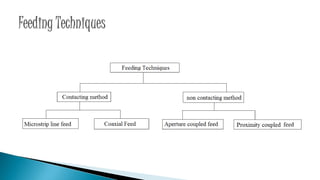
Presented By
Name Roll No.
Sudhaang Mog 29
Punit Patel 35
Bablu Singh 57
Sagar Singh 59
Under the Guidance of :
Prof. P. G. Pawar
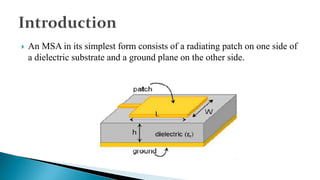
 An MSA in its simplest form consists of a radiating patch on one side of
a dielectric substrate and a ground plane on the other side.
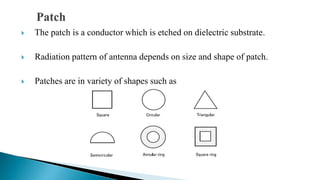
 The patch is a conductor which is etched on dielectric substrate.
 Radiation pattern of antenna depends on size and shape of patch.
 Patches are in variety of shapes such as
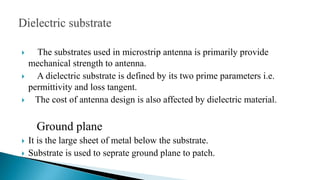
 The substrates used in microstrip antenna is primarily provide
mechanical strength to antenna.
 A dielectric substrate is defined by its two prime parameters i.e.
permittivity and loss tangent.
 The cost of antenna design is also affected by dielectric material.
Ground plane
 It is the large sheet of metal below the substrate.
 Substrate is used to seprate ground plane to patch.
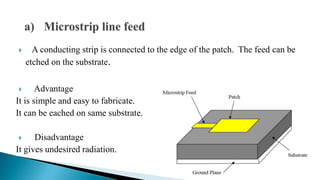
 A conducting strip is connected to the edge of the patch. The feed can be
etched on the substrate.
 Advantage
It is simple and easy to fabricate.
It can be eached on same substrate.
 Disadvantage
It gives undesired radiation.
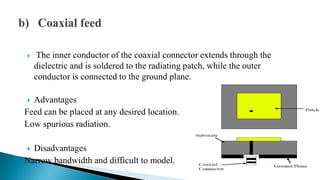
 The inner conductor of the coaxial connector extends through the
dielectric and is soldered to the radiating patch, while the outer
conductor is connected to the ground plane.
 Advantages
Feed can be placed at any desired location.
Low spurious radiation.
 Disadvantages
Narrow bandwidth and difficult to model.
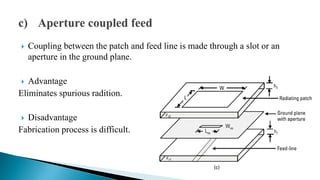
 Coupling between the patch and feed line is made through a slot or an
aperture in the ground plane.
 Advantage
Eliminates spurious radition.
 Disadvantage
Fabrication process is difficult.
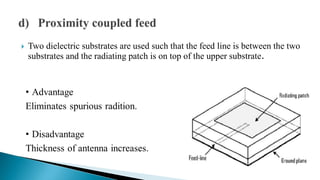
 Two dielectric substrates are used such that the feed line is between the two
substrates and the radiating patch is on top of the upper substrate.
 Low weight, low profile planar configuration and low volume.
 Low cost of fabrication and ease of manufacturing.
 They allow for dual- and triple-frequency operations.
 They can be made compact for use in personal mobile communication.
 Narrow BW;
 Lower gain;
 Low power-handling capability.
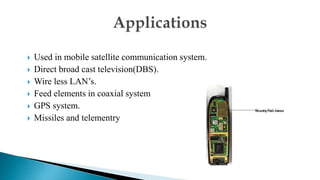
 Used in mobile satellite communication system.
 Direct broad cast television(DBS).
 Wire less LAN’s.
 Feed elements in coaxial system
 GPS system.
 Missiles and telementry
 The analysis methods for MSAs can be broadly divided into two groups.
 The methods are based on equivalent magnetic current distribution
around the patch edges
 There are three popular analytical techniques:
 The transmission line model;
 The cavity model;
 The MNM.
 In the second group, the methods are based on the electric current
distribution on the patch conductor and the ground plane
 Some of the numerical methods for analyzing MSAs are listed as
follows:
 The method of moments (MoM);
 The finite-element method (FEM);
 The spectral domain technique (SDT);
 The finite-difference time domain (FDTD) method.
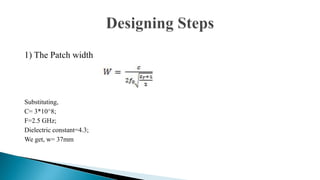
1) The Patch width
Substituting,
C= 3*10^8;
F=2.5 GHz;
Dielectric constant=4.3;
We get, w= 37mm
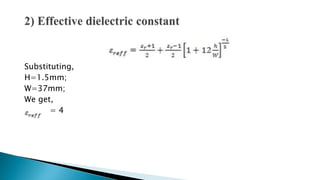
Substituting,
H=1.5mm;
W=37mm;
We get,
= 4
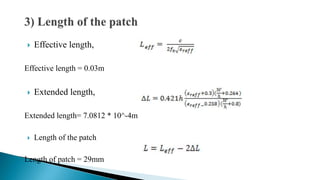
 Effective length,
Effective length = 0.03m
 Extended length,
Extended length= 7.0812 * 10^-4m
 Length of the patch
Length of patch = 29mm
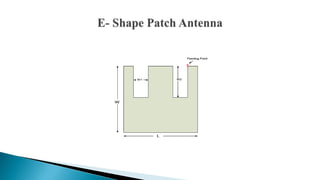
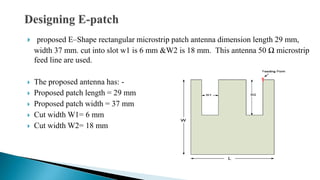
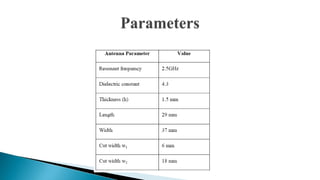
 proposed E–Shape rectangular microstrip patch antenna dimension length 29 mm,
width 37 mm. cut into slot w1 is 6 mm &W2 is 18 mm. This antenna 50 Ω microstrip
feed line are used.
 The proposed antenna has: -
 Proposed patch length = 29 mm
 Proposed patch width = 37 mm
 Cut width W1= 6 mm
 Cut width W2= 18 mm
In this project we design an E-shape rectangular microstrip patch antenna.
It has dual frequency band with center frequency 2.5 GHz, thickness
1.5mm, dielectric constant 4.3, loss tangent 0.019 are simulated at 1-9 GHz
frequency. The best result of L and C band, return loss is three notch -
27.69,-13.71&-20.35dB, VSWR value is 1.086, 1.52 & 1.213 in 2, 6 &
8GHz frequency. Bandwidth up to 33%, 31% and 54%. Antenna efficiency
is 88%. This antenna is very effective in communication.
 IE3D is an integral equation and method of moment based EM simulator.
 IE3D mainly focuses on general planar and 3D metallic structures in
layered dielectric environments. It is very efficient, accurate and flexible
for such structures.
 IE3D can also model 3D dielectric structures such as patch antennas with
finite substrates and dielectric resonator antennas.
 Microwave circuits and MICs
 Microwave, RF and wireless antennas.
 RFID tag antennas.
 Many other low to high frequency structures.
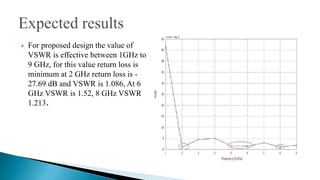
 For proposed design the value of
VSWR is effective between 1GHz to
9 GHz, for this value return loss is
minimum at 2 GHz return loss is -
27.69 dB and VSWR is 1.086, At 6
GHz VSWR is 1.52, 8 GHz VSWR
1.213.
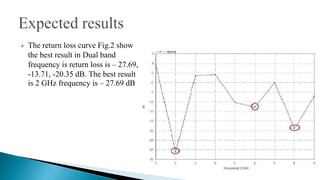
 The return loss curve Fig.2 show
the best result in Dual band
frequency is return loss is – 27.69,
-13.71, -20.35 dB. The best result
is 2 GHz frequency is – 27.69 dB
 By studying Microstrip patch antenna we have learned about the
Radiation Pattern, Bandwidth, VSWR and loss characteristics of the E –
shape antenna.
Microstrip patch-antenna

Microstrip patch-antenna

  • 1.
    Presented By Name RollNo. Sudhaang Mog 29 Punit Patel 35 Bablu Singh 57 Sagar Singh 59 Under the Guidance of : Prof. P. G. Pawar
  • 2.
     An MSAin its simplest form consists of a radiating patch on one side of a dielectric substrate and a ground plane on the other side.
  • 3.
     The patchis a conductor which is etched on dielectric substrate.  Radiation pattern of antenna depends on size and shape of patch.  Patches are in variety of shapes such as
  • 4.
     The substratesused in microstrip antenna is primarily provide mechanical strength to antenna.  A dielectric substrate is defined by its two prime parameters i.e. permittivity and loss tangent.  The cost of antenna design is also affected by dielectric material. Ground plane  It is the large sheet of metal below the substrate.  Substrate is used to seprate ground plane to patch.
  • 6.
     A conductingstrip is connected to the edge of the patch. The feed can be etched on the substrate.  Advantage It is simple and easy to fabricate. It can be eached on same substrate.  Disadvantage It gives undesired radiation.
  • 7.
     The innerconductor of the coaxial connector extends through the dielectric and is soldered to the radiating patch, while the outer conductor is connected to the ground plane.  Advantages Feed can be placed at any desired location. Low spurious radiation.  Disadvantages Narrow bandwidth and difficult to model.
  • 8.
     Coupling betweenthe patch and feed line is made through a slot or an aperture in the ground plane.  Advantage Eliminates spurious radition.  Disadvantage Fabrication process is difficult.
  • 9.
     Two dielectricsubstrates are used such that the feed line is between the two substrates and the radiating patch is on top of the upper substrate.
  • 10.
     Low weight,low profile planar configuration and low volume.  Low cost of fabrication and ease of manufacturing.  They allow for dual- and triple-frequency operations.  They can be made compact for use in personal mobile communication.
  • 11.
     Narrow BW; Lower gain;  Low power-handling capability.
  • 12.
     Used inmobile satellite communication system.  Direct broad cast television(DBS).  Wire less LAN’s.  Feed elements in coaxial system  GPS system.  Missiles and telementry
  • 13.
     The analysismethods for MSAs can be broadly divided into two groups.  The methods are based on equivalent magnetic current distribution around the patch edges  There are three popular analytical techniques:  The transmission line model;  The cavity model;  The MNM.
  • 14.
     In thesecond group, the methods are based on the electric current distribution on the patch conductor and the ground plane  Some of the numerical methods for analyzing MSAs are listed as follows:  The method of moments (MoM);  The finite-element method (FEM);  The spectral domain technique (SDT);  The finite-difference time domain (FDTD) method.
  • 16.
    1) The Patchwidth Substituting, C= 3*10^8; F=2.5 GHz; Dielectric constant=4.3; We get, w= 37mm
  • 17.
  • 18.
     Effective length, Effectivelength = 0.03m  Extended length, Extended length= 7.0812 * 10^-4m  Length of the patch Length of patch = 29mm
  • 19.
     proposed E–Shaperectangular microstrip patch antenna dimension length 29 mm, width 37 mm. cut into slot w1 is 6 mm &W2 is 18 mm. This antenna 50 Ω microstrip feed line are used.  The proposed antenna has: -  Proposed patch length = 29 mm  Proposed patch width = 37 mm  Cut width W1= 6 mm  Cut width W2= 18 mm
  • 20.
    In this projectwe design an E-shape rectangular microstrip patch antenna. It has dual frequency band with center frequency 2.5 GHz, thickness 1.5mm, dielectric constant 4.3, loss tangent 0.019 are simulated at 1-9 GHz frequency. The best result of L and C band, return loss is three notch - 27.69,-13.71&-20.35dB, VSWR value is 1.086, 1.52 & 1.213 in 2, 6 & 8GHz frequency. Bandwidth up to 33%, 31% and 54%. Antenna efficiency is 88%. This antenna is very effective in communication.
  • 22.
     IE3D isan integral equation and method of moment based EM simulator.  IE3D mainly focuses on general planar and 3D metallic structures in layered dielectric environments. It is very efficient, accurate and flexible for such structures.  IE3D can also model 3D dielectric structures such as patch antennas with finite substrates and dielectric resonator antennas.
  • 23.
     Microwave circuitsand MICs  Microwave, RF and wireless antennas.  RFID tag antennas.  Many other low to high frequency structures.
  • 24.
     For proposeddesign the value of VSWR is effective between 1GHz to 9 GHz, for this value return loss is minimum at 2 GHz return loss is - 27.69 dB and VSWR is 1.086, At 6 GHz VSWR is 1.52, 8 GHz VSWR 1.213.
  • 25.
     The returnloss curve Fig.2 show the best result in Dual band frequency is return loss is – 27.69, -13.71, -20.35 dB. The best result is 2 GHz frequency is – 27.69 dB
  • 26.
     By studyingMicrostrip patch antenna we have learned about the Radiation Pattern, Bandwidth, VSWR and loss characteristics of the E – shape antenna.