www.powerpointpresentationon.blogspot.com
RADAR  By- Arvind Chaubey


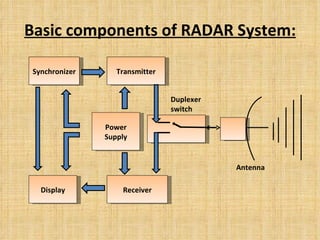
Basic components of RADAR System: Synchronizer Transmitter Display Receiver Power Supply Duplexer switch Antenna
 
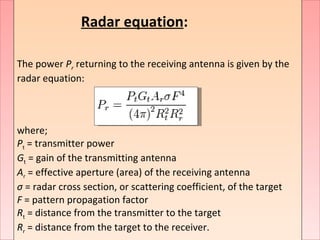
    Radar equation : The power  P r  returning to the receiving antenna is given by the radar equation: where; P t  = transmitter power G t  = gain of the transmitting antenna A r  = effective aperture (area) of the receiving antenna σ  = radar cross section, or scattering coefficient, of the target F  = pattern propagation factor R t  = distance from the transmitter to the target R r  = distance from the target to the receiver.
Type of EM radiation Travel with speed of light Wavelength 100 meters to 30 cm Frequency 3 MHz to  1000   MHz Naturally occurring Artificially generated Radio Waves
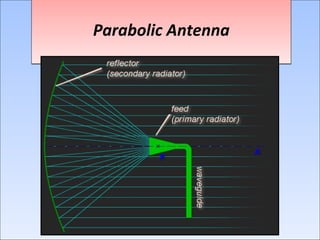
Parabolic Antenna
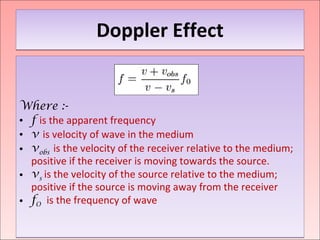
Doppler Effect Where :- f   is the apparent frequency  v   is velocity of wave in the medium v obs   is the velocity of the receiver relative to the medium; positive if the receiver is moving towards the source.  v s  is the velocity of the source relative to the medium; positive if the source is moving away from the receiver f O  is the frequency of wave
Applications of RADAR: Search RADAR  scans a large area   Targeting RADAR  scans a small area Navigational RADAR   used on commercial ships and aircrafts Mapping RADAR  remote sensing and geographic applications Weather RADAR  locate precipitation, its motion & future RADAR is used for  Air Traffic Control
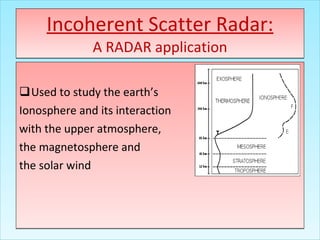
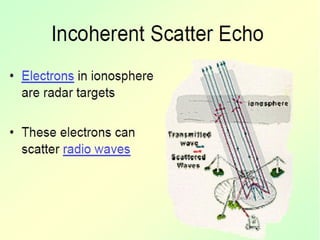
Incoherent Scatter Radar: A RADAR application Used to study the earth’s  Ionosphere and its interaction  with the upper atmosphere,  the magnetosphere and the solar wind
 
RADAR can measure Pressure The strength of the echo received from the Ionosphere measures the number of electrons able to scatter radio waves or what we call - The Electron Pressure
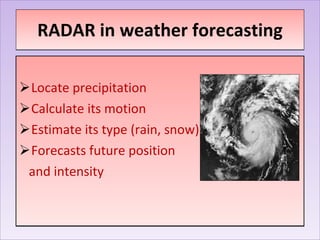
RADAR in weather forecasting Locate precipitation Calculate its motion Estimate its type (rain, snow) Forecasts future position  and intensity
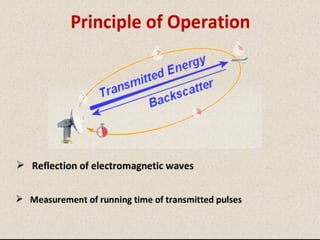
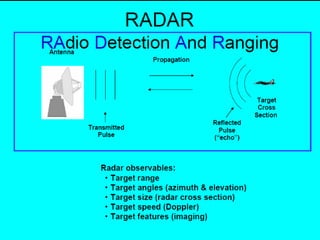
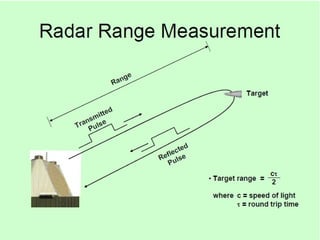
Conclusion: Radar  is a way to detect and study far off objects by transmitting a radio pulse in the direction of the target and observing the reflection of the wave.  Its basically a radio echo.
Arvind Chaubey Thank You

Radar

  • 1.
  • 2.
    RADAR By-Arvind Chaubey
  • 3.
  • 4.
  • 5.
  • 6.
    Basic components ofRADAR System: Synchronizer Transmitter Display Receiver Power Supply Duplexer switch Antenna
  • 7.
  • 8.
    Radar equation : The power  P r  returning to the receiving antenna is given by the radar equation: where; P t  = transmitter power G t  = gain of the transmitting antenna A r  = effective aperture (area) of the receiving antenna σ  = radar cross section, or scattering coefficient, of the target F  = pattern propagation factor R t  = distance from the transmitter to the target R r  = distance from the target to the receiver.
  • 9.
    Type of EMradiation Travel with speed of light Wavelength 100 meters to 30 cm Frequency 3 MHz to 1000 MHz Naturally occurring Artificially generated Radio Waves
  • 10.
  • 11.
    Doppler Effect Where:- f is the apparent frequency v is velocity of wave in the medium v obs is the velocity of the receiver relative to the medium; positive if the receiver is moving towards the source.  v s is the velocity of the source relative to the medium; positive if the source is moving away from the receiver f O is the frequency of wave
  • 12.
    Applications of RADAR:Search RADAR scans a large area Targeting RADAR scans a small area Navigational RADAR used on commercial ships and aircrafts Mapping RADAR remote sensing and geographic applications Weather RADAR locate precipitation, its motion & future RADAR is used for Air Traffic Control
  • 13.
    Incoherent Scatter Radar:A RADAR application Used to study the earth’s Ionosphere and its interaction with the upper atmosphere, the magnetosphere and the solar wind
  • 14.
  • 15.
    RADAR can measurePressure The strength of the echo received from the Ionosphere measures the number of electrons able to scatter radio waves or what we call - The Electron Pressure
  • 16.
    RADAR in weatherforecasting Locate precipitation Calculate its motion Estimate its type (rain, snow) Forecasts future position and intensity
  • 17.
    Conclusion: Radar  isa way to detect and study far off objects by transmitting a radio pulse in the direction of the target and observing the reflection of the wave. Its basically a radio echo.
  • 18.