
1
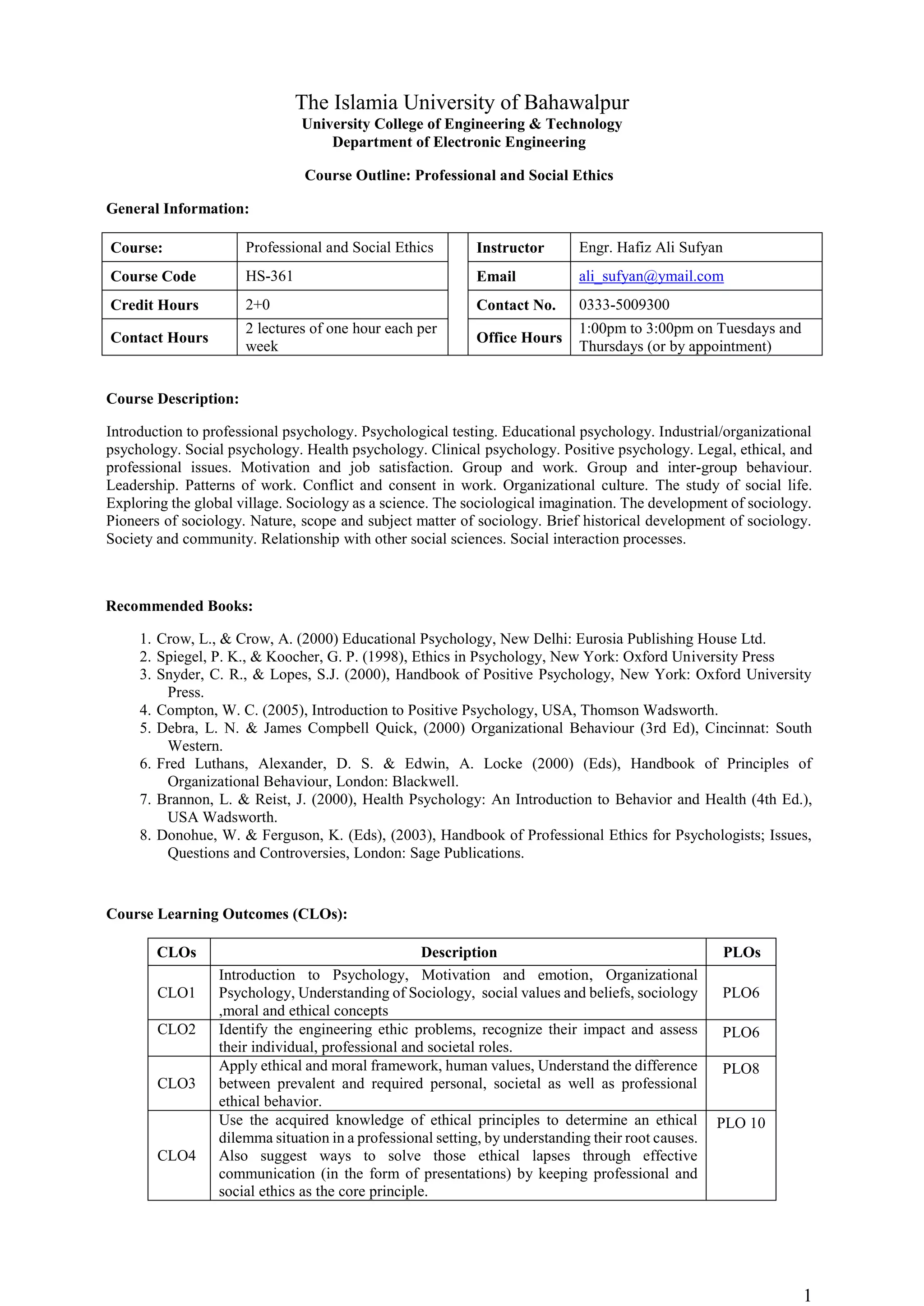
The Islamia University of Bahawalpur
University College of Engineering & Technology
Department of Electronic Engineering
Course Outline: Professional and Social Ethics
General Information:
Course: Professional and Social Ethics Instructor Engr. Hafiz Ali Sufyan
Course Code HS-361 Email ali_sufyan@ymail.com
Credit Hours 2+0 Contact No. 0333-5009300
Contact Hours
2 lectures of one hour each per
week
Office Hours
1:00pm to 3:00pm on Tuesdays and
Thursdays (or by appointment)
Course Description:
Introduction to professional psychology. Psychological testing. Educational psychology. Industrial/organizational
psychology. Social psychology. Health psychology. Clinical psychology. Positive psychology. Legal, ethical, and
professional issues. Motivation and job satisfaction. Group and work. Group and inter-group behaviour.
Leadership. Patterns of work. Conflict and consent in work. Organizational culture. The study of social life.
Exploring the global village. Sociology as a science. The sociological imagination. The development of sociology.
Pioneers of sociology. Nature, scope and subject matter of sociology. Brief historical development of sociology.
Society and community. Relationship with other social sciences. Social interaction processes.
Recommended Books:
1. Crow, L., & Crow, A. (2000) Educational Psychology, New Delhi: Eurosia Publishing House Ltd.
2. Spiegel, P. K., & Koocher, G. P. (1998), Ethics in Psychology, New York: Oxford University Press
3. Snyder, C. R., & Lopes, S.J. (2000), Handbook of Positive Psychology, New York: Oxford University
Press.
4. Compton, W. C. (2005), Introduction to Positive Psychology, USA, Thomson Wadsworth.
5. Debra, L. N. & James Compbell Quick, (2000) Organizational Behaviour (3rd Ed), Cincinnat: South
Western.
6. Fred Luthans, Alexander, D. S. & Edwin, A. Locke (2000) (Eds), Handbook of Principles of
Organizational Behaviour, London: Blackwell.
7. Brannon, L. & Reist, J. (2000), Health Psychology: An Introduction to Behavior and Health (4th Ed.),
USA Wadsworth.
8. Donohue, W. & Ferguson, K. (Eds), (2003), Handbook of Professional Ethics for Psychologists; Issues,
Questions and Controversies, London: Sage Publications.
Course Learning Outcomes (CLOs):
CLOs Description PLOs
CLO1
Introduction to Psychology, Motivation and emotion, Organizational
Psychology, Understanding of Sociology, social values and beliefs, sociology
,moral and ethical concepts
PLO6
CLO2 Identify the engineering ethic problems, recognize their impact and assess
their individual, professional and societal roles.
PLO6
CLO3
Apply ethical and moral framework, human values, Understand the difference
between prevalent and required personal, societal as well as professional
ethical behavior.
PLO8
CLO4
Use the acquired knowledge of ethical principles to determine an ethical
dilemma situation in a professional setting, by understanding their root causes.
Also suggest ways to solve those ethical lapses through effective
communication (in the form of presentations) by keeping professional and
social ethics as the core principle.
PLO 10
2
Relation of CLOs to the Program Learning Outcomes (PLOs):
1 2 3 4 5 6 7 8 9 10 11 12
EngineeringKnowledge
ProblemAnalysis
Design&Developmentof
Solutions
Investigation
ModernToolUsage
TheEngineerandSociety
Environmentand
Sustainability
Ethics
IndividualandTeamWork
Communication
ProjectManagement
LifeLongLearning
CLO1 √
CLO2 √
CLO3 √
CLO4 √
Total 2 1 1
Justification of Program Learning Outcomes (PLO’s) Coverage:
PLO 6 - The Engineer and Society:
An ability to apply reasoning informed by contextual knowledge to assess societal, health, safety, legal and
cultural issues and the consequent responsibilities relevant to professional engineering practice and solution
to complex engineering problems.
PLO8 – Ethics:
Apply ethical principles and commit to professional ethics and responsibilities and norms of engineering
practice.
PLO8 – Communication:
An ability to communicate effectively, orally as well as in writing, on complex engineering activities with
the engineering community and with society at large, such as being able to comprehend and write effective
reports and design documentation, make effective presentations, and give and receive clear instructions.
PLO1 – PLO 5, 7, 11, 12
These objectives are not directly addressed in this course.
Assessment Plan:
Sr. # CLO Week Number Assessment
1 1 2 Assignment 1
2 2 3 Quiz 1
3 3 5 Assignment 2
4 3 7 Quiz 2
5 1, 2, 3 9 Mid Term Examination
6 4 14 – 17 Presentations
10 1, 2, 3, 4 18 Final Term Examination
3
Lecture Plan:
Topics Hours
CLO
Course Overview, Introduction covers:
 The background
 Motivation
 Professionalism
 Characteristics of professionalism
 Introduction to Psychology
 Major fields of Psychology
 Difference between values and facts
 Definition of Organizational /Industrial psychology
 Work, vacation. Personality
 Work efficiency, Job Satisfaction
Week 1-3
1
 Introduction to sociology
 application of Sociology
 Scope and importance of sociology
 Social values and beliefs
 Values and norms
Week 4-5
 Traits of a profession
 Moral laws and Ethics
 IEEE code of Ethics
 Case Studies
 Motivation for “code of ethics”
 Ethical decision making
 Code of ethics for Engineers
 Pakistan Engineering Industry
 Role of Regulators, PEC, HEC, NEPRA, IEEE (P), etc
Week 6-7
2
 Basic Discussion on Ethics
 Morality and Ethics
 Ethics, Social Responsibility
 Why study engineering ethics?
 Engineering ethics
 Engineering as an ethical profession
 Ethical issued faced by Engineers
Week 8
Midterm Exam Week 9 1,2
 Moral dilemmas
 Kohlberg Theory
 Heinz Dilemma
 Procedures for facing moral dilemma
 Moral dilemma scenarios
 How to resolve moral dilemmas
Week 10-11
3
 Professional skills
 Theories About Right Actions
 Virtue Ethics
 Industrial Dispute
 Causes of disputes
 How to settle disputes
 STRIKES, LOCKOUTS, LAYOFFS & RETRENCHMENT
Week 12-13
 Safety, Risk and Hazards
 Job related risks
 Acceptability of Risks
 Knowledge about various risks
Week 14
4
 Engineer’s role towards safety
 various risks Decision Trees
Presentations
 Group and individual
 Mock sessions
Week 15-17 4
Final Exam Week 18 1, 2, 3, 4
Grading Policy:
Assignments, Quizzes, Projects/presentations etc. 20%
Midterm Exam 30%
Final Exam 50%
Course Policy (if any)
---------------END--------------------
5
Instructor Signature: _________________

OBE Based Course outline - professional and social ethics.

  • 1.
    1 The Islamia Universityof Bahawalpur University College of Engineering & Technology Department of Electronic Engineering Course Outline: Professional and Social Ethics General Information: Course: Professional and Social Ethics Instructor Engr. Hafiz Ali Sufyan Course Code HS-361 Email ali_sufyan@ymail.com Credit Hours 2+0 Contact No. 0333-5009300 Contact Hours 2 lectures of one hour each per week Office Hours 1:00pm to 3:00pm on Tuesdays and Thursdays (or by appointment) Course Description: Introduction to professional psychology. Psychological testing. Educational psychology. Industrial/organizational psychology. Social psychology. Health psychology. Clinical psychology. Positive psychology. Legal, ethical, and professional issues. Motivation and job satisfaction. Group and work. Group and inter-group behaviour. Leadership. Patterns of work. Conflict and consent in work. Organizational culture. The study of social life. Exploring the global village. Sociology as a science. The sociological imagination. The development of sociology. Pioneers of sociology. Nature, scope and subject matter of sociology. Brief historical development of sociology. Society and community. Relationship with other social sciences. Social interaction processes. Recommended Books: 1. Crow, L., & Crow, A. (2000) Educational Psychology, New Delhi: Eurosia Publishing House Ltd. 2. Spiegel, P. K., & Koocher, G. P. (1998), Ethics in Psychology, New York: Oxford University Press 3. Snyder, C. R., & Lopes, S.J. (2000), Handbook of Positive Psychology, New York: Oxford University Press. 4. Compton, W. C. (2005), Introduction to Positive Psychology, USA, Thomson Wadsworth. 5. Debra, L. N. & James Compbell Quick, (2000) Organizational Behaviour (3rd Ed), Cincinnat: South Western. 6. Fred Luthans, Alexander, D. S. & Edwin, A. Locke (2000) (Eds), Handbook of Principles of Organizational Behaviour, London: Blackwell. 7. Brannon, L. & Reist, J. (2000), Health Psychology: An Introduction to Behavior and Health (4th Ed.), USA Wadsworth. 8. Donohue, W. & Ferguson, K. (Eds), (2003), Handbook of Professional Ethics for Psychologists; Issues, Questions and Controversies, London: Sage Publications. Course Learning Outcomes (CLOs): CLOs Description PLOs CLO1 Introduction to Psychology, Motivation and emotion, Organizational Psychology, Understanding of Sociology, social values and beliefs, sociology ,moral and ethical concepts PLO6 CLO2 Identify the engineering ethic problems, recognize their impact and assess their individual, professional and societal roles. PLO6 CLO3 Apply ethical and moral framework, human values, Understand the difference between prevalent and required personal, societal as well as professional ethical behavior. PLO8 CLO4 Use the acquired knowledge of ethical principles to determine an ethical dilemma situation in a professional setting, by understanding their root causes. Also suggest ways to solve those ethical lapses through effective communication (in the form of presentations) by keeping professional and social ethics as the core principle. PLO 10
  • 2.
    2 Relation of CLOsto the Program Learning Outcomes (PLOs): 1 2 3 4 5 6 7 8 9 10 11 12 EngineeringKnowledge ProblemAnalysis Design&Developmentof Solutions Investigation ModernToolUsage TheEngineerandSociety Environmentand Sustainability Ethics IndividualandTeamWork Communication ProjectManagement LifeLongLearning CLO1 √ CLO2 √ CLO3 √ CLO4 √ Total 2 1 1 Justification of Program Learning Outcomes (PLO’s) Coverage: PLO 6 - The Engineer and Society: An ability to apply reasoning informed by contextual knowledge to assess societal, health, safety, legal and cultural issues and the consequent responsibilities relevant to professional engineering practice and solution to complex engineering problems. PLO8 – Ethics: Apply ethical principles and commit to professional ethics and responsibilities and norms of engineering practice. PLO8 – Communication: An ability to communicate effectively, orally as well as in writing, on complex engineering activities with the engineering community and with society at large, such as being able to comprehend and write effective reports and design documentation, make effective presentations, and give and receive clear instructions. PLO1 – PLO 5, 7, 11, 12 These objectives are not directly addressed in this course. Assessment Plan: Sr. # CLO Week Number Assessment 1 1 2 Assignment 1 2 2 3 Quiz 1 3 3 5 Assignment 2 4 3 7 Quiz 2 5 1, 2, 3 9 Mid Term Examination 6 4 14 – 17 Presentations 10 1, 2, 3, 4 18 Final Term Examination
  • 3.
    3 Lecture Plan: Topics Hours CLO CourseOverview, Introduction covers:  The background  Motivation  Professionalism  Characteristics of professionalism  Introduction to Psychology  Major fields of Psychology  Difference between values and facts  Definition of Organizational /Industrial psychology  Work, vacation. Personality  Work efficiency, Job Satisfaction Week 1-3 1  Introduction to sociology  application of Sociology  Scope and importance of sociology  Social values and beliefs  Values and norms Week 4-5  Traits of a profession  Moral laws and Ethics  IEEE code of Ethics  Case Studies  Motivation for “code of ethics”  Ethical decision making  Code of ethics for Engineers  Pakistan Engineering Industry  Role of Regulators, PEC, HEC, NEPRA, IEEE (P), etc Week 6-7 2  Basic Discussion on Ethics  Morality and Ethics  Ethics, Social Responsibility  Why study engineering ethics?  Engineering ethics  Engineering as an ethical profession  Ethical issued faced by Engineers Week 8 Midterm Exam Week 9 1,2  Moral dilemmas  Kohlberg Theory  Heinz Dilemma  Procedures for facing moral dilemma  Moral dilemma scenarios  How to resolve moral dilemmas Week 10-11 3  Professional skills  Theories About Right Actions  Virtue Ethics  Industrial Dispute  Causes of disputes  How to settle disputes  STRIKES, LOCKOUTS, LAYOFFS & RETRENCHMENT Week 12-13  Safety, Risk and Hazards  Job related risks  Acceptability of Risks  Knowledge about various risks Week 14
  • 4.
    4  Engineer’s roletowards safety  various risks Decision Trees Presentations  Group and individual  Mock sessions Week 15-17 4 Final Exam Week 18 1, 2, 3, 4 Grading Policy: Assignments, Quizzes, Projects/presentations etc. 20% Midterm Exam 30% Final Exam 50% Course Policy (if any) ---------------END--------------------
  • 5.