1
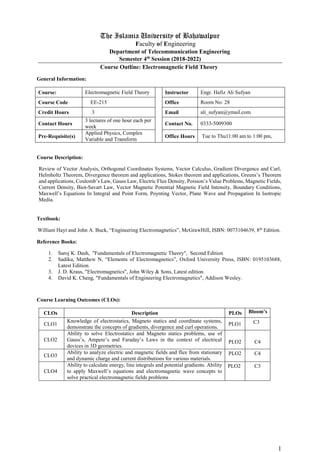
The Islamia University of Bahawalpur
Faculty of Engineering
Department of Telecommunication Engineering
Semester 4th
Session (2018-2022)
Course Outline: Electromagnetic Field Theory
General Information:
Course: Electromagnetic Field Theory Instructor Engr. Hafiz Ali Sufyan
Course Code EE-215 Office Room No: 28
Credit Hours 3 Email ali_sufyan@ymail.com
Contact Hours
3 lectures of one hour each per
week
Contact No. 0333-5009300
Pre-Requisite(s)
Applied Physics, Complex
Variable and Transform
Office Hours Tue to Thu11:00 am to 1:00 pm,
Course Description:
Review of Vector Analysis, Orthogonal Coordinates Systems, Vector Calculus, Gradient Divergence and Curl,
Helmholtz Theorem, Divergence theorem and applications, Stokes theorem and applications, Greens’s Theorem
and applications, Coulomb’s Law, Gauss Law, Electric Flux Density, Poisson’s Value Problems, Magnetic Fields,
Current Density, Biot-Savart Law, Vector Magnetic Potential Magnetic Field Intensity, Boundary Conditions,
Maxwell’s Equations In Integral and Point Form, Poynting Vector, Plane Wave and Propagation In Isotropic
Media.
Textbook:
William Hayt and John A. Buck, “Engineering Electromagnetics”, McGrawHill, ISBN: 0073104639, 8th
Edition.
Reference Books:
1. Saroj K. Dash, "Fundamentals of Electromagnetic Theory", Second Edition
2. Sadiku, Matthew N, “Elements of Electromagnetics”, Oxford University Press, ISBN: 0195103688,
Latest Edition.
3. J. D. Kraus, "Electromagnetics", John Wiley & Sons, Latest edition.
4. David K. Cheng, "Fundamentals of Engineering Electromagnetics", Addison Wesley.
Course Learning Outcomes (CLOs):
CLOs Description PLOs Bloom’s
CLO1
Knowledge of electrostatics, Magneto statics and coordinate systems,
demonstrate the concepts of gradients, divergence and curl operations.
PLO1 C3
CLO2
Ability to solve Electrostatics and Magneto statics problems, use of
Gauss’s, Ampere’s and Faraday’s Laws in the context of electrical
devices in 3D geometries.
PLO2 C4
CLO3
Ability to analyze electric and magnetic fields and flux from stationary
and dynamic charge and current distributions for various materials.
PLO2 C4
CLO4
Ability to calculate energy, line integrals and potential gradients. Ability
to apply Maxwell’s equations and electromagnetic wave concepts to
solve practical electromagnetic fields problems
PLO2 C3
2
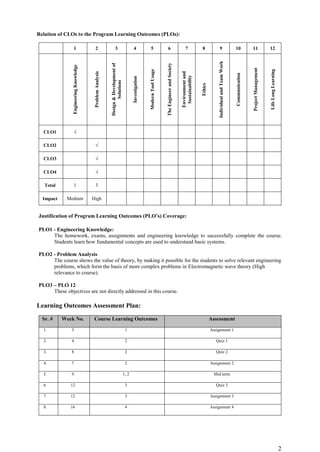
Relation of CLOs to the Program Learning Outcomes (PLOs):
1 2 3 4 5 6 7 8 9 10 11 12
EngineeringKnowledge
ProblemAnalysis
Design&Developmentof
Solutions
Investigation
ModernToolUsage
TheEngineerandSociety
Environmentand
Sustainability
Ethics
IndividualandTeamWork
Communication
ProjectManagement
LifeLongLearning
CLO1 √
CLO2 √
CLO3 √
CLO4 √
Total 1 3
Impact Medium High
Justification of Program Learning Outcomes (PLO’s) Coverage:
PLO1 - Engineering Knowledge:
The homework, exams, assignments and engineering knowledge to successfully complete the course.
Students learn how fundamental concepts are used to understand basic systems.
PLO2 - Problem Analysis
The course shows the value of theory, by making it possible for the students to solve relevant engineering
problems, which form the basis of more complex problems in Electromagnetic wave theory (High
relevance to course).
PLO3 – PLO 12
These objectives are not directly addressed in this course.
Learning Outcomes Assessment Plan:
Sr. # Week No. Course Learning Outcomes Assessment
1. 3 1 Assignment 1
2. 4 2 Quiz 1
3. 8 2 Quiz 2
4. 7 2 Assignment 2
5. 9 1, 2 Mid term
6. 12 3 Quiz 3
7. 12 3 Assignment 3
8. 16 4 Assignment 4
3
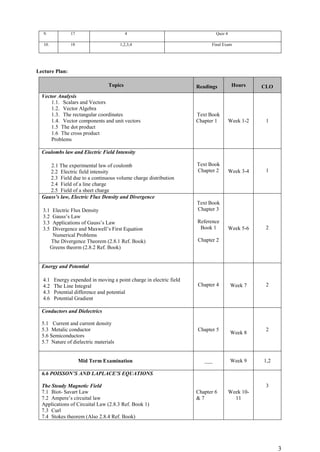
9. 17 4 Quiz 4
10. 18 1,2,3,4 Final Exam
Lecture Plan:
Topics Readings Hours CLO
Vector Analysis
1.1. Scalars and Vectors
1.2. Vector Algebra
1.3. The rectangular coordinates
1.4. Vector components and unit vectors
1.5 The dot product
1.6 The cross product
Problems
Text Book
Chapter 1 Week 1-2 1
Coulombs law and Electric Field Intensity
2.1 The experimental law of coulomb
2.2 Electric field intensity
2.3 Field due to a continuous volume charge distribution
2.4 Field of a line charge
2.5 Field of a sheet charge
Text Book
Chapter 2 Week 3-4 1
Gauss’s law, Electric Flux Density and Divergence
3.1 Electric Flux Density
3.2 Gauss’s Law
3.3 Applications of Gauss’s Law
3.5 Divergence and Maxwell’s First Equation
Numerical Problems
The Divergence Theorem (2.8.1 Ref. Book)
Greens theorm (2.8.2 Ref. Book)
Text Book
Chapter 3
Reference
Book 1
Chapter 2
Week 5-6 2
Energy and Potential
4.1 Energy expended in moving a point charge in electric field
4.2 The Line Integral
4.3 Potential difference and potential
4.6 Potential Gradient
Chapter 4 Week 7 2
Conductors and Dielectrics
5.1 Current and current density
5.3 Metalic conductor
5.6 Semiconductors
5.7 Nature of dielectric materials
Chapter 5
Week 8
2
Mid Term Examination ___ Week 9 1,2
6.6 POISSON’S AND LAPLACE’S EQUATIONS
The Steady Magnetic Field
7.1 Biot- Savart Law
7.2 Ampere’s circuital law
Applications of Circuital Law (2.8.3 Ref. Book 1)
7.3 Curl
7.4 Stokes theorem (Also 2.8.4 Ref. Book)
Chapter 6
& 7
Week 10-
11
3
4
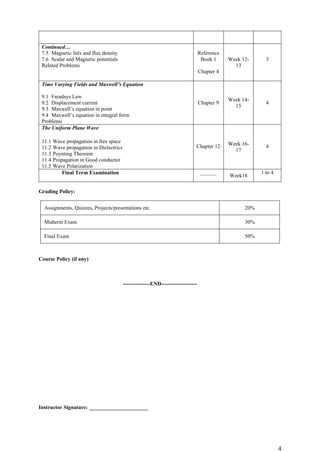
Continued…
7.5 Magnetic fulx and flux density
7.6 Scalar and Magnetic potentials
Related Problems
Reference
Book 1
Chapter 4
Week 12-
13
3
Time Varying Fields and Maxwell’s Equation
9.1 Faradays Law
9.2 Displacement current
9.3 Maxwell’s equation in point
9.4 Maxwell’s equation in integral form
Problems
Chapter 9
Week 14-
15
4
The Uniform Plane Wave
11.1 Wave propagation in free space
11.2 Wave propagation in Dielectrics
11.3 Poynting Theorem
11.4 Propagation in Good conductor
11.5 Wave Polarization
Chapter 12 Week 16-
17
4
Final Term Examination ______
Week18
1 to 4
Grading Policy:
Assignments, Quizzes, Projects/presentations etc. 20%
Midterm Exam 30%
Final Exam 50%
Course Policy (if any)
---------------END--------------------
Instructor Signature: ______________________

Course outline obe based - EMT

  • 1.
    1 The Islamia Universityof Bahawalpur Faculty of Engineering Department of Telecommunication Engineering Semester 4th Session (2018-2022) Course Outline: Electromagnetic Field Theory General Information: Course: Electromagnetic Field Theory Instructor Engr. Hafiz Ali Sufyan Course Code EE-215 Office Room No: 28 Credit Hours 3 Email ali_sufyan@ymail.com Contact Hours 3 lectures of one hour each per week Contact No. 0333-5009300 Pre-Requisite(s) Applied Physics, Complex Variable and Transform Office Hours Tue to Thu11:00 am to 1:00 pm, Course Description: Review of Vector Analysis, Orthogonal Coordinates Systems, Vector Calculus, Gradient Divergence and Curl, Helmholtz Theorem, Divergence theorem and applications, Stokes theorem and applications, Greens’s Theorem and applications, Coulomb’s Law, Gauss Law, Electric Flux Density, Poisson’s Value Problems, Magnetic Fields, Current Density, Biot-Savart Law, Vector Magnetic Potential Magnetic Field Intensity, Boundary Conditions, Maxwell’s Equations In Integral and Point Form, Poynting Vector, Plane Wave and Propagation In Isotropic Media. Textbook: William Hayt and John A. Buck, “Engineering Electromagnetics”, McGrawHill, ISBN: 0073104639, 8th Edition. Reference Books: 1. Saroj K. Dash, "Fundamentals of Electromagnetic Theory", Second Edition 2. Sadiku, Matthew N, “Elements of Electromagnetics”, Oxford University Press, ISBN: 0195103688, Latest Edition. 3. J. D. Kraus, "Electromagnetics", John Wiley & Sons, Latest edition. 4. David K. Cheng, "Fundamentals of Engineering Electromagnetics", Addison Wesley. Course Learning Outcomes (CLOs): CLOs Description PLOs Bloom’s CLO1 Knowledge of electrostatics, Magneto statics and coordinate systems, demonstrate the concepts of gradients, divergence and curl operations. PLO1 C3 CLO2 Ability to solve Electrostatics and Magneto statics problems, use of Gauss’s, Ampere’s and Faraday’s Laws in the context of electrical devices in 3D geometries. PLO2 C4 CLO3 Ability to analyze electric and magnetic fields and flux from stationary and dynamic charge and current distributions for various materials. PLO2 C4 CLO4 Ability to calculate energy, line integrals and potential gradients. Ability to apply Maxwell’s equations and electromagnetic wave concepts to solve practical electromagnetic fields problems PLO2 C3
  • 2.
    2 Relation of CLOsto the Program Learning Outcomes (PLOs): 1 2 3 4 5 6 7 8 9 10 11 12 EngineeringKnowledge ProblemAnalysis Design&Developmentof Solutions Investigation ModernToolUsage TheEngineerandSociety Environmentand Sustainability Ethics IndividualandTeamWork Communication ProjectManagement LifeLongLearning CLO1 √ CLO2 √ CLO3 √ CLO4 √ Total 1 3 Impact Medium High Justification of Program Learning Outcomes (PLO’s) Coverage: PLO1 - Engineering Knowledge: The homework, exams, assignments and engineering knowledge to successfully complete the course. Students learn how fundamental concepts are used to understand basic systems. PLO2 - Problem Analysis The course shows the value of theory, by making it possible for the students to solve relevant engineering problems, which form the basis of more complex problems in Electromagnetic wave theory (High relevance to course). PLO3 – PLO 12 These objectives are not directly addressed in this course. Learning Outcomes Assessment Plan: Sr. # Week No. Course Learning Outcomes Assessment 1. 3 1 Assignment 1 2. 4 2 Quiz 1 3. 8 2 Quiz 2 4. 7 2 Assignment 2 5. 9 1, 2 Mid term 6. 12 3 Quiz 3 7. 12 3 Assignment 3 8. 16 4 Assignment 4
  • 3.
    3 9. 17 4Quiz 4 10. 18 1,2,3,4 Final Exam Lecture Plan: Topics Readings Hours CLO Vector Analysis 1.1. Scalars and Vectors 1.2. Vector Algebra 1.3. The rectangular coordinates 1.4. Vector components and unit vectors 1.5 The dot product 1.6 The cross product Problems Text Book Chapter 1 Week 1-2 1 Coulombs law and Electric Field Intensity 2.1 The experimental law of coulomb 2.2 Electric field intensity 2.3 Field due to a continuous volume charge distribution 2.4 Field of a line charge 2.5 Field of a sheet charge Text Book Chapter 2 Week 3-4 1 Gauss’s law, Electric Flux Density and Divergence 3.1 Electric Flux Density 3.2 Gauss’s Law 3.3 Applications of Gauss’s Law 3.5 Divergence and Maxwell’s First Equation Numerical Problems The Divergence Theorem (2.8.1 Ref. Book) Greens theorm (2.8.2 Ref. Book) Text Book Chapter 3 Reference Book 1 Chapter 2 Week 5-6 2 Energy and Potential 4.1 Energy expended in moving a point charge in electric field 4.2 The Line Integral 4.3 Potential difference and potential 4.6 Potential Gradient Chapter 4 Week 7 2 Conductors and Dielectrics 5.1 Current and current density 5.3 Metalic conductor 5.6 Semiconductors 5.7 Nature of dielectric materials Chapter 5 Week 8 2 Mid Term Examination ___ Week 9 1,2 6.6 POISSON’S AND LAPLACE’S EQUATIONS The Steady Magnetic Field 7.1 Biot- Savart Law 7.2 Ampere’s circuital law Applications of Circuital Law (2.8.3 Ref. Book 1) 7.3 Curl 7.4 Stokes theorem (Also 2.8.4 Ref. Book) Chapter 6 & 7 Week 10- 11 3
  • 4.
    4 Continued… 7.5 Magnetic fulxand flux density 7.6 Scalar and Magnetic potentials Related Problems Reference Book 1 Chapter 4 Week 12- 13 3 Time Varying Fields and Maxwell’s Equation 9.1 Faradays Law 9.2 Displacement current 9.3 Maxwell’s equation in point 9.4 Maxwell’s equation in integral form Problems Chapter 9 Week 14- 15 4 The Uniform Plane Wave 11.1 Wave propagation in free space 11.2 Wave propagation in Dielectrics 11.3 Poynting Theorem 11.4 Propagation in Good conductor 11.5 Wave Polarization Chapter 12 Week 16- 17 4 Final Term Examination ______ Week18 1 to 4 Grading Policy: Assignments, Quizzes, Projects/presentations etc. 20% Midterm Exam 30% Final Exam 50% Course Policy (if any) ---------------END-------------------- Instructor Signature: ______________________