Microwave Link
Engineering
Ali Sufyan
Islamia University of Bahawalpur
Bahawalpur, Punjab, Pakistan
ali.sufyan@iub.edu.pk
Contents
• Propagation on the Earth-Space Link
• Basic Microwave Propagation
• Isotropic Radiator
• Directional Properties of Antennas
• Polarization (Linear and Circular)
• Propagation Losses
Propagation on the Earth-Space
Link
• The process by which radio signals reach the receiving
antenna from the transmitting station is called radio wave
propagation.
• Radio waves represent a part of the electromagnetic
spectrum, encompassing radio, infrared, visible light,
ultraviolet, and X rays .
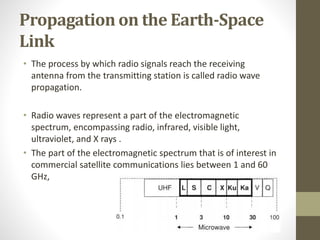
• The part of the electromagnetic spectrum that is of interest in
commercial satellite communications lies between 1 and 60
GHz,
Basic Microwave Propagation
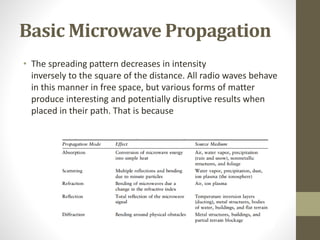
• The spreading pattern decreases in intensity
inversely to the square of the distance. All radio waves behave
in this manner in free space, but various forms of matter
produce interesting and potentially disruptive results when
placed in their path. That is because
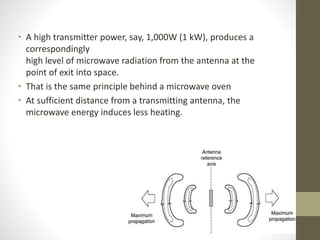
• A high transmitter power, say, 1,000W (1 kW), produces a
correspondingly
high level of microwave radiation from the antenna at the
point of exit into space.
• That is the same principle behind a microwave oven
• At sufficient distance from a transmitting antenna, the
microwave energy induces less heating.
area around the antenna
• There is a defined area around the antenna, called the near-field
region, where the energy has not quite coalesced into a clearly
defined beam.
• Within the near field, microwave energy varies in intensity,
depending where one stands relative to the antenna structure.
• sufficient distance from the antenna called the far-field region,
• the radiation field is formed into the type of beam related with the
particular antenna .
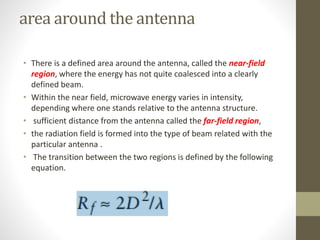
• The transition between the two regions is defined by the following
equation.
Isotropic Radiator
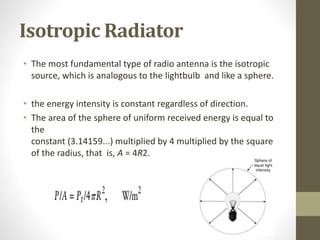
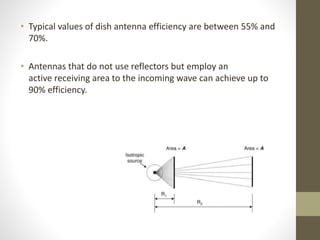
• The most fundamental type of radio antenna is the isotropic
source, which is analogous to the lightbulb and like a sphere.
• the energy intensity is constant regardless of direction.
• The area of the sphere of uniform received energy is equal to
the
constant (3.14159...) multiplied by 4 multiplied by the square
of the radius, that is, A = 4R2.
Continued…
• The denominator, 4R2, is sometimes called the spreading
factor.
• RF power driving the isotropic source produces a constant
power density at a fixed distance.
• That density decreases by 1/R2 as the point of reception
moves farther away from the source.
• There are two receiving antenna surfaces of equal area: one at
distance R2 is farther away from the source than the other at
distance R1.
• The challenge of antenna design is to maximize the
fraction of the energy that the antenna actually delivers from
the reflector surface to the receiver.
• The key parameter is the efficiency of the antenna, defined as
the ratio of the effective area (i.e., the area that would
perfectly capture the same amount of energy) to its physical
area.
• Typical values of dish antenna efficiency are between 55% and
70%.
• Antennas that do not use reflectors but employ an
active receiving area to the incoming wave can achieve up to
90% efficiency.
Directional Properties of Antennas
• The isotropic antenna is neither practical, its ideal
characteristic cannot be achieved .
• Directivity and Gain :
• Directivity is the ratio of the measured signal to the maximum
signal in the peak direction.
• The gain, is an absolute measure, obtained by comparing the
signal from the antenna to that of an isotropic radiator.
• Reciprocity :
• The gain and the directivity are the same at a given frequency
whether it is used to receive or to transmit.
• It allows the antenna to receive with precisely the same
directional characteristics as it transmits.
Directional Properties of Antennas
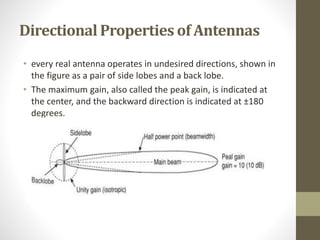
• every real antenna operates in undesired directions, shown in
the figure as a pair of side lobes and a back lobe.
• The maximum gain, also called the peak gain, is indicated at
the center, and the backward direction is indicated at ±180
degrees.
Directional Properties of Antennas
• Beamwidth :
• The half-power beam width or beam width this the angular width of
the main beam measured between the points where the power
intensity is one-half that of the peak.
• An equally accurate name that is often used is the 3-dB beamwidth,
since the half power point is where the directivity is 3 dB down .
• Antenna Pattern:
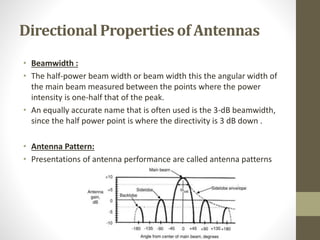
• Presentations of antenna performance are called antenna patterns
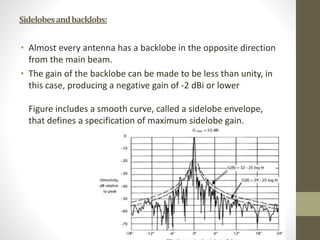
Sidelobesandbacklobs:
• Almost every antenna has a backlobe in the opposite direction
from the main beam.
• The gain of the backlobe can be made to be less than unity, in
this case, producing a negative gain of -2 dBi or lower
Figure includes a smooth curve, called a sidelobe envelope,
that defines a specification of maximum sidelobe gain.
Isolation
• The directive property of an antenna determines how
effective it will be for getting signal power from the source to
the receiver.
• Any undesired signal that can potentially degrade reception is
RFI.
Polarization
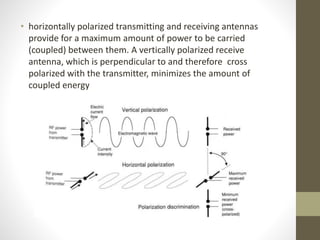
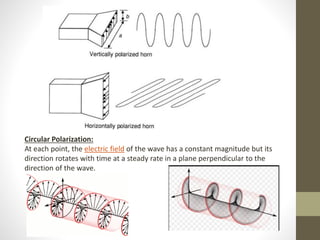
• Horizontal and Vertical Polarization:
• The electrical currents in the rods cause the electromagnetic wave
to have its electric component to be lined up in the same direction,
which is vertical (in the direction of the two arrows).
This type of polarization is called linear polarization (LP) because the
electric component has a fixed orientation.
• Horizontal LP is obtained when the dipole is rotated 90 degrees, so
that the direction of the electrical current also is horizontal.
Reception occurs when the electric component of the incoming wave
produces a current in the receiving antenna, which cannot occur if the
conductors of the receiving antenna are perpendicular with the
incoming polarization
• horizontally polarized transmitting and receiving antennas
provide for a maximum amount of power to be carried
(coupled) between them. A vertically polarized receive
antenna, which is perpendicular to and therefore cross
polarized with the transmitter, minimizes the amount of
coupled energy
Circular Polarization:
At each point, the electric field of the wave has a constant magnitude but its
direction rotates with time at a steady rate in a plane perpendicular to the
direction of the wave.
Propagation Losses
• The free-space path between transmitter and receiver may pass
through a combination of ground obstructions and atmospheric.
• A list of these are:
• Free space loss
• Rain attenuation
• Refraction
• Diffraction
• Multi path propagation
• Doppler
• Absorption
• Scattering
• Reflection

Microwave Link Engineering.

  • 1.
    Microwave Link Engineering Ali Sufyan IslamiaUniversity of Bahawalpur Bahawalpur, Punjab, Pakistan ali.sufyan@iub.edu.pk
  • 2.
    Contents • Propagation onthe Earth-Space Link • Basic Microwave Propagation • Isotropic Radiator • Directional Properties of Antennas • Polarization (Linear and Circular) • Propagation Losses
  • 3.
    Propagation on theEarth-Space Link • The process by which radio signals reach the receiving antenna from the transmitting station is called radio wave propagation. • Radio waves represent a part of the electromagnetic spectrum, encompassing radio, infrared, visible light, ultraviolet, and X rays . • The part of the electromagnetic spectrum that is of interest in commercial satellite communications lies between 1 and 60 GHz,
  • 4.
    Basic Microwave Propagation •The spreading pattern decreases in intensity inversely to the square of the distance. All radio waves behave in this manner in free space, but various forms of matter produce interesting and potentially disruptive results when placed in their path. That is because
  • 5.
    • A hightransmitter power, say, 1,000W (1 kW), produces a correspondingly high level of microwave radiation from the antenna at the point of exit into space. • That is the same principle behind a microwave oven • At sufficient distance from a transmitting antenna, the microwave energy induces less heating.
  • 6.
    area around theantenna • There is a defined area around the antenna, called the near-field region, where the energy has not quite coalesced into a clearly defined beam. • Within the near field, microwave energy varies in intensity, depending where one stands relative to the antenna structure. • sufficient distance from the antenna called the far-field region, • the radiation field is formed into the type of beam related with the particular antenna . • The transition between the two regions is defined by the following equation.
  • 7.
    Isotropic Radiator • Themost fundamental type of radio antenna is the isotropic source, which is analogous to the lightbulb and like a sphere. • the energy intensity is constant regardless of direction. • The area of the sphere of uniform received energy is equal to the constant (3.14159...) multiplied by 4 multiplied by the square of the radius, that is, A = 4R2.
  • 8.
    Continued… • The denominator,4R2, is sometimes called the spreading factor. • RF power driving the isotropic source produces a constant power density at a fixed distance. • That density decreases by 1/R2 as the point of reception moves farther away from the source. • There are two receiving antenna surfaces of equal area: one at distance R2 is farther away from the source than the other at distance R1. • The challenge of antenna design is to maximize the fraction of the energy that the antenna actually delivers from the reflector surface to the receiver. • The key parameter is the efficiency of the antenna, defined as the ratio of the effective area (i.e., the area that would perfectly capture the same amount of energy) to its physical area.
  • 9.
    • Typical valuesof dish antenna efficiency are between 55% and 70%. • Antennas that do not use reflectors but employ an active receiving area to the incoming wave can achieve up to 90% efficiency.
  • 10.
    Directional Properties ofAntennas • The isotropic antenna is neither practical, its ideal characteristic cannot be achieved . • Directivity and Gain : • Directivity is the ratio of the measured signal to the maximum signal in the peak direction. • The gain, is an absolute measure, obtained by comparing the signal from the antenna to that of an isotropic radiator. • Reciprocity : • The gain and the directivity are the same at a given frequency whether it is used to receive or to transmit. • It allows the antenna to receive with precisely the same directional characteristics as it transmits.
  • 11.
    Directional Properties ofAntennas • every real antenna operates in undesired directions, shown in the figure as a pair of side lobes and a back lobe. • The maximum gain, also called the peak gain, is indicated at the center, and the backward direction is indicated at ±180 degrees.
  • 12.
    Directional Properties ofAntennas • Beamwidth : • The half-power beam width or beam width this the angular width of the main beam measured between the points where the power intensity is one-half that of the peak. • An equally accurate name that is often used is the 3-dB beamwidth, since the half power point is where the directivity is 3 dB down . • Antenna Pattern: • Presentations of antenna performance are called antenna patterns
  • 13.
    Sidelobesandbacklobs: • Almost everyantenna has a backlobe in the opposite direction from the main beam. • The gain of the backlobe can be made to be less than unity, in this case, producing a negative gain of -2 dBi or lower Figure includes a smooth curve, called a sidelobe envelope, that defines a specification of maximum sidelobe gain.
  • 14.
    Isolation • The directiveproperty of an antenna determines how effective it will be for getting signal power from the source to the receiver. • Any undesired signal that can potentially degrade reception is RFI.
  • 15.
    Polarization • Horizontal andVertical Polarization: • The electrical currents in the rods cause the electromagnetic wave to have its electric component to be lined up in the same direction, which is vertical (in the direction of the two arrows). This type of polarization is called linear polarization (LP) because the electric component has a fixed orientation. • Horizontal LP is obtained when the dipole is rotated 90 degrees, so that the direction of the electrical current also is horizontal. Reception occurs when the electric component of the incoming wave produces a current in the receiving antenna, which cannot occur if the conductors of the receiving antenna are perpendicular with the incoming polarization
  • 16.
    • horizontally polarizedtransmitting and receiving antennas provide for a maximum amount of power to be carried (coupled) between them. A vertically polarized receive antenna, which is perpendicular to and therefore cross polarized with the transmitter, minimizes the amount of coupled energy
  • 17.
    Circular Polarization: At eachpoint, the electric field of the wave has a constant magnitude but its direction rotates with time at a steady rate in a plane perpendicular to the direction of the wave.
  • 18.
    Propagation Losses • Thefree-space path between transmitter and receiver may pass through a combination of ground obstructions and atmospheric. • A list of these are: • Free space loss • Rain attenuation • Refraction • Diffraction • Multi path propagation • Doppler • Absorption • Scattering • Reflection