Radar
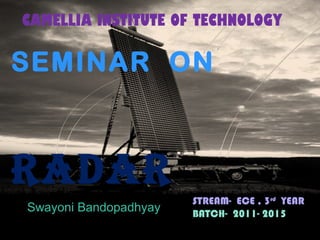
SEMINAR ON
RADAR
Swayoni Bandopadhyay
CAMELLIA INSTITUTE OF TECHNOLOGY
STREAM- ECE , 3rd
YEAR
BATCH- 2011- 2015
INDEX
Introduction
The Range
Range Measurement
Atmospheric Effect
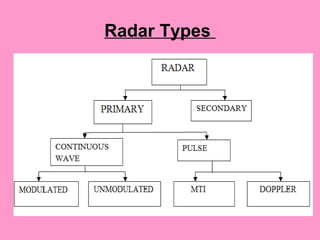
Types of Radar
Applications
Conclusion
Bibliography
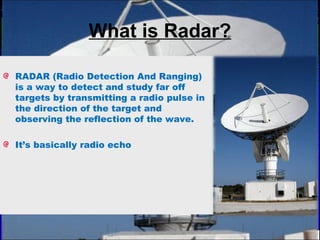
What is Radar?
RADAR (Radio Detection And Ranging)
is a way to detect and study far off
targets by transmitting a radio pulse in
the direction of the target and
observing the reflection of the wave.
It’s basically radio echo
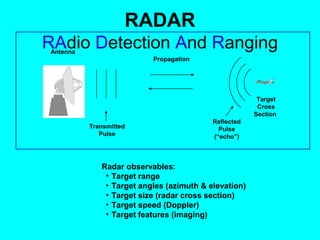
RADAR
RAdio Detection And Ranging
Radar observables:
• Target range
• Target angles (azimuth & elevation)
• Target size (radar cross section)
• Target speed (Doppler)
• Target features (imaging)
Antenna
Transmitted
Pulse
Target
Cross
Section
Propagation
Reflected
Pulse
(“echo”)
The Range
In general v=d/t and d=vt
The range is just a distance
Since radio waves travel at the speed of
light (v = c = 300,000 km/sec )
range = c•time/2
Radar Range Measurement
Transmitted
Pulse
Reflected
Pulse
Range
Target
• Target range =
cτ
2
where c = speed of light
τ = round trip time
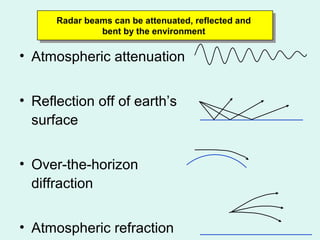
Atmospheric Effects
• Atmospheric attenuation
• Reflection off of earth’s
surface
• Over-the-horizon
diffraction
• Atmospheric refraction
Radar beams can be attenuated, reflected and
bent by the environment
Radar beams can be attenuated, reflected and
bent by the environment
Radar Types
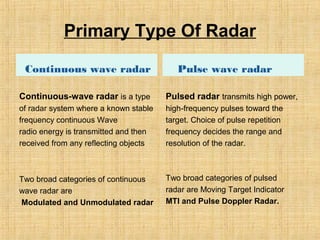
Primary Type Of Radar
Continuous wave radar
Continuous-wave radar is a type
of radar system where a known stable
frequency continuous Wave
radio energy is transmitted and then
received from any reflecting objects
Two broad categories of continuous
wave radar are
Modulated and Unmodulated radar
Pulse wave radar
Pulsed radar transmits high power,
high-frequency pulses toward the
target. Choice of pulse repetition
frequency decides the range and
resolution of the radar.
Two broad categories of pulsed
radar are Moving Target Indicator
MTI and Pulse Doppler Radar.
Fields of Applications
Military applications, security, surveillance etc.
Weather observation
Air Traffic Control
Radar speed meters
Collision Avoidance Radars
Inspection of Construction work
Road maintenance
MILITARY
Important Part of Air Defence System, Operation of offensive
Missiles &Other Weapons.
Target Detection, Target Tracking & Weapon Control.
Tracks the targets, directs the weapon to an intercept and assess
the effectiveness of engagement.
Also used in area, ground &air surveillance.
AIR TRAFFIC CONTROL
Used to safely control Air Traffic
in the vicinity of the airports and
enroute.
Ground vehicular traffic &
aircraft taxing.
Mapping of regions of rain in
the vicinity of airports &
weather.
DAY TO DAY APPLICATIONS
A LIFE SAVER
Livermore engineering technologist
used a micro power impulse radar
sensor attached to an extender to
search for trapped people through
rubble at ground zero of world trade
center following the September
11,2001 terrorist attacks.
ROAD MAINTAINANCE
The HERMES (high performance
electromagnetic roadway mapping and
evaluation system)
Bridge inspector is a Radar based sensing
system mounted in a trailer. This image
shows a area where a delamination
in the concrete may have occurred.
TUNNEL WALL INSPECTIONTUNNEL WALL INSPECTION MINE INSPECTIONMINE INSPECTION
LOCATING UNDER GROUND PIPESLOCATING UNDER GROUND PIPES LOCATING GRAVELOCATING GRAVE
CONCLUSION
RADAR is used to find velocity, range and position
of the object. Advantage of RADAR is that it
provide superior penetration capability through any
type of weather condition.
LIDAR is advanced type of radar which uses
visible light from laser.
BIBLIOGRAPHY
M. Kulkarni, “Microwave and Radar Engineering”, 3rd edition, Umesh Publication,
2003, pp. 493 – 536
Merri.I.skolnik, “Intoduction to Radar System”, 3rd edition, Tata McGraw Hill, 2003
“Types of Radar”, Engineers Garage,2012[online]. Available:
http://www.engineersgarage.com/articles/type-of-radars [accessed: September 2012]
References
http://en.wikipedia.org/wiki/Radar
http://www.radartutorial.eu/01.basics/rb01.en.htm
RADAR

RADAR

  • 1.
    Radar SEMINAR ON RADAR Swayoni Bandopadhyay CAMELLIAINSTITUTE OF TECHNOLOGY STREAM- ECE , 3rd YEAR BATCH- 2011- 2015
  • 2.
    INDEX Introduction The Range Range Measurement AtmosphericEffect Types of Radar Applications Conclusion Bibliography
  • 3.
    What is Radar? RADAR(Radio Detection And Ranging) is a way to detect and study far off targets by transmitting a radio pulse in the direction of the target and observing the reflection of the wave. It’s basically radio echo
  • 4.
    RADAR RAdio Detection AndRanging Radar observables: • Target range • Target angles (azimuth & elevation) • Target size (radar cross section) • Target speed (Doppler) • Target features (imaging) Antenna Transmitted Pulse Target Cross Section Propagation Reflected Pulse (“echo”)
  • 5.
    The Range In generalv=d/t and d=vt The range is just a distance Since radio waves travel at the speed of light (v = c = 300,000 km/sec ) range = c•time/2
  • 6.
    Radar Range Measurement Transmitted Pulse Reflected Pulse Range Target •Target range = cτ 2 where c = speed of light τ = round trip time
  • 7.
  • 8.
    • Atmospheric attenuation •Reflection off of earth’s surface • Over-the-horizon diffraction • Atmospheric refraction Radar beams can be attenuated, reflected and bent by the environment Radar beams can be attenuated, reflected and bent by the environment
  • 9.
  • 10.
    Primary Type OfRadar Continuous wave radar Continuous-wave radar is a type of radar system where a known stable frequency continuous Wave radio energy is transmitted and then received from any reflecting objects Two broad categories of continuous wave radar are Modulated and Unmodulated radar Pulse wave radar Pulsed radar transmits high power, high-frequency pulses toward the target. Choice of pulse repetition frequency decides the range and resolution of the radar. Two broad categories of pulsed radar are Moving Target Indicator MTI and Pulse Doppler Radar.
  • 11.
    Fields of Applications Militaryapplications, security, surveillance etc. Weather observation Air Traffic Control Radar speed meters Collision Avoidance Radars Inspection of Construction work Road maintenance
  • 12.
    MILITARY Important Part ofAir Defence System, Operation of offensive Missiles &Other Weapons. Target Detection, Target Tracking & Weapon Control. Tracks the targets, directs the weapon to an intercept and assess the effectiveness of engagement. Also used in area, ground &air surveillance.
  • 13.
    AIR TRAFFIC CONTROL Usedto safely control Air Traffic in the vicinity of the airports and enroute. Ground vehicular traffic & aircraft taxing. Mapping of regions of rain in the vicinity of airports & weather.
  • 14.
    DAY TO DAYAPPLICATIONS A LIFE SAVER Livermore engineering technologist used a micro power impulse radar sensor attached to an extender to search for trapped people through rubble at ground zero of world trade center following the September 11,2001 terrorist attacks. ROAD MAINTAINANCE The HERMES (high performance electromagnetic roadway mapping and evaluation system) Bridge inspector is a Radar based sensing system mounted in a trailer. This image shows a area where a delamination in the concrete may have occurred.
  • 15.
    TUNNEL WALL INSPECTIONTUNNELWALL INSPECTION MINE INSPECTIONMINE INSPECTION LOCATING UNDER GROUND PIPESLOCATING UNDER GROUND PIPES LOCATING GRAVELOCATING GRAVE
  • 16.
    CONCLUSION RADAR is usedto find velocity, range and position of the object. Advantage of RADAR is that it provide superior penetration capability through any type of weather condition. LIDAR is advanced type of radar which uses visible light from laser.
  • 17.
    BIBLIOGRAPHY M. Kulkarni, “Microwaveand Radar Engineering”, 3rd edition, Umesh Publication, 2003, pp. 493 – 536 Merri.I.skolnik, “Intoduction to Radar System”, 3rd edition, Tata McGraw Hill, 2003 “Types of Radar”, Engineers Garage,2012[online]. Available: http://www.engineersgarage.com/articles/type-of-radars [accessed: September 2012] References http://en.wikipedia.org/wiki/Radar http://www.radartutorial.eu/01.basics/rb01.en.htm