Presented By- Md Shariq Ansari
B.Pharm, Final year
Roll No- 1455250020
 ANTIMICROBIAL: These are the agents that kills the microorganisms or
inhibits their growth.
Antimicrobial can be grouped according to the
(i) Microorganisms- i.e. Antibiotics against Bacteria, Antifungal against Fungi.
(ii) Function- Microbicidal, Microbiostatics.
ANTIBIOTICS: These are the substance produced by microorganisms,
which selectively suppress the growth or kill the microorganisms at very low
concentration.
SOURCE OF ANTIBIOTICS:
FUNGI BACTERIA ACTINOMYCETES
Penicillin's (penicillium notatum) Polymyxin B Aminoglycosides
Cephalosporin's (cephalosporium) Tyrothricin Chloramphenicol
Griseofulvin (penicillium gresiofuloum) Bacitracin Erythromycin
Cholistin Tetracycline
QUINOLONES
INTRODUCTION:
 Synthetic antimicrobial compounds having quinolone structure (active moiety).
 Bactericidal, broad spectrum antibiotics.
 Primarily active against gram-negative bacteria.
 Most widely used because of their relative safety, their availability in both orally
and parenterally and their favorable pharmacokinetics.
HISTORY:
 The first member Nalidixic Acid was introduced in mid-1960s has usefulness
limited to UTI and G.I.Tract infections because of low potency and high
frequency of bacterial resistance.
 In 1980s by fluorination of the quinolone structure at position no 6 & piperazine
substitution at position 7 resulted in derivatives called fluoroquinolones.
CHEMISTRY:
NALIDIXIC ACID
(1) It is active against gram negative bacteria especially coliforms:-
E.coli
Proteus
Kleibseilla
Enterobacter
Shigella
Psuedomonas ( Except)
(2) It acts by inhibiting bacterial DNA gyrase
PHARMACOKINETICS:
- Orally absorbed, high plasma protein binding and partly metabolized in liver.
- t½ is about 8 hrs.
- Therapeutic concentrations attained in urine & gut lumen are lethal to common
urinary pathogens & diarrhoea causing coliforms.
Bactericidal
antibiotic
ADVERSE EFFECTS:
- G.I. disturbance and rashes mostly occurs.
- Headache, vertigo, visual disturbance are the most common adverse effects.
CONTRAINDICATIONS:
- It is contraindicated in infants.
USES:
- It is primarily used as an Urinary antiseptic.
- Nitrofurantoin should not be given concurrently – Antagonism occurs.
- In the treatment of Diarrhoea caused by coliforms.
Norfloxacin /ciprofloxacin preferred.
FLUOROQUINOLONES
INTRODUCTION:
 These are quinolone antimicrobials having one or more fluorine substitutions.
 Fluorination of quinolone structure at position 6 & piperazine substitution at
position 7 resulted in derivatives called fluoroquinolones.
 High potency.
 Broad spectrum antimicrobial activity.
 Slow development of resistance.
 Better tissue penetration .
 Good tolerability.
 Used for wide variety of infectious diseases
HISTORY:
- The first generation fluoroquinolones was introduced in 1980s, have one fluoro
substitution.
- In 1990s, compounds with additional fluoro group and other substitution have
been developed- further exceeding antimicrobial activity to gram-positive cocci and
anaerobes.
CLASSIFICATION:
First generation Second generation
Levofloxacin
Lomefloxacin
Moxifloxacin
Sparfloxacin
Gemifloxacin
Prulifloxacin
Norfloxacin
Ciprofloxacin
Ofloxacin
Pefloxacin
MECHANISM OFACTION
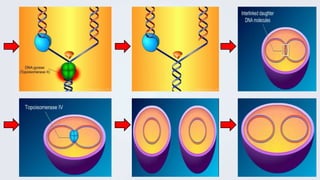
Quinolones target bacterial DNA gyrase & topoisomerase IV.
 Gram negative bacteria - DNA Gyrase
 Gram positive bacteria - Topoisomerase IV
 Double helical DNA
 Two strands must separate to permit DNA replication / transcription
 “over winding” / excessive positive supercoiling of DNA in front of point of
separation.
 Inhibit protein synthesis.
 DNA Gyrase - introduces negative supercoils into DNA (checks mechanical
hindrance).
 DNA Gyrase has (A & B subunit).
 A subunit - strand cutting function of DNA gyrase.
 A subunit reseals the strand.
Quinolones
- Bind to A - subunit with high affinity & interfere with strand cutting &
resealing function.
- Prevent replication of bacterial DNA during bacterial growth & reproduction.
- finally bacterial cell death occurs .
Co
ntd
.
Mechanism of resistance-
PHARMACOKINETICS
 Rapid oral absorption.
 High tissue penetrability.
 CSF & aqueous levels are low
 Excreted in urine.
 Urinary & biliary concentrations are 10-50 fold higher than in plasma.
 Excreted in urine.
 Metabolized by liver should not be used in hepatic failure, except Pefloxacin &
moxifloxacin.
Adverse effects
 Hypersenstivity; rashes including photosensitivity.
 Tendonitis & tendon rupture.
 Generally safe
 Nausea, vomiting, abdominal discomfort, bad taste
 CNS:
 headache, dizziness, rarely hallucinations, delirium.
 & seizures have occurred predominantly in patients receiving theophylline or NSAIDs.
 .QTc prolongation.
 Sparfloxacin.
 Gatifloxacin.
 Moxifloxacin.
 Cautious use in patients who are taking drugs that are known to prolong the QT interval .
 tricyclic antidepressants .
 Phenothiazine.
 class I anti-arrhythmics
INTERACTION
- NSAIDs may enhance CNS toxicity of FQ’s
Seizures reported.
Antacids, Sucralfate, Iron salts reduce absorption of FQ,s
THERAPEUTIC USE
1. Urinary tract infection
2. Gonorrhea
3. Typhoid
4. Bone, soft tissues and wound infections.
5. Respiratory infections
6. Tuberculosis
 Ceftriaxone
 Most reliable
 Fastest acting bactericidal drug for enteric fever.
 i.v 4g daily 2 days.
 2g daily till 2 days after fever subsides.
 Bone, joint, soft tissue & wound infections.
 Skin & soft tissue infections.
 joint infections
Antimicrobial agents

Antimicrobial agents

  • 1.
    Presented By- MdShariq Ansari B.Pharm, Final year Roll No- 1455250020
  • 2.
     ANTIMICROBIAL: Theseare the agents that kills the microorganisms or inhibits their growth. Antimicrobial can be grouped according to the (i) Microorganisms- i.e. Antibiotics against Bacteria, Antifungal against Fungi. (ii) Function- Microbicidal, Microbiostatics. ANTIBIOTICS: These are the substance produced by microorganisms, which selectively suppress the growth or kill the microorganisms at very low concentration. SOURCE OF ANTIBIOTICS: FUNGI BACTERIA ACTINOMYCETES Penicillin's (penicillium notatum) Polymyxin B Aminoglycosides Cephalosporin's (cephalosporium) Tyrothricin Chloramphenicol Griseofulvin (penicillium gresiofuloum) Bacitracin Erythromycin Cholistin Tetracycline
  • 3.
    QUINOLONES INTRODUCTION:  Synthetic antimicrobialcompounds having quinolone structure (active moiety).  Bactericidal, broad spectrum antibiotics.  Primarily active against gram-negative bacteria.  Most widely used because of their relative safety, their availability in both orally and parenterally and their favorable pharmacokinetics. HISTORY:  The first member Nalidixic Acid was introduced in mid-1960s has usefulness limited to UTI and G.I.Tract infections because of low potency and high frequency of bacterial resistance.
  • 4.
     In 1980sby fluorination of the quinolone structure at position no 6 & piperazine substitution at position 7 resulted in derivatives called fluoroquinolones. CHEMISTRY:
  • 5.
    NALIDIXIC ACID (1) Itis active against gram negative bacteria especially coliforms:- E.coli Proteus Kleibseilla Enterobacter Shigella Psuedomonas ( Except) (2) It acts by inhibiting bacterial DNA gyrase PHARMACOKINETICS: - Orally absorbed, high plasma protein binding and partly metabolized in liver. - t½ is about 8 hrs. - Therapeutic concentrations attained in urine & gut lumen are lethal to common urinary pathogens & diarrhoea causing coliforms. Bactericidal antibiotic
  • 6.
    ADVERSE EFFECTS: - G.I.disturbance and rashes mostly occurs. - Headache, vertigo, visual disturbance are the most common adverse effects. CONTRAINDICATIONS: - It is contraindicated in infants. USES: - It is primarily used as an Urinary antiseptic. - Nitrofurantoin should not be given concurrently – Antagonism occurs. - In the treatment of Diarrhoea caused by coliforms. Norfloxacin /ciprofloxacin preferred.
  • 7.
    FLUOROQUINOLONES INTRODUCTION:  These arequinolone antimicrobials having one or more fluorine substitutions.  Fluorination of quinolone structure at position 6 & piperazine substitution at position 7 resulted in derivatives called fluoroquinolones.  High potency.  Broad spectrum antimicrobial activity.  Slow development of resistance.  Better tissue penetration .  Good tolerability.  Used for wide variety of infectious diseases
  • 8.
    HISTORY: - The firstgeneration fluoroquinolones was introduced in 1980s, have one fluoro substitution. - In 1990s, compounds with additional fluoro group and other substitution have been developed- further exceeding antimicrobial activity to gram-positive cocci and anaerobes. CLASSIFICATION: First generation Second generation Levofloxacin Lomefloxacin Moxifloxacin Sparfloxacin Gemifloxacin Prulifloxacin Norfloxacin Ciprofloxacin Ofloxacin Pefloxacin
  • 9.
    MECHANISM OFACTION Quinolones targetbacterial DNA gyrase & topoisomerase IV.  Gram negative bacteria - DNA Gyrase  Gram positive bacteria - Topoisomerase IV  Double helical DNA  Two strands must separate to permit DNA replication / transcription  “over winding” / excessive positive supercoiling of DNA in front of point of separation.  Inhibit protein synthesis.  DNA Gyrase - introduces negative supercoils into DNA (checks mechanical hindrance).  DNA Gyrase has (A & B subunit).  A subunit - strand cutting function of DNA gyrase.  A subunit reseals the strand.
  • 10.
    Quinolones - Bind toA - subunit with high affinity & interfere with strand cutting & resealing function. - Prevent replication of bacterial DNA during bacterial growth & reproduction. - finally bacterial cell death occurs .
  • 13.
  • 14.
    PHARMACOKINETICS  Rapid oralabsorption.  High tissue penetrability.  CSF & aqueous levels are low  Excreted in urine.  Urinary & biliary concentrations are 10-50 fold higher than in plasma.  Excreted in urine.  Metabolized by liver should not be used in hepatic failure, except Pefloxacin & moxifloxacin.
  • 15.
    Adverse effects  Hypersenstivity;rashes including photosensitivity.  Tendonitis & tendon rupture.  Generally safe  Nausea, vomiting, abdominal discomfort, bad taste  CNS:  headache, dizziness, rarely hallucinations, delirium.  & seizures have occurred predominantly in patients receiving theophylline or NSAIDs.  .QTc prolongation.  Sparfloxacin.  Gatifloxacin.  Moxifloxacin.  Cautious use in patients who are taking drugs that are known to prolong the QT interval .  tricyclic antidepressants .  Phenothiazine.  class I anti-arrhythmics
  • 16.
    INTERACTION - NSAIDs mayenhance CNS toxicity of FQ’s Seizures reported. Antacids, Sucralfate, Iron salts reduce absorption of FQ,s THERAPEUTIC USE 1. Urinary tract infection 2. Gonorrhea 3. Typhoid 4. Bone, soft tissues and wound infections. 5. Respiratory infections 6. Tuberculosis
  • 17.
     Ceftriaxone  Mostreliable  Fastest acting bactericidal drug for enteric fever.  i.v 4g daily 2 days.  2g daily till 2 days after fever subsides.  Bone, joint, soft tissue & wound infections.  Skin & soft tissue infections.  joint infections