Dr. Resu Neha Reddy
Post Graduate
Dept of Pharmacology
Osmania Medical College
Angiotensin, Kinins, Leukotrienes,
Prostaglandins & Cytokines
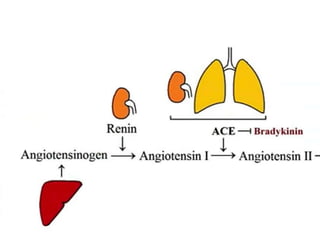
Renin
 Synthesised  Prorenin
 Prorenin and renin stored  Juxtaglomerular cells
of kidney
 3 mechanisms :
 Decrease renal perfusion  reduced tension in
vessel wall
 Decrease Na+ conc.  distal tubule
 Beta 1 adrenoceptors ++
 PGI2 ++
 Half-life – 15 min
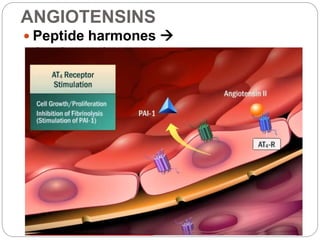
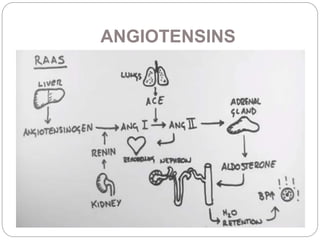
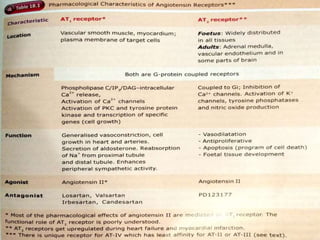
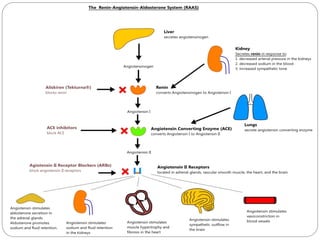
ANGIOTENSINS
 Peptide harmones 
Angiotensinogen
ANGIOTENSINS
KININS
 Vasoactive polypeptide released from alpha 2 globulin
fraction of plasma  Kininogen  by the action of
specific enzymes Kallikreins
 Potent vasodilator peptides
 3 kinins  Bradykinin  nanopeptide
Kallidin  decapeptide
Met-Lys-bradykinin  undecapeptide
KININS
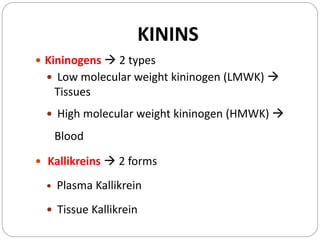
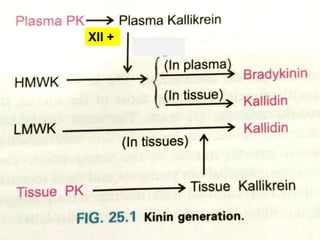
 Kininogens  2 types
 Low molecular weight kininogen (LMWK) 
Tissues
 High molecular weight kininogen (HMWK) 
Blood
 Kallikreins  2 forms
 Plasma Kallikrein
 Tissue Kallikrein
XII +
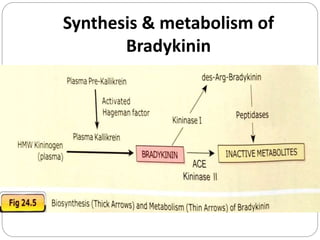
Synthesis & metabolism of
Bradykinin
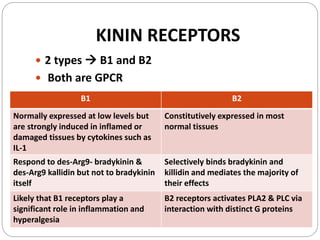
KININ RECEPTORS
 2 types  B1 and B2
 Both are GPCR
B1 B2
Normally expressed at low levels but
are strongly induced in inflamed or
damaged tissues by cytokines such as
IL-1
Constitutively expressed in most
normal tissues
Respond to des-Arg9- bradykinin &
des-Arg9 kallidin but not to bradykinin
itself
Selectively binds bradykinin and
killidin and mediates the majority of
their effects
Likely that B1 receptors play a
significant role in inflammation and
hyperalgesia
B2 receptors activates PLA2 & PLC via
interaction with distinct G proteins
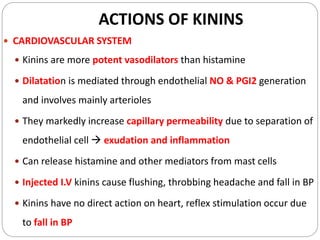
ACTIONS OF KININS
 CARDIOVASCULAR SYSTEM
 Kinins are more potent vasodilators than histamine
 Dilatation is mediated through endothelial NO & PGI2 generation
and involves mainly arterioles
 They markedly increase capillary permeability due to separation of
endothelial cell  exudation and inflammation
 Can release histamine and other mediators from mast cells
 Injected I.V kinins cause flushing, throbbing headache and fall in BP
 Kinins have no direct action on heart, reflex stimulation occur due
to fall in BP
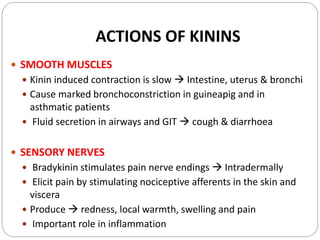
ACTIONS OF KININS
 SMOOTH MUSCLES
 Kinin induced contraction is slow  Intestine, uterus & bronchi
 Cause marked bronchoconstriction in guineapig and in
asthmatic patients
 Fluid secretion in airways and GIT  cough & diarrhoea
 SENSORY NERVES
 Bradykinin stimulates pain nerve endings  Intradermally
 Elicit pain by stimulating nociceptive afferents in the skin and
viscera
 Produce  redness, local warmth, swelling and pain
 Important role in inflammation
Physiological role of Bradykinin
 Maintenance of BP
 Mediation of inflammation & pain
 Production of hyperaemia in various glands
 Tissue growth & repair
 Sperm motility
What are the features of
inflammation… ?
 Heat/fever
 Swelling
 Pain
 Redness
 Loss of function
 IN ONE WAY, fever and pain are beneficial ….. HOW ?
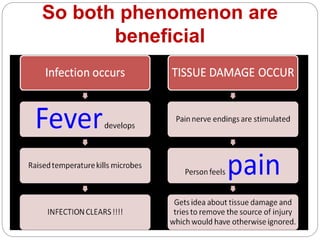
So both phenomenon are
beneficial
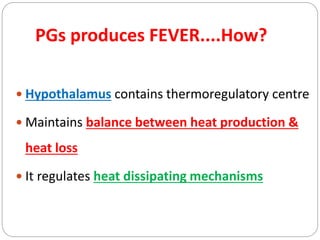
PGs produces FEVER....How?
 Hypothalamus contains thermoregulatory centre
 Maintains balance between heat production &
heat loss
 It regulates heat dissipating mechanisms
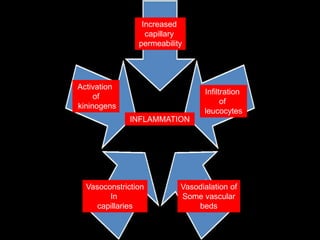
Increased
capillary
permeability
Infiltration
of
leucocytes
Vasodialation of
Some vascular
beds
Vasoconstriction
In
capillaries
Activation
of
kininogens
INFLAMMATION
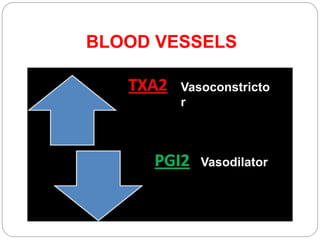
BLOOD VESSELS
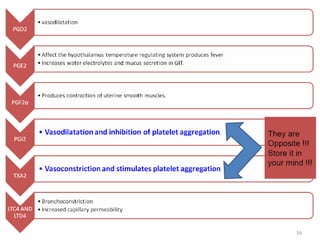
Vasoconstricto
r
Vasodilator
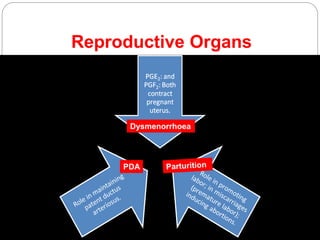
Reproductive Organs
Dysmenorrhoea
PDA
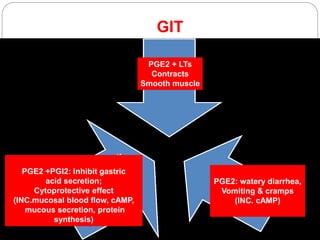
PGE2 + LTs
Contracts
Smooth muscle
PGE2: watery diarrhea,
Vomiting & cramps
(INC. cAMP)
PGE2 +PGI2: Inhibit gastric
acid secretion;
Cytoprotective effect
(INC.mucosal blood flow, cAMP,
mucous secretion, protein
synthesis)
GIT
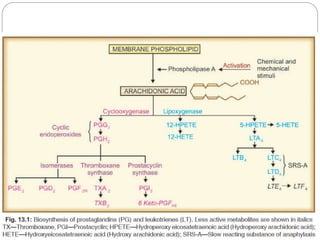
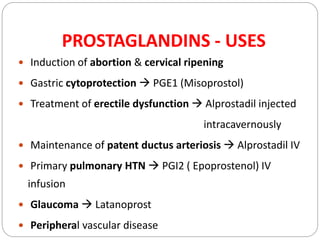
PROSTAGLANDINS - USES
 Induction of abortion & cervical ripening
 Gastric cytoprotection  PGE1 (Misoprostol)
 Treatment of erectile dysfunction  Alprostadil injected
intracavernously
 Maintenance of patent ductus arteriosis  Alprostadil IV
 Primary pulmonary HTN  PGI2 ( Epoprostenol) IV
infusion
 Glaucoma  Latanoprost
 Peripheral vascular disease
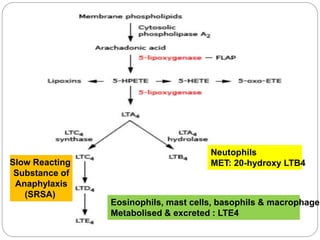
Neutophils
MET: 20-hydroxy LTB4
Eosinophils, mast cells, basophils & macrophages
Metabolised & excreted : LTE4
Slow Reacting
Substance of
Anaphylaxis
(SRSA)
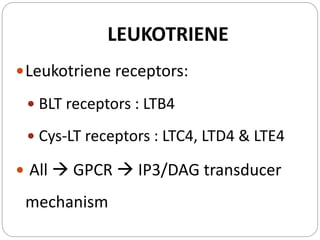
LEUKOTRIENE
Leukotriene receptors:
 BLT receptors : LTB4
 Cys-LT receptors : LTC4, LTD4 & LTE4
 All  GPCR  IP3/DAG transducer
mechanism
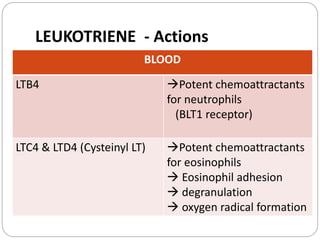
LEUKOTRIENE - Actions
BLOOD
LTB4 Potent chemoattractants
for neutrophils
(BLT1 receptor)
LTC4 & LTD4 (Cysteinyl LT) Potent chemoattractants
for eosinophils
 Eosinophil adhesion
 degranulation
 oxygen radical formation
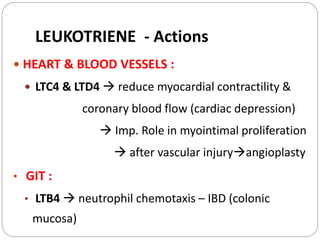
 HEART & BLOOD VESSELS :
 LTC4 & LTD4  reduce myocardial contractility &
coronary blood flow (cardiac depression)
 Imp. Role in myointimal proliferation
 after vascular injuryangioplasty
• GIT :
• LTB4  neutrophil chemotaxis – IBD (colonic
mucosa)
LEUKOTRIENE - Actions
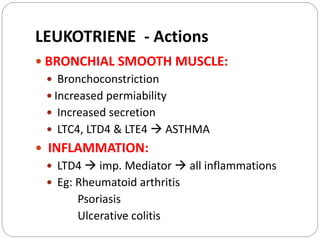
 BRONCHIAL SMOOTH MUSCLE:
 Bronchoconstriction
 Increased permiability
 Increased secretion
 LTC4, LTD4 & LTE4  ASTHMA
 INFLAMMATION:
 LTD4  imp. Mediator  all inflammations
 Eg: Rheumatoid arthritis
Psoriasis
Ulcerative colitis
LEUKOTRIENE - Actions
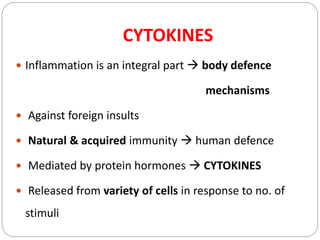
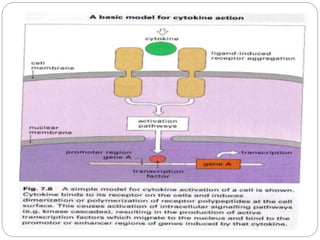
CYTOKINES
 Inflammation is an integral part  body defence
mechanisms
 Against foreign insults
 Natural & acquired immunity  human defence
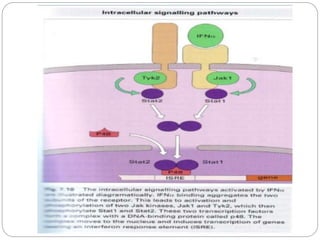
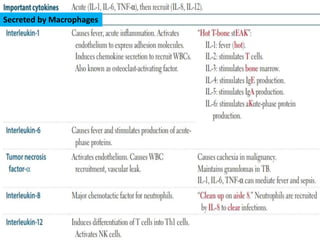
 Mediated by protein hormones  CYTOKINES
 Released from variety of cells in response to no. of
stimuli
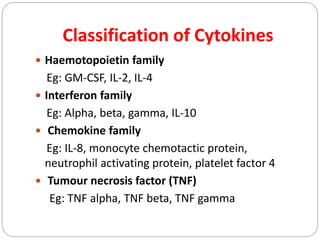
Classification of Cytokines
 Haemotopoietin family
Eg: GM-CSF, IL-2, IL-4
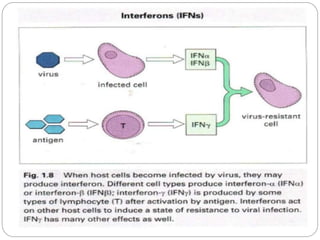
 Interferon family
Eg: Alpha, beta, gamma, IL-10
 Chemokine family
Eg: IL-8, monocyte chemotactic protein,
neutrophil activating protein, platelet factor 4
 Tumour necrosis factor (TNF)
Eg: TNF alpha, TNF beta, TNF gamma
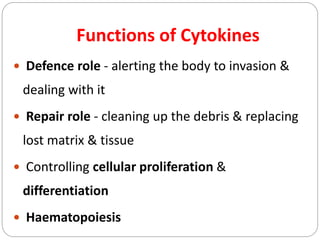
 Defence role - alerting the body to invasion &
dealing with it
 Repair role - cleaning up the debris & replacing
lost matrix & tissue
 Controlling cellular proliferation &
differentiation
 Haematopoiesis
Functions of Cytokines
Secreted by Macrophages
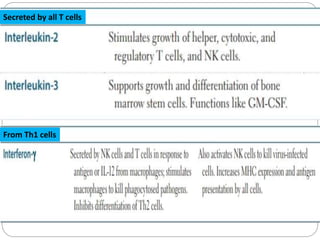
From Th1 cells
Secreted by all T cells
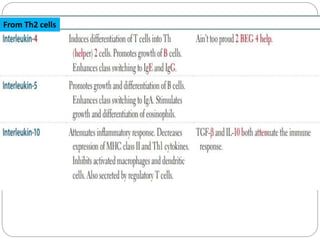
From Th2 cells
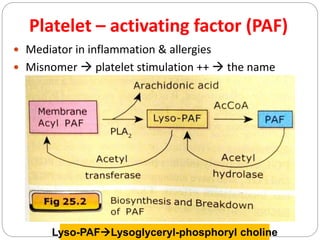
Platelet – activating factor (PAF)
 Mediator in inflammation & allergies
 Misnomer  platelet stimulation ++  the name
Lyso-PAFLysoglyceryl-phosphoryl choline
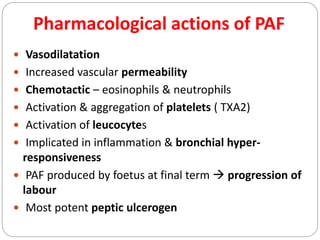
Pharmacological actions of PAF
 Vasodilatation
 Increased vascular permeability
 Chemotactic – eosinophils & neutrophils
 Activation & aggregation of platelets ( TXA2)
 Activation of leucocytes
 Implicated in inflammation & bronchial hyper-
responsiveness
 PAF produced by foetus at final term  progression of
labour
 Most potent peptic ulcerogen
THANK YOU....