1
ANTIMALARIAL DRUG
BY
KUBER BAJGAIN
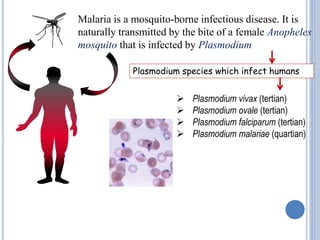
 Plasmodium vivax (tertian)
 Plasmodium ovale (tertian)
 Plasmodium falciparum (tertian)
 Plasmodium malariae (quartian)
Plasmodium species which infect humans
Malaria is a mosquito-borne infectious disease. It is
naturally transmitted by the bite of a female Anopheles
mosquito that is infected by Plasmodium
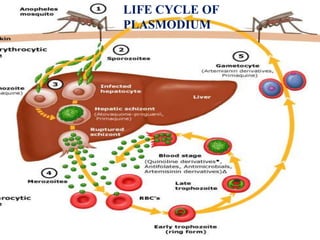
LIFE CYCLE OF
PLASMODIUM
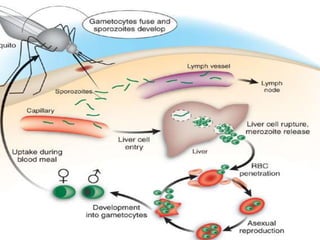
3
4
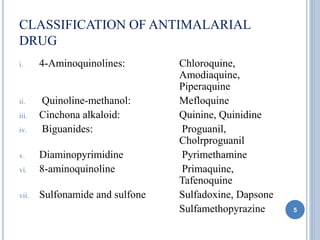
CLASSIFICATION OF ANTIMALARIAL
DRUG
i. 4-Aminoquinolines: Chloroquine,
Amodiaquine,
Piperaquine
ii. Quinoline-methanol: Mefloquine
iii. Cinchona alkaloid: Quinine, Quinidine
iv. Biguanides: Proguanil,
Cholrproguanil
v. Diaminopyrimidine Pyrimethamine
vi. 8-aminoquinoline Primaquine,
Tafenoquine
vii. Sulfonamide and sulfone Sulfadoxine, Dapsone
Sulfamethopyrazine 5
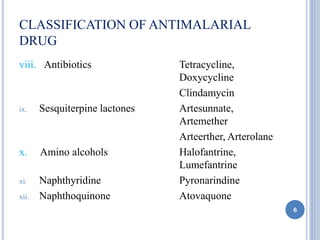
CLASSIFICATION OF ANTIMALARIAL
DRUG
viii. Antibiotics Tetracycline,
Doxycycline
Clindamycin
ix. Sesquiterpine lactones Artesunnate,
Artemether
Arteerther, Arterolane
x. Amino alcohols Halofantrine,
Lumefantrine
xi. Naphthyridine Pyronarindine
xii. Naphthoquinone Atovaquone
6
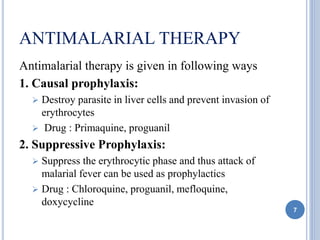
ANTIMALARIAL THERAPY
Antimalarial therapy is given in following ways
1. Causal prophylaxis:
 Destroy parasite in liver cells and prevent invasion of
erythrocytes
 Drug : Primaquine, proguanil
2. Suppressive Prophylaxis:
 Suppress the erythrocytic phase and thus attack of
malarial fever can be used as prophylactics
 Drug : Chloroquine, proguanil, mefloquine,
doxycycline
7
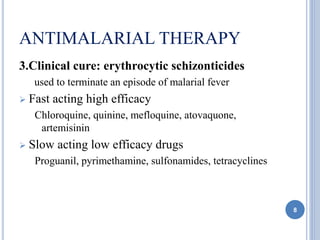
ANTIMALARIAL THERAPY
3.Clinical cure: erythrocytic schizonticides
used to terminate an episode of malarial fever
 Fast acting high efficacy
Chloroquine, quinine, mefloquine, atovaquone,
artemisinin
 Slow acting low efficacy drugs
Proguanil, pyrimethamine, sulfonamides, tetracyclines
8
ANTIMALARIAL THERAPY
4. Radical curatives:
Eradicate all forms of P.vivax & P.ovale from the body
Supressive drugs + hypnozoitocidal drugs
For vivax: primaquine 15 mg daily for 14 days
5. Gametocidal:
 Destroy gametocytes and prevent transmission
 Drugs :Primaquine, artemisinin – against all plasmodia
Chloroquine, quinine – P Vivax
Proguanil ,pyrimethamine – prevent development of
sporozoites
9
CHLOROQUINE
 Synthesized by Germans in 1934 ( resochin)
 d & l isomers, d isomer is less toxic
 Cl at position 7 confers maximal antimalarial
efficacy
 Rapidly acting erythrocytic schizontocide
against all species of plasmodia
10
CHLOROQUINE
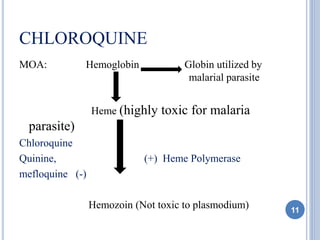
MOA: Hemoglobin Globin utilized by
malarial parasite
Heme (highly toxic for malaria
parasite)
Chloroquine
Quinine, (+) Heme Polymerase
mefloquine (-)
Hemozoin (Not toxic to plasmodium) 11
CHLOROQUINE
Pharmacological actions:
1. Antimalarial activity:
 High against erythrocytic forms of P. vivax, P. ovale, P.
malariae & sensitive strains of P. falciparum
 Gametocytes of P. vivax, P. malariae, P. ovale
 No activity against tissue schizonts
2. Other parasitic infections:
 Giardiasis, taeniasis, hepatic amoebiasis
12
CHLOROQUINE
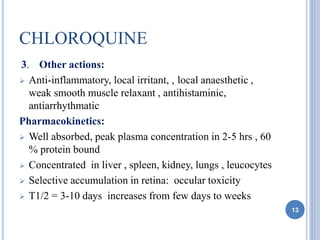
3. Other actions:
 Anti-inflammatory, local irritant, , local anaesthetic ,
weak smooth muscle relaxant , antihistaminic,
antiarrhythmatic
Pharmacokinetics:
 Well absorbed, peak plasma concentration in 2-5 hrs , 60
% protein bound
 Concentrated in liver , spleen, kidney, lungs , leucocytes
 Selective accumulation in retina: occular toxicity
 T1/2 = 3-10 days increases from few days to weeks
13
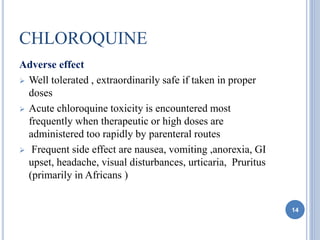
CHLOROQUINE
Adverse effect
 Well tolerated , extraordinarily safe if taken in proper
doses
 Acute chloroquine toxicity is encountered most
frequently when therapeutic or high doses are
administered too rapidly by parenteral routes
 Frequent side effect are nausea, vomiting ,anorexia, GI
upset, headache, visual disturbances, urticaria, Pruritus
(primarily in Africans )
14
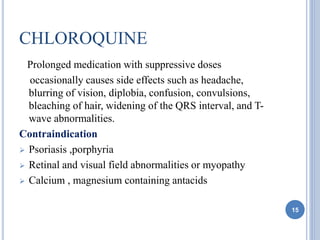
CHLOROQUINE
Prolonged medication with suppressive doses
occasionally causes side effects such as headache,
blurring of vision, diplobia, confusion, convulsions,
bleaching of hair, widening of the QRS interval, and T-
wave abnormalities.
Contraindication
 Psoriasis ,porphyria
 Retinal and visual field abnormalities or myopathy
 Calcium , magnesium containing antacids
15
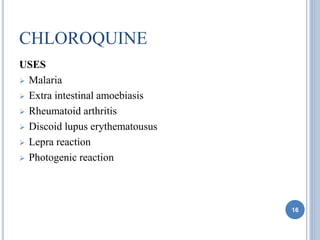
CHLOROQUINE
USES
 Malaria
 Extra intestinal amoebiasis
 Rheumatoid arthritis
 Discoid lupus erythematousus
 Lepra reaction
 Photogenic reaction
16
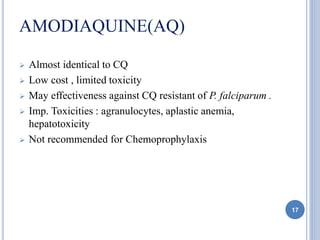
AMODIAQUINE(AQ)
 Almost identical to CQ
 Low cost , limited toxicity
 May effectiveness against CQ resistant of P. falciparum .
 Imp. Toxicities : agranulocytes, aplastic anemia,
hepatotoxicity
 Not recommended for Chemoprophylaxis
17
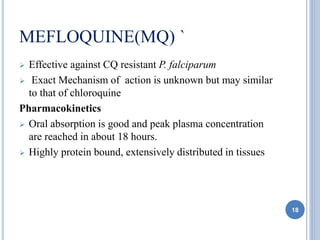
MEFLOQUINE(MQ) `
 Effective against CQ resistant P. falciparum
 Exact Mechanism of action is unknown but may similar
to that of chloroquine
Pharmacokinetics
 Oral absorption is good and peak plasma concentration
are reached in about 18 hours.
 Highly protein bound, extensively distributed in tissues
18
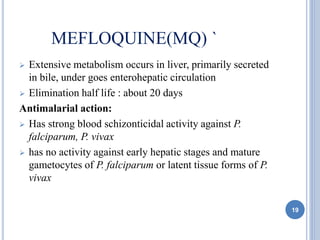
MEFLOQUINE(MQ) `
 Extensive metabolism occurs in liver, primarily secreted
in bile, under goes enterohepatic circulation
 Elimination half life : about 20 days
Antimalarial action:
 Has strong blood schizonticidal activity against P.
falciparum, P. vivax
 has no activity against early hepatic stages and mature
gametocytes of P. falciparum or latent tissue forms of P.
vivax
19
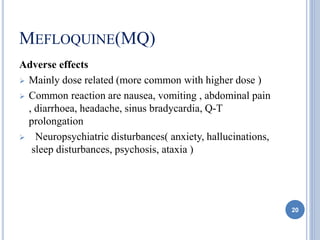
MEFLOQUINE(MQ)
Adverse effects
 Mainly dose related (more common with higher dose )
 Common reaction are nausea, vomiting , abdominal pain
, diarrhoea, headache, sinus bradycardia, Q-T
prolongation
 Neuropsychiatric disturbances( anxiety, hallucinations,
sleep disturbances, psychosis, ataxia )
20
MEFLOQUINE(MQ)
Uses
 Effective against DR P. falciparum and P. vivax
 As prophylactic
Contraindication and cautions
 Contraindicated if there is history of epilepsy ,
psychiatric disorder, arrhythmias .
 Should not co administered with quinine/quinidine,
halofantrine
21
QUININE
 Derived from bark of Cinchona tree.
 Moa is similar to chloroquine
 Erythrocytic schizontocide for all species
22
QUININE
PHARMACOLOGICAL ACTIONS
1. Antimalarial action :
 acts primarily against asexual erythrocytic forms
 The alkaloid also is gametocidal for P. vivax and P.
malariae but not for P. falciparum.
 Quinine is more toxic and less effective than
chloroquine against malarial parasites susceptible to
both drugs.
23
QUININE
2. Local irritant
 Intensely bitter and irritant . Orally it causes nausea,
vomiting, epigastric discomfort
 Injections can cause pain and local necrosis in the
muscle and thrombosis in vein.
3. Cardiovascular:
 depresses myocardium, ↓ excitability, ↓
conductivity, ↑ refractory period, profound
hypotension IV.
4. Miscellaneous actions:
 Mild analgesic, antipyretic activity , stimulation of
uterine smooth muscle, curare mimitic effect
24
QUININE
Pharmacokinetics
 Administered orally , completely absorbed
 PPB: 70% ( mainly binds to alpha acid glycoprotein)
 Peak plasma level reaches in 1-3 hours
 Metabolized in liver degradation products excreted in
urine
 t ½ = 10-12 hrs
25
QUININE
Adverse drug effect
1.Cinchonism:
 Ringing in ears , nausea & vomiting
 Headache mental confusion, vertigo, difficulty in
hearing & visual disturbances
 Diarrhoea , flushing & marked perspiration
 Still higher doses , exaggerated symptoms with
delirium , fever, tachypnoea, respiratory depression ,
cyanosis.
26
QUININE
2. Idiosyncrasy/hypersensitivity
3. Cardiovascular toxicity: cardiac arrest, hypotension
,fatal arrhythmias
 “Blackwater fever”~the triad of massive hemolysis,
hemoglobinemia, and hemoglobinuria leading to anuria,
renal failure, and even death¾is a rare type of
hypersensitivity reaction to quinine therapy .
27
QUININE
USES
1. Malaria:
 uncomplicated resistant falciparum malaria
 Complicated and severe malaria including cerebral
malarial
2. Treatment of Nocturnal Leg Cramps
28
PROGUANIL
 proguanil in body is cyclized to cycloguanil, a cyclic
triazine metabolite
 In sensitive P. falciparum malaria, it exerts activity
against both the primary liver stages and erythrocytic
stage.
 Also active against erythrocytic stage of P. vivax.
 Half life : 16 hrs
29
PROGUANIL
MOA
proguanil selectively inhibits the bifunctional
dihydrofolate reductase-thymidylate synthetase of
sensitive plasmodia, causing inhibition of DNA synthesis
and depletion of folate cofactors
Toxicity and side effect
 In prophylactic doses occasional nausea and diarrhea
30
PROGUANIL
 High dose may cause vomiting, abdominal pain,
diarrhea, hematouria, and the transient
appearance of epithelial cells and casts in the
urine
USES
 For causal prophylaxis
MALARONE- proguanil +atovaquone, used for
multi drug resistance malaria.
31
PYRIMETHAMINE
 Diaminopyrimidine more potent than proguanil &
effective against erythrocytic forms of all species.
 Tasteless so suitable for children
 Longer half life than cycloguanil (t1/2: 4 days)
 Used only in combination with sulfonamide or dapsone
 Adverse events: relatively safe
 megaloblastic anemia, thrombocytopenia,
agranulocytosis( may occur with higher doses)
32
SULFADOXINE-
PYRIMETHAMINE(S/P)
 Form supra-additive synergistic combination with
pyrimethamine sequential block
 Not recommended for prophylaxis
Use:
 single dose treatment of uncomplicated chloroquine
resistant falciparum malaria
 patients intolerant to chloroquine
 First line therapy for treatment of toxoplasmosis
33
PRIMAQUINE
 Inactive against asexual blood stages parasites
 Drug of choice for the eradication of dormant liver forms
of P. vivax and P. ovale
 exert a marked gametocidal effect against all four species
of plasmodia that infect humans
 Plasma half life : 6-8 hrs
 Excreted in urine
34
PRIMAQUINE
MOA:
 Has not been elucidated
 May converted into electrophilic intermediates that act as
oxidation-reduction mediators . This could contribute to
antimalarial effect by generative reactive oxygen species
or by interfering with mitochondrial electron transport in
the parasite
Toxicity and Side Effects
 Nausea, vomiting, epigastric distress(can be minimized
by taking with food)
 Methaemoglobinemia 35
PRIMAQUINE
Therapeutic or higher doses of primaquine may cause acute
hemolysis and hemolytic anemia in humans with G6PD
deficiency
USES
 Radical cure of acute vivax and ovale infection
 Terminal prophylaxis of vivax and ovale infection
 Chemoprophylaxis of malaria
 Gametocidal action
 Pneumocystis jiroveci infection
36
ARTEMISININ AND DERIVATIVE
 It is a Sesquiterpine lactone extracted from Artemisia sp.
 More rapid parasite clearance and fever resolution than
any other currently licensed Antimalarial drug.
 Suited for severe treatment of severe malarial infection
caused by P. falciparum
 Important Derivatives are Artesunate
Artemether
Dihydroartemisinin
37
ARTEMISININ AND DERIVATIVE
 MOA:
 Contentious
 heme iron within the parasite catalyzes cleavage
of the endoperoxide bridge. This releases highly
active carbon centered free radical species that
bind to membrane protein , causes lipid
peroxidation, damages endoplasmic reticulum
 Results lysis of the parasite
38
ARTEMISININ AND DERIVATIVE
Artesunate
 Sodium salt is water soluble and administered by oral,
i.m. or i.v. routes
 peak plasma > 60 min
Artemether
 Lipid soluble and administered by oral , im
 Peak plasma : 2-6 hrs
Both artesunate and artemether are converted extensively
to dihydroartemisinin,
39
ARTEMISININ AND DERIVATIVE
Adverse effect
 Very few adverse effect: most are mild
 Nausea, vomiting, abdominal pain, itching, drug
fever, dizziness,
 Safe in pregnancy
Uses
 Uncomplicated falciparum malaria
 Severe and complicated falciparum malaria
40
ATOVAQUONE(MEPRON)
 hydroxynapthoquinone
 Rapidly acting erythrocytic schizonticide for plasmodium
falciparum & other plasmodia
MOA: Collapses mitochondrial membrane ; interferes ATP
production and pyrimidine biosynthesis
 Proguanil potentiates action of atovaquone and prevents
development of resistance
 Also used in Pneumocystis Jivoreci & Toxoplasma gondii
infections
 Contraindicated in pregnancy
41
42
43

Anti malarial drugs

  • 1.
  • 2.
     Plasmodium vivax(tertian)  Plasmodium ovale (tertian)  Plasmodium falciparum (tertian)  Plasmodium malariae (quartian) Plasmodium species which infect humans Malaria is a mosquito-borne infectious disease. It is naturally transmitted by the bite of a female Anopheles mosquito that is infected by Plasmodium
  • 3.
  • 4.
  • 5.
    CLASSIFICATION OF ANTIMALARIAL DRUG i.4-Aminoquinolines: Chloroquine, Amodiaquine, Piperaquine ii. Quinoline-methanol: Mefloquine iii. Cinchona alkaloid: Quinine, Quinidine iv. Biguanides: Proguanil, Cholrproguanil v. Diaminopyrimidine Pyrimethamine vi. 8-aminoquinoline Primaquine, Tafenoquine vii. Sulfonamide and sulfone Sulfadoxine, Dapsone Sulfamethopyrazine 5
  • 6.
    CLASSIFICATION OF ANTIMALARIAL DRUG viii.Antibiotics Tetracycline, Doxycycline Clindamycin ix. Sesquiterpine lactones Artesunnate, Artemether Arteerther, Arterolane x. Amino alcohols Halofantrine, Lumefantrine xi. Naphthyridine Pyronarindine xii. Naphthoquinone Atovaquone 6
  • 7.
    ANTIMALARIAL THERAPY Antimalarial therapyis given in following ways 1. Causal prophylaxis:  Destroy parasite in liver cells and prevent invasion of erythrocytes  Drug : Primaquine, proguanil 2. Suppressive Prophylaxis:  Suppress the erythrocytic phase and thus attack of malarial fever can be used as prophylactics  Drug : Chloroquine, proguanil, mefloquine, doxycycline 7
  • 8.
    ANTIMALARIAL THERAPY 3.Clinical cure:erythrocytic schizonticides used to terminate an episode of malarial fever  Fast acting high efficacy Chloroquine, quinine, mefloquine, atovaquone, artemisinin  Slow acting low efficacy drugs Proguanil, pyrimethamine, sulfonamides, tetracyclines 8
  • 9.
    ANTIMALARIAL THERAPY 4. Radicalcuratives: Eradicate all forms of P.vivax & P.ovale from the body Supressive drugs + hypnozoitocidal drugs For vivax: primaquine 15 mg daily for 14 days 5. Gametocidal:  Destroy gametocytes and prevent transmission  Drugs :Primaquine, artemisinin – against all plasmodia Chloroquine, quinine – P Vivax Proguanil ,pyrimethamine – prevent development of sporozoites 9
  • 10.
    CHLOROQUINE  Synthesized byGermans in 1934 ( resochin)  d & l isomers, d isomer is less toxic  Cl at position 7 confers maximal antimalarial efficacy  Rapidly acting erythrocytic schizontocide against all species of plasmodia 10
  • 11.
    CHLOROQUINE MOA: Hemoglobin Globinutilized by malarial parasite Heme (highly toxic for malaria parasite) Chloroquine Quinine, (+) Heme Polymerase mefloquine (-) Hemozoin (Not toxic to plasmodium) 11
  • 12.
    CHLOROQUINE Pharmacological actions: 1. Antimalarialactivity:  High against erythrocytic forms of P. vivax, P. ovale, P. malariae & sensitive strains of P. falciparum  Gametocytes of P. vivax, P. malariae, P. ovale  No activity against tissue schizonts 2. Other parasitic infections:  Giardiasis, taeniasis, hepatic amoebiasis 12
  • 13.
    CHLOROQUINE 3. Other actions: Anti-inflammatory, local irritant, , local anaesthetic , weak smooth muscle relaxant , antihistaminic, antiarrhythmatic Pharmacokinetics:  Well absorbed, peak plasma concentration in 2-5 hrs , 60 % protein bound  Concentrated in liver , spleen, kidney, lungs , leucocytes  Selective accumulation in retina: occular toxicity  T1/2 = 3-10 days increases from few days to weeks 13
  • 14.
    CHLOROQUINE Adverse effect  Welltolerated , extraordinarily safe if taken in proper doses  Acute chloroquine toxicity is encountered most frequently when therapeutic or high doses are administered too rapidly by parenteral routes  Frequent side effect are nausea, vomiting ,anorexia, GI upset, headache, visual disturbances, urticaria, Pruritus (primarily in Africans ) 14
  • 15.
    CHLOROQUINE Prolonged medication withsuppressive doses occasionally causes side effects such as headache, blurring of vision, diplobia, confusion, convulsions, bleaching of hair, widening of the QRS interval, and T- wave abnormalities. Contraindication  Psoriasis ,porphyria  Retinal and visual field abnormalities or myopathy  Calcium , magnesium containing antacids 15
  • 16.
    CHLOROQUINE USES  Malaria  Extraintestinal amoebiasis  Rheumatoid arthritis  Discoid lupus erythematousus  Lepra reaction  Photogenic reaction 16
  • 17.
    AMODIAQUINE(AQ)  Almost identicalto CQ  Low cost , limited toxicity  May effectiveness against CQ resistant of P. falciparum .  Imp. Toxicities : agranulocytes, aplastic anemia, hepatotoxicity  Not recommended for Chemoprophylaxis 17
  • 18.
    MEFLOQUINE(MQ) `  Effectiveagainst CQ resistant P. falciparum  Exact Mechanism of action is unknown but may similar to that of chloroquine Pharmacokinetics  Oral absorption is good and peak plasma concentration are reached in about 18 hours.  Highly protein bound, extensively distributed in tissues 18
  • 19.
    MEFLOQUINE(MQ) `  Extensivemetabolism occurs in liver, primarily secreted in bile, under goes enterohepatic circulation  Elimination half life : about 20 days Antimalarial action:  Has strong blood schizonticidal activity against P. falciparum, P. vivax  has no activity against early hepatic stages and mature gametocytes of P. falciparum or latent tissue forms of P. vivax 19
  • 20.
    MEFLOQUINE(MQ) Adverse effects  Mainlydose related (more common with higher dose )  Common reaction are nausea, vomiting , abdominal pain , diarrhoea, headache, sinus bradycardia, Q-T prolongation  Neuropsychiatric disturbances( anxiety, hallucinations, sleep disturbances, psychosis, ataxia ) 20
  • 21.
    MEFLOQUINE(MQ) Uses  Effective againstDR P. falciparum and P. vivax  As prophylactic Contraindication and cautions  Contraindicated if there is history of epilepsy , psychiatric disorder, arrhythmias .  Should not co administered with quinine/quinidine, halofantrine 21
  • 22.
    QUININE  Derived frombark of Cinchona tree.  Moa is similar to chloroquine  Erythrocytic schizontocide for all species 22
  • 23.
    QUININE PHARMACOLOGICAL ACTIONS 1. Antimalarialaction :  acts primarily against asexual erythrocytic forms  The alkaloid also is gametocidal for P. vivax and P. malariae but not for P. falciparum.  Quinine is more toxic and less effective than chloroquine against malarial parasites susceptible to both drugs. 23
  • 24.
    QUININE 2. Local irritant Intensely bitter and irritant . Orally it causes nausea, vomiting, epigastric discomfort  Injections can cause pain and local necrosis in the muscle and thrombosis in vein. 3. Cardiovascular:  depresses myocardium, ↓ excitability, ↓ conductivity, ↑ refractory period, profound hypotension IV. 4. Miscellaneous actions:  Mild analgesic, antipyretic activity , stimulation of uterine smooth muscle, curare mimitic effect 24
  • 25.
    QUININE Pharmacokinetics  Administered orally, completely absorbed  PPB: 70% ( mainly binds to alpha acid glycoprotein)  Peak plasma level reaches in 1-3 hours  Metabolized in liver degradation products excreted in urine  t ½ = 10-12 hrs 25
  • 26.
    QUININE Adverse drug effect 1.Cinchonism: Ringing in ears , nausea & vomiting  Headache mental confusion, vertigo, difficulty in hearing & visual disturbances  Diarrhoea , flushing & marked perspiration  Still higher doses , exaggerated symptoms with delirium , fever, tachypnoea, respiratory depression , cyanosis. 26
  • 27.
    QUININE 2. Idiosyncrasy/hypersensitivity 3. Cardiovasculartoxicity: cardiac arrest, hypotension ,fatal arrhythmias  “Blackwater fever”~the triad of massive hemolysis, hemoglobinemia, and hemoglobinuria leading to anuria, renal failure, and even death¾is a rare type of hypersensitivity reaction to quinine therapy . 27
  • 28.
    QUININE USES 1. Malaria:  uncomplicatedresistant falciparum malaria  Complicated and severe malaria including cerebral malarial 2. Treatment of Nocturnal Leg Cramps 28
  • 29.
    PROGUANIL  proguanil inbody is cyclized to cycloguanil, a cyclic triazine metabolite  In sensitive P. falciparum malaria, it exerts activity against both the primary liver stages and erythrocytic stage.  Also active against erythrocytic stage of P. vivax.  Half life : 16 hrs 29
  • 30.
    PROGUANIL MOA proguanil selectively inhibitsthe bifunctional dihydrofolate reductase-thymidylate synthetase of sensitive plasmodia, causing inhibition of DNA synthesis and depletion of folate cofactors Toxicity and side effect  In prophylactic doses occasional nausea and diarrhea 30
  • 31.
    PROGUANIL  High dosemay cause vomiting, abdominal pain, diarrhea, hematouria, and the transient appearance of epithelial cells and casts in the urine USES  For causal prophylaxis MALARONE- proguanil +atovaquone, used for multi drug resistance malaria. 31
  • 32.
    PYRIMETHAMINE  Diaminopyrimidine morepotent than proguanil & effective against erythrocytic forms of all species.  Tasteless so suitable for children  Longer half life than cycloguanil (t1/2: 4 days)  Used only in combination with sulfonamide or dapsone  Adverse events: relatively safe  megaloblastic anemia, thrombocytopenia, agranulocytosis( may occur with higher doses) 32
  • 33.
    SULFADOXINE- PYRIMETHAMINE(S/P)  Form supra-additivesynergistic combination with pyrimethamine sequential block  Not recommended for prophylaxis Use:  single dose treatment of uncomplicated chloroquine resistant falciparum malaria  patients intolerant to chloroquine  First line therapy for treatment of toxoplasmosis 33
  • 34.
    PRIMAQUINE  Inactive againstasexual blood stages parasites  Drug of choice for the eradication of dormant liver forms of P. vivax and P. ovale  exert a marked gametocidal effect against all four species of plasmodia that infect humans  Plasma half life : 6-8 hrs  Excreted in urine 34
  • 35.
    PRIMAQUINE MOA:  Has notbeen elucidated  May converted into electrophilic intermediates that act as oxidation-reduction mediators . This could contribute to antimalarial effect by generative reactive oxygen species or by interfering with mitochondrial electron transport in the parasite Toxicity and Side Effects  Nausea, vomiting, epigastric distress(can be minimized by taking with food)  Methaemoglobinemia 35
  • 36.
    PRIMAQUINE Therapeutic or higherdoses of primaquine may cause acute hemolysis and hemolytic anemia in humans with G6PD deficiency USES  Radical cure of acute vivax and ovale infection  Terminal prophylaxis of vivax and ovale infection  Chemoprophylaxis of malaria  Gametocidal action  Pneumocystis jiroveci infection 36
  • 37.
    ARTEMISININ AND DERIVATIVE It is a Sesquiterpine lactone extracted from Artemisia sp.  More rapid parasite clearance and fever resolution than any other currently licensed Antimalarial drug.  Suited for severe treatment of severe malarial infection caused by P. falciparum  Important Derivatives are Artesunate Artemether Dihydroartemisinin 37
  • 38.
    ARTEMISININ AND DERIVATIVE MOA:  Contentious  heme iron within the parasite catalyzes cleavage of the endoperoxide bridge. This releases highly active carbon centered free radical species that bind to membrane protein , causes lipid peroxidation, damages endoplasmic reticulum  Results lysis of the parasite 38
  • 39.
    ARTEMISININ AND DERIVATIVE Artesunate Sodium salt is water soluble and administered by oral, i.m. or i.v. routes  peak plasma > 60 min Artemether  Lipid soluble and administered by oral , im  Peak plasma : 2-6 hrs Both artesunate and artemether are converted extensively to dihydroartemisinin, 39
  • 40.
    ARTEMISININ AND DERIVATIVE Adverseeffect  Very few adverse effect: most are mild  Nausea, vomiting, abdominal pain, itching, drug fever, dizziness,  Safe in pregnancy Uses  Uncomplicated falciparum malaria  Severe and complicated falciparum malaria 40
  • 41.
    ATOVAQUONE(MEPRON)  hydroxynapthoquinone  Rapidlyacting erythrocytic schizonticide for plasmodium falciparum & other plasmodia MOA: Collapses mitochondrial membrane ; interferes ATP production and pyrimidine biosynthesis  Proguanil potentiates action of atovaquone and prevents development of resistance  Also used in Pneumocystis Jivoreci & Toxoplasma gondii infections  Contraindicated in pregnancy 41
  • 42.
  • 43.

Editor's Notes

  • #13 Ref : goodman
  • #16 Should be used with caution in patients with history of liver disease or neurologic or hematologic disorder