Leprosy
• Leprosy (Hansen’s Disease) is a chronic
granulomatous disease caused by the acid-fast
bacilli (AFB) Mycobacterium leprae &
Mycobacterium lepromatosis.
• The disease mainly affects the skin, mucus
membrane and the nerves.
• Leprosy is curable and treatment in the early
stages can prevent disability.
• The WHOs global elimination strategy is the
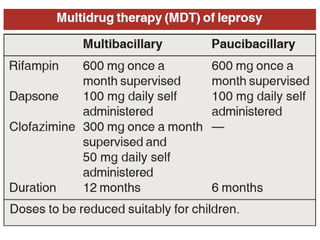
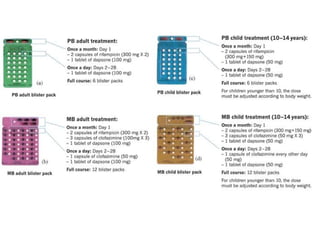
provision of effective multidrug therapy (MDT)
with Dapsone, Rifampicin and Clofazimine free
of cost to all the leprosy patients worldwide.
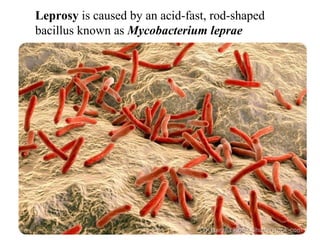
Leprosy is caused by an acid-fast, rod-shaped
bacillus known as Mycobacterium leprae
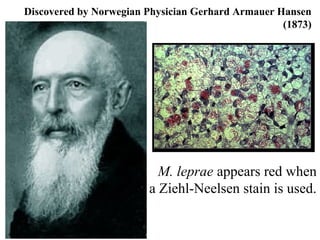
Discovered by Norwegian Physician Gerhard Armauer Hansen
(1873)
M. leprae appears red when
a Ziehl-Neelsen stain is used.
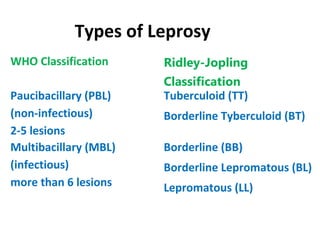
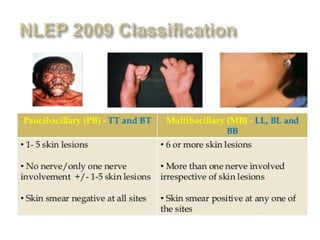
WHO Classification Ridley-Jopling
Classification
Paucibacillary (PBL)
(non-infectious)
2-5 lesions
Tuberculoid (TT)
Borderline Tyberculoid (BT)
Multibacillary (MBL)
(infectious)
more than 6 lesions
Borderline (BB)
Borderline Lepromatous (BL)
Lepromatous (LL)
Types of Leprosy
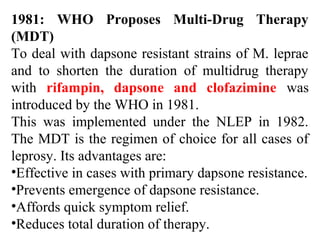
1981: WHO Proposes Multi-Drug Therapy
(MDT)
To deal with dapsone resistant strains of M. leprae
and to shorten the duration of multidrug therapy
with rifampin, dapsone and clofazimine was
introduced by the WHO in 1981.
This was implemented under the NLEP in 1982.
The MDT is the regimen of choice for all cases of
leprosy. Its advantages are:
•Effective in cases with primary dapsone resistance.
•Prevents emergence of dapsone resistance.
•Affords quick symptom relief.
•Reduces total duration of therapy.
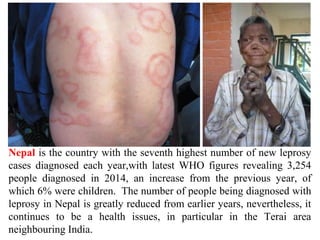
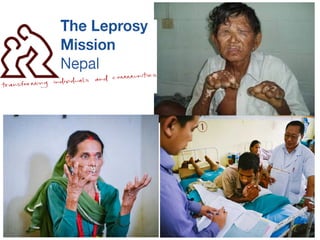
Nepal is the country with the seventh highest number of new leprosy
cases diagnosed each year,with latest WHO figures revealing 3,254
people diagnosed in 2014, an increase from the previous year, of
which 6% were children. The number of people being diagnosed with
leprosy in Nepal is greatly reduced from earlier years, nevertheless, it
continues to be a health issues, in particular in the Terai area
neighbouring India.
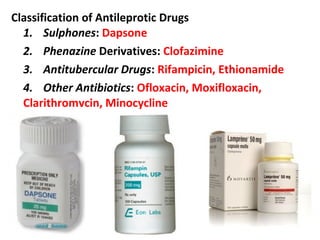
Classification of Antileprotic Drugs
1. Sulphones: Dapsone
2. Phenazine Derivatives: Clofazimine
3. Antitubercular Drugs: Rifampicin, Ethionamide
4. Other Antibiotics: Ofloxacin, Moxifloxacin,
Clarithromycin, Minocycline
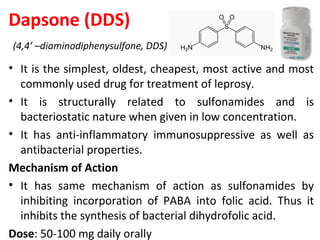
Dapsone (DDS)
(4,4’ –diaminodiphenysulfone, DDS)
• It is the simplest, oldest, cheapest, most active and most
commonly used drug for treatment of leprosy.
• It is structurally related to sulfonamides and is
bacteriostatic nature when given in low concentration.
• It has anti-inflammatory immunosuppressive as well as
antibacterial properties.
Mechanism of Action
• It has same mechanism of action as sulfonamides by
inhibiting incorporation of PABA into folic acid. Thus it
inhibits the synthesis of bacterial dihydrofolic acid.
Dose: 50-100 mg daily orally
Indication
• Leprosy: Dapsone in combination with other antileprotic drugs.
• Malaria: In chloroquin-resistant malaria, dapsone is used in
combination with pyrimethamine.
• Pheumocystis Pneumonia in AIDS: Dapsone can be used
effectively to treat the condition.
Contraindication and Precaution
• Contraindicated to patients with hypersensitivity
• severe anaemia (Hb <7 gm/dl)
• patients with G6PD deficiency and liver dysfunction.
Adverse Effects
• Sulfone syndrome, Hepatotoxicity
• Mild haemolytic anaemia
• Dose related toxicity, i.e. reflects oxidizing property of drug
• Gastric intolerance i.e. Nausea, Anorexia
• headache, praresthesia
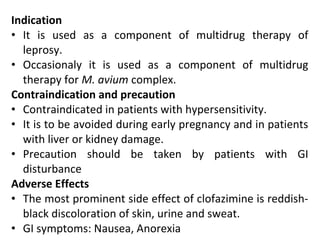
Clofazimine
• Clofazimine is a dye having antileprotic and anti-
inflammatory properties.
• Often used in combination with rifampicin
and dapsone as multidrug therapy (MDT) for the
treatment of leprosy.
Mechanism of Action
• Clofazimine works by interfering with DNA template
function and inhibiting bacterial proliferation.
• Dose: 50-100 mg/day orally
Indication
• It is used as a component of multidrug therapy of
leprosy.
• Occasionaly it is used as a component of multidrug
therapy for M. avium complex.
Contraindication and precaution
• Contraindicated in patients with hypersensitivity.
• It is to be avoided during early pregnancy and in patients
with liver or kidney damage.
• Precaution should be taken by patients with GI
disturbance
Adverse Effects
• The most prominent side effect of clofazimine is reddish-
black discoloration of skin, urine and sweat.
• GI symptoms: Nausea, Anorexia
• Alternative regimens: These are used only in case of
rifampin-resistance or when standard MDT regimen is
not possible.
• Cloflazimine 50 mg + any two of ofloxacin 400
mg/minocycline 100 mg/clarithromycin 500 mg daily for
6 month, followed by
• Clofazimine 50 mg + any one of ofloxacin 400 mg/
minocycline 100 mg daily for additional 18 months.
• Intermittent ROM:
• Rifampin 600 mg + ofloxacin 400 mg + minocycline 100
mg are given once a month for 3–6 month for PBL and
for 12 or 24 month for MBL cases, without any drug in
between.
• Four drug regimen of rifampin 600 mg + sparfloxacin 200
mg + clarithromycin 500 mg + minocycline 100 mg daily
for 12 weeks has yielded equivalent clinical improvement
in MBL cases to standard 12 month MDT.
• In case of refusal to accept clofazimine: ofloxacin 400 mg
or minocycline 100 mg daily can be substituted for it in
the standard MDT.
• Intermitent RMMx:
• Moxifloxacin 400 mg + minocycline 200 mg + rifampin
600 mg is administered once a month: 6 doses given for
PBL and 12 doses given for MBL cases have produced
rapid and marked clinical response
THANK YOU FOR YOUR ATTENTION!

Leprosy; Antileprotic drugs

  • 1.
    Leprosy • Leprosy (Hansen’sDisease) is a chronic granulomatous disease caused by the acid-fast bacilli (AFB) Mycobacterium leprae & Mycobacterium lepromatosis. • The disease mainly affects the skin, mucus membrane and the nerves. • Leprosy is curable and treatment in the early stages can prevent disability. • The WHOs global elimination strategy is the provision of effective multidrug therapy (MDT) with Dapsone, Rifampicin and Clofazimine free of cost to all the leprosy patients worldwide.
  • 2.
    Leprosy is causedby an acid-fast, rod-shaped bacillus known as Mycobacterium leprae
  • 3.
    Discovered by NorwegianPhysician Gerhard Armauer Hansen (1873) M. leprae appears red when a Ziehl-Neelsen stain is used.
  • 4.
    WHO Classification Ridley-Jopling Classification Paucibacillary(PBL) (non-infectious) 2-5 lesions Tuberculoid (TT) Borderline Tyberculoid (BT) Multibacillary (MBL) (infectious) more than 6 lesions Borderline (BB) Borderline Lepromatous (BL) Lepromatous (LL) Types of Leprosy
  • 6.
    1981: WHO ProposesMulti-Drug Therapy (MDT) To deal with dapsone resistant strains of M. leprae and to shorten the duration of multidrug therapy with rifampin, dapsone and clofazimine was introduced by the WHO in 1981. This was implemented under the NLEP in 1982. The MDT is the regimen of choice for all cases of leprosy. Its advantages are: •Effective in cases with primary dapsone resistance. •Prevents emergence of dapsone resistance. •Affords quick symptom relief. •Reduces total duration of therapy.
  • 9.
    Nepal is thecountry with the seventh highest number of new leprosy cases diagnosed each year,with latest WHO figures revealing 3,254 people diagnosed in 2014, an increase from the previous year, of which 6% were children. The number of people being diagnosed with leprosy in Nepal is greatly reduced from earlier years, nevertheless, it continues to be a health issues, in particular in the Terai area neighbouring India.
  • 11.
    Classification of AntileproticDrugs 1. Sulphones: Dapsone 2. Phenazine Derivatives: Clofazimine 3. Antitubercular Drugs: Rifampicin, Ethionamide 4. Other Antibiotics: Ofloxacin, Moxifloxacin, Clarithromycin, Minocycline
  • 12.
    Dapsone (DDS) (4,4’ –diaminodiphenysulfone,DDS) • It is the simplest, oldest, cheapest, most active and most commonly used drug for treatment of leprosy. • It is structurally related to sulfonamides and is bacteriostatic nature when given in low concentration. • It has anti-inflammatory immunosuppressive as well as antibacterial properties. Mechanism of Action • It has same mechanism of action as sulfonamides by inhibiting incorporation of PABA into folic acid. Thus it inhibits the synthesis of bacterial dihydrofolic acid. Dose: 50-100 mg daily orally
  • 13.
    Indication • Leprosy: Dapsonein combination with other antileprotic drugs. • Malaria: In chloroquin-resistant malaria, dapsone is used in combination with pyrimethamine. • Pheumocystis Pneumonia in AIDS: Dapsone can be used effectively to treat the condition. Contraindication and Precaution • Contraindicated to patients with hypersensitivity • severe anaemia (Hb <7 gm/dl) • patients with G6PD deficiency and liver dysfunction. Adverse Effects • Sulfone syndrome, Hepatotoxicity • Mild haemolytic anaemia • Dose related toxicity, i.e. reflects oxidizing property of drug • Gastric intolerance i.e. Nausea, Anorexia • headache, praresthesia
  • 14.
    Clofazimine • Clofazimine isa dye having antileprotic and anti- inflammatory properties. • Often used in combination with rifampicin and dapsone as multidrug therapy (MDT) for the treatment of leprosy. Mechanism of Action • Clofazimine works by interfering with DNA template function and inhibiting bacterial proliferation. • Dose: 50-100 mg/day orally
  • 15.
    Indication • It isused as a component of multidrug therapy of leprosy. • Occasionaly it is used as a component of multidrug therapy for M. avium complex. Contraindication and precaution • Contraindicated in patients with hypersensitivity. • It is to be avoided during early pregnancy and in patients with liver or kidney damage. • Precaution should be taken by patients with GI disturbance Adverse Effects • The most prominent side effect of clofazimine is reddish- black discoloration of skin, urine and sweat. • GI symptoms: Nausea, Anorexia
  • 16.
    • Alternative regimens:These are used only in case of rifampin-resistance or when standard MDT regimen is not possible. • Cloflazimine 50 mg + any two of ofloxacin 400 mg/minocycline 100 mg/clarithromycin 500 mg daily for 6 month, followed by • Clofazimine 50 mg + any one of ofloxacin 400 mg/ minocycline 100 mg daily for additional 18 months. • Intermittent ROM: • Rifampin 600 mg + ofloxacin 400 mg + minocycline 100 mg are given once a month for 3–6 month for PBL and for 12 or 24 month for MBL cases, without any drug in between.
  • 17.
    • Four drugregimen of rifampin 600 mg + sparfloxacin 200 mg + clarithromycin 500 mg + minocycline 100 mg daily for 12 weeks has yielded equivalent clinical improvement in MBL cases to standard 12 month MDT. • In case of refusal to accept clofazimine: ofloxacin 400 mg or minocycline 100 mg daily can be substituted for it in the standard MDT. • Intermitent RMMx: • Moxifloxacin 400 mg + minocycline 200 mg + rifampin 600 mg is administered once a month: 6 doses given for PBL and 12 doses given for MBL cases have produced rapid and marked clinical response
  • 18.
    THANK YOU FORYOUR ATTENTION!

Editor's Notes

  • #2 Granulomas are masses of immune cells that form at sites of infection or inflammation.
  • #14 Sulfone syndrome: consists of fever, malaise, lymph node enlargement, desquamation of skin, jaundice and anaemia.