questioning skills
Presented by :
Rubina Isidore
IEIBS Akademia
What is a Question
????
A question may be either a linguistic expression used
to make a request for information, or else the request
itself made by such an expression. This information
may be provided with an answer.
Why do we ask Questions ?
• To clarify doubts
• To gather more information
• To understand whether the
respondent has understood what is
being told
• To reaffirm whether what we have
heard is correct or not
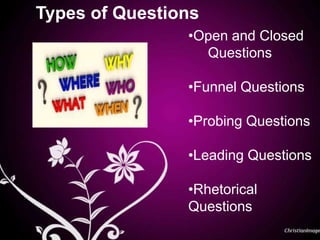
Types of Questions
•Open and Closed
Questions
•Funnel Questions
•Probing Questions
•Leading Questions
•Rhetorical
Questions
Open Questions are :
What is your age?
Did you complete your Matriculation?
Are you thirsty?
Did you participate in the inter-collegiate quiz
competition?
Close Ended Questions are
 What happened at the meeting?
 Why did he react that way?
 How was the party?
 Tell me what happened next.
 Describe the circumstances in more
detail.
What Kind of Questions can you
come up with ?
How to ask Questions
 Avoid asking questions that can be
answered simply with “yes” or “no.”
 Instead, consider questions that start
with “What,” “How,” “When” and
“Where.”
 Avoid leading questions. Those
questions can be perceived by the
other as manipulative and dishonest.
 Avoid frequently asking questions that
begin with “Why.”
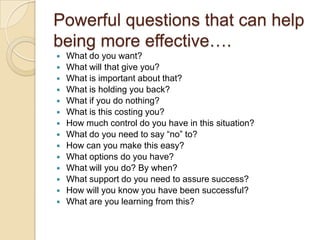
Powerful questions that can help
being more effective….
 What do you want?
 What will that give you?
 What is important about that?
 What is holding you back?
 What if you do nothing?
 What is this costing you?
 How much control do you have in this situation?
 What do you need to say “no” to?
 How can you make this easy?
 What options do you have?
 What will you do? By when?
 What support do you need to assure success?
 How will you know you have been successful?
 What are you learning from this?
Using Questioning
Techniques
 Learning
 Relationship building
 Managing and coaching
 Avoiding misunderstandings
 De-fusing a heated situation
 Persuading people
ACTIVITY
Questioning skills

Questioning skills

  • 1.
    questioning skills Presented by: Rubina Isidore IEIBS Akademia
  • 2.
    What is aQuestion ???? A question may be either a linguistic expression used to make a request for information, or else the request itself made by such an expression. This information may be provided with an answer.
  • 3.
    Why do weask Questions ? • To clarify doubts • To gather more information • To understand whether the respondent has understood what is being told • To reaffirm whether what we have heard is correct or not
  • 5.
    Types of Questions •Openand Closed Questions •Funnel Questions •Probing Questions •Leading Questions •Rhetorical Questions
  • 6.
    Open Questions are: What is your age? Did you complete your Matriculation? Are you thirsty? Did you participate in the inter-collegiate quiz competition?
  • 7.
    Close Ended Questionsare  What happened at the meeting?  Why did he react that way?  How was the party?  Tell me what happened next.  Describe the circumstances in more detail.
  • 8.
    What Kind ofQuestions can you come up with ?
  • 9.
    How to askQuestions  Avoid asking questions that can be answered simply with “yes” or “no.”  Instead, consider questions that start with “What,” “How,” “When” and “Where.”  Avoid leading questions. Those questions can be perceived by the other as manipulative and dishonest.  Avoid frequently asking questions that begin with “Why.”
  • 10.
    Powerful questions thatcan help being more effective….  What do you want?  What will that give you?  What is important about that?  What is holding you back?  What if you do nothing?  What is this costing you?  How much control do you have in this situation?  What do you need to say “no” to?  How can you make this easy?  What options do you have?  What will you do? By when?  What support do you need to assure success?  How will you know you have been successful?  What are you learning from this?
  • 12.
    Using Questioning Techniques  Learning Relationship building  Managing and coaching  Avoiding misunderstandings  De-fusing a heated situation  Persuading people
  • 13.