155 21stCenturySkills 156
QUESTIONING
Questioning
21stCenturySkills
157 158
QUESTIONING
What is
Questioning?
The simple definition of
“questioning” is “the action of
asking questions”. At the same
time, it can be defined as a
competence that involves creative
and critical thinking processes to link
what is known and what is unknown
in order to improve knowledge.
Questioning is a process that helps
collectmore information
– whether our aim is to learn, to
solve a problem, to make a decision
or tounderstandeach other.
1. Description of
Questioning
What is it about?
Questioning can be used in different settings and can
help to:
• Clarify something, and thus reduce a chance of
misunderstandings,
• Express an interest in another person – get to know
them better, show empathy, create rapport, explore
their ideas, feelings, beliefs,
• Improve the understanding of a problem, discover its
root cause, and offer a better solution,
• Test knowledge, e.g. in an exam,
• Encourage thinking, explore other perspec- tives.
In addition to helping to collect information, a good
question may have the power to gener- ate curiosity,
stimulate conversation, encourage creativity and provoke
transformation.
Being able to ask purposeful, impactful, chal- lenging and
sensitive questions is a learnt skill.
If I had an hour to solve a problem and my life
depended on the solution, I would spend the first 55
minutes determining the proper question to ask, for
once I know the proper question, I could solve the
problem
in less than five minutes.
– Albert Einstein
Which are the benefits of questioning?
Why is it important?
Questioning is an important part of the com-
munication and leadership processes. By ask- ing
questions, you may show vulnerability, en- hance trust
and encourage others to ask for help when needed.
The best leaders are not the ones that think they have
all the answers, but those that un- derstand the power
of inquiry to find real an- swers and innovative
solutions.
“A beautiful question is an ambitious yet action- able
question that can begin to shift the way we perceive or
think about something—and that might serve as a catalyst
tobringaboutchange.”
- WarrenBerger
Questioning offers a number of benefits: •
• It encourages conversation and helps collect
information;
• It supports learning and idea generation;
• It shows respect to others as we ask for their opinions
and ideas. In return,it generates re- spect to us;
• It helps uncover challenges and resolve them;
• It increases engagement – good questions energise
team members and help come up with their own
ideas and solutions – which motivates to implement
them;
• Right questions may lead to inspiration and “aha”
moments;
It improves teamwork as people recognise their
collective knowledge and build trust and
accountability.
If you have good questioning skills, you will know what
kind of questions to ask and how to ask them in
different situations. By asking better questions, you will
come to better solu- tions, which will result in improved
outcomes for your business.
21stCenturySkills
159 160
Q
UE
ST
IO
NI
N
G
Step by step
guide
1.
Prepare
Before going to a meeting or starting a
conversation, think of a set of
questions you would like to ask. Think
how to formu- late them well, so that
they help achieve your goals.
QUESTIONING
2.
Learn and use different types of questions.
3.
Good questioning
should be followed by
active listening
– to make sure you understand the
answers and to encourage the
conversation.
Be careful with the
“why” questions.
“Why” may make the other person
feel awkward, threat- ened,
provoked, asked to justi- fy their
actions, and put them in a defensive
state. Try to re- phrase the question
so that the other person feels more
comfortable, e.g. “Tell me more
about…”.
4. 5.
Take time to practice
your questioning skills.
Become conscious about how you
formulate your questions. Start using
more open ques- tions and see how
it affects a conversation. Notice your
col- league’s questioning skills. Just
by paying attention and put- ting
some effort you will notice a
difference.
2. Toolkit The answers you get depend on the
questions you ask:
a. Closed questions – also called
polar questions – those that can
be answered by “yes”, “no” or
“maybe” – are good for getting a
quick answer, concluding a dis-
cussion or testing your un-
derstanding. “So, if I do xxx, zzz
will happen?” A wrong- ly placed
closed question can end a
conversation.
b. Open-ended questions are those
that keep people talking. They
often start with 5Ws and H or
Rudyard Kipling’s “six honest
serv- ing men” - “Who”, “What”,
“Where”, “When”, “Why” and
“How”. If you ask your colleague
“Why are you interested in this
project”, they cannot just
answer “yes” or “no”. There are
all kinds of open questions that
encourage a conver-
sation, creative discussion, allow
to gather more infor- mation, e.g.
“Give me an ex- ample of…”, “Tell
us about your journey”, etc.
c. Factual questions are sim- ilar to
closed-ended ques- tions as they
can be an- swered with a short
phrase and don’t lead to a longer
conversation. For exam- ple,
“What’s his name?” or “What
time does the meet- ing start?”
As the name has it, this kind of
questions al- low to collect the
facts.
d. Leading questions – “Don’t you
agree…?”, “Don’t you want keep
working on this project you’ve
invested so much in?” – are not
real- ly useful (unless you are
trying to make somebody
confess of a crime). They help to
get the answer you want but
make the other person feel they
don’t have
a choice. If you ask a lead- ing
question, try correcting it by
adding a second or oposite
option.
e. Funnel questions involve asking
for more and more details,
starting with gener- al questions
that are often closed, and then
adding more open-ended ques-
tions. Funnel technique is often
used by detectives, but can also
be applied to help a person feel
more comfortable, as the con-
versation starts with sim- ple
questions and gradually
progresses into details.
f. Rhetorical questions are
asked to engage the lis- tener or
getting people to
agree with your point of view.
“Isn’t this a great of- fice space?
Wouldn’t you love to have this
view?”
21stCenturySkills
161 162
QUESTIONING
Case study
Saving a question
The case
This case study shows that in business, questions that are saved/ left unasked may result in
problems or even big losses.
The challenge
Asking the right questions at the right time. A senior executive, instead of ask- ing meaningful
questions about a risky investment, asks a younger colleague in anger “What kind of idiot are
you?!”
The result
The answers depend on the questions you ask! The answer to the above ques- tion was “Ahighly
paid one”, and the project proceeded without expected results. If good questions were asked,
different answers would have been re- ceived, saving the company a lot of money.
164
QUESTIONING
21stCenturySkills
163
Practice
Create 1 question of each type related to the performance of your team. Notice how the type of question influences the
answer.
1. Closed question
2. Open question
3. Leading question
4. Rhetorical question
Use 5W and H technique to write the questions that will help you to create a short article about a recent event in your
company. Has asking these questions helped you shape a story?
What…
Who…
Where…
When…
How…
Why…
Tips & tricks
How to become better at questioning
• Stay curious – it will make you ask questions to check
out what other people think, what ideas they may
have.
• Keep the conversation open – ask open questions,
encourage dialogue, avoid mak- ing conclusions based
on assumptions.
• Take your time – be comfortable with si- lence,
embrace it as an opportunity to pause and formulate
your thoughts.
• Ask follow-up questions – clarify, try to un- derstand
the reasons and the assumptions behind each idea,
solution or decision.
• Listen after you ask a question. Show that you are
interested and listen attentively to encourage the
other person to share infor- mation.
• Focus on learning instead of judging. Ask questions to
get to the details and root causes of the problems
that may emerge in a conversation.
How to develop a questioning culture
• Lead by example – ask a lot of questions yourself,
listen attentively and respond re- spectfully.
• Make it clear - make sure your team mem- bers know
that “asking questions is a good thing”. Repeat it and
reinforce the message as often as necessary.
• Instead of or in addition to brainstorming, try
“question-storming” sessions: have your team
generate many questions about the problem you are
facing. This process brings you to the right questions,
which tend to lead to the right solutions.
21stCenturySkills
165 166
QUESTIONING
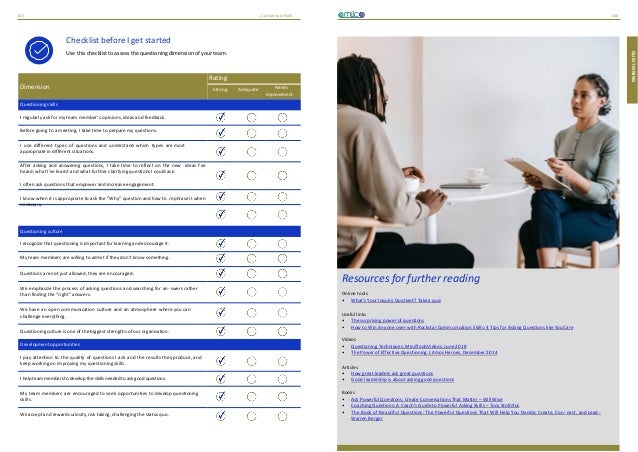
Checklist before I get started
Use this checklist to assess the questioning dimension of your team.
Dimension
Rating
Strong Adequate Needs
improvement
Questioning skills
I regularly ask for my team member’s opinions, ideas and feedback.
Before going to a meeting, I take time to prepare my questions.
I use different types of questions and understand which types are most
appropriate in different situations.
After asking and answering questions, I take time to reflect on the new ideas I’ve
heard, what I’ve learnt and what further clarifying questions I could ask.
I often ask questions that empower and increase engagement.
I know when it is appropriate to ask the “Why” question and how to rephrase it when
necessary.
Questioning culture
I recognize that questioning is important for learning and encourage it.
My team members are willing to admit if they don’t know something.
Questions are not just allowed, they are encouraged.
We emphasize the process of asking questions and searching for an- swers rather
than finding the “right” answers.
We have an open communication culture and an atmosphere where you can
challenge everything.
Questioning culture is one of the biggest strengths of our organisation.
Developmentopportunities
I pay attention to the quality of questions I ask and the results they produce, and
keep working on improving my questioning skills.
I helpteammemberstodevelopthe skillsneededtoaskgoodquestions.
My team members are encouraged to seek opportunities to develop questioning
skills.
We accept and reward curiosity, risk taking, challenging the status quo.
Resources for further reading
Online tools
• What’s Your Inquiry Quotient? Take a quiz
Useful links
• The surprising power of questions
• How to Win Anyone over with Rockstar Communication Skills: 4 Tips for Asking Questions like YouCare
Videos
• Questioning Techniques. MindToolsVideos, June 2018
• The Power of Effective Questioning. Litmos Heroes, December 2014
Articles
• How great leaders ask great questions
• Good leadership is about asking good questions
Books
• Ask Powerful Questions: Create Conversations That Matter – Will Wise
• Coaching Questions: A Coach’s Guide to Powerful Asking Skills – Tony Stoltzfus
• The Book of Beautiful Questions: The Powerful Questions That Will Help You Decide, Create, Con- nect, and Lead -
Warren Berger

Questioning skill Module 5

  • 1.
  • 2.
    21stCenturySkills 157 158 QUESTIONING What is Questioning? Thesimple definition of “questioning” is “the action of asking questions”. At the same time, it can be defined as a competence that involves creative and critical thinking processes to link what is known and what is unknown in order to improve knowledge. Questioning is a process that helps collectmore information – whether our aim is to learn, to solve a problem, to make a decision or tounderstandeach other. 1. Description of Questioning What is it about? Questioning can be used in different settings and can help to: • Clarify something, and thus reduce a chance of misunderstandings, • Express an interest in another person – get to know them better, show empathy, create rapport, explore their ideas, feelings, beliefs, • Improve the understanding of a problem, discover its root cause, and offer a better solution, • Test knowledge, e.g. in an exam, • Encourage thinking, explore other perspec- tives. In addition to helping to collect information, a good question may have the power to gener- ate curiosity, stimulate conversation, encourage creativity and provoke transformation. Being able to ask purposeful, impactful, chal- lenging and sensitive questions is a learnt skill. If I had an hour to solve a problem and my life depended on the solution, I would spend the first 55 minutes determining the proper question to ask, for once I know the proper question, I could solve the problem in less than five minutes. – Albert Einstein Which are the benefits of questioning? Why is it important? Questioning is an important part of the com- munication and leadership processes. By ask- ing questions, you may show vulnerability, en- hance trust and encourage others to ask for help when needed. The best leaders are not the ones that think they have all the answers, but those that un- derstand the power of inquiry to find real an- swers and innovative solutions. “A beautiful question is an ambitious yet action- able question that can begin to shift the way we perceive or think about something—and that might serve as a catalyst tobringaboutchange.” - WarrenBerger Questioning offers a number of benefits: • • It encourages conversation and helps collect information; • It supports learning and idea generation; • It shows respect to others as we ask for their opinions and ideas. In return,it generates re- spect to us; • It helps uncover challenges and resolve them; • It increases engagement – good questions energise team members and help come up with their own ideas and solutions – which motivates to implement them; • Right questions may lead to inspiration and “aha” moments; It improves teamwork as people recognise their collective knowledge and build trust and accountability. If you have good questioning skills, you will know what kind of questions to ask and how to ask them in different situations. By asking better questions, you will come to better solu- tions, which will result in improved outcomes for your business.
  • 3.
    21stCenturySkills 159 160 Q UE ST IO NI N G Step bystep guide 1. Prepare Before going to a meeting or starting a conversation, think of a set of questions you would like to ask. Think how to formu- late them well, so that they help achieve your goals. QUESTIONING 2. Learn and use different types of questions. 3. Good questioning should be followed by active listening – to make sure you understand the answers and to encourage the conversation. Be careful with the “why” questions. “Why” may make the other person feel awkward, threat- ened, provoked, asked to justi- fy their actions, and put them in a defensive state. Try to re- phrase the question so that the other person feels more comfortable, e.g. “Tell me more about…”. 4. 5. Take time to practice your questioning skills. Become conscious about how you formulate your questions. Start using more open ques- tions and see how it affects a conversation. Notice your col- league’s questioning skills. Just by paying attention and put- ting some effort you will notice a difference. 2. Toolkit The answers you get depend on the questions you ask: a. Closed questions – also called polar questions – those that can be answered by “yes”, “no” or “maybe” – are good for getting a quick answer, concluding a dis- cussion or testing your un- derstanding. “So, if I do xxx, zzz will happen?” A wrong- ly placed closed question can end a conversation. b. Open-ended questions are those that keep people talking. They often start with 5Ws and H or Rudyard Kipling’s “six honest serv- ing men” - “Who”, “What”, “Where”, “When”, “Why” and “How”. If you ask your colleague “Why are you interested in this project”, they cannot just answer “yes” or “no”. There are all kinds of open questions that encourage a conver- sation, creative discussion, allow to gather more infor- mation, e.g. “Give me an ex- ample of…”, “Tell us about your journey”, etc. c. Factual questions are sim- ilar to closed-ended ques- tions as they can be an- swered with a short phrase and don’t lead to a longer conversation. For exam- ple, “What’s his name?” or “What time does the meet- ing start?” As the name has it, this kind of questions al- low to collect the facts. d. Leading questions – “Don’t you agree…?”, “Don’t you want keep working on this project you’ve invested so much in?” – are not real- ly useful (unless you are trying to make somebody confess of a crime). They help to get the answer you want but make the other person feel they don’t have a choice. If you ask a lead- ing question, try correcting it by adding a second or oposite option. e. Funnel questions involve asking for more and more details, starting with gener- al questions that are often closed, and then adding more open-ended ques- tions. Funnel technique is often used by detectives, but can also be applied to help a person feel more comfortable, as the con- versation starts with sim- ple questions and gradually progresses into details. f. Rhetorical questions are asked to engage the lis- tener or getting people to agree with your point of view. “Isn’t this a great of- fice space? Wouldn’t you love to have this view?”
  • 4.
    21stCenturySkills 161 162 QUESTIONING Case study Savinga question The case This case study shows that in business, questions that are saved/ left unasked may result in problems or even big losses. The challenge Asking the right questions at the right time. A senior executive, instead of ask- ing meaningful questions about a risky investment, asks a younger colleague in anger “What kind of idiot are you?!” The result The answers depend on the questions you ask! The answer to the above ques- tion was “Ahighly paid one”, and the project proceeded without expected results. If good questions were asked, different answers would have been re- ceived, saving the company a lot of money.
  • 5.
    164 QUESTIONING 21stCenturySkills 163 Practice Create 1 questionof each type related to the performance of your team. Notice how the type of question influences the answer. 1. Closed question 2. Open question 3. Leading question 4. Rhetorical question Use 5W and H technique to write the questions that will help you to create a short article about a recent event in your company. Has asking these questions helped you shape a story? What… Who… Where… When… How… Why… Tips & tricks How to become better at questioning • Stay curious – it will make you ask questions to check out what other people think, what ideas they may have. • Keep the conversation open – ask open questions, encourage dialogue, avoid mak- ing conclusions based on assumptions. • Take your time – be comfortable with si- lence, embrace it as an opportunity to pause and formulate your thoughts. • Ask follow-up questions – clarify, try to un- derstand the reasons and the assumptions behind each idea, solution or decision. • Listen after you ask a question. Show that you are interested and listen attentively to encourage the other person to share infor- mation. • Focus on learning instead of judging. Ask questions to get to the details and root causes of the problems that may emerge in a conversation. How to develop a questioning culture • Lead by example – ask a lot of questions yourself, listen attentively and respond re- spectfully. • Make it clear - make sure your team mem- bers know that “asking questions is a good thing”. Repeat it and reinforce the message as often as necessary. • Instead of or in addition to brainstorming, try “question-storming” sessions: have your team generate many questions about the problem you are facing. This process brings you to the right questions, which tend to lead to the right solutions.
  • 6.
    21stCenturySkills 165 166 QUESTIONING Checklist beforeI get started Use this checklist to assess the questioning dimension of your team. Dimension Rating Strong Adequate Needs improvement Questioning skills I regularly ask for my team member’s opinions, ideas and feedback. Before going to a meeting, I take time to prepare my questions. I use different types of questions and understand which types are most appropriate in different situations. After asking and answering questions, I take time to reflect on the new ideas I’ve heard, what I’ve learnt and what further clarifying questions I could ask. I often ask questions that empower and increase engagement. I know when it is appropriate to ask the “Why” question and how to rephrase it when necessary. Questioning culture I recognize that questioning is important for learning and encourage it. My team members are willing to admit if they don’t know something. Questions are not just allowed, they are encouraged. We emphasize the process of asking questions and searching for an- swers rather than finding the “right” answers. We have an open communication culture and an atmosphere where you can challenge everything. Questioning culture is one of the biggest strengths of our organisation. Developmentopportunities I pay attention to the quality of questions I ask and the results they produce, and keep working on improving my questioning skills. I helpteammemberstodevelopthe skillsneededtoaskgoodquestions. My team members are encouraged to seek opportunities to develop questioning skills. We accept and reward curiosity, risk taking, challenging the status quo. Resources for further reading Online tools • What’s Your Inquiry Quotient? Take a quiz Useful links • The surprising power of questions • How to Win Anyone over with Rockstar Communication Skills: 4 Tips for Asking Questions like YouCare Videos • Questioning Techniques. MindToolsVideos, June 2018 • The Power of Effective Questioning. Litmos Heroes, December 2014 Articles • How great leaders ask great questions • Good leadership is about asking good questions Books • Ask Powerful Questions: Create Conversations That Matter – Will Wise • Coaching Questions: A Coach’s Guide to Powerful Asking Skills – Tony Stoltzfus • The Book of Beautiful Questions: The Powerful Questions That Will Help You Decide, Create, Con- nect, and Lead - Warren Berger