Questioning
The Current Focus on Questioning
• In recent years educational
theorists have paid great attention
to questioning techniques in the
classroom.
• Ofsted have now started to look
more closely at questioning.
• Our recent Challenge Partner
Review also paid close attention to
the use of questioning in the
classroom.
Why Focus on Questioning?
In July 2003 TES published an article in their magazine stating that:
• “Teachers ask up to two questions every minute, up to
400 in a day, around 70,000 a year, or two to three million in
the course of a career. ”
• “Questioning accounts for up to a third of all teaching time,
second only to the time devoted to explanation.”
• “Most questions are answered in less than a second. That's the
average time teachers allow between posing a question and
accepting an answer, throwing it to someone else, or
answering it themselves.”
The Importance of Questioning
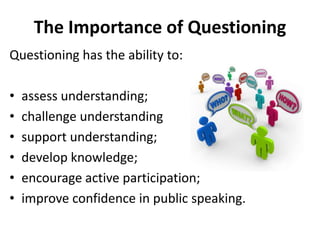
Questioning has the ability to:
• assess understanding;
• challenge understanding
• support understanding;
• develop knowledge;
• encourage active participation;
• improve confidence in public speaking.
Extracts from Ofsted Reports
Outstanding:
‘Teachers’ questioning of learners is well-
developed, both to ensure the promotion of
learning and to address learners’ particular
needs.’
Good:
‘Teachers ask probing questions to check progress
and support their good progress in lessons.’
Effective Questioning Techniques
Lots of different types of questioning can be
effective. Here are just a few examples.
Directed/Targeted Questioning
• Often the students who put their hands up to
answer a question know the correct answer and
this can give a teacher a false representation of
the students’ level of understanding.
• Directed questioning can ensure that all students
are actively engaged in the lesson and contribute
to the class. It can also allow for differentiation to
take place and provides a more accurate
representation of the level of understanding of
the class as a whole.
Directed Questioning with a Twist
Directed questioning leading into students
developing each other’s answers:
• Rather than the teacher developing an individual
student’s answer, the teacher asks another
student to develop the answer given.
• This can support student engagement and
contribute to ensuring ‘no student is left
undisturbed.’
Encouraging Student Independence
The best form of questioning is that which
makes students think for themselves and find
their own answers/solutions.
The Stuck Menu
Students choose 3 strategies from ‘The Stuck Menu’ before putting up their hand
to ask for help...
1. Record what you have tried and the
question you have and move on.
2. Consult the student-led question and answer
board (students pose a question on the board and
if someone has the answer, they add it to the
board).
3. Review previous learning and notes.
4. Use a text book/internet/smart-phone
5. Ask someone else in your group.
The notebook (also mode of self-assessment):
• Students can keep a record of questions they have
throughout the lesson.
• As a plenary or mid-plenary, students can share their
questions in groups and explore the answers the
together.
• Each groups students can choose one question to
pose to the teacher, or the rest of the class.
• The notebook is also a mode of self-assessment and
for students to record their own uncertainties,
alongside the answers. This visibly demonstrates
progress.
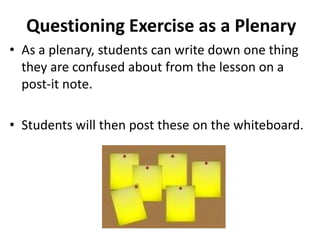
Questioning Exercise as a Plenary
• As a plenary, students can write down one thing
they are confused about from the lesson on a
post-it note.
• Students will then post these on the whiteboard.
• The teacher or a student can then choose some
post-it notes at random and these questions can
then be posed to the rest of the class to answer.
• As a result, students are learning to use each
other as a resource rather depending upon the
teacher.
Task:
• In your department time, think of a specific way
that you can use one or more of these ideas in
your subject.
• Come up with one or more of your own
questioning techniques to contribute to the
feedback.

Questioning

  • 1.
  • 2.
    The Current Focuson Questioning • In recent years educational theorists have paid great attention to questioning techniques in the classroom. • Ofsted have now started to look more closely at questioning. • Our recent Challenge Partner Review also paid close attention to the use of questioning in the classroom.
  • 3.
    Why Focus onQuestioning? In July 2003 TES published an article in their magazine stating that: • “Teachers ask up to two questions every minute, up to 400 in a day, around 70,000 a year, or two to three million in the course of a career. ” • “Questioning accounts for up to a third of all teaching time, second only to the time devoted to explanation.” • “Most questions are answered in less than a second. That's the average time teachers allow between posing a question and accepting an answer, throwing it to someone else, or answering it themselves.”
  • 4.
    The Importance ofQuestioning Questioning has the ability to: • assess understanding; • challenge understanding • support understanding; • develop knowledge; • encourage active participation; • improve confidence in public speaking.
  • 5.
    Extracts from OfstedReports Outstanding: ‘Teachers’ questioning of learners is well- developed, both to ensure the promotion of learning and to address learners’ particular needs.’ Good: ‘Teachers ask probing questions to check progress and support their good progress in lessons.’
  • 6.
    Effective Questioning Techniques Lotsof different types of questioning can be effective. Here are just a few examples.
  • 7.
    Directed/Targeted Questioning • Oftenthe students who put their hands up to answer a question know the correct answer and this can give a teacher a false representation of the students’ level of understanding. • Directed questioning can ensure that all students are actively engaged in the lesson and contribute to the class. It can also allow for differentiation to take place and provides a more accurate representation of the level of understanding of the class as a whole.
  • 8.
    Directed Questioning witha Twist Directed questioning leading into students developing each other’s answers: • Rather than the teacher developing an individual student’s answer, the teacher asks another student to develop the answer given. • This can support student engagement and contribute to ensuring ‘no student is left undisturbed.’
  • 9.
    Encouraging Student Independence Thebest form of questioning is that which makes students think for themselves and find their own answers/solutions.
  • 10.
    The Stuck Menu Studentschoose 3 strategies from ‘The Stuck Menu’ before putting up their hand to ask for help... 1. Record what you have tried and the question you have and move on. 2. Consult the student-led question and answer board (students pose a question on the board and if someone has the answer, they add it to the board). 3. Review previous learning and notes. 4. Use a text book/internet/smart-phone 5. Ask someone else in your group.
  • 11.
    The notebook (alsomode of self-assessment): • Students can keep a record of questions they have throughout the lesson. • As a plenary or mid-plenary, students can share their questions in groups and explore the answers the together. • Each groups students can choose one question to pose to the teacher, or the rest of the class. • The notebook is also a mode of self-assessment and for students to record their own uncertainties, alongside the answers. This visibly demonstrates progress.
  • 12.
    Questioning Exercise asa Plenary • As a plenary, students can write down one thing they are confused about from the lesson on a post-it note. • Students will then post these on the whiteboard.
  • 13.
    • The teacheror a student can then choose some post-it notes at random and these questions can then be posed to the rest of the class to answer. • As a result, students are learning to use each other as a resource rather depending upon the teacher.
  • 14.
    Task: • In yourdepartment time, think of a specific way that you can use one or more of these ideas in your subject. • Come up with one or more of your own questioning techniques to contribute to the feedback.